Lyra, Nicolaus DeBiblio.com
3 résultats
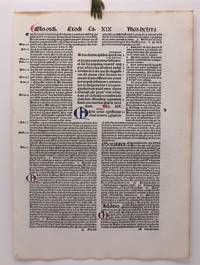
1506W2491Basel Switzerland: Johann Petri & Johann Froben 1506. An original leaf from chapter 19 of the Book of Exodus with rubrication in red and blue. Folio 12 inches by 8 5/8 inches. Printed text in Latin. A leaf from a vulgate Bible with glosses commentary and other matter by the 13th century Catholic theologian Nicolaus de Lyra 1270-1349. De Lyra's insistence on a literal rather than allegorical interpretation of the Bible was a major source of influence on Martin Luther and provided theological impetus to the Reformation. This particular leaf includes passages from Exodus 19 as well as de Lyra's commentary on those passages. It is guaranteed to be more than 500 years old. The leaf is in near-fine condition: clean bright and supple with some minor browning limited to the top edge. Original. Single Sheet. Near Fine. Folio - over 12" - 15" tall. Manuscript. Johann Petri & Johann Froben
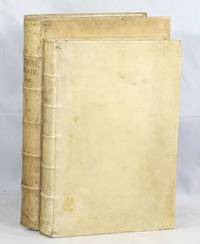
1586000013413Venetiis; Romae: Haeredem Hieronymi Scoti; Iulium Accoltum 1586. Later editions. Hardcover. Very Good. 2 vol. Folio. 12 1-149 foliated leaves; 12 1-269 foliated leaves pp. Later full parchment with manuscript hand on the spines; all edges decoratively stained blue. Later endpapers though volume two retains an original rear endpaper. This is a married set with volume two likely from a larger set of the complete works of St. Thomas Aquinas. Text in Latin. A few woodcut publisher's devices and woodcut initials illustrate this set. Adams 1454. Aertsen "Aquinas' Philosophy in its Historical Setting" Cambridge Companion to Aquinas 16. Encyclopedia Britannica "Peter Lombard: French bishop". Graesse 139. Stanford Encyclopedia of Philosophy "Thomas Aquinas". We could not locate the 1570 volume in Adams or Graesse. It is highly difficult to find all four books of this early work of St. Thomas Aquinas. Composed from 1252 until 1256 these commentaries are dense and systematic. They were written while Aquinas held the position of bachelor of theology and continued into his first term as master of theology. This work constitutes what we would think of today as Aquinas' Ph.D.: thus it is his first major text. The organizational scheme of Aquinas' commentaries on Lombard differs from what Lombard set down in his own work: Aertsen argues that Aquinas' circular notion of reality and existential beings has its origins in Neoplatonism a contrast to St. Augustine's influence on Lombard. Several theologians wrote commentaries on the writings of Peter Lombard but Aquinas' is special because it helped to elevate his reputation in the church and in the academic sphere. Aquinas' perspective on Lombard's theology comes from 100 years later though both men wrote these works in France and it demonstrates his own early theological ideas and notions. Lombard's work discusses topics like God the Trinity divine guidance evil predestination angels demons the Fall of man grace sin the Incarnation of Jesus Christ the redemption of sins virtues the Ten Commandments the sacraments and many other weighty questions of Christian doctrine. The reception of Lombard's work on the sacraments was especially warm. Taken together these commentaries represent the work of two scholars one in conversation with the other. These books are the product of two medieval writers who grappled with ponderous questions and debates that raged in the most powerful institution of medieval Europe. The two title pages in volume one each have repairs to them a previous owner from long ago may have excised library stamps and then mended the leaves. Eight or so other leaves of the set have repairs to a margin or a corner different from the title page mends. Volume two's front hinge gently cracked but holding its title page and next few leaves have minor worming. The set with a few unobtrusive historical ink marks from private owners. Overall the parchment bindings are beautiful and these volumes represent a lovely example of early printing in Europe. Haeredem Hieronymi Scoti; Iulium Accoltum hardcover
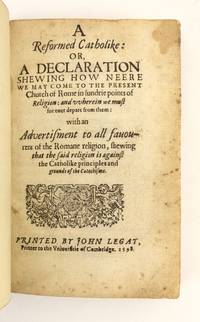
1598ST16441Cambridge: John Legat 1598. Second Printing. 153 x 98 mm. 6 x 3 7/8". 4 p.l. 375 1 pp. <br/> Modern sprinkled calf blind-ruled covers raised bands flanked by double gilt rules brown morocco label remnants of paper library shelf label at tail of spine. Printer's device on title page. Front pastedown with bookplate of the Fox Pointe Collection; rear pastedown with deaccession stamp of Bradford City Libraries. STC 19736; ESTC 19736. ◆Spine just faintly sunned leaves lightly browned due to paper quality and trimmed a bit close at head grazing headline on a couple of leaves isolated marginal stains or tiny rust spots but an excellent copy fresh and clean in a sympathetic binding with few signs of wear.<br/> <br/> This was an important work in establishing distinctions in liturgy and doctrine between the Catholic Church and the Church of England written by a moderate puritan whom DNB considers "perhaps the most significant English theologian of his age." Perkins 1558-1602 was one of the most popular voices of his time speaking from a Calvinist puritan point of view; while he could be virulently anti-Catholic he did not believe in repudiating the English church only in reforming it. According to DNB "The genius of Perkins's work did not lie in its originality—his theology represents a conventional recital of Calvinist scholasticism in virtually every respect. His gift lay rather in bringing to a broad audience a variety of theological and moral issues popularizing essentially technical discussions and therefore as Fuller observed humbling 'the towering speculations of philosophers into practice and morality.'" The present work spread his polemical influence beyond England to the Continent; even the Catholic bishop William Bishop admitted he had "not seene any book of like quality published by a Protestant to contain either more matter or delivered in better method." Both the 1597 first edition and our 1598 second printing are rare: no other copies of either edition are recorded at auction by RBH or ABPC in the past 50 years. John Legat unknown