Theorphrastus; Isaac Casaubon (tr)Biblio.com
6 résultats
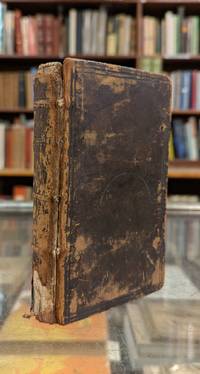
1593113372Apud Franciscum le Preau 1593. Hardcover. Fair/No jacket. Translated into Latin by Isaac Casaubon. Part of spine missing. Covers worn and chipped. As-Is. Apud Franciscum le Preau hardcover
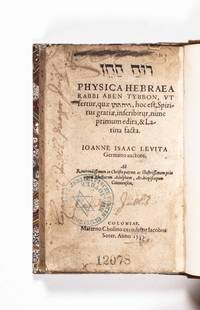
155548871Köln Cologne: Maternus Cholinus and Jakob Soter 1555. First Latin diglot edition. Hardcover. Good. Small octavo. A-L16 = 88 leaves signed on each side e.g. A8 verso is signed A16; H9 missigned G9. 16 157 2 epigram 1 blankpp. Pagination and register run from right to left. Modern quarter sheep over marbled boards gauffered edges endleaves renewed. Library stamps and old owner entries at title; early marginal annotation and underlinings in the “Epistolaâ€; text toned with dampstain affecting bottom quarter of text throughout not impairing legibility; marginal tear at C7. A good complete copy with ample margins.<br /> <br /> Third edition per Steinschneider and the first Latin diglot version of this anonymous introductory work. First published at Venice in 1544 it is notable that a Latin translation appears so soon after a sixteenth-century editio princeps of a Hebrew work. It comprises a commentary on and explanation of difficult terms in Maimonides' Moreh Nevukhim Guide for the Perplexed with an elucidation of terminology in the translations of Arabic to Hebrew as well as the jargon of medieval philosophical literature in general. As the editor of the present edition notes at the title "Ru'ah Hen has been attributed to the renowned translator R. Judah ben Saul ibn Tibbon c. 1120-c. 1190 and to R. Jacob ben Abba Mari ben Samson Anatoli 13th century also a translator of note. Ibn Tibbon known as the 'father of translators' was born in Granada Spain but relocated to Lunel in Provence France to escape the persecution of the Jews in the former location. He supported himself as a physician coming into contact with many sages one of whom R. Meshullam ben Jacob requested that ibn tibbon translate R. Bahya ibn Paquda's Hovot ha-Levavot into Hebrew. In addition to translating that work from Arabic ibn Tibbon also translated several other books into Hebrew among them R. Judah Halevi's Kuzari R. Saadiah Gaon's Emunot ve-De'ot and R. Solomon ibn Gabirol's Middot ha-Nefesh and Mivhar Peninim" Heller. While this is the fourth known printing of the work it is the first to include vowel points and the translation of the formerly Jewish convert to Christianity Johann Isaac Levita 1515-1577 a descendant of Elias Levita the most famous in his time of those Jews who sought scholarly contact with Christians and taught Christians Hebrew. As an added bonus the present edition includes Maimonides' De astrologia epistola elegans. The celebrated English jurist and Hebrew scholar John Selden is known to have had a copy of Ruah ha-Hen in his library Oxford Library note.<br /> <br /> Adams J-403. Cf. Heller The Sixteenth Century Hebrew Book 815 noting the present ed. Steinschneider 1 col. 639; no. 4038. VD 16 I1. Hebrew title: רוח החן. Maternus Cholinus and Jakob Soter hardcover
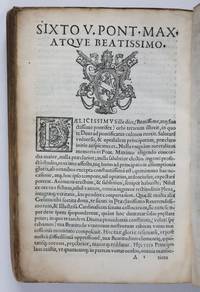
158747668Venice: Apud Ioannem de Gara Giovanni di Gara 1587. First edition. Hardcover. g- to g. Large quarto. Paginated double sided leaves throughout: 5 1 238 5-62 leaves. Period dark brown mottled leather boards with gilt lettering over a brown label on the spine. Raised bands. Speckled edges of the book block in red. Introductory text in Latin dedicates the book to Pope Sixtus V and includes his elaborate engraved papal coat of arms as well as large decorative initials. The initial text also gives biographical and historical background on the author and his roots. The Latin introduction is followed by a two-page Hebrew intoduction.<br /> <br /> This phenomenal volume is a pioneering trilingual Hebrew-Latin-Italian dictionary created by Italian Renaissance-Era Rabbi linguistic scholar and physician David ben Isaac De Pomis 1524-1594. De Pomis' aim with this work being as he was a scholar of both Jewish as well as secular subjects was to create a work which would who have crossover appeal and be useful to both Jewish and non-Jewish scholars alike. In many ways the work can be seen valuable outreach to the Christian and Italian communities of the period. Although De Pomis approaches this work from the perspective of Rabbinic/Biblical Hebrew he also includes numerous additional medical and biological terms given his background as a physician. The main body of the text consists of the dictionary which is organized alphabetically according to the Hebrew. Following sections include a glossary of common Rabbinic abbreviations a Italian-Hebrew Lexicon containing the original Italian in Roman script facing the Judeo-Italian in Hebrew script leaf 5-36 and a final alphabetical index of Latin words leaves 36-62.<br /> <br /> There are original printing errors resulting in the mis-pagination of 7 leaves #77 79 85 112 190 199 and #10 of the second pagination but all content is present.<br /> <br /> Text throughout in Hebrew Latin and Italian all printed in a two-column format.<br /> <br /> Binding with head and tail of spine chipped away hinges splitting and some additional rubbing to extremities. Some scratching to covers. Interior with some sporadic minor to light foxing water stains and/or smudges throughout the text. Title page loose but sill attached. A few minor sporadic instances of worming but all are in the margins. Leaves 222-228 of the first pagination contain minimal water staining along the bottom margin not affecting text. Small tears to the bottom corners of leaf 120 of the first pagination and leaf 35 of the second pagination. Starting at interior front cover. Book block tight overall. Binding in good- interior in good condition overall. Hebrew title: צמח דוד : בו הצמיח ופרש ב×ר היטב בקצור בשלשה ×œ×©×•× ×•×ª כל שורש מלה ומלה ×©×ž×¦× ×‘×¡×¤×¨ הערוך הגדול<br /> Author: פומיס דוד בן יצחק<br /> Alternate Transliterations: Tsemach David Zemah Dawid Tzemach David Zemach David<br /> References: Bartol. II. 37; Wolf I. 311 III. 195 196. Vinograd Venice 717. Roest 944. Zedner p.641. Cowley p.154<br /> <br /> About the author:<br /> David ben Isaac De Pomis 1524-1594 was a noted Italian Rabbi physician linguist and scholar born in Spoleto. De Pomis was respected as something of a savant in his time by both the Jewish and non-Jewish community for his excellence across numerous fields of study. He traced his roots back to the original Roman Jewish community of the ancient era who had first come to the Italian Peninsula during the fist century. In 1587 he published this work "Tsemah David" which many consider to be his magnum opus. Apud Ioannem de Gara (Giovanni di Gara) hardcover
158747873Venice: Apud Ioannem de Gara Giovanni di Gara 1587. First edition. Hardcover. g to vg-. Large quarto. Paginated double sided leaves throughout: 5 1 5-62 238 leaves. Recased in its original period vellum binding and reinforced with new endpapers. Introductory text in Latin dedicates the book to Pope Sixtus V and includes his elaborate engraved papal coat of arms as well as large decorative initials. The initial text also gives biographical and historical background on the author and his roots. The Latin introduction is followed by a two-page Hebrew intoduction.<br /> <br /> This phenomenal volume is a pioneering trilingual Hebrew-Latin-Italian dictionary created by Italian Renaissance-Era Rabbi linguistic scholar and physician David ben Isaac De Pomis 1524-1594. De Pomis' aim with this work being as he was a scholar of both Jewish as well as secular subjects was to create a work which would who have crossover appeal and be useful to both Jewish and non-Jewish scholars alike. In many ways the work can be seen valuable outreach to the Christian and Italian communities of the period. Although De Pomis approaches this work from the perspective of Rabbinic/Biblical Hebrew he also includes numerous additional medical and biological terms given his background as a physician. The main body of the text consists of the dictionary which is organized alphabetically according to the Hebrew. What was originally bound in as a separately paginated concluding section at the end of the volume leaves 5-62 here has been mistakenly rebound before the main pagination 238 leaves. These sections include a glossary of common Rabbinic abbreviations a Italian-Hebrew Lexicon containing the original Italian in Roman script facing the Judeo-Italian in Hebrew script leaf 5-36 and a final alphabetical index of Latin words leaves 36-62.<br /> <br /> There are original printing errors resulting in the mis-pagination of 6 leaves #77 79 85 112 199 and #10 of the other pagination but all content is present.<br /> <br /> Text throughout in Hebrew Latin and Italian all printed in a two-column format.<br /> <br /> Binding with some light rubbing and bumping to the edges. A strip of vellum has been torn away at the top of the front cover. Some additional period staining to the covers. Light water stains and foxing to the title page which includes the period ink signature of the previous owner J. Blacknell in the left margin. Text pages throughout with some light to moderate staining to the margins. Text mostly unaffected and overall clean and vibrant. Bottom corners of the final two leaves including the blank with some light chipping. Book block tight. Binding in good interior in very good- condition overall. Hebrew title: צמח דוד : בו הצמיח ופרש ב×ר היטב בקצור בשלשה ×œ×©×•× ×•×ª כל שורש מלה ומלה ×©×ž×¦× ×‘×¡×¤×¨ הערוך הגדול<br /> Author: פומיס דוד בן יצחק<br /> Alternate Transliterations: Tsemach David Zemah Dawid Tzemach David Zemach David<br /> References: Bartol. II. 37; Wolf I. 311 III. 195 196. Vinograd Venice 717. Roest 944. Zedner p.641. Cowley p.154<br /> <br /> About the author:<br /> David ben Isaac De Pomis 1524-1594 was a noted Italian Rabbi physician linguist and scholar born in Spoleto. De Pomis was respected as something of a savant in his time by both the Jewish and non-Jewish community for his excellence across numerous fields of study. He traced his roots back to the original Roman Jewish community of the ancient era who had first come to the Italian Peninsula during the fist century. In 1587 he published this work "Tsemah David" which many consider to be his magnum opus. Apud Ioannem de Gara (Giovanni di Gara) hardcover
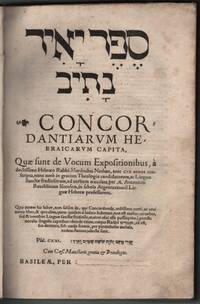
1556157Basileae Basel: Henricum Petri 1556. First edition. Printer’s device on last page. In contemporary vellum. Title on spine lettered in ink. Binding stained. Title page restored. Foxing and waterstain throughout. First edition. Printer’s device on last page. In contemporary vellum. Title on spine lettered in ink. 6°; A1–Ss6 8 p. 2 folding plates 980 col. 2 p. <p><br /> Isaac Nathan ben Kalonymus was a French philospher and contraversialist of the 15th century. Came from the renowned Nathan family which claimed it’s descent from King David. He is the author of the first Bible concordance and the division of the Old Testament into verses is attributed to him.<br /> <p><p><br /> Adams I. 188.<br /> <p>. Henricum Petri unknown
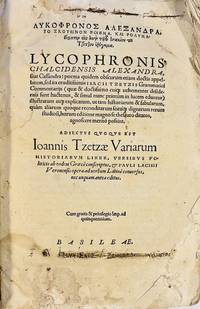
15463314Basel: ex officina Ioannis Oporini / Johann Oporinus 1546. First separate edition of Alexandra Cassandra and first edition of Chiliades. Title and text in Greek and Latin. In contemporary limp vellum. Contemporary possessor’s inscriptions on title page crossed out illegible. Contemporary marginal notes in ink on p. 11 otherwise clean. Binding worn. First leaves worn. Damp stains throughout darker-toned at the lower margin. Lower edge with damages not affecting the text. Wormholes occasionally with no effect on text. In good condition. First separate edition of Alexandra Cassandra and first edition of Chiliades. Title and text in Greek and Latin. In contemporary limp vellum. 16 180 8 268 4 last 3 blank p. <p><br /> The first separate edition of Lycophron’s poem Alexandra Cassandra’s prophecies about Troy with commentaries by Isaac and John Tzetzes; and the first edition of John Tzetzes’ Chiliades.<br /> <p><p><br /> Although the authorship of Alexandra is questioned it is traditionally attributed to Lycophron of Chalcis the 3rd century BC Greek poet and scholar. The commentaries elucidating the otherwise rather obscure text were written by Isaac and John Tzetzes Byzantine scholars who lived in Constantinople in the 12th century. Alexandra was first published in 1513 by Aldus Manutius with texts by Pindar Callimachus Dionysius Periegetes the present one is the first separate edition of the text the second edition overall and also the first with the commentaries by the Tzetzes-brothers. <br /> <p><p><br /> The second part of the book is a lengthy political decapentasyllabic verse John Tzetzes’ most important work the Variarum historiarum liber Book of Histories or the so-called Chiliades edited Nikolaus Gerbel. Chiliades is a collection of literary historical theological and antiquarian miscellanies whose chief value consists in the fact that it to some extent makes up for the loss of works that were then accessible to Tzetzes. <br /> <p>. [ex officina Ioannis Oporini / Johann Oporinus] unknown