13 résultats
1699D7870Paris: Chez Guillaume Desprez 1699. Hardcover. Very Good. 8vo 118 x 120mm. xvi 215pp. ix; xii 217pp. ix; viii 247pp. ix. Woodcut engraved printers device on title of female personification of Hope anchor and Faith torch with legend inscribed: ARDET AMANS SPE NIXA FIDES Faith is supported by hope that burns by the fire of charity. Woodcut engraved chapter vignette at beginning of Book of Tobit depicting Tobit visited by archangel Raphael at Judith showing her beheading Holofernes and lastly Queen Esther in her palace. Woodcut engraved chapter head and tail-pieces. Later three-quarter red morocco over cloth-covered boards; some slight browning and lightest edgewear. Armorial bookplate of Charles Morgan of New York rampant griffin. <br/><br/>Antoine Isaac Baron Silvestre de Sacy was a French Orientalist. He was born in Paris. He studied Hebrew in order to verify the accuracy of the Latin and French versions of the Bible and to this he later added many other Semitic languages. The books of Tobit Judith and Esther are usually run together. Each deals with the lives of individual people. These people were heroes or heroines coming through some major difficulties. Complete with illustrations and in good form. Chez Guillaume Desprez hardcover books
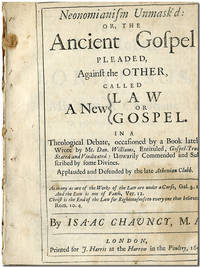
1692WRCLIT64900London: Printed for J. Harris at the Harrow in the Poultry 1692. 840pp. Quarto. Extracted from pamphlet volume. Title leaf trimmed askew with loss of a few letters along fore-margin some headlines cut into stain/fraying to lower fore-corner of four terminal leaves costing a few words from the last faint discoloration to lower quadrant of title leaf; hence a poor but crisp copy. First edition. A response to Williams' tract of earlier the same year and an element in an exchange that continued through a sequence of similar tracts. Chauncey came to Massachusetts in 1638 with his family studied theology and medicine at Harvard and upon his father's appointment as Harvard President returned to England to pursue further studies. He was actively engaged as an Independent Minister in the UK until his death in 1719. ESTC R19390. WING C7354. SABIN 12333. Printed for J. Harris at the Harrow in the Poultry unknown books
16551262906Amsterdam: Elzevier 1655. First edition. 12mo in vellum with flattened corners; VG; moderate soiling or shelf wear and strong binding; ex-libris plate on second front page; pencil and ink inscriptions on back of front board and first end page; dusty edges; clean text in very tight print; two volumes in one book; scarce; this book was published in English in 1656 as "Men before Adam" and burned in public in Paris before La Peyrere recanted and converted to Catholicism; contains a folded map of the Holy Land in very good condition; shelved in Case # 3; VK consignment. 1262906. Shelved Dupont Bookstore. Elzevier unknown books
1647SW1672Argentorati Strasbourg:: Philippi Mulbii 1647. 1647. 4to. x 352; 120 587 1 150 pp. Elaborate added engraved title title printed in red & black. Original full vellum. Ownership signature on title of F. P. Wilcken Lubecensis Lubeck Germany. Very good. Rare. Includes the extensive annotations of scholar Isaac Casaubon as well as a long dissertation on Suetonius by Boeckler. The elaborate half-title is drawn by I. Schef and engraved by Pierre Aubry 1610-1686. Gaius Suetonius Tranquilius was a Roman historian and biographer whose most significant contribution was his biographies of 12 Roman rulers from Julius Caesar to Domitian. Suetonius wrote The Twelve Caesars while serving as the personal secretary of the emperor Hadrian. Philippi Mulbii, 1647. hardcover books
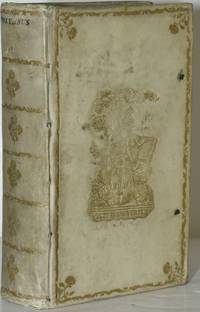
1691285167Lugduni Batavorum: Apud Jordanum Luchtmans & Johannem du Vivie 1691. Third Edition. Full Leather. Very Good binding. The Third Edition or Second Bilingual Edition of Polyaenus' Strategems in War. A second century Macedonian author Polyaenus wrote on the military tactics of the age with unique historical anecdotes; it remains an important historical source. The first printed edition of the text was in Latin only published in 1549; a second edition was published forty years later now in Latin and Greek with a third appearance of the text this edition printed through 1690-91. Additional title page engraved; engraved initials and vignette on the title page. Text in Latin and Greek in opposite columns. Collates complete; 24 832 40 pp. Textblock is bright; previous owner's name on the front endpaper. Full vellum richly decorated in gilt on the spine and boards parts of the gilt now faded; decorative border at the perimeter large device on the front and rear boards with decorative rules and floral devices on the spine and title stamped in black. All edges lightly speckled in blue and red. Very Good binding. Apud Jordanum Luchtmans, & Johannem du Vivie unknown books
1690008482Rotterdam: Reinier Leers 1690. Book. Very good condition. Hardcover. First Edition. 16mo - over 5¾" - 6¾" tall. xiv 453 xi pages. Full leather binding; small chips to spine extremities and overall minor to moderate shelfwear to original binding. Previous owner's engraved armorial bookplate on front paste-down endpaper "The Earl of Ilchester." Another engraved armorial bookplate affixed to back of the title page "Charles Fox of the Parish of St. Martins in the Fields Esqr. 1702." Charles Fox was the 2nd Earl of Ilchester cousin and gambling crony of Charles James Fox. Fictitious imprint as it was actually published in Berlin. No author listed; dedication signed De Larrey. Augustus Emperor of Rome 63 B.C.-14 A.D. Text is in French. Reinier Leers Hardcover books
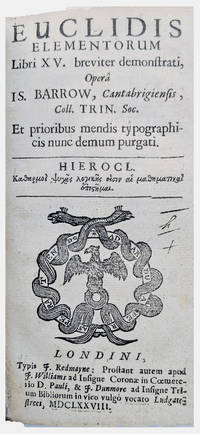
1678SS13405London:: J. Redmayne 1678. 1678. 2 parts bound as 1. Small 8vo. xvi 352 363-401 1 i.e. 391 pp. Title woodcut vignette figs. "Euclidis data" with separate title at p. 347. Contemporary full blind-stamped calf handsomely re-backed with matching calf. PROVENANCE: Inscribed at rear "R. Redding e Castro Windsor preb: . . . " Very good. Scarce. Third edition. Barrow was an English mathematician remembered for discovering the fundamental theorem of calculus. He was the first Lucasian Professor of Mathematics at Cambridge. "The elementary portion of Euclid's Elements was part of Barrow's college syllabus but some time before 1652 he went on to read not only Euclidean commentaries by Tacquet Héigone and Oughtred but also more advanced Greek works by Archimedes and possibly Apollonius and Ptolemy. His first published work his epitomized Euclidis Elementorum libri XV probably written by early 1654 is designed as a quadrivium undergraduate text with emphasis on its deductive structure rather than on its geometrical content its sole concessions to contemporary mathematical idiom being its systematic use of Oughtred's symbolism and a list'ex P. Herigono' of numerical constants relating to inscribed polyhedra." :: DSB I p. 474. REFERENCES: Max Steck Bibliographia Euclideana IV 67; Wing 2nd ed. 1994 E3395. J. Redmayne, 1678. unknown books
168338984Londini: Milonis Flesher pr. for the author sold by Pitt & Aylmer 1683. 4to 23 cm 9.1". 16 450 2 blank pp. Pp. 223/24 Ff3 lacking. <br><br>First edition: erudite translations of eight treatises. Born Jewish the French scholar Louis de Compiègne de Veil studied theology at the Sorbonne after converting to Christianity and set out to translate the whole of Maimonides' Yad ha-Chazakah from Hebrew into Latin. The present work encompasses the Sefer ha-Korbanot the section on sacrifices along with the portion on consecration of new moons and intercalations and Isaac Abravanel's preface to his commentary on Leviticus; the latter gives the => Hebrew and Latin texts on facing pages. Each section has a divisional title-page with continuous pagination. <br>Â Â Â Â <br>Â Â Â Â ESTC R25499; Wing rev. ed. M2854. Contemporary mottled calf framed and panelled in blind with blind-tooled corner fleurons; refurbished and nicely rebacked with speckled calf spine with blind-ruled raised bands and gilt-stamped leather title-label original leather pitted and worn. All page edges speckled red. Front fly-leaf title-page and one other institutionally rubber-stamped; Ff3 either a sectional title or a blank leaf lacking. Pages gently age-toned and cockled with a few corners bumped; small ink smudge in upper outer portions of two facing pages. "Exordium" with intermittent pencilled underlining and two marginal annotations pencilled in English. => Interesting 17th-century Judaica in a strong and decent copy. Milonis Flesher (pr. for the author, sold by Pitt & Aylmer) hardcover books
168118283Cantabrigiæ: Ex Officina Joann. Hayes Sumptibus Henrici Dickinson 1681 1681. Second English edition; the first was published in 1672 also by Hayes. ESTC R9979; Wing V107; Honeyman Sale Catalogue 3029. Edges and hinges repaired; prelims a little foxed; a very good copy. 8vo contemporary panelled calf rebacked raised bands. Five folding plates. Title-page printed in red and black. ¶ The celebrated treatise on scientific and comparative geography by the German geographer Bernhardus Varenius 1622-1650 first published in Amsterdam in 1650. It became the standard textbook on the subject for a century. Isaac Newton edited and revised this edition for his students at Cambridge; it was Newton's first published work. <br/><br/> Cantabrigiæ: Ex Officina Joann. Hayes, Sumptibus Henrici Dickinson, 1681 unknown books
16962447Leipzig: Gross & Fritsch 1696. First edition. vellum marbled boards. Very Good. FIRST PRINTINGS OF THE PAPERS DOCUMENTING THE PROPOSAL AND SOLUTION OF THE "BRACHISTOCHRONE PROBLEM" ONE OF THE MOST FAMOUS MATHEMATICAL CHALLENGES AND ONE OF THE EARLIEST PROBLEMS POSED IN THE CALCULATION OF VARIATIONS. The challenge of the brachistochrone "began in June of 1696 when Johann Bernoulli published a challenge problem in Leibniz's journal Acta Eruditorum. Obviously a legacy of public challenge remained from the days of Fior and Tartaglia. Although contests were now conducted in the sedate pages of scholarly journals they retained their power to make or break reputations as Johann himself observed:<br /> <br /> '. it is known with certainty that there is scarcely anything which more greatly excites noble and ingenious spirits to labors which lead to the increase of knowledge than to propose difficult and at the same time useful problems through the solution of which as by no other means they may attain to fame and build for themselves eternal monuments among posterity.'<br /> <br /> "Johann's particular challenge was a good one. He imagined points A and B at different heights above the ground and not lying one directly above the other. There is certainly an infinitude of different curves connecting these two points from a straight line to an arc of a circle to any number of other wavy undulating paths. Now imagine a ball rolling from A down to B along such a curve. The time it take to complete the trip depends of course on the curve's shape. Bernoulli challenged the mathematical world to find that one particular curve AMB along which the ball will roll the shortest time. He called this curve the 'brachistochrone' from the Greek words for 'shortest' and 'time'.<br /> <br /> "An obvious first guess is to take AMB as the straight line joining A and B. But Johann cautioned against this simplistic approach:<br /> <br /> '. to forestall hasty judgment although the straight line AB is indeed the shortest between the points A and B it nevertheless is not the path traversed in the shortest time. However the curve AMB whose name I shall give if no one else discovered it before the end of this year is one well-known to geometers.'<br /> <br /> "Johann gave the mathematical world until January 1 1697 to come up with a solution. However when his deadline arrived he had received but one solution from the 'celebrated Leibniz' who:<br /> <br /> 'has courteously asked me to extend the time limit to next Easter in order than in the interim the problem might be made public . that no one might have cause to complain of the shortness of the time allotted. I have not only agreed to this commendable request but I have decided to announce myself the prolongation and shall now see who attacks this excellent and difficult question and after so long a time finally masters it.'"<br /> <br /> At this point Johann and others were surprised and perhaps a little delighted that they had not received a solution from their English rival Sir Isaac Newton. Wondering if Newton has not noticed the challenge Johann sent Newton directly a personal letter outlining the problem. When Newton received the letter he did not disappoint. As Newton's niece Catherine Conduitt explained:<br /> <br /> "When the problem in 1697 was sent by Bernoulli - Sir I.N. was in the midst of the hurry of the great recoinage and did not come home till four from the Tower very much tired but did not sleep till he had solved it which was by four in the morning."<br /> <br /> "Even late in life and tired from a hectic day's work Isaac Newton triumphed where most of Europe had failed! It was a remarkable display of the powers of the great British genius. He had clearly felt his reputation and honor were on the line; after all both Bernoulli and Leibniz were waiting in the wings to publish their own solutions. So Newton rose to the occasion and solved the problem in a matter of hours. Somewhat exasperated he is reported at one point to have said 'I do not love . to be . teezed by foreigners about Mathematical things.'<br /> <br /> "Back in Europe as Easter neared a few solutions came into the hands of Johann Bernoulli. The curve that everyone was seeking - one that 'is well-known to geometers' - was none other than an upside-down cycloid. This important curve was studied by Pascal and Huygens but neither of these mathematicians had realized that it would also serve as the curve of quickest descent. Johann wrote with characteristic hyperbole '. you will be petrified with astonishment when I say that precisely this cycloid . of Huygens is our required brachistochrone.'<br /> <br /> "On Easter the challenge period had expired. All together Johann had received five solutions. There was his own and the one from Leibniz. His brother Jakob came through perhaps to Johann's dismay with a third and the Marquis de l'Hospital added a fourth. Finally there was a submission bearing an English postmark. Opening it Johann found the solution correct although anonymous. He clearly had met his match in the person of Isaac Newton. Although unsigned the solution bore the unmistakable signs of supreme genius.<br /> <br /> "There is a legend - probably of dubious authenticity but nonetheless of great charm - that Johann partially chastened partially in awe put down the unsigned document and knowingly remarked 'I recognize the lion by his claw.'" Quoted from William Dunham Journey Through Genius: The Great Theorems of Mathematics Wiley 1990 page 199-202.<br /> <br /> The Brachistochrone Papers - the proposal and the solutions included:<br /> <br /> Johann: Supplementum defectus geometria cartesianae circa inventionem locorum; 2. Leibniz: Communicatio suae pariter duarumque alienarum ad edendum sibi primum a Dn. Joh. Bernoullio; 3. Johann: Curvatura radii in diaphanis non uniformibus . ; 4. Jakob: Solutio problematum fraternorum . ; 5. L'Hospital: Solutio problematis de linea celerrimi descensus; 6. Tschirnhaus: De methodo universalia theoremata eruendi . ; 7. Newton: Epistola missa ad praenobilem virum D. Carolum Mountague .<br /> <br /> Note: Newton's solution original appeared in the Philosophical Transactions.

<br /> <br /> Provenance With stamps and withdrawal markings 7-3-1984 from the famous John Crerar Library Chicago. <br /> <br /> In: Acta Eruditorum vol. 15 and 16: no.1 in 15:264-69 1 plate; no. 2 in 16:201-5 1 plate; no. 3 in 16: 206-11; no. 4 in 16:211-17; no. 5 in 16: 217-20; no. 6 in 16: 220-23; no. 7 in 16: 223-24. Leipzig: Gross & Fritsch 1696-1697. The two entire volumes offered. Quarto 208x170 mm. Two volumes in uniform contemporary three-quarter vellum over marbled boards. pp 2 604 and 9 plates; 8 594 and 8 plates. Some heavy worming to pp 324-42 and plate vi of volume 15 which is not part of any of the above mentioned articles. 1697 volume with repaired gutter tear to plate 8; reinforcement to p.449/50 and minor restoration to binding. Some toning throughout as usual with the Acta. In all a very good set. Gross & Fritsch unknown books
1674000030London: William Godbid 1674. 3rd Printing. 1/2 Vellum. Very Good. 1st Edition 3rd Issue. 4to 19.6 x 15.9 cm. 2 Volumes in one. Bound in later half vellum on early marble boards. Collation: Vol. 1 - vi 127 15 folding engraved plates; Vol 2- viii 151 14 12 folding engraved plates. Plate 13 is duplicated. There are 3 leaves preceding the second part that are misplaced and should be at the front of the first section after the title page. This rebound copy has original marble boards and later vellum. The title page is reduced along the fore edge by 1.1 cm not affecting printed area. Text and plates in very good condition with only occasional minor spotting and dusting. This is a complete copy despite the misplaced pages during rebinding. <br/><br/>This first edition of Barrow's lectures on geometry and optics were given at Cambridge where he was Lucasian professor of mathematics. Newton was one of his students and "is known to have helped in preparing Barrow's Lectiones XVIII 1669 and Lectiones geometricae 1670 for publication and even to have added one or two small improvements. As a mathematician Barrow is well-known as a pioneer in the development of calculusÂ…Barrow also presented although in geometrical form the fundamental theorem of the calculus in which integration and differentiation are shown to be inverse operations. His preferenceÂ…for geometrical proofs over algebraic manipulationsÂ…could well have had some influence on the young Newton who later expressed his own distaste for the new techniques introduced into mathematics by Descartes and his followers." Gjertsen p. 55. Babson 249; Graesse I p. 299; Wallis 358.4; Wing B945 William Godbid hardcover books
16661299Nurnberg 1666. Houzeau & Lancaster 3039; Zimmer 5089 1628 Strasbourg ed.; Poggendorff 1984. Warner The Sky Explored pp. 104-5. Extremely rare German edition a Latin edition was published the same year of Sturms enlargement of Habrechts famous treatise on the making of celestial and terrestrial globes published in 1628. The Habrecht family of clock and instrument makers were famous throughout Europe from the last quarter of the sixteenth century to the end of the seventeenth century. The authors father also called Isaac was responsible for making the monumental second Strasbourg clock which was one of the mechanical wonders of its time on the Continent. Isaac Habrecht 1589-1633 was a Strasbourg physician mathematician and maker of globes. He was much influenced by Blaeu and Hondius and his globes were highly regarded. J. C. Sturm was Habrechts student and a scientist of vision. He organized the first scientific academy in Germany the Collegium Curiosum sive Experimentale at Altdorf in 1672 and introduced the first course in experimental physics in a German university. In 1666 he undertook the task of augmenting Habrechts original text and adding a number of folding plates. The plates include two handsome polar projections of the world two polar stereographic celestial charts of the northern and southern constellations and ten folded engravings showing the various parts of his planiglobiums.The fourteen folded engravings superbly executed by Jacob von der Heyden were probably intended to be mounted and assembled to form several instruments each with a revolving plate measuring 27 cm in diameter and a movable pointer. Each was to be supported on an approximately 12-cm base. The work is one of the most beautiful instrument books published in the seventeenth century and certainly one of the rarest particularly with the full complement of plates. Despite being an obvious Americanum see pp. 205 228 231 and America pictured on one of the maps it is not in Sabin JCB Palmer and other standard bibliographies. Houzeau & Lancaster lists a 1650 edition that is clearly an error as Sturm would have been 15 years old at the time.OCLC lists Yale for the German and Chicago for the Latin editions. unknown books
16932188Oxford: Oxford University Press 1693. First collected edition. Contemporary calf. Very Good. SCARCE FIRST EDITION OF THE COLLECTED WORKS of one of Newton's most important precursors John Wallis Savilian Professor 1649-1703 containing the first printed appearance of Newton's ideas on fluxions. A staunch promoter of English mathematicians Wallis repeatedly urged Newton to publish his theories before others laid claim to he work for the sake of "your Reputation & that of the nation" Gjertsen Newton Handbook 605. While Newton resisted for many years in 1693 Wallis published several letters from Newton in Vol. II of his Opera thereby introducing the concept of fluxional notation-pricked and dotted letters. In the preface to Vol. I 1695 Wallis refers briefly to Newton's claim to the discovery of Fluxions while Vol II 1693 has the first full account of Newton's invention of calculus. The third volume of Wallis's Opera contains previously unpublished correspondence between Newton and Leibniz the most important items of which are Newton's Epistola prior and Epistola posterior. "These two lengthy letters were sent to Leibniz in 1676 to acquaint him with the main lines of Newton's mathematical development. Epistola prior beginning with the binomial theorem went on to describe Newton's work on series. The second letter also contains much discussion on infinite series. It is best known however for Newton's reference to powerful and general methods he had developed for the drawing of tangents the determination of maxima and minima and the quadrature of curves. These he added he preferred to conceal within a quite insoluble anagram. A second and even longer anagram concealed Newton's claim to be able to solve fluxional equations. The solutions to both were publicly disclosed by Wallis 1699" ibid 189. Vol. 2 of the Opera also contains pp. 669-78 De Postulato Quinto; et Definitione Quinta; Lib. 6. Euclidis; disputatio geometrica Wallis's important attempt to prove the parallel postulate of Euclid also published here for the first time. "John Wallis gave a lecture on this topic. on the evening of 11 July 1663. He had been inspired by Nasr-Eddin's attempt on it which he referred to in his lecture to examine the question himself and his analysis is remarkable both for its originality and its caution. Indeed his view of the matter was to be much more profound than many a later writer's" Fauvel & Gray The History of Mathematics 510. This magnificent and comprehensive edition of Wallis's collected works was financed by and printed at Oxford University. In addition to several 'firsts' including those described above these volumes contain reprints of virtually all of Wallis's great books including the Arithmetica infinitorum and Mechanica Vol. 1 an augmented Latin edition of the Treatise of Algebra Vol. II and bilingual editions of a number of ancient Greek texts including Ptolemy's Harmonics Aristarchus's On the magnitudes and distances of the sun and moon and Archimedes's Sand-reckoner Vol. III. In addition to numerous other mathematical works the four volumes include his most popular work Grammaticae lingua anglicanae his "Treatise of Speech which formed a useful theoretical foundation for his pioneering attempts to teach deaf-mutes how to speak" DSB as well as an important tract on cryptography in which he records the methods he developed while deciphering for Cromwell the coded messages of Charles I. Wing W596 W566 W597. Babson 184. Roberts and Trent 345. see J.F. Scott The Mathematical Work of John Wallis London 1938; M. Baron The Origins of the Infinitesmal Calculus Oxford 1969 205-213; Richard Westfall The Life of Isaac Newton Cambridge 1993 207-209ff. Opera Mathematica. Volumen primum -Tertium - Opera quaedam miscellanea. Oxford: Sheldonian Theatre University Press 1695 1693 1699. Four volumes bound in three. Folio contemporary full paneled calf rebacked to style. Complete with four engravings on three leaves and three portraits Vols. I & II with the same portrait by Loggan dated 1678 and engraved by Burghers; Vol 3 by Sonmans dated 1698 and engraved by Burghers. With large bookplate inside each front cover reading "The Gift of Mr. Thomas Heatley Citizen and Iron-monger of London to the Mathematical School in Christ's Hospital Anno Dom. 1700". A very clean copy with only occasional light browning and foxing very handsomely bound. ONE OF THE MONUMENTS IN THE HISTORY OF MATHEMATICS. RARE. . Oxford University Press unknown books