312 résultats
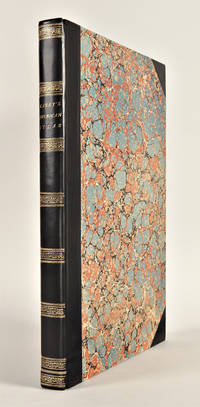
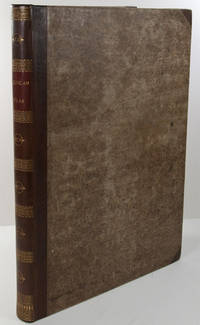
182229763Philadelphia: H.C. Carey & I. Lea 1822. Folio. Mounted on guards throughout. Letterpress title copyright notice on verso 1p. 'Advertisement' dated 'June 21 1822' verso blank 1p. 'Contents' and 'Index' verso blank. 46 double-page hand-coloured engraved maps of America all but one with borders of letterpress descriptive text 1 uncoloured double-page engraved view showing the comparative heights of mountains throughout the world 1 hand-coloured double-page engraved table showing the comparative lengths of the principal rivers worldwide 5 letterpress tables 4 double-page 3 of these hand-coloured 18pp. of uncoloured letterpress text. Contemporary half black morocco over plain paper boards rebacked with original spine laid down and corners renewed. Housed in a cloth clamshell case leather label.<br/> <br/>First edition of one of the most important early atlases printed in the United States: a handsome atlas of the Americas with individual hand-coloured maps of each state in the Union including a seminal map of the West by Stephen H. Long.<br/> <br/>At the time of publication this was the best and most detailed atlas to be produced in the United States. Fielding Lucas the major Baltimore printer was the principal engraver and substantial historical background text accompanies each map. Among the most noted maps in the atlas is Major Stephen H. Long's "Map of Arkansa and other Territories of the United States." That map which depicts the Missouri basin between Nashville in the east the Mandan villages in the north and the Rocky Mountains in the west was based on the surveys conducted by Long on his expeditions of 1819 and 1820. The map published in Carey & Lea's atlas preceded the official account of that expedition by expedition botanist Edwin James which included a smaller map with similar detail titled "Country drained by the Mississippi Western Section". Carey and Lea's 1822 publication of James Account perhaps explains the prior inclusion of this map with Long expedition information in their atlas. On this famous map is the printed legend which would perpetuate a myth for many years to come identifying the high plains as the "Great American Desert." Carey and Lea's atlas was first issued as here in 1822; an 1823 second issue followed substantially the same as the first but with a new title and revised states of several maps and text leaves generally minor revisions including additional shading to maps and improved resetting of several text leaves.<br/> <br/>Phillips 1373a; Howes C133 "aa"; Sabin 15055; Wheat Transmississippi West 348 and 352. H.C. Carey & I. Lea unknown books
182729764Philadelphia: H.C. Carey & I. Lea 1827. Folio. Mounted on guards throughout. Letterpress title copyright notice on verso 1p. "Advertisement" to Third Edition dated "January 1827" verso blank 1p. "Contents" and "Index" verso blank plus forty-six double-page handcolored copper engraved maps most with descriptive letterpress in margins and many with supplementary text pages following; one double-page engraved plate of mountains uncolored; and one double-page colored plate of river lengths. Titlepage remargined minor foxing some faint staining along bottom edge. Later 19th-century three-quarter calf and original plain paper boards later gilt morocco label. Boards slightly rubbed.<br/> <br/>One of the most important early atlases printed in the United States: a handsome atlas of the Americas with individual colour maps of each state in the Union including a seminal map of the West by Stephen H. Long.<br/> <br/>At the time of publication this was the best and most detailed atlas to be produced in the United States. Fielding Lucas the major Baltimore printer was the principal engraver and substantial historical background text accompanies each map. Among the most noted maps in the atlas is Major Stephen H. Long's "Map of Arkansa and other Territories of the United States." That map which depicts the Missouri basin between Nashville in the east the Mandan villages in the north and the Rocky Mountains in the west was based on the surveys conducted by Long on his expeditions of 1819 and 1820. On this famous map is the printed legend which would perpetuate a myth for many years to come identifying the high plains as the "Great American Desert." The 1827 edition "Third edition Corrected and Improved" of Carey & Lea's historic atlas first published in 1822 includes much new material with all the maps and text updated except for the Washington D.C. and Michigan maps. This was the first American atlas that was modeled on Le Sage's plan of having explanatory text surrounding the maps. The maps for the most part by Fielding Lucas are beautifully drawn and colored.<br/> <br/>Howes C133 "aa"; Phillips 1373a; Sabin 15055; Wheat Transmississippi West 348 and 352. H.C. Carey & I. Lea unknown books
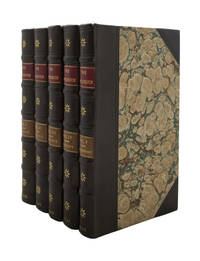
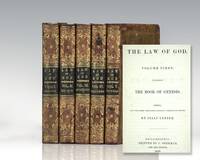
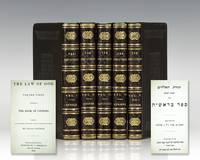
184568182The First English Translation of the Pentateuch in America LEESER Isaac translator editor. BIBLE IN HEBREW. The Law of God. In Five Volumes. The Pentateuch Philadelphia: C. Sherman 1845. First edition of the first English translation of any part of the Hebrew Bible in America the Pentateuch. The Pentateuch means the first five books of the Bible. These books comprise Genesis Exodus Leviticus Numbers and Deuteronomy. Complete with five octavo volumes 7 1/2 x 4 5/8 inches; 189 x 118 mm. With text in Hebrew and the corresponding English on the facing page. Generally the Hebrew is on the recto English on the verso. Modern half calf over marbled boards. Calf ruled in blind. Spines with red and brown calf spine labels lettered in gilt. Spines stamped in gilt. Some unobtrusive creasing to upper corner of final three leaves of volume I. A tiny dampstain to top of text block of volume I not affecting leaves. Edges very slightly trimmed as shown by remnants of gilt but still with large margins. Some minor foxing and toning mainly to preliminary leaves most of text is very clean. Overall a near fine copy. "Leeser's career as a translator also began in Philadelphia in 1830 with the publication of his rendering from German of J. Johlson's Instruction in the Mosaic Religion. Leeser as part of his ongoing efforts to contribute to the development of Jewish education and culture in America translated a number of important works into English from German Spanish French and Hebrew. Among his most important translations were Moses Mendelssohn's Jerusalem Joseph Schwartz' Descriptive Geography and Brief Historical Sketch of Palestine as well as his renowned Bible translations first of the Pentateuch and later of the entire Hebrew Bible. Leeser continued to play an unceasing role in creating the cultural foundations of Jewish life in Philadelphia and throughout North America. In 1845 Leeser founded the first American Jewish Publication Society and in the same year published his translation of the Pentateuch entitled The Law of God a bi-lingual edition which included the unpointed unvocalized Hebrew text. " Penn Libraries; Biographical Sketch of Isaac Leeserby Arthur Kiron Schottenstein-Jesselson Curator of Judaica Collections. "The translator of the first American Jewish Bible Isaac Leeser 1806-68 was a modern Orthodox German Jew who immigrated to America in 1822. Leeser 'was the most important Jewish religious leader in the United States during the Ante-bellum Period.' In 1830 Leeser published an English translation of Johlson's catechism Instructions in the Mosaic Religion in Philadelphia another English edition appeared in 1867. However his major work was a Bible translation for American Jews the authoritative English translation until the first Jewish Publication Society translation appeared in 1917." A History of German Jewish Bible Translation Abigail Gillman pg 126. "The translation of the Bible was Leeser's great literary achievement and represented many years of patient labor and devotion to a task which he considered sacred. Leeser was not fully equipped for this work for he was no specialist in Hebrew philology nor a master if Jewish learning in general and he was quite conscious of his shortcomings but he was inspired. He says in his preface: 'I thought in all due humility that I might safely go to task confidently relying upon that superior aid which is never withheld from the inquirer after truth.' He made good use of the various German translations by Jews of the collective commentary known as the Biur vol. III sec. 81 and of other Jewish exegetic works. As a result his translation though based in style upon the King James version can be considered an independent work for the changes he produced are numerous and great. His prime consern was to supply the traditional interpretation when necessary and the retention of the Jewish spirit at times even at the expense of beauty of style. The translation went through numerous editions and until the new Jewish Publication Society version was issued in 1917 it was the only source from which many Jews not conversant with Hebrew derived their knowledge of the Bible in accordance with Jewish tradition" Waxman History of Jewish Literature 1090. HBS 68182. $11500 C. Sherman hardcover books
1823WRCAM43415APhiladelphia: H.C. Carey & I. Lea 1823. Letterpress title copyright notice on verso 1p. advertisement verso blank 1p. table of contents verso blank. Forty-six double-page handcolored engraved maps of the United States all but one with borders of letterpress descriptive text; uncolored double-page engraved view showing the comparative heights of mountains throughout the world; handcolored double-page engraved table showing the comparative lengths of the principal rivers worldwide; five letterpress tables four double-page three of these handcolored; 18pp. of letterpress text. Mounted on guards throughout. Modern half calf and marbled boards spine gilt leather label. Dampstaining along lower edge causing chipping to initial leaves. Closed tear in bottom margin of first map repaired with tissue. Very light offsetting from maps. Some dust soiling light tanning and foxing. Good plus. A handsome atlas of the Americas with individual color maps of each state in the Union including a seminal map of the West by Stephen H. Long. At the time of publication this was the best and most detailed atlas to be produced in the United States with substantial historical background text accompanying each map. Fielding Lucas the major Baltimore printer was the principal engraver. <br> <br> Among the most noted maps in the atlas is Major Stephen H. Long's "Map of Arkansa and other Territories of the United States." That map which depicts the Missouri basin between Nashville in the east the Mandan villages in the north and the Rocky Mountains in the west was based on the surveys conducted by Long on his expeditions of 1819 and 1820. The map published in Carey & Lea's atlas preceded the official account of that expedition by expedition botanist Edwin James which includes a smaller map with similar detail titled "Country drained by the Mississippi Western Section." Carey & Lea's 1823 publication of James' ACCOUNT perhaps explains the prior inclusion of this map with Long expedition information in their atlas. <br> <br> On this famous map is the printed legend which would perpetuate a myth for many years to come identifying the high plains as the "Great American Desert." Carey & Lea's atlas was first issued in 1822; this is the second issue with revised states of three maps Maine North Carolina and Louisiana with the same printing of the remaining maps and a cancel title. HOWES C133 "aa." PHILLIPS ATLASES 1373a. SABIN 15055. WHEAT TRANSMISSISSIPPI 348 352. H.C. Carey & I. Lea hardcover books
182325085Philadelphia: H.C. Carey & I. Lea 1823. Folio. 17 1/2 x 11 7/8 inches. Mounted on guards throughout letterpress title copyright notice on verso 1p. Advertisement verso blank 1p. Contents verso blank 46 double-page hand-coloured engraved maps of the United States all but one with borders of letterpress descriptive text 1 uncoloured double-page engraved view showing the comparative heights of mountains throughout the world 1 hand-coloured double-page engraved table showing the comparative lengths of the principal rivers worldwide 5 letterpress tables 4 double-page 3 of these hand-coloured 18pp. of letterpress text. Expertly bound to style in half calf over contemporary marbled paper covered boards flat spine in six compartments divided by gilt roll tools red morocco label in the second compartment the others with a repeat decoration in gilt.<br/> <br/>One of the most important early atlases printed in the United States: a handsome atlas of the Americas with individual colour maps of each state in the Union including a seminal map of the West by Stephen H. Long.<br/> <br/>At the time of publication this was the best and most detailed atlas to be produced in the United States. Fielding Lucas the major Baltimore printer was the principal engraver and substantial historical background text accompanies each map. Among the most noted maps in the atlas is Major Stephen H. Long's "Map of Arkansa and other Territories of the United States." That map which depicts the Missouri basin between Nashville in the east the Mandan villages in the north and the Rocky Mountains in the west was based on the surveys conducted by Long on his expeditions of 1819 and 1820. The map published in Carey & Lea's atlas preceded the official account of that expedition by expedition botanist Edwin James which included a smaller map with similar detail titled "Country drained by the Mississippi Western Section". Carey and Lea's 1823 publication of James Account perhaps explains the prior inclusion of this map with Long expedition information in their atlas. On this famous map is the printed legend which would perpetuate a myth for many years to come identifying the high plains as the "Great American Desert." Carey and Lea's atlas was first issued in 1822; this is the 1823 second issue substantially the same as the first but with a new title and revised states of several maps and text leaves generally minor revisions including additional shading to maps and improved resetting of several text leaves though this copy with first state settings of the Maryland and Virginia text leaves.<br/> <br/>Howes C133 "aa"; Phillips 1373a; Sabin 15055; Wheat Transmississippi West 348 and 352. H.C. Carey & I. Lea unknown books
184578547Philadelphia: C. Sherman 5605 1845-46. First edition of the "first English translation of the Pentateuch in America" the 1845 Hebrew-English Bible by one of the most prominent and influential figures in American Jewish history. Octavo 5 volumes. Translated by Isaac Leeser. Bound in full contemporary calf gilt titles and tooling to the spine. In near fine condition. A nice example rare in contemporary binding. Previous editions published by Jews in England had simply utilized the King James translation. The translator was Isaac Leeser 1806-1868 who worked without assistance. In his preface he apologizes for any errors: "How can it be expected that I should escape when I have no Jewish compositors and have necessarily to be often away when the work goes to press" Despite these obstacles Leeser doubted that "the precious word of God ever appeared among us in a more beautiful form than the volumes in which I am now engaged." Leeser avoided reliance on earlier English translations though he made some use of German translations and noted that "the arrangement is strictly Jewish. My intention was to furnish a book for the service of the Synagogue both German and Portuguese." Leeser's "contributions to every area of Jewish culture and religion made him a major builder of American Judaism." The publication of his Pentateuch was the first time that any portion of the Bible was published in America under Jewish auspices. "The translation of the Bible was Leeser's great literary achievement and represented many years of patient labor and devotion to a task which he considered sacred. He made good use of the various German translations by Jews of the collective commentary known as the Biur and of other Jewish exegetic works. As a result his translation though based in style upon the King James version can be considered an independent work for the changes he produced are numerous and great. until the new Jewish Publication Society version was issued in 1917 it was the only source from which many Jews not conversant with Hebrew derived their knowledge of the Bible in accordance with Jewish tradition" Waxman 1090. C. Sherman, 5605 unknown books
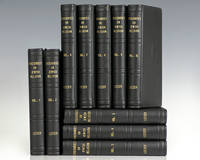
1866107732Philadelphia: Sherman & Co 1866-68. First editions of one of the 'major builders of American Judaism' Isaac Leeser's Discourses on the Jewish Religion. Octavo 10 volumes bound in full leather gilt titles to the spine raised bands. In near fine condition. Complete sets are of the utmost rarity. American Jewish lay minister author translator and publisher Issac Leeser's "contributions to every area of Jewish culture and religion made him a major builder of American Judaism." In addition to his influence on the Jewish pulpit in the United States Leeser became the first American Jewish publisher and produced the first Jewish translation of the bible into English. "The translation of the Bible was Leeser's great literary achievement and represented many years of patient labor and devotion to a task which he considered sacred.until the new Jewish Publication Society version was issued in 1917 it was the only source from which many Jews not conversant with Hebrew derived their knowledge of the Bible in accordance with Jewish tradition" Waxman 1090. Sherman & Co hardcover books
1803122898London: Printed for H.D. Symonds 1803. First complete edition in English of Sir Isaac Newton's Principia the greatest work of physics in the exceedingly rare original boards. Octavo 3 volumes bound in original boards uncut 54 folding copper-engraved plates of diagrams and figures all but one folding; 2 folding tables. with 22 folding. In near fine condition with light toning to the text. An exceptional example rare and desirable in the original boards. Housed in a custom clamshell box. "Newtons Principia is generally described as the greatest work in the history of science. Copernicus Galileo and Kepler had certainly shown the way; but where they described the phenomena they observed Newton explained the underlying universal laws. The Principia provided the greatest synthesis of the cosmos proving finally its physical unity. Newton showed that the important and dramatic aspects of nature that were subject to the universal law of gravitation could be explained in mathematical terms with a single physical theory. With him the separation of the natural and supernatural of sublunar and superlunar worlds disappeared. The same laws of gravitation and motion rule everywhere; for the first time a single mathematical law could explain the motion of objects on earth as well as the phenomena of the heavens. The whole cosmos is composed of inter-connecting parts influencing each other according to these laws. It was this grand conception that produced a general revolution in human thought equaled perhaps only by that following Darwins Origin of Species Newton is generally regarded as one of the greatest mathematicians of all time and the founder of mathematical physics" PMM 161. "It is perhaps the greatest intellectual stride that it has ever been granted to any man to make" Einstein. Printed for H.D. Symonds hardcover books
184549020Philadelphia: C. Sherman 5605 1845-46. First edition of the "first English translation of the Pentateuch in America" the 1845 Hebrew-English Bible by one of the most prominent and influential figures in American Jewish history. Octavo 5 volumes. Translated by Isaac Leeser. Bound in contemporary polished calf gilt titles and tooling to the spine rebacked. Lightly rubbed moderate wear. A very nice example of a scarce and important work. Previous editions published by Jews in England had simply utilized the King James translation. The translator was Isaac Leeser 1806-1868 who worked without assistance. In his preface he apologizes for any errors: "How can it be expected that I should escape when I have no Jewish compositors and have necessarily to be often away when the work goes to press" Despite these obstacles Leeser doubted that "the precious word of God ever appeared among us in a more beautiful form than the volumes in which I am now engaged." Leeser avoided reliance on earlier English translations though he made some use of German translations and noted that "the arrangement is strictly Jewish. My intention was to furnish a book for the service of the Synagogue both German and Portuguese." Leeser's "contributions to every area of Jewish culture and religion made him a major builder of American Judaism." The publication of his Pentateuch was the first time that any portion of the Bible was published in America under Jewish auspices. "The translation of the Bible was Leeser's great literary achievement and represented many years of patient labor and devotion to a task which he considered sacred. He made good use of the various German translations by Jews of the collective commentary known as the Biur and of other Jewish exegetic works. As a result his translation though based in style upon the King James version can be considered an independent work for the changes he produced are numerous and great. until the new Jewish Publication Society version was issued in 1917 it was the only source from which many Jews not conversant with Hebrew derived their knowledge of the Bible in accordance with Jewish tradition" Waxman 1090. C. Sherman, 5605 unknown books
18481803065Daniel Adee 1848. 1st Edition. Hardcover. Near Fine/No Jacket. Near fine TRUE first American edition 1st issue as stated on the title page. Some water stains on page edges. Previous owner's bookplate on front pastedown. Rubbing on outside spine and corners and at bottom of spine. Tape at endpapers and pastedowns along gutters. Housed in custom-made slip case. Daniel Adee hardcover books
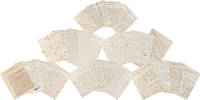
1827WRCAM55911Various locations mostly Valparaiso Chile; Callao and Lima 1827. Forty-six autograph letters signed or manuscript letters signed totaling 103pp. some with integral address leaf. All docketed at the top right edge of the verso of the last leaf likely by William Tudor himself. Original mailing folds light toning occasional short tears from opened wax seals. Overall very good. In a cloth chemise and half morocco and cloth folding case spine gilt. An important historical archive of letters received by William Tudor almost all while he was serving as United States Consul to Peru in Lima. The letters from a breadth of correspondents reveal the range of political cultural military and legal issues faced by an American diplomat serving in a South America during a politically volatile period and are especially interesting for detailing American diplomatic actions in South America in the years just after the issuance of the Monroe Doctrine. The letters are particularly notable for demonstrating the views and actions of the United States during the Peruvian independence struggle and showing the extent of the cooperation between the U.S. and Great Britain less than a decade after the conclusion of the War of 1812. They also paint a picture of the revolutionary actions of Simón BolÃÂvar in Peru the tight grip on the port of Callao by Spanish stalwart José Ramón Rodil and the interplay of American British Spanish Chilean and Peruvian officials in the region. <br> <br> William Tudor 1779-1830 was a leading citizen of Boston and the son of the first judge advocate of the Continental Army. Tudor was a founder and first editor of the NORTH AMERICAN REVIEW and helped found the Boston Athenaeum. He was the first Boston citizen to refer to the city as "The Athens of America" in an 1819 letter. Tudor was the U.S. Consul to Peru from 1824 to 1827 and Chargé d'Affaires at Rio de Janeiro from 1827 until his death there in 1830. <br> <br> The most prominent correspondent in this archive is Commodore Isaac Hull 1773-1843 represented by twelve letters to William Tudor. The Hull letters are a mixture of seven autograph letters signed from Hull and five manuscript letters in a secretarial hand but signed by the Commodore. Hull's letters report on the naval blockade of Peru American movements around South America and the struggles of Simón BolÃÂvar's South American independence movement and also touch on the ultimate defeat of the Spanish in Peru. At the time these letters were written Hull was commander of the United States Pacific Squadron and the letters emanate from Hull's flagship the USS United States positioned in Callao Bay as part of a joint American-British blockade. Hull had a long and distinguished career in the United States Navy beginning during the Quasi War with France battling Barbary pirates and commanding the USS Constitution during the War of 1812. He went on to serve as commandant of the Washington Navy Yard and as commander of the Mediterranean Squadron. Letters by Hull are scarce on the market especially in the quantity quality and intimacy of content seen here. <br> <br> In his first letter on May 28 1824 Hull writes about meeting British naval figure Martin Guise who was at this time serving with the Chilean Navy during the Peruvian War of Independence from Spain. Hull mentions the current blockade in his first two letters writing in the first: "I fear that they will not go all length with me in the blockade; they appear disposed to allow something like a coast blockade." His second letter of June 8 includes more details on the efforts during the blockade namely that Guise is "doing what he has the authority to do from Bolivar" and Captain Prescott "has in great measure made up his mind to submit to the blockade of Guise even in its present form." <br> <br> Hull's communications increase beginning in August and he writes to Tudor on August 21 that he must refuse his request to land U.S. Marines in Lima for the protection of American officials but agrees to send a "sea officer with arms" and as many seamen as necessary "for the protection of American Citizens only" but that they "must be kept within their houses or yards." <br> <br> In his next few letters Hull reports on the ships Dolphin and Peacock being routed to Valparaiso to provide strategic defense to American shipping vessels in the region and asks for more information and communications from Tudor regarding the ships Carington and Nancy condemned by Spanish General José Ramón Rodil. In a September 11 letter Hull states that Rodil intends to sell the two ships and that "it may be necessary for me to take measures that will not please his excellency as I consider his conduct is and has been for some time hostile towards us and cannot much longer be submitted to." Hull also invites Tudor to his ship to "spend the day with your friends Capt. and Mrs. Maling" who were onboard Hull's ship the previous night. Hull and Thomas James Maling were fellow commanders of the American and British forces respectively during this period around Peru. Maling commanded the British ship the Cambridge which is referenced in some of the letters here. José Ramón Rodil was commander of the port of Callao for the Spanish government and one of the last remaining Spanish officials to surrender to BolÃÂvar; he stubbornly refused to officially cede control of Callao until 1826 when he finally gave up and returned to Spain. <br> <br> On October 15 Hull writes to Tudor about the attitudes of the Spanish government "towards our commerce." Hull fears that should the Spanish invoke "the laws of the Indies" against American officials in Peru then Hull and Tudor "shall be in a bad way." The Laws of the Indies were a series of Spanish laws dealing with the relationship between Spain and her colonies in America; Hull is perhaps worried here that if the Spanish government invokes these laws as a sovereign nation then the activities of the American government in South America would stand in violation of that sovereignty. <br> <br> Hull's troubles with Rodil continue in November when he informs Tudor that "the crew of the China had complained to Captain Maling of the bad treatment they had received from General Rodil stating that they were compelled to work and that some of them had been severely punished." Hull writes that he plans to demand the release of these sailors and the ship and if Rodil does not acquiesce he would "resort to reprisal and let the consequence be what it may." <br> <br> In Hull's next letter the true nature of the extreme treatment suffered by some Americans under Rodil is described. Hull writes a lengthy and passionate letter decrying the "injustice and cruelty of all the proceedings" which took place during the Spanish seizure of the China. Hull can no longer "remain inactive or insensible to the repeated wrongs of my countrymen." He then relates how some seamen were threatened with swords muskets or gallows. Hull thinks that "my government will justify me in any measures which I shall be compelled to take to obtain redress for the insults and wrongs which my countrymen have received and to prevent a repetition of them" After all claims Hull "there is not an American in this country knowing all things which have taken place who would not be willing to sacrifice every feeling of interest to have their rights respected." <br> <br> Hull's last two letters come after the decisive battle at Ayacucho in early December 1824 which effectively ended the Peruvian War of Independence in favor of BolÃÂvar's forces. On December 18 Hull transmits his original correspondence with Rodil to Tudor presumably so that Tudor can consolidate communications between American and Spanish officials now that Peru has won the war. Hull's final letter touches on duties owed by American vessels at Ancon; Hull recuses himself from the issue in favor of Tudor as such issues "should more properly come before you as consul or the merchants to whom he consigned and I consider any interference on my part would be improper and that it is a case entirely distinct from my duties." After all as a naval commander Hull is not responsible for imposing import and export duties related to commerce in newly-independent ports. Hull closes by writing that the news of Peruvian independence will be "such glorious news to the United States. It will be received with sincere pleasure by our government and every lover of freedom and humanity." <br> <br> Also present here are seven letters from the aforementioned Thomas James Maling plus one from his wife Harriet to William Tudor all of which were written between August and December 1824. Captain Thomas Maling was the scion of the Maling pottery family in England. He was commissioned into the Royal Navy in 1791 rising to vice admiral in 1830. During his time in Peru Maling was captain in charge of the HMS Cambridge which was stationed in Callao for most of Maling's time there. He married Harriet Darwin daughter of Erasmus Darwin and niece to Charles who accompanied him to South America. Sadly Harriet would die in 1825 in Valparaiso Chile. The Malings were very friendly with William Tudor as evidenced in the present correspondence which includes a friendly partial note from Harriet to Tudor in which she chides Tudor for not visiting their ship and offers to share with him "a good private and confidential letter". <br> <br> In his first letter dated August 18 Captain Maling agrees to take aboard his ship one of Tudor's friends and hopes "you are all made safe & happy by the party I have sent to guard you all at Lima." In his second letter on August 24 Maling mentions that "Guise is sending another Blockading Squadron" but that this will be "of insufficient force to stop the trade of Europe and North America." Maling hopes "your Commodore" meaning Hull agrees with him; blockades were prevalent during this time around Peru and Chile as the various revolutions led by and inspired by Simón BolÃÂvar took root. <br> <br> Maling's letter of September 4 concentrates on battle news in Peru reading in part: "Kelly who I believe you know of returned from the Liberator's Army and I believe brings us good news but he is still with Guise.There has been no second battle but Cantera's army dispersed after the 6th leaving him with only 2000 men with which he is hastening back to Cusco. It is supposed for the purpose of raising the Indians in favor of the Young Inca they have been keeping in reserve. The Commodore Hull has thought this information & what else Kelly may bring of sufficient importance to detain the Dolphin another day." <br> <br> Three days later Maling writes Tudor about a recent naval issue that prompted him to write to the commanding officer of the ship "to tell him he will be made responsible in future for the conduct or his officers & men and I hope we shall hear of no other instance of such impropriety but it is by no means thought here to be ours." This is followed by a mention of the ship China. Maling invites Tudor to his ship for a visit and tells him he may have the "opportunity of seeing a naval fight." This letter is likely concerned with the aforementioned troubles with the China in which American and British sailors were mistreated by Spanish authorities. <br> <br> Maling's October 15 letter is especially interesting as he mentions yet another blockade-related event: "There is an embargo on all vessels at Quilea & no communication permitted with the shore a pretty conclusive hint where our friends will go to when they sail from hence if Guise who is again sailing close in ever suffers them to depart in peace." <br> <br> Maling's last two letters date from December 1824 after BolÃÂvar's victory in Peru. In his December 8 communication he reports that "England has acknowledged the independence of those parts of America which actually form free states." The implication here is clear in that England is ready to recognize democratic regimes and nothing less. In his final letter Maling writes about the slowness in receiving news from the Peruvian government on naval matters though he allows for the "intoxication of success" felt by those in Peru who had just won their independence from Spain. Maling wishes them "so well to their cause that I shall not quarrel with them." <br> <br> Maling's penultimate letter alludes to the recent death of British Consul General Thomas Edward Rowcroft. The present archive includes two letters to Tudor from Rowcroft who was essentially Tudor's British counterpart in Peru. In his first letter dated June 19 1824 Rowcroft writes to Tudor about the "dispositions of the Viceroy on the appointment of Consuls in this Country" and on the importance of maintaining "mutual confidential communications" between himself and Tudor. Towards the end of 1824 on December 2 Rowcroft writes again to Tudor this time to ask about two English Navy vessels allegedly captured by a ship flying "Spanish Colours" and then recaptured by Tudor's brother-in-law Commodore Stewart. This last letter would have been among Rowcroft's final communications as he was gunned down a few days later while traveling back from Lima after delivering letters to Thomas Maling. Rowcroft supposedly held a pass that should have taken him safely through both the loyalist-held sections and the Bolivar-held areas of the city. As he presented his pass to authorities loyal to Bolivar at a checkpoint his coach was met with a hail of bullets as it rolled away. Rowcroft was shot in the hand and the torso and died on December 7; his death is now considered an unfortunate accident perhaps precipitated by a "death sentence" purposely written on his pass by loyalist officials hoping to get Rowcroft in trouble. If this was indeed their plan it worked. <br> <br> Other letters to Tudor here include a February 20 1824 note from John Dorr to Tudor in which Dorr discusses his ship Esther which was seized by the revolutionary government in Callao Peru. Dorr indicates that General BolÃÂvar is willing to "do what is possible to recover that valuable Ship & freight or ample indemnity." On April 18 1824 French Dr. A.V. Brandin writes to Tudor from Lima informing him of a shipment of quinine for Commodore Hull and his wife aboard the USS Franklin. Brandin allegedly founded the first medical journal in Peru and was apparently the first doctor to introduce quinine to South America. <br> <br> In other letters in this archive American ship captain Samuel C. Erwin writes to Tudor on April 22 1824 with regard to the seizure of a "case of Linnens" by the new Peruvian government along with a request to write directly to the governor in Lima for relief and for a "Certificate of American Property for my whole cargo which I have repeatedly applied for without being able to get it." American merchant seaman Thomas R. Gerry son of Elbridge Gerry writes to Tudor from Quilca Peru on August 18 1824 reporting on various business matters and providing a blistering description of Quilca which he sums up as a "miserable hole." Gerry also reports on two American prisoners of war taken by the Chilean government one of whom he currently has on his ship the Tartar while the other is still held at Arica. <br> <br> The present collection also includes a handful of letters from Michael Hogan U.S. Consul and Navy Agent at Valparaiso Chile from 1823 until his death in 1833. Hogan's first communication to Tudor is dated the day after Tudor took over as consul in Peru; Hogan is "anxious" but "hopes for the best" for Tudor in his new position. In June 1824 Hogan sends a short report to Tudor on political maneuverings in Valparaiso where General Pinto was to be appointed "supremo." One of his letters from July 28 1824 reports on political struggles within Chile where a Constitution had just been "amicably" voted down the Senate dissolved General Wager appointed director and General Pinto as prime minister until a new Congress was convened in three months. Another letter from Hogan dated August 9 1824 includes information on the Chilean government's efforts to sell church property "for the publick good." This was a standard practice in the post-colonial governments in South America who often converted church artifacts of silver and gold into new coinage. In this same letter Hogan reports that Chilean officials will soon forbid the importation of flour in favor of the "great landholders" in Chile who plan to produce their own "breadstuffs." <br> <br> Other communications to Tudor involve letters of introduction for new merchant ship captains an appeal by William Wetmore regarding shipping declarations made to General Rodil in Callao two short letters from U.S. consul to Peru James Prevost in Callao regarding permissions from the new Peruvian government Prevost would die in Lima on March 5 1825 and a handful of letters in Spanish from local officials one of which dated Feb. 12 1826 mentions mining in Lima "metales de plata" and "metales ricos un espia". <br> <br> There are also two letters written to Tudor before his time in Peru. One dated July 7 1822 from Thomas Dawes in Boston relates to a pamphlet Tudor wrote on Thomas Paine. The other is an October 30 1822 "Declaration and Protest" from a U.S. schooner called the Dolphin claiming unlawful seizure and false imprisonment by Peruvian officials in Callao; this document was perhaps inherited by Tudor when he arrived in Lima. There is even an intriguing partial manuscript which seems to be part of a confidential report on English government and their public attitudes towards the United States mentioning a debate in the House of Commons regarding "peace or war with America." <br> <br> In total these to William letters shine a rare spotlight on the American intervention in Peru and on the international political and economic machinations in South America during the 1820s. The archive provides a stark picture of American enforcement of the Monroe Doctrine which President Monroe had just elucidated in his State of the Union Address on December 2 1823. Spanish actions in Peru in the 1820s were seen as a violation of this new foreign policy stance by the United States particularly the tenet covering European colonial involvement in the Western Hemisphere. Of course the Monroe Doctrine also served American economic interests in South America which certainly motivated events such as the American blockade of Callao and the dispersal of the Dolphin and the Peacock to other South American ports. <br> <br> An outstanding collection of American diplomatic correspondence from an important moment in South American history. hardcover books
1827305824Charleston: James S. Burges 1827. First and only edition. 18 2 blank pp. 12mo. Modern pale yellow wrappers. Custom chemise and quarter morocco slipcase. Some pale foxing to title otherwise clean. First and only edition. 18 2 blank pp. 12mo. Rarity of American Judaica. A rare pamphlet issued by the first Jewish Reform movement in the United States the Sephardic Reformed Society of Israelites in Charleston South Carolina recording an address by one of the movement's leaders. The Reformed Society of Israelites formed in 1824 when it split off from the Kahal Kadosh Beth Elohim KKBE synagogue in Charleston seeking to implement a number of reforms it deemed crucial to engaging the rising generation. In the process the Society posited a distinctly American form of practice. <br/>Led by Isaac Harby Abraham Moise and David Nunes Carvalho the Reformed Society of Israelites reflected the fact that as Jonathan Sarna has phrased it: "Jews who did not feel at home in synagogue no longer had to compromise their principles for the sake of consensus; they felt free to withdraw and start their own congregations. In free and democratic America congregational autonomy became the rule resulting in a new American Judaism - a Judaism of diversity and pluralism."<br/><br/><br/>The present address was delivered on the third anniversary of the Society by Isaac Cardozo 1786-1855 who served as the group's Vice-President from 1828-1832. Cardozo invokes a "spirit of reform in all existing institutions which is abroad" and reminds the group of its origin as "a society that was instituted mainly for effecting the observance of order and decorum in Hebrew worship: for adapting it to the feelings and propensities of the enlightened Israelite of the present day; and for endeavoring to bring about by argument and petition what neither necessity nor persuasion could before accomplish" before he goes on to defend the mission against various critiques. <br/> <br/>Apart from being a leader within Charleston's Sephardic Jewish community Cardozo was also the patriarch of an important southern African-American family. He had six children with his common-law wife Lydia Weston a free black woman from a prominent Charleston family--one of a number of openly mixed-race households in antebellum Charleston. One of their sons was Francis Cardozo 1836-1903 who became the first African-American to hold statewide office in the United States serving as Secretary of State in South Carolina from 1868 to 1872. Another son Thomas served as State Superintendent of Education from 1873 to 1876. <br/><br/>RARE: OCLC reports only two institutional copies and A.S.W. Rosenbach in his American Jewish Bibliography located only one copy in a private collection. Rosenbach 289 locating one copy in a private collection; OCLC USC Presbyterian College; American Imprints 28385; Singerman 0442 James S. Burges unknown books