Isaac Vossii (Gerardus Joannis Vossius)Biblio.com

97 résultats
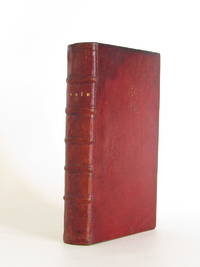
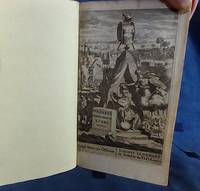
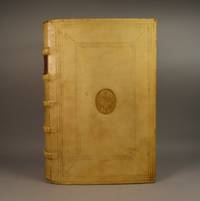
1658106453HagaeComitis The Hague: Adrianum Vlacq. 1658. First edition. Octavo full leather binding with new leather spine red leather title label with giltstamped lettering and decoration new endpapers title page printed in red and black with engraved decoration pp title ii 65 xxiv index second title page 316 xx index. Minor bumps and scrapes to the original binding. Light foxing to the title page. Very good condition. Observations to Pomponius Mela on "de situ orbis" the position of the world. Pomponius Mela was the earliest known Roman geographer: his "de situ orbis" is the only formal treatise on the subject in Classical Latin. Gerrit Janszoon Vos 1577 – 1649 generally known by his Latin name Gerardus Vossius was a classical scholar theologian and polymath. He was well known for his scholarship and taught in the Netherlands and England. "The object of his work was not to invent new ideas but to systematize and interpret the ideas of the past and of his own day. . He must now be regarded as a representative of a very important stage in the history of thought."DBNL. "Observationes ad Pomponium Melam" is an extended commentary on Mela as well as Vossius says an improved translation of his work. 1st Edition. Leather. Adrianum Vlacq hardcover
165326286London Printed by T. Maxey for Rich Marriot PUBL Printed on Laid Paper 1653 HARDBACK NODustJacket ISSUED 1st UK edition was 1653 This POSSIBLE 1st early edition Known as the Griggs facsimile edition published in 1882 by William Griggs London. Griggs was photo-lithographer to the Queen. It is a photographic reproduction of a first edition but many pages required additional touch-up work to make it presentable. GOOD-/GOOD AS-IS NO JACKET 1653 ON TITLE PAGE Light rub wear Fade Plain brown Calf LEATHER BINDING pg. 114 reading VVhen not VVien 246 pgs. NOJACKET Small cover creases 3 3/4 X 6 in. Tiny tears spine cvr Edges Fade Gold Gilt Spine cvr & wear to spine ends PAGE 217 Anglers Song Bassus Printed upside down 246 pgs 13 chaptersa printing or binding error which has led to few sections of pgs need be reglued back into book they are separated OR not being bound in ORIGINALLY The title is engraved within ornaments while the subtitle and imprint are printed using type. Maybe a Fascimile of the 1653 edition done in 1880s OR 1928 Small 8vo he bass part of the Angler s Song is printed upside down by design. Page 44 has Alehouse on Line 19. Page 114 line 10 reads VVhen instead of VVien. Hardcover. Good/No Jacket. London Printed by T. Maxey , for Rich Marriot PUBL, Printed on Laid Paper hardcover
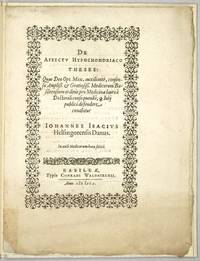
1601446031601. Basileae: Typis Conradi Waldkirchii 1601 Kl.4° 11 pp. Pappband. De ffectu hypochondriaco theses / Quas . pro Medicinae laurea Doctorali consequenda 9 Iulii publice defendere conabitur Iohannes Isacius Helsingorensis Danus Impressum Basileae : typis Conradi Waldkirchii 1601. Husner: Verzeichnis bas. med. Univ.Schriften Nr. 408 unknown
1653934129Amsterdami : Ex Officiana Elzeviriana 1653. Good. 1653. Hardcover. hardback 16mo xii33037 Indexpp engraved decorated title page owner's name on endpaper pages browning minor staining on fore-edges text otherwise clean and tight gilt-ruled full leather binding blindstamped pattern on spine gilt spine titles on coloured label spine rubbed Good condition . Amsterdami : Ex Officiana Elzeviriana 1653, hardcover
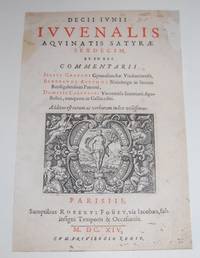
1614OB448<p>Paris Pariis Sumptibus Roberti Fouet 1614. In three parts each with special title-page and separate paging. This edition has what is probably the fullest and most elaborate apparatus of any edition of Juvenal. Bertrand Autumnus 1574-1666 and Isaac Le Grange were commentators contemporary with the publication; the commentary of Domizio Calderino 1447-1478 first appeared in 1474. These plus an index made this edition the most scholarly of its era. Hard Cover. Quarto: 16 531 8 273 48 2 8 290 pages; 24 cm. Bound by Dragonfly Bindery in full leather with elaborate gilt spine. The title-page was soiled and stained by the previous perished binding. stock#OB448.</p> Sumptibus Roberti Fouet hardcover
161415340Paris:: Robert Fouet 1614. 15 x 22cm. Single leaf. Title page only. Red and black print. Vignette woodcut at center. Some minor wear to edges trimmed few minor ink marks. Mounted at corners to larger plain white leaf. Suitable for framing. Robert Fouet, unknown
1697617201697. unknown
169780205Rotterdam: Reinier Leers 1697. Hardcover. Good. Two massive leather bound volumes with text in French. The leather to the front board of volume one is split board still attached. Each vol approx 10 x 15 x 2.75. Illustrated throughout. Age related toning and foxing. oversized and overweight. Please email for photos. Reinier Leers hardcover
169745644Leipzig Grosse & Gleditsch 1697. 4to. No wrappers. In: "Acta Eruditorum Anno MDCXCVII" No V May-issue. Pp. 193-240 entire issue offered. With titlepage to the volume 1697. Leibniz: pp. 201-205. Johann Bernoulli: pp. 206-211. Jacob Bernoulli: pp. 211-214. Newton: pp. 223-224. As usual some leaves with browning. <br/><br/><em>First appearance of the famous issue of Acta Eruditorum in which the 4 solutions by the 4 most eminent mathematicians at the time were printed together. There were in all 5 solutions to the posed problem and Newton's solution was first printed in the Philosophical Transactions January 1697 and reprinted here. The solution proposed by L'Hopital not printed here was not published until 1988.The brachistochrone problem was posed by Johann Bernoulli in Acta Eruditorum in June 1696. He introduced the problem as follows: "I Johann Bernoulli address the most brilliant mathematicians in the world. Nothing is more attractive to intelligent people than an honest challenging problem whose possible solution will bestow fame and remain as a lasting monument. Following the example set by Pascal Fermat etc. I hope to gain the gratitude of the whole scientific community by placing before the finest mathematicians of our time a problem which will test their methods and the strength of their intellect. If someone communicates to me the solution of the proposed problem I shall publicly declare him worthy of praise." Johann Bernoulli and Leibniz deliberately tempted Newton with this problem. It is not surprising given the dispute over the calculus that Johann Bernoulli had included these words in his challenge:- ."there are fewer who are likely to solve our excellent problems aye fewer even among the very mathematicians who boast that they. have wonderfully extended its bounds by means of the golden theorems which they thought were known to no one but which in fact had long previously been published by others."According to Newton's biographer Conduitt he solved the problem in an evening after returning home from the Royal Mint. Newton: . "in the midst of the hurry of the great recoinage did not come home till four in the afternoon from the Tower very much tired but did not sleep till he had solved it which was by four in the morning."Newton send his solution to his friend Charles Montague and Montague published anonymously in the Transactions. Newton's solution presented here in the Acta is also anonymous. The episode did not please Newton as he later wrote: "I do not love to be dunned pestered and teased by foreigners about mathematical things ." After the competition Johann Bernoulli said ". my elder brother made up the fourth of these after Leibniz himself and Newton that the three great nations Germany England and France each one of their own to unite with myself in such a beautiful search all finding the same truth."Struik Edt. "A Source Book in Mathematics 1200-1800 pp. 391 ff. </em> unknown
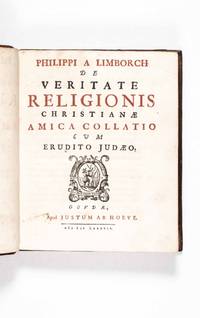
168748832Gouda: Justus van der Hoeve 1687. First edition. Hardcover. Fine. Three parts quarto. asterisk-2 asterisk4 A-3A4 3B = 197 leaves; K2 signed H2. 16 364 14 indexpp. Title in red and black printed marginalia woodcut tailpieces. Contemporary paneled calf expertly rebacked to style gilt lettering piece. Occasional touch of mild foxing else a fine crisp amply-margined copy. <br /> <br /> First edition of this remarkable collection modeled on a work of Hugo Grotius with the same title including the transcription of an epistolary debate between the Dutch theologian Phillip van Limborch 1633-1712 and the Jewish scholar Isaac Orobio de Castro ca.1617-1687. Jonathan Israel views the work as "a key exemplum of the new 'enlightened' method of upholding Christianity." Limborch was a leading Dutch theologian aligned with the Arminians and professor in the Seminary of the Remonstrants at Amsterdam. Orobio de Castro had been Professor of Theology at Salamanca who was imprisoned by the Inquisition on account of his sympathy with the Jews of Spain. He fled the country going first to France and then to Holland where he abjured Christianity and became deeply involved in the philosophico-religious controversies in the Low Countries. In the present work Limborch publishes three letters written by Orobio de Castro along with his own detailed responses. In arguing against the "truth" of the Christian religion "Orobio retorted that the advent of Christ has done nothing to render mankind less sinful or to lessen suffering that the rise of Christianity far from being unparalleled was surpassed by the expansion of Islam. and that far from being unchallengeable Christ's miracles had not been performed publicly like the miracle at Mount Sinai but virtually in secret a circumstance which renders them entirely dubious. These responses and his further claims that the New Testament is unreliable providing no basis for trust in Christ's miracles since the text exists only in Greek a language neither Jesus nor the Apostles had the slightest knowledge of. made no impact on Limborch Le Clerc or Locke who were convinced of their triumph over Orobio. Nevertheless Orobio's arguments were fully and objectively reported in the text and subsequently widely read across Europe and some of those who read it were not so sure that Orobio was 'vanquished'. Boulainvilliers who meticulously examined the text concluded that Limborch's arguments were less securely grounded on reason than he and his allies supposed and that even without their realizing it it was Orobio who won the contest a verdict echoed in other anti-Christian clandestine philosophical literature of the early eighteenth century" Israel.<br /> <br /> Edited from a manuscript formerly in the possession of the Leiden professor of theology Simon Episcopius and now in the University Library Amsterdam the Exemplar Humanae Vitae is the autobiography of the Portuguese Jew Uriel da Costa ca.1585-1640 who was excommunicated from the Sephardi Jewish community of Hamburg in 1618 after addressing a polemical broadside to the leaders of the Sephardi congregation of Venice in which he criticized rabbinic Judaism as incompatible with the Torah. He later settled in Amsterdam where he submitted to a public recantation of his views before the Portuguese Jewish congregation and committed suicide shortly thereafter. A radical freethinker who here makes an imposing plea against dogmatics da Costa may be viewed as a forerunner of Spinoza. An English translation was published at London in 1740; a complete edition of his few works was edited in 1922 by Carl Gebhardt Schriften des Uriel da Costa and published as the second volume of the Bibliotheca Spinozana. At the conclusion Limborch offers his refutation of da Costa's challenge to revealed religion. References: Bamberger no. 67. Fürst 1:17. De Graaf Cat. 70: Spiritualists Nonconformists & Dissenters no. 360. J. Israel Radical Enlightenment OUP 2001 esp. pp. 464-466. Oscott Catalogues: Recusant Books part 2 no. 2286; The Old Library part 2: Bible Collections no. 895. For Da Costa's Exemplar cf. Roth B18.30 citing the English version of 1740. The work was already scarce and much sought after in the early modern era as evidenced by: DeBure Theology no. 583: “ouvrage estime & recherche les exemplaires en sont peu communs†and Osmont Dictionnaire vol. 1 p.406: “rare et estimé.†In his 1694 catalogue of Christian Hebraic works Bibliotheca Latino-Hebraica Carlo Imbonati offers a surprisingly long discussion of De Veritate on pp. 201-209. Justus van der Hoeve hardcover
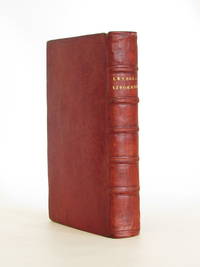
169162895à Paris: Chez Guillaume Desprez 1691. Fine. Chez Guillaume Desprez à Paris 1691 9.50 x 16 cm relié First edition. Ruled copy. Contemporary full burgundy morocco binding. Jansenist spine with raised bands. Gilt title. Gilt roll on edges and turn-ins. A dark stain at the top of the upper cover. A second large one on the lower cover. Foxing. Handsome copy. Before appearing in its entirety in 1696 under the secular title Bible de Port-Royal Pierre Thomas du Fossé gathered the various manuscripts left by Le Maistre de Sacy at his death in 1684 and edited them punctually. He continued the work left unfinished and published separately first the translations of the Vulgate by Le Maistre de Sacy. Each chapter is followed by its explanation and commentary. Before this considerable work on the part of the Port-Royal writers never had the Bible been so accessible to a wide public; this work which was inaugurated by the translation of the New Testament as early as 1666 by Antoine Arnaud and Le Maistre de Sacy. Chez Guillaume Desprez hardcover
167962894Chez Lambert Roulland 1679. Fine. Chez Lambert Roulland 1679 9.50 x 16 cm relié First edition. Printer's device on title page. A ruled copy. Contemporary full bordeaux morocco binding. Spine with raised bands in Jansenist style. Roulette on cuts and interior. Gilt edges. One scratched area on upper board a second area along the external border of the lower board. Dark stain at top of upper board. Tears on top edge or areas gnawed by worms. Foxing. Dampstain in upper margin on numerous leaves. Good copy. Before appearing in its entirety in 1696 under the secular name Bible de Port-Royal Pierre Thomas du Fossé gathered the various manuscripts left by Le Maistre de Sacy at his death in 1684 and published them punctually. He continued the work left unfinished and published separately first the translations of the Vulgate by Le Maistre de Sacy. Each chapter is followed by its explanation and commentary. Before this considerable work on the part of the writers of Port-Royal never had the Bible been so accessible to a wide public; this work which was inaugurated by the translation of the New Testament as early as 1666 by Antoine Arnaud and Le Maistre de Sacy. Chez Lambert Roulland hardcover
169362880à Paris: Chez Guillaume Desprez 1693. Fine. Chez Guillaume Desprez à Paris 1693 10 x 16 cm relié First bilingual edition translated and annotated by Le Maistre de Sacy. Ruled copy. Text in double columns. Contemporary full burgundy morocco binding. Jansenist spine with raised bands. Roll tooling on edges and board-edges. All edges gilt. Trace of dampstain in lower margin of first leaves fading away reappearing on some leaves in the middle and at the end. Before appearing in its entirety in 1696 under the secular title Bible de Port-Royal Pierre Thomas du Fossé gathered the various manuscripts left by Le Maistre de Sacy at his death in 1684 and published them punctually. He continued the unfinished work and published separately first the translations of the Vulgate by Le Maistre de Sacy. Each chapter is followed by its explanation and commentary. Before this considerable work by the writers of Port-Royal never had the Bible been so accessible to a wide public; this work which was inaugurated by the translation of the New Testament as early as 1666 by Antoine Arnaud and Le Maistre de Sacy. Chez Guillaume Desprez hardcover
169527143à Paris: Chez Guillaume Desprez 1695. Fine. Chez Guillaume Desprez à Paris 1695 9 x 16 cm relié First edition in 12mo published simultaneously with the 4to edition. Cioranescu. One title vignette and two headpieces. Contemporary full calf binding. Decorated spine with raised bands. Head worn. Lengthy preface on the nature and essence of the Eucharist. The poem consists of ten cantos in verse. Chez Guillaume Desprez hardcover
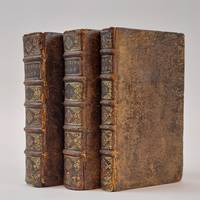
16701395975Amstelodami Amsterdam: Officina Johannis Janssonii à Waesbergen & Johannis van Someren Johannes Janssonius van Waesberge; Joannes van Someren 1670. Hardcover. Octavo three volumes. In Good minus condition. Bound in full brown leather. Spines have gilt ornamentation and lettering and loss of leather along the head/tail edges. Boards have cracking to the joint edges significant rubbing wear and chipping throughout and dents along the edges. Moderate bumping to corners in some cases exposing the boards. Volume 1 has archival repair to front and rear boards with later calf applied to roughly half of each board. Volumes 2 and 3 have archival repairs to the front tail fore corners with later calf applied to corners of boards. <br /> <br> <br /> All textblocks have ink inscriptions from a previous owner on the front pastedowns blue stamps on the title pages mild age toning and minor stains scattered throughout. All volumes contain non contemporary pastedowns presumably added during repairs. <br /> <br> <br /> Textblock of volume 1 has the front free end page engraved title page and typographical title page partially attached together with adhesive glue onto the front pastedown resulting in some obscured text; archival repairs on the fore edges of the front free end page including engraved title page to page 54 and from pages 685-908 not impacting text. Textblock of volume 2 contains engraved title page but backed with new tipped in page; has red ink stains on some pages throughout 1426-1816 impacting text and liquid damage to the fore edges of pages 1426-1816; archival repair to fore edges of pages 1806 1810 1812 and 1816. Text in Greek and Latin. Previously noted repairs appear to be early 19th century. 1395975. Special Collections - Downstairs. Officina Johannis Janssonii à Waesbergen & Johannis van Someren [Johannes Janssonius van Waesberge]; [Joannes van Someren] hardcover
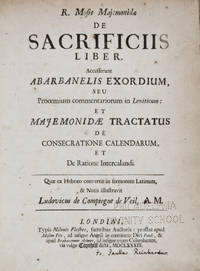
168314061London: Typis Milonis Flesher sumptibus auctoris prostat apud Mosem Pitt & apud Brabazonum Aylmer 1683. First edition. Hardcover. g. 8vo. 10 450pp. 3/4 Vellum over marbled boards with brown lettering and library plate to spine. Age wearing throughout binding.Some tears discoloration scuffing and rubbing to boards and spine. Some browning and foxing to pages not affecting the script. Welling to pages. Ex library. Library card pocket pasted to inside of front board. Perforation to title page: Philadelphia Divinity school. Inscribed by owner with pencil: "to Paullus Reinhardus." This first Latin translation contains texts from Moshe ben Maimon aka Rambam aka Maimonides 1135-1204 and Yitzchak ben Yehuda aka Abravanel Isaac Abrabanel1437-1508. In Latin with some writing in Hebrew. Cover in fair book in good condition. freely translated: Rabbi Moses Maimonides' volountary sacrifice: An approach to Abarbanel's introduction and commentary on Leviticus and Maimonides' Tractate on the consecrated calendar and the rational calendar change R. Moses Maimonides Rambam was a 12th century Jewish philosopher and halachic legal scholar. A highly controversial figure both during his lifetime and after his death but generally acknowledged as the preeminent Jewish thinker of the Middle Ages. He was born in Córdoba Spain but fled as a child from the Almohad persecution. He eventually settled in Egypt where he served as a rabbi physician and philosopher. His fourteen-volume Mishneh Torah his only work not in Arabic still carries canonical authority particularly within the Yemenite Jewish community as the codification of Talmudic law. His other work includes a commentary on the Mishnah entitled Kitab al-Siraj Kitab al-Fara'I a book on precepts and the philosophical work Dalalat al-Ha'irin known in Hebrew as the Moreh Nevukhim The Guide to the Perplexed. The major premise is an attempted philosophical/theological reconciliation of the Hebrew Bible and Greek knowledge. This work came to play a central role in all subsequent major controversies over philosophy within the Jewish community during the Middle Ages. Typis Milonis Flesher, sumptibus auctoris, prostat apud Mosem Pitt, & apud Brabazonum Aylmer hardcover
16401345600Lugduni Batavorum: Ex officina Elzeviriana 1640. Hardcover. 12mo; 12 310 36 50 pages; G; Bound in early full calf with gilt ornamentation to spine. Label now absent. Binding shows shelfwear rubbing and chipping with significant cracking to joints in spite of which binding remains stable. Marbled endpapers; ribbon bookmark sewn in. Text block edges tinted red. Scattered ink underlining and marginalia. Text block age-toned and slightly foxed. Ownership inscription reading "Langdon Lauriston Ward Paris July 29 1902" on front free endpaper. With engraved title page head- and tailpieces and initials. <p>This copy is from the second of two variants printed by the famous Elzevier brothers Bonaventura and Abraham in 1640. Their small editions of which this is an example have historically been regarded as particularly fine and collectible. <p>JR Consignment. 1345600. Special Collections - Upstairs. Ex officina Elzeviriana hardcover
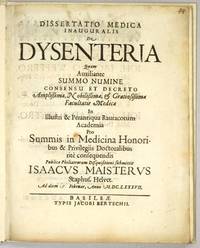
1687446111687. Basileae: Typis Jacobi Bertschii 1687 Kl.4° 20 pp. Pappband. Dissertatio medica inauguralis de dysenteria / quam . pro summis in medicina honoribus & privilegiis doctoralibus rite consequendis publicae . disquisitioni submittit Isaacus Maisterus Scaphus. Helvet. Ad diem . Februar Anno M.DC.LXXXVII. Husner: Verzeichnis bas. med. Univ.Schriften Nr. 1215 unknown
1646BB64100Frankfurt 1646. unknown. gebraucht gut mit geglätteter Mittelfalz Papier altersbedingt etwas fleckig sonst GUTES EXEMPLAR. 175 x 258 cm. Für Ihre Zufriedenheit versenden wir mit DHL und ausschließlich mit Trackingcode für eine sichere Sendungsverfolgung! Weitere Angebote unter antiquariat-kastanienhof unknown
168118283Cantabrigiæ: Ex Officina Joann. Hayes Sumptibus Henrici Dickinson 1681 1681. Second English edition; the first was published in 1672 also by Hayes. ESTC R9979; Wing V107; Honeyman Sale Catalogue 3029. Edges and hinges repaired; prelims a little foxed; a very good copy. 8vo contemporary panelled calf rebacked raised bands. Five folding plates. Title-page printed in red and black. The celebrated treatise on scientific and comparative geography by the German geographer Bernhardus Varenius 1622-1650 first published in Amsterdam in 1650. It became the standard textbook on the subject for a century. Isaac Newton edited and revised this edition for his students at Cambridge; it was Newton's first published work. Small bookplate of Johann Lawrence on the front paste-down. Cantabrigiæ: Ex Officina Joann. Hayes, Sumptibus Henrici Dickinson, 1681 unknown
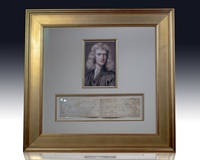
1698149618January 25 1698-1699. Rare vellum manuscript signed by Sir Isaac Newton as Warden of the Royal Mint in which he makes a case against his nemesis coin counterfeiter William Chaloner soon to be hanged for high treason. One page vellum manuscript document signed by Isaac Newton  “Is. Newton†January 25 1698-1699. Recognizance bond issued by Isaac Newton as Warden of the Royal Mint to ensure the future appearance of Nathaniel Peck as a witness against Newton’s nemesis the counterfeiter William Chaloner. The document reads in part "Nathanl Peck de Black Fryars London…Thos Worley de St Sepulchres London Glover…Symon Cross de east Aurifaber…Upon Condition the said Peck do personally appear at the next Genll Sessions of the peace …in St John str for the County aforesaid Then and there to answer…objected agt him touching his packing away Counterfeit money for advantage." Appointed as Warden of the Mint in 1696 upon the recommendation of Charles Montagu Chancellor of the Exchequer Isaac Newton ascended to the role of Master of the Mint the following year—a position he would retain for the remainder of his life. Prioritizing his duties at the Mint over his academic commitments he relinquished his responsibilities at Cambridge in 1701 to devote himself fully to the office. As Master Newton spearheaded significant currency reforms and pursued counterfeiters with unwavering diligence wielding the full force of the law as exemplified by the fate of William Chaloner. On the very day Newton signed this bond he received a formal statement from Nathaniel Peck who attested that seven years prior Chaloner had commissioned him to modify two iron pieces which were subsequently used to produce counterfeit French pistoles. Additionally Peck admitted to purchasing counterfeit pistoles from Chaloner at a rate of eight shillings per coin and reselling them for eleven shillings. Some months later Chaloner provided Peck with forged guineas which he likewise circulated before Chaloner turned to Thomas Holloway as his preferred distributor. By early 1699 Newton had compiled a formidable body of evidence against Chaloner consisting of 44 depositions. Chaloner had been apprehended in November 1698 on charges of forging lottery tickets though those specific allegations were ultimately dismissed. Nevertheless Newton proceeded to indict him on three separate counts securing a conviction for high treason on March 3 1699. Mere weeks later on March 22 Chaloner met his end at the gallows of Tyburn. In good condition fold at center scattered toning. Archivally mounted matted and framed with a portrait of Newton. The document measures 12.25 inches by 3 inches. The entire piece measures 23.5 inches by 23 inches. Signed documents by Newton are exceptionally rare. Isaac Newton 1643–1727 was an English mathematician physicist and astronomer widely regarded as one of the most influential scientists in history. His groundbreaking work Philosophiæ Naturalis Principia Mathematica 1687 laid the foundation for classical mechanics introducing the laws of motion and universal gravitation. However beyond his scientific achievements Newton played a crucial role in England’s financial and legal system. In 1696 he was appointed Warden of the Royal Mint largely due to the recommendation of Charles Montagu Chancellor of the Exchequer. A few years later in 1699 he became Master of the Mint a position he held until his death. Newton took his role seriously overseeing the recoinage of England’s currency implementing measures to stabilize the economy and aggressively pursuing counterfeiters. His meticulous investigations led to the conviction of notorious forgers like William Chaloner demonstrating his unwavering commitment to upholding the integrity of England’s monetary system. hardcover
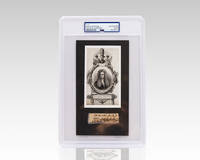
1700151722ca. 1700-1708. Autograph manuscript fragment on the Newton family lineage. England undated. A single leaf bearing autograph text in the hand of Sir Isaac Newton on both sides. 2.25 x 0.75 inches approx. 5.7 x 1.9 cm. Transcription recto: "Of the older family I am . whom I take to be my . of William Newton baptized 1541 whom ." Transcription verso: "for had by a . was next heir at law . infants and to that purpose . of her daughter with his ." A working genealogical note in Newton's hand evidently drawn from a longer document in which he traces a line of descent through one William Newton baptized 1541. The verso references questions of heirship and minor children suggesting the fragment formed part of Newton's private inquiry into the legal and lineal standing of the Newton family. Newton's documented genealogy situates him within the rural gentry of early modern England. He was born at Woolsthorpe Manor Lincolnshire to Isaac Newton a yeoman farmer who died before his son's birth and Hannah Ayscough daughter of a local clergyman. The paternal line can be traced to his grandfather Robert Newton also of Woolsthorpe indicating a family of modest landholding status. The maternal Ayscough line connected Newton to the educated clerical class a milieu that may have shaped his early intellectual formation. The present fragment though brief offers direct testimony of Newton's own engagement with the question of his ancestry and joins the small body of surviving manuscript material in which he records personal and familial concerns rather than scientific or theological matters. Condition: In good condition; minor wear consistent with age. The fragment has been archivally encapsulated by PSA/DNA together with a portrait of Newton and the corresponding authentication with the verso of the autograph remaining visible for examination. Authentication: PSA/DNA. Sir Isaac Newton 1642–1727 widely regarded as one of the most influential scientists in history established the foundational principles of classical mechanics in his Philosophiæ Naturalis Principia Mathematica wherein he articulated the three laws of motion and formulated the law of universal gravitation including the inverse-square relationship governing gravitational force. In addition to these achievements Newton independently developed the mathematical framework of calculus providing essential tools for the advancement of physics and mathematics. His extensive investigations into light and optics grounded in original experimentation significantly advanced contemporary understanding of the nature of light and color. Rejecting the long-standing authority of Aristotelian philosophy Newton instead championed an empirical experiment-based approach to scientific inquiry thereby helping to define the methodological foundations of modern science. unknown
1618270201Amsterdam: Joachimsthal 5616/1856. Hardcover . Good. 86158 pp. double pages s paper yellowing but not brittle Joachimsthal hardcover
1691V75117Leiden: Jordani Lugtmans & Joann du Justo Vultejo interprete. Pancratius Maasvicius recensuit Isaaci Casauboni nec non suas notas adjecitivie 1691. Hardcover. Very Good. copperplate engraved pictorial title woodcut printer's mark & a few decirated small initials. Octavo modern taupe boards with printed spine label lower corner very sl.bumped All edges rouge 12p=extra engr.title title dedication To reader etc 832pp 40pp=index In Ancient Greek & Latin parallel columns throughout. Work divided into 8 books. First four words of title translated from the Ancient Greek. Recent pages added after endpage and before frontispeice 3 on each side. Five page dedication at beginning mentioning the likley transcriber of this edition Pancratius Maasvicius. Maasvicius is also credited on titlepage alongside Vultejus and Casaubon. Vultejus transcribed the 1549 Basel edition of the work whilst Casaubon the 1589 Lyon version. Overall very clean and tight. A manual of strategy and war taken from the most ancient histories down to his own time. These are sources many of which have since been lost making this an important original source. Polyaenus drew on the Roman-Parthian Wars of the mid 2nd century AD dedicating the work to Marcus Aurelius and his co-emperor Lucius Verus who were engaged in the conflict. This is the 2nd edition of the Greco-Latin work the first published in Lyon in 1589. The first latin editon was published in Basel in 1549. "One of the rarer editions in the "Cum notis variorum" series" Ebert 17681. Jordani Lugtmans & Joann du Justo Vultejo interprete. Pancratius Maasvicius recensuit, Isaaci Casauboni, nec non suas, notas adj hardcover
16094708Full ruled contemporary vellum; red morocco label to spine. Gilt armorial 'Martis et artis honos' to boards. 60 1080 32 151 pages. Wear to fore edge of rear board. Dibdin p. 350: "A most excellent edition". Typis Wechelianis apud Claudium Marnium & haeredes Iohannis Aubrii hardcover