[Duche, Jacob]Biblio.com
493 résultats
179169544London: J. Deighton 1791. Third edition 8vo pp. xii 206 2; rebound in modern green buckram gilt title on spine; "Aldine collection" stamp on verso of title page pencil annotation in text and another in ink on penultimate leaf final two leaves with a couple holes not affecting text some light foxing; good largely on account of the unfortunate rebind. Duché was a Pennsylvania born preacher who turned from Revolutionary to Loyalist during the Revolutionary War after his arrest by the British. After the war he was effectively exiled to London where he remained until 1792. ESTC T98030. J. Deighton unknown
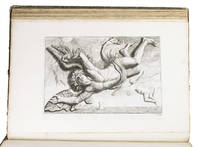
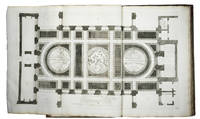
1719ABC_48483Amsterdam: David Mortier 1719. Contemporary quarter brown sheepskin sewn on 5 supports with the corresponding raised bands on the spine the title lettered in gold on the spine sprinkled paper sides red sprinkled edges. Royal folio. With a title-page in red and black with an engraved device a portrait of Erasmus in an elaborate cartouche with allegorical figures and 124 engraved architectural and sculptural illustrations on 109 numbered plates 6 double-page 103 full-page. First French edition of Van Campen's famous description of the Amsterdam City Hall the present day Royal Palace with more than a hundred plates of the architectural features and sculptures of the building including ground plans elevations and sections of the interior and exterior. Particularly impressive are the giant plates of the tympana which are more than 160 cm wide when fully unfolded. The work also includes the famous plate of the extraordinary cartographic mosaic floor of the Burgerzaal which shows the zodiac signs that were originally painted on the celestial map in the middle but are now no longer visible on the floor itself due to fading.The City Hall is the most famous and last major work by Jacob van Campen 1595-1657 the greatest Dutch architect of the 17th century. He began work on the design in 1640 and though the building opened in 1655 it was not actually completed until 1665. It was called "the eighth wonder of the world" at the time and is still considered the most important Dutch monument from the 17th century. It was designed to show off Amsterdam's wealth and magnificence. This is especially visible in the Burgerzaal the heart of the building which depicts Amsterdam as the centre of the world. The impressive mosaic floor with a celestial map in the centre and the two maps of both hemispheres of the world on either side symbolises that the world was at Amsterdam's feet. These maps are the largest ever made. They show Abel Tasman's then recent discoveries in Australia and Tasmania. Many discoveries from his second voyage remained otherwise unpublished until the end of the 17th century.The present work is the French edition of Van Campen's Afbeelding van 't stadt huys van Amsterdam 1664. The plates were drawn by Hubert Quiellinus 1619-1687 and Danckert Danckertsz. 1634-1666 and his father after drawings by Jacob Vennekool 17th century and were first published in Quiellinus' Prima et secunda pars praecipuarum . curiae Amstelrodamenis 1655-1663 and Afbeelding van 't stadt huys van Amsterdam in dartigh coopere plaaten . geteeckent door Jacob Vennekool 1661. As such most of the present engravings were published before the building was completed and may therefore reflect Van Campen's plan more closely than the finished building itself. The edges and corners of the boards are scuffed the spine has been rubbed with loss material old restoration at the head and foot of the spine. The text leaves are lightly browned the plates are very clean.l BAL 132; Berlin Kat. 2235; STCN 182312917 5 copies of which 1 incomplete; cf. Fowler 77 & 274 1661 Danckerts eds.; for the map see also: Schilder Australia Unveiled map 66; Shirley 423. David Mortier, hardcover
1780K6QE3E6Q77WKAmsterdam 1780. Large folio 49.5 x 30 cm. Johannes Covens Cornelis Mortier and Johannes Covens junior Contemporary half red roan sheepskin brown sprinkled paper sides. With the title page printed in red and black with J. Covens & C. Mortiers engraved device by Bernard Picart JCCM cypher monogram in a laurel wreath carried by 6 putti dated 1730; 2 preliminary plates containing portraits of Jacob van Campen by Lutma and Arthus Quellinus by Henricus Quellinus; CIX 109 numbered engraved and etched architectural plates 7 folding 30 double-page and 72 single-page a few printed from 2 or 3 copper plates distinguished by arabic numerals showing plans elevations tympana ceilings floors statues festoons and other ornamentation mostly engraved by Hubertus Quellinus after Arthus Quellinus but some after R.V.H. Rombout Verhulst. All plates have French captions some with laudatory verses below and are described in Dutch in the letterpress text pp. 3-15. 15 pp. A comprehensive collection of plates showing all architectural features and sculpture of the Amsterdam City Hall since 1808 the Royal Palace here in the Covens & Mortier firm's rare ca. 1780 issue with the engravings newly printed from the original copper plates from the years 1655 to 1664 and the text reissued from Leonardus Schenk's 1747 Dutch language edition the whole with a new title-page. ''This version has not been seen'' BAL. At least most of the plates were engraved for and first published in Jacob van Campen's masterpiece Afbeelding van 't stadt huys van Amsterdam Amsterdam Frederick de Wit 1664 Hubert Quiellinus's Prima et secunda pars praecipuarum . curiae Amstelrodamenis Amsterdam Frederick de Wit 1655-1663 and Afbeelding van 't stadt huys van Amsterdam in dartigh coopere plaaten . geteeckent door Jacob Vennekool Amsterdam Dancker Danckerts 1661.It includes the famous plate showing the extraordinary cartographic mosaic floor of the Burgerzaal of the Amsterdam City Hall designed by Jacob van Campen with a celestial map in the centre and the magnificent map of the world in 2 hemispheres on either side. The engraving was first published in 1661 and the map shows Tasman's recent discoveries in Australia and Tasmania and depicts California as an island. Many discoveries from his second voyage remained otherwise unpublished until the end of the 17th century. The drawing of the floor was made by Jacob Vennekool who worked closely with Van Campen and since his drawings were first published even before the building was completed they may reflect Van Campen's plan more closely than the finished building itself. They also of course show it before the alterations made at various times in later years.Binding a little worn untrimmed otherwise in good condition. The Amsterdam city hall in full glory with all its architectural features and sculpture.l BAL 132 note description of 1719 French language ed. but citing Berlin Kat. & Kuyper for unseen "1730" Dutch ed.; Berlin Kat. 2236; Kuyper Dutch Classicist architecture Delft 1980 pp. 212- 215 and note 25 p. 318; STCN 3 copies; cf. for dating the impressum: Van Egmond Covens & Mortier 2005 pp. 66 83-88. ABE CAT Architecture ABE CAT Art History unknown
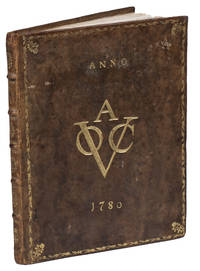
1780ABC_48891The Netherlands 1780. Late 18th-century gold-tooled brown mottled calf sewn on 5 supports bound by the so-called Acorn-and-Foliage Tool Bindery in Amsterdam Storm van Leeuwen. Both boards show the large gold-tooled monogram of the Amsterdam chamber of the VOC as a centre piece sandwiched between the gold-tooled date Anno 1780 all within a gold-tooled floral frame with floral corner pieces in the inside corners spine gold-tooled in six compartments red sprinkled edges. 4to ca. 19 x 15 cm. Manuscript in French written in black ink on paper in a neat cursive script by one hand. With chapter divisions numbered 39-75 and headings. The text is written upside down in relation to the binding. Most leaves show an identical watermark depicting a lion rampant on a pedestal with Vryheyt in a crowned ring with Pro Patria Eiusque Libertate and the letters CR below which is very close to Heawood 3149 date: 1753. Late 18th-century manuscript copy of a French childrens catechism by the Swiss theologian Jacob Vernet 1698-1789 bound in a remarkable late 18th-century binding originally produced for the Amsterdam Chamber of the Dutch East India Company VOC by the so-called Acorn-and-Foliage Tool Bindery which was active between ca. 1760 and ca. 1784 Storm van Leeuwen.It shows the large monogram of the Amsterdam Chamber of the VOC sandwiched between the date "Anno 1780" on both boards. These bindings were usually commissioned as gifts to persons important to the VOC often containing an almanac for the relevant year but possibly also produced as blank notebooks. The present work comprises chapters 39-49 and 58-75 of Vernet's work which form almost the second half of printed editions. The chapters included in the present work are complete and exactly follow the order of the printed text in the Geneva 1742 edition pp. 75-140 checked using a digital copy with a slightly different spelling and replacing some words. For unclear reasons chapters 50-57 dealing with the fourth through tenth commandment have not been copied and several leaves between the end of chapter 49 and the beginning of chapter 58 have been left blank.Vernets religious text was first published in 1741 under the title Instruction chrétienne ou catechisme familier; avec quelques prières a lusage des petits enfans . In 1742 a revised edition appeared with a slightly different title Instruction crhetienne ! ou catechisme familier. Avec quelques passages de lEcriture Sainte & quelques prières à lusage des petits enfans. Nouvelle edition. Revuë corrigée & augmentée. Both works were printed in Geneva for the Swiss bookseller Emanuel Du Villard Emmanuel Duvillard 1693-1776 and subsequently reprinted several more times until 1769. With the book block showing the remnants of 12 removed leaves probably already removed before the manuscript was finished. Both pastedowns partly detached an old annotation Ao. 44305 in black ink on the lower pastedown some foxing. Otherwise in good condition.l For the binding: Landwehr/Van der Krogt VOC pp. XXVII-XXVIII; Storm van Leeuwen I p. 175 p. 196 VOC A-stamp and pp. 612-616 the bindery; for Vernet's work: Google Books digital copy of the 1742 ed. title: Instruction crhetienne ! ou Catechisme familier; physical copy at the Biblioteca Universitaria di Torino; WorldCat 951908419 1 copy 1767 ed.; WorldCat 1040828976 1 copy 1769 ed. no author noted; for the watermark: Heawood 3149. hardcover
1773822371773. BAEGERT JACOB. Nachrichten von der Amerikanischen Halbinsel Californien. Mannheim: Churfurstl Hof-und Academie-Buchdruckerey 1773. 2nd issue. 12mo. 16 358pp. 2 engraved folding plates and 1 engraved folding map. Three-quarter tan morocco over contemporary paper-covered boards rebacked and recornered in period-style leather morocco spine label stamped in gilt. One leather tab in margin marking the folding map; stain marking where a tab once was at the folding plates. Very good or better. Howes B-29; Hill p. 12; Cowan p. 27; Sabin 4363; Bell B5; Streeter Sale 2442; Barrett 129; Wagner Spanish Southwest 157; Meadows Baja California 1; Graff 137; Pilling Proof Sheets 203. Second printing with some corrections after the first printing of the previous year of an early account of Lower California by the Jesuit Jacob Baegert. Baegert lived in Baja California from 1751 to 1768 and spent most of his time at the Mission of San Luis Gonzaga leaving after the expulsion of the Jesuits in 1767. He provides important details on the culture of the Native Americans of the region including the Pericues Guiacuras and Cochiemes. Wagner states that the German Jesuits were especially dissatisfied toward the end of the Jesuit regime in California and Baegert's bitterness is evident in his book: ".it was a land full of ferocious beasts and even more ferocious Indians the soil was poor the water undrinkable and there was no fuel to be had." The fine and important map was made by a fellow Jesuit Ferdinand Consak and is described by Streeter as "most helpful in giving the location of the many Jesuit missions in Lower California. It also shows the route along the west coast of Mexico followed by Baegert in going to California in 1751 and his route out in 1768 after the expulsion of the Jesuits." The two plates apparently not issued with all copies depict male and female Californian Native Americans. Rare. The National Union Catalogue locates only three copies of the second issue. unknown
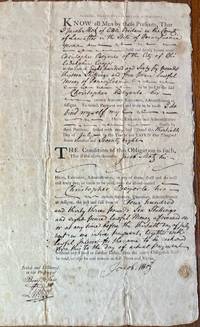
177836668Philadelphia: Printed by Styner and Cist in Second Street 1778. Document. Good. Biofolium paper. Approximately 13.5" x 8.5". Multiple folds. 4 pages. Part printed and part hand manuscript. Contents concern "payment in the Sum of Eight hundred and Sixty six pounds thirteen Shillings and four pence lawful Money of Pennsylvania to be paid Christo Begerle his certain Attorney Executors Administrators or Assigns" from a Jacob Metz. Signed at the bottom left corner by 3 witnesses. Page 2 is blank. Page 3 is more of the printed legal document with no hand writing. Small holes at the fold intersections. Page 4 is mostly blank with exception of hand written note "Jacob Metz's Bond L433 6.8 payl July 30th 1779"<br /> <br /> Styner spelled Steiner in online research and Cist were early German printers in Philadelphia. They formed a printing business in 1779 and dissolved it in 1781. They were responsible for printing the first issue of Philadelphisches Staatsregiste"r published July 21 1779. By then it may have been the only German language paper in America. After 1781 Steiner went on to publish Gemeinnützige. During the American Revolution they published many documents relating to current events including Paine's The American Crisis. After the firm dissolved in 1781 Cist continued in business alone.2 summarized from wikipedia. Printed by Styner and Cist, in Second Street unknown
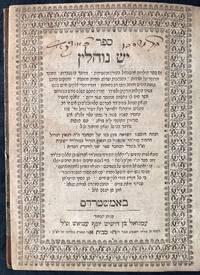
170143446Amsterdam: 'Imanu'el ben Yosef 'Atias 1701. 1st edition. Period Half Leather over Marbled Boards 8vo 2 46 leaves i.e. 4 92 pages 20 cm. In Hebrew.<br> By the father of the Holy Shela'h haKadosh.<br> <br> Ethical teachings and customs by the father of the holy Shelah with the will of his son Rabbi Shabtai Sheftel printed here for the first time<br> Sefer Yesh Nochalin a collection of ethical teachings conduct and laws by the Gaon and Kabbalist Rabbi Avraham HaLevi Horowitz father of the Ba'al Shelah HaKadosh with glosses and additions by his son Rabbi Yaakov Horowitz.<br> At the end of the book the will of Rabbi Shabtai Sheftel Horowitz son of the holy Shelah and grandson of the author was printed for the first time.<br> Rabbi Shabtai Sheftel HaLevi Segal Horowitz 1592-1660 son of Rabbi Yeshayahu HaLevi Horowitz is known for his book "Snei Luchot HaBrit." He was a rabbi and Rosh Yeshiva one of the greatest Ashkenazi Jewish scholars of his generation. He was a preacher in the Prague community and the rabbi of Fürth Frankfurt Poznan and Vienna. He edited his father's book "Snei Luchot HaBrit" and is known by the name of his own book "Vavei HaAmudim."<br> <br> SUBJECTS: Jewish ethics -- Early works to 1800. Morale juive -- Ouvrages avant 1800. Testaments moraux <br> OCLC: 9055147.Light rubbing to boards toning as expected a very attractive copy in original binding Very Good Condition. B Rab-67-15-KKXLB. Amsterdam: 'Imanu'el ben Yosef 'Atias unknown
1729072193Leipzig: Lankisch 1729. 1035 S. 34 Bl. Reg.; mit 1 Kapitelbordüre u. 2 Vignetten in Holzschnitt; es fehlen die Titelei u. der 'Vorbericht' insges. 4 Bl. Titelbl. u. Vorbericht in Kopie beiliegend Text und Register sind vollständig; lt. Vgl. mit dem Expl. der Universitätsbibliothek der Humboldt-Universität Berlin 6. Aufl. 1729; 2 S. mit altem Stempel 1 Doppels. mit Tintenspritzer 1 S. mit Randnotiz wenige Eselsohrspuren Papier sonst weit überwiegend allenfalls mäßig bis kaum fleckig; schöner neuer Handeinband in Halbleder auf 4 Bünden mit Lederecken u. handgemachtem Marmorpapierüberzug Rückentitel u. Zierlinien in Gold mit 4 blindgeprägten Rückenvignetten aus der Buchbinderwerkstatt Rönsberg Velbert-Langenberg. Halbleder. Gut. 202 cm. Handeinband. Lankisch Hardcover
1725227524Uppsala: Werner 1725. Collation π1 A-C8; Pp. i title-ii verso blank 1-48. 1 vols. 16mo. Stitched. Ink signature at foot of title minor paper flaw in top margin of first two leaves three manuscript corrections in text else fine. Collation π1 A-C8; Pp. i title-ii verso blank 1-48. 1 vols. 16mo. Early work on the Norse voyages to Greenland Vinland Helluland Skraelingaland and discussion of the textual record of the exploration of North America.<br /> <br /> Celsius the uncle of Anders of the temperaturs scale fame was an early mentor of Carl Linneaus. Howes W15; Sabin 100960; Alden 725/208 Werner unknown
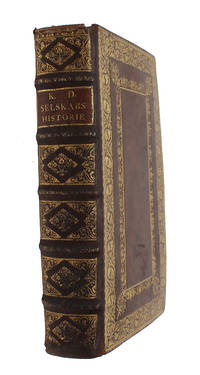
174860987Kiøbenhavn Copenhagen Georg Glasing 1748. 8vo. Bound in a very beautiful Cambridge-style mirror binding with richly gilt spines elaborate gilt borders to boards inner gilt dentelles and gilt ornamentation to edges of boards. All edges gilt. Light wear to extremities. Some of gilting to spine worn off. With a bit of loss of leather to head of spine showing headband. Internally very fine and clean - a magnificent copy printed on good paper. 16360 pp. <br/><br/><em>First edition of this work containing the history of "Det Kgl. Danske Selskab for Fædrelandets Historie og Sprog" i.e. â€Royal Danish Society for Fatherland History†its foundational history laws and constitution and a cataglogue of its library. The society is publishing “Danske Magazin†– the oldest existing Danish periodical. It is published irregularly but has been issued since January 1745. Biblioteca Danica II 973. </em> hardcover
1768250287New York: Hugh Gaine 1768. First. hardcover. poor. I. Of Actions and Remedies Writs Process Arrests.II. Of Courts Attornies and Solicitors therein Juries Witnesses Trials Executions.III. Of Estates and Property in Lands and Goods.IV. Of the Laws relating to Marriage Bastardy Infants.V. Of the Liberty of the Subject Magna Charta the Habeas Corpus Act.VI. Of the King and his Prerogatives.VII. Of publick Offences Treason Murder Felony Burglary Robbery.and their Punishment. All of them so plainly treated of that all Manner of Persons may be particularly acquainted with our Laws and Statues concerning Civil and Criminal Affairs and know how to defend Themselves and their Estates and Fortunes In all Cases whatsoever. 8vo original calf binding heavily worn; blank flyleaves laxing as well as the final pages of the Index .One signature sprung some pages dampstained contemporary name heavily inked on verso of title page. New-York: Hugh Gaine 1768. First American Edition.<br/> <br/> First law book for the layman printed in America. A poor well used copy of an important book printed by Hugh Gaines the official printer of the City of New York. Evans 10935. Ford The Journals of Hugh Gaine volume I p. 118.<br/> <br/> Hugh Gaine unknown
1768168968New York: Hugh Gaine 1768. First. hardcover. very good-. I. Of Actions and Remedies Writs Process Arrests.II. Of Courts Attornies and Solicitors therein Juries Witnesses Trials Executions.III. Of Estates and Property in Lands and Goods.IV. Of the Laws relating to Marriage Bastardy Infants.V. Of the Liberty of the Subject Magna Charta the Habeas Corpus Act.VI. Of the King and his Prerogatives.VII. Of publick Offences Treason Murder Felony Burglary Robbery.and their Punishment. All of them so plainly treated of that all Manner of Persons may be particularly acquainted with our Laws and Statues concerning Civil and Criminal Affairs and know how to defend Themselves and their Estates and Fortunes In all Cases whatsoever. iv 289 12pp. 12mo contemporary calf leather label; spines ends lightly worn covers lightly scuffed light foxing to some margins small light dampstain to several pages contemporary signature on title page and page one in margins. New-York: Hugh Gaine 1768. First American Edition.<br/> <br/> First law book for the layman printed in America. The author Jacob Giles was an English lawyer. This was his most popular work. It had been published in six London editions previously to this New York edition. Giles wrote several other legal works including in 1729 "A New Law Dictionary". In 1768 Hugh Gaine was appointed public printer to the Province of New York. Soon after he became the official printer of the City of New York. Evans 10935. Ford The Journals of Hugh Gaine volume I p. 118.<br/> <br/> Hugh Gaine unknown
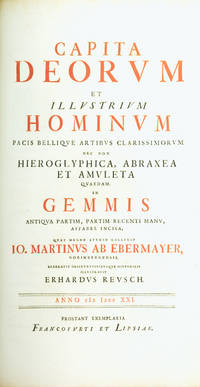
172040329Nuremburg: Aedibus Ebermayerianis 1720. First edition. With folding portrait and folding plate of Cabinet. 30 plates part I 1720; 7 plates part II 1722; 4 plates part III 1722; and 5 plates part IV 1722. 1 vols. Folio. Contemporary mottled sheep rebacked. Wear staining and some cracking to the bottom back board and bottom of spine internally a fine crisp copy. First edition. With folding portrait and folding plate of Cabinet. 30 plates part I 1720; 7 plates part II 1722; 4 plates part III 1722; and 5 plates part IV 1722. 1 vols. Folio. Ebermayer 1664-1743 was a Nuremberg banker whose very fine collection of gems featured many with portraits cut in relief of all the Luminaries of Ancient and Modern History. The last 4 parts are quite rare. According to Graesse the first is usually encountered with another collection of engraved gems by Erhard Reusch published in the same year. Graesse 1: 276; Ebert 6547 Aedibus Ebermayerianis unknown
1758003946Londres Paris; Cacopolis: Duchesne 1766 rt 1758. Due opere in un volume in 12mo. Piena pelle dell'epoca. 1-De la prédication qui in prima edizione è una delle opere più rare e ingiustamente meno conosciute dellabate C. fu anche erroneamente attribuita a Voltaire. In maniera un po confusa si critica lordinamento della società francese e si traccia lo schema di una società nella quale non esistono privilegi di casta ma tutte le cariche sono sottoposte alla ricompensa o al castigo e la giustizia non risparmia i nobili. 2- Prima ed. Il Catèchisme des Cacouacs è stato anche attribuito a Giry ma Conlon n°86 lo attribuisce senza esitazioni a Moreau: Critique générale de la pensée de Rousseau Duchesne unknown
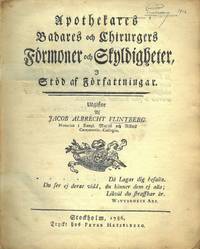
178659187Stockholm. 1786. 4to. Nyere enkelt skinnryggbind med marmorerte dekler. 8 102 1 1 blank. Tryckt hos Peter Hesselberg Svensk. <br/><br/><em>Lite navn på tittelbladet. Klipp i siste blad. </em> unknown
1728RW1451London:: John Senex 1728. 1728. 8vo. iv 187 1 pp. 4 folding plates decorative headpieces. Original gilt-stamped calf modern red leather gilt-stamped spine label raised bands; rubbed joints cracked upper spine mended. Ownership stamp of "P.G." Very good. RARE. First edition in English; first printed in Leiden in 1727 as Matheseos universalis elementa. "This work translated into Dutch 1728 and English 1752 sic is of didactic rather than original merit but it was significant for its invitation to mathematicians to elucidate systematically Newton's Universal Arithmetick which 'sGravesande exemplified by his own explanation of two passages from Newton's book. 'sGravesande found the lighthearted treatment of infinitesimals and the infinite in Bernard de Fontenelle's Elemens de la geometrie de l'infini Paris 1727 unacceptable and he maintained his objections in the Journal litteraire against Fontenelle's rejoinder 1730." – DSB V p. 510. REFERENCES: ESTC no.: T187811; not in Babson. John Senex, 1728. hardcover
172447969Amsterdam: Jan Morterre. Fair. 1724. Hardcover. Regular shelf wear; Heavy scuffing consistent with age; Bumping and chipping to edges and corners; Addiontal wear to edges of leather binding; Yellowing consistent with age; 673 pages . Jan Morterre hardcover
1723030380Lugduni Batavorum Apud Petrum Vander Aa 1723. 1st Edition 1st Printing. Hardcover. Very Good. Seventeen Folding Plates. Title Page 16 413 Pp 15 Pp Catalogus Librorum Followed By 17 Folding Plates At End Each With Many Figures. Full Vellum Early 18Th Century Blind Stamped Design At Center Of Covers Spine Stamped In Gilt. Hand Marbled Papers On Pastedowns All Edges Colored Red. Text Block 17.5 Cm Tall. Latin Exposition Of Newtonian Philosophy Addressed To Students. A Very Nice Example In Original Vellum Light Wear At Spine Ends A Few Tiny Holes In Bottom Spine Edge Of Rear Cover And In Gutter Edge At Bottom Of Plates 16 And 17 Not Affecting Text Or Illustrations. Red Color Of Edges Of Page Blocks Is Almost Entirely Unfaded And Still Shiny. No Marks Or Bookplates. Per Wikipedia Willem Jacob 'S Gravesande 1688 - 1742 Was A Dutch Lawyer And Natural Philosopher Chiefly Remembered For Developing Experimental Demonstrations Of The Laws Of Classical Mechanics. As Professor Of Mathematics Astronomy And Philosophy At Leiden University He Helped To Propagate Isaac Newton's Ideas In Continental Europe. In 1715 'S Gravesande Visited London As Part Of A Dutch Delegation Sent To Welcome The Hanoverian Succession In Great Britain. In London 'S Gravesande Met Both King George I And Isaac Newton And Was Elected A Fellow Of The Royal Society.In 1717 He Became Professor Of Mathematics And Astronomy In Leiden. From That Position He Was Instrumental In Introducing Newton's Work To The Netherlands. 'S Gravesande's Main Scientific Work Is Physices Elementa Mathematica Experimentis Confirmata Sive Introductio Ad Philosophiam Newtonianam "Mathematical Elements Of Natural Philosophy Confirmed By Experiments; Or An Introduction To Newtonian Philosophy" Published In Leiden In 1720. In That Book He Laid The Foundations For The Teaching Of Newtonian Mechanics Through Experimental Demonstrations. He Presented His Work Before Audiences That Included Voltaire And Albrecht Von Haller. The Book Was Soon Translated Into English By John Theophilus Desaguliers Curator Of Experiments For The Royal Society. In 1722 He Published The Results Of A Series Of Experiments In Which Brass Balls Were Dropped From Varying Heights Onto A Soft Clay Surface. He Found That A Ball With Twice The Speed Of Another Would Leave An Indentation Four Times As Deep From Which He Concluded That The Correct Expression For The "Live Force" Of A Body In Motion What Is Modernly Called Its "Kinetic Energy" Is Proportional To Its Mass And The Square Of Its Velocity. <br/> <br/> Lugduni Batavorum Apud Petrum Vander Aa hardcover