1 102 résultats
186042462Bruxelles: J. Gay. 1860. Limited Edition. Paperback. Near Fine. 16mo; 139 pages; Réimpression faite à Bruxelles par J. Gay 1860 avec une notice bibliographique de P. Lacroix. Catalogue de la bibliothèque de M. Emile Desmazières Reimpression faite a 200 exemplaires sur papier de Hollande. No. 63 of 200 Original plain blue-green wrappers in glassine jacket. Very Good This nicely produced reissue of this satirical exposition of the 'privileges' of cuckoldry takes the form of lengthy dialogue between Le Cocu and Le Jaloux. OCLC 1063428053 "THE BENEFITS AND PRIVILEGES OF CUCKOLDS Shewing the little Disgrace there is in being one and the Obligations Men sometimes have to their Wives for conferring that Honour upon them in what Manner soever it is done either as Prudes Coquettes Domines or Writing Desks. The whole beautifully illustrated with several late notable Intrigues that have been carried on in many Parts of the Beau-monde." The purported author: Eustache Le Noble 1643 – 1711 was a 17th-century French playwright and writer. An attorney General at the Parlement of Metz Le Noble led a dissipated life and after he had been condemned for having manufactured false acts he was jailed at the Conciergerie where he fell in love with Gabrielle Perreau la Belle Épicière who was also imprisoned. Having found a way to get away with her in order to make a living he published satirical dialogues about the time topics in which Bayle found "infinite wit and reading." The prose is clear incisive and frequently cut with verses which are not without merit. . (J. Gay) paperback
188042111s. l.: S. n. 1880. Fine. S. n. s. l. s. d. circa 1880 15.50 x 23 cm relié New edition printed on China paper in small numbers and established by the bibliophile Jacob of this play almost unknown to all theater historians. Bradel binding in half mouse-gray cloth with corners smooth spine decorated with a gilt floral motif double fillet at tail gray shagreen title-label marbled paper boards contemporary binding. S. n. hardcover
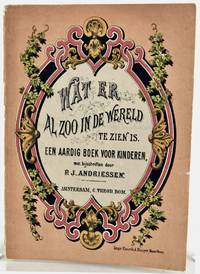
1874BB2328Amsterdam: G. Theod. Bom 1874. Pictorial Wrappers. Fine. Crown 8vo 180 x 128mm: 8pp with six color lithographs printed by Emrik & Binger Haarlem each with flaps that when flipped reveal a completely different image a ship at sea becomes Bedouins in the desert a volcano erupts into walruses in the Arctic Native Americans transform into explorers in the Rockies taking the viewer on a tour around the world. The accompanying text guides the reader through these twists and turns. Original burnt orange illustrated card wrappers printed in green gold and terracotta and lettered in black. A superbly preserved example of this fragile production all but pristine rare with Worldcat Discovery listing only one copy and LHD none. For more than 700 years book designers have been pushing back the boundaries of the two-dimensional page adding flaps and rotating parts to enhance the text most often in scientific literature. But only in the nineteenth century did movable flaps became a regular feature in children’s books. In the Netherlands ‘De nieuwe rijschool’ The new riding school published in 1856 was the first movable children’s book which reached their peak in the 1870s and 1880s. Gerardus Theodorus Bom 1814-1884 was a Dutch publisher of books in Amsterdam issuing such titles as Kindervreugd 1864 Robinson Crusoë c.1865 and Kunstenmakers at work 1875. Andriessen's first books were published under the pseudonym Pieter Jacobsz. Under his own name he wrote a series of romantic stories for young people mainly derived from Dutch national history. N. B. With few exceptions always identified we only stock books in exceptional condition carefully preserved in archival removable mylar sleeves. All orders are packaged with care and posted promptly. Satisfaction guaranteed. Fine Editions Ltd is a member of the Independent Online Booksellers Association and we subscribe to its codes of ethics. G. Theod. Bom unknown
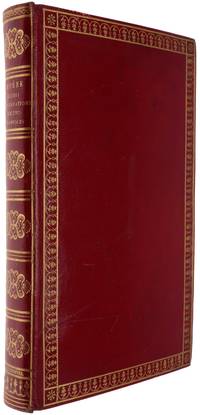
18234768Paris: Crochard 1823. <p>A beautiful copy bound in contemporary red morocco of the definitive version of this continually evolving collection of important memoirs on electrodynamics by Ampère 1775-1836 and others over the period 1820-1823 beginning with his 'Premier Mémoire' the "first great memoir on electrodynamics" DSB.</p>. DOCUMENTING THE BIRTH OF ELECTRODYNAMICS. <p>A beautiful copy bound in contemporary red morocco of the definitive version of this continually evolving collection of important memoirs on electrodynamics by Ampère 1775-1836 and others over the period 1820-1823 beginning with his 'Premier Mémoire' the "first great memoir on electrodynamics" DSB. "Ampère had originally intended the collection to contain all the articles published on his theory of electrodynamics since 1820 but as he prepared copy new articles on the subject continued to appear so that the fascicles which apparently began publication in 1821 were in a constant state of revision with at least five versions of the collection appearing between 1821 and 1823 under different titles" Norman. Some of the 25 pieces in the collection are published here for the first time others appeared earlier in journals such as Arago's Annales de Chimie et de Physique and the Journal de Physique. But even the articles that had appeared earlier are modified for the Receuil or have additional notes by Ampère to reflect his progress and changes in viewpoint in the intervening period. Many of the articles that are new to the present work concern Ampère's reaction to Faraday's first paper on electromagnetism 'On some new electro-magnetical motions and on the theory of magnetism' originally published in the 21 October 1821 issue of the Quarterly Journal of Science which records the first conversion of electrical into mechanical energy and contains the first enunciation of the notion of a line of force. Faraday's work on electromagnetic rotations would lead him to become the principal opponent of Ampère's mathematically formulated explanation of electromagnetism as a manifestation of currents of electrical fluids surrounding 'electrodynamic' molecules. The Receuil contains the first French translation of Faraday's paper followed by extended notes by Ampère and his brilliant student Félix Savary 1797-1841. Ampère's reaction to Faraday's criticisms are the subject of several of the articles in the second half of the Receuil. The collection also includes Ampère's important response to a letter from the Dutch physicist Albert van Beek 1787-1856 in which "Ampère argued eloquently for his model insisting that it could be used to explain not only magnetism but also chemical combination and elective affinity. In short it was to be considered the foundation of a new theory of matter. This was one of the reasons why Ampère's theory of electrodynamics was not immediately and universally accepted. To accept it meant to accept as well a theory of the ultimate structure of matter itself" DSB. The volume concludes with a résumé of a paper read by Savary to the Académie des Sciences on 3 February 1823 and a letter from Ampère to Faraday dated 18 April 1823 which does not appear in the Table of Contents showing that this definitive version of the Receuil was in fact published in 1823. Only three other copies of this work listed by ABPC/RBH. </p> <br /> <p>Provenance: Marcel Gompel 1883-1944 ex-libris on front paste-down - Répertoire général des ex-libris français: G1896. A Jewish professor at the Collège de France Gompel worked in the Laboratoire d'Histoire naturelle des corps organisés from 1922 to 1940 under the direction of André Mayer. In World War II he became a hero of the French resistance and was finally tortured and executed on orders from Klaus Barbie the chief of the Gestapo in Lyon. When Barbie came to trial the prosecutors used Gompel's case as a particularly clear and egregious example of his guilt of crimes against humanity. His superb library was stolen by the Nazis. </p> <br /> <p>The collection opens with the 'Premier Mémoire' 1 numbering as in the list of contents below first published in Arago's Annales at the end of 1820. This was Ampère's "first great memoir on electrodynamics" DSB representing his first response to the demonstration on 21 April 1820 by the Danish physicist Hans Christian Oersted 1777-1851 that electric currents create magnetic fields; this had been reported by François Arago 1786-1853 to an astonished Académie des Sciences on 4 September. In this memoir Ampère "demonstrated for the first time that two parallel conductors carrying currents traveling in the same direction attract each other; conversely if the currents are traveling in opposite directions they repel each other" Sparrow Milestones p. 33. </p> <br /> <p>The first quantitative expression for the force between current carrying conductors appeared in Ampère's less well-known 'Note sur les expériences électro-magnétiques' 2 which originally appeared in the Annales des Mines. Ampère stated without proof that if two infinitely small portions of electric current A and B with intensities g and h separated by a distance r set at angles α and β to AB and in directions which created with AB two planes at an angle γ with each other the action they exert on each other is </p> <br /> <p>gh sin α sin β sin γ k cos α cos β/r2</p> <br /> <p>where k is an unknown constant which he stated could 'conveniently' be taken to be zero. This last assumption was an error which significantly retarded his progress in the next two years before he stated correctly that k = − 1/2 in his article 13 published for the first time in the Receuil. This article comprised 'notes' on a lecture 12 delivered to the Institut in April 1822 in which he surveyed experimental work carried out by himself and others since 1821 he also published for the first time there the words 'electro-static' and 'electro-dynamic'. The full theoretical and experimental proof of the correct value of k appeared in two articles in Arago's Annales in 1822 19 and 20 in an article by Savary 22 and in experiments with de la Rive 17 see below. </p> <br /> <p>On 20 January 1821 Ampère performed an experiment together with César-Mansuète Despretz 1798-1863 intended to support his own theory of the interaction of electric currents against a rival theory of Jean-Baptiste Biot 1774-1862 and Félix Savart 1791-1841 presented to the Académie on 30 October 1820. This was reported in article 21 the first "experimentally based semi-axiomatic presentation of electrodynamics" Hofmann p. 316. A small cylindrical magnet was placed at the same distance from two perpendicular current carrying wires. The Biot-Savart theory predicted that the magnet would experience no net force; Ampère's theory predicted that the magnet would experience a non-zero torque from the nearby currents. But when Ampère and Despretz performed the experiment the magnet did not move p. 343. This defeat together with illness and fatigue caused Ampère to suspend his electrodynamical researches for several months. What little energy he could muster for electrodynamics was mainly devoted to correspondence.</p> <br /> <p>According to Ampère magnetic forces were the result of the motion of two electric fluids; permanent magnets contained these currents running in circles concentric to the axis of the magnet and in a plane perpendicular to this axis. By implication the earth also contained currents which gave rise to its magnetism. It was not long however before Auguste Fresnel 1788-1827 pointed out to his friend Ampère that his theory had several difficulties notably the fact that the supposed currents in magnets should have a heating effect which was not observed. Fresnel suggested that the electric currents circulated around each molecule rather than around the axis of the magnet. In January 1821 Ampère publicly accepted Fresnel's idea. </p> <br /> <p>Not everyone was convinced of the identity of electricity and magnetism however. Humphry Davy 1778-1829 expressed doubts in a letter to Ampère of 20 February 1821 7. Ampère's idea of magnetism created by circulating electric currents was also in direct opposition to a theory put forward by Johann Joseph von Prechtl 1778-1854 and supported by the great Swedish chemist Jöns Jacob Berzelius 1779-1848 according to which electromagnetism was 'transverse magnetism' - whereas Ampère eliminated magnetism and showed how all the phenomena could be accounted for by the action of two electric fluids Prechtl and Berzelius reduced electromagnetism to magnetic action. Berzelius expressed this view in his letter 3; Ampère responded in a letter to Arago 4. </p> <br /> <p>In April 1821 Ampère wrote to Paul Erman 1764-1851 professor of physics at the University of Berlin and perpetual secretary of Berlin's Royal Academy in response to Erman's Umrisse zu den physischen verhältnissen des von Herrn Professor Oersted entdeckten elektro-chemischen Magnetismus Berlin 1821. Ampère declared that his electric theory of magnetism was established "as solidly as a physical theory can be since in only admitting it at first as a hypothesis it serves to predict and make known in advance all the magnetic phenomena formerly known those which M. Oersted has discovered and the new properties whose existence in voltaic conductors I have made known. When one finds such an agreement between the facts and the hypothesis from which one started can one recognize it merely as a simple hypothesis Is it not on the contrary a truth founded on incontestable proofs" In the same letter Ampère calmly harvested Erman's experimental discoveries as further confirmatory evidence. "The observations described in the memoir which you have been so good as to send me are all the more new proofs of it. For if I am not mistaken they could all be predicted according to the theory in which magnets are considered to be assemblages of what I call electric currents" Hofmann pp. 277-8. Erman's experiments influenced Ampère's investigations of induction in July 1821 in which he very nearly anticipated Faraday's landmark discovery of electromagnetic induction a decade later see below.</p> <br /> <p>Ampère again stressed the 'identity' of electricity and magnetism in a lecture to the Académie on 2 April 1821 5. He also expressed his views on the nature of magnetism in a letter to Gaspard de la Rive 1770-1834 8. "Perhaps in an attempt to accommodate the positivistic inclinations of some of his Parisian colleagues or to avoid the adoption of hypotheses Ampère normally wrote on electricity and magnetism in a phenomenological vein eschewing noumenal questions. But there were exceptions: an example occurred in a letter of 15 May 1821 to the Swiss physicist Gaspard de la Rive which was published in the recipient's journal Bibliotheque universelle. Adopting the two-fluid theory of electricity then prevalent in France he spoke rather in passing of "the series of decompositions and of recompositions of the fluid formed by the reunion of the two electricities of which one regards electrical currents as composed" p. 122. Thus at this time Ampère's aetherian framework was based on electric current regarded as de- and recomposition of fluids and magnetism construed in terms of these currents rotating around each magnetic molecule" Grattan-Guinness p. 927.</p> <br /> <p>As far as Ampère was concerned "The physical theory of electrodynamics was now complete. Given the concepts of the ether and the electromotive force of matter as Ampère had formulated them all the observed effects could be explained; not only explained but subjected to mathematical analysis. The combination was a potent one and the accuracy of Ampère's calculations and the depths of his insight led many to embrace his theory. Ampère however was not satisfied with merely creating a model of electrodynamic action. By 1821 he was intoxicated by his vision and convinced that his electrodynamic molecules really existed. They must then also explain other areas of physics and chemistry.</p> <br /> <p>"In his 'Answer to the Letter of M. van Beck' i.e. van Beek 11 published in October 1821 Ampère turned his attention once again to the problem of chemical combination . What determined whether a reaction would take place and if so with what violence was the electrical condition of the participating molecules. To explain the mechanism of chemical combination Ampère had recourse to another analogy; molecules were not only like voltaic piles but also like Leyden jars. The facts of electrochemistry proved "that the particles of substances are essentially in two opposed electrical states." In order to preserve its electrical neutrality each molecule therefore decomposed the ambient ether to attract the electricity of the opposite sign. Ampère did not say if this was why each molecule was surrounded by electric currents but his use of the Leyden jar analogy would appear to rule out this possibility. The molecule presumably had both an inherent electrical charge and electric currents associated with it. It was the inherent static charge that caused chemical combination; the resultant combination of the two electricities gave rise to heat and light and both the material and energy relations of reactions could be understood in terms of the same mechanism . There can be no doubt that he took his own theory seriously as a general theory of matter. Nor was he alone in this. During the 1820's Becquerel in Paris and Auguste de la Rive 1801-73 in Geneva used the electrodynamic model in their researches in electrochemistry" Williams pp. 150-1.</p> <br /> <p>Late in 1821 however Ampère's satisfaction with his theory of magnetism was seriously challenged by Faraday's discovery of electromagnetic rotation a development which thrust Faraday immediately into the first rank of European scientists. "In the autumn he had to face a powerful criticism from Faraday whose paper 'On some new electro-magnetical motions' came out in a French translation 9 in Arago's Annales soon after its appearance in a London journal. A seminal paper in Faraday's contributions to the topic it announced that continuous rotation could occur if a pivoted cylindrical magnet moved around a fixed wire and also if a pivoted wire moved round a fixed magnet. In October he sent to Ampère and Jean-Nicolas-Pierre Hachette 1769-1834 one of his pieces of apparatus and Ampère demonstrated its working to the Académie in November.</p> <br /> <p>"From the theoretical point of view the chief challenge to Ampère's view was Faraday's conviction that such motions could not be explained by theories based on inter-molecular forces. Faraday's alternative drawn from this and other experiments was to give preference to curved 'lines of force'; but Ampère was anxious to preserve his own approach. Accordingly when the translation was prepared he had a set of appendicial notes 10 made by a new helper Félix Savary polytechnicien of the promotion of 1815 and thus one of Ampère's old students and in 1821 principally a geographer by profession. Ampère added his name to these notes to indicate his agreement with them. In his second note Savary rejected Faraday's implicit claim in the paper that the rotatory motion could be taken as a 'primitive fact' in electromagnetic phenomena and in the next note he showed how that motion could be explained in Ampère's terms" Grattan-Guinness p. 928.</p> <br /> <p>"In his original article describing the discovery of a continuous rotation of one extremity of a current-carrying wire around a magnet as well as the rotation of one extremity of a magnet around a current-carrying wire Faraday stated the following: "Having succeeded thus far I endeavoured to make a wire and a magnet revolve on their own axis by preventing the rotation in a circle round them but have not been able to get the slightest indications that such can be the case; nor does it on consideration appear probable." Ampère on the other hand considered that this new kind of motion might be produced in the laboratory. He was also the first to obtain it experimentally. He communicated his discovery to the Academy of Sciences of Paris in 7 January 1822 14. In order to obtain continuous rotation of a magnet around its axis Ampère initially floated it in mercury by the help of a counterweight in its lower extremity. By closing the circuit a constant current flowed vertically downwards through the upper extremity of the magnet leaving laterally along its lower portion and going through the mercury. When this constant current was flowing through the magnet it rotated around its axis relative to the ground" Assis & Chaib p. 123. Ampère wrote to Faraday in April 1823 describing these electromagnetic rotation experiments 24.</p> <br /> <p>In the letter to van Beek 11 described earlier Ampère described an experiment suggested by Fresnel to decide whether in a ring of copper macroscopic currents would be induced by a nearby coil or magnet. A first trial in July 1821 produced a negative result which fitted well into Ampère's theory of molecular currents. When he repeated the experiment with a more powerful magnet in August 1822 however he indeed obtained an effect and realized that this was the induction of currents by magnets. But as a consequence of his struggle with Faraday's rotations he concentrated on his magnetic theory. Although the positive result of the induction experiment again opened the way for both interpretations of magnetization it did not provide any positive hint concerning which of them should be preferred. Thus Ampère declared only that the result did not refer to his theory and decided not to pursue it further. A decade later when Faraday again discovered electromagnetic induction and gained great publicity Ampère bitterly complained about his former disregard of the result.</p> <br /> <p>Between 1821 and 1822 Gaspard de la Rive van Beek and Faraday performed some experiments showing that the poles of a cylindrical magnet are not located exactly at the extremities of the magnet as was predicted by Ampère's theory. These experiments forced Ampère to modify his conception of microscopic currents. In a letter addressed to Gaspard de la Rive dated 12 June 1822 15 Ampère included a figure which presents the equilibrium configuration of the microscopic currents around the particles of the magnet due to the interaction of all microscopic currents. That is due to the collective interactions between the small current-carrying loops the planes of these molecular currents should no longer remain orthogonal to its magnetic axis . This final conception of molecular currents presented by Ampère with their planes inclined relative to the axis of an uniformly magnetized bar is accepted in its essence up to the present time" Assis & Chaib p. 105.</p> <br /> <p>As described earlier Ampère had concluded in his article 13 that the constant k in his law for the force between current carting wires should be equal to −1/2. This implied however that two collinear and parallel current elements should repel one another when both currents flowed in the same direction towards the same point in space. Sceptical about this prediction he performed with Auguste de la Rive in September 1822 in Geneva an experiment to test it reported in 17 pp. 284-5 . This experiment has received several names in the literature: "Ampère's floating wire experiment" "Ampère's hairpin experiment" and "Ampère's bridge experiment." Ampère himself gave a very clear description: "Two very interesting electro-magnetic experiments have lately been made by M. Ampère in the laboratory of M. de la Rive at Geneva. M. Ampère had been induced from his mathematical investigations to expect a repulsion between two portions of an electrical current passing in the same direction and in the same right line or that every part of an electrical current would repel the other parts a result which may be comprehended by conceiving an endeavour in the current to elongate itself. The experiment which M. Ampère has contrived to illustrate this action of the current consisted of dividing a dish into two parts by a division across the middle and filling each division with mercury a piece of wire was then bent into the form of the letter U but the curved part was bent to one side so that the two limbs of the wire might lie on the mercury one on each cell and the bent part pass over the division without touching it. The wire was covered with silk except a small portion at each extremity by which the communication was established with the mercury" Assis & Chaib p. 145. "Ampere and Auguste de La Rive reported that as soon as a current was sent through the circuit and regardless of the direction of this current the originally stationary floating wire was propelled across the mercury pool away from the terminals connected to the power source. Ampere immediately attributed this phenomenon to repulsive forces between collinear pairs of current elements that is pairs in which one member is an element of the current in the mercury flowing between the bare end of the wire and the adjacent terminal and the other is an element of one of the linear segments of the wire. Interpreted in these terms the experiment represented a striking confirmation of the prediction Ampère had made to the Académie three months earlier. The importance Ampère ascribed to this demonstration was promptly reflected in the way he publicized it. For example in sharp contrast to his ambiguous and incomplete descriptions of induction the text he composed for his verbal report to the Académie includes a thorough and accurate account of the floating-wire demonstration" Hofmann pp. 317-8.</p> <br /> <p>In his article 22 Savary provided further support for Ampère's conclusion that k = −1/2 by analyzing an experiment carried out in 1820 by the chemists Joseph Louis Gay-Lussac 1778-1850 and Jean-Joseph Welter 1763-1852. "Initially they utilized an unmagnetized steel ring which did not interact with a compass needle. If this ring was broken into pieces its pieces also had no influence upon the magnetized needle. They then coiled a toroidal helix around this ring and a constant current flowed through it. The current was then turned off and the helix was removed out of the ring. The ring did not interact with a compass needle placed nearby. However when the ring was broken into pieces each piece did now interact with the magnetized needle. Each piece behaved now as a small magnet. That is each small piece of the ring was magnetically polarized with a North and a South pole so that it became magnetized" Assis & Chaib p. 149. Savary showed that the results of this experiment were possible only if k = 1 or −1/2 and as previous experiments by Ampère had shown that k could not be positive he could conclude that k = −1/2. "Savary's contribution was well publicized by Ampère. He wrote several complimentary reviews for influential journals and wrote to la Rive that Savary's presentation of his work to the Académie marked "a kind of epoch in the history of dynamic electricity" Hofmann p. 321.</p> <br /> <p>List of Contents author is Ampère unless otherwise stated:</p> <br /> <br /> Premier Mémoire. De 1'Action exercée sur un courant électrique par un autre courant le globe terrestre ou un aimant pp. 3-68<br /> AMPÈRE & Gillet de LAUMONT Additions au mémoire précédent - note sur les expériences électro-magnétiques de MM. Oersted Ampère Arago et Biot pp. 69-92<br /> BERZELIUS Lettre à M. Berthollet sur l'État magnétique des corps qui transmettent un courant d'électricite pp. 93-99<br /> <br /> <br /> Lettre de M. Ampère à M. Arago pp. 99-108<br /> Notice sur les Experiences électro-magnétiques de MM. Ampère et Arago lue à la séance publique de l'Académie royale des Sciences de Paris le 2 avril 1821 pp. 109-112<br /> Lettre de M. Ampère à M. Erman secrétaire de 1'Académie Royale de Berlin pp. 113-120<br /> DAVY Extrait d'une Lettre de Sir H. Davy à Mr. Ampère pp. 120-121<br /> Extrait d'une Lettre de Mr. Ampère au Prof. De La Rive pp. 121-124<br /> FARADAY Mémoire sur les mouvemens électro-magnétiques et la théorie du magnétisme pp. 125-158<br /> AMPÈRE & SAVARY Notes relatives au Mémoire de M. Faraday pp. 158-167<br /> Réponse de M. Ampère à la Lettre de M. Van Beck sic sur une nouvelle Expérience électro-magnétique pp. 169-198<br /> Exposé sommaire des nouvelles Expériences électro-magnétiques faites par différens Physiciens depuis le mois de mars 1821 lu dans la séance publique de l'Académie royale des Sciences le 8 avril 1822 pp. 199-206<br /> Notes sur cet exposé des nouvelles Expériences relatives aux Phénomènes produits par 1'action électrodynamique faites depuis le mois de mars 1821 pp. 207-236<br /> Expériences relatives aux nouveaux phénomènes électro-dynamiques que j'ai obtenus au mois de decembre 1821 pp. 237-250<br /> Extrait d'une Lettre de M. Ampère au Prof. De La Rive sur des expériences électro-magnétiques 22 June 1822 pp. 252-258<br /> De l'Action qu'exerce la Terre sur les conducteurs voltaïques pp. 259-261<br /> De la RIVE Mémoire sur l'Action qu'exerce le globe terrestre sur une portion mobile du circuit voltaïque pp. 262-286<br /> Remarks on the preceding memoir pp. 286-292<br /> Second Mémoire. Sur la Détermination de la formule que représente 1'action mutuelle de deux portions infiniment petites de conducteurs voltaïques pp. 293-318<br /> Additions au Mémoire précédent. Extrait d'un Mémoire présenté à l'Académie royale des Sciences dans la séance du 16 septembre 1822 pp. 319-324<br /> Exposé méthodique des phénomènes électrodynamiques et des lois de ces phénomènes pp. 325-344<br /> SAVARY Extrait fait par M. Savary du Mémoire qu'il a lu à l'Académie royale des Sciences le 3 fevrier 1823 pp. 345-354<br /> Observations additionelle pp. 354-364<br /> Extrait d'une Lettre de M. Ampère à M. Faraday Paris 18 avril 1823 pp. 365-378<br /> <br /> <p>Table pp. '357-360' errata on p. '360'</p> <br /> <p>Errata p. 383.</p> <br /> <p>The bibliographical complexity of this work is a direct result of Ampère's modus operandi: "His work was marked by flashes of insight and it often happened that he would publish a paper in a journal one week only to find the next week that he had thought of several new ideas that he felt ought to be incorporated into the paper. Since he could not change the original he would add the revisions to the separately published reprints of the paper and even modify the revised versions later if he felt it necessary" Norman. Our version of the Receuil is more extensive than the most complete copy owned by Norman and is probably that alluded to in the note to item 45 in the Norman catalogue: "Another probably later version has been noted with additional pages 361-378 plus an additional page of errata p. 383 and ten instead of nine plates." This copy additionally has pp. 223-236 which are missing from the Norman copy and to which the additional plate refers.</p> <br /> <p>Ekelof 819; Norman 44-45 less complete issues; Ronalds 10; Wheeler Gift 784 copy with 344 pages only - "The author's classical investigations in electro-dynamics together with experimental illustrations. Also a paper by De la Rive on the action of the earth on a movable circuit carrying a current". Assis & Chaib Ampère's Electrodynamics 2015. Grattan-Guinness Convolutions in French Mathematics 1800-1840 1990. Hofmann André-Marie Ampère 1995. Williams Michael Faraday 1965.</p> <br/> <br/> 8vo 204 x 126 mm pp. ii 1-3 4-167 1 blank 169-250 252-258 1 blank 259-378 1 358-360 383 with 10 folding engraved plates plates 1-5 signed by Adam after Girard one small text woodcut. Contemporary red morocco gilt by Lefebvre flat spine richly decorated and lettered in gilt borders of covers gilt-tooled within double rules inner gilt dentelles all edges gilt. A very fine copy. Crochard unknown
18025015CB1802. Schaffhausen o. Dr. 1802. Kl.-8°. 32 S. Steife Original Broschur. Vgl. HBLS I S. 301. Kleine Schrift von Johann Jakob Altorfer 1754-1829 Diakon Professor der Theologie Kirchen- und Schulrat. Mit eh. Gedicht des Verfassers auf Vorsatz gewidmet "Seiner bisherigen Schülerin im Religionsunterricht Anna Elisabeth Habicht zum Andenken . 1808". unknown
186045345Orléans: Imprimerie de Georges Jacob 1860. Fine. Imprimerie de Georges Jacob Orléans 1860 12.50 x 20.50 cm relié The first edition printed in a small number of copies on laid paper. Half tan sheep binding spine with five raised bands set with gilt fillets traces of rubbing to spine olive morocco title-label marbled paper boards a pale dampstain to head margin of front board marbled endpapers and pastedowns an angular stain to foot of rear endpapers contemporary binding. Some minor foxing of no consequence. A rare and handsome copy. Imprimerie de Georges Jacob hardcover
189091881890. Aus dem Laboratorium des Prof. Nencki in Bern. - Virchow's Archiv für pathologische Anatomie u. klinischer Medizin 120.Bd. 1890. - Berlin 1890 kl.8° pp. 204 -217 orig. Broschur; Umschlag etas beschädigt. John Jacob Abel 1857-1938. "The character of Abel's work played a significant and distinct influence in the reshaping of his discipline. .He completed his first essentially biochemical studies in Berne Nencki's laboratory 1889-1890 one on the composition of melanin and another on the determination of the molecular weights of cholic acid cholesterol and hydrobilirubin". DSB I/9ff. C.F.Rosenberg unknown
1898524271898. Johns Hopk. Hosp. Bull. 90-91. - 1898 8° 9 1 pp. orig. wrappers. First Edition! John J. Abel reports from the Pharmacological Laboratory of the John Hopkins University. unknown
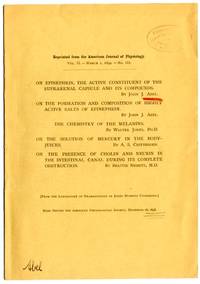
1898404501898. Am. J. Physiol. 2/11. - December 28 1898 8° pp.III-VIII orig. wrappers. First Edition! John Jacob Abel 1857-1938 reports from the Laboratory of Pharmacology in John Hopkis University. "He published his first article on the substance he had isolated in 1897 with A.C. Crawford and in 1899 he christened this blood-pressure-raising harmone 'epinephrine'. The substance he described however was not the free harmone but a monobenzoyl derivate. This work was the first to give Abel international prominece." DSB I/9ff. Further we find in this rare offprint of the American Journal iof Physiology Walter Jones "The Chemistry of the Melanins p.VI; A.S.Chittenden "On the solution of mercury in the body juices pp.VI-VII and Beattie Nesbitt "On the presence of cholin and neuron in the intestinal canal during its complete obstruction p.VIII. unknown
1898404401898. Hoppe-Seyler's Zschr. 28. - Strassburg Verlag von Karl J. Trübner 1898 8° 4 2 615 2 pp 4 Abbildungen 2 lith Tafeln; Halbleinenband d. Zt. St. a. Tit. First Edition! John Jacob Abel 1857-1938 "published his first article on the substance he had isolated in 1897with A.C. Crawford and in 1899 he christened this blood-pressure-raising hormone "epinephrine" The substance he described however was not the free hormone but a monobenzoyl derivative. This work was the first to give Abel international prominence although in 1900 Jokichi Takamine was able to isolate the hormone without the benzoyl radical. Both assumed of course that they were dealing with a unitary substance. In the years after 1905 Abel completed less elaborate studies of the physiological effects of alcoholic beverages isolated epinephrine from the parotid secretions of the South American roat Bufo agua studied the poisons of the mushroom Amanita phalloides-and even published on the pharmacology of several new cherno-action of phthalein derivatives led to the elaboration of a test for kidney function." Complete Dictionary of Scientific Biography Garrison & Morton Nr.1145 unknown
1839000011133London: James S. Hodson 1839. First edition. Hardcover. Very Good. 12mo. 7 2-173 3 pages of publisher's advertisements pp. Green publisher's cloth with gold lettering on the front board spine in four compartments. Later endpapers and pastedowns. Illustrated with five full-page illustrations. Corners gently exposed binding has a lean. James S. Hodson hardcover
1848005721New York: Harper & Brothers 1848. illustrated with 6 fine engravingsxi 331 pp. cat.little edge worn. Spine worn. Light foxing. First Edition. Cloth. Very Good/No Jacket. 12mo - over 6¾" - 7¾" tall. Harper & Brothers hardcover
1850009374New York: Harper & Brothers 1850 Presumed first edition 1850. Red buckram gilt titles 224 pp. Antique ex-library with hand-numbered and hand-dated bookplate. Frontispiece and engraved title plus 8 additional engravings. 224 pp. Small library stamps at corner of each engraving no pocket. Solid copy in very good condition. Harper & Brothers hardcover
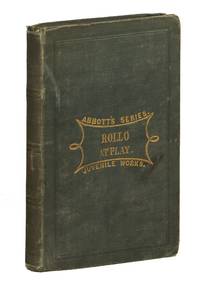
1860RS596New York and Boston: Sheldon and Co./Gould and Lincoln 1860. Book. Very Good. Hardcover. 1st Edition. 12mo - over 6¾" - 7¾" tall. First three 3 volumes of an 8-volume set uniformly bound in mauve textured cloth spine panels lettered in gilt. All 3 volumes show relatively uniform wear with rubbing and shallow loss to spine extremities several corners mildly rubbed. Spine panels somewhat tanned as are text block edges. Firm bindings clean interiors. Former owner's address inscription inked on blank frontis. recto in each volume otherwise unmarked. xiv15-288 xii13-288 xiv15-286 pp. Sheldon and Co./Gould and Lincoln Hardcover
18791515Farmington ME 1879. Fine. 8" x 5" 4 pp. in Abbot's small and precise handwriting two mail folds includes envelope addresed to Oliver Johnson Orange NJ. Content: Abbott sends a long and sympathetic letter to the Johnson family expressing his concern and encouragement for their current life situation. "What an unspeakable degree of comfort and strength we derive from the consciousness that we are all in every time of anxiety and trouble always under the watchful care of a superior providence."<br /> <br /> Jacob Abbott Nov 1803 - Oct 1879 was a prolific author writing juvenile fiction brief histories biographies religious books for the general reader and a few works in popular science. He wrote 180 books and was a coauthor or editor of 31 more. Abbott began his career after a degree from Bowdin as a professor at Amherst. Soon he and his brothers founded a church and he became a pastor then he founded several schools. unknown
1857008321New York: Harper 1857. Spine ends and cover corners slightly worn; covers lightly rubbed and soiled; half-inch tear in frontispiece; light foxing and occasional small spots and stains.Collation: On front flyleaf: "Willie A. Miles/Salisbury/Ct.'From hu./Aunt Annie.". First Edition. Original Red Cloth. Good. Harper Hardcover
184369193New York: William Holdredge 1843. 12mo pp. 3-324; inserted engraved frontispiece and chromolithograph title page 16 wood-engraved plates on pink paper; original red cloth elaborately stamped in gilt on both covers and spine a.e.g.; light wear and foxing but otherwise a very good sound copy. First published in 1835 it is republished here in its entirety with two added chapters on the Opium Wars. Jacob Abbott 1803-1879 was an educator and a prolific writer of children's book "writing juvenile fiction brief histories biographies religious books for the general reader and a few works in popular science. He wrote 180 books and was a coauthor or editor of 31 more" Wikipedia. Among his best-known books are his Rollo series. Not in Lust. William Holdredge unknown
185056772Auburn NY: Derby and Miller. Very Good. 1850. Hardcover. Original cloth stamped in gilt and blind spine gilt vignette. Small format. Frontis and illustrations. Mild foxing small stain to gutter at title page. Points gently bumped. First published in 1842. ; 16mo 6" - 7" tall; 180 pages . Derby and Miller hardcover
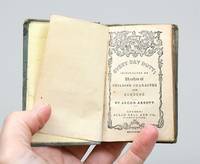
1837146322London: Allan Bell and Co. 1837. Second edition first published in 1836. Jacob Abbott 1803-1893 was a prolific American writer of children's books; "Abbott achieved great popularity with works that were intended to instruct children with empathy and without condescension in both morality and everyday living" ANB. Miniature sextodecimo 82 x 52 mm. Original green cloth spine lettered and tooled in gilt yellow coated endpapers. Minor wear to spine slight splitting to inner hinges but remains strong small mark to front cover internally clean. A very good copy indeed. hardcover
186523440New York: Sheldon & Company 1865. Hard Cover. Good/No Jacket. Gilbert John. Sheldon & Company1865. Hard Cover. Scarce. No dust jacket. Elaborately embossed brown covers have moderate shelfwear corners and spine ends softened. Writing and remains of label water stain and foxing inside front cover. Toned pages have mild foxing and water stains at bottom corner. Binding is tight. Hinges are perfect. Good reading copy. Sheldon & Company hardcover
1854mon0000032578Harper & Brothers ca. 1854-1860 1854. Hardcover. Acceptable. in x in x in. 1854 brown hardcover with wonderful engravings throughout. Complete but first couple pgs separated from spine. Has soiling throughout and cover wear. No dj. Harper & Brothers ca. 1854-1860 hardcover
1857145903Good; Worn and chipped on edges. 1857. Hardback. Vol. 8; 160 pages . hardcover
1856145902Good; Wear on edges. 1856. Hardback. Vol. 7; 160 pages . hardcover
1856001349NY: Harper. Very Good book. Early rebind in half dark brown morocco. 1856. Hardcover. VG book. Identically marbled boards & eps. 4 raised spine ribs. Title in gilt on 2nd spine panel. Bright & clean & tight. . The book is subdivided into three different books. "THE ENGINEER or How To Travel in the Woods" "RAMBLES AMONG THE ALPS" with an 1854 cp date & "THE THREE GOLD DOLLARS". Each with an engraved tp table of contents and from 15-20 engraving some full page. Very nice inside clean & bright mild aging but no other type of stain. "RAMBLES" contains sections on Mt Blanc Chamouny glaciers. . Harper hardcover
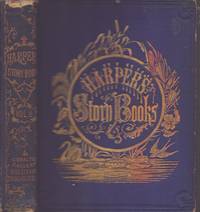
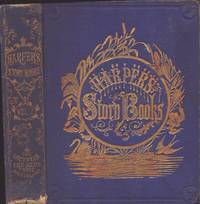
1854188274New York Harper & brothers 1854 1854. First Edition. Hardback. Good copy in the original gilt-blocked gilt-decorated cloth. Spine bands and panel edges somewhat worn and rubbed as with age. Blind tooling to panels with some staining to back panel. Corners sharp with an overall tight bright and clean impression. Minor library marks remain internally. ; 8vo 8"" - 9"" tall; 160 pages; Description: xii 13-160 p. Incl. Front. illus. engr. ; 18 x 14 cm. Subjects: Juvenile literature -- 19th century. Series: Harper's story books. ""Harper's story books: a series of narratives dialogues biographies and tales for the instruction and entertainment of the young by Jacob Abbott embellished with numerous and beautiful engravings"" --Added series title page. New York, Harper & brothers [1854] hardcover