OTTO Jacob AugustusBiblio.com
1 102 résultats
184851617R Cocks & Co. 1848. 8vo. First Edition thus with 2 folding plates small neat contemporary signature on front free endpaper; original printed boards terracotta endpapers uncut backstrip mildly worn but binding entirely sound a remarkably crisp clean copy IN WHOLLY UNRESTORED PERIOD BINDING. VERY SCARCE ESPECIALLY IN THIS CONDITION. R Cocks & Co., hardcover
1842013836Basle Basel: Hasler 1842. Book. Good Plus. Not Bound. First Edition. Folio. Loose in "folder". Original green paper cover printed in black to the front the contents loosely inserted consisting of 24 pages of letterpress text in French 1 folding plan and 18 fine lithographic plates. Condition is generally very good witha little wear and light creasing to the covers the plates are very good too with some foxing to some mostly confined to the edges the plate of the cloisters has a stain to the left-hand margin but does not nearly affect the image. A good plus set of this scarce work. Hasler unknown
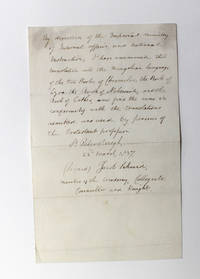
1837023537UK 1837. First Edition . Paper. Very Good. 12mo - over 6¾ - 7¾" tall. An Original Signed Endorsment by Issac Jacob Schmid. Letter dated 1837. A signed endorsement by Schmid with regards to the translation of a two books into the Mongolian language. Isaac Jacob Schmidt 1779 - 1847 was an Orientalist specializing in Mongolian and Tibetan. Schmidt was a Moravian missionary to the Kalmyks and devoted much of his labours to Bible translation.Born in Amsterdam he spent much of his career in St. Petersburg as a member of the Russian Academy of Sciences. He published the first grammar and dictionary of Mongolian as well as a grammar and dictionary of Tibetan. He also translated Sanang Sechen's Erdeni-yin tobci into German and several Geser Khan epics into Russian and German. His works are regarded as ground-breaking for the establishment of Mongolian and Tibetan studies.Size is 205mm x 125mm. Condition is good. Light folding creases. More images can be taken upon request. Ref16652 <br/> <br/> unknown
18311301030020John Murray 1831-01-01. Hardcover. Very Good. 2 volume set. Modern 3/4 cloth binding with handsome marbled boards. Fine binding and cover. 1st ed. xvi 380; xi 415 p. Clean unmarked pages without institutional or ownership stamps. <br><br> Volume one primarily deals with the history of precious metals in the European context. In volume two Jacob turns his attention to the Spanish American production and more contemporary European usage of precious metals. His conclusionary writings concerning paper vs. metallic money will have the greatest significance for modern economic readers. <br><br> John Murray hardcover
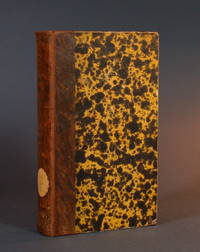
18367529Breda Broese 1836. 1st Edition . Hardcover. . ~ ~ NOTE: THE PRICE OF THIS BOOK IS CURRENTLY REDUCED! ~ ~ . Octavo. Pp. xii ii 418. Plus 5 folding lithograph maps of which one is bound as frontispiece. HARDCOVER bound in contemporary brown calf and marbled boards spine lettered and decorated in gilt cloth French corners marbled endpapers old floral shape shelf ticket to spine; old military institutional stamps to title and verso of first map; gilt faded inner hinges slightly cracked remnants of small blank label to first free endpaper. One map foxed due to different paper stock else nice clean copy in a very good condition. ~ FIRST EDITION. Jacob Cornelis van Rijneveld 1799-1851. Rare. D-3 <br/> <br/> Breda, Broese hardcover
18487895J. J. Gebauer Halle 1748 11848. Oleder 4° 650s.2 Kpfe davon eine Karte. in gutem Zustand AZB689. HC J. J. Gebauer, Halle 1748, hardcover
1831503771831. Lehrb. Chem. 4/2. - Dresden in der Arnold'schen Buchhandlung. 1831 8° 6 pp.707-1080 mit sieben gefalteten Kupfertafeln mit über 200 Figuren Halbldereinband der Zeit; Rücken restauriert; feines Expl.; beigelegt ein Portrait. Erste Deutsche Ausgabe! Chemische Operationen und Geräthschaften Erklärungen chemischer Künstwörter; in alphabetischer Ordnung. Von Abdampfen Alchemie über Gewichte Lampe Messen Thermometer Waage bis Zeichen. Die Kupfer mit 200 Abbildungen chemischer Laborgeräte. Jöns Jakob Berzelius 1779-1848 war ein schwedischer Mediziner und Chemiker. Er gilt als Vater der modernen Chemie. Poggendorff I 172; Ferchl p.42. unknown
1831666311831. Lehrb. Chem. 4/1. - Aus dem Schwedischen übersetzt von F. Wöhler. - Dresden in der Arnold'schen Buchhandlung. 1831 8° 8 703 1 pp. Pappband d.Zt. First German Edition with the ExLibris von Johannes Büttner! Baron Jöns Jacob Berzelius 1779-1848 "was the first person to make the distinction between organic compounds those containing carbon and inorganic compounds. "Organische Chemie" Organisk Kemi. "Berzelius stated in 1810 that living things work by some mysterious "vital force" a hypothesis called vitalism. Vitalism had first been proposed by prior researchers although Berzelius contended that compounds could be distinguished by whether they required any organisms in their synthesis organic compounds or whether they did not inorganic compounds. However in 1828 Friedrich Wöhler accidentally obtained urea an organic compound by heating ammonium cyanate. This showed that an organic compound such as urea could be prepared synthetically and not exclusively by living organisms. Berzelius corresponded with Wöhler on the urea synthesis findings. However the notion of vitalism continued to persist until further work on abiotic synthesis of organic compounds provided substantial evidence against vitalism. " wiki In 1838 Jöns Jacob Berzelius became the first scientist to use the term "protein" a word that has become a cornerstone of biochemistry. "Wöhler is considered a pioneer of organic chemistry because of his synthesis of oxalic acid by hydrolysis of dicyan in 1824 and of urea from ammonium cyanate on 22 February 1828. These syntheses opened up the field of biochemistry as for the first time substances previously known only from living organisms could be artificially produced from "inanimate" matter. At first these in vitro syntheses were hardly noticed by chemists. With the increasing success of chemists in the field of organic synthetic chemistry however Wöhler's synthesis was seen as the beginning of this branch of chemistry and thus a "creation myth" of organic chemistry developed around the urea synthesis which can still be found today in many chemistry textbooks but also in historical accounts. "wiki "If one compares this work with Liebig's book the new path that Liebig took becomes clear. Berzelius had compiled the existing experimental material according to organs. Liebig on the other hand tried to present the large interrelationships of the processes in the living animal organism. Nutrition respiration the production of mechanical work and animal heat as well as the formation of the protein-rich "structures" of the body i.e. the tissues and organs are traced back to chemical processes and explained in their context." Johannes Büttner: Justus von Liebigs "Chemische Physiologie": Schritte zu einer Chemie des Lebens. Mitteilungen Gesellschaft Deutscher Chemiker / Fachgruppe Geschichte der Chemie 17 2004. unknown
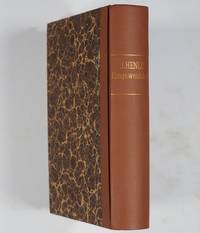
1866702251866. Hdb. syst. Anat. Men. 2. Bd. - Braunschweig Druck und Verlag von Friedrich Vieweg und Sohn 1866 8° X 836 pp. mit 644 mehrfabigen in den Text gedrucktenolstichen Halbleinenband. First Edition! "Considered by many authorities to be the greatest of the 19th-century systems of anatomy. Many structures are named after Henle including the looped portion of the uriniferous tubules of the kidney the layer of cells in the root sheath of a hair and the ampulla of the uterine tube." G&M Friedrich Gustav Jakob Henle 1809-1885 physician pathologist and anatomist. He is credited with the discovery of the loop of Henle in the kidney. His essay "On Miasma and Contagia" was an early argument for the germ theory of disease. He was an important figure in the development of modern medicine. Garrison & Morton No. 417 3 vols. 1855-1871 unknown
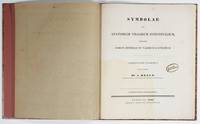
1837657461837. Berolini prostat apud Aug. Hirschwald 1837 4° VI 37 1 pp. und eine lith. Tafel mit 10 Abbildungen feiner Pappand mit eingebundener Titelbroschur; Tafel in Faksimile etwas fleckig. FIRST EDITION - "Modern knowledge of the epithelial tissues starts with Henle. He first described the epithelia of the skin and intestines and defined the structure and function of columnar and ciliated epithelium. He applied the term 'epithelium' to all mucous membranes in the body." "The importance of the cell theory is immediately sensed in the work of Jacob Henle 1809-1885 the greatest German histologist of his time and one of the greatest anatomists of all time. In his classic researches of 1836-37 he was the founder of modern knowledge of the epithelial tissues of the body. Altogether the histological discoveries of Henle take rank with the anatomical discoveries of Vesalius" Garrison pp. 457-458 uncharacteristically fulsome in his praise. "The year 1837 saw the publication of a book of the first importance by Henle 1837 who now described nucleated cells in very diverse human tissues including even the skin of the glans penis. He uses the word 'Cylindri' when referring to cells of columnar epithelium but elsewhere uses 'Cellulae'. In describing his Fig. 4 he refers to the 'Cellulae nucleatae' of the human conjunctiva. He illustrates the nuclei of the epithelium of the trachea particularly clearly Fig. 10. He mentions p. 4 that the nucleus sometimes contains granules. It is not too much to say that this work with that of Valentin 1836a marks the beginning of an epoch in cytology the epoch of the nucleated cell." Baker Henle examined a wide range of epithelial tissues: the respiratory epithelium and its accessories; the conjunctiva; the external auditory meatus and the middle ear; the mucosa of the intestinal canal and the glands opening into it salivary glands tonsils etc.; male and female urogenital mucosa; the glands of the skin; the pleura the pericardium and the dura mater. It was by far the most systematic and wide-ranging study of epithelia that had so far been made and remained for many years the standard work on the subject. The epithelia were divided into three categories: 'Pflasterepithelium' pavement epithelium that was composed of rather regular flat cells enclosing a nucleus; 'Cylinderepithelium' columnar epithelium consisting of a tight array of upright conical bodies with their apexes turned towards the mucosa and their bases towards the free surface. Usually they contained halfway down their length a round or oval flat 'Kern mit Nucleus' This can only mean nucleus and nucleolus so that apparently Henle used the term 'Nucleus' to describe the nucleolus; Flimmerepithelium' ciliated epithelium which was identified only by the presence of the cilia. This study antedates Schwann's monograph and does refer to the observations of Purkyne and Valentin on the choroid plexus. The cells of the epithelium 'contain a round nucleus in which a nucleolus can usually be discerned'. Again Henle uses 'Nucleus' to describe the nucleolus which probably indicates the fluid state of terminology at that time rather than the confusion in Henle's mind. In any case his work established beyond doubt the cellular nature of epithelia and indicated that its constituent cells were usually Cmeist' nucleated and nucleolated." Harris The Birth of the Cell p.107 See - L.J.Rather P.Rather & J.B. Frerichs Johannes Müller and the nineteenth century origins of tumour cell theory Canton Mass science History Publications 1986 Garrison & Morton No.540; Waller 4337; Wellcome III p.246 hardcover
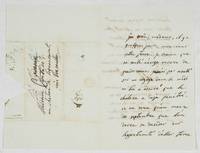
1832708351832. Paris 12.VII.1832. 8° 2 Seiten auf Doppelblatt mit Empfängeranschrift Stempel und Postvermerke; Siegelausschnitt. Augustin Jacob Landré-Beauvais 1772-1840 Leibarzt von König Karl X. der nach der Julirevolution 1830 auf Drängen von König Louis-Philippe aus seinen Ämtern entfernt wurde ist heute vor allem als Erstbeschreiber der rheumatoiden Arthritis bekannt. Die Adressatin "Madame Furtado" war Rose Fould 1800-1871 die Frau des französischen Bankiers Élie Furtado 1796-1867 der später als Finanzminister unter Napoleon III. Berühmtheit erlangte und war die Mutter von Cécile Furtado-Heine 1821-1896. Landré-Beauvais schreibt über ihren erkrankten Bruder Achille Fould 1800-1867 während der großen Cholera-Epidemie in Paris: " J'ai revu Madame il y a quelques jours monsieur votre frère. Je crains que sa santé n'exige encore de grands soins. Je n'ai pas insisté sur un voyage dans le midi ou l'on assuré que le cholera a déjà pénétré. Ce ne sera qu'au mois de septembre que l'on devra se décider sur l'opportunité d'aller faire un troisième voyage durant l'hiver dans un climat plus chaud. J'espère d'ailleurs le voir bientôt ayant moi-même quelques renseignemens à lui demander sur les voyages en Provence ou en Italie. Veuillez bien madame agréer l'assurance des hommages respectueux de votre obéissant serviteur. 12 juillet 1832 Landré-Beauvais. " Rose Fould war auch die Schwiegermutter des Frankfurter Bankiers Carl Heine 1810-1865 Sohn von Salomon Heine einem Onkel des Dichters Heinrich Heine 1797-1856. unknown
183644894Paris Crochard 1836. No wrappers. In: "Annales de Chimie et de Physique Par MM. Gay-Lussac et Arago." 2e Series tome 61 Cahier 2. Pp. 113-224. entire issue offered. Berzelius's paper: pp. 146-151. With titlepage to Tome 61. <br/><br/><em>First French edition of this importent paper in the history of chemistry in which Berzelius advanced the concept of 'Catalysis' and described inorganic reactions by way of metals and the biological reactions by enzymes. The paper on Catalysis was first published in his "Årsberättelse" Annual Survey in 1835. - Axel Holmberg 1836:14. - Partington IV pp. 263-64"This is a new force in inorganic and organic nature bringing into being chemical activity and more widely distributed than has hitherto been thought the naure of which is completely concealed. If I all it a new force it is not my meaning that it is independent of the electrochemical relations of matter but on the contrary I can only assume that it is a special kind of manifestation of these. So long as its nature and relations are unknown it will be convenient to considerit a new force and to give it a name."Berzelius.Parkinson "Breakthroughs" 1836 C.The issue contains furthermore two importent papers by the founder of modern organic cemeistry Auguste Laurent "Sur l'Acide Naphtalique et ses Combinaisons" pp. 113-125 and "Théorie des Combinaisons Organiques" pp. 125-151.Laurent: A founder of modern organic chemistry Laurent was one of the most important chemists of the nineteenth century. </em> unknown
187835735Hauniae Bianco Luno 1878. Folio. Ubeskåret i materie frisk og nærmest uberørt. Portfolio med bindebånd. XII18322 pp. <br/><br/><em>Registerbindet til Langebeks store værk udkom mange år efter værkets afslutning. - Bibl. Danica III:37. </em> unknown
1830lib354645465Bc81830. Hardcover. Good. original paper label on spine dark boards printed by A. J. Valpy at rear of Book Preface dated 1830 Scottish trees begin at p 128 50 engraved plates hardcover
184073710Boston: William Crosby and Company 1840. First edition. Twelvemo. 189 1 pp. plus four full-page hand colored plates. Publisher's blind-stamped sand-grain mauve cloth with gilt cover lettering. Chemised and in a half morocco slipcase with gilt spine lettering. Possibly recased and with very minor and scattered foxing. Overall a lovely presentation of an excellent copy.From 1825 to 1829 Jacob Abbott was professor of mathematics and natural philosophy at Amherst College; was licensed to preach by the Hampshire Association in 1826; founded the Mount Vernon School for Young Ladies in Boston in 1829 and was principal of it in 1829–1833; was pastor of Eliot Congregational Church which he founded at Roxbury Massachusetts in 1834–1835; and was with his brothers a founder and in 1843–1851 a principal of Abbott's Institute and in 1845–1848 of the Mount Vernon School for Boys in New York City.He was a prolific author writing juvenile fiction brief histories biographies religious books for the general reader and a few works in popular science. He wrote 180 books and was a coauthor or editor of 31 more. His Rollo Books such as Rollo at Work Rollo at Play Rollo in Europe etc. are the best known of his works. William Crosby and Company hardcover
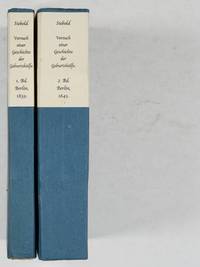
1841274461841. Berlin Verlag von Th. Chr. Fr. Enslin 1841 8° XVI 675 1 pp. Pappband der Zeit. Erste Auflage! Eduard Kaspar Jakob Siebold 1801-1861 "nimmt in der Geschichte der Geburtshilfe eine ganz eigentümliche Stellung ein. Ein Kind der naturphilosophischen Medicin die bis über das 3. Decennium unseres Jahrhunderts hinaus herschte passte er mit seinen Anschaunungen in die spätere Zeit den Beginn der naturwissenschaftlichen Medicin nicht mehr hinein. Er vermochte den in ihrem Entwicklungsgange ihm fremden neuen Fortschritten der Medicin nicht zu folgen und sich ihnen zu assimiliren. Sie standen ihm fern. Aufgewachsen in einer Zeit in der die Geburtshilfe noch fast getrennt von der Gesammtmedicin bearbeitet wurde konnte er sich in die neuere Anatomie und Physiologie nicht einleben. Das Gleiche galt auch von der am Ende des 4. und am Anfange des 5. Decenniums unseres Jahrhunderts sich entwickelnden modernen Gynäkologie. Andererseits aber besass er eine allgemein classische Bildung die theilweise an den Polyhistorismus des 18. Jahrhunderts erinnernd ihn weit über seine Zeitgenosssen stellte ." -cf. Kleinwächter Hirsch V. 392f. unknown
1830011507London: Published for the author 1830 Book. Fair. Half leather. xvi 151 1 pages. A total of 50 plates including the additional illustrated title page. Pages and plates are spotted throughout heavily in places. In old half leather binding with an armorial to the foot of the spine. Some wear to the leather. Bookplate removed from the front pastedown. Pages measure approximately 28 x 18.5cm. Plates printed on india paper. Published for the author hardcover
1807Alibris5059Printed for Richard Phillips by J. G. Barnard 1807. Hard cover. Very Good. Very good. No dust jacket as issued. Bound in green ribbed cloth lightly dampstained with red leather labels on spine. 64 pages. Light foxing and staining as noted above. Dampstain across one third of the pages no sticking. Page 55-56 torn and taped but complete. 2 plates one is fold out. No maps. Spine reads 1805 publication date is 1807. Terribly scarce. John Jacob Grümbke September 6 1771 in Bergen March 23 1849 ibid was a German historian and geographer. He extensively researched the history and culture of Rugen and was founder of rügenschen own research German Wikipedia. This is his first published work. See also: megalithic sites of Rugen painted by Caspar David Friedrich and others. Some think Rügen island might have been the home of the Greek temple of Apollo in 500 B.C. Apollo was the god of light and the sun-god who loved amber and amber was thus considered sacred. The largest deposits of amber in the world and those exploited the longest were on the shores of the Baltic Sea in northern Europe. Baltic amber has a rich history of ancient trade supported by guilds of amber craftsmen and stunning works of art. Apollo's love of music poetry and all the fine arts made him the perfect god for the craftsmen on the island. Annotation by Margaret Odrowaz-Sypniewska Printed for Richard Phillips by J. G. Barnard hardcover
1837AQ34157Derby: Thomas Richardson 1837. xx 13-187pp. Original publisher's gilt-tooled green cloth. Lightly rubbed spine sunned. Inked ownership inscription of Mrs James Smith Branderburgh House February 24th 1881 to FFEP. Leaves lightly browned. The debut of American historian John Stevens Cabot Abbott 1805-1877 brother of children's author Jacob Abbott under whose name the volume was seemingly published. Dedicated to 'those mothers in Britain who are anxious to unite wholesome discipline on Christian principles with the mental improvement of their children' the educational vade mecum was enormously successful inspiring Abbott to dedicate the remainder of his life to literary pursuits. In particular his copious publications on popular history are credited with inspiring a growing historical interest in the American public. Among his most famous works were his History of the Civil War in America 1863-1866 History of Napoleon III Emperor of the French 1868 and The History of Frederick II Called Frederick the Great New York 1871. Very scarce; unrecorded in COPAC with OCLC locating a single copy at NYU. . New edition revised and corrected. 8vo. Thomas Richardson hardcover
1878523261Berlin: Ferd. DUMMLERS Verlagsbuchhandlung 1878. Leather bound hardcovers - two volumes. Text in German. Fading and wear to the boards and spine; splits fraying and one or two bumps to the board edges corners and spine ends. No spine label on vol. 1; this spine also has a 2-3cm split on its rear side. Foxing and tanning on the page blocks and some pages. Faint pencil marks on front pastedown of vol. 1. Clipped upper corner of the FEP from vol. 2. The pastedown hinges on vol. 1 have splits however the binding generally remains sound in both volumes. Some instances of minor tears to the page edges plus some creases and marks throughout. All text remains clear. Relevant newspaper clippings also laid in. CM. Hardcover. Good. Used. Ferd. DUMMLERS Verlagsbuchhandlung Hardcover
1839682881839-1845. Berlin Verlag von Theod. Chr. Friedr. Enslin 1839-1845 8° XVI 308; XVIII 802 pp. 2 Kartoneinbände; Rücken erneuert; teilweise gebräunt. unknown
1880009867USA: Various Publishers 1880. A collection of 19th century sheet music professionally bound into a folio sized book in 3/4 leather. Floral endpapers. The works are arranged for piano and voice and guitar. They are published between c1850 - c1880 many are undated in american cities. They are: Ella's Eyes by Charles Kunkel- 1872; The Veterans' Return March by L. A. Tuttle- c1866; Grand Fantasia on the Popular Theme the Mocking Bird by Edward Hoffman- 1864; In Our Boat by G. D. Wilson- 1873; The Teacher's Joy: The Surpise Rondo by L. Engel- 1878; Blue Bells of Scottland by Wilhelm Kuhe; Court Ball Waltz by Strauss and Lanner and arr by Charles Grobe- 1846; Sebastopol by Henry Worrall- 1860; Annie Lisle by Ch. Grobe- 1857; Selections from Olivette: Waltz by Edmond Audran and arr. by Charles D'Albert; Germans Triumphal March Marche Triomphale Jacob Kunkel- 1871; Alpine Bells by T. Oesten; Happy Thoughts Waltzes: The Fantastics by Fr. Zikoff; Fairy May Waltz by L. Engel- 1878; Twilight Mazurka by William Bendix- 1871; Standard Studies: No. 11 - 20; Introduction Bridal March and Chorus from Lohengrin by Wagner and arr. by Chas. E. Pratt; Convent Bells La Clochette du Convent by G. Ludovic; May Rapture Maienlust by Heinrich Lichner; Progressive Euchre galop by W. S. Stackhouse and arr. by J. B. Ferguson- 1885; Salvia by J. Leybach; La Chatelaine Fantaisie by A. le Duc; Studies for the Piano by A. Loeschhorn; Secret Love by Johann Resch; Forget Me Not Waltz by William Willing- 1876; Maiden's Blush Schottisch by C. Kinkel; Golden Ringlet Waltz Pierre Latour- 1878; Listen to the Mocking Bird by Chas. Grobe- 1866; Priscilla Polka by Julius Bect- 1868; Corn Flower Valse by C. Coote; There are cracks on the front and back hinges. Some light wear to the extremities. There is occasional light foxing- the quality depends on the piece of music. Some pieces have interesting and beautiful titles including some illustrations. . Half Morocco Leather. Very Good. Folio - over 12" - 15" tall. Hardcover. Various Publishers Hardcover
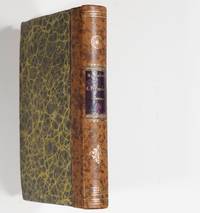
184673457Paris: Alliance des artsA. AubryTresse 1846. Fine. Alliance des arts A. Aubry Tresse Paris 1846-1861 13 x 22 cm 3 volumes reliés en 1 First edition of each catalogue. The second catalogue is in two parts. Contemporary half grey calf binding spine with four raised bands set with gilt fillets and a fleuron morocco title-label and compartment in burgundy marbled paper boards speckled paper endpapers and pastedowns marbled edges contemporary binding. A handsome copy attractively bound. Alliance des artsA. AubryTresse hardcover
183258730Philadelphia: Carey & Lea 1832. First American edition 8vo pp. xii 1 10-427 1; full contemporary sheep; boards starting light foxing tidestain on lower corner a puncture through about 75 pages touching text but not affecting legibility good William Jacob 1762-1851 was appointed to the comptrollership of corn returns in 1822. "On the suggestion of Huskisson Jacob undertook an inquiry into the production and consumption of the precious metals. This work shows great research but is defective which may be attributed partly for the more recent periods to the insufficient historical information available then" Palgrave II 471. Kress C.3181. Carey & Lea unknown
1812EBS100197In Kongl. Vetenskaps Academiens Nya Handlingar Proceedings of the Swedish Academy of Science Vol. XXXIII 1812. 1st Edition. Hardcover. Very Good/No Jacket. 8vo cont ¼ leather on speckled boards raised bands on spine spine gilt leather labels. This is the entire Volume 4 quarterly issues and includes a total of 8 folding plates appearing at the end of corresponding issues. This is the first appearance in Berzelius native Swedish of his introduction of the modern system of nomenclature first published in French in 1811 German in 1812 and English in 1814. Two additional papers were published in Swedish in 1813. See J.E. Jorpes Jac. Berzelius- His Life and Work Almqvist & Wiksell Stockholm 1966 pp 51-53 Wear to edges corners boards internal light dampstaining Overall VG-. In Kongl. Vetenskaps Academiens Nya Handlingar (Proceedings of the Swedish Academy of Science), Vol. XXXIII hardcover