Astor, John JacobBiblio.com

1 102 résultats
1832305489New York 1832. 1/2 page. Docketed. Old folds. 1/2 page. Docketed. Olcott was the president of the Mechanics and Farmers' Bank of Albany N.Y. and a prominent figure in New York State politics and finance.<br /> <br /> Reads in part:<br /> " I have your letter of 4st & regret---not get the loan of 1200$. unknown
187031578Paris 1870. Preparation by Ludovic. Engraved by Roussin after a drawing by Jacob. Very good to fine condition. 60 x 40 cm.<br /> This is one of the largest and most dramatic images in the spectacular Bourgery & Jacob set of anatomical atlases. unknown
180211926Northampton: Printed Typographically at Northampton by Andrew Wright - For the Compiler 1802. First Edition. Hardcover. Good. Oblong in full leather binding has good joints and is tight yet scuffed and worn with a pill-sized hole in the center of the top cover exposing the wooden board beneath. 5 1/4 x 9 inches; plain rules to spine with no label or lettering. Lacks all free end papers. i-xii 9-150; lacks the last leaf of text final music page and index the 3 of page 83 is inverted. Worming to the top right corner of the title page & next leaf with some loss first few leaves browned at edges rest good. No. 194 in Britton Lowens and Crawford American Sacred Music Imprints 1698-1810: A Bibliography. "98 compositions incl. 7 anthems & 11 set-pieces for 4 voices a few for 3; full text.80 American compositions 12 non-American 6 unidentified." The music is in round notes.Jacob French 1754-1817 b. Stoughton MA; d. Simsbury CT. French was a composer and singing-master; the title page designates him "Musico Theorico." During the American Revolution he served several terms between the years 1775 and 1781. Details of his musical career are scarce with documentation existing showing that he was at times a "Teacher of Musick" at Medway and at Uxbridge Massachusetts and also at Providence. French published The New American Melody 1789 and The Psalmodist's Companion 1793 in addition to the Harmony of Harmony offered here. Printed, Typographically at Northampton, by Andrew Wright - For the Compiler hardcover
183267528Paris: Chez F. G. Levrault 1832. ou Lectures Graduées pour les Enfans de Six a Douze Ans. Traduit de L'allemand par Mad.e Élise Voïart. Paris: Chez F. G. Levrault 1832.<br> <br> Three twelvemo volumes out of four . 5 1/4 x 3 1/4 inches; 133 x 82 mm. vii 1 blank 185 1 table; 2 162 1 table 1 blank; 2 138 1 table 1 blank pp. Volumes I III and IV. Each volume has half-title separate hand-colored vignette title-page and two hand-colored plates.<br> <br> Original pink paper boards. Boards stamped and lettered in black ink with a floral border and a colored vignette of the front board of each volume. Volume I edges speckled blue volume II and IV edges speckled brown. Spines a bit sunned. Some light foxing and toning throughout. Each volume with a bookplate on front pastedown reading " Chambre d'etude." Overall a very good set.<br> <br> HBS 67528.<br> <br> $750. Chez F. G. Levrault unknown
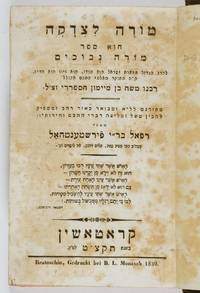
186450647Krotoschin Krotoszyn/ Vienna/ Frankfurt am Main: Printed by B.L. Monasch/ Jacob Schlossberg's Buchhandlung/ Printed by Ferdinand Hauch 1864. First German translations. Hardcover. g to vg-. Octavo. 3/4 black morocco over buckram boards. Gilt lettering and ruling on the spine. Red speckled edges of book block. A complete set of the three parts of Maimonides acclaimed work The Guide for the Perplexed in German and Hebrew bound in one volume. All of the editions included here contain the first German translations of their respective parts of the text.<br /> <br /> Maimonides' intention with this work was to reconcile Aristotelian thought and logic with traditional Rabbinical Jewish theology. Originally written circa 1190 in Judeo-Arabic as Dalalat al-Ha'irin these writings takes the form of a lengthy three-part letter to his student Rabbi Joseph ben Judah of Ceuta and are seen as the main source for understanding Maimonides' philosophic view rather than his strictly being his views on Jewish law. It is the most known of his works in the non-Jewish world. The work's first translation into Hebrew was in 1204 by Rabbi Samuel ben Judah ibn Tibbon c.1150 - c.1230 a contemporary of Maimonides.<br /> <br /> Content:<br /> <br /> Moreh li-Tsedakah. Hu Sefer Moreh Nevukhim FIRST PART. 1839. Second German-language edition. 19 double-sided leaves with Hebrew pagination. 392pp. 3. In 1835 the first part of Maimonides acclaimed work was first translated into German with added commentary in Hebrew by Jacob Raphael Fürstenthal 1781-1855. That first edition featured the German translation printed in Latin script to accompany the Hebrew text. However for this second edition of that translation it is interesting to note that the text of the German is printed in Hebrew script. Content finely printed in double and single-column layouts with commentary printed in Rashi script. Divided in 76 chapters this part of the work contains discussions of an understanding and definition of the nature of God and divine anthropomorphism in the Hebrew bible including a detailed analysis of the Biblical Hebrew of the text to these ends. The final three pages included here contain and index in both Hebrew and German.<br /> <br /> BOUND WITH<br /> More Nebochim. Wegweiser für Berirrte SECOND PART. 1864. First German-language edition. x 99pp. This is the first German translation of the work's second part taken from the original Arabic text by way of the French translation by Salomon Munk 1861. The original Hebrew translation of the text is accompanied throughout by a translation and commentary in German by Max Emanuel Stern 1811-1873. Divided into 48 chapters the second part involves Maimonides discussion of proof of the existence of God the nature of creation the concept of prophecy and an examination of the 26 propositions for Aristotle's metaphysics. The initial pages contain introduction and foreword by Stern. Also included is a fold-out plate containing facsimile text from an original signed manuscript note from the hand of Maimonides himself written in Japhet son of Solomon's corrected manuscript copy of the Mishneh Torah held at Bodleian Library at Oxford MS Hunt.80 leaf 165a. <br /> <br /> AND WITH<br /> Dalalat al Haiirin Burechtweisung der Verirrten. Dritter Theil. THIRD PART. 1838. First German-language edition. viii 9 454pp. 5. This is the first German translation of the work's third part. Simon B. Scheyer 1804-1854 provides the translation and scholarly commentary in German to accompany the Hebrew of the text. This third and final part of Guide for the Perplexed is divided into 54 chapters and is considered the climax of the work and the culmination of Maimonides' previous analysis. Discussed are concepts including Jewish mysticism the Chariot of Ezekiel the moral aspects of the universe the problem of evil free will and the 613 mitzvot of the Torah. The final pages contain a scholarly index in German.<br /> <br /> Binding tight with some rubbing to extremities including the hinges of the spine. Spine and covers lightly sunned. Text throughout with some sporadic minor to light foxing. Much of the text is quite clean. A very few instances of underlining or notes in pencil. Binding in good interior in very good- condition overall. Hebrew title: מורה לצדקה .×”×•× ×¡×¤×¨ מורה × ×‘×•×›×™×/ מורה × ×‘×•×›×™×/ מורה × ×‘×•×›×™×. ×•×”×•× ×¡×¤×¨ דל×לה ×לח×ירין .חלק שלישי<br /> Author: משה בן מימון רפ×ל בר"×™ ×¤Ö¼×™×¨×©×˜×¢× ×˜×”×ל<br /> Publication: ×¤×¨× ×§×¤×•×¨×˜/ קר×ט×שין תקצ״ט<br /> Alternate titles and transliterations: Moreh Nevukim Doctor Perplexorum<br /> <br /> Bibliographic references: PART 1 Vinograd Krotochin 14. PART 3 Vinograd Frankfurt 578<br /> <br /> Provinence: Previously owned by Oxford religion scholar O.H.M. Lehmann dated 1949. Printed by B.L. Monasch/ Jacob Schlossberg's Buchhandlung/ Printed by Ferdinand Hauch hardcover
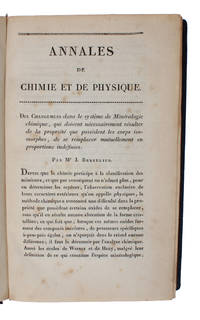
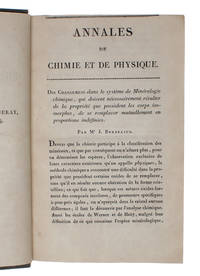
182659822Paris Crochard 1826. 8vo. In later full buckram with gilt lettering to spine. In: "Annales de Chimie et de Physique Par MM. Gay-Lussac et Arago." tome 31. Entire volume offered. Stamp to verso of half title. Light occassional brownspotting. Berzelius' paper: Pp.5-37. The entire issue: 448 pp. 3 plates. <br/><br/><em>First appearance of a milestone paper in chemistry. In this paper Berzelius drew up the table of atomic weights of the elements which with only a few exceptions are similar to those used today. He symbolizes the elements by the first or two letters of the Latin name of the element and he symbolizes compounds by stting the element symbols together together with the number of atoms involved when grater that one. This is the importent revison of his system announced in 1818. "In 1819 Mitscherlich showed that similarity in chemical structure is accompanied by identity of crystalline form Mitscherlich's law of isomorphism. berzelius realized at once that Mitscherlich's findings called for importent changes in his own system. he accordingly published a new table of atomic weights in 1826 the paper offered."Taton "Science in the 19th Century" p. 279. - Holmberg Bibliografi öfver Berzelius nr. 29. The present volume also contain the following important papers: Sur les Minéraux cristallisés qui se trouvent dans les aerolithes Gustave Rose Mémoire sur les Combinaisons du Phosphore et particulièrement sur celles de ce corps avec l'hydrogène Dumas Seconde Lettre sur les Cavernes à ossemens de Lunel-Vieil de Saint-Antoine et de Saint-Julien près de Montpellier Hérault adressés à M. Gay-Lussac par M. Marcel de Serres ; Nouveau Catalogue des cgutes de pierres ou de fer; de poussières ou de substances molles sèches ou humides suivant l'ordre chronologique E. F. F. Chladni Note sur la Communication des mouvements vibratoires Félix Savart Recherches sur les Effets électriques de contact produits dans les changemens de temp </em> hardcover
182660067Paris Crochard 1826. 8vo. In a bit later half cloth with gilt lettering to spine. In: "Annales de Chimie et de Physique Par MM. Gay-Lussac et Arago." tome 31. Entire volume offered. No institutional stamps. Berzelius' paper: Pp.5-37. The entire issue: 448 pp. 3 plates. <br/><br/><em>First appearance of a milestone paper in chemistry. In this paper Berzelius drew up the table of atomic weights of the elements which with only a few exceptions are similar to those used today. He symbolizes the elements by the first or two letters of the Latin name of the element and he symbolizes compounds by stting the element symbols together together with the number of atoms involved when grater that one. This is the importent revison of his system announced in 1818. "In 1819 Mitscherlich showed that similarity in chemical structure is accompanied by identity of crystalline form Mitscherlich's law of isomorphism. berzelius realized at once that Mitscherlich's findings called for importent changes in his own system. he accordingly published a new table of atomic weights in 1826 the paper offered."Taton "Science in the 19th Century" p. 279. - Holmberg Bibliografi öfver Berzelius nr. 29. The present volume also contain the following important papers: Sur les Minéraux cristallisés qui se trouvent dans les aerolithes Gustave RoseMémoire sur les Combinaisons du Phosphore et particulièrement sur celles de ce corps avec l'hydrogène DumasSeconde Lettre sur les Cavernes à ossemens de Lunel-Vieil de Saint-Antoine et de Saint-Julien près de Montpellier Héraultadressés à M. Gay-Lussac par M. Marcel de Serres ; Nouveau Catalogue des cgutes de pierres ou de fer; de poussières ou de substances molles sèches ou humides suivant l'ordre chronologique E. F. F. Chladni Note sur la Communication des mouvements vibratoires Félix SavartRecherches sur les Effets électriques de contact produits dans les changemens de temp </em> hardcover
1820EBS100199Stockholm: Tryckt hos Direct Henr. A. Nordstrom 1820. 1st Edition. Hardcover. Very Good/Dust Jacket Included. Bibliotheca Walleriana 11080. Holmberg Bibliografi över J. J. Berzelius 1820:1. "On the use of blowpipes in chemistry and mineralogy". First edition of this influential work which was translated into many different languages. 8vo ¼ calf original marbled boards wear to spine int. VG original edition in Swedish of Berzelius on the blowpipe. Neville I p 147: Absolutely complete 10 preliminary pages not 8 or 6. Stockholm: Tryckt hos Direct Henr. A. Nordstrom hardcover
181349243London Robert Baldwin 1813. 8vo. Contemp. hcalf. Marbled boards. Spine lacks and boards loose. In: "Annals of Philosophy; or Magazine of Chemistry Mineralogy Mechanics. By Thomas Thomson". Vol. II. - VIII480 pp. a. 7 plates. Entire volume offered. Berzelius' paper: pp. 276-284 357-368. Some browning and brownspots to plates. <br/><br/><em>First printing of this milestone papers in the history of chemistry where Berzelius introduced his famous chemical symbolism the offered paper is the first on the subject - Leicester & Klickstein calls it the "Preliminary note whereby an element is generally represented by the first letter of its Latin name or in the event of elements having the same first letter by the first two letters. Even though his atomic symbols were introduced in 1813 see the note on p. 359 it was quite a few years before Berzelius's symbols were adopted by the chemistry community. But once accepted they became the new international language of chemistry. Berzelius "contributed more to the development of the atomic theory and to the setting up of accurate values of the atomic weights than did any other worker of the time. Of his contributions moreover to the development of the atomic theory and the advancement of chemical science not the least valuable was the introduction of a chemical symbolism which with slight modification is in use at the present day. By giving his symbols a quantitative meaning - the symbol of an element representing one atomic proportion by weight - it was possible "to show briefly and clearly the number of elementary atoms in each compound and after the determination of their relative weights present the results of each analysis in a simple and easely retained manner". This symbolism was speedily adopted on the Continent but in England only after some considerable time."Findlay "A Hundred Years of Chemistry" p. 14.Parkinson "Breakthroughs" 1813 C. - Leicester & Klickstein "A Source Book in Chemistry" p. 258 ff. - Holmberg 1813:28 a. </em> hardcover
184152908Paris Fortin Masson et Cie 1841-47. Bound in 5 uniform contemp. hcalf. Richly gilt spines and with gilt lettering. printed on good paper. Clean and fine. <br/><br/><em>First French edition all published of Berzelius's "Arsberättelser." - Partington IV p. 146. </em> unknown
1824531York County Pennsylvania 1824. Oblong 12mo. 88 pp. Contemporary calf backed wall-paper covered boards; binding rubbed at edges with minor loss of paper and leather otherwise very good. Eichelberger's account book contains a list of expenses as well as income relating to the Eichelberger farm. Entries are organized chronologically and list the item received or service performed as well as the price paid for the item or service. Eichelberger listed prices in both dollars and pounds. Typical expenses include the hiring of farm hands food often dried pork county taxes and the digging of a well. Eichelberger records far more income than expenses. He sold a number of items including wheat apples beef rye and animal fat. Eichelberger provided board to a widow by the name of Miller. Perhaps the most interesting sources of Eichelberger's income are the animals he sold. Between 1806 and 1809 Eichelberger records the sale of 86 horses accounting for the vast majority of his income during those years. He also records the sale of a few steer sheep and hogs but never in quantities as great as the horses. Several pages of the book record Eichelberger's duties as the executor of the will of his father George Allen Eichelberger. These entries list the name of the beneficiary the amount of the estate granted them and the date on which the transaction took place. The final entry in the book which is chronologically out of place and dated 1807 records Eichelberger's activities following the death of his father such as traveling to Carlisle for the reading of the will and appraisal of the estate. Curiously the entries in which the estate is divided among the beneficiaries are dated between 1824 and 1825--seventeen years after the initial reading of the will. This hints at the protracted probate disputes and complications involved in executing a will in the early nineteenth century. Also of note in this book is the inexplicable changes in the way Eichelberger spelled his name. In the earliest entries of the book it is spelled "Echelberger" then appears as "Eichelberger" and finally beginning around 1810 appears as "Higleberger". While the record book mentions no place names other than Carlisle a prosperous farm family by the name of Eichelberger resided in York County Pennsylvania for many years in the eighteenth century. It is very likely that Jacob was a member of this Pennsylvania-German family. unknown
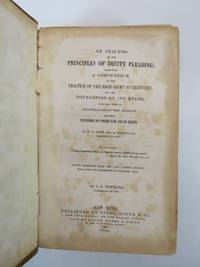
184619359Banks Gould & Co. Very Good. 1846. Hardcover. Second American From the Last London Edition with notes and references to American cases. Rare. Tan calf leather bound cover has significant wear. Front board is detached but present and signatures are loose. Front matter is foxed but only sparse modest foxing and thumbing beyond that and pages are overall in very good condition. A very good candidate for rebinding this very rare title. . Banks, Gould & Co. hardcover
18141358427New-York: Self 1814. Hardcover. Octavo xiv 17-248 pp. Poor; bound in contemporary light green paper with several discolored areas marks and tears to boards and edges with spine hinges cracked; boards shaken and some loose pages to front matter but binding else tight; text block rough and uneven; foxing to pages throughout; INSCRIBED on page vi "Dr. J. Ingersol from his sincere friend The Author;" loose note "Rec'd Monday Feb 23rd 1816 of MD John Ingersoll Sum of 19 dollars 55 cents being in full of all demands Jarves Valentine;" ex-library copy with usual markings including a bookplate to front pastedown institutional stamps to several pages and call number written in pencil; MF consignment. Extremely scarce. 1358427. Special Collections. Self hardcover
1845427571845-1846. Zweite gänzlich umgearb. Aufl. - Leipzig W. Engelmann 1845-1846 Gr.8° XX 1 Bl.Errata 329 1 pp.; XVI 614 pp.; 240 Holzschnitten im Text und 5 lith. Taf. Halbledereinband; Stempel auf einem der 4 Titelblätter. feines Exemplar. The second edition is the first Illustrated and first edition with the subtitle "Botanik als inductive Wissenschaft" Matthias Jakob Schleiden 1804-1881 considered the inductive method the only valid one in biology and the first part of this book constitutes an important document for the study of the methodology of natural history. He declared himself an enemy of all philosophical speculation while at the same time adhering to the views of Kant and rejecting the label of materialist. He completed his attacks against the philosophers with a brief polemical monograph against the philosophy of Schelling and Hegel. The entire structure of Schleiden's textbook was fundamentally new. The lengthy works begins with a study of the material elements of the plant. Next section is a large section of plant cytology and then a treatment of morphology and organology. The book which established the teaching o botany on a completely new basis was often reprinted and appeared in various translations and adaptations. To appreciate the enthusiasm it aroused and its influence in turning young man to the study of botany it is necessary to read the testimony of contemporaries particularly of Julius Sachs a famous botanist and author of the well known history of botany. Schleiden was one of the first to recognize the unique importance of the cell in biology and was a co-founder along with Schwann of the cell theory --- which states that the cell is the basis of both plant and animal life. His fundamentally important textbook of botany which was organized according to this theory contains the first detailed discussion of the structure and function of plant cells and thus marks the beginning of plant cytology. -cf. Marc Klein DSB XII pp.174-175 BMC Nat. Hist. IV 1840. Pritzel 8224; Dibner 31; Grolier/Horblit 93b; Milestones of Science 177; Pritzel 8224; Waller 11732; Norman 1908 all first edition 1842/43 unknown
1835828261835. ABBOTT Jacob. New England and Her Institutions. By One of Her Sons. Boston: John Allen & Co. 1835. 1st ed. 12mo. 271 1 pp. Orig. blind-stamped cloth. Textblock is a trifle shaken else fine. American Imprints 29903. Sabin 33. Most known for his Rollo and The Young Christian series this volume of history and observations of New England by Abbott is remarkably uncommon in commerce. Similarly OCLC locates only 10 institutional holdings. A very nice example of an unusual publisher's binding in a diced cloth forming a diamond pattern with ornate frame and central ornament stamped in blind. This copy with the name label of Lansing Pruyn on the front pastedown and in pencil on the title page. unknown
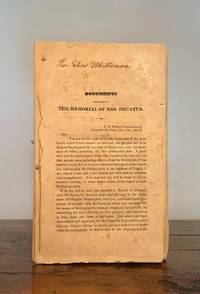
18267724Georgetown D. C.: James C. Dunn printer 1826. First Edition. Side sewn sammelband. Good. 8vo. Pp. 1 2-20 1 2-8 3 4-62. Side sewn self-wraps each of three sections trimmed separately. Moderate foxing throughout light stains and mellowed creases first page inscribed to Hon. Elias Whittemore sic lower edge with short closed tears. Documents supporting Mrs. Susan Wheeler Decatur's claim on behalf of herself her late husband officers and men of the Ketch Intrepid for prize money for the capture of the Philadelphia in the harbor of Tripoli in February 1804 during the first Barbary War.<p>1. Documents Relating to the Memorial of Mrs. Decatur: Letters of Commodore Edward Preble Lieutenant Commander Stephen Decatur pilot Salvadore Catalano Captain Jacob Jones with legal remarks by W. Jones and Richard S. Coxe. <p>2. Mrs. Decatur letter to congressmen dated December 15 1825 appended with a note from Jacob Jones. <p>3. Documents Relating to the Claim of Mrs. Decatur: Letter of Mrs. Decatur followed by letters from Stephen Decatur William Shaler and many others legal opinion from W. Jones and R. Coxe etc. <p>OCLC locates only one copy of The Memorial. Much of the material first printed here was later re-published as the claim moved through congress. SABIN: 19135 for The Claim<p>Elias Whitmore was a U.S. representative from New York serving from 1825 to 1827.<p>Now preserved in a removable clear archival sleeve with acid-free backing. James C. Dunn, printer unknown
1809SKU1021168Jane Aitken 1809-01-01. Hardcover. Good. 0x0x0. Jane Aitken; Philadelphia 1809. Hardcover. Good full leather binding with heavy run marks to boards/board edges some loss to spine tips/tops chipped fore-edge front board moderate shelf wear sunned pages moderate age spotting/foxing to front/back matters possible moisture stains to front/back matters near fore-edge cracked and broken front hinge only attached by binding strings previous owner name in ink on front pastedown and title page else unmarked pulpy/dusty text block edges part of paper label on spine peeled of without Dust wrapper. Overall in a good antiquarian condition. 8vooctavo or approx. 6 x 9 inches 159pp. indexed. We pack securely and ship daily with delivery confirmation on every book. The picture on the listing page is of the actual book for sale. Additional Scans are available for any item please inquire. Jane Aitken hardcover
1821000049London: Printed for R P Moore 1821 2 volumes:xxviii1313pp; 395pp with leaf of errata. Octavo 8" x 5" rebound in 3/4 leather with marbled boards and gilt lettering to spine. Whyld Ravillous 1821:4 First edition.<br /><br /> Jacob Henry Sarratt was a London schoolmaster who learned his chess from Verdoni and established himself as Professor of Chess. He was the leading English chess master from the late 18th century to the early 19th century. He was a frequenter of the London Chess Club which met at Toms Coffee House in Cornhill. His fee was a guinea a lesson. Under his influence stalemate was accepted as a draw. He was the first great English author on chess. His reputation was high and a revelation to English players. His works were of a pioneering character as to chess and the English language. His first excellent books were <i>A treatise on the Game of Chess</i> Vol 1 and Vol 2 1808. There is a prefix listing books on chess from Damiano onwards and some friendly criticism of Philidor. Vol 1 contains Different Methods of Opening the Games then follows 75 Critical Variations. Vol 2 is Teaching the Player who does not have the move how to frustrate his adversarys attack. Then there are instructions how to checkmate and a section on endings with pawns only. His next book introduced in translation the works of Damiano Lopez and Salvio. Published in London in 1813 it deals with those old authors extensively. His next book was Vol 1 Gianutio Vol 2 Selenus with a preface giving some details of the authors. In 1821 was published <i>A New Treatise on the Game of Chess</i>. It is a more exhaustive work than the 1808 publication. He was assisted in this work by his pupil W Lewis. Sarratt died in 1821. His widow then went to Paris and taught chess. In 1844 following an article in <i>Le Palamede</i> describing her as aged 85 and destitute an appeal was launched which enabled her to live in comfort for the rest of her life.<br /><br /><b>Condition:</b><br /><br /> Former library copy from the Brooklyn Public Library with perforated stamp to title and some stamps through out. A very attractively rebound in very good condition. . First Edition. Three-Quarter Leather. Very Good. Illus. by Www.bookcollectorshop.com. Octavo. Printed for R P Moore hardcover
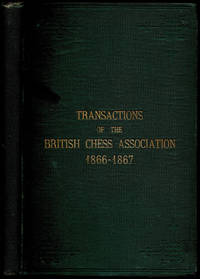
1866C2688<p>164 pages with frontispiece diagrams and indices. Octavo 8 1/2" x 5 1/2" bound in original publisher's green cloth with gilt lettering to cover and blind-stamped embossed cover decoration. From the library of Harold James Ruthven Murray. Betts 25-6; Bibliotheca van der Linde-Niemeijeriana: 5193 First edition.</p><p>Includes the a selection of 37 games from the Congress of London 1866 Challenge Cup: 1. de Vere; 2. MacDonnell. Handicap: 1. Steinitz and Green 46 from the Dundee Congress in 1867 Challenge Cup: 1. Neumann; 2. Steinitz. Handicap: 1. Steinitz and Fraser 14 games in the Steinitz - Anderssen competition in 1866 Steinitz won 8:6 and was then considered " "best player" in the world and 64 problems.</p><p>The Dundee tournament is reckoned as the fourth ever international tournament of modern times. The first of modern chess is perhaps Madrid 1575 under the patronage of Phillip II won by Leonardo ahead of Ruy Lopez. There is a match tournament at Paris in 1821 between Deschappelles Labourdonais and Cochrane not usually listed - Labourdonnais won 13-1. London 1851 was a knock-out tournament won by Anderssen. London 1862 was an all-play-all tournament again won by Anderssen 12-1. But in 1862 a draw had to be replayed until a positive result was obtained. At Dundee in 1867 this carry-over from knock-out events was abandoned and "it was decided that a draw should be reckoned as half a game to each player engaged in it". The Congress of the British Chess Association President: Lord Lyttleton was held at Dundee with the preliminary meeting being in the boardroom of the Caledonian Railway Company on Tuesday September 3rd. The Congress consisted of three events: 1 The Grand Tourney of Blackburne De Vere G. B. Fraser Hamel Dr. J. Fraser Rev. MacDonnell Neumann Col. Robertson Spens and Steinitz. 2 The Handicap Tournament consisting of all the Grand Tournament players except for Hamel plus seven extra players contested on a knock-out system and won jointly by Steinitz and Dr. J. Fraser "by mutual agreement" after they in the final "owing to an alleged excess of the time limit by the latter Fraser consented to reckon their game as annulled. "This is the result of no rule or procedure being laid down for deciding the penalty for overstepping the time limit. No replay of the final game was possible "as Steinitz had to leave per steamer in the afternoon". 3 The Scottish Championship of eight players all-play-all won by Dr. J. Fraser 6-1. A contemporary newspaper report said about this event "after a very tedious contest".</p><p>Harold James Ruthven Murray 1868-1955 was a British educationalist inspector of schools and prominent chess historian. His book <em>A History of Chess</em> is widely regarded as the most authoritative and comprehensive history of the game.</p><p><strong>Condition:</strong> An autograph dedication by Charles E. Ranken on the front end paper: P. Powter with compliments from the Publisher of the "Chess Player's Chronicle … Nov. 1883. Some foxing. Cover stained with bumped corners spine ends rubbed else very good. Scarce chess item.</p> Longmans, Green, Reader, and Dyer Company hardcover
1888102057<p>Folio 12" x 15" publisher's leather somewhat crudely rebacked gilt title on front cover illustrated with engraved frontispiece and 119 chromolithographed plates with tissue guards 182 8 pp. Binding shaken top cover and spine and front endpapers partially separated from text block back joint cracked but still attached significant wear to covers around extremities bookplate on front pastedown; contents clean and bright. Published in several editions the plates are extremely attractive. Studer 1840-1904 was born in New York City and would become a printer and lithographer. He was also an ornithologist and seems to have been active in this field in the Columbus Ohio area after the Civil War. However it is believed that the plates were based on drawings by Theodore Jasper. The plates while very attractive are believed to be designed to help with identification. Size of book will require extra postage. online Cornell library website.</p> The Natural Science Association of America,
182820235<p>First Edition</p><p>London 1828. John Murray Albemarle Street. 8vo.</p><p>293 85 i. e. 58 41 pages. 1 unnumbered page.</p><p>Contemporary half calf.</p><p>Author was a one time MP and a London merchant who spent many years as comptroller of corn returns for the Board of Trade. He was commissioned to write a report on the Corn Trade and Corn Laws and was an advocate for the repeal of the Corn Laws.</p><p>In addition to the report on the Trade in Corn in some of the States of Northern Europe this book includes sections on the Commerce of the Black Sea and the Sea of Azoff and also Observations on the Benefits arising from the Cultivation of Poor Soils. <br /><br /></p><p>Book is in very good condition with raised bands on spine and morocco label. Spine and corners in leather. Leaves are remarkably clean and no significant age toning. Edges sprinkled. No inscriptions or markings except for previous sale price in pencil on first blank and on rear pastedown. No foxing or spotting.</p><p>Armorial bookplate on front pastedown.</p><p><br />Imperfections: slight tear approx 1cm at joint at head of spine. Head and tail of spine show a little wear and leather at corners somewhat scuffed. <br />Top edge a little dusty.<br />A very scarce first edition particularly in such good condition.</p> John Murray, Albemarle-Street hardcover
188826485New York: Natural Science Assn. of America 1888. Large 4to pp. 10 182; title-p. printed in red and black; engraved portrait frontispiece 119 chromolithograph plates "representing upwards of seven hundred different species and varieties of North American birds including a popular account of their habits and characteristics." Original maroon cloth lettered and decorated in gilt on upper cover t.e.g. the whole recased and rebacked in black pebble-grain cloth gilt-lettered direct on spine; tissue guards browning but otherwise a nice copy. Another edition of Nissen I 473; Sitwell Fine Bird Books 1700-1900 p.145. Natural Science Assn. of America unknown
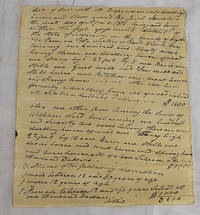
18152605140003Wyeth County Virginia: Manuscript letter 1815. Manuscripts & Paper Collectibles. Very Good. Early Wyeth County Virginia property inventory from Jacob Snavely presumed Jacob Snavely Sr 1759 - 1826 his son 1785 - 1850 moved to Missouri. The county was established in 1790. The Snavely's were some of the first settlers. Inventory includes: 1st tract includes 190 acres of land w/a dwelling a barn grist mill Sawmill valued at $1600.00. 2nd tract includes a 172 acre farm with a dwelling barn a stable meat house and a spring house. This property is valued at $1000.00. The inventory also includes 1 male slave between 12 and 50 years of age 1 slave under 12 years old 1 female between 12 and 50 years of age total value of all assets including the property and slaves was $3600.00. <br> Manuscript letter unknown
1846208561846/53. Braunschweig Druck und Verkag von Friedrich Vieweg 1846-1853 8° 1698 pp. 3 Kupfertafeln 3 feine Halblederbände mit Pergamentecken; minimal fleckig. Erste Ausgabe! "In Heidelberg entsteht Jacob Henle's 1809-1885 Handbuch der rationellen Pathologie eine allgemeine Krankheitslehre im weitesten Sinn: die Morphologie ist ausgeklammert! Henle formuliert in der Vorrede: "Es ist ein Versuch die physiologischen Tatsachen welche die Beobachtungen des kranken Körpers zu Tage gefördert hat nebst den Theorien und Hypothesen zu denen sie Anlaß geben in diejenige Form zusammenzuführen die der systematische Geist der Deutschen verlangt um ihre Stelle in der Entwicklungsgeschichte der Wissenschaft anzuweisen." So sind die ersten Kapitel denn auch wissenschaftstheoretischen Analysen der ärztlichen Methoden der medizinischen Disziplinen und der Aufgaben einer "rationellen Pathologie." Henle setzt sich dabei energisch für die Rolle der Statistik in die medizinischen Wissenschaft ein die numerische oder statistische Methode "die einzige von deren Anwendung die empirischen Medizin Vorteil erwarten darf wie sie überhaupt in empirischen Wissenschaften die einzig zulässige ja die einzig mögliche ist" p.12. Henle weist auf die französische Schule und speziell auf Louis hin. Von der rationellen Pathologie erwartet er zu Recht eine Darstellung der Ursachen und des Wesens krankhafter Vorgänge. Für Henle sind rationelle Pathologie und Physiologie identisch. Der Begriff der Pathologie umfasst dabei alle beobachtbaren Krankheitsäußerungen die Störungen der Morphe sind nur ein Teil des Ganzen. Henle geht es lettlich also um eine rechte Theorie der Krankheit um eine "theoretische Pathologie" wie er formuliert. Dabei stellt für Henle der krankhafte Prozess nur eine graduelle Abweichung gegenüber dem normalen dar. In der allgemeinen Ätiologie spielen Anlage und Disposition eine gewichtige Rolle. Der 2. Band als "Specieller Theil" bezeichnet ist vor allem eine auf die Organsysteme bezogenen klinische Symptomatologie wobei sich Henle bemüht die einzelnen Symptome mit der vermuteten Pathophysiologie in Einklang zu bringen. Den heutigen Leser besticht vor allem der erste wissenschaftstheoretische Teil in seinem logischen Aufbau und mit seiner klaren Sprache. . Warum zwischen dem Erscheinen des ersten und zweiten Bandes 7 Jahre verstrichen wird von Henle nicht kommentiert. . Kein Zweifel Henles Handbuch der rationellen Pathologie ist der zeitgebundene Versuch einer Standortbestimmung für die eben im Aufbruch begriffene naturwissenschaftliche Medizin. Henle und Virchow stehen sich in ihren Grundüberzeugungen dabei viel näher als sie es in dem laufenden Auseinandersetzungen zugeben wollen. Freilich mit Virchows Formulierung einer Cellularpathologie 1855 tritt Henles rationelle Pathologie in den Hintergrund." Georg Dohm Gesch. Histopath. pp.73-80 "Jakob Henle "wollte mit dem »Handbuch der rationellen Pathologie« das in den Jahren 1846 bis 1853 entstand eine theoretische Grundlage schaffen. Die Zielsetzung bestand darin Möglichkeiten zu eröffnen seine Hypothesen experimentell zu bestätigen oder zu verwerfen - Grundprinzip des Wechsels zwischen theoretisch und experimentell forschenden Naturwissenschaften. Er nennt für die Medizin seiner Zeit zwei Methoden die empirische der klinischen Erfahrung und die theoretische physiologische oder rationelle um das Wesen dir krankhaften Veränderungen zu erfassen. Wenn auch in den klassischen Fächern experimentelle Methoden seither Ansatzpunkte fanden und auch das Mikroskop als technisches Hilfsmittel akzeptiert war so bewirkte dies kein grundsätzliches Umdenken d.h. die Forschungsstrategien blieben unverändert. Manche Ansätze waren in den vierziger bis siebziger Jahren sozialpolitisch geprägt so daß die Folgen von Krankheit bzw. die gesellschaftlichen Ursachen prioritär vor medizinischen Fragestellungen waren - struktureller Modernisierungsdruck und traditionsverhaftete Theorien bildeten jedoch zunehmend Diskrepanzen. Im letzten Teil seiner Abhandlung unterteilt Henle drei Untergruppen nämlich äußere Schädlichkeiten . die physikalischen chemischen und organischen oder bestimmter ausgedrückt lebendigen Krankheiten. Krankheiten deren Ursachen Henle rätselhaft nannte unterschied er nach verschiedenen den Verlauf beeinflussenden Faktoren wobei lebende Organismen den Übergang zu den Ursachen den Übergang zu den Ursachen der miasmatisch-contagiösen Krankheiten bezeichneten. Zu lebenden Organismen zählt Henle Parasiten zumindest teilweise nur mit dem Auge erkennbar und er beschreibt geradezu bildhaft das Verhältnis von Angreifen und Anzugreifenden. Die Zuordnung zu biologischen Kategorien erforderte den Nachweis von Werkzeugen der Fortpflanzung." Ragnhild Münch Robert Koch und sein Nachlass in Berlin p.7ff. see - Long p.116; Krumbhaar p.131; Bulloch p.372; Brock Milestones . pp.76-79; Garrison pp.457-469; Hirsch-H. III pp.162-165. Osler 2944; Waller 4345 unknown
1837ZB1291349Livorno: Eliahu Ben Amozegh 1837. 80 pp. bound upside-down in modern vellum backed blue cloth covered boards very good. - If you are reading this this item is actually physically in our stock and ready for shipment once ordered. We are not bookjackers. Buyer is responsible for any additional duties taxes or fees required by recipient's country. Photos available upon request. Livorno: Eliahu Ben Amozegh hardcover