Marchant, Jacob (Jacobi Marchantii)Biblio.com
172 résultats
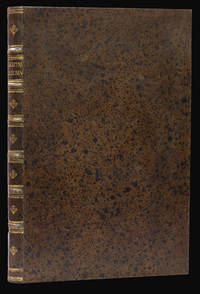
168238370Cologne: Demen. Good with no dust jacket. 1682. Hardcover. 790 pp plus index. Full vellum spine bands spine labels. Vellum is chipped away with loss at spine head tear at tail. Board edges worn. Upper spine label chipped with losses. PO names foxing dampstaining. Few instances of underlining. Pin embedded in bottom block edge. ; Large 8vo 9" - 10" tall . Demen hardcover
1694013947Londini: Typis Mary. Clarke. & Benjamin. Motte. impensis T. Dring & C. Harper in vico Fleetstreet dicto. 8vo - over 7¾ - 9¾" tall. 10 4 10 491 56pp. Full blind-tooled leather moderately worn. Front board recently reattached. Interesting copper frontispiece by Dring and Harper. Partial contents: Jacobus Gronovius Lectori Commentarius in Somnium Scipionis Lib. II Saturnalia Lib. VII De Differentiis & Societatibus Graeci Latinique Verbi Libellus Cum integris & ex chirographo auctis Joh. Isacii Pontani Joh. Meursii Jacobi Gronovii Notis. Also includes indices of names words and remarkable authors. Latin text with abundant use of Greek in "Saturnalia" and "De Differentiis.". Macrobius evidentially a pagan was known to Cassiodorus and Boethius. The "Dream of Scipio" was one of the most cited books in the Middle Ages for its Platonism. Gronovius was a Dutch classical scholar and chief editor of the Thesaurus Antiquitatum Graecarum 1697-1702. ESCT R36883 Wing M229. . Good. Leather Bound. 1694. Typis M[ary]. C[larke]. & B[enjamin]. M[otte]. impensis T. Dring & C. Harper, in vico Fleetstreet dicto hardcover
167712861Amsterdam: Printed by Jacob and Casparus Loots-man Bookseller upon the Water in the Loots-man 1677. Folio 440 by 280mm engraved title 20 engraved charts numerous woodcut charts and coastal profiles within text seventeenth century speckled calf to style spine in seven compartments separated by raised bands gilt. The Lootsman family a surname adopted by the founder of the firm Anthonie or Theunis Jacobsz are one of the less well-known firms of chart makers and publishers working in Amsterdam specialising in pilot books of European coastal waters but who also published a sea atlas of the world. Their output of charts and chart-books deserves to be better known as much of their work was original rather than the slavish copies some of their better-known rivals produced. Dutch chart publishers dominated the European market and by preparing editions in vernacular languages they were able to achieve wide distribution of their output. Most of the Dutch publishers produced English editions of their atlases and pilots and such was the dominance achieved that the Dutch were effectively able to stifle English competitors such as Joseph Moxon and John Seller. But it was the Lootsmans' misfortune to be overshadowed by the larger established firms or newcomers such as van Keulen and their productions often achieved only limited distribution. For example almost all the English editions published by the Lootsmans are located by Koeman in but a single example. It is interesting to compare Seller's early output with this volume and others like it to see the problems that early English publishers faced breaking the Dutch monopoly. This rare work is the first edition preceding the editions cited by Koeman with the title bearing the joint imprint of the brothers Jacob and Caspar Lootsman; whereas Koeman's earliest edition from 1678 bears the sole imprint of Caspar Lootsman. c.f. Koeman Jac 75 a & b. Printed by Jacob and Casparus Loots-man, Bookseller upon the Water, in the Loots-man, hardcover
169141859Leipzig Grosse & Gleditsch 1691. 4to. Contemp. full vellum. Faint handwritten title on spine. a small stamp on titlepage. In: "Acta Eruditorum Anno MDCLXXXXI". 85906 pp. and 13 of 15 folded engraved plates. The 2 first plates lacks but they do not belong to the papers listed.Leibniz' papers: pp.277-281 a. 1 plate pp. 435-439. Johann Bernoulli: pp. 274-276 a. 1 plate. Huygens: pp. 281-282. - Jacob Bernoulli: pp. 282-290 a. 1 plate. <br/><br/><em>All papers first apperance. All 5 of extreme importence in the development of the Calculus. Leibniz' 2 papers on the catenary curve paper 1-2 offered here was written at the instigation of Jacques Bernoulli. Following the example of Blaise Pascal who had initiated in 1658 a contest for the construction of the cycloid Leibniz also provoked the geometers of his time by challenging them to submit at the fixed date of mid-1691 their geometric method for the construction of the catenary curve. Leibniz later provided the answer followed by Johann Bernoulli and Huygens.'These two papers are a historical account of the origin of the study of this transcendental curve and at the same time the first physical-geometric construction showing the species-relationship between the catenary and the logarithmic curves as two companion curves; one arithmetic the other geometric. All of the differentials of the catenary curve are arithmetic means of corresponding differentials of the logarithmic curve; and all of the differentials of the logarithmic curve are geometric means of the catenary.'"The Catenary is the form of a hanging fully flexible rope or chain the name comes from "catena" which means 'chain' suspended on two points. The interest in this curve originated with Galileo who thought that is was a parabola. Young Christiaan Huygens proved in 1646 that this cannot be the case. What the actual form was remained an open question till 1691 when Leibniz Johann Bernoulli and the then much older Huygens sent solutions to the problem to the "Acta" Jakob Bernoulli 1690 Johann Bernoulli 1691 Huygens 1691 and Leibniz 1691 - these 4 1691-papers offered here - in which the previous year Jakob Bernoulli had challenged mathematicians to solve it. As published the solutions did not reveal the methods but through later publications of manuscripts these methods have been known. Huygens applied with great paper 4 virtuosity the by then classical methods of 17th century infinitesimal mathematics and he needed all his ingenuity to reach a satisfactory solution. Leibniz the papers 1-2 and Bernoulli paper 3 applying the new Calculus found the solutions in a much direct way. In fact the catenary was a test-case between the old and the new style in the study of curves and only because the champion of the old style was a giant like Huygens the test-case can formally be considered as ending in a draw." Grattan-Guiness in "From the Calculus to Set Theory 1630-1910.".The paper by JACOB BERNOULLI no. 5 offered here is a milestone papers as it marks the invention of the "SYSTEM OF POLAR COORDINATES" with points located by reference to a fixed point and a line through that point. Although newton had earlier also devised such a coordinate system in 1671 his work was not known so that the credit for the discovery generally goes to Bernoulli. Parkinson Breakthroughs 1691.Further papers contained in this volume of Acta Eruditorum:DENYS PAPIN: Mecanicorum de Viribus Motricibus sententia asserta a D. Papino adversius C.G.G. L. Leibniz objectiones. pp. 6-13. The plate lacks. - and Dion. Papini Observationes quaedam circa materias ad Hydraulicam spectantes. Pp. 208-213 a. 1 plate. This importent paper is part of the LEIBNIZ-PAPIN-CONTROVERSY.JACOB BERNOULLI: Specimen Calculi Differentialis in dimensione Parabolæ helicoidis ubi de flexuris curvarum in genere carundem evolutionibus. Pp. 13-22. The plate lacks. - and J.B. Demonstratio Centri Oscillationis ex Natura Vectis reperta occassione eorum quæ super hac materia in Historia Literaria Roterodamensi recensentur articulo.Pp.317-321.LEIBNIZ: O.V.E. Additio ad Schediasma de Medii Resistentia publicatum in Actis mensis Febr. 1889. Pp. 177-178. and O.V.E. Quadratura Arithmetica Communis Sectionum Conicarum quæ centrum babent.Pp. 178-182 a. 1 plate.TSCHIRNHAUS: Singularia Effecta Vitri Caustici bipedalis quod omnia magno sumtu hactenus constructa specula ustoria virtute superat per D.T. Pp. 517-520 </em> hardcover
169745644Leipzig Grosse & Gleditsch 1697. 4to. No wrappers. In: "Acta Eruditorum Anno MDCXCVII" No V May-issue. Pp. 193-240 entire issue offered. With titlepage to the volume 1697. Leibniz: pp. 201-205. Johann Bernoulli: pp. 206-211. Jacob Bernoulli: pp. 211-214. Newton: pp. 223-224. As usual some leaves with browning. <br/><br/><em>First appearance of the famous issue of Acta Eruditorum in which the 4 solutions by the 4 most eminent mathematicians at the time were printed together. There were in all 5 solutions to the posed problem and Newton's solution was first printed in the Philosophical Transactions January 1697 and reprinted here. The solution proposed by L'Hopital not printed here was not published until 1988.The brachistochrone problem was posed by Johann Bernoulli in Acta Eruditorum in June 1696. He introduced the problem as follows: "I Johann Bernoulli address the most brilliant mathematicians in the world. Nothing is more attractive to intelligent people than an honest challenging problem whose possible solution will bestow fame and remain as a lasting monument. Following the example set by Pascal Fermat etc. I hope to gain the gratitude of the whole scientific community by placing before the finest mathematicians of our time a problem which will test their methods and the strength of their intellect. If someone communicates to me the solution of the proposed problem I shall publicly declare him worthy of praise." Johann Bernoulli and Leibniz deliberately tempted Newton with this problem. It is not surprising given the dispute over the calculus that Johann Bernoulli had included these words in his challenge:- ."there are fewer who are likely to solve our excellent problems aye fewer even among the very mathematicians who boast that they. have wonderfully extended its bounds by means of the golden theorems which they thought were known to no one but which in fact had long previously been published by others."According to Newton's biographer Conduitt he solved the problem in an evening after returning home from the Royal Mint. Newton: . "in the midst of the hurry of the great recoinage did not come home till four in the afternoon from the Tower very much tired but did not sleep till he had solved it which was by four in the morning."Newton send his solution to his friend Charles Montague and Montague published anonymously in the Transactions. Newton's solution presented here in the Acta is also anonymous. The episode did not please Newton as he later wrote: "I do not love to be dunned pestered and teased by foreigners about mathematical things ." After the competition Johann Bernoulli said ". my elder brother made up the fourth of these after Leibniz himself and Newton that the three great nations Germany England and France each one of their own to unite with myself in such a beautiful search all finding the same truth."Struik Edt. "A Source Book in Mathematics 1200-1800 pp. 391 ff. </em> unknown
169542860Leipzig Grosse & Gleditsch 1695. 4to. Contemp. full vellum. Faint handwritten title on spine. A small stamp on titlepage and pasted library label to pasted down front free end-paper. In: "Acta Eruditorum Anno MDCXCV". 2 560 52 pp. 10 plates. As usual with various browning to leaves and plates. The entire volume offered. Leibniz's papers: pp. 145-57; 184-185; 310-316; 369-372; 493-495. Jacob Bernoulli's paper: pp. 537-553 one folding table; 65-66. Johann Bernoulli's: pp. 59-65; 374-376. <br/><br/><em>First printing of a series of influential papers by Leibniz Jacob Bernoulli and Johann Bernoulli.First publication of Jakob Bernoulli's famous and influential "Bernoulli Equation". In "Notatiuncula Constructiones Lineae" Bernoulli proposed a solution to non linear equations which today is one of the most common used solutions of the general fluid. Bernoulli equations are significant because they are nonlinear differential equations with known exact solutions. In the "Specimen dynamicum" Leibniz presents a conception of body and force which distinct between primitive and derivative forces and between active and passive forces. This article is regarded as being the clearest exposition of Leibniz' dynamics. DSB VII 151b."The first attempt at a detailed account of the dynamics was a long dialogue the "Phoranomus seu de potentia et legibus naturae" written in July 1689 while Leibniz was in Rome. This was quickly followed be the composition of the massive Dynamica de potential et legibus naturae corporeae 1689-90 . Though it was written with the intention of publication and though Leibniz work at publishing it he never considered it entirely finished and it remained unpublished during his lifetime.The later . he finally revealed some of the metaphysical foundations of the project in an essay the present paper." Garber Daniel. Leibniz: body substance monad. 2009. 132 p."Its title suggests a summary of or a selection from the earlier work . However it actually contains something in a way rather more interesting: a careful exposition of the metaphysical foundations of the new science something that is hard to find in the old Dynamica or any of the more Technical pieces." Garber Daniel. Leibniz: Body Substance Monad. 2009. 133 p. </em> hardcover
1699210071699. Ed. secunda. - Genf Chouet & Ritter 1699 Folio 28 124 1072 pp. 2 1233 pp. mit vielen Holzschnitten u. 124 davon 9 doppelseitig u. gefalt ganzseitigen Kupfertafeln Pergamenteinband d.Zt.; etwas gebräunt wie üblich. Second Edition! This edition contains significant additions and revisions to this "extraordinary storehouse of seventeenth century anatomical works" Russell 524 which was first published in 1685. The impressive collection with its striking engraved title and 124 plates based on original sources gathers in a single work the most important discoveries of the seventeenth century the period which laid the foundation for modern anatomy and physiology. ALL THE BST IN SEVENTEENTH CENTURY OF MEDICINE - "Here are Harvey's important embryological work 'De generatione animalium' 1551 as well as his treatise on the circulation of the blood with the four figures and also Malpighi's discovery 1651 of the capillary anastomosis in the lungs which supplied the missing link in Harvey's demonstration; . Olof Rudbeck's work on the lymphatics illustrated with nineteen figures on three folio plates; and the works of Pecquet and Bartholin. Here is given s short list of some of the more important works: Asseli discovery of the lacteal vessels 1617 Thomas Wharton's description of the duct of the submaxillary salivary gland Wharton's duct Zambeccari's proof that the spleen is not essential to life; Borelli's 'De moti animallium' 1680 on the application of mechanics to the motion of the limbs of animals Niels Stensen's papers on the muscular mechanics and his account of the excretory duct of the parotid gland Stensen's duct John Mayow's classic on the physiology of respiration 1674 DuVerney's account of the structure function and diseases of the ear and Schelhammer's account of the physiology of hearing Thomas Willi's on the circle of Willis; Richard lower treatise on the heart 1669 and the first blood transfulsion Francis Glisson's first accurate description of the capsulae of the liver Glisson's capsule Regnier de Graaf's detailed description of the male and female reproductive system including the first account of 'Grafiaan follicle' and his work on pancreatic secretion Malpighi's and Swammerdam's many excellent discoveries whit microscope to name but a few. Jean Jacques Manget 1652-1742 practised in Geneva with great success. In 1699 the Elector of Brandenburg made him his first physician. His literary work in which he was assisted by Daniel Le Clerc 1652-1728 chiefly consisted of collecting and reprinting in large volumes important treatises on medicine anatomy and chemistry. Le Clerc is sometimes called the "Father of the History of Medicine" because he wrote the first large history of medicine. That valuable and still consulted work was first published in 1696. Waller 5663; Haller Bibl. Anatomica I 803-04; Keynes Harvey no.45; Neu 2263; Hahn & Dumaitre 218; Osler 3192; Hahn & Dumaitre 218 describing the Baroque engraved title and reproducing it 226; Parkinson-Lumb 1422 lists complete content unknown
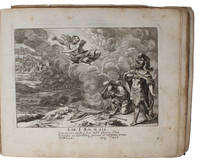
168860433Norimbergae Nuremberg J.L. Buggelii 1688. 4to-oblong. In contemporary full calf. Wear to extremities boards with scratches upper part of spine missing leather cords showing. Inner hindges partly split. Ex-libris pasted on to pasted down front end-paper. First and last quires detached. Brownspotting throughout. 4 48 28 pp. 51 engraved plates. <br/><br/><em>Rare first and only edition of this illustrated verson of Vergil's Aeneid presumably intended for children. </em> hardcover
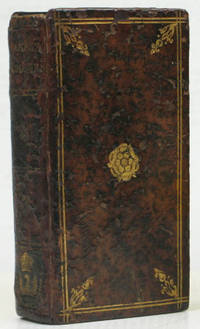
164217147Lugduni Batavorum Leiden: Ex Officina Joannis Maire 1642. Second edition 16mo 377 1 pp. Engraved title marbled paste downs armorial bookplate of Lord Sinclair. Contemporary calf a.e.g. covers with double gilt rules cornerpieces and a central rose gilt phoenix to the foot of the spine with the motto Rinasce Piu Gloriosa "It rises again more glorious" spine somewhat worn with loss to top. A leading Protestant lawyer who helped negotiate the Peace of Westphalia Lampadius' writings form part of the basis of Germanic constitutional law. First published 1634. Lugduni Batavorum [Leiden]: Ex Officina Joannis Maire unknown
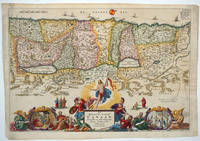
17008410Dordrecht. Netherlands: Keur 1700. Early printing. Maps. Very good condition. From a Keur Bible published in Dordrecht the Netherlands. Copper engraved map with land divisions of the twelve tribes with attractive modern color. This map was re issued over many years with the early edition having a radiating glow copper lines coming from Christ. Our copy also has the sculptor J.V. Jagen and has the original fold lines strengthened on the verso with some light tissue paper. text below very legible. The Holy Land with lovely cartouche of Jesus rising above the group with sml insets of his birth and crucifixion. 17 1/2 x 12" & sml. margins. "The Keur family were active over a long period and some of these maps may date from the 18th century." Shirley p.507. Keur unknown
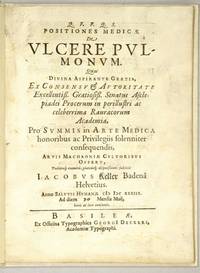
1638446241638. Basileae: Ex Officina Tyopographia Gerogi Deckeri 1638 Kl.4° 24 pp. Pappband. Positiones medicae de ulcere pulmonum / quas . pro summis in arte medica honoribus ac privilegiis solenniter consequendis . offert publicoque examini placidaeque disquisitioni subiicit Iacobus Keller Badena Helvetius. Anno . M DC XXXIIX. Ad diem . Mensis Maii. Husner: Verzeichnis bas. med. Univ.Schriften Nr. 1004 unknown
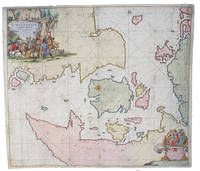
169647333Amsterdam 1696. 52x595 cm. Kobberstukket og håndkoloreret søkort visende Bælterne mellem Østjylland Fyn Sjælland Lolland og Falster Sydsverige Rü Bornholm Nordtyskland m.v. Med det danske rigsvåben i nederste højre hjørne; heri dedikation til Cornelis Tromp den danske og hollandske flådes admiral. Den store kartouche i øverste venstre hjørne viser scener fra folkelivet og brydning af kalksten fra Møn eller Stevns. Fin reparation i højre margin. <br/><br/><em>Sjældent søkort over de indre danske farvande og porten til Østersøen. Kortet "ligger ned" med øst orienteret oppe. Jacob Robyn var kortsælger og kortudgiver. Han købte rettighederne til Pieter Goos's Zee-Spiegel og Zee Atlas fra Goos' enke men han udfærdigede også selv adskillige kort. Hans lager blev overtaget af Johannes Loots i Amsterdam."Alle de anførte hydrografers samtidige kartografer kortarbejder er overordentlig sjældne både herhjemme og i udlandet og noteres betydelig højere i pris end de samtidige landkort" Bo Bramsen p. 112. </em> unknown
160856<p>Early Latin Edition of Both of Wecker's Famed Collections Of Alchemical Medical Formulas</p><p>Wecker Johann Jacob. Antidotarium Generale et Speciale. Apud Georgium Variscum. Venice. 1608.</p><p>Dual binding of Wecker's alchemical magio-medical formularies for general and special antidotes first published in 1561 and 1588 respectively.</p><p>The texts include sections on medicines for different parts of the body as well as by the elements in addition to more complicated remedies and including instructions for the creation of pills oils unguents and elixirs.</p><p>Its formulas are notable for their mix of "simples" and polypharmacy compounds demonstrating a relationship with the work of alchemists like Paracelsus including his recipe for laudanum – here "laudanum Theophrastii". In addition to its relatively explicit instructions for the creation of abortifacient medicines it also contains entries for the benefits to be derived from various baths as well as instructions for the use of stones and precious gems in medicine including their occult powers and use in amulets. In addition to an index and tables of contents the books also feature useful charts for navigating the text and identifying the proper remedy for specific ailments.</p><p>Wecker 1528 – 86 a professor at the College of Basel is most famous for authoring his own widely published book of secrets De Secretis mostly concerned with natural philosophy and trade secrets but which also including explicit descriptions of Goetic and necromantic magic among many other topics.</p><p>6 copies of this edition found in OCLC as of March 2025.</p><p>8 222 cl 2 6 1210 col 21. Vellum bound with minor worming and soiling. Title in pen to spine. Small split to top spine vellum. Text block toned. Pages largely clean with occasional spotting. Front pastedown cracked with pencil notation. Soiling to front pastedown and first free endpaper bottom edge. Stain affecting upper fore corners of index and back pastedown. Minor worming to index up to H. Includes multiple charts and some illustrations.</p><p>$1125</p> Apud Georgium Variscum
16162602240004Bey Paul Jacobi in Verlegung des Auctoris Franckfurt 1616. First Edition. Hardcover. Good. First edition of one of the earliest military manuals printed in Europe. Handsomely bound in later vellum. Short 4to; 21 cm. Fine binding and cover. 8 195 32 pages 19 fold out page. Illustrated title-page with engraved border. 19 double-page engravings depicting soldier formations and munitions. Generally clean. Minor spotting. Light dampstain at bottom margin effecting some of the early pages. Marginal loss to p. 80; loss to bottom corner p. 102 partially affecting text. Cockle 622. Klara Andresova 2019 "Military Camps in Military Manuals" in Alexander Samuel Wilkinson; Graeme Kemp eds. Negotiating Conflict and Controversy in the Early Modern Book World Brill pp. 163–177. <br> Johann Jacob served in the army of Maurice Price of Orange and fought in the Eighty Years' War in the Netherlands. He later served as an offer in Danzig and in Hungary and Russia. In 1616 he was appointed by Count John VII of Nassau-Siegen to head up the newly established Kriegsschule the first military academy in the world. The outbreak of the 30 Years War in Germany prematurely caused the school to close. Jacob was one of the most important German military writers before the 30 years war. Bey Paul Jacobi, in Verlegung des Auctoris, Franckfurt hardcover
1610013709Basel: Durch Conrad Waldkirch 1610 Book. Good. Soft cover. xvi 264 pages. Disbound with modern plain card covers which are lightly browned. Pages browned and heavily browned throughout. Pencil note to the rear end paper. Durch Conrad Waldkirch paperback
16659688<p>12 pages 1790 i.e. 1788 columns 118 160 62 pages 63-366 columns skips 150-154 with correct catchword 2 pages. Worn dark brown calf. Tear to front fly. Handsome full calf with losses to front board & top of spine see images. 24 x 36 x 8.5 cm; 9 x 14.25 inches.</p> Sumptibus, Henric-Petrinorum : Typis Jacobi Bertsch hardcover
1676626591676. Francofurti ad Moennum & Lipsiae Sumptibus Johannes Frizschil 1676 4° 30 pp. mit Holzschnitt Titelvignette Halbpergamenteinband im Stil d.Zt.; feines Expl. Erste Ausgabe! Jakob Jan 1604-1671 - siehe HeBis VD17 1:065968X. unknown
165127391651. : 7 . Extremely Rare first edition of the description of Heusden.Normally bound with Beschryvinghe van het landt van Heusden we offer only the complete description of Heusden. First of three editions 2nd 1743 3th 1794 2 Blank pages / 1 Blank pages / 2 NNP / 60 Pages / 2 Blank pages Binding: Full vellum Duodecimo 12mo Height cm: 195 CM Width cm: 157 CM Thickness cm: 12 CM hardcover
167022401670. : 8 Latere schutbladen titelblad verstevigd professioneel gerestaureerd. Binding: Contemporary Full Vellum Octavo 8vo Height cm: 205 CM Width cm: 155 CM Thickness cm: 35 CM hardcover
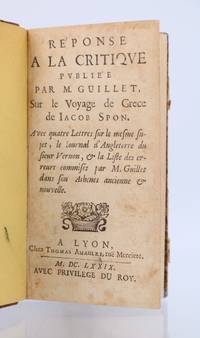
167989345Lyon: Thomas Amaury 1679. Fine. Thomas Amaury Lyon 1679 8.5 x 15 cm Relié Very rare first edition. Some light foxing. Contemporary 19th-century modest half-grained cloth binding spine faded marbled paper boards with surface abrasions yellow endpapers and pastedowns marbled edges. Sole edition uncommon of this vindication by Jacob Spon 1647-1685 concerning his major travel account of the Levant Voyage d'Italie de Dalmatie de Grèce et du Levant fait aux années 1675 & 1676 published in 1678. Georges Guillet de Saint-Georges 1624 or 1625-1705 had a little earlier 1675 produced a description of the contemporary state of the city and monuments of Athens which Spon disputed in his own narrative even going so far as to question whether Guillet had ever travelled in Greece at all. Hence a quarrel of the kind scholars delight in: sharp and somewhat futile. Bookplate of a Greek educational institution affixed to a pastedown. Thomas Amaury hardcover
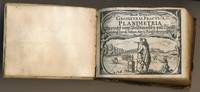
1663904348674<p>Extremely rare first edition of Jacob Meyers <em>Geometria Practica sive Planimetria</em> complete with the fold-out. Our copy please see images has been severly burned on the back cover vellum damaged and partly missing - with surprisingly little impact on the inside of the book which shows age-appropriate browning but no signs of burn.<br />Numerous geometrical images. Printed by Johannes Rudolph Genath. Coat of arms ex libris with the initials "OGHZS" Otto Gall Herr zu Stubenberg; 1631-1688. See the copy of Universitätsbibliothek Basel here: https://doi.org/10.3931/e-rara-65110</p><p>A beautiful example of the first refinement of the recording methods of land use documenting the demarcation of sovereign power and private use. The book shows a large number of precise calculation methods mathematical geodesy.</p> Johann Königs Büchführeren hardcover
1644SP08-0481-8903Sumpt. Ioannis Kinchii et Sociorum 1644-01-01. Hardcover. Acceptable. In Latin. 1644 first edition Sumpt. Ioannis Kinchii et Sociorum Col. Agrippinae Cologne Germany 3 1/8 x 5 inches tall full leather bound faded gilt dentelles to front cover and gilt lettering and four raised bands to spine elaborately engraved title page eight full-page engravings 22 6 7-522 4 60 pp. Lacking half title page but otherwise complete. Covers rubbed and edgeworn with fraying to the spine caps and tips. Heavy wear along front hinges with chipping to the leather at the upper and lower spine. Holes and marks to the covers especially rear cover where a clasp closure once was. Old one-inch shelf label to spine. Front cover splays open slightly. Prior owner name in period hand to blank front free-endpaper. Cracking along the gutter between the title page and blank front free-endpaper but the binding is quite solid. Burning to the fore margin of six leaves 12 pages pp.408-20 including one of the full-page engravings and the beginning of Chapter 7 not obscuring text or engraving. A few pages with mild creasing or light soiling and a couple of pages with a short edge tear. Otherwise a good to very good copy of this rare first edition of one of the most popular Catholic devotional manuals of the 17th through 19th centuries. OCLC 877150798 and 420229078 locates only five copies at institutions worldwide - one each at the National Library of Scotland in Edinburgh University of Aberdeen Libris in Stockholm Bibliotheque Municipale in Lyon France and the Zentralbibliothek in Zurich Switzerland. ~SSS~ 1.0P Jacob Merlo Horstius 1597-1644 born in Horst Holland from whence he derives his name was a prominent doctor of theology known as an effective preacher at the Lyskirchen in Cologne where he served as pastor. The Paradisus Animae which has gone through many editions in the original Latin since this 1644 first edition was long a favorite prayer book among Catholics. Several English translations appeared one as early as 1670 as 'Paradise of the Christian Soul.' It was translated into French by Nicolaus Fontane under the title 'Heures Chretiennes Tirnes de l'Ecriture et des Saints Peres.' In addition Horstius authored 'Septem Tubae Orbis Christiani' a compilation from the writings of the fathers intended for young Roman Catholic priests. He also edited a commentary of Estius on the Pauline Letters; the works of St. Bernard in two volumes and the works of Thomas a Kempis with Horstius' commentary. Sumpt. Ioannis Kinchii et Sociorum hardcover
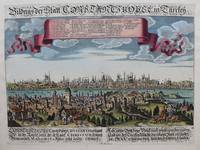
1665P4556Nuremberg : Paul Furst c.1665. Very Good. Notes: A scarce and charming view of Constantinople during the mid 17th century. This view is based off of the Merian view of 1635. Image Size : 272x373 mm 10.71x14.69 Inches Platemark Size : Paper Size : 335x419 mm 13.19x16.50 Inches Coloring: Hand Colored Medium: Copper Engraving Categories: Views Asia Near East Turkey; Paul Furst unknown
1661r014.202HOLLAND: Joannem Janssonium Amsterdam 1661. LATIN TEXT. 140 x 80 x 45 mm. Dated 1661 and part 6 1658. Divided into six books liber.540 and 190 pages plus indexes etc. Clean tight text is dust marked at edges . Some early leaves including frontispiece and plate opposite bit damp marked at base. Bound in old vellum which is HEAVILY DUSTMARKED and a bit damaged. . Just a good working copy. . Hardback. Good/No DW. Joannem Janssonium (Amsterdam) Hardcover
167031901670. : 8 . 4 Blank pages / 1 Blank pages / 4 NNP / 256 Pages / 1 NNP / 1 Blank pages / 6 NNP / 53 Pages / 1 NNP / 2 Blank pages / 2 NNP / 206 Pages / 4 Blank pages Binding: Contemporary Full Vellum Sextodecimo 16mo Height cm: 155 CM Width cm: 105 CM Thickness cm: 45 CM Sales: Old Price:68500 New Price:510 hardcover