Lincoln AbrahamABAA

189 résultats
1872WRCAM31184Washington 1872. 4pp. of manuscript on a single long ruled sheet of paper folded in half to produce two folio-size leaves. Light fold lines. Minor browning. Very good. A legal manuscript copy of a land patent issued by Abraham Lincoln to John Hicks granting him lands in Missouri set aside by the United States in 1842 for reservation land but unclaimed at the time of the original grant on May 3 1861. The lands in question were ceded back to the United States via a treaty with the Wyandot Nation of the Upper Sandusky in Ohio signed March 17 1872. Includes numerous references to other key treaties made between 1842 and 1872. Good evidence of land transfer issues as the wholesale cession of Indian lands to the United States began in earnest. EBERSTADT 165:363. unknown books
1866238120Washington D.C.: John H. Littlefield; Wm. Terry Printer 1866. Photograph by John Goldin of Littlefield's painting on printed mount. 1 vols. Image 11 1/2 x 18 3/4 in.; mounted to 19 x 24 in. Soiling to image vertical crease large chips to bottom of mount not affecting image or legend; good. Photograph by John Goldin of Littlefield's painting on printed mount. 1 vols. Image 11 1/2 x 18 3/4 in.; mounted to 19 x 24 in. A published photograph of Littlefield's hyper-realistic Lincoln death-bed painting each figure meticulously rendered from photographs. Littlefield studied law under Lincoln in 1858 stumped for him in his Presidential bid and was rewarded with a position in the Treasury Department. After Lincoln's death Littlefield invented this tableau of twenty-five people ranged around the death-bed including Vice-President Johnson Surgeon Chalres Leale and Mrs. Lincoln. "The artist used photographs as models for the twenty-five people gathered in the death room but his profile of the dying Lincoln shows a first-hand acquaintance" Ostendorf LINCOLN'S PHOTOGRAPHS p. 279. Provenance: Harper Family John H. Littlefield; Wm. Terry, Printer unknown books
1866238011Washington D.C.: John H. Littlefield; Wm. Terry Printer 1866. Photograph by John Goldin of Littlefield's painting on printed mount. Image 8 1/2 x 13 3/4 in.; mounted to 13 x 17 in. Faint toning to mount; fine. Photograph by John Goldin of Littlefield's painting on printed mount. Image 8 1/2 x 13 3/4 in.; mounted to 13 x 17 in. A published photograph of Littlefield's hyper-realistic Lincoln death-bed painting each figure meticulously rendered from photographs. <br/>Littlefield studied law under Lincoln in 1858 stumped for him in his Presidential bid and was rewarded with a position in the Treasury Department. After Lincoln's death Littlefield invented this tableau of twenty-five people ranged around the death-bed including Vice-President Johnson Surgeon Charles Leale and Mrs. Lincoln.<br/>"The artist used photographs as models for the twenty-five people gathered in the death room but his profile of the dying Lincoln shows a first-hand acquaintance" Ostendorf LINCOLN'S PHOTOGRAPHS p. 279. John H. Littlefield; Wm. Terry, Printer unknown books
184829488Cincinnati: Robinson & Jones 1848. Original printed wrappers light wear spine reinforced with archival tape three rubberstamps on blank portions with ornamental borders stitched. 49 3 blanks pp. Very Good. <br/><br/> This scarce pamphlet is the address of 'An Israelite to the Christian World' asserting "that Israelites view with as much concern and regret as devout Christians the lamentable attempts to instil disbelief in a Divine revelation." Lindo argues that God's Covenant with the Jews "has never been intermitted but has always been and still continues to be in operation." Through the revelation they received at Sinai "the world is indebted for the civilization it now enjoys and will continue to be indebted for the preservation of that civilization." Christianity he says was "originally a Jewish sect adhering strictly to the monotheism of the Old Testament" but it has "gradually become so perverted as to remove it from what it was originally." <br/>FIRST EDITION. Rosenbach 637. Singerman 1026. Not in Sabin Thomson Eberstadt Decker. Robinson & Jones unknown books
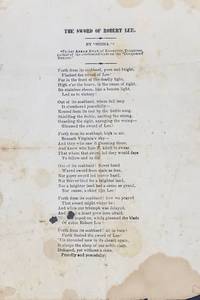
186865220Knoxville TN 1868. Broadside. 21 x 14cm. Six six-line stanzas. Some stains and two small holes one affecting two words. Short break at one fold. See BAL 17099 for two sheet music printings ca. 1866. A famous poem in perhaps the first or only separate non-music printing. OCLC lists only musical scores. <br/><br/> unknown books
186122671<p><b>ABRAHAM LINCOLN.</b>Book. <i>Message of the President of the United States to the Two Houses of Congress. Volume 1</i> Washington: Government Printing Office 1861. 839 pp. 5¾ x 8¾ in. </p><b>Excerpt</b><p><i>"A disloyal portion of the American people have during the whole year been engaged in an attempt to divide and destroy the Union. A nation which endures factious domestic division is exposed to disrespect abroad and one party if not both is sure sooner or later to invoke foreign intervention. </i></p><p><i> Nations thus tempted to interfere are not always able to resist the counsels of seeming expediency and ungenerous ambition although measures adopted under such influences seldom fail to be unfortunate and injurious to those adopting them. </i></p><p><i> The disloyal citizens of the United States who have offered the ruin of our country in return for the aid and comfort which they have invoked abroad have received less patronage and encouragement than they probably expected.</i></p><p><i> It continues to develop that the insurrection is largely if not exclusively a war upon the first principle of popular government--the rights of the people. Conclusive evidence of this is found in the most grave and maturely considered public documents as well as in the general tone of the insurgents. In those documents we find the abridgment of the existing right of suffrage and the denial to the people of all right to participate in the selection of public officers except the legislative boldly advocated with labored arguments to prove that large control of the people in government is the source of all political evil. Monarchy itself is sometimes hinted at as a possible refuge from the power of the people. </i></p><p><i> In my present position I could scarcely be justified were I to omit raising a warning voice against this approach of returning despotism."</i></p><p><b>Historical Background</b></p><p>President Lincoln's first message to Congress in 1861 immediately follows the title page. In the first year of both his presidency and the Civil War Lincoln criticizes disloyal citizens who are trying to ruin the country. He acknowledges that the Confederates firing on Fort Sumter ended hope of a peaceful solution and expresses his confidence in General McClellan. Lincoln also expounds on the foreign affairs the relationship of labor to capital and reports on domestic commerce and other affairs. The remainder of the book is over 400 pages of papers relating to foreign affairs and correspondence with other nations and diplomats. The second half of the book is made up of the Reports of the Secretaries of the Interior War Navy and Postmaster General.</p><p><b>Condition </b></p><p>Good. Original cloth boards with U.S. seal and titled spine some slight chipping and wear to boards and spine binding a little loose and front endpaper almost detached hinges a bit weak but still firm some aging but generally clean internally.</p> hardcover books
186564322Davenport Iowa: Designed by W.H. Pratt and lithographed by A. Hageboeck 1865. Broadside. 38 x 31 cm. Several small tape repairs on verso several untaped tears on edges. A calligraphic portrait memorial of Lincoln using shading to form his likeness with the text of his Emancipation Proclamation. "Designed and written by W. H. Pratt and printed in Iowa the state that sent the most soldiers per capita to the front in the Civil War"- EBERSTADT 40. <br/><br/> Designed by W.H. Pratt and lithographed by A. Hageboeck unknown books
1865WRCAM56487Providence: Salisbury Bro. & Co. 1865. Illustrated broadside 12 1/2 x 8 inches. Old folds. Remnants of a label on verso a few small chips to edges uneven tanning light foxing. Very good. Rare broadside advertising gold jewelry and "Patent Embossed Carte de Visites.of all noted personages." from Salisbury Bro. & Co. of Providence Rhode Island. The text describes a large stock of photographs offered at wholesale prices to retailers across the country. The broadside has a vignette of the Salisbury factory in the top quarter of the sheet with a dense cascade of text in a variety of different fonts below. The lower third of the sheet is devoted to descriptions of images of Lincoln and the Civil War advertising three different Lincoln images and the promise "Our Picture of Lincoln is the best ever taken. All others as good as ever sold by any one." They also offer images of other prominent Civil War personages as well as "Booth the Assassin Robert E. Lee Jeff Davis and other prominent Rebels all at the same price. Also we have the ASSASSIN'S VISION and the ASSASSIN'S DOOM on full Cards." <br> <br> This broadside is primarily directed towards retailers as opposed to private customers and provides costs for bulk orders of up to 1000 cartes de visite. They claim their prices are "500 per cent. less than any dealers ever have." with prices starting at $7 for 100 and up to $100 for 1000 depending on the image. Although Salisbury Bros. & Co.'s cartes de visite and other photographic products are easily accessible in many libraries we could find no record of this broadside. An interesting record of the mass-marketing of photographic images in the post-Civil War era. Salisbury, Bro. & Co. unknown books
186330001.20<p>Contains Lincoln's entire 1863 Message to Congress where he reaffirmed his commitment to emancipation as well as His Proclamation of Amnesty and Reconstruction which laid out a plan to return the rebellious states to the Union fold. Commonly called the "Ten Percent Plan" it allowed for a state to hold new elections when 10% of its 1860 voters took a loyalty oath to the Union.</p> <b>ABRAHAM LINCOLN.</b>Newspaper. <i>New York Times</i> New York N.Y. Dec. 10 1863 with <i>"Supplement to The New York Times"</i> complete with its own masthead. 12 pp. 14¾ x 21 in.<p><b><br /></b></p><p><b>Excerpt</b></p><p>"<i>To now abandon them would be not only to relinquish a lever of power but would also be a cruel and an astounding breach of faith. I may add at this point that while I remain in my present position I shall not attempt to retract or modify the emancipation proclamation nor shall I return to slavery any person who is free by the terms of that proclamation or by any of the acts of Congress.</i>"</p><p><b>Historical Background</b></p><p>Throughout the fall of 1863 eventual Union victory became increasingly clear and on December 8 1863 Lincoln issued his Proclamation of Amnesty and Reconstruction. This lenient plan that offered citizens of the rebellious states full pardons voting and property rights except possession of slaves encouraged the states to begin addressing the issue of the freedmen and women without compromising their rights and allowed a former Confederate state to hold elections and form a pro-Union government once 10% of the number of voters in the 1860 election swore loyalty oaths. Commonly called the "Ten Percent Plan" it reflected both Lincoln's charitable view of Reconstruction as well as the reality that heavy penalties denial of voting and property rights to rebels and impoverishing the South was no way to rebuild a nation after a war fought at least initially to preserve the Union.</p> books
1877239161877. No binding. Fine. Autograph Quote Signed from Lincoln's Cooper Institute speech given on February 27 1860. Sept 10 1877. Schuyler Colfax U.S. representative from Indiana and vice president under Ulysses S. Grant pens a famous quote from Lincoln's Cooper Institute speech. Transcript""Let us have faith that Right makes Might; and in that faith let us to the end dare to do our Duty."" Lincoln's Cooper Institute speech Feb. '60. Yrs truly Schuyler Colfax / Sept 10 1877Schuyler Colfax 1823-1885 born in New York City moved with his family to Indiana when he was an adolescent. Colfax pursued a career in journalism serving as legislative correspondent for the Indiana State Journal and becoming part-owner of the Whig organ of northern Indiana the South Bend Free Press renamed the St. Joseph Valley Register in 1845. Colfax was a member of the 1850 state constitutional convention and four years later was elected as a Republican to Congress where he served until 1869. An energetic opponent of slavery Colfax's speech attacking the Lecompton Legislature in Kansas became the most widely requested Republican campaign document in the 1858 mid-term election. In 1862 following the electoral defeat of Galusha Grow Colfax was elected Speaker of the House. In that capacity Colfax announced the passage of the Thirteenth Amendment on January 31 1865: ""The constitutional majority of two thirds having voted in the affirmative the Joint Resolution is passed."" Colfax considered February 1 1865 the day he signed the House resolution the happiest day of his life. ""Fourteen years before among a mere handful of kindred spirits in the Constitutional Convention of his State he had said: 'Wherever within my sphere be it narrow or wide oppression treads its iron heel on human rights I will raise my voice in earnest protest.' He had kept his word and well earned his share in the triumph."" Hollister 245. Colfax next served as Vice President under Ulysses S. Grant 1869-1873. He lost a re-nomination bid in 1872 as a result of his involvement in the Crédit Mobilier of America scandal. Hollister Ovando James. Life of Schuyler Colfax 1886. books
186124870<p>"<i>The Sanitary Commission is … of direct practical value to the nation in this time of its trial. It is entitled to the gratitude and confidence of the people… There is no agency through which voluntary offerings of patriotism can be more effectively made. A. Lincoln.</i>"</p> <b>ABRAHAM LINCOLN. HENRY W. BELLOWS.</b>Printed Circular Letter to "<i>the Loyal Women of America</i>." Washington D.C. October 1 1861. 3 pp. 8 x 10 in.<p><b><br /></b></p><p><b>Historical Background</b></p><p>The United States Sanitary Commission USSC was a private relief agency to support sick and wounded Union soldiers and sailors. The idea began at a meeting of the Women's Central Relief Association of New York in April 1861 and was modeled on the British Sanitary Commission which operated during the Crimean War. The USSC set up and staffed hospitals and operated thirty soldiers' homes lodges and rest houses for traveling and disabled Union soldiers.</p><p>This circular urges American women to send contributions to the USSC for distribution to suffering servicemen. "<i>Every woman in the country can at the least knit a pair of woolen stockings</i>" the letter declared "<i>or if not can purchase them.</i>" The USSC sought blankets quilts pillows slippers delicacies such as cocoa and dried fruit checker and backgammon boards and books and magazines for convalescing soldiers and sailors. Before it was printed Frederick Law Olmsted wrote to Lincoln requesting "a line from the President recommending the purpose of the Commission to the confidence of the public." Lincoln's response sent the same day is included at the end.</p><p>7000 affiliated local societies held bazaars concerts raffles and plays to raise money. Beginning in the fall of 1863 major cities—including Chicago Cincinnati Brooklyn New York Pittsburgh Philadelphia St. Louis and Boston—held large sanitary fairs that lasted for weeks. With donations from many famous figures and artifacts for sale such as signed copies of the Emancipation Proclamation over the course of the war the USSC raised an estimated $5 million in cash and $15 million in in-kind contributions.</p><p>At first the Army Medical Bureau resented civilian involvement and questioned the use of women as nurses. Similar groups such as the Christian Commission argued that their counterparts were more interested in providing something for the upper classes to do in the war aside from fighting than they were in sympathizing with the plight of soldiers. But its success silenced most critics over time.</p><p>The USSC did provide significant opportunities for women to participate in the war effort. Dorothea Dix Mary Livermore and Mary Ann Bickerdyke held leadership roles. Novelist Louisa May Alcott was a nurse in a USSC hospital. One of its nurses Clara Barton became a founder of the American Red Cross. Many of the Northern women who were its grass roots workers developed an involvement in philanthropic and public affairs including the Civil Rights and Women's Suffrage movements.</p><p><b>Henry W. Bellows</b> 1814-1882 born in Boston graduated from Harvard College in 1832 and Harvard Divinity School in 1837. In 1839 he became the pastor of the First Congregational church in New York City. Gaining a reputation as a pulpit and lyceum speaker he became a leader of the Unitarian Church in America. From 1847 to 1866 Bellows edited the <i>Christian Inquirer</i> a weekly Unitarian newspaper. Bellows planned the United States Sanitary Commission and served as its only president from 1861 to 1878. In 1877 he became the first president of the first Civil Service Reform Association.</p> books
186424202<p>Two tickets to the Great Central Fair in Philadelphia. One admitted a pupil of the public schools of Philadelphia and was used on Saturday June 11 according to the stamp on the verso. The other is an apparently unused "Season Ticket" that admitted the bearer "<i>To All Parts of the Fair</i>" except the Children's Exhibitions but was "<i>Forfeited if Transferred and Not Good unless Endorsed</i>." The verso includes the oath "<i>I hereby promise that this Ticket shall be used to obtain admission to the Fair by myself only</i>" and a blank line for a signature.</p> <b>CIVIL WAR. ABRAHAM LINCOLN.</b>Great Central Fair Tickets June 1864. Pair of passes for the Great Central Fair held in Philadelphia June 7-28 1864. One ticket is for one day's admission for a public school student. The other is a season ticket. 1 p. each 3½ x 2¼ and 3½ x 2 in.<p><b><br /></b></p><p><b>Historical Background</b></p><p>During the Civil War several northern cities hosted sanitary fairs between 1863 and 1865 to raise money for the care of wounded soldiers. The Great Central Fair held at Logan Square in Philadelphia in June 1864 was a fundraiser for the United States Sanitary Commission and was one of the largest fairs. The main exhibit building constructed in forty working days by local volunteer skilled labor enclosed 200000 square feet. It featured nearly one hundred departments offering a broad range of displays from Arms and Trophies to Fine Arts to Umbrellas and Canes. Curiosities included a $1000 doll house a recreated parlor of William Penn with Penn artifacts the boat used by Arctic explorer Elisha Kent Kane and George Washington's carriage.</p><p>Over three weeks the fair welcomed more than 400000 visitors. The season ticket offered here cost $5 a week's pay for a day laborer or a domestic and several days' wages for skilled workers. The fair served more than 9000 meals per day in its restaurant and had a daily newspaper with descriptions of the various departments. During its existence the fair raised approximately $1 million for the Sanitary Commission second only to New York City in money raised.</p><p>President Abraham Lincoln attended the fair with his family on June 16. He also donated forty-eight signed copies of the Emancipation Proclamation printed under the auspices of George Boker of the Union League which were sold for $10 each.</p><p><b>Condition</b></p><p>Both have glue discolored on the reverse sides. The smaller card has a 1" edge tear on the right side neatly repaired with archival tape.</p><br /> books
1862100336Newspaper folio unbound 8pp. Dampstained browned at edges with some foxing early owner's ink stamp on top margin some small tears and chips along edges and a little creasing. Still in decent shape overall. This is one of the earliest printings of the Emancipation Proclamation which was issued on September 22 1862. The Emancipation Proclamation declared freedom for all slaves in any Confederate state that didn't return to the Union by January 1 1863. Although this executive order did not actually free a large number of slaves it set the stage for the freedom of all slaves. Coverage of the Emancipation in this newspaper begins in the middle of the first page. This newspaper article represents important coverage of a very significant event in American History. archives government exhibits emancipation website books
1864M13597New York: Derby & Miller 1864. 1864. Volume II. 8vo. xxxi 1 711 1 pp. Subtle waterstain at top margin viewable from pages 500-712. Original full dark blue-green pebbled cloth gilt spine titles; light wear to extremities. Bookplate of the Essex Institute; small rubber stamp on title C.W. Post College Documents Library. The Emancipation Proclamation declared freedom for all slaves by January 1 1863. This proclamation is dated January 2 1863. Lincoln in writing this one of the most important documents in all US history declared "And by virtue of the power and fpr the purpose aforesaid I do order and declare that all persons held as slaves within said designated States and parts of the States are and henceforward shall be free; and that the Executive government of the United States including the military and naval authorities thereof will recognize and maintain the freedom of said persons." / The War Orders of 1863 are among the most historical during the Civil War. The volume includes: General Orders No.1: Emancipation Proclamation Liberty for Slaves. / General Orders No.100: The Lieber Code How soldiers should conduct ethically themselves in wartime. / General Orders No. 143: Order for the creation of the United States Colored Troops. / General Orders No.1. President Abraham Lincoln issued the Emancipation Proclamation on January 1 1863. With this Executive Order. He took a decisive stand on the most contentious issue in American history redefined the Union's goals and strategy and sounded the death knell for slavery. / Lincoln had always believed slavery to be immoral and fought its expansion. The President took the action "sincerely believed to be an act of justice" knowing that it might cost him the election. / With the Emancipation Proclamation Lincoln dramatically tied the Union's war aims to ending slavery. Whether they approved or not after January 1 1863 Americans could no longer deny that emancipation was central to the Union war effort. / Though ready to lay the groundwork for emancipation Lincoln feared that delivering the Proclamation at the wrong time would doom its chances for public acceptance and harm the Union cause. / On September 22 1862 Lincoln issued his preliminary Emancipation Proclamation giving the South 100 days to end the rebellion or face losing their slaves. / His final Proclamation on January 1 1863 further demonstrated his own evolving views by eliminating earlier references to colonizing freed blacks and compensating slave-owners for voluntary emancipation. Lincoln also added provisions for black military enlistment. Pausing before he signed the final Proclamation Lincoln reportedly said: "I NEVER IN MY LIFE FELT MORE CERTAIN THAT I WAS DOING RIGHT THAN I DO IN SIGNING THIS PAPER." Despite the political risks by 1864 he insisted on both reunion and emancipation as preconditions to any peace negotiation. Though the battle for civil rights would have to follow Lincoln rightly regarded the Proclamation as: "THE CENTRAL ACT OF MY ADMINISTRATION AND THE GREAT EVENT OF THE 19TH CENTURY" Derby & Miller, 1864. hardcover books
1817619331817. Appeals of murder were abolished after this Case. Appeals of murder were abolished after this Case. "Diabolically Ravished Murdered And Thrown Into a Pit" Trial. Thornton Abraham c.1793-1860 Defendant. Horrible Rape and Murder!! The Affecting Case of Mary Ashford A Beautiful Young Virgin Who was Diabolically Ravished Murdered And Thrown Into a Pit As She Was Returning From a Dance; Including the Trial of Abraham Thornton For the Wilful Murder of the Said Mary Ashford; With the Whole of the Evidence Charge to the Jury &c. Tried at Warwick Assizes Before Mr. Justice Holroyd On the 8th of August 1817. Taken in Short Hand. To Which is Added Copious Elucidations of this Extraordinary Case; And a Correct Plan of the Spot Where the Rape and Murder were Committed &c. &c. London: Published by John Fairburn 1817. ii 60 columns 34 pp 64 1 pp. Several contemporary newspaper clippings concerning this case pasted to final leaf rear wrapper and verso of title page. Woodcut folding map of crime scene. Octavo 8-3/4" x 5-1/2". Stab-stitched pamphlet in printed wrappers untrimmed edges. Some soiling and edgewear spine and fold-lines of table reinforced fore-edge mended some toning to text. Early owner signatures and annotation to front wrapper and map not the image side interior otherwise clean. $950. "Third Edition." Abraham Thornton a bricklayer "was accused of rape and murder after attending a dance where he became intimate with a gardener's daughter named Mary Ashford. They left the dance together and her body was found the next morning in a deep pool of water near a local footpath. Thornton was tried at the Warwick assizes on 8 August 1817. Since the marks on Mary's body were not necessarily inconsistent with Thornton's claim that she had consented to sexual intercourse and since the times on the morning in question when Thornton was seen walking home to Bromwich suggested he could not have been with her when she met her death the jury found him not guilty. The case aroused much interest and reminded people of a similar murder of a local woman a year earlier. Many were convinced of Thornton's guilt and he was assailed in local and London newspapers. A group collected around the Birmingham solicitor William Bedford invoked the old legal process of 'appeal of murder' by which a person acquitted of murder could be tried again for the same offense. This process was generally regarded as obsolet. unknown books
186323743<p>In this creative pamphlet Lincoln stands trial before a jury of his "peers" former presidents and statesmen from American history including Stephen A. Douglas Daniel Webster Henry Clay John Hancock Patrick Henry Gouverneur Morris Alexander Hamilton John C. Calhoun James Madison George Mason Elbridge Gerry Andrew Jackson Thomas Jefferson George Washington and William Gaston. The author compiles passages from their speeches in mock dialogue with the defendant Lincoln as they contradict his defenses against their charges.</p> <b>ABRAHAM LINCOLN.</b>Pamphlet. <i>Trial of Abraham Lincoln by the Great Statesmen of the Republic. A Council of the Past on the Tyranny of the Present. The Spirit of the Constitution on the Bench—Abraham Lincoln Prisoner at the Bar his own Counsel.</i> New York: Office of the Metropolitan Record 1863. Original printed wrappers stitched. 29 3 pp. First Edition.<p><b><br /></b></p><p><b>Excerpts:</b></p><p>"<i>George Washington the father of the American Union who was surrounded by the great statesmen of the Revolution and by others of a still later date…had assembled for the trial of the present incumbent … on charges of the gravest and most serious character. the Spirit of the Constitution…occupied the bench of Justice.</i>" 4-5</p><p>"<i>Abraham Lincoln is herein charged with treasonable intent purposes and designs in having committed the following unconstitutional acts in the course of his administration:</i></p><p>"<i>1. In having declared war against independent and sovereign States under the pretence of repossessing himself of certain forts and other property seized and held by said States.</i></p><p>"<i>2. In having arrested citizens of the United States and incarcerated them in Government bastiles without process of law.</i></p><p>"<i>3. In having suppressed the liberty of speech thereby denying to the citizen the Constitutional right of criticizing the acts of his Administration.</i></p><p>"<i>4. In having prohibited and stopped the publication of certain newspapers for the exercise of the same right referred to in the preceding charge.</i></p><p>"<i>5. In having placed the military above the civil power as shown in the establishment of martial law over portions of the country which were not embraced within the theatre of war.</i></p><p>"<i>6. In overthrowing State sovereignty as in the case of Virginia the integrity of which was violated by the erection of the so-called State of Kanawha within its limits.</i></p><p>"<i>7. In having approved indorsed and partially carried into execution the unconstitutional act of Congress known as the Confiscation Bill.</i></p><p>"<i>8. In having approved of the infamous law known as the Conscription Act which was not only subversive of the Constitution but violative of State sovereignty.</i></p><p>"<i>9. <b>In having attempted to carry into execution the Emancipation Act thereby violating the most sacred guarantees of the Constitution.</b></i> 5-6</p><p>"<i>The criminal looked around the court and on the faces of the assembled patriots of the past but as they returned his gaze they shuddering averted their heads. Then the Spirit of the Constitution addressing him spoke as follows:</i></p><p>"<i>'You have been tried and found wanting. You have been given the opportunity of saving a nation but you have stabbed it to the heart. You were born in the freest country under the sun but you have converted it into a despotism. You have violated your oath; you have betrayed the trust reposed in you by the popular will and to the outraged justice of your countrymen I now leave you with the brand of "Tyrant" upon your brow. They will hereafter inflict upon you that penalty which justice demands while history will pronounce its judgment upon the infamous acts of your Administration.'</i>" 28-29</p><p><b>Historical Background</b></p><p>Contemporaries historians and others have criticized Lincoln for violating state sovereignty freedom of speech and freedom of the press for suspending habeas corpus and imposing martial law. All of these charges figure prominently in this ghostly trial of the President.</p><p>The publisher and possibly author of this pamphlet was John Mulally the Irish-born editor and proprietor of the <i>Metropolitan Record</i> a weekly Catholic family newspaper published from 1859 to 1868 in New York City. From 1859 to March 1863 it was the official organ of the Archbishop John Hughes of New York. Catholic critics accused it of taking an "open and avowedly treasonable course…since the war broke out; but more especially since the President issued his Emancipation Proclamation" and of forcing Archbishop Hughes to withdraw his support.</p><p><i>The Indiana State Sentinel</i> a Democratic newspaper published in Indianapolis printed much of the pamphlet on its front page declaring it "perhaps the most thorough and effective exposition of the terrible character and extent of the departure of the present Administration from the word and spirit of the fathers of the Constitution that has yet been put in print."</p><p>In 1863 authorities arrested Baltimore booksellers Michael J. Kelly and John B. Piet publishers of the <i>Catholic Mirror</i> for printing works of a "treasonable character." On May 23 1864 Provost Marshal detectives again arrested Kelly and Piet and searched their store. Among the "inflammable matter" found were 97 copies of <u>this</u>pamphlet envelopes with rebel flags 57 packs of playing cards with Confederate officers and some 212 Confederate photographs. The authorities imprisoned Kelly and Piet in Fort McHenry. On May 28 Kelly's son received permission to reopen the store and authorities allowed the press to resume publication of the <i>Catholic Mirror</i> on May 30 while Kelly and Piet awaited trial. On June 1 and 2 Major General Lew Wallace ordered Kelly and Piet released if they each posted a $5000 security bond not to violate any departmental regulations.</p><p>In March 1864 Major General William S. Rosecrans a Catholic commander of the Department of the Missouri ordered the Provost Marshal General in St. Louis to seize all issues of the <i>Metropolitan Record</i> to prohibit further distribution of the newspaper in that department and to punish all vendors who sold or distributed issues of the newspaper knowing their "traitorous contents." Rosecrans had read enough in the <i>Metropolitan Record</i> to satisfy himself that "no reasonable freedom nor even license of the press suffice for the traitorous utterances in those articles" and that they were "a libel on the Catholics who as a body are loyal and national." In November 1864 Major General Hugh Ewing commanding the District of Kentucky likewise banned the circulation of the <i>Metropolitan Record</i> and seven other newspapers in his district.</p><p>In the midst of the 1864 presidential election campaign the <i>Metropolitan Record</i>advertised for canvassers to sell this as "the great campaign pamphlet of the day." Mulally later reportedly repudiated McClellan as the Democratic nominee favoring a peace candidate instead.</p><p>111 Eberstadt 332. Monaghan 252. Sabin 41234. LCP 10399.</p><p><b>Condition</b></p><p>Margin dusting to the front wrapper Very Good.</p> Office of the Metropolitan Record paperback books
186536639New York 1865. Elephant Folio. 8pp. Each page printed in six columns. Uncut at top edge. Very Good. A contemporary hand has written in pencil at the top blank margin "His last Proclamation. Keep this Paper."<br/><br/> This was Lincoln's "Last Public Address" Abraham Lincoln Online. This issue of the Times appearing the following day is surely a candidate for its earliest printing. His Speech discloses Lincoln's most recent thoughts on Reconstruction the War having virtually ended by the surrender of Lee's Army at Appomattox Court House on April 9. Reconstruction he says is "fraught with great difficulty. We simply must begin with and mould from disorganized and discordant elements. Nor is it a small additional embarrassment that we the loyal people differ among ourselves as to the mode manner and means of reconstruction."<br/> Lincoln emphasizes his flexibility. He disclaims any intention to insist upon a single comprehensive plan. He makes clear that "the Executive claimed no right to say when or whether members should be admitted to seats in Congress" from the rebellious States. He remarks that he has never pronounced on the interesting legal question "whether the seceding States so called are in the Union or out of it." Such an issue has no practical significance. "We all agree that the seceded States so called are out of their proper relation with the Union; and that the sole object of the government civil and military in regard to those States is to again get them into that proper practical relation." Lincoln will act as circumstances require the only criterion being whether the proposed policy will expedite that "proper practical relation." It is obvious that Lincoln had he lived would have been much more successful than his dogmatic and inflexible successor at guiding Reconstruction.<br/> This issue treats many other issues arising from the War's end including the topic "What shall be done with Jeff. Davis unknown books
186323577.01<p>"<i>and that Government of the people for the people and for all people shall not perish from earth.</i>"</p><p>As printing technology advanced through the middle decades of the nineteenth century illustrated newspapers grew in popularity even though their engravings added a few weeks to press time. <i>Leslie's</i>printing—from December 5—includes an article containing the full text of Lincoln's timeless speech page 11. Illustrations include a centerfold spread with the formal dedication ceremony prominently placed and smaller views of Union and rebel graves defensive works Meade's headquarters and a view of the town centerfold. A large illustration of "<i>The War in Tennessee—Lookout Mountain and Its Vicinity</i>" appears on the front page.</p><p>There is no definitive text that captures exactly how Lincoln spoke that day though the AP reporter's text is most familiar. <i>Leslie's</i> printing following the <i>Philadelphia Enquirer</i>version contains variations most notably in the final two sentences regarding the nation's unfinished work and closing phrase of "<i>Government of the people for the people and for all people</i>" rather than "<i>of the people by the people and for the people.</i>"</p> <b>ABRAHAM LINCOLN. GETTYSBURG ADDRESS.</b>Newspaper <i>Frank Leslie's Illustrated Newspaper</i> New York December 5 1863. 16 pp. complete.<p><b><br /></b></p><p><b>Excerpt:</b></p><p>"<i>Fourscore and seven years ago our fathers brought forth upon this Continent a new nation conceived in liberty and dedicated to the proposition that all men are created equal. Now we are engaged in a great civil war testing the question whether this nation or any nation so conceived so dedicated can long endure. We are met on the great battle-field of that war. We are met to dedicate it on a portion of the field set apart as the final resting place of those who gave their lives for the nation's life; but the nation must live and it is altogether fitting and proper that we should do this. In a larger sense we cannot dedicate we cannot consecrate we cannot hallow this ground in reality. The number of men living and dead who struggled here have consecrated it far above our poor attempts to add to its consecration. The world will little know and nothing remember of what we see here but we cannot forget what these brave men did here. We own this offering to our dead. We imbibe increased devotion to that cause for which they here gave the last full measure of devotion; we here might resolve that they shall not have died in vain; that the nation shall under God have a new birth of freedom and that Government of the people for the people and for all people shall not perish from earth.</i>"</p><p><b>Historical Background</b></p><p>Though November 20th imprints are the most valuable newspaper publications of the Gettysburg Address none are as lavish as this issue of <i>Leslie's</i> and none show the cemetery or provide images of the ceremony. It is also interesting to note that the leading illustrated newspaper <i>Harper's Weekly</i> did not publish the Address or illustrate the ceremony. This <i>Leslie's</i> issue published in far smaller quantities than <i>Harper's</i> is quite scarce.</p><p><i>Frank Leslie's Illustrated Newspaper</i> was founded in 1852 and published until 1922. Originally established by <i>Illustrated London News</i>owner Frank Leslie 1821-1880 the weekly continued under the guidance of his widow suffragette Miriam Florence Leslie from 1880 until 1902 when she sold the highly recognizable brand. Specializing in patriotic topics and heavily reporting war efforts from the Civil War to World War I the newspaper also covered Arctic exploration the Klondike Gold Rush strikes and sporting events. Civil War reporting and illustration was among the paper's most successful ventures.</p><p><b>Historical Background</b></p><p>Lincoln's speech delivered at Gettysburg National Cemetery on November 19 1863 has endured as a supreme distillation of American values. Over the past 150 years it has become a compelling testament to the sacrifices required to achieve freedom for all Americans. Lincoln made his speech at the cemetery's dedication some four months after the bloody and pivotal battle that turned the tide of the Civil War in favor of the Union. Edward Everett the most famous orator of his day spoke first and his address took some ninety minutes to deliver. He evoked the ancient Greeks who save their society by defeating the Persians at Marathon drew upon Wellington's victory over Napoleon at Waterloo and then moved to a history of the Battle of Gettysburg—America's decisive victory in the struggle to save the nation. Though a masterpiece of period it has been largely forgotten.</p><p>Lincoln's speech delivered in only a few minutes has persisted despite his assertion that "the world will little note nor long remember what we say here." Much has been written about Lincoln's famous speech from whether he read it or memorized it to when and where he wrote it. Many Americans believe Lincoln wrote the speech on the back of an envelope while riding the train to Gettysburg. This charming piece of fiction originated in Mary Shipman Andrews's 1906 book <i>The Perfect Tribute</i>. The real Address's writing is more complex. When Secretary of State William Seward gave a prepared speech on the evening of November 18 he gave a copy to the Associated Press. Reporters then repeatedly harassed John Hay one of Lincoln's personal secretaries for a copy of the President's speech. Hay demurred having neither the text nor any idea when it would be available. Based on the paper Lincoln used for his two drafts one page of Executive Mansion stationery and a page of lined paper then 2 identical pages of lined paper historian Gabor Boritt has concluded that the "likelihood remains that having written the first part of his speech in Washington Lincoln finished his First Draft in the evening in Gettysburg and then hurriedly wrote his Second Draft the next morning" Boritt 273. The text of the second draft is closest to the words recorded by reporters at the scene and is generally considered to be Lincoln's reading copy.</p><p>Newspaper copies and reports are another story one complicated by the fact that most witnesses to the dedication ceremony and speech outlived Lincoln by decades. But the words he spoke at Gettysburg only gained traction as his seminal contribution in the 1880s. As both the Lincoln legend and the speech's significance grew following the Civil War Reconstruction the Centennial and the rise of Jim Crow many more people than could have been possibly involved in the event have staked their claims to a Gettysburg Address connection.</p><p>With the advent of the telegraph news reporting had become big business and Lincoln surrounded himself with the press corps. Roy Basler editor of the <i>Collected Works of Abraham Lincoln</i> noted four reporters making shorthand notes of the speech: Associated Press and <i>New York Herald</i> reporter Joseph Gilbert <i>Boston Daily Advertiser</i> reporter Charles Hale and reporters from the <i>Chicago Tribune</i> and <i>Philadelphia Enquirer</i>. Gabor Boritt author of the definitive <i>The Gettysburg Gospel</i> adds John Hay one of Lincoln's personal secretaries to the list and refers to at least 23 additional reporters on the scene including many of Lincoln's allies in the Republican press. Known as "Lincoln's dog" <i>Philadelphia Press</i>owner John Forney offered a drunken pro-Lincoln rant on the evening before the speech but he was sober enough to wait for a slew of correspondents to arrive to take down his words.</p><p>What has come down as the standard version of the Address was compiled from Lincoln's drafts reports of what he spoke at the time and later revisions made by Lincoln himself. What is certain however is that "variations of the AP version reached more Americans in 1863 than any other" Boritt 239. The <i>New York Herald</i> received the text by telegraph and published it the next day. Later when Lincoln penned copies of his speech he is said to have referenced the AP report. A longtime story credits Joseph I. Gilbertof the Associated Press as having had "actually consulted Lincoln's delivery text briefly after the ceremony." This noted Garry Wills in 1992 "makes his version more authoritative for some scholars." Wills correctly credits the AP text as authoritative and in terms of cultural significance no other version had the reach of the AP's wording. The AP version and its slight variants usually comma placement and capitalization are easily identifiable because of the phrase "dedicated here to the refinished work…" rather than the correct "unfinished work."</p><p>However Gilbert's claim to be the reporter who delivered the AP's text does not withstand scrutiny. Gilbert did work for the AP at the time of the speech but he only made his assertion in 1914. In the ensuing fifty-four years the event's stature had grown to near-Biblical proportions. Gilbert recalled being so taken with Lincoln's words that he stopped recording the speech in shorthand. He claimed the President fortuitously allowed him to look at the manuscript copy and Gilbert insisted that "the press report was made from the copy no transcription from shorthand notes was necessary Boritt 371. However the AP version missed the word "poor" which other reporters caught and was present in the second draft; it also contained the phrase "under God" which was absent from the draft and notes five interruptions for applause followed by sustained applause at the speech's conclusion. When asked in 1917 Gilbert denied hearing any applause at all. These and other critical elements of the AP text cast serious doubt on Gilbert's claims.</p><p>Gabor Boritt writes that <i>Boston Daily Advertiser</i> reporter Charles Hale's eyewitness handwritten version should be preferred since it relied only on what Lincoln said; although one could counter-argue that he may not have captured Lincoln's words exactly. Both Boritt and Wills agree that while many other reporters' transcripts are generally inferior they nevertheless captured the word "poor" that both the AP and Hale missed. Interestingly when Hale's paper the <i>Boston Daily Advertiser</i> first published the Address on November 20 the paper incorrectly printed "The world will note nor long remember what we say here but it can never forbid what they did here" omitting the word "little" before "note" and changing "forget" to "forbid" —an odd discontinuity for a claim to the authoritative text though the reporter lamented that the speech had "suffered somewhat at the hands of telegraphers."</p><p>Versions printed on November 20 1863 are the Address's first appearance anywhere and are highly desirable as are other early printings. The <i>Washington Daily Chronicle</i> also owned by John Forney published Edward Everett's speech in its entirety but failed to include Lincoln's words in their November 20 edition so the paper published a 16-page pamphlet entitled "The Gettysburg Solemnities" dated November 22. It contained a number of the day's speeches and was the first time Lincoln's speech was printed separately. There are only three known copies a fourth disappeared from a library the last one on the market having sold at auction and then resold privately for approximately $650000. The first publication in book form printed by Baker and Godwin of New York was entitled <i>An Oration Delivered on The Battlefield of Gettysburg November 19 1863 at the Consecration of the Cemetery Prepared for the Interment of the Remains of Those Who Fell in the Battles of July 1st 2d and 3d 1863</i> also appeared within the week. Copies have sold privately for over $30000.</p><p><b>Gettysburg Address Manuscripts</b></p><p>Five manuscript versions written in Lincoln's hand are known. Library of Congress.</p><p>1. First draft the Nicolay copy after Lincoln's personal secretary John Nicolay. Library of Congress.</p><p>2. Second draft the Hay copy after Lincoln's personal secretary John Hay.</p><p>Much ink has been spilled over which of the first two was the copy Lincoln read; the answer is probably neither.</p><p>Three more versions were written later for charitable purposes and more closely approximate the words that Lincoln actually spoke.</p><p>3. The copy given to Edward Everett was intended as a fundraiser for the New York Metropolitan Fair; it is now at the Abraham Lincoln Presidential Library in Springfield Illinois.</p><p>4. George Bancroft requested a copy to be lithographed and sold at the Baltimore Sanitary Fair to support the troops. Lincoln agreed but did not pen a title or signature and ran into the margins. Cornell University.</p><p>5. Because the Bancroft copy was impractical to reproduce Lincoln penned another adding the title and his signature. This known as the Bliss copy after Bancroft's stepson is at the White House.</p><p><b>Condition</b></p><p>Some loss to the gutter margin; the only text/engravings affected are along the vertical fold of the center spread on pages 8-9 168-69. The majority of the issue including the text of Lincoln's Address is in good or better condition.</p> books
1863021633New York City: New York Daily Tribune. Good with no dust jacket. 1863. Newspaper. Original issue of the New York Daily Tribune November 21 1863 featuring a very early printing of Abraham Lincoln's Gettysburg Address. Paper measures 15 5/8 x 19 7/8 inches. Typical disbound tears to spine not intruding into text save for a couple tears to final leaf but no loss of text. Uneven trimming to bottom edge with loss of a line of text on several pages. Front page headlines include "Entire Success of the Rio Grande Expedition" "Siege of Charleston" and "From the Army of the Ohio". The report from the Gettysburg Ceremonies and Consecration of the National Cemetery fill three columns on page 2. Lincoln's short speech was preceded by several other orators including Edward Everett's ninety minute speech. Lincoln's 271 word speech remains one of America's best known and memorable speeches soon to be published in newspapers throughout the United States. Some Eastern papers published the speech on November 20th. Versions printed on the 20th are the Addresss first appearance and are highly desirable as are other early printings such as this copy. ; 12 pp . New York Daily Tribune unknown books
1860WRCAM54620New York 1860. 117pp. plus 4pp. of ads including rear wrapper. Frontispiece portrait. Original printed wrappers. Wrappers chipped and worn spine perished lower quarter of rear wrapper torn away. Very light dampstaining occasional spotting. Good. A rare campaign biography of Lincoln with a portrait of a beardless Lincoln and his first name spelled incorrectly. Prints many of his speeches and glorifies his backwoods origin and includes a very brief biographical sketch of Hannibal Hamlin. ".This was the first life of Lincoln in book form" - Howes. HOWES L341 "aa". STREETER SALE 1744. SABIN 41200. MONAGHAN LINCOLNIANA 92. unknown books
1865235590Boston: Oliver Ditson & Co 1865. First edition front wrapper without portrait of Lincoln appearing in later issues. Engraved title and piano score; 5 pp. 1 vols. Folio. Loose as issued; split along spine with some chipping to extremities. First edition front wrapper without portrait of Lincoln appearing in later issues. Engraved title and piano score; 5 pp. 1 vols. Folio. Donizetti died 17 years before Lincoln having gone mad from syphilis. His Funeral March gained a measure of recognition in America after it was performed during Lincoln's funeral ceremonies. It is a heavy solemn piece in a minor with droning octaves in the bass a haunting chromatic figure in the middle register and a lyrical upper voice. see Barret Sale Lot 693; Stern Collection of Lincolniana Oliver Ditson & Co unknown books
1860116741Columbus: Follett Foster and Company 1860. First edition second issue with the Table of Contents on page ii of "the most important series of American political debates" Howes L338. Octavo original publisher's brown cloth with gilt titles to the spine and elaborate blind stamping to the front and rear panels. In very good condition. Ownership name. Although the debates were originally performed during the Illinois Senatorial race in 1858 they were published when both men became presidential candidates in 1860. Douglas won the race for senator but the debates were his undoing in the presidential race as Lincoln reminded voters repeatedly of the inconsistency between Douglas' principle of "popular sovereignty" in which the new territories would individually determine the status of slavery and the Dred Scott decision in which the Supreme Court declared that slavery would not be excluded from the territories by Congress. As a result Douglas was too tolerant of slavery for many northerners and not vigorous enough for Southern Democrats. Somewhat surprisingly for an attorney Lincoln did not seek Douglas' permission to publish a book of their combined speeches although Douglas was later given the last-minute opportunity--he declined--to make corrections to his own remarks" Morris 121. Follett, Foster and Company hardcover books
18661009808vo one sheet printed on both sides. Even toning and aging small closed tear to the upper margin; otherwise very good. This is a rather scarce government document that informs the military that the "Thirteenth Amendment" has passed and slavery is officially abolished. Article XIII states "Neither slavery nor involuntary servitude except as a punishment for a crime whereby the party shall have been duly convicted shall exist within the United States or any place subject to their jurisdiction." This document is signed in type by William H. Seward 1801-1872 as the Secretary of State. Congress would follow with a Civil Rights Act of 1866 to give African Americans the same rights as all citizens but this small printed document presenting the essence of the "Thirteenth Amendment" is an important piece of history. ANB. books
186322448.01New York N.Y. 1863. No binding. Fine. New York Journal of Commerce. Newspaper. New York Journal of Commerce. New York N.Y. January 3 1863. 4 pp. 24 x 32 1/2 in. An early report of the Emancipation Proclamation where the editors describe Lincoln's bold move as ""a farce coming in after a long tragedy.Most of the people regard it as a very foolish piece of business."" Historical BackgroundThe Emancipation Proclamation was the single most important act of Lincoln's presidency. Its text reveals the major themes of the Civil War: the importance of slavery to the war effort on both sides; the courting of border states; Lincoln's hopes that the rebellious states could somehow be convinced to reenter the Union; the role of black soldiers; Constitutional and popular constraints on emancipation; the place of African Americans in the United States and America's place in a worldwide movement toward the abolition of slavery. In sounding the death knell for slavery and the ""Slave power"" the President took a decisive stand on the most contentious issue in American history and the United States joined other western nations in embracing a future of free labor.In addition to the moral impact of this ""sincerely believed.act of justice"" the Proclamation aided the Union cause tangibly and decisively. Because it focused on territory still held by the Confederacy only small numbers of slaves compared to the total slave population were immediately freed. However the Proclamation deprived the South of essential labor by giving all slaves a reason to escape to Union lines. Failing that it freed slaves immediately upon the Union Army's occupation of Confederate territory. The Proclamation also encouraged the enlistment of black soldiers who made a crucial contribution to the Union war effort. Moreover England and France who had already abolished slavery were restrained from supporting the Confederacy which would have been in their own economic interests. Lincoln summed up the Proclamation's importance in 1864: ""no human power can subdue this rebellion without using the Emancipation lever as I have done.""Nonetheless the editors of the Journal of Commerce disagreed and their opinion reflects the truly controversial nature of the act for many contemporary Americans. books
186022476Columbus OH 1860. Hardcover. Fine. Book. Political Debates Between Hon. Abraham Lincoln and Hon. Stephen A. Douglas in the Celebrated Campaign of 1858 in Illinois. Columbus Ohio: Follett Foster and Co. 1860. 3rd edition with publisher's advertisements bound in. 268 pp. 6 1/2 x 9 1/2 in. Historical BackgroundLincoln's debates with incumbent Illinois Senator Stephen Douglas earned him national prominence. Slavery was the pressing national issue especially regarding its expansion into the western territories. Douglas authored the Kansas-Nebraska Act 1854 which effectively repealed the free-slave dividing line set by the Missouri Compromise 1820 at 36° 30' north latitude. Instead of banning slavery north of the line and banning south of it new states would instead decide on slavery's status within their borders by ""popular sovereignty."" On its surface Douglas's bill appeared to offer the nation a middle path on the contentious issue of slavery. Instead it would only muddy the waters on slavery.The Kansas-Nebraska Act was only one of a long list of compromises in the middle decades of the nineteenth century. Despite these attempts the slavery debate only became more heated throughout the 1850s. Northerners seeing the hypocrisy of ""states rights"" advocates chafed when a new Fugitive Slave Act 1850 required the use of federal marshals to return escaped slaves. An unintended consequence of Douglas's bill resulted in fraudulent elections and violence in Kansas in 1855 and 1856. South Carolina Representative Preston Brooks bludgeoned Massachusetts anti-slavery Senator Charles Sumner on the Senate floor after an 1856 speech. In 1857 the Supreme Court handed down the Dred Scott decision which decreed that African Americans could not be citizens and based on one's right to bring property across state lines effectively erased the division between free and slave states. Slavery unspoken but protected in the Constitution and mitigated by antebellum compromisers was a tinderbox about to roar to fire.Lincoln recognized the problems slavery presented for the nation and in his debates with Douglas focused his attention on the nationalization of slavery both West and North. After he was nominated as the Republican candidate for the Senate he spoke to the convention famously asserting that ""a house divided against itself cannot stand."" The House Divided speech delivered at Springfield Illinois on June 17 1858 is the opening piece of this book. Though he would lose the Senate race the rest of the book details Lincoln's intellectual combat with Douglas over slavery. This book is a third edition identified by the line over publisher's imprint on the back of the title page the numeral ""2"" at bottom of page 13 and publisher's advertisements bound in at head.Harrison Yerkes 1841-1899 enlisted as soon as the Civil War erupted but since he was under 21 years of age in 1861 his father removed him from service. As soon as he reached the age of majority he enlisted in the 31st Michigan Infantry Company and remained in the Army for the remained of the war. He returned to Michigan purchased two tracts of land which he farmed until retiring in 1891. He was a lifelong Republican though never held office.ConditionLight green boards faded blind stamped gilt lettering on spine ""Harrison Yerkes Northville Mich 1860"" erased from free front endpaper same present minus date on verso of ffep bep and back paste down. Very minor scattered foxing. Publishers advertisements bound into headmatter Minor shelf wear. Tight.SourcesPaul Leake History of Detroit Volume II Chicago: Lewis 1912 pp. 765.http://books.google.com/booksid=ZkUOAQAAMAAJ&pg=PA765&lpg=PA765&dq=harrisonyerkes&source=bl&ots=B-C-cmyauC&sig=gYKZ0sLD9AIMK2XCYuUZOEFn6eA&hl=en&ei=Wq7oTpO-CsLx0gHdisX-Bg&sa=X&oi=book_result&ct=result&resnum=8&sqi=2&ved=0CEwQ6AEwBw#v=onepage&q=harrison%20yerkes&f=false hardcover books