ORTELIUS, AbrahamBiblio.com
201 résultats
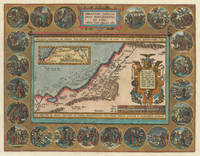
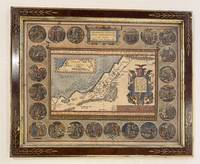
1603328971Antwerp: Ortelius Abraham 1603. unbound. Map. Engraving with hand coloring. 17 3/8 x 21 1/2" Framed in Eli Wilner carved frame.<br/> <br/> Beautiful map of the Holy Land bordered by 22 medallions depicting Abraham's wanderings. An inset map shows the path Abraham took. Ortelius used both Ptolemy and the Bible as sources for the map and based the medallion scenes on drawings by Maarten de Vos also of Antwerp. Latin text on verso. Expert repair to lower margin minor scattered stains in margins. Abraham Ortelius 1527 - 1598 a Flemish cartographer and geographer is widely regarded as one of the important and influential cartographers in history. He is known for his "Theatrum Orbis Terrarum" which was the first modern atlas. Van den Broecke 183.2 1603Lv; Laor 547C. Antwerp 1603<br/> <br/> Ortelius, Abraham unknown
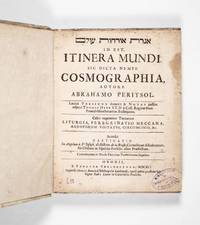
169048858Oxford: Sheldonian Theatre; Henry Bonwick 1690. First edition. Hardcover. Very Good -. Two parts quarto published in 1690 and 1691. A-Z4 pi4 b4 Aa4 Bb/CC4 Dd-Gg4 = 124 leaves. 16 196; 4 31 1 blankpp. Text in Hebrew and Latin in parallel columns. De Turcarum liturgia with separate title page dated 1690 and pagination. Contemporary vellum neatly rebacked. Old library stamp at bottom margin title front blank endleaf detached occasional oxidation spot and mild toning else a very good copy crisp and amply margined.<br /> <br /> First Hebrew-Latin edition of the first modern Hebrew work on geography the author’s most famous and important book. Abraham Farissol or Peritsol was a learned Jew from Avignon who compiled his cosmographical works at the court of the Estes in Ferrara. The present text was composed in 1524-25 and first published in Hebrew at Venice in 1586. The Latin translation and notes in the present edition were prepared by the English orientalist and librarian Thomas Hyde 1636-1703 with the assistance of R. Isaac Abendana working from a manuscript which Hyde located in the Bodleian Library. “Each of its 30 chapters deals with a certain geographical area or subject. In addition many cosmological and historical matters are also treated. The author collected all the evidence he could regarding Jewish settlements in each country. The inclusion of a description of the New World makes Farissol the first Hebrew writer to deal in detail with the newly-discovered America. The 14th chapter of Iggeret Orhot Olam which deals mainly with the settlements of the Ten Lost Tribes is of special interest. According to Farissol’s introduction to this chapter it is clear that what moved him to undertake this investigation was the appearance in Italy in 1523 of David Reuveni many of whose descriptions are included in this work†EJ 6.1185. Reuveni was "an adventurer who aroused messianic hopes in the early 16th century" EJ 14.114. The appended work is a tract on Islamic customs by Albert Wojciech Bobowski a Polish Christian who converted to Islam after his capture by the Ottoman Turks. Adopting the name Ali Ufki Bey he served as translator court musician at Topkapi and as a notator of Ottoman classical music. Bell F26. Christian Hebraism Cat. Harvard 1988 no. 39. ESTC R27480. Fürst Bibliotheca Judaica 1.276. Heller 17th Century pp. 1176-1177. Sabin 60934. Smitskamp PO 372. Vinograd Oxford 4. Wing F-438. Cf. Alden European Americana 1.187 Venice 1586; Heller 16th Century pp.732-733 ed. 1586. Full title beginning in Hebrew: ×גרת ×רחות על×<br /> Id est Itinera mundi sic dicta nempe cosmographia. Latinâ versione donavit et notas passim adjecit Thomas Hyde. Calce exponitur Turcarum liturgia peregrinatio Meccana aegrotorum visitatio circumcisio etc. Sheldonian Theatre; Henry Bonwick hardcover
161230715Antwerp: Balthasar Moretus 1612. Other. A very strong impression. In excellent condition. 353 by 457mm 14 by 18 inches. Original copper engraving published 1612 in the famous historical atlas Parergon Latin text-edition by Abraham Ortelius. Finely later hand colored in wash and outline. The map shows the travels and life of Abraham. More else this highly decorative map is surrounded by 22 fine engraved medallions which are showing episodes of the life of the Patriach Abraham. The map was published 1592 for the first time in Abraham Ortelius edition of theTheatrum Orbis Terrarum. Ortelius who created this map used as cartographical source for this map information from Ptolemy and from the bible particulary for the illustrations of Abrahams life depicted in 22 medallions. Broe. 182 Balthasar Moretus unknown
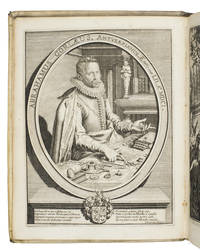
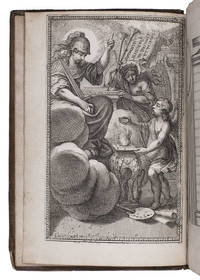
1601ABC_46116Leiden 1601. 4to. Petrus van de Aa Contemporary limp vellum manuscript title on spine. With 2 different engraved allegorical title-pages reflecting the themes of rings and intaglio-carved gems 2 letterpress title-pages in red and black with one of Van der Aas engraved allegorical devices Minerva/Athena books a cock and Hercules/Heracles with motto "studio et vigilantia" a portrait of the author by Jacques de Gheyn with a calligraphic verse by Hugo de Groot below 138 engraved plates: 196 numbered illustrations of ancient rings with carved gems shown at actual size on 101 engraved plates and 148 numbered illustrations of carved gems alone on 37 engraved plates. 2 volumes. 22 28 16 16 pp. plus 109 plates; 64 32 pp. plus 173 plates. The second much enlarged edition by the Dutch classical scholar Jacobus Gronovius of the first extensive repertory of Greco-Roman rings with intaglio-carved gems by Abraham Gorlaeus Van Goorle; 1549-1608 which Gorlaeus had published in 1601 with the title Dactiliotheca seu annulorum sigillarium quorum apud priscos tam Graecos quam Romanos usos 1601 as a catalogue of engraved gems in his cabinet of curiosities.The present edition is also remarkable as one of the earliest books too incorporate - at the end of vol. 2 pp. 1-32 - a medieval treatise on precious stones by Marbodi the bishop of Rennes ca. 1035-1123: Marbodaei Galli Poetae vetusti Carmen de gemmis sive lapidibus pretiosis. The poem is written in exquisite Latin metre and each of the 63 sections is devoted to a single gem explaining its formation appearance etymology exotic origins medical properties and preparations. In his prologue Marbodi says it is partly based on a work on the subject by the first century Arabian King Evax addressed to Emperor Tiberius.With three inserted pages with titles in German translation written by a 19th-century hand and one leaf inserted with 43 tracings of rings etc. from the book also in a 19th-century hand-writing. Bindings a little dust-soiled otherwise in very good condition.l Brunet II 1671; Ebert 8711; Kockel-Graepler Daktyliotheken Kat. 2006 pp. 111-112; Simoni G126; Sinkankas 2470; Ter Meulen & Diermanse 247; STCN 5 copies incl. 2 incomplete; Vinet 1609; cf. Ciconara 2871; J. G. van Gelder Notes on the royal collection - IV: the 'Dutch gift' of 1610 to Henry Prince of Wales'. in: The Burlington Magazine 105 December 1963 pp. 541-545; David Jaffé Aspects of gem collecting in the early seventeenth century Nicolas-Claude Peiresc and Lelio Pasqualini in: The Burlington magazine 135 February 1993 pp. 103-120; Sinkankas 2472; P. & H. Zazoff Gemmensammler pp. 31-34; for the author: NNBW 5 1921 cols. 209-210. hardcover
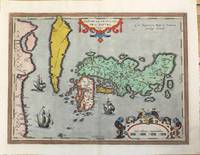
1601M10202Antwerp 1601. Very Good. Notes: Latin text on verso.<br>Rare map of Japan. Korea is depicted as an elongated island. Size : 355x480 mm 13.98x18.90 Inches Coloring: Original Hand Coloring Reference: Marcel P. R. van den Broecke #165. Category: Maps Asia Far East Japan & Korea; unknown
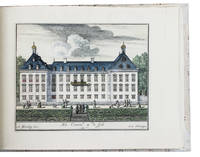
16833691Amsterdam 1683. Oblong 8vo. Modern half vellum floral chintz paper sides. With 16 numbered engraved views ca. 13 x 16 cm tipped onto blank leaves 17 x 23 cm all hand coloured. 16 ll. with engravings. Extraordinary rare first state of a very fine print series of the Honselaarsdijk palace and gardens at Honselersdijk near Naaldwijk complete with all 16 views. They are all signed numbered and captioned in Dutch and have been coloured by hand. We have not been able to find any other copies of the complete series in the first state.The monumental palace of Honselaarsdijk was built between 1621 and 1647 on the orders of the stadholder Frederik Hendrik 1584-1647 who - together with his wife Amalia van Solms and in the context of their ambition to enhance the position and power of the House of the Dutch stadholder possibly to a Royal status - was involved in a project to build a number of new prestigious castles and manor houses in and around The Hague Huis Ten Bosch Rijswijk and Honselaarsdijk as well in the country Soestdijk Het Loo Dieren etc. He financed the building of Honselaarsdijk mainly with the money coming from the "Silverfleet" captured from the Spaniards by Piet Hein in 1629. A number of important architects were involved with the Honselaarsdijk-project among others the famous Jacob van Campen 1596-1657 and Pieter Post 1608-1669. French garden architects were hired for designing the gardens. King William III further embellished the gardens under the direction of the architect Jacob Roman 1640-1716. As early as 1671 William III was personally involved with the rebuilding of the water supply system at Honselaarsdijk as evidenced by a letter of Christiaan Huygens to his brother Lodewijk. The palace later became known as "Little Versailles". After the death of William III in 1702 the estate was neglected and ultimately demolished in 1815. All that still remains is a part of the garden and parts of the coach-houses.Abraham Blooteling 1640-1690 a pupil of Cornelis Van Dalen II 1636-1664 was a Dutch engraver draughtsman and print seller. His dated prints begin to appear in 1665 and they include portraits biblical mythological and genre subjects as well as six views of Amsterdam after Jacob van Ruisdael and two of the Jewish burial-ground in Ouderkerk 1670 also after van Ruisdael. From 1672-78 he worked in London with Gerard Valck. His major contribution was in the development of the new technique of mezzotint specifically the invention of the rocker the tool used in the technique. In England the technique was adopted with such success that it later became known as the "English Manner". Blooteling was again in Amsterdam by September 1678 when he acted as godfather to his nephew Abraham Valck but he kept up his contacts with London.Between 1681 and 1685 his presence in The Hague is recorded. During these years he engraved a major view of Honselaarsdijk 385 x 482 mm after the design by Abraham Begheyn alias Bega 1637-1697. It is likely that he engraved our 16 views in the same year probably also after the drawings by Abraham Bega. However both the 16 views and the bird's eye view are now exceptionally rare. In fact the present 16 views were until now only known in their second state the reissue by Gerard Valck 1651/2-1726 in his Veues et perspectives de Loo Honslardyck et Soestdyck chasteau & maison de plaisance du Roy de la Grande Bretagne 1695. The views in the second state are numbered differently and lack Blooteling's name.Some of the views have been cut a few millimetres short on the right hand side two of the blank leaves with a crease and two pinprick holes in the bottom margin. Otherwise a fine hand coloured copy.l Hunt & de Jong The Anglo-Dutch garden pp. 136-7; cf. Hollstein II p. 216 no. 117 bird's eye view of Honselaarsdijk by Blooteling after A. Bega dated 1683 & XXI p. 267 nos. 95-16 same print-series by G. Valck dated 1695; Thieme/ Becker IV pp. 139-40; not in Springer. hardcover
1672ABC_50310Amsterdam 1672. 8vo. Jacobus Wagenaar 18th-century sprinkled paper over contemporary gold-tooled calf with a brown paper label lettered "Hobbes" on the foot of the spine mottled edges. With an engraved frontispiece a woodcut vignette on the title page an engraved portrait of Thomas Hobbes and a folding table on the classification of sciences. 16 744 64 pp. First Dutch edition of the seminal work by Thomas Hobbes 1588-1679 one of the most original political philosophers of his era. Written during his exile in Paris amidst the English Civil War 1642-1651 Leviathan presents the state as a vast artificial monster composed of individual men whose authority is necessary to protect citizens from the natural state of war. Hobbes argued that survival property and power drive human behaviour making submission to a strong sovereign preferable to the chaos of anarchy. The present Dutch translation was made by Abraham van Berkel 1630-1688 who was closely associated with the Dutch freethinking circles around Spinoza. For this translation van Berkel wrote an important preface explicitly stating the political aims of publishing his Dutch Leviathan at that particular moment in Dutch history. A close reading of the Dutch text reveals several telling deviations from the English original one of which may represent a deliberate reinterpretation of Hobbes meaning presumably intended to adapt Hobbesian ideas more effectively to a Dutch context.With 2 stamps of the Breslau library on the verso of the title page and a later pencil annotation on p. 722. The boards are rubbed the spine is worn with a tear and loss of material at the head. The leaves are somewhat browned and foxed.l Graesse III 311 u; Knuttel Verboden Boeken 185; STCN 095379150 4 copies; USTC 1808932 5 copies; cf. PMM 138 English ed. hardcover
16082092902141700962Not Available 1608. Soft Cover. Fine. Volume: 1 Not Available paperback
1658B6453Frankfurt a. M: J. Bayern J. W. W. Serlin 1658. Covers and spine worn and reinforced; otherwise generally very good. . Binding: Contemporary blind full calf; spine with four 4 bands and embossed title on two. Notes: Text in German. Gothic Script; with Latin inserts in Roman script.<br>Final and most extended edition with 67 plans. <br>This is the most expanded edition and therefore most desirable edition of this work by Saur; the first was published in 1581 the ones that followed under varying titles and the present revised work in 1658. Size: small quarto 201x115mm. Illustration: Illustrated title copper printed title with printer's device rubricated initials at openings; head and tailpieces; sixty-seven 67 city plans at 2 54 88 109 166 173 188 201 207 241 265 291 309 400 463 494 500 523 538 545 557 583 587 597 703 762 779 837 880 885 935. 4 23 37 69 76 84 93 113 117. 2 25 46 102 107. 60. 29. 10 17 74. 15 28 50 56 73. 51 84 119. 36 47 64 89 148 173 188 195. 16. Two of the plans are full-page Jerusalem/Hierosolyma and Rom/Roma; all remaining are half-page in size and comprise Aach/Aquisgranum Aix La Chapelle. Antorff/Antwerpen Augusta/Augspurg Basel Braunschweig/ Brunopolis Breszlau Bruessel Burgos Bremen Calaris Cassel Coelln/Colonia Constantinopel Dreszden Erdfurt/Erffurt Franckenberg Franckfurt am Mayn Franckfurt an der Oder Freyburg in Briszgaw Friedberg in der Wetterau Fulda Geneva/Genff Gandavum/Gent Genua Groeningen Hamburg Hanaw Heydelberg/Budoris Jena Koenigsperg Landeshut in Baeyern Leipzig Leon/Lugdun/Lion Lisabona/Ulixibona Londen/London Loeven/Lovanium Luebeck Lueneburg Luettich/Leodium/Liege Magdeburg/Meydenburg Marpurg/ Martisburgum Meintz/ Moguntiae Muenchen/Abadiaum Muenster/Monasterium Nuernberg/Norinberga Osnabruck Palma Parisz/Lutetia Parisiorum Prag/Praga Regenspurg/Ratisbona Riga Roan/Rouen/Rohmagus Rostock/Rhodopolis/ Laciburgum Schweinfurt Speyer/Nemetum Straszburg/ Argentoratum Trier/Treveris Tuebingen Venedig/Venetia Ulm/Rhetia Wien/Fabiana/Fabana/Faviana Wittenburg/Wittenberg Wormbs/ Wormatia Wuertzburg/Erebipolis/Herbipolis Zuerch/ Tigurum/Turegum. References: Graesse VI 276; Bachmann Pages: Ll: bl. 2 939 bl.; collated as: Bl.2; i-iv with illustrated title printed title dedication and to the reader; A1 -Zzzzz4 Aaaaaa1 - Eeeeee4 Ffffff1-2 A1-R4 S; A1-O4 At1-It4; Aï“1- Dï“4 Eï“1-3; aA1- mM4 nN1-2; Aa1-Ll4; An1-Rn4; ∞a1-∞z4 ∞aa1-4 bb1-3; A1-C4 bl. Category: Book Atlas & Cartography; Book Europe Germany; J. Bayern, J. W., W. Serlin unknown
1616ABC_48242Amsterdam 1616. Oblong 4to ca. 16 x 21 cm. Abraham Goos in de Kalverstraet 19th-century quarter calf with a manuscript number on the spine "32" sprinkled paper sides. With an engraved title page signed by P.Serwouter scul. bottom right after D.Vinck Boons bottom left 23 full page maps several decorated woodcut initials and woodcut tailpieces. 7 "305" =294 2 1 blank pp. Rare first edition of one of the first atlases of the Low Countries with 23 very detailed maps. It is the only atlas published by the mapmaker Abraham Goos himself. At the time the present atlas was published the Seven United provinces The Northern Netherlands were still together with the 10 provinces of the Spanish or Habsburg Low Countries. The atlas includes two maps of the Low Countries as a whole one map of each of the seventeen provinces except Drenthe which is included in the map of Overijssel four additional maps of Holland and one additional map of Brabant. Gooss maps were also used for the Atlas Minor published by Johannes Janssonius in 1628.The maps are elegantly designed with decorative title cartouches finely engraved and set in a decorative oval rectangular frame while the corners are decorated in a Renaissance style. The work was reprinted by Janssonius in 1625 and Doncker in 1685. Only the first edition was printed by Goos himself. Koeman recognizes only one Goos issue but Van der Krogt's reissue of Koeman's Atlantes Nederlandici distinguishes two of which ours is the second. The two issues are nearly identical but the second can be recognised by the imprint which includes Goos's new address "inde Kalverstraet" and the addition of the text "cum privilegio" to the maps which Goos added after receiving his privilege for this atlas on 24 December 1615 and an honorarium of 120 guilders from the States General on 8 January 1616. Generally 20 of the 23 maps of the second issue have this addition but in the present copy it is 17: the text is not present on maps 3-5 8 and 11-12.The text was written by the poet and translator Reinier Telle 1559-1618 who based it mainly on Ludovicos Guicciardinis Beschrijvinghe van alle de Nederlanden translated by Telle in 1613. Telles text was in turn the main source for the text in De Vyerighe Colom; finally that text was again used for a new edition of Guicciardinis work published by Jacob van Meurs in 1660.Abraham Goos ca. 1590-before 1643 was born in Antwerp as the son of Margaretha van den Keere the sister of the famous mapmaker Hendrik van den Keere. In 1600 Goos moved to Amsterdam where he soon was employed and trained by the Hondius family and by Willem Jansz. Blaeu. He had his own shop named "In t vergulde Caertboeck" first located op den Dam later around 1615 in the Kalverstraat. Pieter Goos Abrahams son later became famous for his sea atlases and pilot guides.With an erased ownerships entry at the head of the half-title and 18th-century annotations on pp. 136-138. The edges and corners of the boards are scuffed the boards have been rubbed with some loss of material. The first few leaves are somewhat browned a repaired hole in the lower margin of the title page false folds in the half title some marginal small tears small holes in 2 leaves with some loss of text a repaired tear in the last leaf a water stain in the outer half of the last few leaves. Otherwise in good condition.l Krogt P. van der Koemans Atlantes Neerlandici IIIB § 363 pp. 612-615 no. 363:01B; Koeman Atlantes Neerl. II p. 121 Goo 1; STCN 853385556; USTC 1032942; cf. for the text: Fontaine Verwey H. de la Reinier Telle hekeldichter pamfletschrijver vertaler in: Uit de wereld van het boek III pp. 55-86 esp. 68. hardcover
1673ABC_46764The Hague: Jan and Daniel Steucker 1673. 17th- or 18th-century calf gold-tooled spine with a red morocco title label lettered in gold blind-tooled triple fillet frame on both boards gold-tooled board edges and turn-ins red edges marbled endpapers. 4to. With 10 finely engraved scenes on the horrors of war on 8 folding/double-page plates. Further with a woodcut device on the title page and a woodcut tailpiece on the final page. First edition of a famous Dutch history book vividly describing and depicting the cruelties of war committed by the French army of Louis XIV in The Netherlands in the years 1672 and 1673. The illustrations also rank among the best masterpieces of Baroque book-illustration. By their passionate denunciation of the horrors of war Romeyn de Hooghe's illustrations stand comparison with Goya's Desastres de la Guerra. Thieme & Becker calls the artist "the most important and fertile master of the second half of the 17th century in Holland". And Furstenberg judged the present print-series "One of the few and too-little known masterpieces of the period" The Book Collector 1960 p. 432.'The text includes a detailed account of the cruelties committed by the French army of Louis XIV in the Dutch villages of Bodegraven and Swammerdam. The work was published anonymously because the author Abraham de Wicqefort 1598-1682 a diplomat and politician was well-known in Paris and at the French court. He also wrote an excellent manual for ambassadors L'Ambassadeur ses fonctions published in The Hague in 1682. The present work became popular in The Netherlands and was several times republished in Dutch with the plates reduced.With a manuscript note on the recto of the final flyleaf. Slightly foxed throughout the two double-page plates loose. Otherwise in very good condition.l Hollstein Dutch & Flemish IX pp. 90-96 only 7 plates; Landwehr De Hooghe Book Illustrator 30; STCN 851219519; Van Nierop Grabowsky etc. Romeyn de Hooghe 1673.19; Willems Les Elzevier 1874 note. Jan and Daniel Steucker], hardcover
16679027Paris 1667. 8vo 17.5 x 12 cm. Abraham Bosse Sprinkled calf ca. 1700 sewn on 5 cords 3 attached to the boards the other 2 cut flush with the bookblock richly gold-tooled spine with black morocco spine label gold-tooled board edges brown sprinkled edges. With engraved allegorical title-print 45 full-page plate size mostly ca. 13.5 x 8.5 cm and 1 double-page ca. 16.5 x 15 cm engraved plates of faces hands feet ears and other parts of the human body a camera obscura battles landscapes perspective drawings human bodies and skeletons all intended as models for artists to follow. 47; 30; 4; 4; 11 2 added engraved prints. Highly interesting collection of five 17th-century print series one a set of plates for an illustrated book all in the field of art drawing and ornamentation. They seem likely to have been printed together sometime around or soon after 1688.Ad 1: A beautiful print series intended as plates for a manual to learn the art of drawing and painting ranging from images of the human body to battle fields by the famous French artist Abraham Bosse 1602-1676. In the event the plates were published on their own and the makeup varies from set to set. Ad 2: A numbered series of 30 engravings of ornamentation that could be used in sculptural architectural art and book illustration including putti grotesque masks garlands etc. Paolo Farinati 1524-1606 worked mostly in his native city of Verona. Ad 3: A series of 4 prints showing artists at work intended to illustrate art technique. Two are devoted to drawing and the other two are devoted to painting. These prints are often considered part of the larger series described here separately as ad 1.Ad 4: A beautiful series of 4 prints representing the four elements in the form of two male and two female figures elegantly dressed with various items related to the relevant element. Blum tentatively dates the series to 1630 making it one of Bosse's earliest mature works.Ad 5: A complete set of the plates made to illustrate the first and only edition of Pierre Bullet's work on surveying Paris 1688. With a few plates primarily in ad 2 spotted but otherwise a good copy. The binding is somewhat worn and the front hinge cracked.l BAL 494 ad 5; Berlin Kat. 4355 ad 2 1736 ed.; A. Blum L'oeurve gravé d'Abraham Bosse 358-387 ad 2 940-943 ad 4 1101-1152 ads 1 3; for Bosse: Thieme & Becker IV pp. 402-403. ABE CAT Architecture ABE CAT Art History hardcover
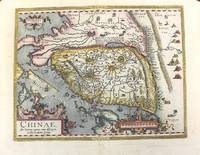
1612M10204Antwerp 1612. Very Good. Notes: Italian text on verso wide margins. <br>The first map of China to appear in a Western atlas with decorative cartouches.<br>The map is based on the work of Jorge de Barbuda a Portuguese Jesuit also known as Ludovicus Georgius whose manuscript map reached Ortelius by way of Arias Montanus. <br><br> Size : 365x470 mm 14.37x18.50 Inches Coloring: Original Hand Coloring Reference: Marcel P. R. van den Broecke #164 Category: Maps Asia Far East China; unknown
169555262Amsterdam: Be-veit ha-meshutafim Asher Anshil ben Eliezer ve-Yisakhar Ber ben Avraham Eliezer/ Moses Wiesel 1695. First edition. Hardcover. fair. Small folio 29 by 18.5 cm. Collation: aleph-vav4 zayin2 = 26 numbered leaves. Additional engraved title page engraved folding map at rear; main title with woodcut vignette; 14 half-page engraved illustrations in the text. Contemporary quarter calf over dark brown pastepaper boards skilfully rebacked. Images of Moses and Aaron at engraved title excised the seven small engraved vignettes along with letterpress text of engraved title and imprint mounted on old paper. Old marginal repairs at main title resulting in slight loss of initial letters along right margin and several leaves; slight strictly marginal worming and occasional tears. Stained throughout sometimes heavily though not impairing legibility. Map mounted to reinforce tears with virtually no loss of text or engraved imagery apart from printed border at right side. A fair copy at best; despite all defects the half-page engraved illustrations have survived intact with minimal staining. Housed in new maroon buckram slipcase.<br /> <br /> First edition of this gorgeously illustrated work now referred to simply as the Amsterdam Haggadah. The first such work to be illustrated with copperplate engravings it ranks among the most imitated of the Jewish manuals for the Passover seder. The popularity of these illustrations can be attested by the huge number of reprint editions over the centuries. Fourteen finely printed half-page engravings appear throughout the text. Some of these images illustrate the traditional content of the Passover seder or the Exodus story while others reference other biblical tales. Images include: the Rabbis of Bene Brak discussing the Passover story the four sons Abraham smashing the idols of his father Abraham welcoming the three angels Moses slaying the Egyptian overseer the rescuing Moses from the river Moses and Aaron coming to Pharaoh w/ staves turning to snakes the ten plagues the Egyptian army drowning in the Red Sea the Exodus the receiving of the Ten Commandments at Mt. Sinai the eating of the Pascal Lamb King David composing his psalms and finally an exterior view of the Jewish Temple with the cityscape of Jerusalem in the background. All images are captioned with relevant passages in Hebrew. The engravings were all created by Abraham ben Jacob a German convert to Judaism who had moved to Amsterdam although some sources over the years misattributed them to financier Moses Wiesel 6 of which were adaptations and/or modifications of previous images by Swiss artist Matthäus Merian 1593-1650 from his original work "Icones Biblicae" 1625-30.<br /> <br /> In addition to the in text engravings there is famously fold-out engraved biblical map of the Holy Land in a notable format. Measuring a total of 19.5 by 11.5" the map shows the land of Israel the Wilderness of Sinai and Egypt in landscape orientation looking eastward towards the top of the map. It traces the journey of the Israelites starting with the Exodus from Egypt through the Sinai and into the Land of Israel. The map is detailed showing the areas of the twelve tribes important locations and cities as well as geographic features including the Red Sea Mount Sinai the Dead Sea the Sea of Galilee and many others. Additional illustrations appear near the bottom along with a legend. This beautiful work also by Abraham ben Jacob is considered among the earliest if not the first map of its kind to be printed within a Hebrew publication. It is now known to have been heavily based on the previously printed 1620 map in Hebrew by Jacob ben Abraham Zaddiq and Abraham Goos 1590 - ca. 1643 which itself was based on the map of 1590 by Christian Kruik van Adrichom Adrichem printed in Latin.<br /> <br /> Text throughout is printed in Hebrew with smaller text in Rashi script underneath containing famous commentary on the Passover Haggadah by acclaimed Portuguese Rabbi and scholar Isaac ben Judah Abarbanel 1437-1508. The verso of the title page contains the order of the Passover seder with brief instructions in both Ladino Judeo-Spanish and Yiddish Judeo-German a nod to the subtitle which references both the Ashkenazi and Sephardi traditions.<br /> <br /> Provenance and annotations: Full page of text appx. 1500 words in neat Hebrew cursive at front endleaf which discusses aspects of the Haggadah text; inscription in German at front endleaf by Isidor Adler who mentions his friend Hermann Mechlenburg dated March 1906; old annotations throughout in at least two hands. In one notable instance the Hebrew phrase l'shana ha-ba'ah be-hamburg next year in Hamburg! has been added in fine block characters above the traditional phrase l'shana ha-ba'ah bi-yerushalayim next year in Jerusalem. Hebrew title: סדר הגדה של פסח ×›×ž× ×”×’ ××©×›× ×– וספרד <br /> Alternate transliterations: Seder Hagadah shel Pesah Seder Hagadah sel Pesah<br /> <br /> References: Friedberg 278 Fuks HTN II 521; Yudlov Haggadah 93; Vinograd Amsterdam 627; Ya'ari no. 59; Laor 876 Map; Nebenzahl pp.138-1389 Map; Yerushalmi plate 59-62; Rosenau "Vision of the Temple" p.135 146-7. Be-veit ha-meshutafim [Asher Anshil ben Eliezer ve-Yisakhar Ber ben Avraham Eliezer]/ Moses Wiesel hardcover
16193941Dordrecht & Amsterdam 1619. Folio. Isaack Jansz. Canin & Jan Evertsz. Cloppenburgh 17th- or 18th-century gold-tooled calf sewn on 6 supports with corresponding raised bands on the spine with a red morocco title label lettered in gold in the second compartment. The boards show a very detailed floral patterned lozenge center-piece within a triple fillet frame with large highly detailed corner-pieces with remnants of ties. With an engraved title-page and 106 very vivid woodcut illustrations of tortured and/or executed martyrs several repeats the text alternately set in roman and gothic type. 14 632 46 ll. First edition of the first official Dutch Reformed Protestant martyrologium composed by Abraham Mellinus ca. 1580-1622. Born at Vlissingen Mellinus studied at Leyden and became Minister at St. Anthonispolder and Cellartshoek. The present "first" volume of his "History of Christian Martyrs" runs to 1520 it is the only volume ever published. It was dedicated by the author to Prince Maurits of Orange and to the Synode of Dordrecht who both rewarded the author with a good sum of money. The work showed great learning and was at the time much praised. The author planned to write a second volume but he died before this was really started. In 1622 Balthasar Lydius Minister at Dordrecht then was ordered to write the second volume but he also died so a second volume never appeared. Mellinus' Martyrologium especially enraged the Roman Catholics.With the bookplate of Paul Hildebrandt mounted on the front paste-down and an ownership stamp and inscription of "Ds. H.C. Hopkins militêre kamp Wynberg K. 31. 8. 1965." on the recto of the first flyleaf. The binding shows clear signs of wear the leather around the corners of the boards is somewhat damaged showing the paperboard beneath some loss of material at the head and foot of the spine. Internally fine and clean except for some very slight thumbing at the start of the work and a tear in one leaf. Otherwise in good condition.l Bibl. Belg. M. 317; De la Rue p. 225; De Wind p. 502; Knuttel Ned. Bibliogr. Kerkgesch. p. 215; NNBW VII col. 858; STCN 83335423X 8 copies; USTC 1028377 9 copies incl. 7 also in STCN. hardcover
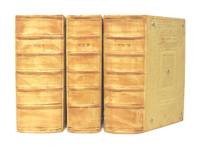
168110510Wittenberg Christian Schrödtern 1681-1682. 3 volumes 52 1189 2378 columns 28 601 1202 columns 1 32 524 1048 columns 28 688 1376 columns 1 48 602 1204 columns 26 751 1502 columns 96 1 p. Blind-stamped Leather with 5 raised bands each board equipped with 5 brass studs Folio Facsimile Edition of the famous Bach Bible in 3 volumes all kept in a perfectly fitting wooden case decorated with gilt. The set contains a true and complete reprint of Bach's Bible being a German Bible with extensive commentaries by Abraham Calovius founded on the writings of Martin Luther. This is the first complete facsimile-edition of Bach's Bible published by the Dutch publisher Uitgeverij Van Wijnen after the original being preserved in Concordia Seminary Library St. Louis. Each volume contains Bach's handwritten monogram on the title page and the set contains a total of 348 additions by Bach. Among which many underlined passages -both in red and black ink- various corrections of typographical and grammatical errors but most importantly his comments in the margins. A unique glimpse into Bach's personal beliefs and how he understood his vocation. Wittenberg, Christian Schrödtern hardcover
162451428Köln Ioannis Gymnici Antonius Boetzer 1624 a. 1621-1640. Folio. 40 x 26 cm. Bound in 8 thick uniform contemporary full pigskin bindings over wooden boards. Raised bands and richly blind-tooled boards. Title labels with gilt lettering. Clasps missing. Spines a bit rubbed. Wear to some spine-ends. Some upper compartments with nicks one volume having a tear in leather at upper compartment. One volume with a small loss of leather to upper compartement. With engraved title-page engraved portrait of Baronius engraved portrait of pope Urban VII. More than 10.000 pp. Printed in double-columns. In general internally fine. <br/><br/><em>Baronius's monumental work with its continuation by Bzovius up to the year 1565 hailed by Roman Catholic writers as the greatest history of the church ever written and Baronius hailed as the "father of ecclestical history" 1-12 dealt with Anno 1-1198 and volume13 -20 Anno 1198-1565."The Annales were first published between 1588 and 1607. This work functioned as an official response to the Lutheran Historia Ecclesiae Christi History of the Church of Christ. In that work the Magdeburg theologians surveyed the history of the Christian church in order to demonstrate how the Catholic Church represented the Antichrist and had deviated from the beliefs and practices of the early church. In turn the Annales fully supported the claims of the papacy to lead the unique true church."Before Baronius was appointed Librarian of the Vatican in 1597 he had access to material and sources in its archives that were previously unpublished or unused. He used these in the development of his work. Accordingly the documentation in Annales Ecclesiastici is considered by most as extremely useful and complete. Lord Acton called it "the greatest history of the Church ever written"."Graesse I 296. - Brunet I 662-631. </em> hardcover
167376SED10JGA06The Hague 1673. 4to. Jan and Daniel Steucker Contemporary vellum with the gold-stamped and crowned initials "E.F.V.D" on the front board. With 10 scenes on the horrors of war on 8 folding engraved plates ca. 31 x 20 cm by Romeyn de Hooghe. 1 1 blank 202 pp. First edition of a famous Dutch history book vividly describing as well as depicting the cruelties of war committed by the French army of Louis XVI in The Netherlands in the years 1672 and 1673. The illustrations also rank among the best masterpieces of Baroque book-illustration. By their passionate denunciation of the horrors of war Romeyn de Hooghe's illustrations stand comparison with Goya's Desastres de la Guerra. Thieme & Becker calls the artist "the most important and fertile master of the second half of the 17th century in Holland". And Furstenberg judged the present print-series "One of the few and too-little known masterpieces of the period The Book Collector 1960 p. 432.''The text includes a detailed account of the cruelties committed by the French army of Louis XIV in the Dutch villages of Bodegraven and Swammerdam. The work was published anonymously because the author Abraham de Wicqefort 1598-1682 a diplomat and politician was well-known at Paris and the French court. He also wrote an excellent manual for ambassadors: "L'Ambassadeur ses fonctions" published at The Hague in 1682. The present work became popular in The Netherlands and was several times republished in Dutch with the plates reduced.Back hinge loosening. Fine large paper copy with contemporary manuscript owner's entry on the title page. Otherwise in good condition.l Hofer Baroque Book Ill. plate 140; Hollstein Dutch & Flemish IX pp. 90-96 only 7 plates; Landwehr De Hooghe Book Illustrator 30; Nierop Grabowsky etc. Romeyn de Hooghe 1673.19 p. 263; STCN 851219519; Thieme & Becker XVII p. 458; Willems 1874. hardcover
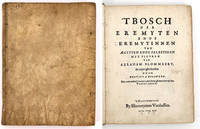
16191516Hantvverpen Antwerp: Hieronymus Verdussen 1619. First Edition in book form. Near Fine. Bloemart Abraham. 4to 8 7/8 x 6 3/4 inches 251 x 171 mm. ix pp 51 sheets on cream laid paper text in Dutch gothic letters. 50 numbered full page copperplate engravings of Christian hermit saints 25 male 25 female printed recto with text pages on verso. Full-page frontispiece for the work and with an additional full-page frontispiece for each of the two sections. Full contemporary vellum untitled with some handling discoloration but the vellum remains supple and the binding is tight. Pages clean and bright with a couple of foxing spots and a small brown stain on the 2nd frontis titled "Sacra Eremus ascetarum"; toned page edges. Previous owner's name and date in ink on front flyleaf and small pencil and ink notations inside back cover; bookplate of Buijnsters Smets pasted inside front cover.<br /> De Backer/ Sommervogel VII 194-5; Hollstein 355-403; Roethlisberger 163 ill. 262-317<br /> <br /> Full title: 't Bosch der Eremyten ende eremilinnen van Aegypten ende Palestinen met figuren van Abraham Blommaert door Ghristophorus a Sichem. Met kort verhael van een yders leven getrocken uyt het Vadersboeck door H. Jan van Gorcum Priesler ende H. R. Societatus sic Jesu. The Forest of the Hermits of Egypt and Palestine with illustrations by Abraham Blommaert engraved by Ghristophorus a Sichem. With brief stories of their lives taken from the book of the Fathers by H. Jan van Gorcum priest of the Society of Jesus. A fine series of engravings of the early Christian male and female hermits living in the Egyptian and Palestinian desert engraved in copper by Boetius A Balswert on drawings by Abraham Bloemart 1566 - 1651 the Dutch painter and engraver know mostly for his historical subjects and for being a central figure and teacher among the Utrecht Caravaggisti. <br /> Provenance: the library of the book- and art-historians Piet Buijnsters and Leontine Smets. Hieronymus Verdussen unknown
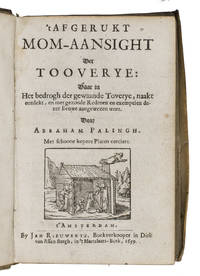
1659ABC_47611Amsterdam: J. Rieuwertz 1659. Contemporary overlapping vellum. Small 8vo. With a woodcut title-vignette showing a witch on a broomstick leaving a house through the chimney 4.3 x 5.2 cm 13 etched full-page illustrations on 8 plates by Salomon Savry. An exceptionally rare first edition of a book focusing on the subjects of witchcraft sorcery demonology and black magic. The author passionately expresses his dissatisfaction with the brutalities inflicted upon individuals accused of being witches using vivid and disturbing illustrations as evidence. Notably the book features a captivating woodcut title vignette depicting a witch's daring escape through a chimney. In the image her legs hang from the opening inside the house while she simultaneously rises on her broom outside the chimney creating a striking visual effect. Abraham Palingh is a somewhat elusive figure in Early Modern Dutch literature and his book provides a fascinating insight into the attitudes of an educated man toward witchcraft. He claims that his 't Afgerukt Mom-aansight Der Tooverye is based on firsthand accounts. Information regarding the occurrence of harmful sorcery and attitudes towards sorcery in Amsterdam and Haarlem has been documented from the initial witchcraft trials to the point where such crimes were no longer a concern for the judiciary. Between 1542 and 1566 trials for harmful sorcery took place in Amsterdam while Haarlem witnessed similar trials in 1549. Historical accounts of both cities as well as Jacobus Scheltema's History of Witch Trials published in Haarlem in 1828 make mention of sorcery trials in Amsterdam. However these references often provide only superficial details despite the potential for valuable insights found in the actual procedural documents. Conversely little information about witchcraft in Haarlem can be gleaned from existing literature. Abraham Palingh author of 't Afrukt Mom-aansight der Tooverye published in Haarlem in 1659 briefly mentions a few cases of sorcery accusations that he claims to have personally known yet his accounts remain vague.The fine and copperplate illustrations were made by Salomon Savry 1594-1683. He was a recognised engraver of his time highly involved with the Amsterdam book industry of the seventeenth century. Some wear to binding. Ex libris from the library of Leontine Buijnsters-Smets. Light browning and foxing. Otherwise in very good condition.l Bibl. Med. Neerl. I p.150; Muller 539 1725 edition; Scheepers I 552; STCN 841091951 12 copies; Waller 1315 1725 edition; WorldCat 56854247 3 copies. J. Rieuwertz, hardcover
169555736Amsterdam: Be-veit ha-meshutafim Asher Anshil ben Eliezer ve-Yisakhar Ber ben Avraham Eliezer/ Moses Wiesel 1695. First edition. Hardcover. g to near fine. Small folio 30 by 18.8 cm. Collation: aleph-vav4 zayin2 = 26 numbered leaves. Full period brown paper boards re-backed with a brown leather spine with raised bands.<br /> <br /> Letterpress title-page with ornate floral woodcut device; additional engraved title-page mounted depicting Moses and Aaron along with six small biblical scenes within round borders all against an architectural background. Engraved folding map at rear mounted; main title with woodcut vignette; 14 half-page engraved illustrations in the text.<br /> <br /> This gorgeously illustrated work is the first edition of the famous and highly influential Passover Haggadah printed in Amsterdam in 1695. Simply known as the Amsterdam Haggadah this edition stands as among the most imitated and copied haggadahs in history and was the first to be illustrated with copperplate engravings. Previous illustrated haggadahs had used woodcuts. The popularity of these illustrations can be attested by the huge numbers of reprint editions over the centuries. There are 14 finely printed large in-text engravings plus the full page engraved title page showing Moses Aaron and Adam in the Garden of Eden. Some of these images illustrate the traditional content of the Passover seder and/or the exodus story while some are other biblical stories less directly related. Images include: the Rabbis of Bene Brak discussing the Passover story the four sons Abraham smashing the idols of his father Abraham welcoming the three angels Moses slaying the Egyptian overseer the rescuing Moses from the river Moses and Aaron coming to Pharaoh w/ staves turning to snakes the ten plagues the Egyptian army drowning in the Red Sea the Exodus the receiving of the Ten Commandments at Mt. Sinai the eating of the Pascal Lamb King David composing his psalms and finally an exterior view of the Holy Temple with the cityscape of Jerusalem in the background. All images are captioned underneath with relevant passages in Hebrew. The engravings were all created by Abraham ben Jacob a German convert to Judaism who had moved to Amsterdam although some sources over the years misattributed them to financier Moses Wiesel 6 of which were adaptations and/or modifications of previous images by Swiss artist Matthäus Merian 1593-1650 from his original work "Icones Biblicae" 1625-30.<br /> <br /> In addition to the in text engravings there is famously a phenomenal fold-out engraved biblical map of the holy land. Measuring a total of 19.5x11.5" the map shows the land of Israel the Sinai desert and Egypt in landscape orientation looking eastward towards the top of the map. It traces the journey of the Israelites starting with the Exodus from Egypt through the desert and into the Land of Israel. The map is detailed showing the areas of the twelve tribes important locations and cities as well as geographic features including the Red Sea Mount Sinai the Dead Sea the Sea of Galilee and many others. The map is decorated with additional illustrations near the bottom and includes a key. This beautiful work also by Abraham ben Jacob is considered among the earliest if not the first map of its kind to be printed within a Hebrew publication. It is now known to have been heavily based on the previously printed 1620 map in Hebrew by Jacob ben Abraham Zaddiq and Abraham Goos 1590 - ca. 1643 which itself was based on the map of 1590 by Christian Kruik van Adrichom Adrichem printed in Latin.<br /> <br /> Text throughout is printed in Hebrew with smaller text in Rashi script underneath containing famous commentary on the Passover Haggadah by acclaimed Portuguese Rabbi and scholar Isaac ben Judah Abarbanel 1437-1508. The verso of the title page contains the order of the Passover seder with brief instructions in both Ladino Judeo-Spanish and Yiddish Judeo-German a nod to the subtitle of Haggadah which references the both Ashkenazi and Sephardic traditions.<br /> <br /> This copy with binding in beautiful condition with being professionally restored includining spine re-backed to style. Book block tight. Interior with some staining to pages throughout from use. Binding in very good to near fine inteiror in good condition overall. Hebrew title: סדר הגדה של פסח ×›×ž× ×”×’ ××©×›× ×– וספרד <br /> Alternate transliterations: Seder Hagadah shel Pesah Seder Hagadah sel Pesah<br /> <br /> References: Friedberg 278 Fuks HTN II 521; Yudlov Haggadah 93; Vinograd Amsterdam 627; Ya'ari no. 59; Laor 876 Map; Nebenzahl pp.138-1389 Map; Yerushalmi plate 59-62; Rosenau "Vision of the Temple" p.135 146-7. Be-veit ha-meshutafim [Asher Anshil ben Eliezer ve-Yisakhar Ber ben Avraham Eliezer]/ Moses Wiesel hardcover
1658ABC_47326Amsterdam 1658. Folio. Pieter Goos Contemporary vellum with a manuscript title on the spine. With a half-page engraving on the half-title a woodcut vignette on the title-page 6 folding engraved tables and numerous woodcut mathematical diagrams figures tables and other illustrations in the text. With woodcut tailpieces and woodcut decorated initials. 7 parts in 1 volume. 1 1 blank 8 39 1 blank; 2 4 45 1 blank 90 5-91 1 blank; 96; 86 2 blank; 39 1 blank; 60 18 2 blank; 96 7 1 blank pp. Rare first edition of Abraham de Graaf's mathematical work published for nautical experts studying navigation. The mathematical and astronomical theories are illustrated with countless woodcut diagrams and figures in the text and 6 additional folding engraved plates. Included are numerous incredibly detailed logarithmical and other mathematical tables mainly in the second book. "The tables are the first logarithmical tables in a Dutch navigation book. The tables are probably computed and computed and enlarged by Adriaen Vlacq and based on those of John Napier and Henry Briggs" Crone 210.The present work comprises 7 parts with individual title-pages each dated 1657 bound and published as one with two general title-pages and a comprehensive index. The subject of the "books" include for example: astronomy geometry calculations regarding compasses cartography concerning "paskaarten" a type of nautical chart and observation and navigation at sea.Binding browned and somewhat worn mainly the back board some mould spots on the pastedowns and flyleaves some light water staining to the head margin slight foxing throughout. With a tear in the 3rd and 4th folding plates. Overall in good condition.l Bibl. Nautica 2048; Cat. NHSM p. 666; Crone Library 210; STCN 09324195X 6 copies; WorldCat 1156962499 1 copy 993578800 1 copy 1154627661 8 copies; for the author: NNBW part 10 cols. 293-296. hardcover
161918555<p>Very Good HC. Text in Dutch blackletter; tekst in het Nederlands gotisch. Full contemporary vellum; untitled; raised bands on spine; red edges; 50 numbered full page copperplate engravings of Christian eremite saints 25 male 25 female printed recto with text pages verso; full page frontispiece for work as well as full page frontispiece for female section. Vellum in very good condition with some handling discoloration remains supple; ties at cover fore edges lacking; tightly bound; few pencil notes on front pastedown; without free end papers; lacking frontispiece for male section leaf A!; facsimile laid in; few leaves with light damp stains or soiling mostly in margins otherwise light and clean interior; one leaf B3 with large chip at top fore corner not affecting portrait but with some text missing from marginal notation on verso see photo; all leaves remain supple. 25 x 18 cm; 51 text pages; 50 numbered plates 2 frontispiece plates; in 4s. Ref OCLC #901301549.</p> Hantvverpen (Antwerp): Hieronymus Verdussen hardcover
169640906Leiden and Utrecht: Pieter vander Aa and François Halma 1696. Two volumes folio. 15 5/16 x 10 1/4 inches. Half title title printed in red and black with engraved vignette. Engraved additional title and 243 engraved plates. Contemporary Dutch blindstamped vellum with arabesque design.<br/> <br/> Provenance: Karl Magnussun bookplate – John David Drummond 8th Earl of Perth Viscount Strathallan<br/> <br/> First expanded edition of one of the most attractive Dutch florilegia of the seventeenth century.<br/> <br/> Munting was professor of botany at the University of Groningen and took over and enlarged the botanic garden founded by his father Henricus. The present work depicts some of the exotic and remarkable plants growing in the garden. It is one of the earliest and most important documents concerning Japanese flora and its importation into the West predating Thunbergs works by almost one hundred years. "Munting wrote a number of works on medical-botanical topics but his posthumously published opus magnum the Naauwkeurige enjoyed particular success at least in part due to the novelty of the plates which in a radical departure from the iconography of the traditional florilegium presented its plant species against a charming series of landscape backgrounds . The illustrations are remarkable for their elegance and originality" Oak Spring Flora. The initial botanical line drawings are now known to have been by about ten different but unidentified artists. Some time after Munting's death and in preparation for their publication these line drawings had tone and the pictorial back- and fore-grounds added by Jan Goeree 1670-1731 under the supervision of the publishers. The engraving and etching was then carried out by Jacob Gole and Joseph Mulder engraver of many of plates in Maria Sibylla Merians work on the insects of Surinam.<br/> <br/> Hunt 396; Nissen BBI 1428; Tomasi Oak Spring Flora 45 latin edition; Pritzel 6556; Brunet 1947. Pieter vander Aa and François Halma unknown
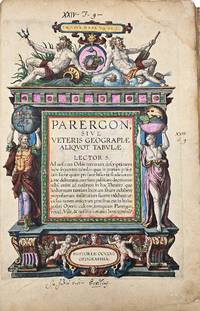
160312720Antwerp Jan Baptist Vrients 1603. Parergon sive veteris geographiae aliquot Tabulae . Engraved title 33 maps of the Ancient World 2 plates with costumes and 3 views ""Tempe"" ""Daphne"" and ""Escorial"". H. 43 x W. 30 cm. / H. 16.90 x W. 11.8 inch. A fine and complete copy of the Parergon by Abraham Ortelius 1527-1598 published in Antwerp in 1603. This celebrated companion to the Theatrum Orbis Terrarum represents one of the earliest and most influential works of historical cartography. The volume contains a full suite of maps illustrating the ancient world including the Roman Empire classical Greece and Biblical regions. All maps are original contemporary hand coloured exceptionally well-preserved and vibrant throughout. The engraved title page is richly decorated with allegorical figures and classical motifs. Latin text on verso. A highly decorative and scholarly work reflecting the humanist interest in antiquity and geography. Light age toning and occasional marginal wear are consistent with age. Overall a very attractive copy. Antwerp, Jan Baptist Vrients unknown