BLOEMAERT, AbrahamBiblio.com
254 résultats
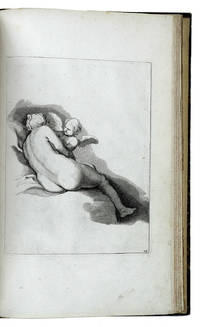
1730D8IBHTPY7SFPAmsterdam 1730. Folio. Reinier & Joachim II Ottens Half mottled sheepskin ca. 1840 sewn on 4 cords the spine has 5 gold-tooled raised bands but the middle one may be merely decorative papier coulé sides red spine-label red sprinkled edges. With a letterpress title page printed in red and black an engraved frontispiece self-portrait of Bloemaert engraved by Joachim Ottens here serving as no. 1 of 140 otherwise numbered engraved plates including illustrated part-titles for parts 2-6 with drawn models of parts of the human body and human figures and characters in various postures movements and scenes. 1 leaf plus plates. Famous drawing book of Abraham Bloemaert 1564-1651 a very influential Dutch painter and art teacher. It contains 140 numbered engraved plates with no text providing models for drawing parts of the human body including eyes ears noses faces hands feet arms legs busts heads hair styles and beards some for men women and children as well as human figures and character types in various postures kinds of movement also including men women and children. Four plates give models for drawing animals and animal's heads including horses cats a dog a fish a lion and cattle. In good condition and with generous margins with a small tear and minor smudges in the title-page the first and last leaves slightly browned and a few unobtrusive restorations. A classic Dutch drawing book providing a storehouse of human forms that influenced many artists for more than a century.l WorldCat 1 or 2 copies; cf. Bolten Method & Practice. Dutch & Flemish drawing books pp. 51-67; Hollstein II p. 86 nos. 36-155 ca. 1650-ca. 1657 F. Bloemaert ed. of parts 1-6. ABE CAT Art History hardcover
172037027A AMSTERDAM: TOMO 1º 4ª et Dernière Edition corrigée et augmentée Chez Zacharie Chatelain 1739 Avec Privilege; TOMO 2º primera parte Nouvelle Edition Chez L'Honore & Chatelain Libraires 1720; TOMO 3º o segunda parte del tomo segundo Nouvelle Edition Chez L'Honore & Châtelain Libraires 1720; TOMO 4º Nouvelle Edition revue corrigée et considerablement augmentée Chez Zacharie Chatelain 1725; TOMO 5º Seconde Edition corrigée et augmentée Chez Zacharie Châtelain 1732 Avec Privilege; TOMO 6º Seconde Edition corrigée et augmentée Chez Zacharie Chatelain 1732 Avec Privilege; TOMO 7º & dernier Chez Zacharie Chatelain Libraire 1732 Avec Privilege.- CONTIENE CADA VOLUMEN: TOMO 1º 8 h. 8p. 2 h. 2 h. 8 p. 2 h. 9-24 p. 14 h. 25-38 p. 5 h. 39-50 p. 3 h. 51-66 p. 10 h. 67-74 p. 12 h. 75-82 p. 8 h.: Con 46 grabados al cobre a saber 1 in-frontis grabado por B. Picort 26 mapas plegados 19 cuadros genealógicos heráldicos y cuadros sinópticos de historia muchos plegados. TOMO 2º primera parte 8 h. 12 p. 6 h. 13-18 p. 5 h. 19-30 p. 4 h. 31-44 p. 4 h. 45-58 p. 12 h. 59-66 p. 17 h. 67-90 p. 6 h.: Con 37 grabados al cobre a saber 1 in-frontis grabado por Sluyter 12 mapas plegados 25 cuadros genealógicos heráldicos y sÃntesis históricas muchos plegados hasta en tres partes / además 7 textos impresos que van numerados correlativamente con los grabados. TOMO 3º o segunda parte del tomo segundo 6 h. 91-120 p. 20 h. 121-130 p. 6 h. 131-136 p. 17 h. 137-144 p. 10 h. 145-154 p. 4 h. 155-162 p. 8 h. 2 h.: Con 30 grabados al cobre a saber 18 mapas muchos plegados 12 cuadros genealógicos históricos administrativos etc. bellamente ilustrados / además 6 textos impresos con aclaraciones históricas que van numerados correlativamente con los grabados. TOMO 4º 6 h. 14 p. 5 h. 15-62 p. 31 h. 63-70 p. 19 h. 71-86 p. 6 h. 87-98 p. 13 h.: Con 30 grabados al cobre a saber 1 in-frontis por P. Siurter 15 mapas plegados 18 cuadros genealógicos láminas de costumbres y enumeración de muchas casas reales con sus reyes escudos de armas y blasones. TOMO 5º 4 h. IV p. 2 h. 196 p. pero son 198 p. ya que se repite por error el nº 127-128 : Con 58 grabados al cobre a saber 1 in-frontis 13 mapas plegados 44 cuadros genealógicos sinopsis históricas cuadros de costumbres con ilustraciones. TOMO 6º 1 h. IV p. 2 h. 166 p. por error de impresión la página nº 48 figura con el nº 41 pero continúa correctamente la numeración: Con 38 grabados al cobre a saber 16 mapas plegados 22 láminas con sinopsis históricas cuadros de costumbres plantas y animales descripción y planos de ciudades reyes etc. NO TIENE LA LAMINA Nº 30 "CARTE TRES CURIEUSE DE LA MER DU SUD" PERO HA SIDO FIELMENTE REPRODUCIDA EN FACSIMIL Y ESTA BELLAMENTE ILUMINADA. TOMO 7º 2 h. IV p. 2 h. 112 p.: Con 40 grabados al cobre a saber 1 grabado in-frontis por B. Picaut 9 mapas plegados 32 grabados plegados con cuadros genealógicos de las casas reales escudos y blasones órdenes de caballerÃa y sus escudos y cuadros históricos ilustrados / también lleva impresas 4 sÃntesis de Historia Sagrada que van correlativamente numeradas con los grabados; En gran folio 465 x 304 cm.; Excelente impresión a 2 columnas sobre magnÃfico y grueso papel de hilo verjurado; Portada a dos tintas; Texto en francés; Enc. de la época en Plena Piel pasta antigua lomo con 7 nervios y cuajado en oro. La encuadernación tiene las esquinas rozadas y con pequeñas faltas de piel la cabeza y pie de los lomos también con pequeñas faltas. Particularmente al Tomo 3º le falta un trozo de piel al pie del lomo de 35 cm. al Tomo 5º le falta un trozo de piel en la cabeza del lomo de 13 cm. en disminución y una grieta de 10 cm. mas abajo. Todo esto ha sido reparado en lo posible quedando los libros con buen aspecto. El interior en muy buen estado salvo varias hojas en general muy pocas que tienen algunas motas de óxido y la lámina Nº 9 del Tomo 1º que tiene la parte superior del tÃtulo cortada por error del encuadernador. Como ya hemos indicado anteriormente al Tomo 6º le falta la lámina Nº 30 que es un precioso gran mapa plegado y dividido en 2 partes hemisferio norte y hemisferio sur titulado "Carte tres curieuse de la Mer du Sud" pero va incluÃda en su lugar una reproducción facsÃmil a tamaño real del original bellamente iluminada e impresa sobre papel especial. H. A. Chatelain fue un pastor hugonote de origen parisino que vivió en ParÃs St. Martins Londres ca. 1710 La Haya ca. 1721 y Amsterdam ca 1728. Es reconocido como un gran cartógrafo alemán en especial por su gran obra el "Atlas Historique" que fue publicado en Amsterdam entre 1705 y 1720. Innovador para su tiempo por la gran calidad y exactitud cartográfica de sus mapas bellamente grabados al cobre que iban acompañados con gran cantidad de planchas igualmente grabadas al cobre conteniendo multitud de datos históricos genealógicos heráldicos nobiliarios etnográficos cosmográficos todos ellos bellamente ornamentados artÃsticamente con muchas ilustraciones. Cada lámina va numerada individualmente e indicando el número de tomo correspondiente. Los grabados y tablas de esta obra están realizados por los mejores autores del momento como: Dapper Chardin de Bruyn Le Hay y otros. Muchos mapas están basados en los trabajos del gran geógrafo Guillaume de L'Isle. Esta formidable obra fue presentada por la Familia Chatelain en forma de enciclopedia. Los textos van impresos a dos columnas por lo general. Al parecer algunos eruditos dudan de que Henri Abraham Chatelain fuese el único autor de esta magna obra - ya que en el libro solo figuran escritas como autor las iniciales "Mr. C."- y suponen que en su realización colaboró toda la familia en especial su hermano ZacarÃas Chatelain y su padre tambien ZacarÃas. GEOGRAFÃA GUÃAS Y ATLAS DEL EXTRANJERO Livre en français Chez Zacharie Chatelain, Chez L'Honore & Chatelain Libraires hardcover
179912534Paris: Du Pont 1799. Three engraved maps 465 by 420 mm 550 by 340 mm and 530 by 350 mm respectively with fine contemporary hand-colour in full old folds. These maps from the library of the Rochambeau family were published in the first edition of Rochefoucauld-Liancourt's travels in the United States 'Voyage Dans les États-Unis D'Amérique Fait en 1795 1796 et 1797 " Paris 1799 annotated in an early 19th-century hand after Abraham Bradley Junior's 1796 map 'A Map of the United States. Exhibiting Post Roads & Distances'. They are reduced copies of the 1796 first edition of Bradley's map and are therefore the first French edition of these maps. The Comte de Rochambeau 1725-1807 was a battle-hardened French general chosen by King Louis XVI in 1780 to command the expeditionary corps in the United States under the orders of General George Washington. Their combined success at the Siege of Yorktown on the 19th of October 1781 ended the Revolutionary War and secured American independence. 1."Carte générale des États-Unis de l'Amérique Septentrionale divisée en ses 17 provinces" annotated in an early 19th-century hand numbering each of 16 states giving the location of Native American tribes providing a key showing the major post roads from Main to South Carolina all after Abraham Bradley's map of 1796 acknowledged by the inscriber who has replaced the imprint with "par Abraham Bradley Jun.r" This map of the East Coast extends from Quebec south to include part of East and West Florida; the western boundary of Georgia extends to the Mississippi River; a strip of land extending westward between Georgia and Tennessee is designated "United States Territory" having been ceded back to the United States in 1787 from South Carolina; another strip between Georgia and West Florida is "Land claimed by the united states" referring to the ongoing dispute between the United States and Spain; all the land to the west which would become the Louisiana Purchase is "Spanish Territory Louisiana." English captions and French title. Manuscript ink annotations in French indicating the names of the 17 states and the position of the Indian tribes. Ink manuscript inscription to verso "IK 403" shelfmark of Rochambeau family library and as "Etats-Unis en 17 provinces." 2. The "Carte des États-Unis Provinces méridionales" shows Kentucky Virginia Tennessee North and South Carolina Georgia a strip of land between Tennessee and Georgia as "United States Territory" and to the south of Georgia "Land claimed by the united states". 3. The "Carte des États-Unis provinces Septentrionales" shows the states from Main sic to Maryland and Delaware. François Alexandre Frédéric duc de La Rochefoucauld-Liancourt 1747-1827 was a French writer and courtier. A social and scientific reformer he was elected to the Estates-General and pushed for changes to the absolute monarchy of France. Rochefoucauld-Liancourt was the first to warn Louis XVI of the fall of the Bastille; when the king called it a revolt Rochefoucauld Liancourt replied "No sire it is a revolution". Despite being sympathetic to the original aims of the Revolution and serving as the first president of the Constituent Assembly he opposed republicanism and secretly tried to arrange for the escape of the king. Following the storming of the royal palace in August 1792 and the beginning of the September Massacres later that same year precipitated his flight from France and he went into self-imposed exile in America. From London in September 1794 Angelica Schuyler Church wrote to her brother-in-law Alexander Hamilton with a glowing introduction. Liancourt made his was to Philadelphia in November and travelled extensively from "le Haute-Canada" above Lake Ontario to Charleston South Carolina taking notes on everything from the economy to slavery to agriculture. After returning to France in 1799 when Napoleon took power he published his analysis as an eight-volume work in which these maps were published. Related Letters and Historic Background Angelica Church to Alexander Hamilton September 19 1794: "My dear Brother I have very particular and very good motives to ask your kindness for the Duke de Liancourt. he loved Liberty with good sence and moderation; and he meant so well towards his country as to introduce into France a better system of Agriculture and to soften the situation of the Lower class of people there: Virtue has not found its reward for in the many scenes of distress that has afflicted his unfortunate country he like many more good men has been obliged to leave his possessions and seek an Asylum in this country. He goes to America and goes there without a friend unless my dear Brother who is always so good will extend to Monsieur de Liancourt his ease. besides many good Qualities this gentleman is the friend of the Marquis de La Fayette. Angelica Church." On April 10 1795 Liancourt wrote to Hamilton in a letter docketed by the recipient and then later by his widow Elizabeth Schuyler Hamilton. Rough translation from French: "You have allowed me to count on your interest Monsieur and this without complaint a hope for which I am flattered. I am herewith asking you to prove it which I hope will be one for you interest since it seems to me not being a stranger to you. I am at the point of leaving for a voyage that will take me as far as Canada. I will enter the United States through the province of Maine from there for another voyage in the east There are introduction letters to principle places that I am due to visit that I would be more pleased to get from you rather than anyone else. If you agree as I think you will to give them to me would you please send them to General Knox in the province of Maine where I will be until the end of July. I flatter myself that you will excuse my importunity!." Although France and the United States had been allies since 1778 political developments in both countries damaged the relationship. The French Revolution was viewed by Federalists like Alexander Hamilton as a dangerous precedent; and the ensuing wars between Britain and France placed the neutral United States in a precarious position. Relations deteriorated further on the signing of Jay's Treaty 1794 with Great Britain. France ordered the seizure of American ships carrying British goods and in 1796 the French refused to admit American diplomats. This impasse led to the XYZ Affair which provoked Congress in turn to suspend commercial relations with France and to authorize American warships to seize armed French vessels. This undeclared naval war lasted for three years with the United States capturing about eighty-five French vessels Du Pont, unknown
171548763Augsburg.: Jeremias Wolff. c.1715. Full contemporary blond calf boards with elaborate neo-classical decorative borders composed of rules foliate floral and rope-work tools vase tools at head and foot and mask corner tools all to surround a central lozenge with a decorative composition of floral foliate and mask tools later banded spine with elaborate decorative tooling in gilt in seven compartments turn-ins tooled in gilt red speckled edges. Folio. 554 x 423 mm. Engraved allegorical title with Latin and German text leaf with letterpress text in German in double columns and 56 engraved allegorical plates all after the Deckers by various engravers see below. Sheet size: 435 x 560 mm. An exceptional copy of Decker’s very rare suite of engravings – here in-plano and with exceptional additional colouring and highlighting in gilt by hand – illustrating the battles of the War of the Spanish Succession.Decker’s suite depicts the battles of the complex series of engagements that became known as the War of the Spanish Succession 1701–1714. Prompted by the death of the last of the Spanish Habsburg Kings the childless Charles II and with a shifting group of alliances and a field of warfare that included not only Continental Europe and the Mediterranean but also the Caribbean and North America the War of the Spanish Succession has a case to be a true world war. In part an attempt to check French hegemony the war featured a number of outstanding victories for the Duke of Marlborough and Prince Eugene of Savoy including Blenheim although the war was ultimately at best indecisive.Each of Decker’s magnificent plates features a single engagement depicted in the central portion of the plate the whole image surrounded with a decorative border composed of architectural allegorical and armorial symbols and motifs in the Baroque manner and a descriptive text concerning the battle. Many of the plates feature an additional small vignette of the battlefield keyed to the descriptive text and illustrating the placement of the armies and the most significant figures involved.The colouring and highlighting by hand of the present copy is remarkable. The painstaking detailing and the additional ornamentation in liquid gold is lavish and in combination with the binding suggests this copy was important and worthy of presentation. The printed text 'Kurze Beschreibung des Spanisch Successions-Krieg . &c.' here and unusually in German gives a detailed outline of the origins and history of the conflict and concludes with the list of plates and the engagements they depict. The text appears in other copies in other languages suggesting a commercial flexibility of distribution.It is a measure of the importance attached to Decker’s suite that the painter Ignaz Preissler used Decker’s plates as the basis for the decoration of an important tea service and garniture now at least partly in the collection of the Metropolitan Museum in New York see ‘Repraesentatio Belli ob successionem in Regno Hispanico . A Tea Service and Garniture by the Schwarzlot Decorator Ignaz Preissler’ by Maureen Cassidy-Geiger.‘Such commemorative series were considered works of art as well as encapsulations of recent events and were highly valued by collectors of the period who acquired them for their libraries or print cabinets.’ Maureen Cassidy-Geiger.Decker’s suite is very rare outside Germany: COPAC lists copies at the British Library and V & A only while KVK lists copies at the Polish National Library the Bibliothèque Nationale and the Université de Charles de Gaulle Lille in France and the Rijksmuseum Amsterdam; the only traceable copy in North America is at Brown University. We can locate no other copies with contemporary colouring or highlighting by handBerlin 103 incomplete; Bobins III 1165; Brunet V 626 for the French edition. Jeremias Wolff. hardcover
