[Abraham Lincoln] [Louis Mauer?]Biblio.com
496 résultats
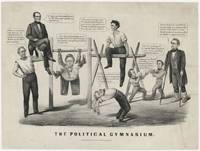
186060001<p><strong>Scarce iconic & fantastic lithograph Abraham Lincoln cartoon <em>The Political Gymnasium</em></strong></p><p>Abraham Lincoln Louis Mauer <strong><em>The Political Gymnasium</em></strong>. New York: Currier & Ives 1860. Lithograph broadside 18 x 13-1/2 inches.</p><p>This scarce and iconic lithograph is a detailed humorous "parody on the field of presidential candidates and their supporters in the 1860 campaign." Bell and Everett for the Constitutional Union Party are there: Bell a muscle man holds Everett aloft on a barbell. Horace Greeley struggles to do a pull-up in his effort to gain the New York governorship while Lincoln is easily astride his own bar wooden rails offering helpful advice: "You must do as I did Greely get somebody to give you a boost. I'm sure I never could have got up here by my own efforts." The New York Courier's James Watson Webb does a backward somersault in the foreground.</p><p>The broadside evidently issued after the parties' nominating Conventions because Seward is depicted as a cripple "on crutches and with bandaged feet." Breckinridge and Douglas "the two sectional Democratic candidates compete in a boxing match."</p><p>Auction records for the last couple of years show a colored example with trimmed right margin selling for $8125 and a nice but sooty uncolored example for $5250. Both sold by Heritage. Measures 18 x 13-1/2 in. and is an ideal candidate for framing. Overall Near Fine. Professionally cleaned & mended. Closed tear crosses most of Seward's midsection.</p> Currier & Ives
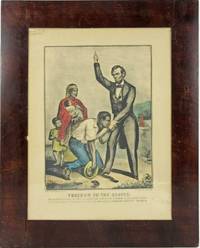
186538499New York: Currier & Ives 1865. Color print 11-3/4" x 15-1/2" by sight. A black man newly freed from slavery kneels at Lincoln's feet his shackles broken. He kisses Lincoln's hand. His wife and babies stand behind him. Lincoln's right arm is raised and pointing heavenward. Light uniform toning but brightly colored. Two blank margin tears at lower right corner one blank margin tear at upper left corner. Framed in wood a few small dings to overall size 16" x 20." Very Good.<br /> <br /> "This commemorative print was issued soon after the assassination of President Lincoln to comfort his supporters. The semi-allegorized representation portrayed the former president as the emancipator of enslaved African Americans guided by divine principles" Description online at The Met. <br /> Entering Richmond in 1865 Lincoln was met by many former slaves who kneeled before him. Lincoln told them to stand and thank God not Lincoln for their freedom. A decade later the Colored People's Educational Monument Association headed by the African-American abolitionist Henry Highland Garnet. created a memorial to Lincoln. The result was a sculpture erected in 1876 in Lincoln Park near Capitol Hill depicting a supplicant slave and a towering Lincoln. Known as the Emancipation Memorial or the Freedmen's Memorial it generated some contemporary criticism for its depiction of the inferior position of the black man. <br /> Gale 2311. Not in LCP Reilly or Weitenkampf. OCLC 1292616124 1- OH Hist. Connection 870219805 1- IN Hist. Soc. as of May 2024. AAS also owns a copy. Currier & Ives unknown
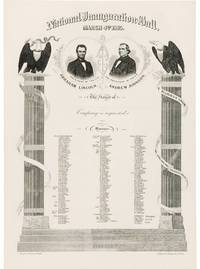
186540934Washington: Designed & Drawn by Bruff. Engraved by Dempsey & O'Toole 1865. Engraved broadside invitation 10-1/2" x 7-1/2" printed on heavy card stock engraved by Dempsey & O'Toole Designed & Drawn by Bruff to the Ball celebrating the second inauguration of President Abraham Lincoln and the inauguration of Vice President Andrew Johnson. The name of the invitee is not filled in. Fine.<br /> <br /> The attractively engraved invitation has detailed engraved portraits of Lincoln and Johnson flanked by two iconic American Eagles perched atop Corinthian columns. The Eagle on the left holds a rattlesnake in its beak reminiscent of the "Dont Tread on Me" flag. The pillars rest on three steps labeled "1777-83" "1812-15" and "1860-65." Beneath the portraits a three-column list of Managers is printed including prominent political and military figures of the time such as outgoing Vice President Hamlin Generals Grant Sherman Thomas Sheridan Doubleday Winfield Scott Hancock and Admirals Farragut and Porter. "E Pluribus Unum" and "We Are One and Indissoluble" are inscribed on banners wrapped around the columns<br /> The 1865 Inaugural Ball was held on March 6 1865 not March 4 at the Patent Office in Washington D.C. now home to the Smithsonian American Art Museum and National Portrait Gallery.<br /> OCLC records about ten locations under several accession numbers as of May 2025. Designed & Drawn by Bruff. Engraved by Dempsey & O'Toole unknown
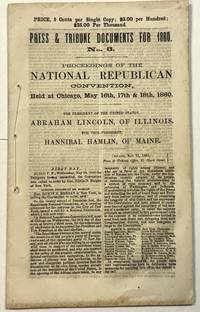
186041812Chicago: Press & Tribune Office 1860. Caption title as issued. 44pp. Stitched. Widely scattered light foxing. Near Fine. At head of title: "PRICE 5 Cents per Single Copy; $3.00 per Hundred; $25.00 Per Thousand."<br /> <br /> The "stenographic report" Monaghan of the country's most significant political convention with a record of all activities including speeches platform and the balloting for President and Vice President. Unlike modern conventions the winner of this one was far from clear. Several formidable candidates-- including Seward Chase Bates and Fremont--- stood in Lincoln's way. Although he had planned his strategy with great intelligence Lincoln was a true 'Dark Horse.' <br /> "Instead of attending in person Lincoln was represented by his friend and campaign manager Illinois judge David Davis whose initiative and deal-making skills despite his candidate's disapproval of such behind-the-scenes maneuvering is widely credited with his eventual nomination. Davis did however follow Lincoln's instruction in forming their general strategy as he maneuvered throughout the building nicknamed The Wigwam. <br /> "To make up for his meagre resume compared to Seward and Chase his team thought it prudent to not go on the attack against the frontrunners and instead become 'everybody's second choice.' through the convention's ranked voting system. His campaign also used the convention to start forging Lincoln's image as the Rail-Splitter a reference to his working-class background and a potential golden opportunity to appeal to the common laborers in the industrial Northern states who stood to benefit the most from the Republicans' Free Soil ideology. They also made direct appeals to delegates from the critical swing states of Pennsylvania and Indiana. When voting began on the 18th Davis and his allies felt confident in their chances to pull ahead. The first ballot placed Seward predictably with the highest vote total of 173.5 but not enough to win a majority while Lincoln followed with a total of 102. The second round bumped Lincoln's total number of votes to 181. The momentum on Lincoln's side continued to surge into the third round where Lincoln received a total of 231.5 votes still not enough to be nominated until David Cartter leader of the Ohio delegation announced his decision to switch support from Chase to Lincoln making him the 1860 Republican nominee for President" American Battlefield Trust 'Inside the Wigwam'.<br /> Ante-Fire Imprints 504. Monaghan 76. Sabin 65894. Press & Tribune Office unknown
186095830c. 1860. Rare original painting of the 16th President of the United States Abraham Lincoln. After a photograph by Civil War photographer Alexander Gardner. Scottish photographer Alexander Gardner immigrated to the United States in 1856 where he became best known for his photographs of the American Civil War President Abraham Lincoln and the execution of the conspirators to Lincoln's assassination. In near fine condition. In a period frame. The entire piece measures 20.75 by 16.75 inches. Rare and desirable. Abraham Lincoln served as the 16th President of the United States from March 1861 until his assassination in April 1865. He led the United States through its Civil War and in doing so preserved the Union of the United States of America abolished slavery and strengthened the federal government. Lincoln began constructing his cabinet on election night and sought to create a cabinet that would unite the Republican party. His eventual cabinet would include his primary rivals for the Republican nomination and although his appointees held differing views on economic issues all were opposed to the expansion of slavery into the territories of the United States. The most senior cabinet post of Secretary of State was appointed to William Seward who had recently failed to win the 1860 Republican presidential nomination and Lincoln's choice for Secretary of the Treasury was Ohio Senator Salmon P. Chase Seward's primary political rival and the leader of a radical faction of the Republican party that sought the immediate abolition of slavery. unknown
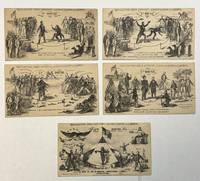
186141884New York: J.H. Tingley 1861. Five postal covers each oblong 3-1/4" x 5-7/8." The recto of each is an engraving of a Round of the boxing match. Near Fine.<br /> <br /> From the U VA description: "Five envelopes in the Champion Prize Envelope set depict a boxing match between Lincoln and Davis in which the latter is easily defeated and Winfield Scott commands the Union armies. Smaller vignettes in the corners depict dogs guarding southern cotton and then fleeing; liberated slaves Union artillery advancing firing and marching home; Union and Confederate politicians commenting on the fight including John Minor Botts who is seen as keeping Virginia in the Union; European countries commenting on the fight; and the Union eagle and Liberty victorious with Lincoln the champion of all sections."<br /> 1st Round: Standing around a boxing ring Lincoln and Davis in the middle are a group of civilians Soldiers cannon. two dogs guarding a bale of cotton and a Confederate flag a group of slaves three men on a globe Capitol and American flag in the background. In the ring Davis cowers before Lincoln who says "I use no more force than necessary." Davis: "Let me alone!"<br /> 2nd Round: The same group encircles the ring. Lincoln: "Go back you dog to the junction I'll call on you there soon." Davis: "Beauregard Lets fall back on Richmond." From the crowd of civilians: "Secession is looking smaller" and "We shall soon strip it." Other comments are also uttered.<br /> 3d Round: Lincoln: "I will soon smother those pirates." From the same encirclement anti-Confederate comments such as "General That's secession's last kick" rebel soldiers saying "Let's go home boys." The cotton bale and Confederate flag are missing.<br /> 4th Round: Seward and Scott are in the ring. Seward: "General where is secession now" Scott : "Don't you see that greasespot" Comment: "Virginia and Kentucky may now be heard in behalf of the whole Union."<br /> 5th Round: Lincoln with "The Champion Belt": "You shall all have my impartial constitutional and humble protection." He is surrounded by the iconic Screaming Eagle; a triumphant West North East and South; and Lady Liberty who says "I still live." <br /> Not in Reilly or Weitenkampf. AAS and the University of Indiana own all five envelopes. OCLC 277634667 1- U VA 14953428 2- CT Mus. Hist. Culture U IL as of June 2026. J.H. Tingley unknown
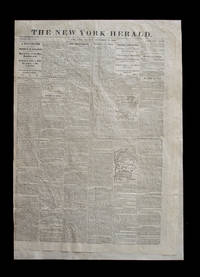
186268870New York: The New York Herald 1862. Full Description:<br> <br> LINCOLN Abraham. Emancipation Proclamation."A Proclamation by the President of the United States. Operations of the Confiscation Act. All Slaves in States in Rebellion January 1 1863 to Be Free." New York. Published in: The New York Herald Tuesday September 23 1862. Whole No. 9506.<br> <br> The publication of Lincoln's Emancipation Proclamation in James Gordon Bennett's pro-Democratic New York Herald and one of if not the first official public announcements of the preliminary Emancipation Proclamation.<br> <br> Broadsheet folio one large leaf folded along top to make four pages two leaves printed on recto and verso. Six-column format. 22 x 15 1/2 inches; 560 x 395 mm. Light creases down the middle in both directions. Some nearly invisible repaird along top margin and edges. Some of the repairs just touching a few letters in the headline. Still a very good copy of this important declaration. We could only find 3 copies of this at auction and it is not mentioned in Eberstadt. Eberstadt mentions that his Third edition of the Emancipation has a publication date somewhere between September 24th and 26th therefore putting the current copy before this. Eberstadt's first and second edition are the official state department editions printed the day of the declaration September 22nd just the day before this New York Herald was printed.<br> <br> Abraham Lincoln issued the preliminary Emancipation Proclamation on September 22 1862 stating that if the rebelling states did not cease fighting and rejoin the Union by January 1 1863 the slaves in those states would be set free. The New York Herald issued this front-page top left corner early printing of Lincoln's Proclamation the very next day appearing under the headline: "All Slaves in States of Rebellion January 1 1863 to Be Free."<br> <br> "Lincoln read the first draft of what came to be known as the Preliminary Emancipation Proclamation to his cabinet on 22 July 1862. Given the criticism directed at Lincoln for moving too slowly on the issue of emancipation it is worth noting that this first reading took place just sixteen months after he had pledged not to 'interfere with the institution of slavery in the States where it exists.' He continued to revise the document throughout the summer and following the Union victory at Antietam he issued the preliminary proclamation-which managed to balance daring with prudence-on 22 September. This first proclamation essentially gave the Rebel States one hundred days to return to the Union after which period any slaves within their borders would be "then thenceforward and forever free." Any rebellious states that returned to the Union in the interim would be able to adopt immediate or gradual-and compensated-abolition of slavery within their borders." Sotheby's.<br> <br> The front page of this newspaper also contains two maps and reports of the campaigns in Kentucky.<br> <br> HBS 68870.<br> <br> $3500. The New York Herald unknown
1864D16155Baltimore: Cushings & Bailey 1864. First Edition. First and only edition extra-illustrated with approximately 65 inserted portraits. Full red pebbled morocco gilt dated 1882 on the spine rebacked with the original spine laid down the covers panelled in gilt the spine tooled and lettered in gilt with the initials "W.H.W." at the foot. 10 x 8 inches 25.5 x 21 cm; with lithographed title and approximately 65 mostly engraved or lithographed portraits inserted three are original drawings including one of Julia Ward Howe xi lithographed contents 200 pp. lithographed fascsimiles of the handwriting of the authors. Intermittent foxing the inserted portraits have offset to the text leaves opposite rebacked as noted and lightly rubbed. <br/><br/>This volume produced at the time of the 1864 Baltimore Sanitary Fair contains what is considered the first reproduction of the Gettysburg Address in Lincoln's hand. The facsimile was made from what is now known as the "Bliss Copy" of the address the fifth and final manuscript copy of the address that Lincoln executed at the request of the editors of this volume. Other authors represented here include Emerson Poe Melville Hawthorne and many other notables of the period. Cushings & Bailey unknown
1867376997Washington D.C.: Government Printing Office 1867. Frontispiece portrait. 2XXX930pp. 4to. Original full brown turkey morocco elaborately stamped in gilt repair to front joint. Frontispiece portrait. 2XXX930pp. 4to. One of only 100 specially-bound copies of this official government printing reproducing in its totality the foreign correspondence and declarations of sympathy received from foreign governments and diplomats across the world in response to Lincoln's assassination. <br /> <br /> Congress' resolution for the publication of this work is printed within: "Resolved by the Senate and House of Representatives of the United States of America in Congress assembled That in addition to the number of copies of papers relating to foreign affairs now authorized by law there shall be printed for distribution by the Department of State on fine paper with wide margin a sufficient number of copies of the Appendix to the Diplomatic Correspondence of 1865 to supply one copy to each senator and each representative of the Thirty-ninth Congress and to each foreign government and one copy to each corporation association or public body whose expressions of condolence or sympathy are published in said volume; one hundred of these copies to be bound in full Turkey morocco full gilt and the remaining copies to be bound in half Turkey morocco marble edged." <br /> <br /> The text organizes the messages of sympathy alphabetically by source country and contains an extensive and detailed index to the correspondents within. The frontispiece reproduces the famous Darby & Miller engraved portrait of Lincoln. Monaghan mentions that a small number of copies were bound with Carpenter's portrait as the frontispiece. Monaghan 881; Sabin 41174 Government Printing Office unknown
188139061New Haven Conn. J.D. & E.S. Dana 1881. 8vo. Extracted from "The American Journal of Science" Third series vol. XXII Numb. CXXVIII pp. 87- 166. With title-page to the entire volume. Title-page with a faint rubberstamp. The Michelson-paper: pp. 120-129. Two leaves with small tear to the margin. <br/><br/><em>The seminal first edition of the first description of the first version of a series of experiments with the Interferometer which was built by Michelson and with which he planned to measure the relative speeds of light-waves moving at right angles to each other - an experiment that would ultimately lead to the special theory of relativity. The series of experiments ended with the so-called "Michelson-Morley experiment" the results of which were published 6 years after Michelson's first experiment the item offered here. The 1887 paper written together with Morley constituted an improved attempt of the 1881- version of the experiment. The experiments were designed to calculate the effect of the earth's motion on the passage of light rays through the "luminous ether" which was believed to surround the earth. The experiments were negative and as such led to the introduction of relativity."Michelson tried to determinate the relation of ether drift and the velocity of light effect of extremely minute values.no drift could be found and the "negative result held revolutionary implications which led directly through Lorentz and Einstein to the acceptance of new standards of reference of time and space from geometry an cosmometry."Dibner.In 1919 Einstein met Michelson in California. At a dinner given in honor of them both Einstein said in a speech "You Michelson uncovered an insidious defect in the ether theory of light as it existed and stimulated the ideas of H.A. Lorentz and Fitzgerald out of which the Special Theory of Relativity developed. Without your work this theory would today be scarcely more than an interesting speculation." In an interview in 1842 Einstein said: "It is no doubt that Michelson's experiment was of considerably influence upon my work insofar as it strengthened my conviction concerning the validity of the Principle of relativity.On the other side I was pretty much convinced of the validity of the principle before I did know this experiment and its result. In any case Michelson's experiment removed practically any doubt about the validity of the principle in optics and showed that a profound change of the basic concepts of physics was inevitable."Michelson was awarded the 1907 Nobel Prize "for his optical precision instrument the inteferometer and the spectroscopic and metrological investigations he has carried on."Dibner: Heralds of Science: 161 the 1887-experiment - Vide PMM: 378410408. </em> unknown
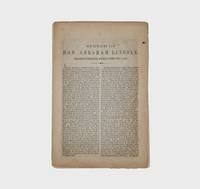
1858376861Springfield IL 1858. 8pp. printed in double columns. 8vo. Unbound. Minor toning. Housed in a cloth box. 8pp. printed in double columns. 8vo. The only separate printing of this address given by Lincoln at Springfield Illinois. Lincoln's speech which preceded his debates with Douglas puts forth the great themes that marked his political philosophy during the last ten years of his life. More importantly it firmly placed Lincoln as against the expansion of slavery and Douglas on the opposite side of the issue. By targeting Douglas a strategy that resurrected Lincoln's political career he made his fellow Illinoisan out to be the embodiment of the wicked forces safeguarding slavery's expansion . This speech is Lincoln's opening salvo against Douglas for the 1858 senate campaign: 'Free men of Illinois - free men of everywhere - judge ye between him and me'" Abraham Lincoln: His Life in Print p. 67<br /> <br /> Urging that slavery be placed on course for "ultimate extinction" he repeats his "House Divided" warning first given at the State Republican Convention a month earlier. He insists that the Kansas-Nebraska bill was "the beginning of a conspiracy" to nationalize slavery. Attacking Douglas and defending himself against the charge that he would "invite a war of sections" he stands on "the principles of our Declaration of Independence." Though African Americans are not the equal of whites "in all respects" the Declaration "does mean to declare that all men are equal in some respects; they are equal in the right to 'life liberty and the pursuit of happiness.'" Most significantly "In the right to put into his mouth the bread that his own hands have earned he is the equal of every other man white or black."<br /> <br /> A scarce Lincoln speech. Monaghan 12; Byrd 2960 unknown
1863149486Washington: Government Printing Office January 2 1863. Rare first War Department and fifth overall printing of the Emancipation Proclamation. Twelvemo General Orders No. 1 extracted from the larger volume of orders for 1863 4 pages disbound. President Lincoln had intended to issue the order earlier in 1862 but deliberately delayed its release until after the Union's strategic victory at Antietam at which point he announced the Preliminary Emancipation Proclamation. General Order No. 139 September 22 1862 which declared that all slaves held in rebelling states would be forever free from the first day of January 1863. The text of the final Emancipation Proclamation present in this order is noted for its direct and decisive language: "By the President of the United States of America . That on the first day of January in the year of our Lord one thousand eight hundred and sixty-three all persons held as slaves within any State or designated part of a State the people whereof shall then be in rebellion against the United States shall be then thenceforward and forever free; and the Executive Government of the United States including the military and naval authority thereof will recognize and maintain the freedom of such persons and will do no act or acts to repress such persons or any of them in any efforts they may make for their actual freedom." The first printing for the War Department of General Orders No. 1 was distributed to various military outposts and bureaus throughout the United States. Based on the extensive research of Charles Eberstadt the copy for the War Department was the fifth time the final version of the Emancipation Proclamation appeared in print on January of 1863 following three hastily prepared issues for the State Department and another for Lincoln's hometown Illinois States Journal newspaper in Springfield Illinois. A copy of the War Department Printing was included in the Grolier Club's One Hundred Influential American Books Printed before 1900. Eberstadt 12; Grolier Club One Hundred Influential American Books 71; Streeter 1751. In near fine condition. Housed in a custom half morocco case. A scarce work. The Emancipation Proclamation issued by President Abraham Lincoln on January 1 1863 represented a pivotal moment in the trajectory of the American Civil War and the broader struggle over the institution of slavery. Although it did not immediately free all enslaved individuals the proclamation declared that all persons held as slaves in states or parts of states still in rebellion against the United States were to be henceforth free. This executive order grounded in Lincoln's war powers as commander-in-chief was intended primarily as a military measure to weaken the Confederacy by undermining its labor force and discouraging foreign powers from recognizing or supporting the secessionist cause. The proclamation also signaled a significant shift in Union war aims reframing the conflict from a struggle solely to preserve the Union to one explicitly linked to the abolition of slavery. While its immediate legal impact was limited to areas outside Union control the Emancipation Proclamation laid the groundwork for the eventual passage of the Thirteenth Amendment which formally abolished slavery throughout the United States. Government Printing Office unknown
186595831Davenport Iowa 1865. Original typographic portrait of Abraham Lincoln composed of his Emancipation Proclamation issued on January 1 1863. In near fine condition. Double matted and framed the entire piece measures 26.5 inches by 19 inches. An exceptional piece a rare and desirable piece of Americana. Abraham Lincoln issued the The Emancipation Proclamation or Proclamation 95 on January 1st 1865. The executive order changed the federal legal status of more than 3.5 million enslaved African Americans from slave to free and made the abolition of slavery an explicit goal of the Union war effort. To ensure emancipation Lincoln pushed for passage of the Thirteenth Amendment and insisted that Reconstruction plans for Southern states require abolition in new state constitutions. Congress passed the 13th Amendment by the necessary two-thirds vote on January 31 1865 and it was ratified by the states on December 6 1865 ending legal slavery. unknown
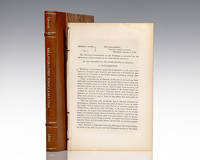
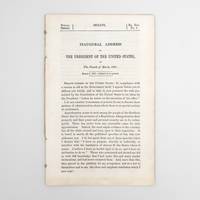
1861377680Washington D.C.: Government Printing Office 1861. Special Session Senate Ex. Doc. No. 1. 10pp. 8vo. Disbound. Housed in a cloth box. Special Session Senate Ex. Doc. No. 1. 10pp. 8vo. Lincoln began drafting his first inaugural in Springfield soon after his election hoping the speech would impart a spirit of reconciliation toward the seceded states. His speech balances his pledge to protect Federal property in the south while insisting that he would not use military force unless attacked first. In all he eloquently argues against secession presenting the United States as undissolvable. Lincoln ends his speech with the memorable lines: "We are not enemies but friends. We must not be enemies. Though passion may have strained it must not break our bonds of affection. The mystic chords of memory stretching from every battle-field and patriot grave to every living heart and hearth-stone all over this broad land will yet swell the chorus of the Union when again touched as surely they will be by the better angels of our nature."<br /> <br /> "Lincoln became President on March 4 1861. Before being sworn in he gave his First Inaugural Address devoting it entirely to the secession crisis. It was the linguistic equivalent of an optical illusion: one could view it two ways. As historians have noted he seemed to placate the South; he would not 'interfere with the institution of slavery in the States where it exists.' This language was the old Lincoln . The new Lincoln was a resolute executive who had no choice but to enforce the Constitution a contract that does not allow states to withdraw from it unilaterally. In his enforcement there would be no bloodshed 'unless it be forced upon the national authority" Mazy Boroujerdi editor Abraham Lincoln: His Life in Print p. 108.<br /> <br /> Lincoln had begun writing his inaugural the month prior before leaving Springfield and once in Washington asked William Seward to review the draft. It was Seward who suggested softening the tone so as not to appear too inflammatory suggesting "a nostalgic call for unity emphasizing the country's shared history. Lincoln embraced the idea but massaged it into near poetry. Seward's prosaic text ended up as Lincoln's oft quoted appeals to the 'mystic chords of memory' and 'the better angels of our nature.' The words did nothing to reverse disunion" Ibid. p. 97.<br /> <br /> This is the official government printing of Lincoln's first inaugural address issued as a document of a special session of the Senate printed by their order four days after its delivery being only the second printing overall of the memorable speech. Monaghan 102; Abraham Lincoln: His Life in Print p. 108 [Government Printing Office] unknown
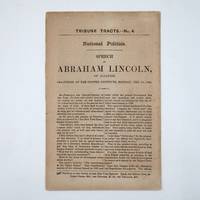
1860367583New York: Office of the New York Tribune 1860. First edition Monaghan's first issue. 1 2-15 1pp. Lincoln's speech comprises pages 1-11 out of a total of 16 pages. With New York Tribune ads and subscription terms on rear wrapper. 8vo. Stitched self-wrappers minor toning minor chip to terminal leaf. First edition Monaghan's first issue. 1 2-15 1pp. Lincoln's speech comprises pages 1-11 out of a total of 16 pages. With New York Tribune ads and subscription terms on rear wrapper. 8vo. This address made at the Cooper Institute in New York on February 27 1860 catapulted Lincoln into the public eye and made him a viable presidential candidate. Indeed many historians have considered it the key to his success in the 1860 election and it is probably the most important speech Lincoln made after the Gettysburg Address and his inaugural addresses.<br /> <br /> The Cooper Union address was months in preparation; Lincoln was fully aware of its importance in moving himself from a regional favorite son to a viable national candidate. In the event some 1500 people including many prominent political figures attended on a snowy new York evening. The speech divides into three major parts. In the first Lincoln addressed the spread of slavery arguing that the framers of the constitution had been opposed to it and that the Federal government could regulate the question. In the second he argued that the Republicans were not a sectional Northern party and attacked the threats of southern Democrats to secede if the Republicans should win the election. Finally he addressed his fellow Republicans calling on them to act carefully and do "nothing through passion and ill temper.Let us have faith that right makes might and in that faith let us to the end dare to do our duty as we understand it."<br /> <br /> The Cooper Union speech was a resounding success. Horace Greeley described it as "one of the happiest and most convincing political arguments ever made in this City. No man ever made such an impression on his first appeal to a New York audience." Greeley quickly issued the speech in the form of this "Tribune Tract." It includes a final page of advertisements for other Tribune publications. The speech was later widely reprinted and made Lincoln nationally famous.<br /> This printing differs from other editions by its inclusion of a speech by James Doolittle Senator from Wisconsin and the message of Samuel Medary Democratic governor of the Kansas Territory vetoing the Kansas abolition bill.<br /> <br /> "The Cooper Union address tested whether Lincoln's appeal could extend from the podium to the page and from the rollicking campaigns of the rural West to the urban East. Cooper Union held the promise of transforming Lincoln from a regional phenomenon to a national figure. Lincoln knew it and rose to the occasion" Harold Holzer Lincoln at the Copper Union: The Speech That Made Abraham Lincoln President. Monaghan 50 Office of the New York Tribune unknown
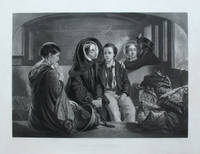
185717454London: E. Gambart & Co 25 Berners St. 1857. First printing. In fine condition. The Departure - Second Class" and "The Return - First Class" are a pair of moralistic narrative works a popular genre in Victorian times and demonstrate the growing trend towards emigration particularly to Australia. The Victorian artist Abraham Solomon depicts a family traveling second class to a port where the young boy will go to sea in "The Departure". In "The Return" the boy returns as a successful middle aged squatter in the first class carriage with his son and daughter. <br /> <br /> Both paintings by Solomon are held in the National Railway Museum UK . Of "The Departure" they write "The painting is a contemporary image of rail travel showing the discomfort of the lower classes traveling in a draughty bench-seated second class carriage. Despite their discomfort this shows how the railways opened up travel to the less wealthy as well as those with money. It also shows how the industry allowed travel nationally and internationally with the posters in the background advertising passage to Australia highlighting the growing trend of emigration. " National Railway Museum UK website. The advertising includes ship departures for Port Phillip and Sydney.<br /> <br /> Published 4th April 1857 with a stated edition of 225 pairs. Engraved by W.H. Simmons. 26 3/4 x 20 3/4" image & text on paper 32 1/4 x 25 1/4". Black & white as issued. E. Gambart & Co 25 Berners St. unknown
186425614<p>The second in a series of four racist political cartoons published in 1864 by Bromley & Company which was closely affiliated with the Copperhead New York <i>World</i> newspaper. These prints sought to undermine Abraham Lincoln's chances for reelection by branding him as a "miscegenationist" and playing on white fears of "race-mixing." The cartoon scene pictures several interracial couples enjoying a day at the park eating ice cream discussing wedding plans and a woman's upcoming lecture. Two African American families have white employees a carriage driver and footmen and a babysitter.</p><p>The only other example traced at auction brought $7800 in 2010.</p> <b>ABRAHAM LINCOLN. RACISM.</b>Print. "Miscegenation or the Millennium of Abolitionism." Political Cartoon. New York: Bromley & Co. 1864. 1 p. 20¾ x 13â… in.<p><br /></p><p>American politics had long played on fears of sexual relationships between races. A powerful new word for "race-mixing" was coined in an anonymous December 1863 pamphlet entitled <i>Miscegenation: The Theory of the Blending of the Races Applied to the American White Man and Negro</i> published in New York. Purporting to advocate the virtues of the "blending of the white and black races on this continent" it was a literary forgery prepared by <i>The World</i> managing editor David Goodman Croly and reporter George Wakeman. The authors were unsuccessful in their attempt to trick President Lincoln into endorsing the work.</p><p>At the far left of the image Abraham Lincoln declares "<i>I shall be proud to number among my intimate friends any member of the Squash family especially the little Squashes.</i>" The African American woman to whom he is speaking replies "<i>I'se 'quainted wid Missus Linkum I is washed far her 'fore de hebenly Miscegenation times was cum. Dont do nuffin now but gallevant 'round wid de white gem'men! he-ah! he-ah! he-ah!</i>"</p><p>Senator Charles Sumner says "<i>Mr. President! Allow me the honor of introducing my very dear friend Miss Dinah Arabella Aramintha Squash.</i>" A white carriage driver complains in the background "<i>Gla-a-ang there 240t! White driver white footmen niggers inside my heys! I wanted a situation when I took this one</i>" while a black man in the carriage tells his companion "<i>Phillis de_ah dars Sumner. We must not cut him if he is walking.</i>" A black woman at a table tells a white man with her "<i>Ah! Horace its-its-its-bully 'specially de cream</i>" and he replies "<i>Ah! my dear Miss Snowball we have at last reached our political and social Paradise. Isn't it extatic</i>"</p><p>To the right are two couples embracing each a white woman and an African American man. The first white women tells her partner "<i>Oh! You dear creature. I am so agitated! Go and ask Pa</i>" to which he replies "<i>Lubly Julia Anna name de day when Brodder Beecher shall make us one!</i>" The second white woman says "<i>Adolphus now you'll be sure to come to my lecture to morrow night won't you</i>" to which he answers "<i>I'll be there Honey on de front seat sure!</i>" In the background are various immigrant minorities viewing the scene. One exclaims "<i>Most hextwadinary! Aw neva witnessed the like in all me life if I did dem me!</i>" and another adds "<i>Mine Got vat a guntry vat a beebles!</i>" An Irish girl complains "<i>And is it to drag nagur babies that I left old Ireland Bad luck to me.</i>"</p><p>Manton Marble the editor of <i>The World</i> collaborated with printmaker Bromley & Company to issue a series of four anti-Lincoln "Political Caricatures." The present example was the No. 2 in that series. No. 1 was "The Grave of the Union or Major Jack Downing's Dream"; No. 3 "The Abolition Catastrophe Or the November Smash-up"; and No. 4 "The Miscegenation Ball."</p><p>Republicans responded by trying to turn the "miscegenation" charge against the Democrats. A Republican print "The Political "Siamese" Twins: The Offspring of Chicago Miscegenation" pictures McClellan and Pendleton joined together despite their very different ideas on ending the war.</p><p>Although Abraham Lincoln won New York states' electoral votes in 1860 Stephen Douglas had carried New York City and its environs. Financial elites fearing that civil war would ruin business and recent immigrants fearing competition with free black labor supported Douglas. Lincoln's unpopularity in New York City during the Civil War was a factor in the deadly 1863 Draft Riots.</p><p>In 1864 Lincoln again won the states' electoral votes while New York City favored his Democratic opponent McClellan. In fact Lincoln's majority dropped from 50136 votes in 1860 to only 7373 votes in 1864 with approximately 50000 more total votes cast than in 1860.</p><p>Bromley and Company continued to sell the caricatures after the election as this January 1865 advertisement from an Ohio newspaper makes clear. Another advertisement assured purchasers that the set of four prints available for $1 were "sent on wooden rollers to insure safe carriage."</p><p><b><i>The World</i></b> 1860-1931 a daily independent newspaper was published in New York City. Alexander Cummings founded it as a religious Republican outlet in 1860. August Belmont and others purchased it in 1862 changing the editorial focus. With editor Manton Marble 1834-1917 <i>The World</i> soon became the country's leading Democratic newspaper. In 1864 Union authorities shut down <i>The World</i>and another paper for three days after they published forged documents purportedly written by Lincoln that were really part of a hoax to manipulate the price of gold. The paper actively supported George B. McClellan against Lincoln in 1864.</p><p><b>Condition</b></p><p>Fine for exhibit despite flaws. Cropped with loss of "Political Caricature No. 2" from top edge and part of printed pricing information from bottom edge publisher's name rubbed out from the copyright statement lacking ½" from lower left corners a few short tape repairs by the edges a 2" closed tear through the second dialogue bubble along the top edge and a 3" closed tear parallel to the right edge. Mount remnants on verso.</p>
186369520Washington D.C.: War Department 1863. CIVIL WAR. War Department General Orders 1863. Washington D.C.: War Department 1863.<br> <br> Full Description:<br> <br> LINCOLN Abraham. CIVIL WAR. Emancipation Proclamation War Department General Orders 1863. Washington D.C.: War Department 1863.<br> <br> The first War Department printing General Orders #1 Jan 2 1863 and fifth overall printing of the final Emancipation Proclamation. The 4 page pamphlet bound together with a nearly complete run of War Department general orders for the year 1863. Two octavo volumes 6 7/8 x 4 5/8 inches; 174 x 119 mm. Volume I comprising General Orders of the War Department Adjutant General's Office Numbers 1-221 2 January 1863 to 16 July 1863 and Volume II comprising Numbers 222-400 16 July 1863 to 28 December 1863. Nearly complete only lacking numbers 55 63 116-119 148 in volume I and 274 352 and 381 in volume II. With 5 copies of number 149 and and 3 copies of number 240.<br> <br> Contemporary half calf over marbled boards. Spine lettered in gilt. All edges speckled brown. Hinges repaired. Some rubbing to board edges. Previous owner's contemporary ink signature Bvt. Col. E.J. Wells on front paste down of each volume. Numerous annotations in the same old ink throughout generally noting when the order was received and dated 1863. Some glue marks to the General Order #1 not affecting text. A small tear to last leaf of text in volume I with no loss. Overall a very good copy.<br> <br> In addition to the very important first War department printing of the Emancipation Proclamation these volumes contain several other very important and interesting General Orders from the War Department as well as President Abraham Lincoln in relation to the military during this year in the Civil War.<br> <br> Notably:<br> <br> No. 100 April 24 "Instructions for the Government of Armies of the United States in the Field." "commonly known as the 'Lieber Code' after its main author Francis Franz Lieber. The Lieber Code set out rules of conduct during hostilities for Union soldiers throughout the U.S. Civil War. Even today it remains the basis of most regulations of the laws of war for the United States. The Lieber Code consists of 157 provisions that deal with a wide range of legal issues that must be considered in armed conflict. It contains general principles but also very detailed rules. Among the issues addressed are whether armed force is justified by military necessity the principle of humanity the distinction between combatants and civilians POW status retaliation and permissible methods and means of warfare." LOC"<br> <br> No. 143 May 22 the establishment of the United States Colored Troops. This authorized the establishment of a bureau regulating the recruitment training and organization of the U.S. Army's first regiments composed entirely of African-American soldiers.<br> <br> Numerous court cases are documented including #17- The sentenced hanging death of a "colored man" for "attempted rape". #346- The trial of George Woolfolk for "Being secretly within lines of the US forces as the same time belonging to the so-called Confederate Army." He was sentenced to be shot to death. And #396- The trial brought by Colonel John Gault against Dr. Aaron James for "Being the captain of a band of guerillas or marauders and shooting at US soldiers." He was sentenced to death but the President disapproved the sentence and directed him to be released.<br> <br> A number of orders of Military discharges both honorable and dishonorable as well as military promotions. #337 announces "Major General U.S. Grant U.S. Army is placed in command of the Military Division of the Mississippi Headquarters in the field." #349 announces "Major General William T. Sherman is appointed to the command of the Department and Army of the Tennessee Headquarters in the field." #194 is the appointment of Major General George Meade as commander of the Army of the Potomac who would defeat General Robert E. Lee at Gettysburg only days later. And #398 honors Ulysses S. Grant for his Mississippi River campaign and presents him a gold medal.<br> <br> Numerous obituaries including #71 which announces the death of Major General E.V. Sumner who fell ill and died on his way to take command of the Department of the Missouri and directs the ways that Department should give him military honors.<br> <br> Important presidential proclamations including #58- Calling to all soldiers who were "absent without leave" urging them to return to their regiments and would not face punishment beside loss of wages for time missed. #252- Orders regarding the treatment of prisoners of war stating that 'if the enemy shall sell or enslave anyone because of his color the offence shall be punished by retaliation upon the enemy's prisoners in our possession'. "President Abraham Lincoln issued an 'eye-for-eye' order warning the Confederacy that Union soldiers would shoot a rebel prisoner for every Black prisoner shot. It also would condemn a rebel prisoner to a life of hard labor for every Black prisoner sold into slavery. AA Registry. #315- Lincoln's suspension of the "writ of habeas corpus." "The doctrine of habeas corpus is the right of any person under arrest to appear in person before the court to ensure that they have not been falsely accused. Lincoln's suspension of the "writ of habeas corpus" was one of the most controversial acts of his administrations. Lincoln defended himself against charges that his administration had subverted the Constitution however arguing that acts that might be illegal in peacetime might be necessary "in cases of rebellion" when the nation's survival was at stake." The Gilder Lehrman Institute of American History. #340- Proclamation by the President calling for three hundred thousand volunteers. "Whereas the term of service of a part of the volunteer forces of the United States will expire during the coming year; and Whereas in addition to the men raised by the present draft it is deemed expedient to call out 300000 volunteers to serve for three years or the war not however. exceeding three years."<br> <br> And numerous other General Orders pertaining to soldiers and the war effort including #35- A list of items that could be sold to soliders by sutlers. #40- The establishment of a Volunteer force for Kentucky. #163- "A resolution to encourage the enlistments in the Regular Army and Volunteer forces." #323- which authorized each enlisted cook "two under-cooks of African descent who shall receive for their full compensation ten dollars per month and one ration per day." #351- This discusses the governance of "The Employment of women nurses in the U.S. General Hospitals." and #364 which discusses the cos of clothing and camp for the U.S. Army and includes a folding chart.<br> <br> Eberstadt 12. Grolier 100 American 71. Streeter 1751.<br> <br> HBS 69520.<br> <br> $7500. War Department unknown
1819805K1London: A. J. Valpy 1819-1830. Hardback. Good. 10" by 7". None. A scarce 136 volume set of the Regent's Edition 'Delphin Classics' based off of a published series used to educate le Grand Dauphin Louis with works by notable thinkers such as Virgil Horace and Cicero. An extensive run of the scarce 'Delphin Classics' very scarce to see a large run of the work like this.This set contains volumes I-CVIII CXIII-CXLI published between 1819 and 1830 a total of 136 volumes.The Regent's Edition of this work.In Latin.'The Delphin Classics' was an extensive series of the Latin classics which reached to 182 volumes this set containing 136 of the volumes.The series printed the prominent works of writers such as Virgil Sallust Pliny the Elder Ovid Horace Cicero and Caesar often printing their complete works in the original Latin.Edited by George Dyer the series was based off a monumental publication of the Latin classics that had been published for the education of le Grand Dauphin Louis the heir to Louis XIV to assist in his education. In fact the title 'Delphin' translates to 'Dauphin'. Le Grand Dauphin was the eldest son of Louis XIV but predeceased him and thus never became the king his grandson succeeding to the throne as Louis XV after the death of Louis XIV.Working off those original Dauphin editions Dyer and the publisher Abraham John Valpy supplemented the texts with the best variorum editions and literary notes from important late eighteenth century editions. These include the Variorum Classics and the Zweibrucken editions.This Georgian edition reached around six hundred subscribers and saw great success. Publisher's adverts to the front of volumes XII XXV XXVII XL and CXXVIII.Subscriber's lists bound in to volumes I and XXXII.With remarks on 'The Review Relative to Stephens' Greek Thesaurus in the Quarterly review No. 48 bound in with vol. XXXI. The Classical Journal No. XLIII bound into the front of no. XX. With 'Delphin Classics with the Variorum Notes' sheet bound in with no. X XXI and LXIV. In the original publisher's paper covered boards. Externally generally sound with shelf wear and bumping to the head and tail of the spine and extremities minor chipping to the extremities of the boards and rubbing to the occasional volume a touch of edge wear; general light soiling to the boards and age toning to the spine. Tears and losses to back strips of XLIV LXXXI XLVII LXXIII and XCIII with back strips of volumes CXLI and LIVII absent. Faint handling mark to the front board of nos. I IV XI XXXIV XXIX XXXII LVI LVII LXIII and LXIV. Minor staining mark to the front board of no. XXXIV. Small library stamps to the front board of the majority of volumes. A little loss to the paper of the front board of volume XLVII LIV and LXXV. Joints to nos. VII XI XXII XXX XXXIII XCIV LXXI and CXXXI starting. Front joint of Volume XI is starting with boards held by cords only. Front joint of volumes CXXXV CXXXIII CXXXVI XLIX starting with boards holding firm. Rear joint is strained to CXIX. Rear joint is starting to Volumes III VI XVIII XXIV XL CXIII and CXV. Rear joint to no. LXXXV strained held by cords only. Rear joint of no. XIX has failed with board held by the front joint. Front joint no. IX XL XXX XXXIX LXXXIV LXXV and CXIX are starting. Front joint of no. LXXXVI cracked binding held by endpapers. Front joints to CXVII CXIII CXX and CXVI have failed front boards are detached but present. CI with cracked joints front and rear board loose but present light soiling to the rear of the text block. Back strip and front board of volume XLVII detached but present both boards and back strip of volumes XCIX LXXXII and LII detached but present. Boards of volumes LIVII and CXXXIX detached. Boards of volumes CXLI and CXXXII loosely held. Minor chipping to the spine of no. II V XIX XI XVII XXXVII XXIX XXXVI LXV LXXXIV LXXXV CI CVI and CVII. Loss to the head and tail of the spine of no. XIX XXI and XXIX. Loss to head of the spine on no. I II IV XIX CXVII CXVIII and CXX and paper to spine is lifting exposing interior of the spine. Tearing to the spines on no. XXV and XL. A few ink marks to the spine of IV and VII. Spine is lifting to XI CXIII CXXI and CXIX. General bumping particularly noticeable to the extremities of XVI XCV CXXX. Volume CXXIV has the odd mark to the front board. Volume CXXIII has some slight loss to the paper of the front board front joint is starting a little to the tail. Volumes LXIX LXVII have slight loss to the paper of the front board. Tidemarks and loss to the front board of volume XCV. Loss to the head of the spine of volumes XIII CXXX XXVII LXXXVI and LXVIII. Small perforation to the tail of the spine of LXXIV. Loss to the tail of the spine of XIV. Loss to the paper of the rear board to volumes LXXXVII and CXXVI. Minor loss to the tail of the spine of no. XXXII minor chipping to the joints holding firm. Backstrip no. LIX laid down. Backstrip is lifting to the tail of volume XCII CXXIV. Backstrip is loose to volumes XXVIII XC. Head of the backstrip of volume XVII is detached but present with the remainder of the backstrip held at the rear board. Backstrips of volumes LXX LXXI LXXXIX are loose. Backstrip lifting to the head of volume LXVII. Front and rear hinges starting to volumes XCIV CXXXVII with boards holding firm. Rear hinge to no. XXV is strained. Rear hinge to II III V VI XXIV starting. Hinges to no. XXX and CXXI have failed and boards are hanging by cords only. Front hinges to no. VIII and XXXIII are starting. Front hinges to no. VII and X are tender. Front hinge of No III XI are weak. Rear hinge to no. III LI and CXV is attached by cords only and may detach with further handling. Hinges to no. XXXIX and CXIV have failed; boards and spine are detached but present. Front hinge to CXVIII has failed front board is detached but present. Rear hinge is held by cords only. Front and rear hinge of volume XCI strained with boards tenderly held. Front hinge strained to volume LXXXVIII and held by two cords only. Front hinge has failed to volumes XC XCIII LXXXIX CXXVII; front boards are loose but present. Textblock is held to the rear board of XC by a cord only. Front board is held by cords only to volume XV XXVIII. Rear hinge starting to LXXXVIII . Rear hinge has failed to XIV XVI XVII with rear boards held by a cord only. Front and rear hinges failed to volumes LXXXIX XCII with rear board held by two cords only paper in the case of XCII. Rear joint starting to CXXVI and LXXXVI. Rear joint starting at the tail of LXVI. Front joint starting to volume LXX and LXVII. Front joint starting at the tail of volume CXII and LXXIII. Front endpaper detached to XCIII. Front free-endpaper of no. CXIV is torn. Tidemark to the head of the front pastedown in no. XL and to rear pastedown of no. XI. Small bookseller sticker to the front pastedown of volumes XVI XVII XIX XX XXII XXIV XXV XXVI XXVII XXVIII XXX XXXII XXXIII XXXIV XXXVI XXXVIII XXXIX LXIII CVIII CXXVIIII and CXXIX. Internally generally firmly bound though some volumes are tender. Binding tender to p. 497 no. LVI holding firm; p. 769 no. LXXXV held by three cords only; p. 3049 of no. CII holding firm; and to p. 5640 no. CVI held by two cords only; p. 5001 no. CV; binding of volume CXLI tender. Binding is tender to LXXXVI noticeably at pages 928 and 929 XCV CXII and LXXII. Binding is tender to Volumes XV XXVIII XIV XVI XVII. Some light spotting or handling marks to the odd leaf particularly to the first and last few otherwise the pages are generally bright and clean throughout. Some leaves unopened. Large mark to top corner of page 1729 of no. XIX. Half title and title page bound in to the rear of no. XXXVII. Half title and title page to vol. I II III IV and V 'Quinti Curtii Rufi' bound in to no. LXXIX. Half title and title page for vols. II - IV of 'P. Papinii Santi' as well as for vol. III 'L. Annaei Flori' and vol. II 'Boethi' vol. III 'Justini' bound in to no. LXIV. Title page to vol. I 'Pub. Terentii Afri' and half titles and title pages for vol. II-IV of 'Pub. Terentii Afri' bound in to no. LXI. Half title and title page for vol. I-III 'D. Magni Ausonii' to no. LVII. With remarks on 'The Review Relative to Stephens' Greek Thesaurus in the Quarterly review No. 48 bound in with vol. XXXI. Subscribers leaflet bound in with no. XXXII. Insert of fifteen pages of the front of No. I with list of 'Subscribers' Names Already Received to the New and Corrected Edition of the Delphin Classics; with the Variorum Notes'. The Classical Journal No. XLIII bound into the front of no. XX. With 'Delphin Classics with the Variorum Notes' sheet bound in with no. X XXI and LXIV. Publisher's advert bound into the front of no. XXV and XL. Publisher's adverts to the front of volumes XII XXVII and CXXVIIII. Good A. J. Valpy hardcover
18345037<p>Half brown morocco; ruled raised bands marbled boards. Mouradgea d'Ohsson was a Swedish historian and diplomat of Armenian descent. This important work is a large expansion of his 1824 publication which was the first serious study of Genghis Khan. Kenneth Meyer Setton A History of the Crusades notes "among the general histories of the Mongols d'Ohsson remains unequaled. Avowedly or tacitly most later works rely on it." Two folding genealogical charts; large 1824 folding map of Asia in the thirteenth century to rear of volume four. Previous owner's bookplates removed from front pastedowns. A nice wide-margined set many pages yet uncut in a sound period binding.; lxviii452; 651; 6241; 774.; 8vo 22 x 15 cm; All shipments through USPS insured Priority Mail.</p> Freres van Cleff hardcover
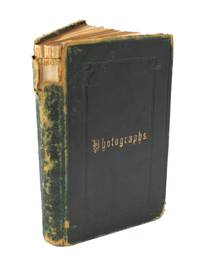
1864175101864. Abraham Lincoln and Civil War Figures Album of pasted oval portraits with signatures underneath each image. 1861. Features most notably Abraham Lincoln with a pasted signature below his image. This mid-nineteenth-century photographic album assembles oval portraits of political and military figures during the Civil War era including a pasted signature beneath an engraved portrait of Abraham Lincoln on the 15th page. Dated inscriptions from 1861 situate the compilation at the outset of national conflict. The inclusion of Lincoln Henry Clay and numerous uniformed figures reflects contemporary practices of collecting and memorializing political leadership through photographic reproduction and autograph acquisition.<br /> <br /> Photographic album measuring approximately 4.5 x 7 inches. Dark green morocco boards with gilt "Photographs" title. Contains 93 black-and-white and sepia portraits most approximately 2.5 x 2.25 inches mounted on pages. Lincoln portrait with separate pasted signature "A. Lincoln"; Henry Clay portrait with pasted signature; additional signatures written directly on album leaves. Spine chipped at head with separation; rubbing along margins; binding intact; photographs generally clear with minor age toning. Overall condition very good. he album reflects nineteenth-century commemorative culture preserving images and autographs of national figures during a transformative political moment. unknown
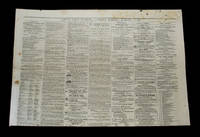
186369186Boston: Boston Daily Courier 1863. Full Description:<br> <br> LINCOLN Abraham. Emancipation Proclamation."President's Proclamation. Emancipation of Slaves in Rebellious States." Boston. Published in: Boston Daily Courier Volume LXXVIII no. 2. Friday Morning January 2 1863.<br> <br> The publication of Lincoln's Emancipation Proclamation in the Boston Daily Courier and one of if not the first official public announcements of the Final Emancipation Proclamation once it was signed and in effect as of January 1 1863. The Proclamation is featured at the top of the center column of page 3.<br> <br> We could find no other copies of this or any other January 2nd edition at auction and it is not mentioned in Eberstadt. Eberstadt's entry for the second edition of the "Final Proclamation" Eberstadt 9 states "Second edition. Apparently the only separate newspaper edition of the final proclamation and the earliest non-official edition. Printed on Friday evening January 2 1863 this Extra in point of chronological sequence was preceded only by the first official edition." Our present copy although not a separate newspaper edition was rushed to press and published in the Friday Morning edition of the Courier placing it's publication prior to Eberstadt 9.<br> <br> According to Eberstadt "A number of newspapers did not issue on January 2nd because of the previous day's holiday but most of those that did carried the final proclamation. Many of the others printed it on January 3rd." pg. 17.<br> <br> Broadsheet folio one large leaf folded along side to make four pages two leaves printed on recto and verso. Seven-column format. 26 x 19 inches; 655 x 490 mm. Light creases down the middle in both directions. A few minor closed tears. A large old ink signature along top margin of front page causing some bleed-through and foxing but not affecting text. Still a very good copy of this important declaration.<br> <br> Abraham Lincoln issued the preliminary Emancipation Proclamation on September 22 1862 stating that if the rebelling states did not cease fighting and rejoin the Union by January 1 1863 the slaves in those states would be set free. Once January 1st 1863 arrived President Lincoln signs and issues the final Emancipation Proclamation freeing the slaves in the Confederate states. The Boston Courier issued this early printing of Lincoln's Proclamation the very next morning January 2 1863. "<br> <br> HBS 69186.<br> <br> $8500. Boston Daily Courier unknown
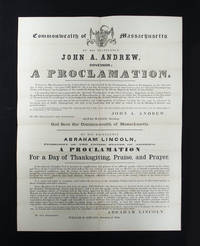
186368373Massachusetts 1863. LINCOLN Abraham. Massachusetts: 1863.<br> <br> Letterpress broadside 27 3/4 x 20 in.; 708 x 508 mm on paper incorporating several display and ornamental fonts as well as the seal of Massachusetts docketed on the verso "Post Office Hanover.' Some light offsetting. Nearly invisible professional repairs to the verso along the folds. A very nice example of this rare and important broadside<br> <br> This original broadside produced in Massachusetts is formatted in two halves with the top half being Governor John A. Andrew's announcement of Lincoln's Proclamation endorsing the observation of this day of Thanksgiving in his state dated July 27 1863 and the bottom half being Lincoln's actual proclamation dated July 15th 1863 and announcing that August 6th shall be set aside as a National Day of Thanksgiving. Though the exact printing date is unknown it can be assumed that it was printed within the week following July 27th.<br> <br> Thanksgiving was observed as a Holiday since colonial times and each state would set aside its own day for celebration. This proclamation was the first time that the Holiday would be celebrated on a set day nation wide making it the first observed Thanksgiving as a National Holiday.<br> <br> Though later the same year on October 3rd 1863 Lincoln made a second proclamation again announcing Thanksgiving as a Holiday but this time in November a date closer to the time most states had been celebrating it in the past. This earlier proclamation is actually the first time Thanksgiving was given national status but because the second proclamation was widely accepted the knowledge of this earlier one has been somewhat forgotten making this piece a rare and important document in the annals of American history.<br> <br> Though this broadside is for the State of Massachusetts no other broadsides from any other states that announce this date are known to exist and only three other copies of this rare document are located through OCLC.<br> <br> HBS 68373.<br> <br> $8500. Massachusetts unknown
18065649Philadelphia: Samuel F. Bradford and Murray Fairman and Co. Fair. 1806. Leather Bound. Complete set of 41 volumes plus 6 illustrated volumes published between 1806 and 1820 in half-volume jobs. This is the US edition of the British original published between 1802 and 1820. All books appear to be complete except for some blank endpages of Illustrated Volume I. Covers are quite worn and four front covers are detached Volumes I VI X and Illustrated I and two more noticeably loose Volume VIII and Illustrated II. Illustrated I has tapemarks from poor repair work and the title page is torn. On most volumes the title pastedowns on spine have fallen off. Three volumes have a little water damage most extensively on Volume XV -- but even that is isolated mainly to cover and endpages. Volume XVI has child's drawings on one blank endsheet. On Illustrated III the foldouts are worn on the edges but still intact. Some foxing but no mold. Occasional creases and waviness. Ex-owner plate in each volume "The property of Phineas J. Miller bequeathed to him by his uncle Phineas Janney and his aunt Sarah S. Janney. 1852-3." All in all despite the wear to the covers the set is nicely preserved. ; Vol. 1/1/2047 . Samuel F. Bradford, and Murray, Fairman and Co. hardcover
1839373003Vandalia Illinois 1839. First edition. 3 1pp. 8vo. Disbound. Housed in a morocco backed slipcase. First edition. 3 1pp. 8vo. Abraham Lincoln had yet to join the bar when he began his first stint in politics in the Illinois legislature in 1834 serving four consecutive terms in the Assembly through 1841. "This rare printing has the prestige of being the first occurrence of Lincoln's name as the sole author of a work. As a Whig lawmaker he was devoted to his party's program of public works through government financing. After the Panic of 18376 the spending he had advocated for had resulted in massive state debts. To relieve the budgetary burden Lincoln proposed that Illinois acquire land within its borders which the federal government still possessed and then sell the land at a fourfold profit to settlers and speculators resulting in both increased revenues and self-determined land ownership" Boroujerdi. Very rarethoma. Monaghan 1; Boroujerdi et. al. Abraham Lincoln: His Life in Print p. 29 unknown