189 résultats
186542656Philadelphia: Published by John Dainty 1865. Age-toning to engraving with some discoloration sections to margins especially to left. Minor wear to frame. Very Good. Oval image sepia toned 8" x 6-1/8". Period black oval wood frame 13-7/8" x 11-5/8" <br/><br/>Full-length group portrait of Abraham Lincoln and his family. Mary Todd Lincoln and the president are seated left to right with Robert Todd standing behind them and Thomas to Lincoln's right. A portrait of William Wallace Lincoln hangs on the wall. Published by John Dainty unknown books
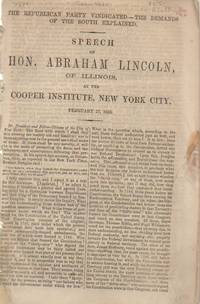
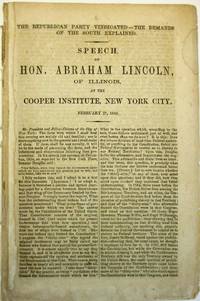
1860013685New York. Good. 1860. Disbound. Disbound pamphlet containing Abraham Lincoln's speech at the Cooper Institute New York City on February 27 1860. Item is in good condition: all edges have moderate wear; pieces of binding are still attached and book tape located where item was once bound into a book; fore edge has a dampstain that affects most leaves; first leaf has closed tear affecting content and a red rubber stamp is located on top right corner; all leaves have moderate soiling. One of his most effective speeches which some historians believe won him the presidency later that year. Carefully crafted speech examining slavery and is broken down in three parts: Part one presenting a rational argument concerning the Founding Fathers; part two is an emotional talk to the South; and part three is an appeal to Republicans. Sabin 41160. ; 8vo 8" - 9" tall; 8 pp . unknown books
184255774Providence: published for the purchaser 1842. First edition 12mo pp. 160; original black cloth-backed printed paper-covered boards; very good. Chapter I verse 1: "Now it came to pass that Harrison was dead and Tyler was made President in his stead over all the United States of America." "This curious book relates to the dissensions among various religious denominations in Rhode Island. It is written in scriptural language and divided into chapters and verses." Not in American Imprints; Bartlett p. 6; Sabin 148 authorship unattributed; Sabin 55932 later editions with Norwood the attributed author. <br/><br/> published for the purchaser hardcover books
1804291047Lausanne.: Hignou. 1804. Contemporary half speckled leather over marbled boards. Very good old ink name to ffep old bookseller’s pencil notes to pastedown. . 8vo. 18.7x12/.2 cm. . French text. Scarce. Bonjour served with the British army in India. After his return to Switzerland he wrote essays on promoting religious tolerance a federal army and progressive taxation. weight: 0.6 lb. One large folding plate. Hignou. hardcover books
1832004264United Kingdom: Not published 1832. Book. Very good condition. Unbound. Signed by Authors. First Edition. Painter of Horses. Stampless cover dated April 19th 1832; one page letter to Henry Graves 1806-1892 leading London printseller saying that he has "tried to procure you a ticket for Private View at the RA without success" but he may see many more members "on the varnishing days" suggesting Sir Edwin Landseer 1802-1873 "he being on the Council has 4. I have but 2 tickets" ending "Yrs truly in haste". One-side 8vo leaf with conjugate address leaf postmarked Lamb's Conduit Street. Corner of address stuck under seal. Cooper was groom to Sir Henry Meux and in 1809 unable to afford a portrait of the horse "Frolic" to which he was greatly attached bought an introduction to painting in oils. His master bought the resulting canvas and Cooper never looked back. Henry Graves was at that time in partnership with F.G. Moon and Thomas Boys. He engraved all the most famous pictures of his day paying Landseer a total of pounds sterling 50000 for copyrights alone and 20000 to the owner of Frith's "A Railway Station" for the painting the engraved plate and the list of subscribers. Not published Paperback books
1865WRCAM31218New York 1865. 8pp. Large folio newspaper. Split along fold with loss to a few words. Good. Published three days after Lincoln's death and bordered in black this edition of THE NEW YORK HERALD begins to sift details of the assassination from the fog of recent events and also contains important news regarding the conclusion of the Civil War. One story contains statements of eyewitnesses including Dr. Charles A. Leale who attended to Lincoln in his box at Ford's Theatre immediately after the President was shot. Another story gives details of the route for Lincoln's funeral train. There are also reports on the condition of Secretary of State Seward and the arrest of his attacker. This issue also carries news of the important meeting between Gen. Sherman and Gen. Johnston regarding the latter's surrender. unknown books
1864011648John A. Gray & Green. Very Good. 1864. First Edition. Pamphlet. A hard-to-find document rarely up for auction. Fold creases fold split of first page at spine light soil and edge wear. A pro-Lincoln pamphlet for the election of 1864 listing statements of Lincoln specifically against slavery and dating from 1837-1864 with a summary list of his views by Whiting at the end. ; 8vo - over 7¾ - 9¾" tall; 16 pp . John A. Gray & Green unknown books
1865WRCAM48848Olympia 1865. 4; 4pp. Large folio. Folded with some loss at folds. Chipping and small tears at edges light soiling and wear. Good. Washington state newspaper issue reporting on the assassination of President Abraham Lincoln. The interior two pages are both column-edged in black the lead headline reading: "President Lincoln Murdered!! Mr. Seward Stabbed." The newspaper likewise reports on the surrender of Gen. Lee at Appomattox and the end of the Civil War. The issue for April 1st reports a small column on the unconstitutionality of the Emancipation Proclamation. The WASHINGTON DEMOCRAT was published from Oct. 17 1864 to July 15 1865. Scarce. unknown books
189222436City of Washington: The Smithsonian Institution 1892. First Separate Edition. Wrappers. Very Good. First Separate Edition. 1-24 pages plus 5 plates and original printed wrappers. Folio 9 3/4 x 13 inches. Top page edges uncut an unread copy. Wrappers have been professionally restored and reattached with missing paper filled in correcting a common failing of this title. The wrappers are often chipped and/or detached with large pieces missing due to the thin almost ephemeral nature of the binding. Smithsonian Contributions to Knowledge number 842. Wrappers. "Michelson was the first American citizen to win the Nobel prize for his 'precision optical instruments and the spectroscopic and metrological investigations conducted therewith'.He was clearly recognized as one of the foremost experimental physicists of the nation." - DSB <br/><br/>"The Nobel Prize in Physics 1907 was awarded to Albert A. Michelson "for his optical precision instruments and the spectroscopic and metrological investigations carried out with their aid". Nobel Prize d o t org. The Smithsonian Institution unknown books
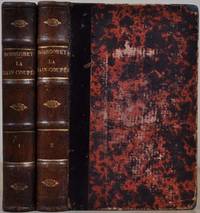
1880015934Paris: E. Plon et Cie 1880. Book. Good condition. Hardcover. Third edition. 12mo - over 6¾" - 7¾" tall. Two volume set; complete. Black leather spines marbled paper-covered boards and dark cloth covered corners; moderately rubbed and worn remaining intact and attractive. The first few pages of the first volume are water-stained and a previous owner's name is on the title page. The half-title page of the second volume has a previous owner's name the same. The texts of both volumes are moderately foxed. Minor soiling to the closed page edges and a few pages with creases to the upper corners. Two quires small gatherings of pages are loosened from the text remaining attached. Text is in French. The story is set in Paris and the story turns upon the unraveling of the plots of a group of Nihilist refugees. It contains careful character studies both Russian and French. Translation of title: The Lost Casket. Detective/Crime Fiction. E. Plon et Cie Hardcover books
1865WRCAM42946New York 1865. Card measuring 5 x 3 1/2 inches. Small closed tear at top edge. Minor wear to front of card; heavier wear to back of card where it has been removed from a later mount. Good. In a blue half morocco and cloth folder spine gilt. A mourning memento card commemorating the life of Abraham Lincoln. The card features a white embossed headstone on a black background and reads: "In memory of Abraham Lincoln President of the United States of America. Born Feb. 12 1809. Died April 15 1865. 'With malice toward none with charity for all.' - Second inaugural address. Requiescat in pace!" Printed on the verso is "Lincoln Tablet Cards. .50 per 100" and the name of the company partially perished. An interesting and macabre souvenir. hardcover books
188853558San Francisco: C. A. Murdock & Co 1888. First edition 8vo pp. 48; original printed salmon wrappers; red ink mark on p. 21 and bleeding onto p. 20; all else near fine. Rocq 13510. <br/><br/> C. A. Murdock & Co unknown books
186424901.02<p>"<i>with the same determination to divide the country unless they can secure universal abolition we are exposed to the same dangers every day and God only knows in what unlucky hour our ruin may be consummated. Compare his policy with McClellan's expression of readiness to receive any State when its people offer to submit to the Union.</i>"</p><p>This Democratic Party campaign pamphlet quotes an April 1864 letter to argue that Lincoln gave Lieutenant General Ulysses S. Grant free rein to conduct the war after having interfered with and micromanaged McClellan's Peninsula Campaign in 1862. The publication also declared that Republicans were stained with "<i>The Taint of Disunion</i>" and quoted from Republican speeches and editorials to insist that the Democrats were the party of "<i>UNION AND PEACE</i>."</p> <b>ABRAHAM LINCOLN.</b>Printed Document. Democrat Campaign "<i>Document No. 12</i>" with headings "<i>Lincoln's Treatment of Gen. Grant</i>" "<i>Mr. Lincoln's Treatment of Gen. McClellan</i>" and "<i>The Taint of Disunion</i>." New York 1864. 8 pp. 5¾ x 8â… in.<p><b><br /></b></p><p><b>Excerpts:</b></p><p>Lincoln to Grant April 30 1864</p><p>"<i>I wish to express in this way my entire satisfaction with what you have done up to this time so far as I understand it. The particulars of your plans I neither know nor seek to know. You are vigilant and self-reliant; and pleased with this I wish not to obtrude any restrains or constraints upon you while I am very anxious that any real disaster or capture of our men in great numbers be avoided.</i>" p1/c1</p><p>"<i>Such in brief are some of the most notable instances in which Mr. Lincoln interfered with General McClellan when he occupied a position similar to that held by General Grant. They reflect so severely upon the President that no attempt to gloss them over by his apparent subsequent repentance can disabuse the patriotic portion of the nation of the matured conviction that he is to be held responsible for the lack of decisive victories in Eastern Virginia. The blame must and will rest upon him to whom it belongs.</i>" p5/c2</p><p>"<i>Having shown by copious extracts from the speeches of Abraham Lincoln W. H. Seward Wendell Phillips Wm. Lloyd Garrison and from the editorial writings of the Chicago Tribune and the N. Y. Tribune… that they were all <b>original secessionists and disunion men</b> we propose now to give the evidence that Mr. Lincoln himself has within the last three months been concerned in a movement to make peace with Jeff. Davis on terms involving the direct proposal to divide the Union and let the South go.</i>" p7/c2-p8/c1</p><p>"<i>with the same determination to divide the country unless they can secure universal abolition we are exposed to the same dangers every day and God only knows in what unlucky hour our ruin may be consummated. Mark how Mr. Lincoln constantly keeps up the idea of negotiating only with Jefferson Davis. Why does he never address himself to the people or the States of the South. Compare his policy with McClellan's expression of readiness to receive any State when its people offer to submit to the Union.</i>" p8/c2</p><p><b>Historical Background</b></p><p>The 1864 presidential election pitted President Lincoln against his Democratic challenger General George B. McClellan. Although McClellan had been the commander of the Army of the Potomac and general-in-chief of the Union Army the Peace platform adopted by the Democratic National Convention in Chicago declared the war a failure. The party was bitterly divided between War Democrats who favored continuing the war to restore the Union while leaving slavery alone; moderate Peace Democrats who favored an armistice and a negotiated peace that would likely protect slavery in a reconstructed union and radical Peace Democrats who favored an immediate end to the war without securing Union victory. McClellan was a War Democrat but the platform was written by radical Peace Democrat Clement Vallandigham and Peace Democrat George H. Pendleton was nominated for vice president.</p><p>In 1864 Republicans created the National Union Party to attract War Democrats Unconditional Unionists and Unionist Party members who would not vote for the Republican Party though most state Republican parties did not change their name. President Abraham Lincoln won the nomination of the "National Union Party" at its Baltimore convention and won re-election with new running mate War Democrat Andrew Johnson.</p><p>Although Lincoln was convinced by August 1864 that he would not be reelected General William T. Sherman's capture of Atlanta in early September and General Philip Sheridan's successes in the Shenandoah Valley of Virginia from August to October ensured his victory. Without the participation of the seceded states Lincoln and Johnson won 55 percent of the popular vote and an overwhelming 212-to-21 victory in the Electoral College. McClellan and Pendleton carried only Kentucky Delaware and McClellan's home state of New Jersey.</p> books
186423084New York: Sold at 13 Park Row and at all Democratic Newspaper Offices 1864. 8pp caption title disbound a bit of blank margin wear Good. At head of title: 'Document No. 12.' <br/><br/> This Democratic Party campaign pamphlet portrays President Lincoln as an incompetent military strategist who perpetually "interfered with General McClellan both when he was general-in-chief and afterward when he commanded the brave Army of the Potomac." Worse Lincoln has "The Taint of Disunion." He not McClellan the Democratic presidential candidate supported the Jeffersonian right of revolution in a speech during his single term in Congress. He and other "ultra abolitionists" are the "original secessionists and disunion men." <br/> George McClellan wants the rebel States to return to the Union but Lincoln's policies render that impossible. Lincoln "regards the States as dead and gone. He magnifies and strengthens the position of the Richmond dynasty" by seeking to negotiate "only with Jefferson Davis." <br/>Monaghan 326. Not in LCP. Sold at 13 Park Row, and at all Democratic Newspaper Offices unknown books
186335588Auburn N.Y. 1863. Broadside 8" x 12-1/4". Very Good.<br/><br/> Congressman Pomeroy of Auburn who represented New York in Congress during the Civil War years and early Reconstruction has high praise for Colonel Clark serving on the staff of General Banks and recently wounded in the advance on Port Hudson. In the earliest days of the War during the Baltimore disorders he "mingled during the day and following night with the populace and rioters gathered all possible information and on the following morning returned to Washington and laid the information before the military authorities. Communications with Annapolis being cut off he accepted the hazardous position of bearer of dispatches from the War Department to Gen'l Butler and of the seventeen messengers sent on that mission was the only one who succeeded in reaching his destination without arrest and that was accomplished only by a night march on foot of twenty-five miles in a country with which he was unfamiliar and by swimming the Patuxent within sound of the voices of the enemies sentinels." <br/>OCLC 768761257 1- Allen Cy Pub. Lib. as of January 2019. unknown books
1869100245New York: The Tribune Association 1869. Frontispiece illustrated throughout. xviii ii 13-136 pp. 12mo. Original cloth very worn and stained. Laid into a blue cloth chemsie. Frontispiece illustrated throughout. xviii ii 13-136 pp. 12mo. Lincoln's Law Partner and Biographer's Copy. Signed by William H. Herndon in pencil on the front flyleaf and again on the first blank with his notes concerning pear cultivation on the rear blanks. Mass. Hort. Soc. p. 258 The Tribune Association unknown books
1804WRCAM27029New Haven: Printed for the General Committee of Republicans From Sidney's Press 1804. 24pp. Modern half morocco and cloth by Sangorski & Sutcliffe. Small old circular blindstamp on titlepage. Bit tanned. Else very good. An influential address on the acquisition of Louisiana highly partisan in outlook: "To federalists this territory for which they would have shed blood now seems a barren waste where no verdure quickens; but to us it appears fruitful abounding in broad rivers and streams producing whatever is necessary to our commerce with foreign nations." Shaw & Shoemaker distinguish two printings of this pamphlet the other originating from Hartford. It is just possible that they are one and the same printing. HOWES B472 "aa." SHAW & SHOEMAKER 5881. SABIN 5596. EBERSTADT 135:496. Printed for the General Committee of Republicans, From Sidney's Press hardcover books
186036919np 1860. 8pp caption title as issued. Disbound with a bit of loosening light inner margin spotting. Good.<br/><br/> Lincoln's great Cooper Union Address argues that the Framers and early Congresses contemplated a narrow and ever-diminishing role for slavery. Examining Constitutional and early Congressional debates he demonstrates that contemporary statesmen viewed slavery "as an evil not to be extended but to be tolerated and protected only because of and so far as its actual presence among us makes that toleration and protection a necessity." <br/> Lincoln's argument fusing the interests of all anti-slavery men whether abolitionists or not ranks among his greatest contributions to American political thought. It received wide press coverage catapulting him into presidential contention for it transported the new Republican Party into the center of American constitutional and legal thinking rather than to an unacceptable extreme. He thus made it easy for moderate Northern Democrats Whigs and Know-Nothings to vote Republican in 1860.<br/>Monaghan 55. LCP 5944. unknown books
190041809Denver: Halsey M. Rhoads 1900. Later printing. A very good copy small repaired tear at top small tear at bottom both in blank areas vertical and horizontal folds some minor edge wear. 1 sheet. Sheet size 17 3/4 x 14 inches. Calligraphic portrait of Lincoln in which the script of the Emancipation Proclamation forms Lincoln's image within a 9 x 11 inch decorated frame surrounded by the names of those members of Congress who voted for the resolution as an amendment of the U.S. Constitution. The original design by W.H. Pratt Davenport 1865 contained just the portrait and border Eberstadt 40 followed by this variation with the additional names 42. Only one at auction in the last forty years and that one dampstained. Quite scarce in all forms: OCLC locates five libraries with the original 1865 print 40 two with the 1865 variant 42 in the Lib. of Congress and Lincoln Memorial Library and two of this later edition: Lincoln Memorial Library and Lilly Library. See Eberstadt: Lincoln's Emancipation Proclamation 42. Lilly Library: Lincoln Prints 4/97. Halsey M. Rhoads unknown books
182434668New York: Printed for the Publisher and Sold at the Book-Stores 1824. 48pp. Light rubberstamp faint blindstamps. Modern plain wrappers light scattered foxing. Good.<br/><br/> Abraham Paul was a successful busy New York publisher and printer. "William and Peter C. Smith publishers were charged with conspiracy to ruin the business of another publisher Abraham Paul. They placed fictitious orders with him and cut the price of their edition of a Bible commentary which was also published by Paul" Cohen. This trial pamphlet prints the indictment and summarizes statements of counsel the testimony the charge of the court to the jury. <br/> William Smith had "made unfriendly declarations against Paul as to his business." He had also made statements of his intention to "take every advantage of Paul he could." Other circumstances and declarations indicated his guilt; but the evidence against Peter Smith was very shaky. The court indicated that a verdict of 'Not Guilty' was appropriate and the jury agreed. Since the defendants had been charged with conspiracy and the involvement of Peter was doubtful no conspiracy existed. Hence the acquittal.<br/>Cohen 12219. Sabin 103189. OCLC records eight locations under four accession numbers as of February 2018. Printed for the Publisher, and Sold at the Book-Stores unknown books
1848008085btWashington D.C.: Wendell and Van Benthuysen. Very Good. 1848. Hardcover. 30th Congress Executive Doc No. 41 ordered for printing in February 1848. Reports from the 1846-1847 topographical expedition across the southwest known for its maps and descriptions of the landscapes flora and fauna and people of the region. The text and maps were to become important resources in the development and exploration of the region. Handsomely rebound in tan leather which is scuffed in places. Lithography by C. B. Graham. Interior is foxed throughout pages are free of markings. Missing plates 25 and 25 and 9 in the Abert report. Both fold-out maps are present. Wagner-Camp 148:5 Howes E-145.; Book; 8vo - over 7¾ - 9¾" tall . Wendell and Van Benthuysen hardcover books
18811331695á¹¾ilna Vilnius: Defus Sh. Y. Fin A. Ts. Rosenḳrants M.M. Shrifá¹zeá¹tser 1881. Hardcover. Quarto 292 pages; VG-; newly rebound in quarter blue leather blue cloth covered boards paneled spine with burgundy label and gilt titling; page edges brittle pages age-toned; upper fore corner of first 96 pages clipped; text in Yiddish; scarce; shelved case 4. Isaac Aboab was an early 14th century Spanish Talmudic scholar and Kabbalist. "The Menorah of Light" is a collection of midrashic sermons. Per the Jewish Encyclopedia: "It has won considerable fame for the author though in his humility he assures his readers that he composed it chiefly for his own use as a public speaker. But besides this it has contributed probably more than any other medieval book to the popularization of rabbinical lore and to the religious edification and elevation of the masses. It belongs to that class of ethical works which sprang up in the thirteenth century in a time of reaction against the one-sided manner in which the Talmudic studies had been previously pursued.'. It was published with a Spanish translation Leghorn 1657 with a Hebrew commentary and a Judæo-German translation by Moses Frankfurter Amsterdam 1701 with a modern German translation by Fürstenthal and Behrend Krotoschin 1844-46. It was translated also into Yiddish Wilna 1880.";. 1331695. Shelved Dupont Bookstore. Defus Sh. Y. Fin, A. Ts. Rosenḳrants, M.M. Shrifá¹zeá¹tser hardcover books
186230007.01<p>On the front page under <i>"News from the North" </i>is the text of Abraham Lincoln's reply to <i>New York Tribune</i>editor Horace Greeley. Greeley's letter urging Lincoln to emancipate all slaves in Union-held territory was known as "The Prayer of Twenty Millions." It was first published on August 20 1862. Lincoln responded on August 22 declaring that his paramount goal is to save the Union regardless of its effect on slavery as well as his personal views that all men should be free.</p> <b>ABRAHAM LINCOLN.</b>Newspaper. <i>Richmond Whig</i> Richmond Va. August 30 1862. 2 pp. 17 x 24 in.<p><b><br /></b></p><p><b>Excerpt:</b></p><p><i>"…As to the policy I 'seem to be pursuing' as you say I have not meant to leave any one in doubt. </i></p><p><i> I would save the Union. I would save it the shortest way under the Constitution. The sooner the national authority can be restored the nearer the Union will be 'the Union as it was.' If there be those who would not save the Union unless they could at the same time </i>save<i> slavery I do not agree with them. If there be those who would not save the Union unless they could at the same time </i>destroy<i> slavery I do not agree with them—My paramount object in this struggle </i>is <i>to save the Union and is </i>not<i> either to save or to destroy slavery. If I could save the Union without freeing </i>any<i> slave I would do it and if I could save it by freeing </i>all<i>the slaves I would do it; and if I could save it by freeing some and leaving others alone I would also do that.—What I do about slavery and the colored race I do because I believe it helps to save this Union and what I forbear I forbear because I do not believe it would help to save the Union. I shall do </i>less<i> whenever I shall believe what I am doing hurts the cause and I shall do </i>more<i>whenever I shall believe doing more will help the cause. I shall try to correct errors when shown to be errors; and I shall adopt new views so fast as they shall appear to be true views. </i></p><p><i> I have here stated my purpose according to my view of </i>official<i> duty; and I intend no modification of my oft-expressed </i>personal<i> wish that all men every where could be free." </i></p><p><b>Historical Background</b></p><p>Though this letter is often as proof that Lincoln did not intend to abolish slavery unknown to Greeley and most Americans Lincoln had already drafted the preliminary Emancipation Proclamation and was only waiting for a Union military victory to deliver it. Moreover Lincoln makes a "divide and conquer" rhetorical move: he splits the issue by stating that his constitutional duty as president is to keep the Union together while simultaneously expressing his personal view of universal freedom at the end.</p><p>Additional content in this issue includes a front page editorial <i>"European Recognition" "The Indian Atrocities in Minnesota" "Yankee Finances" "An Order From Gen. Burnside" "The Peninsular Campaign—Gen. </i><b><i>J. Bankhead </i></b><i>Magruder's Official Report"</i> which takes over two columns with considerable detail.<br /><br />The back page has additional content with: <i>"A Brilliant Cavalry Exploit" "The Impressment of Slaves In Georgia" "Outrages in Arkansas" "From Kentucky"</i> and more. Additionally there are various reports from the <i>"Confederate Congress"</i> and numerous advertisements including a <i>"$100 Reward"</i> for a runaway slave.</p><p>The <i>Richmond Whig</i> is one of the less common—but still important—newspapers from the capital of the Confederacy.</p><p>In <i>Four Years in Rebel Capitals: An Inside View of Life in the Southern Confederacy from Birth to Death</i> journalist T. C. DeLeon wrote that the <i>Richmond</i> <i>Whig</i>was among the South's best wartime newspapers. Their pages "recorded the real and true history of public opinion during the war. In their columns is to be found the only really correct and indicative 'map of busy life its fluctuations and its vast concerns' in the South during her days of darkness and of trial."</p><p>One of the more interesting episodes in the history of the <i>Whig</i> is its alleged involvement in a terror plot against New York City during the Civil War. The <i>Whig</i>was reputed to have worked with the Confederate government to use advertisements and editorials to convey secret messages to Southern sympathizers in the North. In October 1864 the <i>Whig</i> was alleged to have run an editorial that signaled Southern supporters to embark on a terror campaign that called for widespread fires to be set in New York city and federal offices to be taken over and the capture of the city's military commander Maj. Gen. John Adams Dix.</p><p><b>Condition</b></p><p>Good. Never bound several folds with minor wear at the folds.</p> books
186424898<p>"<i>As a MAN OF THE PEOPLE understanding them and trusted by them he has proved himself the man for the time.</i>"</p> <b>ABRAHAM LINCOLN. HENRY CHARLES LEA.</b>Printed Pamphlet. <i>No. 17: Abraham Lincoln</i> March 1864. 12 pp. 5¾ x 8¾ in.<p><b><br /></b></p><p><b>Excerpts:</b></p><p>"<i>What will be the place assigned by history to Abraham Lincoln</i>" p3</p><p>"<i>Few of us can forget the feelings of doubt and distrust with which we regarded his advent to the Presidential chair. That his native energy had elevated him from a youth of poverty and labor was reassuring and yet the narrow sphere in which his life had mostly been passed seemed to deprive him of the opportunities of familiarity with the great principles and details of statesmanship requisite for the perilous contingencies of the future.</i>" p3-4</p><p>"<i>Thus with doubt confusion and demoralization around him with no landmarks in the past to serve as a guide for the present or as a precedent for the future did Mr. Lincoln undertake the awful responsibilities of his high position. Thus relying on himself and on the people he boldly set to work to restore the Republic.</i>" p5</p><p>"<i>The country was saved so soon as the people recognized in their President a man who believed that he could save it and who honestly intended to do so. Had Abraham Lincoln done no more than this he would have merited a place between Washington and Jackson. It is a great thing to lift a nation to the highest level of its duties and responsibilities and few men to whom in the world's history the opportunity has been vouchsafed have accomplished the task so thoroughly.</i>" p6</p><p>"<i>And now the momentous question arises before the American people—to whose hands shall be confided the delicate trust of restoring the Union of our fathers</i>" p7</p><p>"<i>The great duty to which Mr. Lincoln has dedicated himself with rare singleness of purpose is the one thought which engrosses every true American heart—the re-establishment of the Union on a permanent basis.</i>" p7</p><p>"<i>The results of the war during the last twelve-month have not shown that the Proclamation was a mistake in military policy.</i>" p9</p><p>"<i>When Mr. Lincoln recommended the plan of compensated emancipation which was adopted by Congress he showed that he recognized fully how great an element of future strife lay in the institution of slavery and how beneficial to the whole country its abolition would be. Moderate in all his opinions he wanted a gradual not a violent change and long after his Emancipation Proclamation was issued he provoked the wrath of the radical emancipationists in Missouri by lending what aid he constitutionally could to the 'conservatives' in that State who desired that the extinction of slavery should be brought about gradually. Possibly in this Mr. Lincoln was mistaken yet if so the error arose from the desire which he has constantly manifested to harmonize the conflicting interests of the country even at the expense of temporary popularity.</i>" p9-10</p><p>"<i>The wisest statesman does not disdain to profit by experience nor can the head of a popular government adopt measures of fundamental change before the people are ripe for them. It is probable that Mr. Lincoln learned much as the war wore on; at all events the people did.</i>" p10</p><p>"<i>There are many who have richly earned the gratitude of the people for eminent services rendered to the Republic in the hour of her trials. There is no one who has so signally centered upon himself the confidence of all. There have been mistakes of detail in military naval and financial matters—mistakes inseparable from the sudden transition from profound and prolonged peace to civil war upon the largest scale. Yet in the general policy of the administration in its principles of statesmanship there have been few errors save those arising from a too generous disbelief in the sincerity of Southern madness.</i>" p11</p><p>"<i>Had Mr. Lincoln moved faster than he has done he would have left the people behind him and lost the support without which no popular government can conduct an exhausting war.</i>" p11</p><p>"<i>As a MAN OF THE PEOPLE understanding them and trusted by them he has proved himself the man for the time.</i>" p12</p><p>"<i>no one can be named who unites like Abraham Lincoln the kindliness and firmness the skill and experience the native sagacity and honesty to bring about an harmonious settlement and to extort from repentant rebels the implicit confidence which those high qualities have won from all loyal men.</i>" p12</p><p><b>Historical Background</b></p><p>The Union League Club of Philadelphia formed in 1862 as a patriotic society to support the Union and the policies of the Lincoln administration. The members of this private club represented the Philadelphia region's elite in business education and religion.</p><p>On April 15 1864 Lea met with Lincoln in Washington and three days later he wrote to Lincoln including two pamphlets he had recently written for the Union League Club including this one. He informed Lincoln "To prevent misconstruction perhaps I should add that I am a man of independent position with nothing to ask at your hands except the preservation of our institutions."<br /></p><p><b>Henry Charles Lea</b> 1825-1909 was born in Philadelphia and received a classical education from a private tutor. He showed particular promise in natural history. He joined his father in the publishing business in 1843 but had a nervous breakdown in 1847. While recuperating he read medieval French history and decided to become a historian rather than a scientist. Over the next fifty years Lea produced ten books and numerous articles on medieval institutional legal and ecclesiastical history. During the Civil War Lea was a member of the Union League of Philadelphia and led its Board of Publication. In that role he wrote many of the League's published pamphlets including this one. From 1863 to 1865 he served as a Bounty Commissioner and aided the provost marshal in recruiting soldiers including African Americans.</p> books
1828009569This ciphering book measures 8" x 12.5". It contains 92 pages of ciphering work. There is also an additional 36 pages of text in a different hand perhaps by a sister copied from Timothy Shay Arthur's <i>Advice to Young Ladies</i> and the American Tract Society's <i>Helps for Every Hour</i>. Quarter-bound with marbled boards. The owner's label reads "Abraham Rex / Philadelphia / 1828." An 8.5" x 4" pencil drawing copied from <i>The Tours of Dr. Syntax</i> is laid in. <br /><br />Ciphering books were prepared as part of the basic mathematical training of relatively well-off American students usually boys. Most like this one contain examples of the Numeration Addition Subtraction Compound Multiplication Reduction Compound Reduction Rule of Three Indirect Proportion Vulgar Fractions Compound Proportions The Double Rule of Three Avoirdupois Weight Troy Weight Long and Land Measure etc. <br /><br />In addition to providing mathematical basics boys venturing into trades or businesses needed advanced or specialized training in mathematics. In this case Abraham's book includes some work that would prepare him for mercantile positions including Tare and Tret calculating weight adjustments for packing and shipping materials Insurance Commissions and Brokerage Compound Interest Rebate or Discount Equation calculating combined payments Barter Loss and Gain Fellowship calculating complicated partnership percentages etc. <br /><br />Abraham was a member of a prominent and prosperous Pennsylvania Dutch family. Online genealogical records show that the Rüx anglicized to Rex family immigrated to the United States sometime prior to 1720 and settled in Germantown north of Philadelphia. The family soon moved westward to Schaefferston in Lancaster County where it proliferated and prospered with members becoming merchants innkeepers informal bankers brokers pharmacists and physicians. <br /><br />For more information about the Rexes of Schaefferstown see Wenger's <i>Delivering the Goods: The Country Storekeeper and Inland Commerce in the Md-Atlantic</i>. An archive of Rex family business papers is held by the Winterthur Library. <br /><br />For more information about ciphering books see Kilpatrick's <i>Rewriting the History of School Mathematics in North America . . . The Central Role of the Cyphering Books</i> Doer's master's thesis: <i>Cipher Books in the Southern Historical Collection of the University of North Carolina</i> and Andries's "Learning Mathematics in North America" at the University of Pennsylvania's Kaplan Collection of Early American Judaica. <br /><br />18th-century American ciphering books are scarce as the overwhelming majority of extant examples date from the early 1800s into the mid-1850s. hardcover books