201 résultats
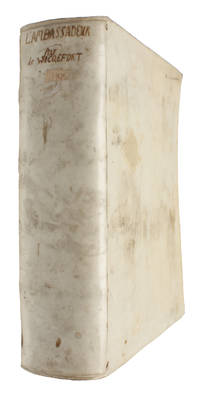
1649518331649. Luguni Joannis Antoni Huguetan 1649 Folio Portrait 2 2 68 984 311 pp.; 50 655 1 46 2 pp.; 14 148 6 1 pp. zwei Pergamenteinbände d.Zt.; von einigen kleineren Mängel abgesehen ein feines Expl. Editio postrema à mendis purgatissima - Second Edition of this Opera Omnia first published 1642. ABRAHAM ZACUTUS LUSITANUS 1575-1642 - or Abraham ben Samuel Zacutus "was born in Lisbon. He studied medicine at Coimbra and Salamanca and took his degree of doctor in 1596 when he was twenty-one years of age after having attended the Universities of Salamanca Coimbra and Siguenza . He then returned to Lisbon where according to L. Lemos "In the thirty years he practiced there . He stood out preeminent among his colleagues of many lands . . . whether in discussion or in consultation in medical practice or in literary matters he easily won the palm. . . . But when there seemed that nothing could be added to the happiness of Zacutus- behold a sudden whirlwind of fate . he was plunged headlong from the high peak of the good fortune to which his merit had raised him. A most cruel edict of the king of Lusitania banished all of the Hebrew stock from the kingdom." Zacutus departed from the city of his birth when he was 50 years of age and settled in Amsterdam. " . He journeyed to Amsterdam in the hope of obtaining a peaceful abode ." Zacutus joined the Amsterdam Jewish Community and was one of that remarkable body of physicians who as Portuguese emigres won fame for themselves and added luster to Portuguese medicine; many proudly added "Lusitanus" to their names. In his "Peroration" to the first volume of his Opera Omnia Zacutus writes: " For I am a Jew and a stranger who fled from Portugal and my beloved and most lovely birthplace Lisbon tossed about hither and thither by severe misfortune and the storms of a long life. . I have allowed no day to pass-as Seneca says-without writing a line in which I showed my love for the Republic of Medicine. . I was determined to spend my life in devotion to study." He regarded " physicians as the tutelaries of Divinity sons of the gods." M. Lemos has studied Zacutus' works and presents us with an interesting summary. From this we can see that as an anatomist and pathologist Zacutus deserves special praise for the frequency with which he made autopsies at a time when they were rare. He embraced every opportunity and as a result he published post-mortem findings in the plague in affections of the heart malignant tumors renal and vesical calculi etc. He was much interested in drugs . But it is chiefly as clinician that he showed his greatness; he examined carefully with all the means then known and he relied upon his observations. As a result M. Lemos claims that the name of Zacutus is inseparable from the history of such diseases as plague diphtheria the eruptive fevers and malignant growths. He was one of the first to describe black water fever. He is praised for his studies of and contributions to the knowledge of syphilis. In estimating Zacutus' place in medicine we must bear in mind with M. Lemos that he was one of the most illustrious representatives of moribund Galenism which he defended with great loyalty. In his devotion he combated with all his force those whom he regarded as perverting the text and showing disregard to the masters. But as Carvalho points out "it is true that we had at that time some doctors who without despising traditional science by their devotion to progressive tendencies made great advance in the field of pathology and therapeutics. Of this number Zacutus and Duarte Madeira Arrais take front rank." The universality of Zacutus' interest in human diseases is everywhere apparent. His writings are arranged very systematically and no part of the body fails of attention. An interesting account could be made of the diseases of the eye which he describes and discusses. The same may be said of other organs. It is to be regretted that Zacutus did not live to publish his promised work on surgical diseases for the purpose itself furnishes proof there was nothing in medicine that was foreign to his concern. The collected works the Opera Omnia published in Lyon 1st.Ed. 1642/44 in two large volumes shortly after Zacutus' death January 22 1642 "hauptsächlich betrauert von den Armen" Hirsch but bearing the note of the author's revision present vast scholarship. They were dedicated to King Louis XIII of France. Volume I is described in its title as: The History of the Great Physicians being all the medical histories of internal diseases which are found scattered in the works of the foremost physicians most carefully arranged in proper order and supplied with explanatory notes and commentaries; together with a review of questions and matters of doubt." This is a medical history written not in chronological order of the general development of medicine nor in the sequence of eminent medical personages and their discoveries and their writings but from the point of view of single diseases their course and their treatment as recorded in the works of medical writers throughout the centuries. At the end of the volume Zacutus writes that he has presented " the histories of medical cases gathered from the foremost physicians in bountiful measure-to the number of 433 " and that he has illustrated clarified arranged and confirmed them on the authority of the most learned scholars to the number of 1711 "whom he has cited. It represents work of astounding volume. Volume II is entitled " The Practice of Cases-in which the treatment of all internal diseases is explained according to the views of leading physicians; serious doubts are discussed and resolved; and finally many practical observations are interspersed in their proper places. With an introduction of the physician into practice together with a most elegant pharmacopoeia. To which are added extraordinary medical cases by the very same author fully and newly enriched in which rare wonderful monstrous cases are presented together with their hidden causes signs courses and treatments." Each disease is considered under the following heads: Definition sometimes followed by "differentia" species causes signs prognosis treatment together with illustrative cases. The volume ends with a deeply pious and moving prayer of gratitude for Divine help-just as the book of precepts mentioned above opens with Precept I: "The physician should be a faithful worshipper of Divine Majesty "; yet in discussing objectively a medical problem he adds: "for we are physicians and not theologians! " It is also worthy of mention that the editions of 1649 and 1657 both volumes were from the same printer and are identical in form and paging with the first. What estimate have medical historians placed upon Zacutus Lusitanus Sprengel summarizes his life and work with the words that he distinguished himself as a practitioner as well in Holland as in Portugal. He commends the well ordered and carefully explained collections of cases of older writers as well as his own observations and experiences in rare cases. Daremberg describes the books as "precious works . . . still very useful." Neuburger and Pagel cite Zacutus frequently and praise his works. Neuburger regards him as the first to deal with the history of medicine." Harry Friedenwald The Jews and Medicine I pp.307-321 Cat. p.154 unknown
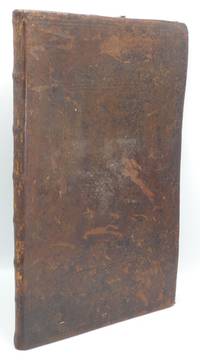
163734148Oxford: Leonardus Lichfield Impensis Gulielmi Webb. 1637. First Edition. Hardcover. Good in No Dust Jacket dust jacket. Mild dampstaining to a few pages. Leather boards with black spine label and gilt lettering. Browning to edges of endpapers. Ink lettering to endpapers. Edges of boards are worn. A few cracks along spine joints. Pencil marginalia to a few pages. Base of titlepage appears to have been slightly trimmed as some point.; 24mo 5" - 6" tall; 247 pages . Leonardus Lichfield Impensis Gulielmi Webb hardcover
16855057Benjamin Tooke 1685. Second Edition. Hardcover. Used - Good/None. Spine binding and cover fine and robust; corners turning in and exposed slightly and scuff marks on front board. Slight crack between front board and spine spine worn at top; five raised bands on spine spine cover missing in one section. Contents clean with inscription on inside cover. Overall very good and clean copy. 267 pages. Benjamin Tooke hardcover
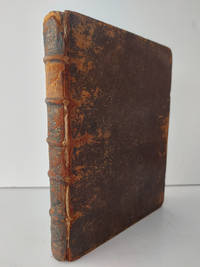
168522303Oxford: Theater 1685. Book. Poor. Full-Leather. 8vo - over 7¾" - 9¾" tall. 342 pages plus supplenda. Front board through to page 2 are detached but present. All pages are correct and clean. Theater Hardcover
169060801Cologne Pierre Marteau 1690. 4to. In contemporary full vellum with yapp edges and title in contemporary hand to spine. Small paper-label pasted on to top of spine. Light soiling and miscolouring to extremities. Small worm-tract on pp. 295-457 210 far from affecting text. Worm-tract to upper outer margin of Pp. 1-47 of 'Discours Historique de L'election' slightly touching text otherwise a fine and clean copy. 4 457 pp.; 219 49 pp.; 2 266 1 pp. <br/><br/><em>Later expanded edition first published in 1682 of Wicquefort’s work on ambassadors and international relations in general. From 1626 to 1658 Wicquefort served as Brandenburg's envoy to the French court. However Cardinal Mazarin suspected him of involvement in a dubious correspondence and had him imprisoned in the Bastille. After a year he was released with a French pension and moved to The Hague as the representative of the Duchy of Braunschweig-Lüneburg. In 1675 he faced imprisonment again this time by the Dutch government on charges of treasonous dealings with the French. Sentenced to life and his assets confiscated he later escaped to Celle where he died. Brunet V p.1442 </em> hardcover
1660R7BROWN2009<p>The Hague: Adrian Vlacq 1660. Hardback contemporary blind-panelled full-calf. Large folio. 41cm x 25.5cm. Text in French. 108pp. Title with engraved coat-of-arms vignette lacking the folding portrait of Charles II with 6 double-page engraved plates by David and Pierre Philippe and Theodor Matham after Jacob Toorenvliet and Adriaen van de Venne. 1st edition 1660. Binding is rubbed and worn. Bookplate of William Bolitho Ponsandane and Christopher Rowe to front pastedown. A small engraved coat-of-arms pasted over small tear to title page. Some light marginal water staining. Scarce. A heavy book additional postage may be required for orders outside the UK. r7. Hard Cover. Good.</p> Adrian Vlacq hardcover
1693000046Leipzig : David Fleischer 1693. Hardcover. Very Good/not applicable. No publisher no place no year. - Large 4to 33.5x20.5 cm. - 2 73 recte 75 38 p. - In Fraktur. Many errors of pagination. - Much later late 19th century half-clioth with marble-paper covered hard boards; quite worn. - Rare abbreviated printing of Schonberg's 1693 "magnum opus" which is of the size of 8 240 38 134 2 pages. -- For the present copy no publisher's name publication place or year given. Though the font is identical to that of the well described edition this is not a direct reprint - the present copy has a somewhat different spatial arrangement and contains many misprints for instance on the title-page "Vatterland" for "Vaterland" etc. not in the original. WorldCat describes it as : "Vermutlich in Leipzig bei David Fleischer gedruckt"; and the date is likely to be 1693 or close to it. -- Schonberg gives a comprehensive description of mining and of all kind of related practices such as prospecting underground surveying tunnel construction machinery flood control in mines washing of ore assaying smelting et. even administration and industrial relation. - The second part "Redens-arten" gives the terminology af mining in dictionary form. - Much rarer than the original: WorldCat gives only three locations: two in Denmark and one in Germany. <br/> <br/> David Fleischer (?) hardcover
16051103040008Medius meri diannus 1605. Map. Very Good. 14 x 18 inches. Hand-colored. Extracted from the atlas Medius Meri Diannus. Ornately decorated and colored title cartouche in top right corner reads "Medius Meri Dianus 75 relequi ad cum inclinati funt ratione 50 and 58 perallelo rum." This beautifully crafted chart illustrates the region now known as the Ukraine and the Caucausus in vivid detail. Minor chipping around edges. Some discoloration due to age. Colors remain bright and vivid. A superior map in exquisite condition. Medius meri diannus unknown
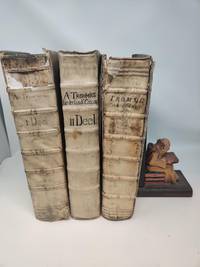
169184646Groningen and Amsterdam: Johannes Purmerent Gerardus Borstius 1691. First Edition. Vellum. Good. Three thick folios in vellum approx. 12x7 inches. <br /> <br /> 1: New Testament. Corners worn front hinge split but holds firm. Top half of rear hinge split one inch chip to head of spine covers soiled and smudged. Binding sound. 1036 pages. SIGNED by Abraham Trommius Groningen on page preceeding dedication. Printed by Johannes Purmerent in Groningen 1672. <br /> <br /> 2. Old Testament Vol 1 From Genesis to Esther. Published by Gerardus Borstius Amsterdam. 1685. Corners worn wear along bottom edges. Chip to bottom of spine top two inches of top of spine is flaked off but present. Covers soiled. Some wear to front pastdown text clean pages supple binding solid. 1242 88 pages. <br /> <br /> 3. Old Testament Vol 2: From Job to Malachi Published by Gerardus Borstius Amsterdam. 1691. Corners worn wear to extremities. Boards smudged and front board has some warping. Binding solid. Text clean pages supple. 984 1317 pages. Abraham Trommius 1633-1719 was a noted scholar and theologian and was the pastor at Groningen for 48 years. Johannes Purmerent, Gerardus Borstius unknown
1636254CLASHU1Ex Officina Elseviriorum Bonaventure & Abraham Elzevier Lugd. Batavor. Leiden: 1636. 1636 pp. 20 96 24. Solitaire printer's mark. Small 24mo. 122 x 70 mm. Early plain vellum binding. A guide to princely behavior first issued by Elzevier the year before. The Dutch family of Elzevier Elzevir; Elsevier were the foremost printers of their time. They produced a vast variety of well printed scholarly and popular books; many in a very small handy format. Louis Elzevier the founder of the firm produced his first book in Leiden in 1583. The 'golden age' of Elzevier printing was between 1620 and 1680. The Elzevier dynasty probably produced their last publication in 1770. Willems 442. PRICE JUST REDUCED! SMALL BOX 2/SH U10 Language: eng. Full Vellum. Hardbound. Very Good. Ex Officina Elseviriorum [Bonaventure & Abraham Elzevier], Lugd. Batavor. (Leiden): 1636. hardcover
17000066066La Haye Hague: Adrian Moetjens 1700. Hardcover. Very Good/No Jacket. Circa 1700. Hardcover 16mo. full burgundy calf gilt bands and title. 250 pp. Leather lightly rubbed and cornerworn; spine in nice shape showing only minor wear to its ends. Small sticker on front pastedown; donation and library stamp on title page and rear fly leaf. Unmarked readable text; endpapers foxed. Place-ribbon. In French and Latin. Comes in a protective mylar sleeve. Scarce. The author 1634-1706 originally published this title under the pseudonym La Motte Josseval. Digital images available upon request. Adrian Moetjens hardcover
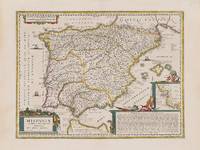
1662200014AG1662. Amsterdam Janssonius c.1662. Original hand-coloured copper engraving. Plate Size: 49.2 cm x 37 cm. Sheet Size: 59.8 cm x 45 cm. Original map. Very good condition. Faint hint of foxing along left fore edge. Centre fold as issued. Latin text on reverse. Koeman I 6000H:1.2. Border with longitudinal and latitudinal information. A richly detailed and very interesting map showing Roman Hispania - the Iberian Peninsula and the Balearic Islands. The three Ancient Roman provinces organised by the emperor Augustus of Hispania Citerior et Tarraconensis Hispania Baetica and Lusitania Hispania are shown on the map. Northern tip of Africa 'Hispania Transfretana Sive Tingitana Qua et Mauritania' pictured also. Relief shown pictorially with rivers mountains and significant towns and cities depicted. Large decorative cartouche with finely detailed Classical allusions in lower right section of map contains an inset box showing the coastal area around 'Gades' Cadiz. Cartouche also lists numerous place names of uncertain location in Latin. Bar-scales within cartouche in top right corner of the map. Decorative title cartouche in lower left corner. Three ships are also pictured suggesting the region's maritime importance. 'Mare Mediterraneum Internum' and 'Ocean Atlanticus Quod et Mare Hesperium Vespertinum Occiduum et Externum' are also listed. Abraham Goos 1590 c. 1643 was a Dutch cartographer publisher and engraver. He made globes maps of North America a comprehensive map of European coastlines and the first printed Hebrew language map of The Holy Land. His first teacher was Jodocus Hondius 15631612 a renowned map-maker whose son-in-law was Johannes Janssonius. After Hondius died his son-in-law Jan Janssonius took over Hondius's business and continued the partnership with Goos. One of Hondius' specialties was the manufacture of globes and Goos and Janssonius continued this regularly modifying them as more geographical information became available. In 1616 he published Nieuw Nederlandtsch Caertboeck an atlas of the Seventeen Provinces in 23 maps and one of the first atlases of the Netherlands; Johannes Janssonius 1588-1664 was a renowned geographer and publisher of the seventeenth century when the Dutch dominated map publishing in Europe. unknown
1657012951Nurnberg: Zufinden bey Paulus Fursten Kuntsthandler 1657. Book. Very good condition. Hardcover. First Edition. Oblong 16mo. Engraved title page 20 leaves of introductory text followed by 71 leaves of text followed by four leaves of black and white copper-engraved plates numbered I-IIII followed by 226 leaves of black and white copper-engraved plates numbered 1-226. Each engraved leaf is engraved on one side only. Original full leather binding is moderately worn on the exterior hinges and extremities with minor warping of front board. Front endpapers are lacking. Minor staining to the fore-edge of the majority of pages affecting the margins only. Minor foxing scattered throughout in several instances affecting the plates. Previous owner's stamp circa 1900 on title page and half title page and bookplate on front pastedown endpaper: Henry von Wackerbarth Chicago. The final two leaves of plates are creased on the edge not affecting the engravings and the rear endpapers are heavily creased. A very attractive first edition of this work. No author is stated on the title page but Sibmacher is mentioned in the text. "gedruckt bey Christoff Gerhard zufinden bey Paulus Fursten." Title continues "aussgebildet zuersehen. Erste-Theil.". Zufinden bey Paulus Fursten Kuntsthandler Hardcover
1658B6453Frankfurt a. M: J. Bayern J. W. W. Serlin 1658. Covers and spine worn and reinforced; otherwise generally very good. . Binding: Contemporary blind full calf; spine with four 4 bands and embossed title on two. Notes: Text in German. Gothic Script; with Latin inserts in Roman script.<br>Final and most extended edition with 67 plans. <br>This is the most expanded edition and therefore most desirable edition of this work by Saur; the first was published in 1581 the ones that followed under varying titles and the present revised work in 1658. Size: small quarto 201x115mm. Illustration: Illustrated title copper printed title with printer's device rubricated initials at openings; head and tailpieces; sixty-seven 67 city plans at 2 54 88 109 166 173 188 201 207 241 265 291 309 400 463 494 500 523 538 545 557 583 587 597 703 762 779 837 880 885 935. 4 23 37 69 76 84 93 113 117. 2 25 46 102 107. 60. 29. 10 17 74. 15 28 50 56 73. 51 84 119. 36 47 64 89 148 173 188 195. 16. Two of the plans are full-page Jerusalem/Hierosolyma and Rom/Roma; all remaining are half-page in size and comprise Aach/Aquisgranum Aix La Chapelle. Antorff/Antwerpen Augusta/Augspurg Basel Braunschweig/ Brunopolis Breszlau Bruessel Burgos Bremen Calaris Cassel Coelln/Colonia Constantinopel Dreszden Erdfurt/Erffurt Franckenberg Franckfurt am Mayn Franckfurt an der Oder Freyburg in Briszgaw Friedberg in der Wetterau Fulda Geneva/Genff Gandavum/Gent Genua Groeningen Hamburg Hanaw Heydelberg/Budoris Jena Koenigsperg Landeshut in Baeyern Leipzig Leon/Lugdun/Lion Lisabona/Ulixibona Londen/London Loeven/Lovanium Luebeck Lueneburg Luettich/Leodium/Liege Magdeburg/Meydenburg Marpurg/ Martisburgum Meintz/ Moguntiae Muenchen/Abadiaum Muenster/Monasterium Nuernberg/Norinberga Osnabruck Palma Parisz/Lutetia Parisiorum Prag/Praga Regenspurg/Ratisbona Riga Roan/Rouen/Rohmagus Rostock/Rhodopolis/ Laciburgum Schweinfurt Speyer/Nemetum Straszburg/ Argentoratum Trier/Treveris Tuebingen Venedig/Venetia Ulm/Rhetia Wien/Fabiana/Fabana/Faviana Wittenburg/Wittenberg Wormbs/ Wormatia Wuertzburg/Erebipolis/Herbipolis Zuerch/ Tigurum/Turegum. References: Graesse VI 276; Bachmann Pages: Ll: bl. 2 939 bl.; collated as: Bl.2; i-iv with illustrated title printed title dedication and to the reader; A1 -Zzzzz4 Aaaaaa1 - Eeeeee4 Ffffff1-2 A1-R4 S; A1-O4 At1-It4; Aï“1- Dï“4 Eï“1-3; aA1- mM4 nN1-2; Aa1-Ll4; An1-Rn4; ∞a1-∞z4 ∞aa1-4 bb1-3; A1-C4 bl. Category: Book Atlas & Cartography; Book Europe Germany; J. Bayern, J. W., W. Serlin unknown
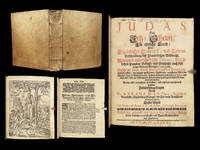
169127448<p><strong>1691 German Monsters Satanic Rituals Judas DEMONS Dragons Abraham Sancta Clara</strong></p><p>Abraham a Sancta Clara was a 17th-century German clergyman known for his eccentric Augustinian views. His sermons were popular not only because of content but because he was known to be entertaining and satirical in his delivery. His main book "<em>Judas Der Ertz-Schelm</em>" is a German personal devotional which discusses moral doctrines as well as Bible history and ecclesiastical poetry focusing on Judas Iscariot and his betrayal of Jesus Christ.</p><p>This title was extensively used by Adolf Hitler and the Nazi regime as a supplement to their foundational philosophies.</p><p>Item number: #27448</p><p>Price: $750</p><p>SANCTA CLARA Abraham a</p><p><strong><em>Judas Der Ertz-Schelm/ Für ehrliche Leuth/ Oder: Eigentlicher Entwurff/ und Lebens-Beschreibung deß Iscariotischen Bößwicht : Worinnen underschiedliche Discurs sittliche Lehrs-Puncten/ Gedicht/ und Geschicht/ auch sehr reicher Vorrath Biblischer Concepten. </em></strong></p><p>Salzburg: Melchior Haan 1691.</p><p><u>Details</u>:</p><p><!-- if !supportLists-->· <!--endif-->Collation: Complete with all pages;</p><p><!-- if !supportLists-->o <!--endif-->28 457 11</p><p><!-- if !supportLists-->o <!--endif-->Allegorical illustration of Judas hanging himself</p><p><!-- if !supportLists-->· <!--endif-->Provenance: Handwritten – <em>Antonius Hacke</em></p><p><!-- if !supportLists-->· <!--endif-->Language: German</p><p><!-- if !supportLists-->· <!--endif-->Binding: Vellum; tight and secure</p><p><!-- if !supportLists-->o <!--endif-->One functional clasp</p><p><!-- if !supportLists-->· <!--endif-->Size: ~8in X 6.25in 20cm x 16cm</p><p>Our Guarantee:</p><p>Very Fast. Very Safe. Free Shipping Worldwide.</p><p>Customer satisfaction is our priority! Notify us with 7 days of receiving and we will offer a full refund without reservation!</p><p><u>Photos available upon request. </u></p> Melchior Haan, hardcover
166341874Nuremburg: Heirs of J. & W. Endter 1663. 8vo. 6 3/16 x 3 3/4 inches. xiv 998 xl pp. Title in red and black engraved frontispiece and 42 plates 7 folding. Early ownership signature on front pastedown. Early 18th-century lengthy manuscript commentary referencing passages on Brahmins from a work by Johann Albrecht von Mandelslo 1616-1644. Contemporary vellum<br/> <br/> First German Edition of one of the earliest European accounts of Hinduism in Southern India by a missionary who worked in Palicatta Coromandel for ten years from 1630 enlarged by supplementary accounts of Asian African and American religions not included in the Dutch and French editions.<br/> <br/> Abraham Roger was a Dutch missionary and linguist who spent a significant portion of his career working in India under the Dutch East India Company VOC. He was stationed in Pulicat a trading hub on the Coromandel Coast of South India where he worked among the Tamil speaking population. His experiences as a missionary coupled with his interest in local culture prompted him to document Hindu religious practices and beliefs culminating in this notable work. First published in Dutch in 1651 and translated into German in 1663 it is one of the earliest and most significant works by a European exploring Hinduism in South India. Roger's approach was distinct in its attempt to understand and accurately portray Hinduism a religion he sought to comprehend despite his missionary objectives. His work stands out for its translations of Hindu hymns and descriptions of temple rituals and he drew much of his knowledge from his close collaboration with local Brahmins reflecting a relatively objective tone compared to other European writings of the period. Despite his Eurocentric and missionary perspective Roger was unique in that he did not entirely dismiss Hinduism but rather engaged with it to create one of the earliest detailed European accounts of the religion.<br/> <br/> Sabin 72603; JCB III p. 92; Ackermann V 1273; Landwehr VOC 65. Heirs of J. & W. Endter unknown
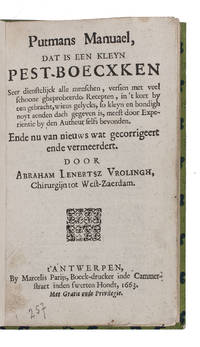
1663I1TG729PBDLDAntwerp: Marcelis Parijs 1663. Later boards covered with decorated paper. 8vo. Third edition of a handbook on the plague by Eduardus Putman enlarged and improved by Abraham Lenertsz Vrolingh. The first edition was published in 1603 in Amsterdam a second in 1646 in Zaandam. The present edition was most likely designed so that it could also be bound with Der matroosen ghesontheyd an account of scurvy by Vrolingh. In the preface Vrolingh states that by joining the two works both sailor and soldier would benefit from the knowledge.Putmans manuael seeks the cause of the plague in astrology holding Mercury responsible for the illness in the whole body and other planets for specific regions of the body such as behind the ears Saturn and the moon in the armpits Mars and the sun and in the groins Venus and Jupiter. It also discusses the influence of the four elements: water fire earth and air. Other subjects covered are the plague in pregnant women and a description of various symptoms such as headache heart palpitations thirst fever and diarrhoea followed by suggested treatments selected from experience. Most of the medicines pills and powders are made from plants and herbs such as nettle rhubarb rosemary and camomile. With the bookplate of Van der Hoeven. Owner's manuscript note on flyleaf.l BMN I p. 209; Dijstelberge "Plague and print" 1663/8; STCN 3 copies; STCV 1 copy; cf. Krivatsky 9325 1603 Amsterdam & 1646 Zaandam eds. Marcelis Parijs, hardcover
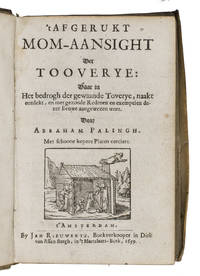
1659ABC_47611Amsterdam: J. Rieuwertz 1659. Contemporary overlapping vellum. Small 8vo. With a woodcut title-vignette showing a witch on a broomstick leaving a house through the chimney 4.3 x 5.2 cm 13 etched full-page illustrations on 8 plates by Salomon Savry. An exceptionally rare first edition of a book focusing on the subjects of witchcraft sorcery demonology and black magic. The author passionately expresses his dissatisfaction with the brutalities inflicted upon individuals accused of being witches using vivid and disturbing illustrations as evidence. Notably the book features a captivating woodcut title vignette depicting a witch's daring escape through a chimney. In the image her legs hang from the opening inside the house while she simultaneously rises on her broom outside the chimney creating a striking visual effect. Abraham Palingh is a somewhat elusive figure in Early Modern Dutch literature and his book provides a fascinating insight into the attitudes of an educated man toward witchcraft. He claims that his 't Afgerukt Mom-aansight Der Tooverye is based on firsthand accounts. Information regarding the occurrence of harmful sorcery and attitudes towards sorcery in Amsterdam and Haarlem has been documented from the initial witchcraft trials to the point where such crimes were no longer a concern for the judiciary. Between 1542 and 1566 trials for harmful sorcery took place in Amsterdam while Haarlem witnessed similar trials in 1549. Historical accounts of both cities as well as Jacobus Scheltema's History of Witch Trials published in Haarlem in 1828 make mention of sorcery trials in Amsterdam. However these references often provide only superficial details despite the potential for valuable insights found in the actual procedural documents. Conversely little information about witchcraft in Haarlem can be gleaned from existing literature. Abraham Palingh author of 't Afrukt Mom-aansight der Tooverye published in Haarlem in 1659 briefly mentions a few cases of sorcery accusations that he claims to have personally known yet his accounts remain vague.The fine and copperplate illustrations were made by Salomon Savry 1594-1683. He was a recognised engraver of his time highly involved with the Amsterdam book industry of the seventeenth century. Some wear to binding. Ex libris from the library of Leontine Buijnsters-Smets. Light browning and foxing. Otherwise in very good condition.l Bibl. Med. Neerl. I p.150; Muller 539 1725 edition; Scheepers I 552; STCN 841091951 12 copies; Waller 1315 1725 edition; WorldCat 56854247 3 copies. J. Rieuwertz, hardcover
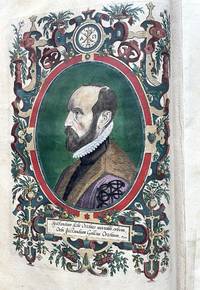
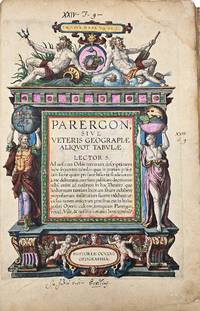
160312725Antwerp Jan Baptist Vrients / Robert Brunaeu 1603. Theatrum orbis terrarium followed by Parergon sive veteris Geograpiae aliquot tabulae followed by Nomenclator Ptolemaicus. Complete copy bound in a contemporary vellum binding stamped with multiple friezes on the covers and 5 raised bands on the spine 358 f. Folio. Illustrated edition with an engraved allegorical frontispiece the arms of the Kingdom of Spain on the verso an engraved portrait of Ortelius an architectural frontispiece Parergon and 156 engravings. including 151 engraved maps 33 of which are in the Parergon as well as 3 plates of views and 2 plates of costumes. Some pages of the text are foxed and the stamp has been scratched off on the title page. Restoration work at the bottom of the two costume plates. Reinforcement in the margin of the inner hinges of 7 maps. H. 46 x W. 32 x D. 10 cm. / H. 18.11 x W. 12.6 x D. 3.94 inch. The finest edition of this iconic atlas considered to be the first true atlas the first true atlas Van der Broecke. ""The unique place occupied by Ortelius' Theatrum in the history of cartography is mainly due to its status as the world's first regularly produced atlas . Its form and content set the standards for subsequent atlases"" Koeman 1969 III 29. Ortelius' atlas was revolutionary because it was the first attempt to present the geography of the world in a uniformly produced collection of maps of all known parts of the world. Ortelius designed the maps himself basing his designs on the cartographic sources that he had at hand and equally revolutionary also mentioning his sources on the maps and once finished had them engraved by Frans Hogenberg and Ambrosius and Ferdinand Aertsen. Finally Gielis Coppens van Diest printed the maps after which they could be coloured also in a uniform style and bound in a logical order in one volume. These atlases were a new phenomenon and proved to be very popular in Europe. Soon editions were published in various languages of Europe in print runs of a few hundred copies each. A perfectly complete copy of the Theatrum Orbis Terrarum the Parergon and the Nomenclator Ptolemaicus in its original colours. Literature: Van de Krogt/ Koeman IIIA 31:053; Adams O-335; Phillips 382; Shirley 122 Antwerp, Jan Baptist Vrients / Robert Brunaeu hardcover
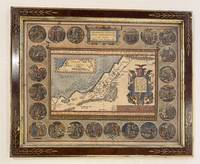
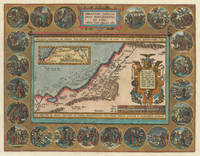
1603328971Antwerp: Ortelius Abraham 1603. unbound. Map. Engraving with hand coloring. 17 3/8 x 21 1/2" Framed in Eli Wilner carved frame.<br/> <br/> Beautiful map of the Holy Land bordered by 22 medallions depicting Abraham's wanderings. An inset map shows the path Abraham took. Ortelius used both Ptolemy and the Bible as sources for the map and based the medallion scenes on drawings by Maarten de Vos also of Antwerp. Latin text on verso. Expert repair to lower margin minor scattered stains in margins. Abraham Ortelius 1527 - 1598 a Flemish cartographer and geographer is widely regarded as one of the important and influential cartographers in history. He is known for his "Theatrum Orbis Terrarum" which was the first modern atlas. Van den Broecke 183.2 1603Lv; Laor 547C. Antwerp 1603<br/> <br/> Ortelius, Abraham unknown
161230715Antwerp: Balthasar Moretus 1612. Other. A very strong impression. In excellent condition. 353 by 457mm 14 by 18 inches. Original copper engraving published 1612 in the famous historical atlas Parergon Latin text-edition by Abraham Ortelius. Finely later hand colored in wash and outline. The map shows the travels and life of Abraham. More else this highly decorative map is surrounded by 22 fine engraved medallions which are showing episodes of the life of the Patriach Abraham. The map was published 1592 for the first time in Abraham Ortelius edition of theTheatrum Orbis Terrarum. Ortelius who created this map used as cartographical source for this map information from Ptolemy and from the bible particulary for the illustrations of Abrahams life depicted in 22 medallions. Broe. 182 Balthasar Moretus unknown
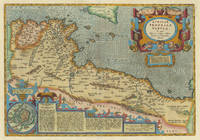
161230987Antwerp: Balthasar Moretus 1612. Other. In excellent condition. 338 by 488mm 13 by 19 inches. Original copper engraving published 1612 in the famous historical Atlas Parergon Latin text-edition by Abraham Ortelius. Finely later hand-colored in wash and outline. Very decorative map of North Africa Libya and Tunisia with Malta and southern Sicily.This map is ornated with a decorative title cartouche in the upper right corner and an inset with text cartouches in the lower left corner. Villages and towns are shown as miniature views. Ortelius was born on 14 April 1527 in the city of Antwerp which was then in the Habsburg Netherlands modern-day Belgium. The Orthellius family were originally from Augsburg a Free imperial city of the Holy Roman Empire. In 1535 the family had fallen under suspicion of Protestantism. Following the death of Ortelius's father his uncle Jacobus van Meteren returned from religious exile in England to take care of Ortelius. Abraham remained close to his cousin Emanuel van Meteren who would later moved to London. In 1575 he was appointed geographer to the king of Spain Philip II on the recommendation of Arias Montanus who vouched for his orthodoxy. He travelled extensively in Europe and is specifically known to have traveled throughout the Seventeen Provinces; in southern western northern and eastern Germany e.g. 1560 15751576; France 15591560; England and Ireland 1576; and Italy 1578 and perhaps twice or thrice between 1550 and 1558. Beginning as a map-engraver in 1547 he entered the Antwerp Guild of Saint Luke as an illuminator of maps. He supplemented his income trading in books prints and maps and his journeys included yearly visits to the Frankfurt book and print fair where he met Gerardus Mercator in 1554. In 1560 however when travelling with Mercator to Trier Lorraine and Poitiers he seems to have been attracted largely by Mercator's influence towards the career of a scientific geographer. Wikipedia Broe. 218 Koemann III map 8610H:31 ed. 31:051 1595 Latin Balthasar Moretus unknown
160312720Antwerp Jan Baptist Vrients 1603. Parergon sive veteris geographiae aliquot Tabulae . Engraved title 33 maps of the Ancient World 2 plates with costumes and 3 views ""Tempe"" ""Daphne"" and ""Escorial"". H. 43 x W. 30 cm. / H. 16.90 x W. 11.8 inch. A fine and complete copy of the Parergon by Abraham Ortelius 1527-1598 published in Antwerp in 1603. This celebrated companion to the Theatrum Orbis Terrarum represents one of the earliest and most influential works of historical cartography. The volume contains a full suite of maps illustrating the ancient world including the Roman Empire classical Greece and Biblical regions. All maps are original contemporary hand coloured exceptionally well-preserved and vibrant throughout. The engraved title page is richly decorated with allegorical figures and classical motifs. Latin text on verso. A highly decorative and scholarly work reflecting the humanist interest in antiquity and geography. Light age toning and occasional marginal wear are consistent with age. Overall a very attractive copy. Antwerp, Jan Baptist Vrients unknown
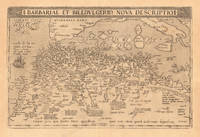
160819024Antwerpen: Platin 1608. Other. In excellent condition. 330 by 500mm 13 by 19 inches. Original copper engraving published 1608 in an Italian text edition of the " Theatrum Orbis Terrarum. A good and strong impression of this map. This antique map shows North Africa with the Mediterranean Sea and the Atlantic coast. The map is equipped with many place names rivers mountains towns a small part of Italy Sicily the islands Corsica Sardinia Menorca Mallorca etc. The map is ornated with a large title cartouche in the upper margin as well we find for decoration a sea monsters and a ship in the sea. Villages and towns are shown as miniature views. Ortelius was born on 14 April 1527 in the city of Antwerp which was then in the Habsburg Netherlands modern-day Belgium. The Orthellius family were originally from Augsburg a Free imperial city of the Holy Roman Empire. In 1535 the family had fallen under suspicion of Protestantism. Following the death of Ortelius's father his uncle Jacobus van Meteren returned from religious exile in England to take care of Ortelius. Abraham remained close to his cousin Emanuel van Meteren who would later moved to London. In 1575 he was appointed geographer to the king of Spain Philip II on the recommendation of Arias Montanus who vouched for his orthodoxy. He travelled extensively in Europe and is specifically known to have traveled throughout the Seventeen Provinces; in southern western northern and eastern Germany e.g. 1560 15751576; France 15591560; England and Ireland 1576; and Italy 1578 and perhaps twice or thrice between 1550 and 1558. Beginning as a map-engraver in 1547 he entered the Antwerp Guild of Saint Luke as an illuminator of maps. He supplemented his income trading in books prints and maps and his journeys included yearly visits to the Frankfurt book and print fair where he met Gerardus Mercator in 1554. In 1560 however when travelling with Mercator to Trier Lorraine and Poitiers he seems to have been attracted largely by Mercator's influence towards the career of a scientific geographer. Wikipedia Platin unknown
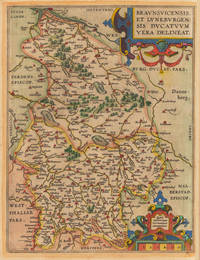
160235922Antwerpen 1602. Kräftig und gleichmäßig gedrucktes Exemplar. Tadellos. . 31 x 234 cm 12.25 x 925 inches. Hand-Colored Original Copperplate Engraving by Abraham Ortelius depicting Braunschweig Herzogtum. Published Antwerpen 1602. Sheet: 31 x 234 cm 12.25 x 925 inches. A fine and original hand-colored example of Ortelius's celebrated cartographic work documenting this region of Germany with the precision and decorative artistry characteristic of the 16000s. Abraham Ortelius 1527-1598 was a Flemish cartographer and geographer from Antwerp widely regarded as the creator of the first modern atlas. His landmark publication Theatrum Orbis Terrarum 1570 set the standard for atlas-making for the next century presenting uniform copper-engraved maps with scholarly commentary. By Ortelius's death the Theatrum had appeared in 25 editions in seven languages. In 1575 King Philip II of Spain appointed him Royal Geographer. His maps engraved with extraordinary precision are among the most sought-after in antique cartography held in collections including the Plantin-Moretus Museum in Antwerp the Library of Congress and the British Library.This plate presents a original copperplate engraving with original hand coloring depicting the city of Braunschweig Herzogtum published in Antwerpen 1602. The view is framed with a decorative Baroque cartouche containing the title inscription. Such topographic views from Ortelius's workshop are primary historical documents of German urban history in the 1600s now prized equally by historians map collectors and interior decorators. Sheet measures 31 x 234 cm 12.25 x 925 inches. In good condition overall with minor signs of age appropriate for a 17th-century engraving. Retains its original contemporary hand coloring. Ready to frame. Koem. Ort. 33 unknown