MOIVRE, Abraham deBiblio.com
254 résultats
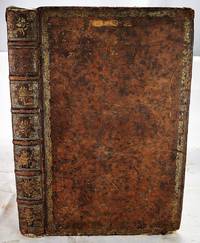
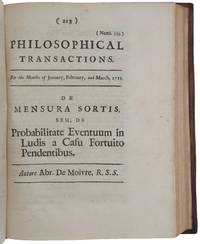
17126431London: Printed for H. Clements . and W. Innys . and D. Brown 1712. First edition. <p>First edition published in the Philosophical Transactions and de Moivre's first published work on probability-the earliest original contribution to the subject to appear in Britain. This pioneering paper laid the groundwork for his later masterpiece The Doctrine of Chances 1718 the definitive English-language textbook on probability theory for over a century. As Hald notes "Nearly all of De Mensura Sortis was later incorporated into The Doctrine of Chances . the most important textbook on probability theory until the publication of Laplace's Théorie Analytique des Probabilités 1812."</p>. <p>THE FOUNDATION OF THE DOCTRINE OF CHANCES</p> . <p>First edition contained in a complete volume of the Phil. Trans. of de Moivre's first published work on probability and the first original work on the subject published in Britain a precursor to his Doctrine of Chances which appeared seven years later. "De Moivre's work on the theory of probability surpasses anything done by any other mathematician except Laplace. His principal contributions are his investigations respecting the Duration of Play his Theory of Recurring Series and his extension of the value of Daniel Bernoulli's theorem by the aid of Stirling's theorem" Cajori p. 245. "The only systematic treatises on probability printed before 1711 were Huygens' De ratiociniis in ludo aleae 1657 and Pierre Rémond de Montmort's Essay d'analyse sur les jeux de hazard 1708. Problems which had been posed in these two books prompted de Moivre's earliest work and incidentally caused a feud between Montmort and de Moivre on the subject of originality and priority" DSB. "Nearly all of De Mensura Sortis was later incorporated into de Moivre's book The Doctrine of Chances 1718 1738 1756 which was the most important textbook on probability theory until the publication of Laplace's Théorie Analytique des Probabilités 1812. In the preface de Moivre states that he began his work on probability theory at the exhortation of Francis Robartes who asked him to solve the division problem for two gamesters playing bowls and also to find the probability of getting certain given faces as the outcome of a given number of throws with a die. He also states that he had previously read the books by Huygens and Montmort 'but these distinguished gentlemen do not seem to have employed that simplicity and generality which the nature of the matter demands.' Furthermore he writes that 'while they suppose that the skill of the gamesters is always equal they confine this doctrine of games within limits too narrow.' Finally his remarks about Montmort may be read as if Montmort had used only the method of Huygens on some new examples. These rash remarks naturally provoked a dispute with Montmort" Hald 1984 pp. 230-1. "The most remarkable of de Moivre's contributions in De mensura sortis are his derivation of the ruin probability in Huygens' fifth problem; his use of the Poisson approximation to solve the binomial equation Bc n p = ½ with respect to n; his solution of the occupancy problem by means of the method of inclusion and exclusion and the algorithm for the continuation probability in the duration of play for the ruin problem. Furthermore he gives without proof the probability of getting a given number of points by throwing any given number of dice and the probability of ruin when one of the players has infinitely many counters. The only contemporary evaluation of these impressive results is the critical review given by Montmort in a letter of 5 September 1712 to Nicholas Bernoulli about a month after Montmort had received a copy of the paper from de Moivre . Montmort recognizes de Moivre's priority to the Poisson approximation to Robartes' problem and to the algorithm for finding the continuation probability in the problem of the duration of play" Hald 2003 pp. 403-4. No copies in auction records.</p> <br /> <p>Provenance: Toft Hall in Cheshire England seat of the Leycester family since the 14th century bookplate on front paste-down.</p> <br /> <p>De Moivre's interest in probability was awakened by Francis Robartes 1649-1718 Member of Parliament and scion of an aristocratic family. In 1692 Robartes wrote a manuscript on two probability problems that he presented to the Royal Society but never published and in the following year he succeeded in publishing another paper on probability. In 1710 Robartes helped John Harris with his article entitled "Play" in Harris's scientific dictionary Lexicon Technicum. Robartes devised an algorithm that Harris used to extract the appropriate terms in a binomial expansion in order to solve the problem of the division of stakes. At some point over the years 1708 to 1710 Robartes received a copy of Montmort's Essay which he showed to de Moivre. He also gave de Moivre three challenge problems of his own devising to work on. "Once de Moivre had solved the first problem within a day of Robartes posing it Robartes gave de Moivre the other two problems to work on while at the same time encouraging him to write on probability. The encouragement proved fruitful. De Moivre finished his manuscript on probability during a holiday that he spent at a country house possibly Robartes's. On June 11 1711 de Moivre submitted his manuscript to the Royal Society. The Society's Journal Book quietly marked the beginning of a new era for probability in England with the note 'Mr. De Moivre presented a Treatise Intituled de Probabilitate Eventum in Ludo Alea This Treatise was Ordered to be printed in the Transactions.' The treatise with the title De Mensura Sortis or 'Of the measurement of lots' comprises an entire issue Number 329 of Philosophical Transactions. At 52 journal pages it is more than three times longer than anything else de Moivre had written to that date" Bellhouse p. 70.</p> <br /> <p>De Moivre begins De Mensura Sortis with two basic definitions from which many of his results are derived. The first comes directly from Huygens's De ratiociniis. For two players A and B contending for a stake of value a A has p chances to win and B has q. The expected value for each player follows what Huygens obtained: ap/ p q for A and aq/ p q for B. The second definition may have come from Edmond Halley or Francis Robartes. If an event can happen in p ways and fail to happen in q and a second event can happen in r ways and fail to happen in s then all the chances for events happening or failing are in the product p qr s or pr qr ps qs. For example pr is the number of ways both events can happen and ps is the number of ways that the first event happens and the second fails. This is the approach that Halley used in evaluating joint life annuities in his 1693 paper on mortality data from the city of Breslau .</p> <br /> <p>"De Moivre finishes the introduction by saying that if the first event is repeated n times then the total number of chances in the game is given in the binomial expression p qn. When this expression is expanded it may be written as a sum containing terms of the form piqn-imultiplied by an appropriate coefficient where i represents the number of times the event happens and n - i represents the number of times it fails the sum of the first c terms of this expansion is denoted Bc n p . The binomial expansion becomes the motif for the paper . At the beginning nine of the first ten problems there are some simple variations on the use of the expansion of p qn and then at the end the last seven problems the expansion is used to solve a very complex problem the problem of the duration of play. In the middle there are several solutions to a number of challenge problems taken from various sources including the three from Robartes" Bellhouse p. 73.</p> <br /> <p>Problems 1 3 and 4 are relatively straightforward applications of the binomial distribution. Problem 1 is to find the chance of throwing an ace two or more times in 8 throws with a single die. Problem 3 is to determine the chances of A and B winning a single game supposing that A can give B two games out of three. Problem 4 is similar.</p> <br /> <p>In problems 5 to 7 de Moivre considers the problem of finding the number of trials that gives an even chance for getting at least one success but fewer than some given number of successes c say. This means he has to solve the equation Bc - 1 n p = ½ for n when c and p are given. De Moivre considers the two extreme cases p = ½ and p tends to 0 of which the first is easy by symmetry. De Moivre shows that as p tends to 0 Bc - 1 n p tends to e-mmultiplied by the sum of the first c terms in the series expansion of em in powers of m where m = np/1 - p de Moivre was not able to express the result this way because our notation for the exponential function had not yet been invented. This result the 'Poisson approximation' to the binomial distribution played a very important role in later developments. "There has been some discussion of whether it is reasonable to contend that de Moivre found the Poisson distribution" Hald 1984 p. 231 more than a century before Simeon-Denis Poisson. </p> <br /> <p>Problems 2 3 4 and 10 are on the division of stakes or 'problem of points'. "Consider a series of games with two players A and B where in each game A has probability p and B probability q = 1 - p of winning a point. If play stops when A lacks a points and B lacks b points in winning how should the stake be divided between them De Moivre proves that A's probability of winning equals the sum of the last b terms of the expansion of p qab-1 and B's probability of winning equals the remaining a terms. This result had already been derived by Johann Bernoulli in 1710 in a letter to Montmort but it was not published until 1713 . In Problem 8 de Moivre generalizes to k players say and gives the solution as the sum of the appropriate terms of the multinomial pl p2 . pknl-k n being the total number of points lacking. He points out that certain terms have to be divided among the players depending on the permutation of the p's.</p> <br /> <p>"In Problems 16 and 17 he gives the solution of Robartes's problem: the division problem for two gamesters playing bowls. In each game B say gets a number of points equal to the number of his bowls which is nearer to the jack than any of A's bowls. By combinatorial methods de Moivre finds the probability of getting i points in a single game assuming that the players have the same number of bowls and are of the same skill. The division problem is then solved by recursion" Hald 1984 pp. 231-2.</p> <br /> <p>Problems 11 12 and 13 are related to the first two of the five problems Huygens posed at the end of his De ratiociniis. "In these problems the players take turns in a specified order until one of them wins. De Moivre gives the solution as the sum of an infinite series" ibid. p. 232.</p> <br /> <p>Problem 15 is 'Waldegrave's problem' James Waldegrave 1684-1741 later the first Earl Waldegrave was a British diplomat living in Paris who himself published nothing in mathematics. "Let there be n 1 players A1 . An1 of equal skill. Players A1 and A2 play a game and the loser pays a crown to a common stock and does not enter the play again until all the other players have played; the winner plays against A3 and the loser pays a crown to the stock and so on. If the winner of the first game beats all the rest the play is finished; if not the play goes on each player coming in again in turn until one player has beaten in succession all the other players and he then receives all the money in the stock.<br /> The problem is to determine</p> <br /> <br /> the probability of each player winning the stock;<br /> the expectation of each player; and<br /> <br /> the probability of a given duration of the play.<br /> <br /> <p>"In a letter to Bernoulli of I0 April 1711 Montmort writes that the problem has been proposed to him and also solved by Waldegrave for three players. Independently de Moivre formulated and solved the problem for three p1ayers in De Mensura Sortis 1712" Hald 2003 p. 378. "De Moivre solves this problem by means of conditional expectations. First he supposes that A beats B in the first game. On this assumption the play may end with A as winner in the second fifth eighth . game. The probabilities of A for reaching these games and winning are ½ ½4 ½7 . Hence the expected stake plus fines may be found and subtracting A's expected fine his conditional expectation results. Under the same assumption B's expectation is obtained. The unconditional expectation is then found as the average of the two conditional expectations" Hald 1984 p. 232.</p> <br /> <p>Problems 18 and 19 are 'occupancy problems' the third type of problem posed to de Moivre by Robartes: Find the probability pn that f specified faces occur at least once in n throws with a die having k faces. De Moivre calculates pn by means of the method of 'inclusion and exclusion'. In Problem 19 he solves the equation pn = ½ under the assumption that f is small compared to k.</p> <br /> <p>Problem 9 is a generalization of the 'gambler's ruin problem' the fifth of Huygens's problems in De ratiociniis. "Consider two players A and B having a and b counters respectively. In each game A has probability p and B has probability q = 1 - p of winning and the winner gets a counter from the loser. The play continues until one of the players is ruined. What is the probability of A being ruined Huygens's fifth problem is obtained for a = b = 12" ibid. Problems 20-26 are a continuation of the discussion of the ruin problem: what is the probability that the play ends at the nth game or before Problem 25 is the case when A has infinitely many counters; de Moivre states the result without proof.</p> <br /> <p>"Although the publication date is given as 1711 De Mensura Sortis was not in print until 1712. Shortly after its publication de Moivre sent copies of the issue to several people in England including Edmond Halley Isaac Newton and de Moivre's fellow chess player at Slaughter's Coffeehouse the Earl of Sunderland. De Moivre's friend Pierre des Maizeaux handled several copies that were bound for the Continent. Using his connections in the Republic of Letters des Maizeaux sent copies of De Mensura Sortis to Abbé Jean-Paul Bignon at that time the French minister of state with responsibility for the Académie Royale des Sciences. Bignon wrote to des Maizeaux on September 24 1712 saying that the copies he received had been distributed. He also enclosed a letter from Montmort to de Moivre thanking him for his treatise; the letter has not survived. Whatever he thought personally about de Moivre's treatise Montmort was adhering to the code of civility in the Republic of Letters by sending the letter of thanks. Other people on the Continent receiving copies were Nicolaus Bernoulli Johann Bernoulli and Pierre Varignon. Johann Bernoulli received his copy via William Burnet a younger son of Gilbert Burnet Bishop of Salisbury; Bernoulli had asked Burnet to obtain a copy for him" Bellhouse p. 71.</p> <br /> <p>Abraham Moivre stemmed from a Protestant family. His father was a surgeon from Vitry-le-François in the Champagne. From the age of five to eleven he was educated by the Catholic Péres de la doctrine Chrètienne. Then he moved to the Protestant Academy at Sedan were he mainly studied Greek. After the latter was forced to close in 1681 for its profession of faith Moivre continued his studies at Saumur between 1682 and 1684 before joining his parents who had meanwhile moved to Paris. At that time he had studied some books on elementary mathematics and the first six books of Euclid's elements. He had even tried his hand at Huygens' 1657 tract without mastering it completely. In Paris he was taught mathematics by Jacques Ozanam who had made a reputation from a series of books on practical mathematics and mathematical recreations. Ozanam made his living as a private teacher of mathematics. He had extended the usual teachings of the European reckoning masters and mathematical practitioners by what was considered fashionable mathematics in Paris. Ozanam enjoyed a moderate financial success due to the many students he attracted. It seems plausible that young Moivre took him as a model he wanted to follow when he had to support himself. After the revocation of the Edict of Nantes in 1685 the Protestant faith was no longer tolerated in France and hundreds of thousands of Huguenots who had refused to convert to Catholicism emigrated to Protestant countries. Amongst them was Moivre who arrived in England in 1687. There he began his occupation as a tutor in mathematics. He also added a 'De' to his name probably because he wanted to take advantage of the prestige of a pretended noble birth in France in dealing with his clients many of whom were noblemen. An anecdote from this time which goes back to de Moivre himself tells that he cut out the pages of Newton's Principia of 1687 and read them while waiting for his students or walking from one to the other - the main function of this anecdote was to demonstrate that de Moivre was amongst the first true and loyal Newtonians and that as such he deserved help and protection in order to gain a better position than that of a humble tutor of mathematics. In 1692 de Moivre met with Edmond Halley and shortly afterwards with Newton. Halley ensured the publication of de Moivre's first paper on Newton's doctrine of fluxions in the Philosophical Transactions for 1695 and saw to his election to the Royal Society in 1697. Newton's influence concerning university positions in mathematics and natural philosophy persuaded de Moivre to engage in the solution of problems posed by the new infinitesimal calculus. In 1697 and 1698 he published the polynomial theorem a generalization of Newton's binomial theorem together with application in the theory of series. In 1704 de Moivre began a correspondence with Johann Bernoulli but Bernoulli's letters showed de Moivre that he lacked the time and perhaps the mathematical power to compete with a mathematician of this calibre in the new field of analysis. De Moivre ceased his correspondence with Bernoulli after he was made a member of the Royal Society commission to adjudicate in the priority dispute between Newton and Leibniz over the invention of calculus - continuing the correspondence may have made him appear disloyal to the Newtonian cause. When the Lucasian chair in mathematics at Cambridge was given in 1711 on Newton's recommendation to Nicholas Saunderson de Moivre realized that this only option was to continue his occupation as a tutor and consultant in mathematical affairs in the world of the coffee houses where he met his clients; additional income he could draw from the publication of books and from translations. He therefore turned to the calculus of games of chance and probability theory which was of great interest for many of his students and where he had few competitors in England.</p> <br /> <p>Hald 'A. de Moivre: De Mensura Sortis or On the Measurement of Chance' International Statistical Review 52 1984 pp. 229-262. Hald History of Probability and Statistics and their Applications before 1750 2003. Bellhouse Abraham de Moivre 2011. Cajori A History of Mathematics 1894.</p> <br/> <br/> 4to 218 x 168 mm pp. vi 555 with 13 plates a little browning and foxing. Contemporary calf sides decorated in blind with corner fleurons a little rubbed joints starting spine label mostly missing. A handsome copy with no restoration. Printed for H. Clements ... and W. Innys ... and D. Brown unknown
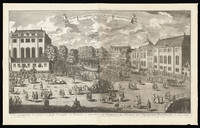
175214421Amsterdam c1752. 565 by 935mm. 21.5 by 36.75 inches. Engraving with etching on two sheets joined. View of the Plantage Muidergracht and the Jonas Daniël Meijerplein. The view shown from the present day Mr. Visserplien the busy intersecti.on in central Amsterdam depicts the Portuguese Synagogue on the left and the High German or Great Synagogue. These momumental buildings now house the Jewish Historical Museum. The first Jews to settle in Amsterdam were the Sephardim who had been expelled from Portugal and Spain in 1493. They were joined in the following decades by the Ashkenazi from Central and Eastern Europe the first of whom had come from Germany in 1600. In those years the only available land for them was at the outskirts of the eastern side of the Centrum the island of Vlooienburg surrounded by the Amstel River and the canals so they settled along the island's main street Breestraat which quickly became known as Jodenbreestraat. The Great Synagogue now the Jewish Historical Museum and the Portuguese-Israelite Synagogue were opened in 1671 and 1675 respectively. The Portuguese Synagogue was the place where Spinoza was placed under the ban by the Sephardic Jewish community in 1656. Pieter Stevensz. van Gunst 1659-1732 also known as Pieter Stevens van Gunst or Petrus Stephani was a Dutch draughtsman copperplate engraver and printmaker active in Amsterdam London 1704 and the Dutch town of Nederhorst 1730-1731. Abraham Rademaker 1677 21 January 1735 was an 18th-century painter and printmaker from the Northern Netherlands. Rademaker was born in Lisse. According to the RKD he was a versatile artist who painted Italianate landscapes but is known mostly for his many cityscapes and drawings of buildings that were made into print. R.W.P. de Vries auction 1925: 295. unknown
173014402Amsterdam c1730. 565 by 935mm. 22.25 by 36.75 inches. Engraving with etching on two sheets joined. View of the Plantage Muidergracht and the Jonas Daniël Meijerplein. The view shown from the present day Mr. Visserplien the busy intersecti.on in central Amsterdam depicts the Portuguese Synagogue on the left and the High German or Great Synagogue. These momumental buildings now house the Jewish Historical Museum. The first Jews to settle in Amsterdam were the Sephardim who had been expelled from Portugal and Spain in 1493. They were joined in the following decades by the Ashkenazi from Central and Eastern Europe the first of whom had come from Germany in 1600. In those years the only available land for them was at the outskirts of the eastern side of the Centrum the island of Vlooienburg surrounded by the Amstel River and the canals so they settled along the island's main street Breestraat which quickly became known as Jodenbreestraat. The Great Synagogue now the Jewish Historical Museum and the Portuguese-Israelite Synagogue were opened in 1671 and 1675 respectively. The Portuguese Synagogue was the place where Spinoza was placed under the ban by the Sephardic Jewish community in 1656. Pieter Stevensz. van Gunst 1659-1732 also known as Pieter Stevens van Gunst or Petrus Stephani was a Dutch draughtsman copperplate engraver and printmaker active in Amsterdam London 1704 and the Dutch town of Nederhorst 1730-1731. Abraham Rademaker 1677 21 January 1735 was an 18th-century painter and printmaker from the Northern Netherlands. Rademaker was born in Lisse. According to the RKD he was a versatile artist who painted Italianate landscapes but is known mostly for his many cityscapes and drawings of buildings that were made into print. R.W.P. de Vries auction 1925: 295. unknown
17211906090004Amsterdam J. Lindenbergh 1721. First Edition. Hardcover. Good. Folio 42 x 28 cm. Bound in contemporary mottled calf. Shelf worn corners bumped. Joints cracked. Additional engraved titles 2 engraved portraits 2 double-page maps map of the world map of Greece and the Mediterranean. A total of 179 engravings within text and plates after works by Romein de Hooghe. Includes engraving of the Temple of Jerusalem. Scattered foxing. 10 482 p. Pages misnumbered. Dutch. Hollstein IX 2; Van Eeghen/ Van der Kellen 404; Klaversma/ Hannema 129. Amsterdam, J. Lindenbergh hardcover
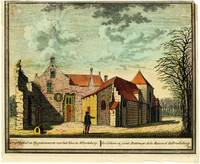
17301611Amsterdam 1730. Engraving with extensive hand coloring in watercolor on laid paper with a partial heraldic watermark 6 3/4 x 7 3/4 inches 171 x 197 mm; sheet 6 3/8 x 8 1/8 inches 163 x 206 mm; margins unevenly trimmed at the top plate mark and 1/4- inch below the bottom platemark. Condition consistent with age including a repaired vertical tear extending 2- inches downward into the image area from the top right sheet edge and several tabs of non archival tape on the verso. There are some light areas of toning. Color is vibrant and fresh. unknown
175779383London:: Printed for and sold by the Author.by Mr. Meadows 1757. old full calf attractively rebacked with a new calf spine and the original gilt-lettered spine labels. Bookplate on pastedown; a little foxing/age toning to the text; plates generally clean. Folio. This volume complete with 65 numbered engraved plates. This is Volume II ONLY. Printed for and sold by the Author...by Mr. Meadows, unknown
175747855London.: Printed for and sold by the author near the George in Portland Street Cavendish Square; by Mr. Brotherton over against the Royal-Exchange; Mr Buckland at the Buck in Pater-Noster Row; H. Piers and Partner at the Bible and Crown in High Holborn. 1757 - 1758. Later calf-backed marbled boards spine with compartments and black morocco label bearing titles in gilt board edges tooled in gilt. 3 vols. in 1. Folio 400 x 260 mm. Two vols with Title page Preface and a Description of the Plates each followed by 60 full page copper plate engravings all plates numbered signed and with imprints dated '1757'; final vol with Title page Introduction iii - viii Description of the plates beginning 'Of the Orders in General' pp. 1 - 16 followed by 65 numbered plates. PROVENANCE: Label of Doddington Library to front pastedown. Abraham Swan's extensive two volume study of domestic architectural designs 'A Collection of Designs' bound here with his seminal work on staircases 'The British Architect . ' .The two volume 'Collection of Designs' - the second of three pattern books published by Swan a carpenter and joiner - was his attempt to provide an inexpensive pattern book of inexpensive designs. Swan made his intentions of quantity over quality clear in his Preface: 'I hope that whatever defects may be observed in any of them will be candidly excused considering what a number of designs are contained in these two volumes and that they are all of my own contriving and drawing.' 'The first volume contains 4 engravings of the staircase at Blair Castle Perthshire which Swan designed for the Duke of Atholl 1757. Two Chinese Bridges for the grounds at Blair appear in the second volume. Swan's designs belong to the 'rococo' taste popular in the mid-18th century'. Weinreb.Swan's comprehensive work 'The British Architect' - first published 1745 here in the 3rd edition - was destined to be the first architectural book published in America. The title page of the earlier edition described the author as 'Abraham Swan Carpenter' later changed to 'Abraham Swan Architect.' The work includes the following: 'I. An easier more intelligible and expeditious Method of drawing the Five Orders than has been hitherto been published by a Scale of Twelve equal Parts free from those troublesome Divisions call'd Aliquot Parts. Shewing also how to glue up their Columns and Capitals.II. Likewise Stair-Cases those most useful ornamental and necessary Parts of a Building though never before sufficiently described in any Book Ancient or Modern; shewing their most convenient Situation and the Form of their Ascending in the most grand Manner: With a great Variety of curious Ornaments whereby any Gentleman may fix on what will suit him best there being Examples of all Kinds; and necessary Directions for such Persons as are unacquainted with the Branch.III. Designs of Arches Doors and Windows.IV. A great Variety of New and Curious Chimney-Pieces in the most elegant and modern Taste.V. Corbels Shields and other beautiful Decorations.VI. Several useful and necessary Rules of Carpentry; with the Manner of Truss'd Roofs and the Nature of a splay'd circular Soffit both in a streight and circular Wall never published before. Together with Raking Cornices Groins and Angle Brackets described.' From the title-page.Across all three volumes the title page imprint has been altered Meadows and Hitch and Hawes erased and replaced in ink manuscript with 'Mr Brotherton' and 'Buckland at the Buck'.'This is one of the books that had great influence on the builders and architects of eighteenth-century America.' Fowler.Park 80 / 79 first edition 1745 but citing other eds. including the present; RIBA Early Printed Books 3220; Fowler 341 second American edition 1794; Weinreb 1:166; Millard Architectural Collection Vol. 2 82; Berlin 2285. Printed for and sold by the author, near the George in Portland Street, Cavendish Square; by Mr. Brotherton, over against the Ro hardcover
1723AR20GLTBLK10London: Printed By A. Moore 1723. Hardback recent quarter leather marbled paper covered boards. New end-papers. 30cm x 18.5cm. Bound with a Portion of Abraham Cowley's Miscellanies - but lacking the title page for it. Pp. iv 30 17 41. Decorative initials and headpieces. 2nd edition 1723. A couple of small marks to final page 41. Scarce. ar20. 2nd Edition. Hard Cover. Very Good. Printed By A. Moore Hardcover
1800007304Providence: John Carter Printer 1800. First Edition. Pamphlet. Good. Pamphlet lacking any wraps that may have been issued. Disbound from a larger work. First edition. 26 pp. A speech reflecting on the life and legacy of George Washington containing several lengthy quotes from Washington regarding his role as general of the American Army as well as president. With several passages of historical detail on the American Revolution including brief mention of Yorktown and Valley Forge. A footnote also contains a short genealogy of the Washington family. This speech was given to the freemason members of the Mount-Vernon Lodge as well as to St. John's Church in Providence Rhode Island on February 22nd 1800 5800. GOOD condition. Mostly minor scattered foxing minor staining and soiling. Remains of leather along the spine. Minor wrinkling. Light browning and some ghosting to the text. Evans 37189. John Carter, Printer unknown
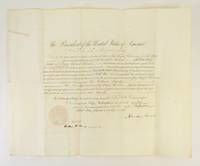
1718ST16605bWashington D.C.: U. S. Government 17 July 1862. 445 x 565 mm. 17 3/4 x 22 1/2". 17 lines of engraved text in copperplate script with names and dates completed in a fine secretarial hand. <br/> Loose as issued in an archival mylar sleeve. ◆Neatly mended two-and-three-quarters-inch tear to one edge well away from text half inch slit to end of one fold three very short separations along two folds only one touching text otherwise A FINE FRESH SPECIMEN clean and bright the signature dark and clear the wax-and-white-paper seal intact.<br/> <br/> This is an excellent example of a presidential document with Lincoln's full signature and with that of his Secretary of State William Henry Seward 1801-72 remembered for negotiating the purchase of Alaska from Russia. The consul appointed in this document Jay Haziel Sherman of Vermont served in Charlottetown Prince Edward Island from 1861 to 1865. It is likely this appointee was Jahaziel Blossom Sherman 1801-65 son of pioneering steamship captain Jahaziel Sherman 1770-1844 and that his unusual Old Testament name was misspelled by the scribe who filled in the appointment form. The younger Sherman died in Nova Scotia in 1865. U. S. Government unknown
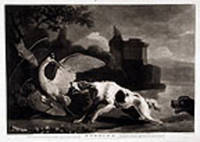
177814190London: Published by J. Watts Dealer in Prints & Drawings opposite the Mews Gate Charing Cross 1778. Mezzotints. Printed on laid watermarked paper. In excellent condition. Morning Image size: 9 1/2 x 13 7/8 inches. Plate mark: 10 x 13 7/8 inches. Sheet size: 10 5/8 x 14 7/8 inches. Evening Image size: 9 3/8 x 13 7/8. Plate mark: 9 7/8 x 13 7/8. Sheet size: 10 3/4 x 15 1/8 inches. This is a stunning pair of mezzotints of two hunting dogs catching their quarry by John Watts after paintings by Abraham Hondius.<br/> <br/> Watts was a successful printmaker and publisher who was active in London during the second half of the eighteenth century. He was famed for his rich mezzotints which he exhibited in London between 1766 and 1778. Watts scraped mezzotints after some of the most renowned artists of his day but he had a special penchant for works by the Dutch masters such as this handsome pair after Abraham Hondius the celebrated Dutch animal painter. These rich mezzotints are a superb example of Watts's luxurious style of engraving translating the energy and fluidity of Hondius's beautiful paintings into a dramatic example of superior mezzotint engraving.<br/> <br/> Benezit Dictionnaire Des Peintres Sculpteurs Dessinateurs et Graveurs. Published by J. Watts, Dealer in Prints & Drawings opposite the Mews Gate Charing Cross unknown
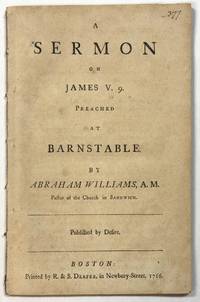
176642036Boston: Printed by R. & S. Draper in Newbury-Street 1766. 29 1 blank pp. Disbound with mild foxing. Else Very Good.<br /> <br /> A scarce Sermon preached on Cape Cod. ESTC locates two copies at AAS and one each at Boston Athenaeum Houghton the Library of Congress and NYHS.<br /> The Sermon asserts that "Christianity contains the most perfect rules for governing the temper and conduct; it prohibits every vicious affection and passion and directs to a right behavior in every circumstance and relation of life." James counsels: "Grudge not one against another Brethren lest ye be condemned. . ." <br /> Evans 10522. ESTC W26499. Printed by R. & S. Draper, in Newbury-Street unknown
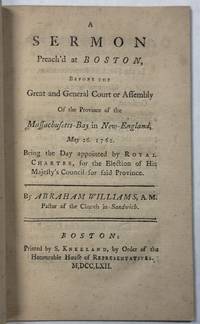
176241972Boston: S. Kneeland 1762. 28pp with the half title. Light toning imperfection at leaf 3-4 obscures a few letters. Disbound. Good. <br /> <br /> This election sermon illustrates the conditional loyalty that Colonists were willing to give their colonial government. Williams Pastor of the Church in Sandwich emphasizes that "Rational forms of government" are "conformable to the Will of God." The only legitimate function of rulers is "Good to the People." In forming Society its members do not surrender their natural rights to the fruits of their labors or the "immutable Laws of Equity." A Government "when tolerably answering the good Ends of it ought quietly to be submitted to for Conscience sake." <br /> FIRST EDITION. Evans 9310. S. Kneeland unknown
177125148Boston: Richard Draper. 1771. Half title 31 1 blank pp. Disbound. Lightly foxed. Very Good. <br /> <br /> "As we are made rational and accountable creatures the care of ourselves and of our own happiness is the first natural and reasonable concern of every man. A rational self love though distinct from is not inconsistent with the more noble principles but subserves and promotes them." A footnote states that Hilliard succeeded Reverend Joseph Green who served the Barnstable church from 1725 until his death in 1770. <br /> FIRST EDITION. Evans 12289. 664 NUC 0319346 6. Richard Draper... unknown
1718500029192Amstelodami: Trajecti ad Rhenum 1718. First Edition. . Hardcover. Poor. Folio worn vellum binding loss top spine. Stitching loose. Prelims damp affected and pages deteriorated on edges volume 1 <br/> <br/> Trajecti ad Rhenum hardcover
17189854432Sumptibus Societatis Amstelodami Amsterdam 1718. Volumes 1 and 2. First edition. Ex-library books but no library markings found. Hardback covers. Clean from markings. With previous owners names inside cover of volume 1. In fair condition suitable as a study copy. Folio rebound with very worn quarter red leather binding brown mottled boards. Covers scuffed and edgeworn leather on covers and spines almost worn away. Raised bands on spines. Front hinge of volume 2 split front board almost detached. Internally clean and good condition. Title pages in red and black. Please note the Image in this listing is a stock photo and may not match the covers of the actual item6380grams ISBN: Sumptibus Societatis, Amstelodami (Amsterdam) hardcover
1721E75858Vienna & Nurnberg Germany: Georg Lehmann 1721. Hardcover. Good. Frontispiece with a party of six sitting under a tree near their hut with a cook preparing a meal in a tent beyond 29 Floral & other initial letters 30 x 30mm a few large handsome tail-pieces. 4to brown leather on 4 raised bands with gilt rules and light tan spine label gilt titled edges worn /lacking approx. 1cm at the head and foot of spine/ hinges cracking but both covers held by all cords and head-bands/ covers are thus well attached Frontispiece titlepage in red and black 8pp = approbation Privilege and Preface 4pp =contents 473pp 37pp =index The front free endpaper has a tearout to remove and inscription and the foot of the page there is a marginal worm tack which decreases until it ends with the last page of the contents. It just touches three letters of one word of the privilege however it just encroaches on the fore-ground of the frontis.where it makes a 1cm V shaped track not touching any of the figures just the floor The verso of the title page 92 have a 2cm round purple library stamp of "S.Maria D.Lacum" The titlepage has an old ink name crossed out to the upper outer margin and "Specto ad biblio" written to the opposide margin and there are also a few ink slurps in pale brown. The text is decorated with floral initial letters 28 of themand a few handsome large head- and tail-pieces.The text has quite some foxing throughout and some gatherings have the text block with a uniform tanning to the text area showing that the ink used had an acidic content. The paper is still entirely sound and not brittle. There are side notes throughout the book and they are nowhere cropped having a good 2cm clear margin to the sides.No tears no loose pages and no writing except to the titlepage. Georg Lehmann hardcover
1763146314Amsterdam: Gerrit Ten Boekelaar 1763. Hardcover. Very good. 3 vols.: 6 382; 6 367 14; 4 393 18 p. 16 cm. Engraved title in vol. I. Black and red title pages. Full leather with gilt trim on spines marbled endpapers and red text block edges. Light wear to extremities. Dutch text. <br/><br/>Title continues: "Welke Hutte niet alleen met Loof-en Bladeren maar met een Tafel vol heerlyke Spysen en Vruchten voorzien is: Aangericht Voor Jooden Ter Bekeering Voor Christenen Ter Leering. Met Veele uitgeleezene zoo wel Heilige als andere Zinryke Geschriften Geschiedeniffen en Gedichten verciered. Door Pr. Abraham a st. Clara. Augustiner der Barvoeteris-Ordens en Roomsch-Keyserlyke Hof-Prediker Uit bet Hoogduitsch Vertaaldt." Gerrit Ten Boekelaar hardcover
1718102323<p> Newspaper 16" x 22" six columns of text 4 pp. Folded at center several tears and chips at folds and extremities some loss of text Lincoln text less affected some aging and browning and some uneven darkening ; in about fair condition overall for a newspaper from this period. Dated April 17 1865 this is a relatively early account of the Lincoln assassination. Most of the coverage is on the second and third pages of the newspaper. The articles include stories on the "death bed scene" the attacks on Secretary Seward and his son the national reaction and reports on those involved in the plot. Some interesting coverage of a national event in a local newspaper.</p>
1788799861788. WEATHERWISE Abraham pseud. An Almanack for the Year of Christian ra 1788. Portsmouth NH: John Melcher 1787. 12 leaves. Sewn. Complete. Early owner's name on final leaf some short closed tears else very good. Drake 4645 locates four copies. Evans 20859. ESTC W25187. Includes Franklin's "The Way to wealth. unknown
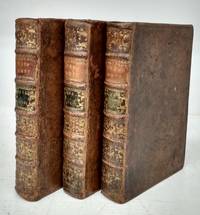
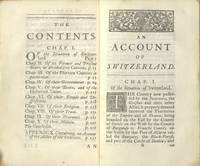
1714008296London : at Shakespear's Head over-against Catherine-street in the Strand.: Jacob Tonson 1714. 1st Edition . Hardcover. Very Good. 12mo - over 6¾ - 7¾" tall. First edition 1714 in full calf gilt tooled central image a few small marks edge blind tooling tips repaired. Professionally respined gilt & blind tooling gilt titles to black morocco label. Internally title within double ruled border & vignette port. of Shakespeare 8 1 2-247 pp marbled endpapers faded gilt text block edges some edge browning more towards end. Uncommon at printing no other copy available commercially! 188114 mm. The author describes the people customs economy and trade militia as well as the government and democratic institutions. The book was used by William Coxe in his Sketches of Switzerland published in 1779 and was the first significant book on the country by an English traveler. The appendix is an Account of the Allies of the Switzers. <br/> <br/> Jacob Tonson hardcover
178851711090014Printed for Thomas Dobson Philadelphia 1788. Leather. Acceptable. Fair Leather covered Hardcover. SCARCE ORIGINAL 1788 PRINTING. Text unmarked. Pages lightly tanned with foxing spots. Covers show edge wear with rubbing/stain marks and bumped corners. Spine edge wear. Binding is still tight and hinges still fairly strong. Preserved quite well for its age. pages still quite legible/readable. Previous owner's name on end paper.; 100% Satisfaction Guaranteed! Ships same or next business day! Printed for Thomas Dobson, Philadelphia hardcover
1733050535London: None Given 1733. First Edition. Softcover Disbound. Good Condition/No Dust Jacket. 8vo. Disbound pamphlet no wrappers light foxing pages untrimmed and some edge soiling & light wear. Size: 8vo. 33 pages. Quantity Available: 1. Shipped Weight: 1 pound or less. Category: Antiquarian & Rare; 18th century; Religion & Theology. Pictures of this item not already displayed here available upon request. None Given paperback
1730378329Samuel Fuller; J. Peele 1730 1731. Full leather. Ex-library foxing. Full leather with raised bands. Boards are significantly bowed. The first title lacks title page and publisher and publication date unknown. 135 72 32 pages. Samuel Fuller; J. Peele hardcover
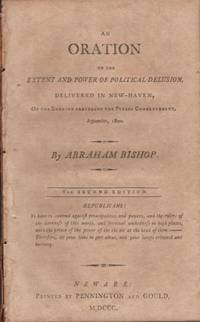
180033195Newark: Printed by Pennington and Gould 1800. Second Edition. Wraps. Good. Disbound wraps. 71 pages 1 page blank. Title on page 1. Light to moderate toning to the text. Political argument regarding the Federalist Party. The author was an anti-Federalist. <br /> <br /> Evans 36980. Printed by Pennington and Gould unknown