S T [The Guardian Society for the Preservation of Public Morals, London] / Abraham John VALPY (Ed)Biblio.com
496 résultats
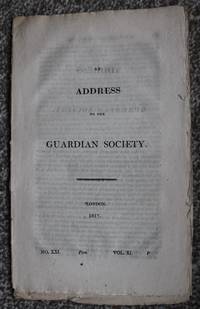
181765412mo paginated 225-252. Extracted from volume XI of 'The Pamphleteer' London: A. J. Valpy Tooke's Court Chancery Lane. 1818 1817. Text is clear and complete. On lightly-aged paper. Title page reads: 'An Address to the Guardian Society. London. 1817. No. XXI. Pam. Vol. XI. P'. The following gives an impression of the sceptical tone in which this pamphlet is written. 'Your Society is declared to be "for the preservation of public morals" a most praise-worthy and highly commendable institution. But how do you propose to preserve the public morals Why by "providing temporary asylums for prostitutes removed by the operation of the laws from the public streets and affording to such of them as are destitute employment and relief." This may be very well so far as it goes; but it is certainly going a very short way towards the preservation of public morals.' Both this reprint from Valpy's magazine 'The Pamphleteer' and the original are scarce with the only copies of either on COPAC at the British Library Cambridge and LSE. A. J. Valpy, Tooke's Court paperback
186335588Auburn N.Y. 1863. Broadside 8" x 12-1/4". Very Good.<br /> <br /> Congressman Pomeroy of Auburn who represented New York in Congress during the Civil War years and early Reconstruction has high praise for Colonel Clark serving on the staff of General Banks and recently wounded in the advance on Port Hudson. <br /> In the earliest days of the War during the Baltimore disorders he "mingled during the day and following night with the populace and rioters gathered all possible information and on the following morning returned to Washington and laid the information before the military authorities. Communications with Annapolis being cut off he accepted the hazardous position of bearer of dispatches from the War Department to Gen'l Butler and of the seventeen messengers sent on that mission was the only one who succeeded in reaching his destination without arrest and that was accomplished only by a night march on foot of twenty-five miles in a country with which he was unfamiliar and by swimming the Patuxent within sound of the voices of the enemies sentinels." <br /> OCLC 768761257 1- Allen Cy Pub. Lib. as of November 2025. unknown
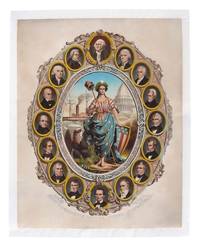
186131279Philadelphia: F. Bouclet 1861. Very Good. Philadelphia: F. Bouclet 1861. Original color lithograph 68x54cm. Mounted to matte backing; marginal tears and soiling; rubbing and a few scrapes around title; colors remain bright; a Very Good copy. <br /> <br /> This large vibrant lithograph was issued to commemorate Lincoln's first inauguration depicting the first sixteen Presidents with George Washington at top a beardless Abraham Lincoln at the bottom. The female personification of Columbia stands in the center before the Capitol holding a shield and staff with a liberty cap. The Capitol Dome sits in the background and is depicted as the artist anticipated it would look--the structure was not completed until late 1863. A handsome and uncommon print scarce in retail and auction records with only two holdings found in OCLC at the Library of Congress and the Mankato Area Public School District in Minnesota. . F. Bouclet unknown
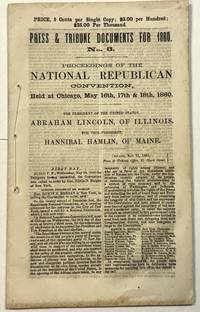
186041812Chicago: Press & Tribune Office 1860. Caption title as issued. 44pp. Stitched. Widely scattered light foxing. Near Fine. At head of title: "PRICE 5 Cents per Single Copy; $3.00 per Hundred; $25.00 Per Thousand."<br /> <br /> The "stenographic report" Monaghan of the country's most significant political convention with a record of all activities including speeches platform and the balloting for President and Vice President. Unlike modern conventions the winner of this one was far from clear. Several formidable candidates-- including Seward Chase Bates and Fremont--- stood in Lincoln's way. Although he had planned his strategy with great intelligence Lincoln was a true 'Dark Horse.' <br /> "Instead of attending in person Lincoln was represented by his friend and campaign manager Illinois judge David Davis whose initiative and deal-making skills despite his candidate's disapproval of such behind-the-scenes maneuvering is widely credited with his eventual nomination. Davis did however follow Lincoln's instruction in forming their general strategy as he maneuvered throughout the building nicknamed The Wigwam. <br /> "To make up for his meagre resume compared to Seward and Chase his team thought it prudent to not go on the attack against the frontrunners and instead become 'everybody's second choice.' through the convention's ranked voting system. His campaign also used the convention to start forging Lincoln's image as the Rail-Splitter a reference to his working-class background and a potential golden opportunity to appeal to the common laborers in the industrial Northern states who stood to benefit the most from the Republicans' Free Soil ideology. They also made direct appeals to delegates from the critical swing states of Pennsylvania and Indiana. When voting began on the 18th Davis and his allies felt confident in their chances to pull ahead. The first ballot placed Seward predictably with the highest vote total of 173.5 but not enough to win a majority while Lincoln followed with a total of 102. The second round bumped Lincoln's total number of votes to 181. The momentum on Lincoln's side continued to surge into the third round where Lincoln received a total of 231.5 votes still not enough to be nominated until David Cartter leader of the Ohio delegation announced his decision to switch support from Chase to Lincoln making him the 1860 Republican nominee for President" American Battlefield Trust 'Inside the Wigwam'.<br /> Ante-Fire Imprints 504. Monaghan 76. Sabin 65894. Press & Tribune Office unknown
18642547081864. very good-. This historic and rare black printed broadside presents the platforms of both parties the Republicans having convened in Baltimore in June and nominated Abraham Lincoln for President and Andrew Johnson for Vice President and the Democrats having convened in Chicago in August and nominated George B. McClellan for President and George H. Pendleton for Vice President. This copy measures 29 x 23 cm is double columned and with the imprint "For sale by all News Agents. Price $1 per 100." Very light foxing at the bottom margin more visible on the verso. Fraying at the margins as usual. Sabin 63348 Exceedingly scarce.<br/> <br/> unknown
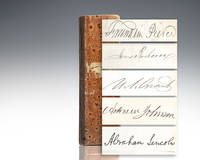
18771465621877-1880. Unique 19th-century autograph album containing the signatures of six American presidents fifteen senators several cabinet members and governors including Abraham Lincoln Ulysses S. Grant James Buchanan and Franklin Pierce. Narrow quarto bound in one quarter period dark brown cloth over stiff marbled wrappers the autograph album is a repurposed 19th-century caucus record dating from ca. 1870. The caucus book is alphabetically tab-indexed and filled out in ink voters are tracked by their name with caucus results appearing in the back. Although this is labeled “Ward 5†in the first page the term "Ward" was flexible in its usage. This could have been for a Ward election precinct caucus legislative congressional or state convention caucus. The autographs are mounted over the caucus records in their respective alphabetical tab. Also mounted at front are 6 printed pieces of 19th-century ephemera. The autograph album was assembled between 1877 and 1880 and can be dated by a contemporary pencil note that John Sherman had transitioned from the Senate to be Secretary of the Treasury. From the collection of a Mr. Boyd a 19th-century Ward politician in the upper Midwest Minnesota or Wisconsin. The Presidential autographs are primarily clipped from Presidential appointments and include: Abraham Lincoln James Buchanan Ulysses S. Grant Andrew Johnson Franklin Pierce and Rutherford B. Hayes. In very good condition. A very rare and unique collection. hardcover
1864101729Np New York: For sale by all News Agents. Price $1 per 100. 1864. 4to. Broadside text in two columns; creased from prior folding and split at creases some toning and paper clip rust staining. Republic campaign broadside reprinting an interview with Lincoln by former Wisconsin State Assemblyman Joseph T. Mills and former state Governor Alexander Williams Randall. Lincoln vigorously defends the use of Black soldiers in the Union Army against Democratic candidate McClellan's strategy of leniency towards Southern States rejoining the Union: "The slightest knowledge of Arithmetic will prove to any man that the rebel armies cannot be destroyed with Democratic strategy. It would sacrifice all the white men of the North to do it. There are now in the service of the United States near 200000 able-bodied colored men most of them under arms defending and acquiring Union territory. The Democratic strategy demands that these forces be disbanded and that the masters be conciliated by restoring them to slavery. Will you give our enemies such military advantages. to get them back into the Union Abandon all the posts now garrisoned by black men take 200000 men from our side and put them in the battle-field or corn-field against us and we would be compelled to abandon the war in three weeks. . There have been men base enough to propose to me to return to slavery the black warriors of Port Hudson and Olustee and thus win the respect of the masters they fought. Should I do so I should deserve to be damned in time and eternity. My enemies pretend I am now carrying on this war for the sole purpose of abolition. So long as I am president it shall be carried on for the sole purpose of restoring the Union. But no human power can subdue this Rebellion without the use of the emancipation policy and every other policy calculated to weaken the moral and physical forces of the Rebellion." This is the first separate printing of the interview which was first published as "The Loyal Road to Peace and the Disloyal Road to Ruin President Lincoln on Democratic Strategy" in the Wisconsin Grant County Herald August 1864. The broadside also prints Grant's letter to E.B. Washbourne "The Rebels have now in their ranks their last man. The little boys and old men are guarding prisoners guarding railroad bridges and forming a good part of their garrisons for entrenched positions " and a poem by Bayard Taylor on the Democrats' presidential nominating convention. REFERENCE: Sabin 41157; Weinstein Against the Tide 141 For sale by all News Agents. Price, $1 per 100. unknown
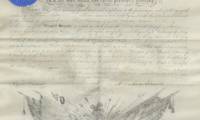
18623341204/03/1862. <p>As 1862 opened the war was not going well for the Union. In the east Bull Run had been a disaster and led to the shake-up of command with no results yet to show for it. In the west the loss at Wilson’s Creek gave the Confederates the upper hand. The Federal armies in the west then turned their attention to implementation of the Anaconda Plan – to cut the Confederacy in half by securing the Mississippi River from St. Louis all the way to the Gulf of Mexico and clearing a maritime invasion route into the heart of the Confederacy by taking the Tennessee and Cumberland Rivers which lay just to the east of the Mississippi. If successful these maneuvers would cut Texas Arkansas and Louisiana off from the main body of the South hold Kentucky and Missouri firmly in the Union and make it difficult for Tennessee to cooperate with her sister Confederate states. The first moves would be to take and hold commanding locations north on the Tennessee and Cumberland rivers and command of the operation was given to Brig. Gen. Ulysses S. Grant an obscure and largely unproven officer.</p><p>On February 6 1862 Fort Henry commanding the Tennessee River was captured by Grant’s forces. It had a poor defensive position and was reduced mainly by the bombardment of gunboats on the river. Nonetheless its fall opened the Tennessee River to Union gunboats and shipping past the Alabama border and provided a real victory for Union arms. Grant next focused his attention on Fort Donelson eleven miles away on the more strategically important Cumberland River. This fort had a much stronger physical position and the Confederates had placed some 20000 men and a number of senior commanders on site to engage in its defense. They were not about to concede the fort and they were ready and waiting for Grant. Grant arrived at Fort Donelson late on February 12 and on the 13th established his headquarters near the left side of the front of the line. That day was spent in battle preparation with a few small probing attacks being carried out against the Confederate defenses.</p><p>Grant's headquarters was at Cairo Ill where the head of Ordnance was Stephen Lyford. Grant arrived at Fort Donelson late on February 12 and on the 13th established his headquarters near the left side of the front of the line. That day was spent in battle preparation with a few small probing attacks being carried out against the Confederate defenses.</p><p>The battle was severe with nearly 1000 soldiers on both sides killed and about 3000 wounded. When Simon Buckner the Confederate commander asked for surrender terms Grant famously replied “No terms except unconditional and immediate surrender can be accepted“ adding “I propose to move immediately upon your works.†Buckner surrendered his command of about 15000 men; this was the first of three Confederate armies that Grant captured during the war.</p><p>The capture of Fort Donelson gave the North control of the Cumberland River which provided the road that opened the Deep South to Union invasion. It boosted morale in the North which now saw that the war could result in great victories and not just defeats. It gave President Lincoln the fighting general he was looking for and it made Grant’s career in the process; he was soon promoted to major general of volunteers.</p><p>Stephen C. Lyford had a long and distinguished career. He served from May to August 1861 in the defenses of Washington D. C. and in the Manassas Campaign participating in the Battle of Bull Run July 21 1861. He was Aide-de_Camp to Brig. General McDowell in the defenses of Washington D. C. August to October 1861 and Asst. Ordnance Officer at St. Louis Arsenal Mo. November 2 1861 to February 1 1862; in command of the Cairo Ordnance Depot Ill. February to May 1862 being detached to the Cumberland River and was present at the Surrender of Ft. Donelson. He was part of Gen. Halleck's Mississippi Campaign May to July 1862 being engaged in the Siege of Corinth May 1862 and was Chief of Ordnance for Department of the Tennessee July 11 1862 to September 6 1863 and fought in the Battle of Corinth. He would go on to teach at West Point and also serve as aide-de-camp for Gen. Halleck and as representative of the US to Japan to bring back information and technology relevant for American ordnance.</p><p><strong>Document signed</strong> with engravings of flags and weapons Washington March 4 1862 Naming Lyford a <em>“Second Lieutenant in the Ordnance Department.""</em></p><p><img class=""alignnone wp-image-25018 size-post-window"" src=""https://cdn.raabcollection.com/wp-content/uploads/20231204144051/Folder-site-11-1600x1327.jpg"" alt="""" width=""1600"" height=""1327"" /></p> unknown
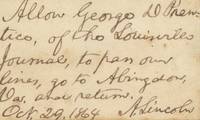
18643503129/10/1864. <blockquote><p>Journalist George D. Prentice's son was a Confederate officer captured by Union forces who would later be charged with murder</p></blockquote><p>George D. Prentice was born in Connecticut on December 18 1802 and graduated from Brown University in 1823. He came to Kentucky in 1830 to write a campaign biography entitled The Biography of Henry Clay and remained in this state until his death on January 22 1870 in Louisville. Prentice became the editor of the Louisville Journal the newspaper of the Whig Party. The main focus of this paper was the promotion of Henry Clay’s agenda and his multiple presidential campaigns. Prentice brought the Journal from upstart newspaper to the most widely read newspaper in the western United States because of his wit and command of the English language. Upon the failure of the Whig Party Prentice supported the Know-Nothing Party. Prentice then supported John Bell and his Unionist platform in the 1860 election calling for the Southern states to stay in the Union. Following the repeal of neutrality in Kentucky the pro-Union Prentice wrote in the Louisville Journal on September 19 1861: “Well thank God we at last have weighed anchor and set out for the haven of safety and of honor. Now let all possible sail be spread and the noble ship of state be driven into the lines of her insolent foe with the whole might of the valor and devotion of her true men.†Prentice became part of Lincoln’s core group of advisors for Kentucky affairs during the war. But despite Prentice’s Unionist satisfaction that Kentucky was no longer neutral his two sons fought in the Confederate army one dying in 1862 and the other being captured in 1863.</p><p>The son of Prentice Clarence J. Prentice was one of the most colorful Kentuckians in the Confederate Army. From 1863 to 1865 he commanded the 7th Confederate Cavalry Battalion. Based in southwestern Virginia the 7th was composed of mountaineers who resided along the Kentucky-Virginia border. The unit was difficult to discipline and was regarded as a ""black sheep"" battalion by other units in the department. While some members of the battalion accompanied Gen. John Hunt Morgan on his last Kentucky raid they were part of the dismounted brigade. Prentice and the balance of the 7th was left behind to guard Pound Gap. In his ""Kentucky Cavaliers in Dixie"" George Dallas Mosgrove left a lively pen portrait of the young officer. He described the 7th as wild and difficult to discipline but added that the men were afraid of Prentice who was a crack shot. Major Prentice was captured on March 31 1863.</p><p>George Prentice wrote to Lincoln to enlist his help in securing a parole for his son. In his letter to Lincoln dated Journal Office Louisville Ky. May 6 1863 Prentice stated: “I wrote to you last week in regard to my son Major Clarence Prentice now a rebel prisoner at Camp Chase. He would ere this have been forwarded for exchange but Gen. Burnside at my solicitation consented to have him detained until I could have time to hear from you. I think there has been time but I have received nothing from you either by mail or telegraph. I know that the pressure of the affairs of state upon you is very great. Perhaps you did not read my letter at all. Major Prentice is the only child left to me. My household is very desolate. My son is tired of the war but unfortunately he thinks the south right. I ask you to direct his release upon his taking the non combatants oath and giving bond and security for its scrupulous observance. If you cannot do this as I painfully fear you cannot I earnestly appeal to you to parole him to stay outside of both the United States and the Southern Confederacy until after the rebellion. I should scarcely venture Mr. President to make this appeal to you but that I think I have served the Union cause faithfully devotedly and successfully. I have suffered very much and sacrificed very much in its behalf—more I am sure than any other man in Kentucky; and I am likely even at the best to suffer and sacrifice much hereafter. I think there is not a candid and intelligent Union man in this state who would hesitate to say to you that I have saved it to the Union politically.</p><p>“And now dear sir pray grant me what I ask in behalf of my only son. His mother is half delirious and so am I. I am scarcely capable of performing my daily duties to the country but if my request were granted I feel I should be buoyant with new life. Please let me know your decision soon for if my son cannot be paroled upon either of the conditions I have mentioned I want him sent forward as soon as possible to City Point as he is extremely uncomfortable in his present situation.â€</p><p>Ten days later Lincoln issued an order written on the back of Prentice's letter instructing General Burnside to parole young Prentice ""to remain outside the limits of both the loyal and disloyal States or so-called 'Confederate States’…during the present rebellion and to abstain from in any wise aiding or abetting said rebellion."" He was released in May 1863. However Clarence Prentice immediately upon his release from Camp Chase violated his oath and re-entered the Confederate Army. He was promoted to lieutenant colonel. Only a few months after his parole he was back to robbing banks burning courthouses and spreading terror and destruction generally along the Kentucky-Virginia border.</p><p>In the fall of 1863 after being released from Union custody Prentice shot and killed a hotel proprietor named White in Abingdon Va. during a ""personal difficulty."" His trial was set for November 8 1864 in Abingdon and his father wanted to attend and assist him at his trial. George Prentice again wrote Lincoln asking for his assistance.</p><p>Lincoln complied with Prentice’s request. <strong>Autograph note signed</strong> Washington October 29 1864.<em> “Allow George D. Prentice of the Louisville Journal to pass our lines go to Abingdon Va. and return.â€</em></p><p>Prentice also wrote to Secretary of State William Seward on October 25 1864. A letter of Captain R. H. Baptist exists October 22 1864 to Prentice offering to give evidence in the forthcoming trial of his son saying “a conversation occurred between White & myself that ought to be made known in the trial of your son by all means.†Prentice sought Seward’s help in lining up Baptist up as a witness for his son: “Capt Baptist who formerly served under my son…and is now a prisoner…at Johnson's Island writes to me some facts which would be of vast importance to my erring child in his approaching trial…and which Capt. B. says he would state on oath…if he could be paroled to the Southern Confederacy or exchanged…I think that the exchange of Capt Baptist would subserve the cause of truth humanity and justice.’’ After being shown Baptist's letter Lincoln arranged for his parole so that he could testify on behalf of Clarence Prentice.</p><p>Thus did Lincoln intervene twice to aid his Kentucky advisor.</p><p>Clarence Prentice was acquitted of the murder charge. He continued to serve in the Confederate Army until the war ended.</p><p><img class=""alignnone wp-image-25018 size-post-window"" src=""https://cdn.raabcollection.com/wp-content/uploads/20231204144051/Folder-site-11-1600x1327.jpg"" alt="""" width=""1600"" height=""1327"" /></p> unknown
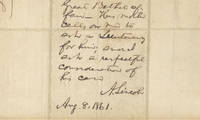
18613521508/08/1861. <blockquote><p>""It is said that the young man named within was in the Great Bethel affair. His mother calls on me to ask a Lieutenancy for him""</p><p> </p><p>We have never before a document on the market referencing Bethel by name or referring to the battle as great</p><p> </p><p>Part of a private collection assembled at Sesslers more than a half century ago</p></blockquote><p>The Civil War formally began with the bombardment of Fort Sumter on April 12–13 1861 but the first sustained clash between organized armies on land was the Battle of Big Bethel also called the Battle of Bethel Church fought on June 10 1861 near Hampton Virginia.</p><p>Virginia's decision to secede from the Union had been ratified by popular vote on May 23 and Confederate colonel later major general John B. Magruder was sent down to the peninsula to deter any advance on the state capital Richmond by Union troops based at the well-defended post of Fort Monroe.</p><p>Confederate forces under Magruder defeated a probing Union attack led by John Adams Dix and field commander Theodore Winthrop who was killed in the assault. The Union objective was to push back Confederate outposts guarding the Yorktown Road but poor coordination and a nighttime friendly-fire incident ruined surprise. When Union troops advanced at dawn they were repulsed by well-positioned Southern artillery and infantry around Big Bethel Church. The battle ended in a Confederate victory providing an early morale boost to the South while exposing the inexperience and disorganization of Union forces in the war’s opening weeks. It confirmed that the conflict would not be short or bloodless.</p><p>Abraham Lincoln was distressed by the Union defeat at Big Bethel. The battle underscored for him the Union's lack of military preparedness and the challenges in finding capable commanders reinforcing his determination to avoid future losses.</p><p>During his presidency Lincoln would regularly meet with members of the public who would wait to see him in the foyer of his office in the White House. This included soldiers and their family members.</p><p>Autograph letter signed Frank J. White as Captain of Company A 10th Regiment Fortress Monroe July 27 1861 seemingly given to the soldier himself or his sent to his family. ""Mr. Charles. J. Seymour has been a member of my company for three months and has gained my highest esteem for the excellent manner in which he has discharged his duties. He is well qualified to hold a much higher position than his present one.""</p><p><strong>Autograph document signed</strong> August 8 1861 on a detached leaf no recipient but likely Secretary of War Simon Cameron. <em>""It is said that the young man named within was in the Great Bethel affair. His mother calls on me to ask a Lieutenancy for him; and I ask a respectful consideration of his case.""</em></p><p>Seymour received the promotion Lincoln requested becoming a lieutenant just weeks later on August 27 1861. He served as Aide-de-Camp on the staff of Gen. Daniel E. Sickles and was later promoted to major. He also assisted in recruiting efforts in New York City.</p><p>This was acquired from Mabel Zahn at Sesslers in the 1970s.</p><p><img class=""alignnone wp-image-25018 size-post-window"" src=""https://cdn.raabcollection.com/wp-content/uploads/20231204144051/Folder-site-11-1600x1327.jpg"" alt="""" width=""1600"" height=""1327"" /></p> unknown
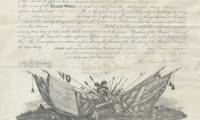
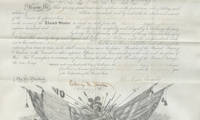
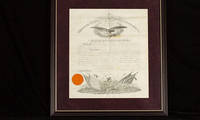
18623568928/02/1862. <blockquote><p>He was later promoted to Lt. Colonel for gallantry in action at the Battle of Groveton</p></blockquote><p><strong>Document signed</strong> with fine engravings of an eagle flags and cannons Washington February 28 1862 naming Percy B. Spear a Commissary of Subsistence of Volunteers with the rank of Captain effective November 30 1861. The document is countersigned by Secretary of War Edwin M. Stanton. The appointment is listed in the U.S. Army Register.</p><p>The Civil War Commissary Department was responsible for procuring storing and distributing food to soldiers. The rations managed by the department included such things as pork beef bread coffee and soap.</p><p>But Spear did not serve solely as a Commissary for the entire war. He would soon serve an aide-de-camp in the Fifth Corps in the Gettysburg campaign with Gen. James Barnes mentioning him with distinction in dispatches. Spear ended the war as a Brevet Major. In July 1865 he was appointed Lt. Colonel of Volunteers for meritorious service and for gallantry in action at the Battle of Groveton in 1862. After the war he was again named Commissary of Subsistence this time at the recommendation of Gen. George G. Meade.</p><p><img class=""alignnone wp-image-25018 size-post-window"" src=""https://cdn.raabcollection.com/wp-content/uploads/20231204144051/Folder-site-11-1600x1327.jpg"" alt="""" width=""1600"" height=""1327"" /></p> unknown
18643560801/08/1864. <blockquote><p>This appointment is listed in War Department General Orders no. 256</p></blockquote><p>According to the National Museum of Civil War Medicine and other sources Lt. Adam Miller of the 2nd Mass. Vols. aged twenty-three years was badly wounded August 9 1862 at the Battle of Cedar Mountain by an elongated musket ball which entered below the right eye socket and traversing the nasal cavity emerged through the left eye socket destroying the globe of the left eye and lacerating the left lower eyelid. He was made a prisoner and taken to a hospital at Charlottesville Va. where his wound ultimately formed a scar with great deformity. After being exchanged he entered the New York Eye Infirmary and on April 10 1863 a plastic surgical operation was performed by Dr. Henry B. Sands for the restoration of the eyelid. The operation was eminently successful and on April 22 1863 the parts were sufficiently healed to permit the insertion of an artificial eye. He thus survived a catastrophic facial wound and underwent pioneering plastic surgery.</p><p>Due to his injuries which made him unfit for active field duty but still capable of light service he was transferred to the Veteran Reserve Corps in August 1863 with his commission dating back to June 27 1863. The Veteran Reserve Corps was a military organization of the Union Army created for partially disabled or otherwise infirm soldiers who could still perform simple duties such as guarding prisoners or patrolling cities. This appointment is listed in War Department General Orders no. 256.</p><p><strong>Document signed</strong> with engravings of an eagle flags and weapons Washington August 1 1864 naming Adam Miller a lieutenant in the Veteran Reserve Corps effective June 27 1863.</p><p>An extraordinary Lincoln appointment of a soldier who made medical history in the Civil War.</p><p><img class=""alignnone wp-image-25018 size-post-window"" src=""https://cdn.raabcollection.com/wp-content/uploads/20231204144051/Folder-site-11-1600x1327.jpg"" alt="""" width=""1600"" height=""1327"" /></p> unknown
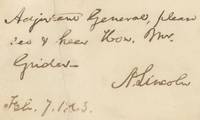
18633619207/02/1863. <blockquote><p>This document has been in a private collection for a generation</p><p> </p><p>Kentucky Unionists were important to Lincoln a Kentucky native as he famously said ""I hope to have God on my side but I must have Kentucky.â€</p><p> </p><p>The Congressman Henry Grider apparently needed to see Thomas to discuss the Act its impact on Kentucky and the details of how the recruitment would be handled</p></blockquote><p>Kentuckian Henry Grider was a Whig who served in Congress from 1843-1847 and then as a Unionist from March 4 1861 until 1865. For the Thirty-ninth Congress 1865–1867 Grider shifted to the Democratic Party but retained his commitment to the Union serving from March 4 1865 until his death in office on September 7 1866. Grider represented a Kentucky pro-slavery but Union-loyal constituency and he retained that point of view throughout the Civil War. Kentucky Unionists like Grider were particularly important to Abraham Lincoln a Kentucky native who had famously said ""I hope to have God on my side but I must have Kentucky.†Lincoln is known to have consulted with Grider about Kentucky affairs and relied on his support and that of the Kentucky delegation to Congress.</p><p>On February 7 1863 Congress passed an Act providing that “the Governor of the State of Kentucky by the consent and under the direction of the President of the United States shall have power to raise and organize into regiments a volunteer force not exceeding twenty thousand rank and file to be raised within the State of Kentucky to serve for the term of twelve months to be employed within the limits of Kentucky in repelling invasion suppressing insurrection and guarding and protecting the public property: Provided That at any time it may be necessary in the discretion of the President of the United States these troops may be employed out of the limits of Kentucky against the enemies of the United States.â€</p><p>Thus the Governor of Kentucky would raise a force of 20000 volunteers to serve in Kentucky but President Lincoln had the authority to order them used outside the state. This Act was received with mixed reviews in Kentucky and on the very day it was enacted Grider’s son Benjamin C. Grider a slave-holding Unionist resigned from the Union Army. From the timing of his resignation one can surmise that he disapproved of the Act. He had commanded the 9th Kentucky Volunteers.</p><p>Lorenzo Thomas was the Adjutant General of the U.S. Army at that time and his job was to maximize operational effectiveness of the army by manning recruiting for and sustaining military operations.</p><p><strong>Autograph note signed</strong> Washington February 7 1863 the day of the Act to Lorenzo Thomas expediting Grider’s ability to see Thomas. <em>“Adjutant General Please see and hear Hon. Mr. Grider. A. Lincoln.â€</em> It seems clear that Grider needed to see Thomas to discuss the Act its impact on Kentucky and the details of how the recruitment would be handled and managed. Not in Basler. A separation running vertically archivally mended.</p><p>This is a very scarce communication involving Lincoln aiding a Kentucky Unionist.</p><p><img class=""alignnone wp-image-25018 size-post-window"" src=""https://cdn.raabcollection.com/wp-content/uploads/20231204144051/Folder-site-11-1600x1327.jpg"" alt=""historical memorabilia dealer"" width=""1600"" height=""1327"" /></p> unknown
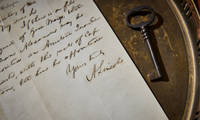
18642292021/03/1864. <blockquote><p>“If there is on file a request of Gen. Meigs that William Alexander may be appointed an Assistant Quarter-Master with the rank of Captain let him be appointed.â€</p><p> </p><p>There is no record of the appointment having been made with speculation being that Lincoln possibly sent the appointment to Stanton to die there</p><p> </p><p><img class=""alignnone wp-image-22921 size-post-window"" src=""https://cdn.raabcollection.com/wp-content/uploads/20231204160847/branding-Lincoln-March-21-1864-C-e1640668975889-1600x692.jpg"" alt="""" width=""1600"" height=""692"" /></p></blockquote><p>Lincoln had the rare quality of not taking opposition personally. During the Civil War he was vilified more than any other public figure in American history yet saw the issues as so great that they transcended any personal aspect. He bore no resentments because as he said he “never thought it paid.†He appointed men to high office because he perceived that they would be useful to the war effort. When Gen. George B. McClellan was insufferably rude to him he was willing to suffer the personal indignity if only McClellan would win. His most important civilian appointment shows this management principal in operation. Edwin Stanton had met Lincoln before the war when they had served as co-counsel in a famous lawsuit involving the McCormick reaper. Stanton who had a reputation for being stern imperious hot-tempered and controlling had snubbed him and then ridiculed him publicly as a gorilla and an imbecile. Lincoln also saw him as honest dedicated and extremely competent. Carrying no grudges he appointed Stanton to be Secretary of War and it was a brilliant choice. The two men came to respect and even like each other as they worked together daily to achieve victory.</p><p>Lincoln even used Stanton to deflect criticism from himself. Lincoln was inundated with requests for military positions requests in which he had little if any interest. But these requests often came from members of his administration from Union generals or other notables and the President could not decline them without angering his friends colleagues or other supporters of the Union cause. He shoveled these requests to Stanton with his endorsement. But Stanton would only approve those requests he deemed meritorious.</p><p><img class=""alignnone wp-image-22923 size-post-window"" src=""https://cdn.raabcollection.com/wp-content/uploads/20231204160837/Lincoln-March-21-1864-B-e1640669110694-1600x636.jpg"" alt="""" width=""1600"" height=""636"" /></p><p>Montgomery C. Meigs was a career United States Army officer civil engineer and construction engineer. At the start of the Civil War Lincoln appointed Meigs quartermaster general a crucial post that was perfectly suited to his organizational and management talents. Before the war Meigs played a key role in the extension and dome of the U.S. Capitol. After the war he oversaw much of the design and monument construction at Arlington National Cemetery.</p><p>Meigs had requested that Lincoln make an appointment in his department and the President wrote this letter to accommodate him. <strong>Autograph letter signed</strong> on Executive Mansion letterhead Washington March 21 1864 to <em>“Hon. Secretary of War.â€</em> Lincoln writes <em>“My dear Sir If there is on file a request of Gen. Meigs that William Alexander may be appointed an Assistant Quarter-Master with the rank of Captain let him be appointed. Yours truly A. Lincoln.â€</em></p><p>There is no record of the appointment having been made with speculation being that Lincoln sent the appointment to Stanton to die there. An interesting letter associating the President Secretary of War and Quartermaster General and taking place just eleven days after Grant assumed the role that led to Union victory.</p><p><img class=""alignnone wp-image-22732 size-post-window"" src=""https://cdn.raabcollection.com/wp-content/uploads/20231204162353/Folder-site-1600x1327.jpg"" alt="""" width=""1600"" height=""1327"" /></p> unknown
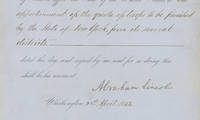
18642373223/04/1864. <blockquote><p>A search of public sale records going back 40 years fails to turn up even one other example of this document</p></blockquote><p>After the firing on Fort Sumter on April 12 1861 enthusiasm for enlisting in military service swept through both the North and South. In remarkable speed two large volunteer armies were created. Except for a tiny number of professional soldiers all expected to be in service for a brief term. Not just soldiers but the public and political leaders had fooled themselves about the war's likely duration. However the patriotic hope on each side that the war would be over in a matter of weeks or months was dashed in the first battle of Bull Run on July 21 1861. By late 1862 no sensible person believed that an early end to the bloody strife was possible and the knowledgeable expected peace to be far off in the future. Facing a protracted war maintaining a sufficiently sizable army became the greatest problem facing both Union leader Abraham Lincoln and Confederate leader Jefferson Davis.</p><p>In 1862 rather than institute a draft President Lincoln requested 300000 more men and assigned each state a quota. The states could meet their quota in any manner they saw fit. Most states offered cash incentives known as bounties to gain recruits. Depending on where one enlisted the combination of local state and federal bounties could exceed $1000. But the 1862 policy also did not recruit enough troops.</p><p><img class=""alignnone wp-image-24611 size-post-window"" src=""https://cdn.raabcollection.com/wp-content/uploads/20231204150003/Lincoln-April-23-1864-2-1600x602.jpg"" alt="""" width=""1600"" height=""602"" /></p><p>As the war dragged on with no end in sight the inflow of volunteers was drying up and the Union needed to keep the ranks filled. The U.S. Congress resorted to the first draft in the country’s history in March 1863. All able-bodied men between ages 20 and 45 were required to be enrolled and available for military service. Draftees were chosen by lottery. Once conscripted a man could avoid service for that particular round of the draft either by paying a $300 commutation fee or by hiring a substitute to take his place. As in the South this raised accusations that the war had become “a rich man’s war but a poor man’s fight.†Nevertheless in both North and South statistics indicate that wealthy men were represented in the service in at least the same proportion as they were in the general population.</p><p>A lot of blood was spilled in 1863 with the battles of Chancellorsville Gettysburg Vicksburg Chickamauga and Chattanooga among others. By year’s end President Lincoln and the Union leadership realized that more men were needed for the army and urgently. On February 1 1864 Lincoln called for 500000 men to serve for three years or for the duration of the war. Then on March 15 he supplemented this with a call for 250000 more. There would be another draft call in December 1864 but it was never completed due to the impending end of the war.</p><p>The March 1864 draft call stated: “Washington March 15 1864. In order to supply the force required to be drafted for the Navy and to provide an adequate reserve force for all contingencies in addition to the 500000 men called for Feb. 1 1864 the call is hereby made and a draft ordered for Two Hundred Thousand men for the military service – Army Navy and Marine corps of the United States. The proportional quotas for the different wards towns townships precincts or election districts or counties will be made known through the Provost Marshall General’s bureau and account will be taken of the credits and deficiencies of former quotas.</p><p>The 15th day of April 1864 is designated as the time up to which the numbers required from each ward of a city town etc. may be raised by voluntary enlistment; and drafts will be made in each ward of a city town etc. which shall not have filled the quota assigned to it within the time designated for the number required to fill said quota. The draft will be commenced as soon after the 15th of April as practicable…†It took little more than a week for everything to be in place.</p><p><img class=""alignnone wp-image-24623 size-full"" src=""https://cdn.raabcollection.com/wp-content/uploads/20231204145931/My-Movie-177ygbhbj.gif"" alt="""" width=""1920"" height=""1080"" /></p><p>The mechanics of the draft were that each state and district within a state were assigned quotas and the President would order that each state’s draft numbers and districts be implemented. This was the actual order for the draft. Then each individual district would receive from the President details of its requirements in a circular letter. One sees these individual district circular letters on the market every now and then. But what one never sees is the order to implement the draft for a state assigning the districts and number of troops being called forth. In fact a search of public sale records going back 40 years fails to turn up another example nor have we seen one before.</p><p><strong>Document signed</strong> as President Washington April 23 1864 being Lincoln’s implementation order for New York. <em>“I hereby authorize and direct the Secretary of State to affix the Seal of the United States to the apportionment of the quota of troops to be furnished by the State of New York from its several districts dated and this day signed by me and for so doing this shall be his warrant.â€</em></p><p>An extremely rare if not unique document showing Lincoln raising troops on the macro level of a state.</p><p><img class=""alignnone wp-image-23729 size-post-window"" src=""https://cdn.raabcollection.com/wp-content/uploads/20231204152429/Folder-site-7-1600x1327.jpg"" alt="""" width=""1600"" height=""1327"" /></p> unknown
18611571129/03/1861. <p>James E. Harrison though born in Virginia served the Union cause during the Civil War. He received his first appointment as a Second Lieutenant to the 2d U. S. Cavalry in June 1856 and was stationed in Texas and various forts in the West until December 1858 when he was assigned to scouting Indians. He returned East and with the Civil War imminent he was promoted to First Lieutenant 2d U.S. Cavalry in March 1861 and then to Captain 5th U.S. Cavalry in May of that year. Harrison was engaged in the Peninsular campaign and commanded a regiment in the Army of the Potomac from September 1862 to June 1863. During that time he served at the battles of Antietem Chancellorsville and Brandy Station among many others. He was Breveted Major U.S. Army for gallant and meritorious services at the battle of Hanover Court House and Brevet Lieutenant Colonel U.S. Army for gallant and meritorious services at the battle of Antietam. In July of 1864 Harrison was assigned to be Inspector-General of Cavalry in the Department of Arkansas and was later appointed as Special Inspector of Cavalry in West Mississippi.</p><p><strong>Document signed</strong> as President Washington March 29 1861 effective retroactively to February 27 1861 an ornate vignetted commission with an eagle cannons and flags appointing Harrison to the rank of “First Lieutenant in the Second Regiment of Cavalry.†The document is countersigned by Secretary of War Simon Cameron.</p> unknown
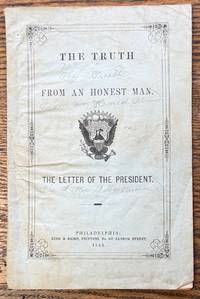
1863BOOKS350084Philadelphia PA: King & Baird. Good /NO DUSTJACKET. 1863. First Edition. Pamphlet. Vallandigham became a martyr for civil liberties symbolizing the struggle for dissent even as he returned to Ohio and was nominated for governor while in exile. He was exiled by Lincoln using War Powers Act. . 8vo. 16 pp. Not sure if it ever had a rear cover. Minor foxing. . King & Baird unknown
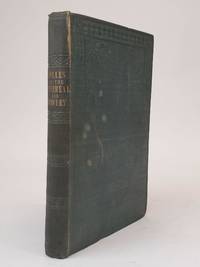
18370003681837. 1st American Edition . Hardcover. Good/None. This volume comprises 2 books in one. It is a first edition bound in good leather with gilt stamping and lettering. It would be excellent except the title label is loose. The boards are worn a little at the edges and corners as are the spine ends and there is a crack in the leather front hige at the top about 1" long. The hinges are however tight. Bright mable end papers with matching page edges. There is a book plate of Henry Tweedy m MD inside the cover.The pages are clean and bright. There is a two page color print at the end of book one. That text is 351 pages. The second text by Richard Carmichael Clinical Lectures on Venereal Disease is 219 pages. published in 1942.no markings. The book seems to have been bound as a presntation copy. a rare find. <br/> <br/> hardcover
18371357511London: Sherwood Gilbert & Piper 1837. Hardcover. Octavo xvii 351 pp. Good; bound in contemporary embossed green cloth with gilt titling some discoloration to covers crack to top of front hinge and wear and rubbing to spine edges and corners; binding tight; text block age-toned with some top edges of pages uncut; very minor foxing to pages; ex-library copy with usual markings including institutional stamps to several pages and call number written in pencil; MF consignment. 1357511. Special Collections. Sherwood, Gilbert, & Piper hardcover
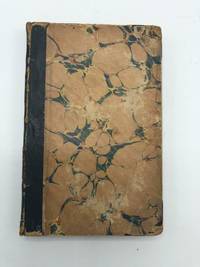
18373807Philadelphia: A. Waldie 1837. First American edition part of the "American Medical Library" series. 8vo 211pp orange marbled boards with black morocco and gilt spine. The author was was Professor of Anatomy Surgery and Physiology at the Royal College of Surgeons in Ireland. An important treatise on venereal disease in which the author first published "Colles' Law" regarding veneral disease in infants. Foxing to text block edges rubbing and wear to covers. An attractive copy. A. Waldie hardcover
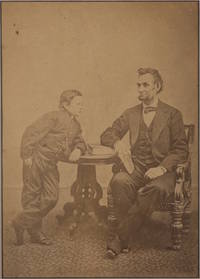
186632820664<br />Perhaps the most delightful of the Lincoln family photographs this portrait shows an impish Tad leaning on a table as his seemingly bemused father sits on Gardner's studio chair. Thomas "Tad" Lincoln was the youngest of the Lincoln boys.<p>Abraham Lincoln an indulgent father let his children run wild at his law offices and at the White House. His law partner William H. Herndon recounted "I have felt many and many a time that I wanted to wring their little necks and yet out of respect for Lincoln I kept my mouth shut. Lincoln did not note what his children were doing or had done."Lincoln sat for this portrait at Alexander Gardner's studio on February 5 1865. Just a month later he delivered the Second Inaugural Address and within weeks he was assassinated. It would be his final sitting for Gardner who made five poses that day. This fine portrait does not show the heavy retouching evident in later prints</p><p>By this date the end of the Civil War seemed to be drawing near. The war years had taken a heavy toll on Lincoln and on the nation. Horace Greeley observed "his face was haggard with care and seamed with thought and trouble. It looked care-ploughed tempest-tossed and weatherbeaten."</p><p>Albumen print 14 x 10 in. card mount. Minimal wear and fading two spots at the upper left. Good tones. An excellent photograph. Framed.</p><p>Ostendorf <i>Lincoln's Photographs</i> O-114.</p><p><b>This fine portrait is the largest example we have seen and a scarce survival showing Lincoln as a loving father.</b></p><br /> Gardner
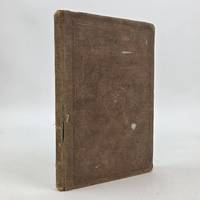
1860809901860. LINCOLN Abraham. Political Debates Between Hon. Abraham Lincoln and Hon. Stephen A. Douglas In the Celebrated Campaign of 1858 in Illinois; Including the Preceding Speeches of Each at Chicago Springfield etc.; also the Two Great Speeches of Mr. Lincoln in Ohio in 1859 as Carefully Prepared by the Reporters of Each Party and Published at the Times of Their Delivery. Columbus: Follett Foster and Company 1860. iv 268 pp. Later cloth. Scattered foxing old waterstain to upper free corner of first few leaves else a very good copy. HOWES L-338 "aa." Monaghan 69. Early state but not 1st. Rule above publisher on copyright page; "2" on p. 13; no "2" on p. 17; lacks advertisements. "Historically the most important series of American political debates"-Howes. unknown
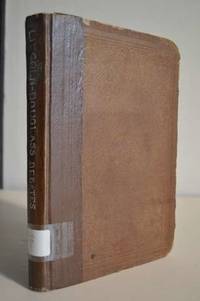
1860SKU1039674Follett Foster and Company 1860. First Edition. hardcover. Acceptable. 0x0x0. This Book is an Ex-Library Book with several library markings. Political debates between Hon. Abraham Lincoln and Hon. Stephen A. Douglas in the celebrated campaign of 1858 in Illinois; including the preceding speeches of each at Chicago Springfield etc.; also the two great speeches of Mr. Lincoln in Ohio in 1859 as carefully prepared by the reporter of each party and published at the times of their delivery. Follett Foster and Company; Columbus 1860. Hardcover. First Edition First Issue. First issue with no advertisements no rule above the publishers imprint on the copyright page and with numeral 2 at the bottom of page 17. An Acceptable brown cloth binding with blind stamped ornate design on boards re-enforced spine with handwritten white ink title and library locations sticker on spine binding shaky starting hinges with partially cracked rear hinge heavy wear to board corners with some loss some scuffing and discoloration to boards abrasions along board margins specifically to rear bit pulpy text block with age toning and scattered foxing throughout rubbing to board and spine edges previous owner handwritten ink info on front free endpaper few small dog-eared pages faint moisture stain on fore-edge and slightly on page margins several library markings include: library bookplate library due date card pocket embossed library stamp ink library stamps few ink and pencil notes barcode sticker without Dust wrapper. 8vooctavo or approx. 6 x 9 inches. 268pp. We pack securely and ship daily with delivery confirmation on every book. The picture on the listing page is of the actual book for sale. Additional Scans are available for any item please inquire. Follett, Foster and Company hardcover
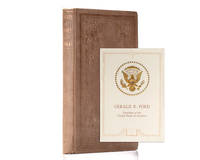
1860149362Columbus: Follett Foster and Company 1860. First edition early issue of the most famous debates in American history which cemented Lincoln as a national presidential candidate. Octavo original cloth stamped in blind. Ownership bookplate of President Gerald R. Ford to the front pastedown. President Gerald R. Ford and Abraham Lincoln occupy distinct yet symbolically linked places in American presidential history united by their encounters with political violence and national division. Abraham Lincoln the 16th president led the United States through the Civil War and became the first American president to be assassinated when he was shot by John Wilkes Booth at Ford’s Theatre in 1865—a moment that transformed him into a martyr for the Union and a symbol of democratic perseverance. Over a century later Gerald R. Ford the 38th president survived two assassination attempts within seventeen days in 1975 both carried out by women—Lynette “Squeaky†Fromme and Sara Jane Moore—amid the turbulence of the post-Watergate era. While Ford’s brush with assassination did not result in tragedy it echoed the lingering volatility of American political life that had claimed Lincoln’s. In near fine condition. An exceptional example with even better provenance. Running as a little-known candidate for the Illinois senatorship in 1858 Lincoln challenged incumbent and Democratic leader Stephen Douglas to a series of debates. The result was a memorable chain of lively arguments in front of cheering crowds. Though Lincoln lost the senatorial race “he began collecting a scrapbook of his best speeches particularly those from the just-concluded campaign against Douglas for possible inclusion in a book. Assiduously pasting newspaper accounts of the debates into the scrapbook Lincoln cast about for a publisher. Initial efforts failed mainly because Lincoln wanted the book printed in Springfield which had no local publishing or printing facilities. Eventually however the Columbus Ohio firm of Follett Foster & Company showed interest and he began preparing the first edition… Somewhat surprisingly for an attorney Lincoln did not seek Douglas’ permission to publish a book of their combined speeches although Douglas was later given the last-minute opportunity—he declined—to make corrections to his own remarks†Morris 121. Follett, Foster and Company hardcover
18601408600Columbus: Follett Foster and Company 1860. First Edition Second Impression. Hardcover. Octavo 2-5 4 268 pages. In Good condition. In publisher's full brown cloth binding with blind stamped decoration to covers. Sunning and heavy wear to spine with gilt titling mostly worn away. Boards show significant scuffing and soiling with rubbing and exposed board along all edges and at fore corners. Splitting to joints hinges in tact. Chipping at head and tail of spine lacking end bands. Text block is moderately worn and soiled along edges. Age toning light foxing and faint tidemarks throughout. Pencil inscriptions on front endpapers. Tear in front flyleaf near gutter is patched with tape. Shelved in Room F. 1408600. Special Collections. Follett, Foster and Company hardcover