189 résultats
1854008887Philadelphia: George W. Taylor 1854. Half leather. Very good. Philadelphia: George W. Taylor 1853-1854. Half leather. 24 monthly issues bound together. Complete; each volume contains 104 text pages. Half-leather with marbled boards; 6.75" x 10.25". Sound binding. Clean pages with light intermittent foxing. Old pencil annotation at top of the first title page. Light dampstain to the first six leaves. Some edgewear to cover; two-inch loss of spine covering at head and tail. This ardent abolitionist journal includes coverage of the debate regarding the expansion of slavery news of anti-slavery events some early writings of Frederick Douglass discussion of Quaker events American slavery laws Uncle Tom's Cabin temperance issues including the "Maine Law" and much more. The journal was the organ of the Free Produce Society of Philadelphia and its publisher George Taylor managed the city's Free Produce Store. 'Free Produce' included all manners of goods traditionally made with slave labor that were produced without any taint of slavery. Such items were much more expensive than slave-produced items but the most principled Quakers and abolitionists paid the price to keep their consciences clear. Although the Society disbanded in 1856 Taylor kept the store open until after the Civil War when customers no longer saw a reason to patronize him. See The Atlantic Monthly October 1868 and Cison's "Quality Came Second" in Main Line Today March 2007. Scarce. While digital and microform reprints are available at the time of listing OCLC shows only a few institutions holding intermittent original issues. Two auction records are on file at the Rare Book Hub. George W. Taylor unknown books
1865102321<p> Newspaper 16" x 23" uncut six columns of text 8 pp. Folded at center some tears and a little loss of text at center fold but not significant other chips tears and folds mostly at extremities some aging and browning a little uneven darkening uncut and center pages probably never read; good or better for a newspaper and still very presentable. Dated April 26 1865 this paper covers events relating to the Lincoln funeral. The Herald reports that 750000 stood in silence during the funeral procession and that there were many disappointed mourners who didn't get a chance to join the 150000 that had a chance to make it to view the body. The paper gives details about the funeral procession and the final church services for the slain president. An important piece of American History.</p> books
1865102320<p> Newspaper 16" x 23" uncut six columns of text 8 pp. Folded at center some tears and a little loss of text at center fold but not significant other chips tears and folds mostly at extremities normal aging and darkening uncut and center pages probably never read; good or better for a newspaper and still very presentable.</p><p>Dated April 21 1865 this paper covers events of the Lincoln assassination Most of the front page and part of the last page are dedicated to Lincoln's death. The Herald discusses the eminent capture of John Wilkes Booth and gives an updat on Secretary Seward"s condition. The paper also carries a story on the conspiracy to kill Lincoln and an arrest made in Baltimore. The Herald gives a clear picture of a nation in mourning and the large crowds that turned out for a final viewing of the late president. An important piece of American History. </p> books
1865WRCAM31127New York 1865. 8pp. Large folio newspaper. Moderate foxing. Very good. The assassination of President Lincoln on April 14 1865 came on the same day Gen. Joseph Johnston of the Confederacy contacted Sherman to discuss the suspension of operations under similar terms granted to Lee. The present issue of THE NEW YORK HERALD treats both events with an account of Johnston's actual surrender under desired terms along with a relation of the progress of Lincoln's funeral train across America. The previous day the President's body was in Cleveland on the 29th the body was in Columbus. A poignant slice of America at the close of the Civil War. Long E.B. THE CIVIL WAR DAY BY DAY pp.675- 76684. unknown books
1865WRCAM31218New York 1865. 8pp. Large folio newspaper. Split along fold with loss to a few words. Good. Published three days after Lincoln's death and bordered in black this edition of THE NEW YORK HERALD begins to sift details of the assassination from the fog of recent events and also contains important news regarding the conclusion of the Civil War. One story contains statements of eyewitnesses including Dr. Charles A. Leale who attended to Lincoln in his box at Ford's Theatre immediately after the President was shot. Another story gives details of the route for Lincoln's funeral train. There are also reports on the condition of Secretary of State Seward and the arrest of his attacker. This issue also carries news of the important meeting between Gen. Sherman and Gen. Johnston regarding the latter's surrender. unknown books
1865WRCAM31223New York 1865. 8pp. Large folio newspaper. Split along fold with loss to a few words. About very good unopened. The main news in this edition concerns the ongoing events in the assassination of President Lincoln. A long story from Springfield Illinois reports on the arrival of the funeral procession and there are several stories about the pursuit of the conspirators in the President's murder. One story calls Jefferson Davis "a fugitive from justice with a price set on his head as an assassin." Another long piece brings news from the South as military action in the Civil War winds to a halt. The last page is taken up by an account of the Irish Independence movement and a profile of "Fenians at Home and Abroad." unknown books
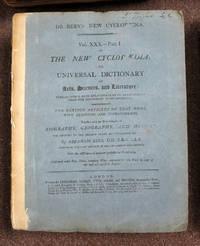
182041461London: Printed for T. N. Longman and O. Rees No. 39 Paternoster-Row 1820. 1st edition thus. 80 volumes in original publishers quarter-bound cloth beige spines over light blue paper-covered boards black lettering printed to front board and paper title labels on spine. 7 volumes period half-bound in black leather spine and edges with gilt & brown lettering and labels to spines over green cloth boards. Boards heavily worn and rubbed edges bumped and spines chipping. Some boards detached. Some volumes with previous owner signature penned to front board B. Fulford. Binding and paper age-toned as one would expect with the ages of the titles with the occasional stain & foxing. Withal a Good original set sold w.a.f. 87 volumes total. 80 of the Cyclopaedia 7 volumes of Plates. 7 volumes of plates b/w engravings. Cyclopaedias: ~ 11-1/4" x 9". Plate Volumes: 11" x 8-3/4" <br/><br/>"I. The Work will be printed in Quarto at the Office of A. Strahan Esq. with New Types cast for the Purpose and on a superfine yellow woven Paper. II. The Work will be comprised in about Twenty Volumes. III. Three sheets stitched in blue paper will be regularly published every Week till the whole be completed price One Shilling. IV. Numerous Plates engraved in a superior stile sic of elegance will be given in the course of the Publication. V. A Part of Half a Volume containing Seventeen Numbers together with the Plates will be regularly published in advance price Eighteen Shillings in boards. VI. A few copies will be printed on a superfine royal woven Paper with proof impressions of the Plates to be sold in Parts of Half Volumes only price One Pound Sixteen Shillings in boards. VII. Number I and Part I was published on Saturday January 2 1802." <br /> <br />"The encyclopaedia was largely Rees' own work and was especially strong in new and well-written biographical articles. The articles on music were written by Dr. Charles Burney and those on botany were mostly written by Sir James Edward Smith the founder of the Linnean Society.Rees's Cyclopaedia is said to have outclassed the Encyclopaedia Britannica of that time and 'remains a monument to the memory of another native of Wales namely dr. Abraham Rees the Encyclopaedist who was a native of Llanbrynmair Montgomeryshire." Cyclopaedia - dot - org. <br /> <br />Dr. Rees' Cyclopaedia is known all over the world and is often hailed as one of the greatest collections of material in the field of Encyclopedias. Printed for T. N. Longman and O. Rees, No. 39 Paternoster-Row hardcover books
1866WRCLIT18304New York: D. Appleton 1866. 91pp. Full blue polished calf gilt a.e.g. a presentation binding. Inscribed on the front binder's blank in pencil by the author to his sister. Light rubbing else fine with a decent familial association. D. Appleton unknown books
1860662048<p><b>Campaign Biography-1860 THE WIGWAM EDITION. THE LIFE SPEECHES AND PUBLIC SERVICES OF ABRAHAM LINCOLN. TOGETHER WITH A SKETCH OF THE LIFE OF HANNIBAL HAMLIN. New York: Rudd & Carleton 1860. 1st ed. 117p. frontis. port. illus. front wrap. Monaghan 92; Wesson 1.</b> <b>Bookplate: copy of Joseph B. Oakleaf Lincoln collector and bibliographer. </b></p><p>The publishers were one of a number who announced on May 19 the day after the Lincoln's nomination for the presidency that they had a life of him "in press." The unknown author of "The Wigwam Edition" relied upon newspaper articles and chose the wrong first name. But this was by far <i>the</i> most popular "life" issued during the campaign and it rightfully remains <i>the keystone</i> to any collection of Lincolniana. </p><p>Bound in ½-leather and marble boards scuffed. Front illustrated wrapper only which is chipped at edge; otherwise very good and clean. <br /></p> Rudd & Carleton paperback books
182126063New York: Published by James Eastburn Literary Rooms 1821 1821. First edition. BAL 8512. Boards somewhat stained and slightly worn; very good copy. 8vo original drab boards and printed paper label. ¶ A vision poem about the final day of retribution read by James Hillhouse 1789-1841 at the anniversary of the Phi Beta Kappa Society in 1812. This was an early work by the New York poet predating his first book by several years but it was not published until this edition in 1821. <br/><br/> New York: Published by James Eastburn, Literary Rooms, 1821 hardcover books
1898241437Boston: Houghton Mifflin and Company 1898. Hardcover. 256p. first edition spine lettering obliterated worn and soiled binding hinges cracked. A poor copy of a scarce first edition. Houghton, Mifflin and Company hardcover books
1845163008New York: Daniel Fanshaw Printers 1845. Original Edition not a reprint. Paperback. Fair. Complete but with covers detaching soiling to covers and foxing to pages. Pages corners curled. No extraneous marks. Green wraps with black lettering. 40 pp.; no illustrations. Cover title reads "Dr. Messer's Discourse on Domestic Feeling." Important to New Brunswick NJ and the Reformed Church in America. Daniel Fanshaw (Printers) paperback books
186841288Cincinnati Ohio: Wrightson & Company Printers 1868. 4th Edition Thirty-Fifth Thousand Wheaton & Kelly 2996. Not found in Axford. Cf. Monaghan 734 for the 1865 1st printing of Biographies. Original publisher's green cloth spine over printed buff paper-wrapped boards. Average wear to binding. Prior owner signature to ffep. A VG copy. 96; 2 46 pp. 2nd title illustrated with 19 bust portrait wood engravings. 12mo. 7-1/2" x 4-7/8" <br/><br/>Uncommon recipe book first published in 1865 with this 4th edition adding "a large number of new ones never before made public .". Wrightson & Company, Printers hardcover books
186325971<p>"<i>The brave men living and dead who struggled here have consecrated it far above our poor power to add or detract…</i>"</p><p>Lincoln's Gettysburg Address is on page 2 along with Edward Everett's entire speech and a report on the ceremonies. Printed in an important newspaper owned by John Forney this version is in some ways more accurate than the more widely spread Associated Press report.</p> <b>ABRAHAM LINCOLN. GETTYSBURG ADDRESS.</b>Newspaper <i>Philadelphia Press</i> Philadelphia November 20 1863. Complete 4 pp. approx. 20¼ x 28 in.<p><b><br /></b></p><p><b>John Wien Forney</b> 1817-1881 had been a Democrat whose support for President James Buchanan brought appointment as clerk of the House of Representatives and lucrative printing contracts. However after Forney lost his election bid for the U.S. Senate he started the anti-Buchanan Philadelphia <i>Press</i> and switched to the Republican Party in 1860 becoming a key Lincoln supporter. Forney again served as House clerk and then secretary of the Senate until 1868. In that position he was one of only four men to sign the official 13th Amendment Resolution: President Lincoln Vice President Hamlin Speaker of the House Schuyler Colfax and Forney writing "I certify that this Resolution originated in the Senate." At the same time he maintained his editorial "Letter from Occasional" column in the <i>Press</i> and established the Washington <i>Chronicle</i> aimed at the public and to soldiers in the Army of the Potomac. He interviewed the President on issues such as freedom of the press and the probable effects of the Emancipation Proclamation and was invited to consult about cabinet appointments. His White House access caused opponents to call him "Lincoln's dog."</p><p>The night before the Gettysburg Cemetery Forney got "roaring drunk and gave a violently pro-Lincoln speech" Boritt. Given that history he probably should not have been chosen to chaperone newly-elected vice president Andrew Johnson at the March 4 1865 inauguration; Johnson was widely criticized for his drunken performance there. After Lincoln's assassination and Johnson's veto of the Freedman's Bureau Act in 1868 Forney changed positions and campaigned for impeachment. Selling the <i>Chronicle</i> and returning to Philadelphia the chameleon-like editor switched back to the Democrats and started a weekly magazine <i>The Progress</i>. In addition he served as a director of the Texas & Pacific Railway.</p><p><b>Partial Transcript:</b></p><p>"<i>Four score and seven years ago our fathers brought forth upon this continent a new nation conceived in liberty and dedicated to the proposition that all men are created equal. Applause Now we are engaged in a great civil war testing whether that nation or any nation so conceived and so dedicated can long endure. We are met on a general battle-field of that war; we are met to dedicate a portion of it as the final resting place of those who here gave their lives that that nation might live. It is altogether fitting and proper that we should do this but in a larger sense we cannot dedicate we cannot consecrate we cannot hallow this ground. The brave men living and dead who struggled here have consecrated it far above our poor power to add or detract. Applause The world will note nor long remember what we say here but it can never forget what they did here. Applause. It is for us the living rather to be dedicated here to the unfinished work that they have thus far so nobly carried on. Applause. It is rather for us here to be here dedicated to the great task remaining before us that from these honored dead we take increased devotion to that cause for which they here gave the last full measure of devotion. That we here highly resolve that the dead shall not have died in vain. Applause That the nation shall under God have a new birth of freedom and that the Government of the people by the people and for the people shall not perish from the earth. Long applause. Three cheers given for the President of the United States and the Governors of the States…</i>"</p><p><b>Textual Differences</b></p><p>The speed with which printings were produced given 19th century communication issues and the lack of any official manuscript or text produced questions about Lincoln's exact words. This version includes the word "poor" in the line "<i>far above our <b>poor</b> power to add or detract.</i>" This was heard by some reporters and is present in both of Lincoln's drafts though is lost in most other contemporary printings. This version correctly quotes Lincoln's "<i>unfinished work</i>" which the AP incorrectly transcribed as "refinished work." The applause notations also differentiates the <i>Philadelphia Press</i> version from the AP report especially with the three cheers at the speech's conclusion.</p><p>Additional differences:</p><p>- The "<i>general battle-field of that war</i>" is the "great battle-field of that war" in the AP text.</p><p>- "<i>We are met to dedicate</i>" is "We have come to dedicate" in Lincoln's written copies.</p><p>- "<i>carried on</i>" is found here and in Lincoln's second draft but Lincoln used "advanced" in subsequent versions: "<i>have thus so far</i> so <i>nobly</i> carried on advanced"</p><p><b>Other Contents of the Paper</b></p><p>Page 1 starts with a column of advertising ie "<i>Cotton is not king yet.-I am selling linen sheetings at prices that are cheaper than cotton.</i>" The news begins with a report from Chattanooga: "<i>We lost 100 a fourth of whom were killed. The enemy had completely invested the place but Gen. Burnside will defend it to the last man … Our troops are in the best spirits. Every import point is fortified and confidence prevails that we shall whip the enemy out.</i>" Also reports from Charleston Atlanta Cumberland MD Harpers' Ferry VA Texas etc. A report via Baltimore on November 19th carries "most gloomy" news from Union prisoners at Richmond ending "these men must not be permitted to starve." A New York bank was rumored to have been robbed of $20000.</p><p>From Europe there's notice of a speech of Emperor Napolean III the differing interpretations as to whether it called for peace or war. There are reports of war like preparations in Russia.</p><p>An interesting notice: "<i>A slander on Mr. Lincoln refuted.-The remark said to have been ascribed to President Lincoln by Wendall Phillips to the affect that 'the greatest folly of his life was the issuing of the Emancipation Proclamation' out of which such Copperhead journals as The World and The National Intelligencer are attempting to make political capital is emphatically pronounced in high quarters to be all together untrue.</i>"</p><p>Column 4 starts the extensive reporting on the National Cemetery at Gettysburg dedication including a "documentary history on the battles of July" and General Meade's letter sending his official report on the battle.</p><p>Column 5 discusses the grounds of the cemetery and starts Edward Everett's two hour oration which on page 2. Transcriptions include the prayer the dirge after the dedication the consecration speech by Charles Henry Brock and more.</p><p>Page 2 column 5 has more foreign news re Japan Britain Napoleon III's war with Mexico etc. Column 8 includes lengthy reports on battles in Tennessee and Virginia "half of Lee's army reported to be falling back to Richmond." At the bottom a <i>Boston Journal</i> description of some of Confederate firebrand Robert Toombs' slaves is republished.</p><p>Page 3 includes advertisements list of arrivals at hotels the offering of about 200 million dollars in treasury notes and the "five-twenty" six percent loan with Jay Cooke as subscription agent.</p><p>Page 4 includes a report from New York on the raising of colored troops and a notice about Professor McCulloh "who recently left a professorship in Columbia College … suddenly turned up in the south as Confederate brigadier general. He's said to be a native of Baltimore and a graduate of Princeton College. The <i>Pittsburgh Commercial</i> says that several years ago he was a professor of mathematics and natural sciences in Jefferson College Pennsylvania and was subsequently connected with the Coast Survey and the Philadelphia Mint."</p><p>More political news includes from a Western newspaper a platform "said to have been adopted by Ohio and others elsewhere since the elections: "<b>Resolved That we air in favur uv subjoogashen emansipashen confiscashen taxashen conscripshen exterminashen nigger enlistments and f there is anything else the peeple desire let em write post-pade and weel pass the necessary resolushen.</b>"</p><p>Reports from Philadelphia including police account of an attempted murder by a deserter who was passing counterfeit money a case of concealed deadly weapons and an arraignment of a women for running a "disorderly house". Plus Philadelphia financial reports "gold was much excited today and rose to 153 ½" p 4 col 3.</p><p>This is a scarce large format paper.</p><p><b>Condition</b></p><p>Some archival tape repairs on front page which we will have removed by a conservator.</p> books
186323577.01<p>"<i>and that Government of the people for the people and for all people shall not perish from earth.</i>"</p><p>As printing technology advanced through the middle decades of the nineteenth century illustrated newspapers grew in popularity even though their engravings added a few weeks to press time. <i>Leslie's</i>printing—from December 5—includes an article containing the full text of Lincoln's timeless speech page 11. Illustrations include a centerfold spread with the formal dedication ceremony prominently placed and smaller views of Union and rebel graves defensive works Meade's headquarters and a view of the town centerfold. A large illustration of "<i>The War in Tennessee—Lookout Mountain and Its Vicinity</i>" appears on the front page.</p><p>There is no definitive text that captures exactly how Lincoln spoke that day though the AP reporter's text is most familiar. <i>Leslie's</i> printing following the <i>Philadelphia Enquirer</i>version contains variations most notably in the final two sentences regarding the nation's unfinished work and closing phrase of "<i>Government of the people for the people and for all people</i>" rather than "<i>of the people by the people and for the people.</i>"</p> <b>ABRAHAM LINCOLN. GETTYSBURG ADDRESS.</b>Newspaper <i>Frank Leslie's Illustrated Newspaper</i> New York December 5 1863. 16 pp. complete.<p><b><br /></b></p><p><b>Excerpt:</b></p><p>"<i>Fourscore and seven years ago our fathers brought forth upon this Continent a new nation conceived in liberty and dedicated to the proposition that all men are created equal. Now we are engaged in a great civil war testing the question whether this nation or any nation so conceived so dedicated can long endure. We are met on the great battle-field of that war. We are met to dedicate it on a portion of the field set apart as the final resting place of those who gave their lives for the nation's life; but the nation must live and it is altogether fitting and proper that we should do this. In a larger sense we cannot dedicate we cannot consecrate we cannot hallow this ground in reality. The number of men living and dead who struggled here have consecrated it far above our poor attempts to add to its consecration. The world will little know and nothing remember of what we see here but we cannot forget what these brave men did here. We own this offering to our dead. We imbibe increased devotion to that cause for which they here gave the last full measure of devotion; we here might resolve that they shall not have died in vain; that the nation shall under God have a new birth of freedom and that Government of the people for the people and for all people shall not perish from earth.</i>"</p><p><b>Historical Background</b></p><p>Though November 20th imprints are the most valuable newspaper publications of the Gettysburg Address none are as lavish as this issue of <i>Leslie's</i> and none show the cemetery or provide images of the ceremony. It is also interesting to note that the leading illustrated newspaper <i>Harper's Weekly</i> did not publish the Address or illustrate the ceremony. This <i>Leslie's</i> issue published in far smaller quantities than <i>Harper's</i> is quite scarce.</p><p><i>Frank Leslie's Illustrated Newspaper</i> was founded in 1852 and published until 1922. Originally established by <i>Illustrated London News</i>owner Frank Leslie 1821-1880 the weekly continued under the guidance of his widow suffragette Miriam Florence Leslie from 1880 until 1902 when she sold the highly recognizable brand. Specializing in patriotic topics and heavily reporting war efforts from the Civil War to World War I the newspaper also covered Arctic exploration the Klondike Gold Rush strikes and sporting events. Civil War reporting and illustration was among the paper's most successful ventures.</p><p><b>Historical Background</b></p><p>Lincoln's speech delivered at Gettysburg National Cemetery on November 19 1863 has endured as a supreme distillation of American values. Over the past 150 years it has become a compelling testament to the sacrifices required to achieve freedom for all Americans. Lincoln made his speech at the cemetery's dedication some four months after the bloody and pivotal battle that turned the tide of the Civil War in favor of the Union. Edward Everett the most famous orator of his day spoke first and his address took some ninety minutes to deliver. He evoked the ancient Greeks who save their society by defeating the Persians at Marathon drew upon Wellington's victory over Napoleon at Waterloo and then moved to a history of the Battle of Gettysburg—America's decisive victory in the struggle to save the nation. Though a masterpiece of period it has been largely forgotten.</p><p>Lincoln's speech delivered in only a few minutes has persisted despite his assertion that "the world will little note nor long remember what we say here." Much has been written about Lincoln's famous speech from whether he read it or memorized it to when and where he wrote it. Many Americans believe Lincoln wrote the speech on the back of an envelope while riding the train to Gettysburg. This charming piece of fiction originated in Mary Shipman Andrews's 1906 book <i>The Perfect Tribute</i>. The real Address's writing is more complex. When Secretary of State William Seward gave a prepared speech on the evening of November 18 he gave a copy to the Associated Press. Reporters then repeatedly harassed John Hay one of Lincoln's personal secretaries for a copy of the President's speech. Hay demurred having neither the text nor any idea when it would be available. Based on the paper Lincoln used for his two drafts one page of Executive Mansion stationery and a page of lined paper then 2 identical pages of lined paper historian Gabor Boritt has concluded that the "likelihood remains that having written the first part of his speech in Washington Lincoln finished his First Draft in the evening in Gettysburg and then hurriedly wrote his Second Draft the next morning" Boritt 273. The text of the second draft is closest to the words recorded by reporters at the scene and is generally considered to be Lincoln's reading copy.</p><p>Newspaper copies and reports are another story one complicated by the fact that most witnesses to the dedication ceremony and speech outlived Lincoln by decades. But the words he spoke at Gettysburg only gained traction as his seminal contribution in the 1880s. As both the Lincoln legend and the speech's significance grew following the Civil War Reconstruction the Centennial and the rise of Jim Crow many more people than could have been possibly involved in the event have staked their claims to a Gettysburg Address connection.</p><p>With the advent of the telegraph news reporting had become big business and Lincoln surrounded himself with the press corps. Roy Basler editor of the <i>Collected Works of Abraham Lincoln</i> noted four reporters making shorthand notes of the speech: Associated Press and <i>New York Herald</i> reporter Joseph Gilbert <i>Boston Daily Advertiser</i> reporter Charles Hale and reporters from the <i>Chicago Tribune</i> and <i>Philadelphia Enquirer</i>. Gabor Boritt author of the definitive <i>The Gettysburg Gospel</i> adds John Hay one of Lincoln's personal secretaries to the list and refers to at least 23 additional reporters on the scene including many of Lincoln's allies in the Republican press. Known as "Lincoln's dog" <i>Philadelphia Press</i>owner John Forney offered a drunken pro-Lincoln rant on the evening before the speech but he was sober enough to wait for a slew of correspondents to arrive to take down his words.</p><p>What has come down as the standard version of the Address was compiled from Lincoln's drafts reports of what he spoke at the time and later revisions made by Lincoln himself. What is certain however is that "variations of the AP version reached more Americans in 1863 than any other" Boritt 239. The <i>New York Herald</i> received the text by telegraph and published it the next day. Later when Lincoln penned copies of his speech he is said to have referenced the AP report. A longtime story credits Joseph I. Gilbertof the Associated Press as having had "actually consulted Lincoln's delivery text briefly after the ceremony." This noted Garry Wills in 1992 "makes his version more authoritative for some scholars." Wills correctly credits the AP text as authoritative and in terms of cultural significance no other version had the reach of the AP's wording. The AP version and its slight variants usually comma placement and capitalization are easily identifiable because of the phrase "dedicated here to the refinished work…" rather than the correct "unfinished work."</p><p>However Gilbert's claim to be the reporter who delivered the AP's text does not withstand scrutiny. Gilbert did work for the AP at the time of the speech but he only made his assertion in 1914. In the ensuing fifty-four years the event's stature had grown to near-Biblical proportions. Gilbert recalled being so taken with Lincoln's words that he stopped recording the speech in shorthand. He claimed the President fortuitously allowed him to look at the manuscript copy and Gilbert insisted that "the press report was made from the copy no transcription from shorthand notes was necessary Boritt 371. However the AP version missed the word "poor" which other reporters caught and was present in the second draft; it also contained the phrase "under God" which was absent from the draft and notes five interruptions for applause followed by sustained applause at the speech's conclusion. When asked in 1917 Gilbert denied hearing any applause at all. These and other critical elements of the AP text cast serious doubt on Gilbert's claims.</p><p>Gabor Boritt writes that <i>Boston Daily Advertiser</i> reporter Charles Hale's eyewitness handwritten version should be preferred since it relied only on what Lincoln said; although one could counter-argue that he may not have captured Lincoln's words exactly. Both Boritt and Wills agree that while many other reporters' transcripts are generally inferior they nevertheless captured the word "poor" that both the AP and Hale missed. Interestingly when Hale's paper the <i>Boston Daily Advertiser</i> first published the Address on November 20 the paper incorrectly printed "The world will note nor long remember what we say here but it can never forbid what they did here" omitting the word "little" before "note" and changing "forget" to "forbid" —an odd discontinuity for a claim to the authoritative text though the reporter lamented that the speech had "suffered somewhat at the hands of telegraphers."</p><p>Versions printed on November 20 1863 are the Address's first appearance anywhere and are highly desirable as are other early printings. The <i>Washington Daily Chronicle</i> also owned by John Forney published Edward Everett's speech in its entirety but failed to include Lincoln's words in their November 20 edition so the paper published a 16-page pamphlet entitled "The Gettysburg Solemnities" dated November 22. It contained a number of the day's speeches and was the first time Lincoln's speech was printed separately. There are only three known copies a fourth disappeared from a library the last one on the market having sold at auction and then resold privately for approximately $650000. The first publication in book form printed by Baker and Godwin of New York was entitled <i>An Oration Delivered on The Battlefield of Gettysburg November 19 1863 at the Consecration of the Cemetery Prepared for the Interment of the Remains of Those Who Fell in the Battles of July 1st 2d and 3d 1863</i> also appeared within the week. Copies have sold privately for over $30000.</p><p><b>Gettysburg Address Manuscripts</b></p><p>Five manuscript versions written in Lincoln's hand are known. Library of Congress.</p><p>1. First draft the Nicolay copy after Lincoln's personal secretary John Nicolay. Library of Congress.</p><p>2. Second draft the Hay copy after Lincoln's personal secretary John Hay.</p><p>Much ink has been spilled over which of the first two was the copy Lincoln read; the answer is probably neither.</p><p>Three more versions were written later for charitable purposes and more closely approximate the words that Lincoln actually spoke.</p><p>3. The copy given to Edward Everett was intended as a fundraiser for the New York Metropolitan Fair; it is now at the Abraham Lincoln Presidential Library in Springfield Illinois.</p><p>4. George Bancroft requested a copy to be lithographed and sold at the Baltimore Sanitary Fair to support the troops. Lincoln agreed but did not pen a title or signature and ran into the margins. Cornell University.</p><p>5. Because the Bancroft copy was impractical to reproduce Lincoln penned another adding the title and his signature. This known as the Bliss copy after Bancroft's stepson is at the White House.</p><p><b>Condition</b></p><p>Some loss to the gutter margin; the only text/engravings affected are along the vertical fold of the center spread on pages 8-9 168-69. The majority of the issue including the text of Lincoln's Address is in good or better condition.</p> books
186421371<p><i>Report of the Select Committee Relative to the Soldier's National Cemetery Together with the Accompanying Documents as Reported to the House of Representatives of the Commonwealth of Pennsylvania March 31 1864.</i></p> <b>ABRAHAM LINCOLN.</b>Book. Includes a foldout map of the planned cemetery and a copy of Lincoln's dedication. Published in Harrisburg 1864. Fair condition. <br /> hardcover books
18641403210Wright & Potter 1864. 5th or later Edition. Soft cover. Very Good. Boston. 1864. 88110pp. plus folding map. Original printed paper wrappers. Internally clean back cover not attached anymore water stain at top of spine and around it. Very good. Devoted almost entirely to the Massachusetts war effort published early in January 1864. The folding map shows the Soldier's National Cemetery at Gettysburg dedicated November 19 1863 with the long speech of Edward Everett of Massachusetts and the short "Dedicatory Speech by President Lincoln" better known as the Gettysburg Address. Also printed is the "Programme of Arrangements" of that day a list of Massachusetts soldiers killed at Gettysburg and buried there and details of the cemetery. Monaghan notes this as an early printing of the Gettysburg Address. MONAGHAN LINCOLN BIBLIOGRAPHY I:48. This historically significant and very early book publication of the Gettysburg Address which may be the most important and certainly best known speech in US history is extremely uncommon and almost only found rebound or with the covers missing. This version intact and in its original condition is a coveted artifact of Americana. Comes in a custom-made slipcase. Wright & Potter unknown books
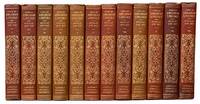
18942311448Harrogate Tennessee: Lincoln Memorial University 1894. Limited Edition. Full-Leather. Very Good/No Jacket. Limited edition #399 of an unspecified limitation this set 'especially prepared for Harry J. Williams.' Signed by John Wesley Hill opposite limitation page. Copyright page states 1894 but this is clearly reproduced from the plates of the original - this set is circa 1905. Volume 1 has very minor discoloration to edges of cloth on rear board minor wear to corners spine a bit faded. Complete in twelve hardcover volumes. Red full leather gilt titles & decorations top edges gilt decorative endpapers. A complete collection of Abraham Lincoln's works including speeches letters biographical writings etc. with an introduction by John Wesley Hill and special articles by various other contributors. The editors were Lincoln's private secretary and assistant secretary and also served in various other governmental roles Hay going on to become Secretary of State under McKinley and Roosevelt. Nicolay and Hay are perhaps best known for their ten-volume biographical history of Lincoln's administration originally published serially in The Century Magazine beginning in 1886 -- it remains one of the more exhaustive and personal accounts of the life of the 16th President of the United States and is notable for the inclusion of facsimiles of original drafts of important documents most importantly the Emancipation Proclamation. This set includes facsimiles of original correspondence and documents reproductions of contemporary photographs and engravings etc. Lincoln Memorial University hardcover books
18942283609Lincoln Memorial University 1894. Limited Edition. Full-Leather. Near Fine/No Jacket. Limited edition #212 of an unspecified limitation this set 'especially prepared for Ann Emerson Strong to whom it was presented by her father Pritchard H. Strong. Copyright page states 1894 but this is clearly reproduced from the plates of the original - this set is circa 1905. Small chip from spine head of volume 7 1/4 inch tear to spine head of first volume otherwise an excellent set small bookplate with initials A.E.S. on front endpaper of first volume. Complete in twelve hardcover volumes. Red full leather gilt titles & decorations top edges gilt decorative endpapers. A complete collection of Abraham Lincoln's works including speeches letters biographical writings etc. with an introduction by John Wesley Hill and special articles by various other contributors. The editors were Lincoln's private secretary and assistant secretary and also served in various other governmental roles Hay going on to become Secretary of State under McKinley and Roosevelt. Nicolay and Hay are perhaps best known for their ten-volume biographical history of Lincoln's administration originally published serially in The Century Magazine beginning in 1886 -- it remains one of the more exhaustive and personal accounts of the life of the 16th President of the United States and is notable for the inclusion of facsimiles of original drafts of important documents most importantly the Emancipation Proclamation. This set includes facsimiles of original correspondence and documents reproductions of contemporary photographs and engravings etc. Lincoln Memorial University hardcover books
184238683Hamilton Ontario: Ruthven's Book and Job Office 1842. 8vo. English and Mohawk text on facing pages. viii 456pp. Contemporary blue calf flat spine ruled and lettered in gilt.<br/> <br/>A fine copy of a scarce Book of Common Prayer in Mohawk.<br/> <br/>"Rev. Abraham Nelles archdeacon of Brant Ontario was born at Grimsby Ont. December 25 1805 and died December 20 1884. He was chief missionary of the New England Company to the Six Nation Indians for 53 years being first appointed as assistant missionary in 1829" Pilling. The Collects Services of Baptism etc. etc. translated by John Hill Junr. appear in Mohawk for the first time in this edition of the prayer book. Nelles proposed this edition for the use of the Grand River Mohawks. "This is the most complete of all editions of the Mohawk Prayer Book" Wright. Scarce.<br/> <br/>Pilling 2735; Sabin 6352; TPL 1st Supplement 5228; Wright Early Prayer Books of America p.40. Ruthven's Book and Job Office unknown books
184253946Providence: No Publisher. Very Good. 1842. Hardcover. Providence: 1842 original binding front board missing rear board loose. Foxing 160 pages contents good. . No Publisher hardcover books
184255774Providence: published for the purchaser 1842. First edition 12mo pp. 160; original black cloth-backed printed paper-covered boards; very good. Chapter I verse 1: "Now it came to pass that Harrison was dead and Tyler was made President in his stead over all the United States of America." "This curious book relates to the dissensions among various religious denominations in Rhode Island. It is written in scriptural language and divided into chapters and verses." Not in American Imprints; Bartlett p. 6; Sabin 148 authorship unattributed; Sabin 55932 later editions with Norwood the attributed author. <br/><br/> published for the purchaser hardcover books
186022476Columbus OH 1860. Hardcover. Fine. Book. Political Debates Between Hon. Abraham Lincoln and Hon. Stephen A. Douglas in the Celebrated Campaign of 1858 in Illinois. Columbus Ohio: Follett Foster and Co. 1860. 3rd edition with publisher's advertisements bound in. 268 pp. 6 1/2 x 9 1/2 in. Historical BackgroundLincoln's debates with incumbent Illinois Senator Stephen Douglas earned him national prominence. Slavery was the pressing national issue especially regarding its expansion into the western territories. Douglas authored the Kansas-Nebraska Act 1854 which effectively repealed the free-slave dividing line set by the Missouri Compromise 1820 at 36° 30' north latitude. Instead of banning slavery north of the line and banning south of it new states would instead decide on slavery's status within their borders by ""popular sovereignty."" On its surface Douglas's bill appeared to offer the nation a middle path on the contentious issue of slavery. Instead it would only muddy the waters on slavery.The Kansas-Nebraska Act was only one of a long list of compromises in the middle decades of the nineteenth century. Despite these attempts the slavery debate only became more heated throughout the 1850s. Northerners seeing the hypocrisy of ""states rights"" advocates chafed when a new Fugitive Slave Act 1850 required the use of federal marshals to return escaped slaves. An unintended consequence of Douglas's bill resulted in fraudulent elections and violence in Kansas in 1855 and 1856. South Carolina Representative Preston Brooks bludgeoned Massachusetts anti-slavery Senator Charles Sumner on the Senate floor after an 1856 speech. In 1857 the Supreme Court handed down the Dred Scott decision which decreed that African Americans could not be citizens and based on one's right to bring property across state lines effectively erased the division between free and slave states. Slavery unspoken but protected in the Constitution and mitigated by antebellum compromisers was a tinderbox about to roar to fire.Lincoln recognized the problems slavery presented for the nation and in his debates with Douglas focused his attention on the nationalization of slavery both West and North. After he was nominated as the Republican candidate for the Senate he spoke to the convention famously asserting that ""a house divided against itself cannot stand."" The House Divided speech delivered at Springfield Illinois on June 17 1858 is the opening piece of this book. Though he would lose the Senate race the rest of the book details Lincoln's intellectual combat with Douglas over slavery. This book is a third edition identified by the line over publisher's imprint on the back of the title page the numeral ""2"" at bottom of page 13 and publisher's advertisements bound in at head.Harrison Yerkes 1841-1899 enlisted as soon as the Civil War erupted but since he was under 21 years of age in 1861 his father removed him from service. As soon as he reached the age of majority he enlisted in the 31st Michigan Infantry Company and remained in the Army for the remained of the war. He returned to Michigan purchased two tracts of land which he farmed until retiring in 1891. He was a lifelong Republican though never held office.ConditionLight green boards faded blind stamped gilt lettering on spine ""Harrison Yerkes Northville Mich 1860"" erased from free front endpaper same present minus date on verso of ffep bep and back paste down. Very minor scattered foxing. Publishers advertisements bound into headmatter Minor shelf wear. Tight.SourcesPaul Leake History of Detroit Volume II Chicago: Lewis 1912 pp. 765.http://books.google.com/booksid=ZkUOAQAAMAAJ&pg=PA765&lpg=PA765&dq=harrisonyerkes&source=bl&ots=B-C-cmyauC&sig=gYKZ0sLD9AIMK2XCYuUZOEFn6eA&hl=en&ei=Wq7oTpO-CsLx0gHdisX-Bg&sa=X&oi=book_result&ct=result&resnum=8&sqi=2&ved=0CEwQ6AEwBw#v=onepage&q=harrison%20yerkes&f=false hardcover books
1860WRCAM54620New York 1860. 117pp. plus 4pp. of ads including rear wrapper. Frontispiece portrait. Original printed wrappers. Wrappers chipped and worn spine perished lower quarter of rear wrapper torn away. Very light dampstaining occasional spotting. Good. A rare campaign biography of Lincoln with a portrait of a beardless Lincoln and his first name spelled incorrectly. Prints many of his speeches and glorifies his backwoods origin and includes a very brief biographical sketch of Hannibal Hamlin. ".This was the first life of Lincoln in book form" - Howes. HOWES L341 "aa". STREETER SALE 1744. SABIN 41200. MONAGHAN LINCOLNIANA 92. unknown books
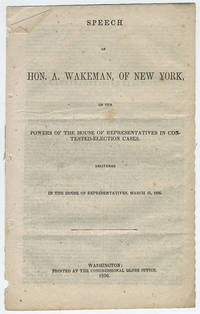
18568964Washington: Pr. at the Congressional Globe Office 1856. 8vo. 8 pp. <br><br>Uncommon. <br>Â Â Â Â <br>Â Â Â Â NSTC 2W1460. Removed from a nonce volume. Fold marks across width of pamphlet. Top left corner of title-page folded. Foxed. Now in a mylar folder. Pr. at the Congressional Globe Office unknown books