Smith AdamBiblio.com
252 résultats
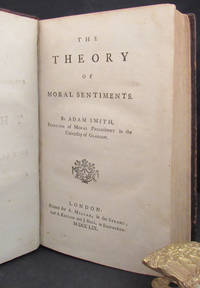
175931208London: Printed for A. Millar in the Strand and A. Kincaid and J. Bell in Edinburgh 1759 1759. First Edition. Thick 8vo 202 x 123 mm. bound in its original contemporary binding of full calf neatly and very sympathetically and skillfully restored at the back with the original spine panel laid down preserving all but ca. 2cm at the foot a nearly invisible sophistication the original morocco label replaced free endleaves renewed sympathetically with antique paper. xii 551 1 errata uncorrected in the text with an error: 412 should read 413; pp. 317-336 omitted from pagination as usual; complete with the half-title pp. A very handsome copy crisp and unpressed clean throughout the binding strong and in good order the occasional spot as to be expected but truly a pleasing copy of this monumental work. THE ESPECIALLY RARE FIRST EDITION IN ORIGINAL CONTEMPORARY BINDING OF ADAM SMITH'S FIRST BOOK PUBLISHED IN 1759. A TRULY RARE BOOK AND ONE OF THE MOST IMPORTANT WORKS IN ALL OF ENGLISH PHILOSOPHY. <br> 'THE THEORY OF MORAL SENTIMENTS was a true scientific breakthrough. It shows that our moral ideas and actions are a product of our very nature as social creatures. It argues that this social psychology is a better guide to moral action than is reason. It identifies the basic rules of prudence and justice that are needed for society to survive and explains the additional beneficent actions that enable it to flourish.<br> As individuals we have a natural tendency to look after ourselves. That is merely prudence. And yet as social creatures explains Smith we are also endowed with a natural sympathy – today we would say empathy – towards others. When we see others distressed or happy we feel for them – albeit less strongly. Likewise others seek our empathy and feel for us. When their feelings are particularly strong empathy prompts them to restrain their emotions so as to bring them into line with our less intense reactions. Gradually as we grow from childhood to adulthood we each learn what is and is not acceptable to other people. Morality stems from our social nature.<br> So does justice. Though we are self-interested we again have to work out how to live alongside others without doing them harm. That is an essential minimum for the survival of society. If people go further and do positive good – beneficence – we welcome it but cannot demand such action as we demand justice.<br>Virtue. Prudence justice and beneficence are important. However the ideal must be that any impartial person real or imaginary – what Smith calls an impartial spectator – would fully empathize with our emotions and actions. That requires self-command and in this lies true virtue.<br> Morality says Smith is not something we have to calculate. It is natural built into us as social beings. When we see people happy or sad we feel happy or sad too. We derive pleasure when people do things we approve of and distress when we believe they are doing harm.<br> Of course we do not feel others’ emotions as strongly as they do. And through our natural empathy with others we learn that an excess of anger or grief or other emotions distresses them. So we try to curb our emotions to bring them into line with those of others. In fact we aim to temper them to the point where any typical disinterested person – an impartial spectator says Smith – would empathise with us.<br> Likewise when we show concern for other people we know that an impartial spectator would approve and we take pleasure from it. The impartial spectator is only imaginary but still guides us: and through experience we gradually build up a system of behavioural rules – morality.<br> Punishments and rewards have an important social function. We approve and reward acts that benefit society and disapprove and punish acts that harm it. Nature has equipped us with appetites and aversions that promote the continued existence of our species and our society. It is almost as if an invisible hand were guiding what we do.<br> For society to survive there must be rules to present its individual members harming each other. As Smith comments it is possible for a society of robbers and murderers to exist – but only insofar as they abstain from robbing and murdering each other. These are the rules we call justice.<br> If people do not help others when they could or fail to return a good deed we may call them uncharitable or ungrateful. But we do not punish people to force them to do good: only for acts of real or intended harm. We force them only to obey the rules of justice because society could not otherwise survive.<br> But nature has given us something even more immediate than punishment namely our own self-criticism. We are impartial spectators not only of other people’s actions thanks to conscience. It is nature’s way of reminding us that other people are important too.<br> In the process of making such judgments on a countless number of actions we gradually formulate rules of conduct. We do not then have to think out each new situation afresh: we now have moral standards to guide us.<br> This constancy is beneficial to the social order. By following our conscience we end up surely but unintentionally promoting the happiness of mankind. Human laws with their punishments and rewards may aim at the same results; but they can never be as consistent immediate or effective as conscience and the rules of morality engineered by nature.<br> Smith ends THE THEORY OF MORAL SENTIMENTS by defining the character of a truly virtuous person. Such a person he suggests would embody the qualities of prudence justice beneficence and self-command.<br> Prudence moderates the individual’s excesses and as such is important for society. It is respectable if not endearing. Justice limits the harm we do to others. It is essential for the continuation of social life. Beneficence improves social life by prompting us to promote the happiness of others. It cannot be demanded from anyone but it is always appreciated. And self-command moderates our passions and reins in our destructive actions.<br> Freedom and nature Smith concludes are a surer guide to the creation of a harmonious functioning society than the supposed reason of philosophers and visionaries.' The Adam Smith Institute <br> The phrase that he is especially known for is first used here and would be repeated in THE WEALTH OF NATIONS: that the rich ".led by an invisible hand to make nearly the same distribution of the necessities of life which would have been made had the earth been divided into equal portions among all its inhabitants and thus without intending it without knowing it advance the interest of the society and afford means to the multiplication of the species." Part IV Section 1 pp. 350.<br> Both THE THEORY OF MORAL SENTIMENTS Adam Smith's first book and his later WEALTH OF NATIONS demonstrate "a great unifying principle.Smith's ethics and his economics are integrated by the same principle of self-command or self-reliance which manifests itself in economics in laissez faire" Spiegel.<br> "The fruit of his Glasgow years The Theory of Moral Sentiments would be enough to assure the author a respected place among Scottish moral philosophers and Smith himself ranked it above the Wealth of Nations. Its central idea is the concept closely related to conscience of the impartial spectator who helps man to distinguish right from wrong. For the same purpose Immanuel Kant invented the categorical imperative and Sigmund Freud the superego" Niehans 62 Printed for A. Millar, in the Strand and A. Kincaid and J. Bell, in Edinburgh, 1759 unknown
1776144265London: Printed for W. Strahan; and T. Cadell 1776. First edition of Adam Smith's magnum opus and cornerstone of economic thought. Quarto 2 volumes bound in full brown calf elaborately gilt-decorated spines front and rear panels red morocco spine labels marbled endpapers. In near fine condition. Remarkably clean throughout with some light toning. Housed in a custom half morocco calf clamshell box elaborately gilt decorated spines. An exceptional example of this landmark work. First published in 1776 Adam Smith's masterpiece The Wealth of Nations is the foundation of modern economic thought and remains the single most important account of the rise of and the principles behind modern capitalism. It took Smith ten years to produce An Inquiry into the Wealth of Nations. His commentary during such an incremental time the first years of the Industrial Revolution sought to reform outdated theories of mercantilist and physiocratic economic thought with broader concepts that we are all familiar with today such as the division of labor productivity and free markets. An important theme that persists throughout the work is the idea that the economic system is automatic and when left with substantial freedom able to regulate itself. This is often referred to as the “invisible hand.†The ability to self-regulate and to ensure maximum efficiency however is limited by a number of external forces and “privileges†extended to certain members of the economy at the expense of others. The 1776 publication of An Inquiry into The Wealth of Nations was the first of only five editions that were published in Adam Smith’s lifetime and greatly influenced a number of economists and philosophers of his time and those that followed including Jean-Baptiste Say Alexander Hamilton Thomas Malthus and Ludwig von Mises. "The history of economic theory up to the end of the nineteenth century consists of two parts: the mercantilist phase which was based not so much on a doctrine as on a system of practice which grew out of social conditions; and the second phase which saw the development of the theory that the individual had the right to be unimpeded in the exercise of economic activity. While it cannot be said that Smith invented the latter theory.his work is the first major expression of it. He begins with the thought that labour is the source from which a nation derives what is necessary to it. The improvement of the division of labour is the measure of productivity and in it lies the human propensity to barter and exchange.Labour represents the three essential elements-wages profit and rent-and these three also constitute income. From the working of the economy Smith passes to its matter -'stock'- which encompasses all that man owns either for his own consumption or for the return which it brings him. The Wealth of Nations ends with a history of economic development a definitive onslaught on the mercantile system and some prophetic speculations on the limits of economic control.The Wealth of Nations is not a system but as a provisional analysis it is complete convincing. The certainty of its criticism and its grasp of human nature have made it the first and greatest classic of modern economic thought" PMM. Printed for W. Strahan; and T. Cadell unknown