KRUSENSTERN, Adam Johann Crusius vonBiblio.com
742 résultats
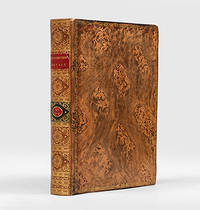
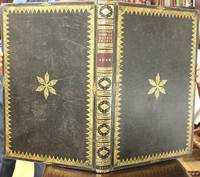
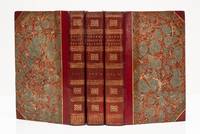
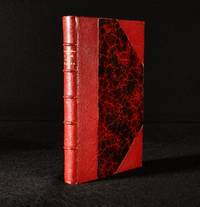
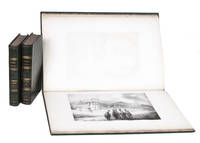
1821ABC_48814Paris 1821. 8vo and folio atlas. Librairie de Gide et Fils Contemporary blind-tooled dark green goatskin with a dark green morocco title label and a dark green morocco volume label on the spine dark green buckram sides marbled end papers. The atlas in contemporary gold- and blind-tooled dark green quarter goatskin with the title lettered in gold on the spine blue green cloth sides marbled end papers. With 30 engraved plates 21 views and portraits 9 maps and charts of which 3 folding. 2 text volumes and 1 atlas. XII 418 2 blank; 2 blank 4 531 1 blank; 4 pp. 30 plates. Very scarce first French edition of the very important and significant account of the discoveries of Krusenstern. Borba de Moraes writes: "The expedition became famous as the beginning of Russian exploration in the North Pacific on the Asian coast as well as the American. Krusenstern explored the northern part of the Sakhalin Island concluding erroneously that it was a peninsula. This mistake was only corrected fifty years later by Nevelskoi. Besides its geographical interest Krusenstern's account is also valuable for the study of the fur trade in the extreme north. From the Brazilian point of view the interest lies in the description of the expedition's stay in Santa Catharina."The descriptions of the Marquesas Islands Hawaii and Japan are of great scientific importance. The views in the atlas show among others the Marquesans with five plates concerning Japan and two of the Ainu people. Among the charts are those of the Washington Isles Port Ana Maria at Nukuhiva Port Tschitschagoff Nagasaki Sakhalin the Kuriles and Awatscha Bay.With a paper label R. D. P. on the front pastedown of volume 1 and the atlas a manuscript shelf mark "A. 14. R. 2." on the first flyleaf of the two text volumes. The edges and corners of the boards of the text volumes are slightly scuffed. Some of the leaves are somewhat foxed around the margins. The joints of the boards of the atlas are slightly weakened without affecting the structural integrity of the binding. The first and last few leaves are browned with a water stain in the lower outer corner of the first few leaves not affecting the images. Otherwise in good condition.l Borba de Moraes I 442; Forbes I 530; Hill 167-168; Sabin 38332; O'Reilly and Reitman 732 & 4728. hardcover
1821143059Paris: Gide fils 1821. A beautiful set with the rare atlas First edition in French of the first Russian circumnavigation one of the most significant Pacific voyages after Cook presented here in superior condition in a choice period binding complete with the rare atlas of plates "very important and. difficult to obtain" Hill. A highly desirable set. Krusenstern Ivan Fedorovich Kruzenshtern 1770-1846 had served in the British Navy between 1793 and 1799. He was given command of the two-ship expedition under "a brilliant corps of officers" Hill intended to establish trade with China and Japan facilitate trade in South America and examine California for a possible colony. His expedition encompassed the Canary Islands Brazil the Marquesas Kamschatka Nagasaki Sakhalin and Macao. "The voyage made a significant contribution to the knowledge of the hydrography of the Pacific coast of North America. Krusenstern took the first Russian embassy of Nikolai Rezanov to Japan" Howgego. The first edition published at St Petersburg between 1809 and 1814 with a folio atlas of 105 plates and issued in both Russian and German is a signal rarity of travel literature. Editions in Dutch English and Italian followed although none were accompanied by a plate volume which marks the present first edition in French as being the first edition following the original publication to include an atlas of plates. The illustrations are re-drawn versions of images in the original and includes a portrait of Krusenstern views and images of native people of the Marquesas Japan Sakhalin Island Kamtchatka etc. as well as nine maps. The translation is by the French geographer Jean-Baptiste Benoît Eyriès 1776-1846 a founder member of the Société de Géographie a member of the Société Asiatique and Académie des Inscriptions et Belles-Lettres awarded the Legion of Honour and in 1841 elected a Foreign Honorary Member of the American Academy of Arts and Sciences. However he is best remembered for a non-geographical work: his Fantasmagoriana 1812 an anthology of German ghost stories was read by the Byron-Shelley circle during their stay at the Villa Diodati the most famous child of that famous excursion being Mary Shelley's Frankenstein. 2 octavo vols letterpress 199 x 123 mm atlas vol. of plates 425 x 280 mm. Atlas with 30 plates including lithograph portrait of Krusenstern by G. Engelmann after Baptiste 19 lithograph plates 10 engraved maps 3 double-page. Contemporary dark green straight-grain half calf flat spines gilt lettered direct and divided into compartments by zig-zag rolls two broad panels filled with a reticulated pattern highlighted with a quatrefoil device at the interstices sailing ship motif in third and sixth compartments green vellum corner tips green marbled sides. Vol. I with superficial crack and minor wear at head of front joint a few light abrasions to spine of atlas occasional toning and scattered foxing. An excellent set with the half-titles in the letterpress vols. Arctic Bibliography 9377; Forbes 530; Hill 952; Howes K 272; Lada-Mocarski 61 and 62; Nissen Zool. 2310; Sabin 38332. hardcover
182134467Paris: Gide fils 1821. 3 volumes text: 2 volumes 8vo 8 x 5 1/2 inches; atlas: folio 18 1/2 x 12 inches. xii 418; 4 531 1pp. 30 engraved plates portrait 9 maps and 20 plates; 2 double-page maps. Uncut. Text in period patterned paper wrappers the atlas bound to style in uniform period panelled wrappers. Housed in black morocco backed boxes.<br/> <br/> First edition in French of Krusenstern's seminal account of the first Russian expedition to circumnavigate the globe: complete with the rare atlas of plates.<br/> <br/> Capt. Ivan von Krusenstern's voyage was one of the most important post-Cook Pacific voyages specifically aimed at obtaining more knowledge of the northern Pacific region establishing diplomatic and commercial relations with Japan and visiting the Russian trading posts in Alaska and on the west coast of America. It comprised the first Russian expedition to circumnavigate the globe under the command of Krusenstern between 1803 and 1806. Sailing in 1803 the expedition touched on Brazil and rounded Cape Horn visiting the Marquesas Islands Hawaii Kamchatka and Japan. In Hawaii the expedition separated with ships under Langsdorff and Lisianski sailing to the Northwest Coast while Krusenstern himself undertook the delicate Japan expedition returning via Macao and the Cape of Good Hope. "The importance of this work stems from its being the official account of the first Russian expedition to circumnavigate the globe and form the discoveries and rectifications of charts that were made especially in the North Pacific and on the northwest coast of America" Hill. First published in St. Petersburg between 1809 and 1814 with issues in both Russian and German that first edition with its folio atlas of 105 plates is a major rarity of travel literature. Dutch English and Italian editions followed although none contained an atlas of plates. The present first edition in French is the first edition following the original publication to include an atlas of plates. The images are re-engraved versions of images in the original and includes a portrait of Krusenstern views and images of natives of the Marquesas Japan Sakhalin Island Kamtchatka etc. as well as nine maps of various Pacific regions visited.<br/> <br/> cf. Lada-Mocarski 62; Sabin 38332; Arctic Bibliography 9377; Howes K272 "c;" Borba de Moraes pp.374-75; Hill 952 ref; cf. Forbes Hawaii 407. Gide fils unknown
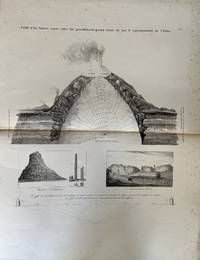
18363162Paris: F.-G. Levrault rue de la Harpe No. 81. / Strasburg: Même Maison rue des Juifs 33 Imprimé chez Paul Renouard rue Garancière no. 5.; Imp. Lith: de Thierry Frères à Paris 1836. First edition. Authors copy at least partly. In three volumes plus atlas. In modern uniform half leather. Publisher’s printed wrappers bound into. Pierre Mosse’s bookplate on the inner front panel in each volume. Artistically restored. Overall in fine condition. Vol. 1.: Possessor’s inscription or dedication clipped from the front wrapper restored. Water stain to upper outer corner almost throughout otherwise fine. Vol. 2.: With several annotations corrections and deletions in Bylandt Palstercamp’s own hand in pencil many inserted autograph notes in ink in various lengths from a paragraph to pages and a 16-page autograph supplement in ink at the end of the volume. Light water stain to the gutter. Otherwise fine. Vol. 3. Light foxing throughout some pages tanned. Otherwise fine. Album: The maps are kept in the original printed paper wrappers restored at folding. Some plates are slightly dusted and chipped at the edges some with light or darker foxing. Otherwise in very good condition. First edition. Authors copy at least partly. In three volumes plus atlas. In modern uniform half leather. Publisher’s printed wrappers bound into. 4 470=490 and 1 plate; 4 438 and 16 p. autograph supplement; 4 460 2 and 1 plate. 17 lithograph plates in album; sizes ca.: 72 × 36; 72 × 54; 98 × 66 cm. <p><br /> An extremely scarce scientific work on volcanos the second volume with several corrections and inserted notes in the author’s hand. With the atlas of 17 plates.<br /> <p><p><br /> Bylandt-Palstercamp’s Théorie des volcans is a result of more than thirty years of research and survey of volcanos while the author visited the mountain chains of Europe Asia and America. In this three-volume monumental work he delineates many interesting and curious discoveries and revelations about the volcanos in general and the volcanic phenomena. Discusses his theories about the distinct elevation and the different shapes of the volcanos the fixed orientation of their summits slopes and orifices and the specific location of the volcanos around the globe. The author attributes the currents of the sea to volcanic activities correlates earthquakes to the same phenomena and shows the relation between mount altitudes and magnetic power. Bylandt-Palstercamp classifies the mountains the lavas and the operation of the volcanos and defines a general law to determine the formation of volcanic cones. The work is appended with an album of seventeen large plates to illustrate the subject.<br /> <p><p><br /> Not much is known about the author besides the present work and it's preliminary pamphlet we couldn’t find anything else he published. The preliminary contains the same text as “Avant-propos†of the present book vol. 1. pp. 1–83 with some minor stylistic and typographical changes and was published twice under the title Résumé préliminaire de l’ouvrage sur la Théorie des volcans in Naples in 1833 and under a slightly different title in Paris in 1834.<br /> <p><p><br /> The second volume of our copy contains several annotations corrections and deletions in the author’s hand. The shorter notes and corrections are in pencil in the text and the longer ones written in ink on separate small papers are inserted into the gutter at the corresponding locations. The extent of these notes varies mostly the length of a paragraph some are longer like a 2-page one supplementing the section “Influence volcanique†on p. 38 and a 4-page revision of the text of “Effects des Eaux†on pp. 54–57. The section on Basalt on pp. 329–362 was corrected in pencil more heavily than the others and a 16-page supplement in ink on Bohemia was added to the end of the volume corresponding with the text on p. 396. <br /> <p><p><br /> The album printed the subsequent year in 1836 contains 17 lithograph plates of maps views and diagrams in three different large sizes each designed by Bylandt-Palstercamp. Most of the plates are maps 12 and the others are views some bear more than one and/or diagrams. The majority of the plates are folio size and folded once ca. 72 × 54 cm four are half of this size unfolded and three plates are extra large folded twice ca. 98 × 66 cm.<br /> <p><p><br /> 1: Atmosphère …. <br /> <p><p><br /> 2: Carte Générale Des Courants Volcaniques Et De Leur Influence Sur Le Système De La Terre. <br /> <p><p><br /> 3: Carte Du Foyer Oriental.<br /> <p><p><br /> 4: Carte Du Foyer Occidental. <br /> <p><p><br /> 5. Carte Géologique et Volcanique De L’Etna. ….<br /> <p><p><br /> 6: Etna Siracusa <br /> <p><p><br /> 7: Profil d’un Volcan assis entre les paralleles du grand Canal de feu & spécialement de l’Etna. / Basalts des Iles Ciclopëinner. / Les roches prismatiques à Paterno. / Les effets des tremblemens de terre sont entr’eux en raison inverse du guarré …<br /> <p><p><br /> 7bis: Intérieur du cratère de l’Etna 1832.<br /> <p><p><br /> 8: Les Iles Eoliennes ou de Lipari.<br /> <p><p><br /> 9: Carte volcanique du midi de l’Europe …. <br /> <p><p><br /> 10: Carte volcanique de la France Cenrale ….<br /> <p><p><br /> 11: Archipel de la Grèce. Ile De Santorin.<br /> <p><p><br /> 12: Environs de San-Léo. Urbin. …. / Grotte basaltique près Arciréale dans Sicile. / Volcan qui s'est élevé momentanément en devant de la Sicile 1831. / Tableau comparatif entre quatre principaux Volcans …. <br /> <p><p><br /> 13. Carte Volcanique du grand Internum de Baia et de l'Ile d’Ischia. ….<br /> <p><p><br /> 14: Cratère du Stromboly. / Construction géométrique du Vesuve.<br /> <p><p><br /> 15: Carte volcanique du Vesuve et de la Campanie. ….<br /> <p><p><br /> 16: Peninsule de Sorrento.<br /> <p><p><br /> Scarce no records on RBH.<br /> <p>. unknown
1813124187London: Printed by C. Roworth vol. II T. Davison; for John Murray 1813. The first Russian circumnavigation First edition in English of the first Russian circumnavigation. Krusenstern's account was first published at St Petersburg in 1810. Krusenstern Ivan Fedorovich Kruzenshtern had served in the British Navy in 1793-99. He was given command of the two-ship expedition under "a brilliant corps of officers" Hill intended to establish trade with China and Japan facilitate trade in South America and examine California for a possible colony. It proved to be one of the most important Pacific voyages after Cook encompassing the Canary Islands Brazil the Marquesas Kamschatka Nagasaki Sakhalin and Macao. "The voyage made a significant contribution to the knowledge of the hydrography of the Pacific coast of North America. Krusenstern took the first Russian embassy of Nikolai Rezanov to Japan" Howgego. The translator Hoppner 1786-1872 was an English diplomat also remembered for his friendship with Byron. 2 vols bound in one quarto 277 x 210 mm. Engraved folding map Japan with coastline of China and Korea based on D. F. Sotzmann's map of 1811 2 hand-coloured aquatint plates by J. A. Atkinson a native of Nuku Hiva in the Marquesas view of Nagasaki. Contemporary tree calf professionally rebacked to style richly gilt spine red and green morocco twin labels red morocco numbering ovals gilt floriate roll tool border on sides gilt Greek-key turn ins marbled endpapers. Neat oval book label of the distinguished travel bibliophile Martin Greene. Vol. I title lightly creased and upper right blank corner restored frontispiece of vol. II lightly offset to title short closed tear at foot of same title. A very good handsome copy clean and generously margined. Abbey Travel 1; Cordier 459; Hill 952; Howgego II K23; Sabin 38331. unknown
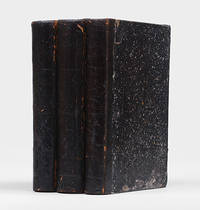
186699950St Petersburg: I. I. Glazunov 1866. First edition of the much-improved second Russian translation of Adam Smith's Wealth of Nations reproducing the notes and apparatus from the 1843 Blanqui edition. This translation published following the growing public dissatisfaction with an earlier version encumbered with obsolete prose and unspecific terminology appeared in the Library of Classical European Writers translated by P. A. Bibikov. "The first Russian translation of the Wealth by N. R. Politkovsky had appeared between 1802 and 1806; in its first volume the translator himself had referred to the difficulty of rendering Smith's specific terminology in Russian writing that 'he vas a novice in the subject himself although Smith also seemed to have some difficulty in elaborating his ideas with clarity'" Tribe p. 156. "By the middle of the nineteenth century the first translation of Wealth of Nations was increasingly unsatisfactory to Russian readers working in a language that had developed considerably since the early part of the century. Bibikov already had a reputation as a historian philosopher and literary critic and this undoubtedly had a part in the generally high level of presentation of the translations which have notes indexes and supplements. However Bibikov's translation was not made from the English original but from Blanqui's version of Garnier's French edition including an apparatus that drew upon the commentary of Buchanan Garnier McCulloch and others which Bibikov retained in the Russian translation" ibid. pp. 160-161. 3 vols octavo 202 x 134 mm. Contemporary black calf spines over black speckled boards cloth corners spines ruled and lettered gilt. Housed in a black cloth flat-back box by the Chelsea Bindery. Joints a little rubbed gilt on spine faded; paper covering on boards a little cockled and worn lifted in places and repaired. Pale waterstain to first few leaves of volume 1. Without pages 7-8 of volume 1 as in all recorded copies. Withal a very good set. Tribe 184; Vanderblue p. 30. OCLC lists three copies besides the Vanderblue copy: at the University of Illinois at Ohio State University and at the National Diet Library in Japan. hardcover
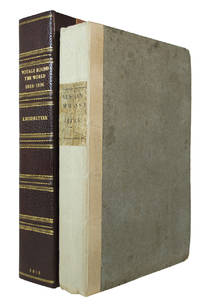
181367660London: Printed by C. Roworth.for John Murray 1813. Full Description:<br> <br> KRUSENSTERN Adam Johann von. Voyage round the World in the Years 1803 1804 1805 & 1806 by order of His Imperial Majesty Alexander the First on board the ships Nadeshda and Neva under the command of Captain A.J. von Krusenstern of the Imperial Navy. In two volumes. Translated from the original German by Richard Belgrave Hoppner Esq. Vol. I. II. London: Printed by C. Roworth for John Murray 1813.<br> <br> First edition in English. Two quarto volumes in one. vii 1 blank 4 contents ix-xxxii 314; 9 1 blank 404 pp. Folding engraved map "Chart of the Northwest Part of the Great Ocean" and two hand-colored aquatint frontispieces one for each volume.<br> <br> Original quarter parchment over drab blue boards. Original printed paper spine label. Uncut. Previous owner's light ink signature on title-page. Very light small library stamp to title-page. Leaf a2 with a few closed tears neatly repaired. Original paper label a bit rubbed and unreadable. Boards with some light soiling and bumping. A very clean and handsome copy. Housed in a custom quarter morocco clamshell. Overall an excellent copy.<br> <br> Laid in is a hand-written half-page letter dated March 1815. The identity of the author is unknown. The letter reads:<br> <br> "Capt. Krusenstern of the Russian navy presents his compliments to Dr. Thomsen and takes the liberty to send him a publication of Professor Carrol which Capt. Krusenstern has just received from . He at the same time must make every apology for intruding himself on Dr Thomsen the of Dr Thomsens personal acquaintance. 34 Upper Berkley Street/ 4 March 1815"<br> <br> Krusenstern 1770-1846 "appointed to command the first Russian round-the-world expedition had serving with him a brilliant corps of officers including Lisiansky Langsdorff and Kotzebue. The expedition was to attempt to 'open relations with Nippon and the Sandwich Islands to facilitate trade in South America to examine California for a possible colony and make a thorough study and report of the Northwest coast its trade and its future.'.The importance of this work is due to its being the official account of the first Russian expedition to circumnavigate the globe and the discoveries and rectifications of charts that were made especially in the North Pacific and on the northwest coast of America.The introduction is particularly important and interesting because of the information it contains respecting the state of Russian commerce during the eighteenth century the Russian voyages and discoveries in the Northern Ocean and the Russian fur trade" Hill.<br> <br> A Russian edition was published in 1809-1814 and a German edition from which this English edition was translated in 1810-1814.<br> <br> Abbey Travel 1. Arctic Bibliography 9377. Borba de Moraes pp. 374-5. Hill pp. 167-8. Howes K271. Sabin 38331.<br> <br> HBS 67660.<br> <br> $18500. Printed by C. Roworth...for John Murray unknown
1811137677Rio de Janeiro: Na Impressão Regia 1811-12. Adam Smith in Portuguese First edition in Portuguese comprising a selection of passages from books I-IV of Smith's Wealth of Nations translated from the third English edition of 1784 by Bento da Silva Lisboa. "Given the strong Brazilian interest in Smith's work one can better understand why the first Portuguese translation of Wealth of Nations appeared during 1811-12 in Rio de Janeiro. This is a partial translation with the omission of Book V and half of Books I and IV. The translator's preface makes clear that Wealth of Nations was translated and studied as a doctrinal blueprint to promote the liberalisation of economic relations between Portugal and her most important colony fostering in this way the independent development of the Brazilian economy." Reeder & Cardoso "Adam Smith in the Spanish- and Portuguese- speaking world" in Tribe. 3 vols bound in 1 octavo 205 x 122 mm. Contemporary sprinkled half roan and marbled paper boards smooth spine divided into compartments by gilt roll toll red leather label. Housed in a brown cloth flat-back box by the Chelsea Bindery. Shelf label to front pastedown and first spine compartment. Joints and corners slightly rubbed occasional light spotting; a very good copy. Goldsmiths' 20224: Tribe 104; Vanderblue p. 33. WorldCat finds copies at Columbia Yale Princeton John Carter Brown and the National Library of Scotland. hardcover
182134964Paris: Gide fils 1821. 3 volumes text: 2 volumes 8vo 8 x 5 1/2 inches; atlas: folio 18 1/2 x 12 inches. xii 418; 4 531 1pp. 30 engraved plates portrait 9 maps and 20 plates; 2 double-page maps. Text volumes bound in grey paper boards rebacked paper labels; atlas bound to style in grey paper boards.<br/> <br/> First French edition with the very rare atlas not published with the English edition.<br/> <br/> This is the first Russian circumnavigation written by its commander and of great importance to Pacific history for his account of the attempt to open Japan to commerce and for Krusenstern's notes on the Russian-Chinese trade. The two ships sailed from Kronstadt on July 19th 1803 and were together until the Marquesas and Hawaii. They visited Hawaii in the summer of 1804 touching briefly on the Big Island to trade for needed supplies. From there Krusenstern sailed by himself for Kamchatka where he made extensive surveys and ethnographic inquiries. Japan was the main focus of the expedition. They arrived at Nagasaki on Aug. 30th 1804 with the emissary from the Tsar and presents including looking glasses and a portrait of Catherine the Great. Hoping to open a trade mission and expecting more freedom than was granted the Dutch they found themselves "greatly mistaken." They were kept in confinement and suspense and at the audience the following April the negotiations collapsed. The ships' repairs were put to the Imperial account all gifts were sent back and they were politely but firmly asked not to return. The narrative contains a detailed account of the negotiations and includes a view of Nagasaki Harbor one of the first views of Japan published in the west. Krusenstern charted much of the west coast of Japan made a short stop at Hokkaido and at Aniwa Bay and gives an account of his contact with Ainu people. The fine atlas is illustrated with twenty-one lithographic plates by Engelmann and nine engraved maps three folding. Though unsigned O'Reilly says the plates are probably the work of Tilesius one of the naturalists of the ship. They include a portrait of Krusenstern four views of Nukuhiwa and eight of Japan including the Ainus. The maps include three of the Marquesas and four of Japanese interest. "The atlas volume is very important and is difficult to obtain" - Hill. The work was translated and revised by J.B.B. Eyries who also wrote part of the text for Choris' "Voyage Pittoresque."<br/> <br/> Hill pp. 167-68. Forbes Hawaii 530. Kroepelien 695. Sabin 38382. O'Reilly & Reitman 732. Gide fils unknown
181769616Philadelphia: Published by Anthony Finley. J. Maxwell Printer 1817. Full Description:<br> <br> SMITH Adam. The Theory of Moral Sentiments. Or an Essay Towards an Analysis of the Principles by which Men naturally judge concerning the Conduct and Character first of their Neighbours and afterwards of themselves. To Which is added A Dissertation on the Origin of Languages. First American from the Twelfth Edinburgh Edition. Philadelphia: Published by Anthony Finley. J. Maxwell Printer. 1817.<br> <br> First American edition stated. There was a edition printed in Boston the same year. It is believed that this Philadelphia edition came before the Boston edition. Sabin only lists the Boston edition. Kress calls this the first American and Vanderblue collection lists the Philadelphia copy first and does not have a Boston copy. Both editions are very rare. We could only find 7 copies total on Rare Book Hub the last appearing in 2007. One octavo volume 8 1/2 x 5 1/8 inches; 215x 130 mm. 2 blank vii 1 blank 598 2 publisher's ads 2 blank pp.<br> <br> Contemporary full marbled sheep. Spine with red leather spine label lettered in gilt. Spine ruled in gilt. Spine with repairs along hinges and head and tail. Boards a bit scuffed and corners bumped. Some washed dampstaining to preliminary leaves. Leaves foxed and toned throughout as is usual from American paper of this time. Two previous owner's bookplates to front pastedown Joel Crawford and C.P. Crawford. Title-page and final leaf with the old ink signature "J. Crawford." A few instances marginalia in the same ink as well as a few pencil underlines. Overall a very good copy.<br> <br> Smith's Theory of Moral Sentiments is drawn from his course of lectures while he was professor of moral philosophy at the University of Glasgow. "The work received wide acclaim and so impressed the stepfather of the young duke of Buccleuch that he invited Smith to become the duke's tutor with the promise of a pension for life.The greater part of the Theory of Moral Sentiments is an account of moral psychology.The mainstay of Smith's moral psychology is sympathy.Smith characterizes the mechanism of sympathy in this way: 'Whatever is the passion which arises from any object in the person principally concerned an analogous emotion springs up at the throught of this situation in the breast of every attentive spectator'.Smith argues that if the appearance of grief or joy for example arouses similar feelings in us it is because these feelings suggest to us the general idea of some good or evil that has befallen the person in whom we observe them" Encyclopedia of Philosophy.<br> <br> "The Theory of Moral Sentiments was published in April 1759 and at once brought Smith something more than local fame. It was hailed by David Hume in typical ironic manner: 'I proceed to tell you the melancholy news' he wrote from London 'that your book has been very unfortunate: for the public seem disposed to applaud it extremely'" Mossner Adam Smith: The Biographical Approach p. 12.<br> <br> Provenance: The bookplates on this copy are for Joel Crawford Milledgeville GA 1824 and C.P. Crawford. Joel Crawford June 15 1783 - April 5 1858 was an American politician soldier and lawyer. He served as a U.S. Congressman in the state of Georgia.<br> <br> Kress B.7052. The Vanderblue memorial collection of Smithiana Pg 40-41. Sabin 82314 for first edition<br> <br> HBS 69616.<br> <br> $15000. Published by Anthony Finley. J. Maxwell Printer unknown
1827B6041Munic: Chez Hermann & Barth. 1827. A fine example in contemporary decorative binding plates are clean and crisp. Binding: contemporary decorative black morocco rebacked expertly matching the boards spine with 6 raised bands and decorative gilt motifs title on red morocco label on spine upper and lower board with gilt ruling and decorative central gilt motif. Notes: An important plate book on Russia and Napoleonic era. The plates depict city or landscape views together with studies of soldiers and battle views particularly in Smolensk near Borodino and in Moscow - where the account ends.<br>Albert Adam son of artist Victor Adam followed the Prince Eugene recording views and events of the disastrous 1812 campaign. After the death of the Prince he published his drawings in the present volume sometimes as fully accomplished lithographs sometimes as line drawings only. He specialized in battle painting and accompanied the French army and became famous by Eugene de Beauharnais who appointed him painter of the Court and drawing designer in 1812. Size: Large Folio 530 x 350 mm Illustration: Finely illustrated with 3 lithographed portraits of Napoleon Eugene and Murat; & 97 lithographed plates. Pages: P. Title decorative title with portrait preface 1 leaf table 1 leaf text 26 leaves 100 lithographed plates. Category: Book Russia; Book Military Chez Hermann & Barth. hardcover
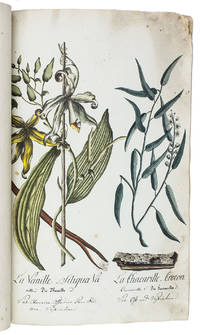
1804K59DWF5YDV43Ofen Buda 1804. Small folio 31.5 x 20 cm. Contemporary marbled paper wrappers. With manuscript title-page followed by 18 leaves of coloured drawings of plants and trees. 19 ll. Collection of high quality drawings of plants and trees by the physician Adam Johann Ingruber who graduated from the faculty of Medicine of the University of Pest in 1803. The 18 leaves of drawings mostly show two species of plants or trees each with captions in French Latin and German at the foot the last two show silkworms bees a rattlesnake and a scorpion. Most species are from Asia South America Africa and the southern part of Europe.Water stained some occasional smudges a few leaves cut short tattered spine: in fair condition. unknown
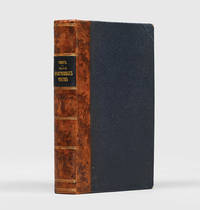
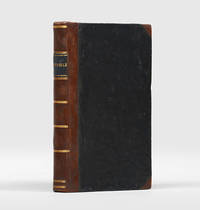
1868128700St Petersburg: I. I. Glazunov 1868. First edition in Russian of The Theory of Moral Sentiments very rare. This landmark translation it is still the one used in Russia today was made by Pavel Bibikov who had brought out a translation of the Wealth of Nations the edition read by Lenin two years before. Both were published as part of his series the Library of Classical European Writers. "Bibikov 1831-1875 already had a reputation as a historian philosopher and literary critic and this undoubtedly had a part in the generally high level of presentation of the translations" Artemieva p. 160. The translations were probably made via French but whereas Bibikov's Wealth of Nations was superceded by the end of the century his Theory of Moral Sentiments remained the only Russian version available until 1997. Tatiana V. Artemieva "Adam Smith in Russian translation" A Critical Bibliography of Adam Smith ed. Keith Tribe 2002 pp. 153-167. Octavo 207 x 138 mm pp. 2 5-515 4pp. contents and advertisement leaf complete. Recently bound in quarter marbled calf and pebble grain cloth vellum tips spine ruled gilt black morocco label. First and last leaves a little darkened short chip to upper margin of title small stain to final few leaves and last leaf strengthened in the gutter; a very good copy. Tribe 186; Vanderblue p. 42 but not in the collection. OCLC locates copies at National Library of Scotland Yale Illinois and the National Library of Israel only. Not in the British Library. hardcover
186856148St Petersburg I. I. Glazunov 1868. 8vo. In contemporary half calf with with embossed boards. Three raised bands and gilt lettering to spine. Spine with wear. Small label pasted on to top left corner of pasted down front free end-paper. Removed stamp to half-title and title-page with stamp and a a few number written to top of title-page. A few light occassional underlining in pencil otherwise internally fine and clean. 1-515 1 IV pp. <br/><br/><em>Rare first Russian translation of Adam Smith's 'The Theory of Moral Sentiments'.The translator Pavel Bibikov 1831-1875 also translated the 'Wealth of Nations' in 1866 both being part of his series the Library of Classical European Writers. Bibikov regarded the two works as complementing each other as he remarks in his preface to this translation "the works reinforce each other. That is why having published in Russian Adam Smith's great work of political economy I decided to translate and publish his other work which is no less remarkable and yet known even less to Russian society than the first" p. 5. "Bibikov's translation probably done via French remained the only Russian version available until 1997". National Library of Scotland.Adam Smith developed a comprehensive and unusual version of moral sentimentalism in his Theory of Moral Sentiments 1759 TMS. He did not expressly lay out a political philosophy in similar detail but a distinctive set of views on politics can be extrapolated from elements of both TMS and his Wealth of Nations. Although these economic doctrines had not been unheard of in Russia prior to the rise of Anglophile feelings at the beginning of the nineteenth century "it was not until interest and admiration for things British was firmly rooted that classical economics could secure its ground in Russia" Tanaka The Controversies Concerning Russian Capitalism - An Analysis of the Views of Plekhanov and Lenin this processes coincided with the present publication which became important in the spreading of Adam Smith's economic principles in Russia. OCLC only locates three copies. </em> hardcover
18501702701850. ADAM Victor. Les Synonymes en Action. Contents include: hand-coloured lithographed title and twenty-four hand-colored lithographed plates heightened with gum arabic W X & Y on one plate. Folio 337 x 250 mm. bound in publisher's blind stamped red cloth over boards front cover decorated and lettered in gilt expertly rebacked to style. Paris: Chez Arnauld de Vresse 1850. A rare and attractive Abécédaire by the keen Parisian societal observer and illustrator Victor Adam. Each letter of the alphabet is represented by a series of colourful and imaginative vignettes on subjects including costume animals trades and many others. OCLC lists only a copy at NYPL. Minor rubbing to extremities. Short marginal tears to plate numbers 11 12 19 & 21 minimal marginal foxing and soiling otherwise an excellent copy of this scarce series of plates. PROVENANCE: Small bookplate of J.J. Coudera on front pastedown. hardcover
18501716611850. ADAM Victor. Charades alphabet. 25 coloured and gummed lithographic plates. 268 x 340 mm. Publisher's blue moiré percaline boards in a new cloth folding box. Paris: Aubert ca. 1850. A truly spectacular large scale alphabet with the stunning plates by Victor Adam exquisitely hand coloured. The book was clearly intended for export with the plates bearing the names of English and American publishers. This copy is clearly as published and is without title-page or text. Extremely rare with OCLC listing Princeton UCLA Amsterdam American Antiquarian Society and BN hardcover
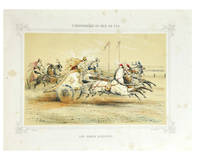
1840F6LCN62N0MKRParis: A. de Vresse 1840. Original publishers gold-blocked blue cloth. With a bookseller's ticket. Oblong 1mo full-sheet leaves or oblong Royal folio 30 x 42 cm. With 16 hand-coloured lithographed plates each with a caption and decorative border. Lacking the title-page. A fine example of Adam's expertise in lithography. The plates depict a variety of unusual equestrian racing scenes including chariot racing with women driving and monkeys riding horseback.Victor Adam 1801-67 was originally employed as painter for the Museum at Versailles but in the 1840s he decided to concentrate on the art of lithography. The present scarce album is typical of his work.Ten plates with some mostly marginal spotting; one plate with a 1 cm marginal tear not affecting the plate paper on front paste-down wrinkled. Overall an attractive copy.l WorldCat 3 copies; not in Colas; Lipperheide; Schwerdt. A. de Vresse, hardcover
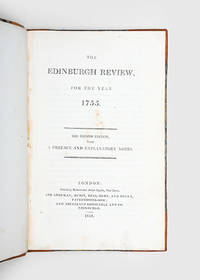
1818171057London: for Longman Hurst Rees Orme and Brown and Archibald Constable and Co. Edinburgh 1818. Identifying Smith's earliest published work Second edition a facsimile reprint of both issues of the Review incorporating the earliest published work by Adam Smith. The Edinburgh Review only ran for this single year from 1755 to 1756 yet its contributors included Adam Smith and William Robertson and it had the fortune to coincide with Rousseau's Discourse on Inequality and Johnson's Dictionary. Both works are covered here by Smith. The journal aimed to review every publication originating in Scotland but this belied a deeper manifesto of social economic and cultural reform. In the preface Alexander Wedderburn 1733-1805 later Lord High Chancellor of Great Britain wrote that the review aimed towards "the progressive state of learning in the country" ODNB. This second edition was supervised by Sir James Mackintosh 1765-1832 a jurist politician and a leading figure in early 19th-century Whiggish history. Mackintosh provides a 12-page preface and explanatory notes in which he puts names to the originally anonymous articles. Provenance: Professor Arnold Heertje 1934-2020 with his engraved bookplate fixed to the front pastedown. Octavo 208 x 133 mm pp. ii-xvi 2 vi 135 1; lacking half-title. Contemporary half calf rebacked and re-cornered spine ruled and decorated in gilt and with red morocco label lettered in gilt contemporary marbled paper sides edges sprinkled red. Bookseller's ticket of J. Seacome Chester to front pastedown. Infrequent light foxing: a very good copy indeed. Goldsmiths' 22015; Vanderblue p. 46. unknown
1851E429P001U79OMunich 1851. Royal oblong folio 62.5 x 45.5 cm. Cotta Plates loose in a contemporary red cloth slipcase with a silk lining. With tinted lithographed title dedication leaf to Radetzky preface and 24 lithographed plates. With 24 ll. of explanatory text printed on blue paper. 24 ll. First edition of a monumental commemorative work to mark the campaigns of the Austrian army in Italy during the years 1848-49. The plates lithographed by Ernst and Franz Adam and printed by Julius Adam depict the street riots assaults cavalry battles and sieges near Milan Santa Lucia Vicenza Custozza Volta Mortara Novara Malghera and elsewhere during the suppression of the Italian revolt by the Habsburgs. The war correspondent Friedrich Wilhelm Hackländer 1816-77 wrote the extensive explanatory texts most in both German and French for each plate. Austria won this first Italian War of Independence; a decade later however Italy was an independent state.From the library of Duke Maximilian Joseph in Bavaria 1808-1888 father of Elisabeth Empress of Austria 'Sisi'. Some minor browning and foxing. Frayed edges. Very good set of lithographs depicting military scenes during the first Italian Independence War.l Hiler p. 6; Lipperheide Qe 20. hardcover
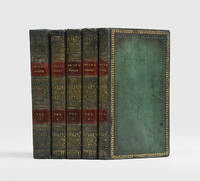
1822186529London: Printed for J. Richardson and Co. Thomas Tegg & 8 others in London A. Allardice Edinburgh and R. Griffin and Co. Glasgow 1822. The birth of modern economics Second collected edition the first in duodecimo following the octavo of 1811-12 and including the Wealth of Nations and the Theory of Moral Sentiments among other works. Smith's powerful argument for free markets and free trade remains a cornerstone of economic thought. 5 vols duodecimo 174 x 101 mm. Contemporary green calf twin red morocco labels spines gilt in compartments covers bordered with gilt and blind rolls gilt turn-ins green endpapers marbled edges. A few minor pencilled notes. Top label of vol. I peeling slightly a little rubbed light wear at extremities with tips recoloured and strengthened some light foxing to contents minor running stain at foot towards end of vol. III. A very good copy. Tribe 133. unknown
1811119352Vilnius: Drukarnia XX Bazylianów 1811. Scarce Polish translation of Georg Sartorius's Von den Elementen des National-Reichthums und von der Staatswirtschaft nach Adam Smith translated from the second German edition of 1806 first 1796 translated by Jan Znosko holder of the chair of political economy at the Vilnian University from 1810 to 1823. "Znosko established his credentials with a work entitled A Science of Political Economy according to Adam Smith thought by his contemporaries to be an original work but which later turned out to be a translation of the second editoin of Gaorg Sartorius's 1796 Handbuch. The book is of course a summary of Wealth of Nations but in places Znosko inserts some critical obervations printed in a smaller typeface. The longest of these is related to Smith's conception of 'fertile' and 'infertile' labour that is productive and unproductive labour." Stefan Zabieglik 'The Reception of Adam Smith's Works in Poland from the Eighteenth to the Twentieth Centuries' in: A critical Bibliography of Adam Smith. Octavo 168 x 97 mm. Contemporary roan-backed drab paper boards spine renewed yellow edges. Ownership stamp of Gwalbert Pawlinkowski to title verso and T6 verso library stamps to title recto and verso partly blacked out. Spine renewed corners worn stamp to lower margin of B1 cut away; occasional light spotting; a good copy. Tribe p. 174. Not in Vanderblue. OCLC locates only the Polish national union catalogue copy. hardcover
181127288London: J. Maynard.Haymarket; and F. Zinke.Strand 1811. 3 volumes. Very early printing. This printing now with an Account of the Life of the Author which has been specially drawn up for the first time as well as studies on the author and the French economists of the period and a method of facilitating the study of the work. 8vo bound in very handsome and well preserved three-quarter contemporary polished calf over cloth covered boards compartments of the spines decorated with gilt decorated raised bands bordering decorations tooled in blind one compartment lettered in gilt one with maroon morocco lettering label gilt. lxxi 360; vi 512 513-514 appendix; vi 448 50 pp.extensive index. An especially bright and fine set in very handsome and well preserved contemporary bindings. The text remains very clean crisp and fresh. There has been no restoration work of any sort to bindings or text. Rare thus. AN UNUSUALLY WELL PRESERVED AND HANDSOME SET OF THIS EXTRAORDINARY WORK. Eighteenth century editions of Smith’s magnum opus are becoming very scarce. This edition of 1811 is a very early English printing of the nineteenth century still in 18th century style. It retains Smith’s introduction and also incorporates the author’s advertisements to the third and fourth editions and a new advertisement to this edition setting out the additions made to the preliminary materials for this edition.<br> ‘The history of economic theory up to the end of the nineteenth century consists of two parts: the mercantilist phase which was based not so much on a doctrine as on a system of practice which grew out of social conditions; and the second phase which saw the development of the theory that the individual had the right to be unimpeded in the exercise of economic activity. While it cannot be said that Smith invented the latter theory – the physiocrats had already suggested it and Turgot in particular had constructed an organised study of social wealth – his work is the first major expression of it. He begins with the thought that labour is the source from which a nation derives what is necessary to it. The improvement of the division of labour is the measure of productivity and in it lies the human propensity to barter and exchange: "labour is the real measure of the exchangeable value of all commodities … it is their real price; money is their nominal price only". Labour represents the three essential elements – wages profit and rent – and these three also constitute income. From the working of the economy Smith passes to its matter – "stock" – which compasses all that man owns either for his own consumption or for the return which it brings him. The Wealth of Nations ends with a history of economic development a definite onslaught on the mercantile system and some prophetic speculations on the limits of economic control.<br> ‘Where the political aspects of human rights had taken two centuries to explore Smith’s achievement was to bring the study of economic aspects to the same point in a single work … The certainty of its criticism and its grasp of human nature have made it the first and greatest classic of modern economic thought’ PMM. <br> Smith's classic work was begun at Toulouse in 1763-64 where he had travelled as guardian of Henry Scott the young duke of Buccleuch and in the company of David Hume historian and fellow professor at Glasgow University. The work took shape over the next ten years and was finally published in 1776. At one point during its composition Hume wrote that Smith was "cutting himself off entirely from human society." But his labors however severe his methods yielded the "first and greatest classic of modern economic thought" Printing and the Mind of Man.<br> "It may be said that the WEALTH OF NATIONS certainly operated powerfully through the harmony of its critical side with the tendencies of the half-century which followed its publication to the assertion of personal freedom and 'natural rights.' It discredited the economic policy of the past and promoted the overthrow of institutions which had come down from earlier times but were unsuited to modern society. As a theoretic treatment of social economy and therefore as a guide to social reconstruction and practice in the future it is provisional not definitive. But when the study of its subject comes to be systematized on the basis of a general social philosophy more complete and durable than Smith's no contribution to that final construction will be found so valuable as his" Britannica J. Maynard...Haymarket; and F. Zinke...Strand hardcover
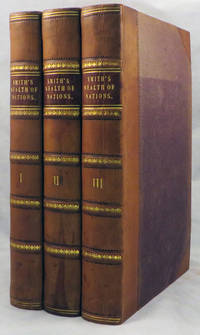
18063464Edinburgh: Arch. Constable and Company 1806. First Edinburgh Edition. Leather Bound. Very Good. First Edinburgh Edition. Leather Bound. 3 vol. Adam Smith An nurture into the Nature and Causes of the Wealth of Nations.<br /> First Edinburgh Edition. With Life of the author. Bound in 3/4 red crushed Morocco leather with marbled boards and gilt embellishment motifs and lettering on spines. Marbled endpapers all edges marbled. Published Edinburgh: Arch. Constable and Company 1806.<br /> H: 8 3/4" W: 5 1/2" D: 1 1/4". Arch. Constable and Company unknown
1886779L7Paris: Tresse et Stock 1886. First edition. Leather. Very Good Indeed. 7" by 5". None. An extremely scarce first edition copy of this important symbolist novel. This particular copy once belonged to Edmund Gosse and has been signed by the author. The dedication to the half-title bears the author's inscription to Gosse. Edmund Gosse an English poet met Moreas in Paris 1893 during a week of absinthe drinking which is possibly the occasion for the inscription to this book and for the sketch. Gosse wrote to Heinemann on the 6th April 'My week in Paris has been a great success tho' quite unlike what I expected. We were mostly in the Latin Quarter and I saw a great deal of the Symbolist poets. Mallarmé was ill but all the rest from Verlaine and Moréas downward were on show and they were extremely cordial to me'.With an original sketch tipped in as a frontispiece of Moreas and Verlaine signed 'Dauphin Meunier 31.3.93' bound in before the title. In the original French. Bookplate to the front pastedown of Edmund William Gosse. This novel is an collaboration between Jean Moreas and Paul Adam. It is one of a couple of works the two worked on together. in a contemporary half crushed morocco binding with paper covered boards. Externally generally smart. Light rubbing to the joints and to the extremities. Bookplate to the front pastedown Edmund William Gosse. Signature and original drawing from the author tipped in to the frontispiece. Internally firmly bound. Pages are age toned to the edges. Tidemark to the title page and to the tipped in page. Occasional light spots to pages. Very Good Indeed Tresse et Stock hardcover
1801177821Dublin: Printed by N. Kelly and William Porter for P. Wogan Gilbert and Hodges W. Porter J. Moore and B. Dornin 1801. Political economy and the Anglo-Irish union Fourth Irish edition of the "first and greatest classic of modern economic thought" PMM in a handsome contemporary Irish binding. Towards the end of the Wealth of Nations Smith outlines an expansive and audacious plan for the political-economic consolidation of the British Empire. In this plan Ireland was to be united with Great Britain in a move largely modelled on the Anglo-Scottish union of 1707. Smith stresses the political and economic benefits to the Irish anticipating that the move would end British trade restrictions and even neutralize the fractious nature of Irish politics. Ironically Smith's wider theories of political economy in the Wealth of Nations were often co-opted by Irishmen diametrically opposed to his political proposals most notably the United Irishman Arthur O'Connor 1763-1852 whose approach to democratic land reform was "a radicalised version of Smith's political economy" Andersen. The United Irishmen mounted a rebellion in 1798 the failure of which led to precisely the Anglo-Irish union advocated by Smith. This fourth Irish edition was the first to be published in the newly formed United Kingdom of Great Britain and Ireland. 2 vols octavo 204 x 131 mm pp. xiii 1 498; viii 489. 61; lacking blank A1 in vol. II. Tables in the text. Contemporary red straight-grain sheep spines lettered ruled and decorated in gilt covers panelled in gilt marbled endpapers. With 1824 prize inscription in Latin to fourth blank of vol. I. Extremities refurbished light scuffing faint sunning to spines minor foxing and offsetting to contents leaf P6 of vol. II with 7 cm closed tear touching text: a very good copy. Kress B.4448; Tribe 75; Vanderblue p. 20. L. S. Andersen "The Political Economy of Ireland and Its Counterfactuals: Review of James Strafford The Case of Ireland: Commerce Empire and the European Order 1750-1848 CUP 2022" History of European Ideas vol. 50 no. 1 2023. unknown