Zantzinger, AdamBiblio.com
252 résultats
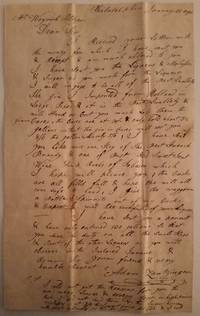
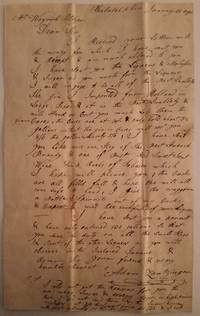
1790319Philadelphia 1790. Autograph Letter Signed. Folio sheet folded. 1 page of text with address on the verso. Folded with small tears at the folds blank piece missing at the wax seal. Highly legible hand. Watermark paper " I R ".Letter from Adam Zantzinger concern the receipt of money and shipment of "Liquers and Molasses and Sugar . . all of the best quality. The gin I imported from Holland in large Pipes & it is the best Quality & will cost you much less then the gin in cases; the cases are at 30/ only hold about 3 1/2 gallons so that the gin in cases will cost you 8/6 the gallon & this only 5/6. I have sent you like wise on keg of the best French Brandy & one of the best Red Sweet Wines and a Roal of Tobacco which I hope will please you. The casks are all filled full and hope thy will all com safe to hand. I give the waggoner a bottle of Spirrits out of my casks & expect he will see carefully of your liquor."Adam Zantzinger was a member of the Pennsylvania Militia 1775-1783 and is listed in the Revolutionar War Batallion Index. In 1775 he purchased a 9 acre parcel of land north of the City of Philadelphia called the Norther Liberites on Ridge Avenue across the street from what is now Girard College. He was listed in the membership rolls of the Carpenters Company for 1786 and became a shareholder in the Library Company of Philadelphia in 1790. unknown
1790549Philadelphia 1790. Autograph Letter Signed. Folio sheet folded. 1 page of text with address on the verso. Folded with small tears at the folds blank piece missing at the wax seal. Highly legible hand. Watermark paper "I R". Letter from Adam Zantzinger concern the receipt of money and shipment of "Liquers and Molasses and Sugar . . all of the best quality. The gin I imported from Holland in large Pipes & it is the best Quality & will cost you much less than the gin in cases; the cases are at 30/ only hold about 3 1/2 gallons so that the gin in cases will cost you 8/6 the gallon & this only 5/6. I have sent you like wise one keg of the best French Brandy & one of the best Red Sweet Wines and a Roal of Tobacco which I hope will please you. The casks are all filled full and hope they will all com safe to hand. I give the waggoner a bottle of Spirrits out of my casks & expect he will see carefully of your liquor." Adam Zantzinger was a member of the Pennsylvania Militia 1775-1783 and is listed in the Revolutionary War Batallion Index. In 1775 he purchased a 9-acre parcel of land north of the City of Philadelphia called the Norther Liberites on Ridge Avenue across the street from what is now Girard College. He was listed in the membership rolls of the Carpenters Company for 1786 and became a shareholder in the Library Company of Philadelphia in 1790. 319 549. unknown
1798EBS100467Paris: Chez Théophile Barrois 1798. 1st Edition. Hardcover. Very Good/No Jacket. Weikard wrote the earliest reference to attention deficit hyperactivity disorder ADHD. He was progressive for his time believing that diseases have physical causes and not the result of moral wrongs or spiritual influences. A rare work. By the late 18th century Brown's Elementa Medicinae 1780 had sparked intense controversy across Europe. His system proposed that all diseases stemmed from either excessive or insufficient excitability in the body a radical departure from humoral and mechanical theories. Weikard an influential German physician sought to explain Brown s ideas in more accessible terms addressing both supporters and skeptics. BOOK DETAILS. 8vo 2 vols in one leather worn int. VG. Has internally pressed flower pieces. Interesting. Paris: Chez Théophile Barrois hardcover
172221374Erfurt: Druck bei Grosch 1722. perfect. Gut. 24 Seiten 1 Blatt. Orig.-Broschur. Oktav 197 x 16 cm ohne Einband gering wellig und gebräunt recht frisch. Dissertation über die Behandlung von Entzündungen. Angebunden ein Blatt mit einem Huldigungsgedicht von J. F. de Pre an Wechsung. Wechsung stammte aus Frankenhausen Schwarzburg-Rudolstadt. - Weitere Bilder auf Anfrage oder auf unserer Homepage. Wegen Urlaub kann Ihre Bestellung / Anfrage erst nach dem 21.06.2026 bearbeitet werden. - Because of holidays your order / question can be handled only after 06/21/2026. Druck bei Grosch unknown
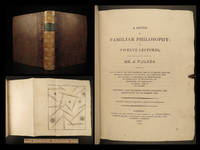
179921091<p><b>1799 Science Lectures Adam Walker Electricity Astronomy Optics Chemistry Physics</b></p><p>Adam Walker was an 18th-century scientist known for his numerous lectures on a variety of topics including mechanics hydrostatics hydraulics pneumatics and electricity. Many of these lectures were included in this 1799 printing of the '<i>Familiar Philosophy</i>'. The first lecture is of particular interest – discussion on light zodiac and the power of fire! It should be noted that this <b>impressive edition contains 47 copper engravings.</b></p><p>Item number: #21091</p><p>Price: $750</p><p>WALKER Adam</p><p><b><i>A System of familiar philosophy in twelve lectures</i></b></p><p>London: Printed for the author 1799. 1st edition</p><p><br /></p><p><u>Details</u>:</p><p>· Collation: Complete with all pages</p><p>o xviii 571 5</p><p>o <b>47 engravings</b></p><p>· Provenance: Armorial bookplate – John Plumptre</p><p>o John Pemberton Plumptre 1791–1864 was a British politician. He was elected as a Conservative Member of Parliament for East Kent in 1832 and resigned on 29 January 1852 through appointment as Steward of the Chiltern Hundreds. Motto: SUFFICIT MERUISSE</p><p>· Language: English</p><p>· Binding: Leather; tight and secure</p><p>· Size: ~11.25in X 9.25in 28.5cm x 23.5cm</p><p>· Quite rare </p><p>Our Guarantee:</p><p>Very Fast. Very Safe. Free Shipping Worldwide.</p><p>Customer satisfaction is our priority! Notify us with 7 days of receiving and we will offer a full refund without reservation!</p><p>21091</p><p>Photos available upon request. </p> for the author hardcover
1790QQ0043Printed for the Author 1790. ~Original half speckled tan calf marbled paper to boards. Gilt fillets and red gilt label to spine. Nick to mid-spine; board corners slightly pushed in. 8vo 13.8 x 21.2cm. Hinges sound. Original endpapers just barely starting at gutters. Rear free endpaper closely written on both sides with pencil 'index' to vol. with p. nos and topics of interest. In-text illus throughout. Text block clear and fresh. Adam Walker 1730/31-1821 itinerant lecturer and writer. Born into the family of a woollen manufacturer Walker was almost entirely self-educated and developed 'considerable mechanical skill constructing models of the milling machinery employed locally for fulling grinding and papermaking' ODNB. In 1766 he bought the apparatus of a previous itinerant lecturer and began travelling himself developing numerous spectacular exhibits including a transparent orrery. Walker published and lectured extensively and extremely successfully establishing his sons in what was now the family business becoming friendly with many eminent members of the Lunar Society and developing various mechanical inventions among them early steam engines and the rotary lights installed under his direction in St Agnes Lighthouse in the Scilly Isles. This present volume of travel writing was one of two such works inspired by visits to the continent. Scarce. ~Robust packaging. Overseas orders trackable on request. Used books are exempt from USA tariffs. 1st edn. Hardback. Hardback. Very Good/Fine. iv 442 1pp. Printed for the Author Hardcover
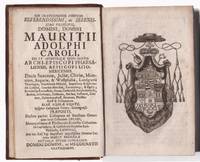
174827496B1748. Prague: Franciscus Carolus Hladky. 1748. 16cm x 10cm. 12 415 2 p. Zeitgenössisches Leder auf Bünden. Leder etwas berieben und beschabt kleine Fehlstelle unteres Kapital bestoßen und mit etwas Materialverlust. Vorsätze stärker sonst nur leicht gebräunt. Zeitgenössische Notizen auf Vorsatz und Vorwort-Titel. Insgesamt guter Zustand. / Contemporary calf with raised bands. Calf with some rubbing and partly with minimal worming. Inside slightly foxed contemporary handwritten markings to end-papers and to title of preface. Overall stable and still in good condition. Seltenes Buch in lateinisches Sprache mit 2 Stichen: 1 ganzseitiges Kupfer eines Wappen und eine halbseitige Schlußvignette auf S. 2 / Rare book of 1748 with two engravings. Text in Latin. hardcover
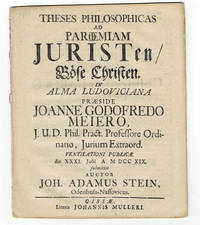
171998283Gissae Giessen: Literis Johannis Mulleri 1719. 1719. Very good. - Small quarto 7-1/8 inches high by 5-7/8 inches wide. Softcover bound in printed self-wrappers. There is an line penned in ink to the right of the title and the rear cover leaf is nearly detached though present. 20 pages illustrated with a headpiece featuring lady justice holding a scale in one hand and a sword in the other set within an oval in a floral decorated panel with a cherub at each side. There are a couple of minor creases to the corners and a tiny chip to the front edge of one leaf. Very good. <p>RARE. First only edition.<p>The work is a University of Giessen thesis. It is in the form of 11 theses followed by a response.<p>Johann Gottfried von Meiern 1664-1721 was a German lawyer and historian. In 1718 he became Professor extraordinarius of law at the University of Giessen. His professorship at Giessen was short-lived due to conflict with his colleagues over his belief in the theory of natural law. He returned to his hometown of Bayreuth in 1720. Von Meiern aka Meyern is probably best known for his contribution to the "Acta Pacis Westphalicae" from 1734. Gissae [Giessen]: Literis Johannis Mulleri, (1719). paperback
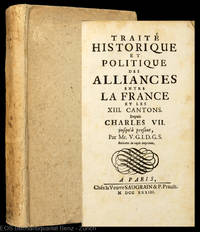
17337893CB1733. Paris Chéz la Veuve Saugrain & P. Prault 1733. 8°. 462 10 S. Pappband der Zeit. Barth 23956. Haller VI 1807. HBLS VII 286 für die Erstausgabe und für den Verfasser. Zweite Ausgabe erschien erstmals 1731. Franz Adam Vogel 1749 war Grossrichter der Schweizergarde in Paris. Seine erste Ausgabe von 1731 war in Frankreich verboten. Vorliegende Ausgabe gemäss Haller nicht in Paris sondern in Bern «gesondert» verlegt «und auch mit den Bündnissen selbst abgedruckt worden». Das Papier durchgehend stockfleckig. Der Einband berieben und bestossen. unknown
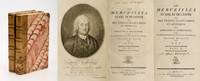
178229252AB1782. 2 Volumes ensemble complet. Berlin G.J.Decker 1782. Octavo 13 cm x 20 cm. Frontispice 98 1 304; 2 382 1 pages. Reliure originale demi-cuir de 19ème siècle. Tres bon exemplaire. This work is listed in Albert Louis Calillet - Manuel bibliographique des sciences psychiques ou occultes - No. 10472 First French edition of one of Swedenborg's main works from the library of swedish baron Carl Adam Wrangel with his name on the titlepage in ink. Carl Adam Wrangel af Adinal born 28 November 1748 in Ovesholm died 16 April 1829 in Araslöv in Färlöv parish was a Swedish baron one of the kingdom's lords and governor of Kristianstad county. He was the son of Baron Henning Reinhold Wrangel af Adinal and his wife Hedvig Sofia Winterfeld. Wrangel became a lifeguard in 1766 a captain in the army in 1772 and then resigned in April 1773. He became chamberlain to the widowed queen Lovisa Ulrika in 1774 and governor of Kristianstad county from 1786 to January 1803. After his father's death in 1783 Carl Adam Wrangel inherited Ovesholm's estate in Träne parish from his parents. In 1787 he also inherited Araslöv's estate which at this time encompassed the entire parish of Färlöv. Araslöv was previously owned by his mother's aunt Sofia Elisabeth Ridderschantz. She was called "Skånska Prinsessan" because she was the grand-granddaughter of King Christian IV of Denmark and her habits were also very royal. Carl Adam Wrangel was a prominent farmer fully comparable to Macklean on Svaneholm and Stjernswärd on Engeltofta and carried out major reforms on his Scanian properties. Through large ditching companies new land was laid under the plow. One shift was carried out and Araslöv was divided according to the Scottish pattern into farm units eleven so-called farmer. Each farm covered a few hundred acres and was provided with magnificent and stately buildings newly laid out gardens and avenue-planted access roads. During the years 1790-1820 the manors Wrangelsberg Sofieberg Sofiedal Hamiltonhill Harastorp Gustafsfält Skottlandshus Wrangelsdal Ulriksdal Adinal and Kristineberg arose to which was added the mother property Araslöv. An entire parish was transformed in this way and today Araslöv's farmers with their fields and avenue systems give a definite touch to the landscape. Carl Adam Wrangel finally inherited Sperlingsholm's estate in Övraby parish outside Halmstad in 1789 from his uncle Georg Gustaf Wrangel who this year moved abroad. He married 6 April 1779 at Barsebäck in Skåne to Countess Anna Margareta Hamilton born 1760. She was the daughter of the field marshal Baron Gustaf David Hamilton af Hageby and his wife Jakobina Henrietta Hildebrand. In the marriage two sons were born: Henning Gustaf 1780-1833. Ludvig Ulrik Carl Adam 1783-1809. None of the sons had children and the baronial family Wrangel af Adinal was thus extinct in 1833. unknown
1759106536Bambergae : Martini Gbhardi Haeredes 1759. 180x110mm. 8 Bl. - 552 S. - 51 Bl. Index 422 Martini Gbhardi Haeredes unknown
1709419091709. Halae Magdeb. Literis Christiani Henckelii 1709 Kl.4° 39 1 pp. orig. Broschur. Adam Friedrich Pezoldt 1679-1761 unknown
1708418911708. Halae Magdeb. Literis Christiani Henckelii 1708 Kl.4° 48 pp. orig. Broschur. unknown
1797AQ20001Cambridge: Printed by Benjamin Flower: for J. Deighton et al. 1797. 4 290pp 2. With a final publisher's advertisement leaf not recorded by ESTC. Contemporary dark green calf-backed marbled boards ruled and lettered in gilt. Extremities worn loss to head of spine. Head of title page shaved sadly to remove an early ownership inscription foxed. The rare first edition of the first work of economics in English consciously intended for use as a textbook. As the author himself notes in a preliminary 'advertisement' which heaps justifiable praise on the magnum opus of Adam Smith the work was designed to be 'found convenient as a text book in those institutions of liberal education in which the "Wealth of Nations" makes an essential branch of their letters'. A lucid abridgement by English radical Jeremiah Joyce 1763- 1816 of Scottish philosopher Adam Smith's monumental Wealth of nations it condensed the two thick quartos of the original edition London 1776 - or the by then well-known bulky triple-decker octavo editions of the late eighteenth-century - into a single convenient octavo volume. As Joyce himself notes in a footnote to the final page of text the developments suggested by Smith relating to alleviating the national debt by introducing the British system of taxation to 'all provinces of the empire' were superseded by events in America during the 1770s and any hope for the 'discharging of the national debt' brought even more into doubt by the 'present melancholy situation of Ireland'. ESTC locates only 11 copies in the UK and just 12 further elsewhere. ESTC T95379. First edition. 8vo. Printed by Benjamin Flower: for J. Deighton et al. hardcover
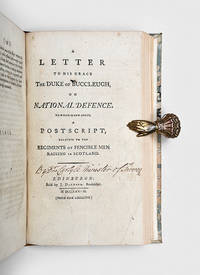
1778152780Edinburgh: J. Dickson 1778. First edition second issue "a re-issue of the London edition of the same year with a cancel title page and the addition of a postscript dated: Lincoln's Inn July 20th 1778" ESTC this copy also retaining the London title page. "This discussion of the bill for extending the militia law of Scotland introduced in 1776 contains a number of passing references to the war in America" Adams. The postscript comments on Burgoyne's defeat. Carlyle is identified as author in a contemporary hand on the Edinburgh title. After studies at Edinburgh Glasgow and Leiden where his classmates included William Robertson Adam Ferguson and John Home Carlyle was licensed to preach in 1746 and was introduced to the parish of Inveresk some five miles south-east of Edinburgh by the duke of Buccleuch the following year receiving his ordination in 1748. A moderate in his support for ecclesiastical patronage and politically conservative issues as well as in his endorsement of Enlightenment cultural principles including liberal education polite learning and religious toleration Carlyle was a familiar figure in the cultural life of what has come to be known as the Scottish Enlightenment. Strong and outspoken in his support for the Scots militia cause having written in 1760 The Question relating to a Scots Militia Considered the present pamphlet attacks Smith's apparent opposition to militias in the Wealth of Nations citing passages from Smith's book and also referring to the opinions of the Encyclopedistes. The other pamphlets included in this volume are: DOUGLAS John William Pulteney and Junius attributed authors. A Letter addressed to two Great Men on the prospect of peace; and on the terms necessary to be insisted upon in the negotiation. London: Millar and A. Kincaid & J. Bell Edinburgh 1760. Howes 6095. DALRYMPLE Sir John. The Rights of Great Britain asserted against the Claims of America: being an answer to the declaration of the General Congress. The third edition with additions. London: T. Cadell 1776. Howes 2564. LIND John. An Answer to the Declaration of the American Congress. The fourth edition. London: T. Cadell J. Walter and T. Sewell 1776. Howes 6167. TOWNSHEND Charles. Remarks on the Letter addressed to two Great Men. I a Letter to the author of that piece. London: printed in the year 1760. Howes 10372. Manuscript attribution to Henry Lord Holland on title. Octavo 209 x 122 mm. Bound fourth with four other pamphlets related to American affairs in contemporary quarter sheep and marbled boards vellum tips spine ruled gilt in compartments red morocco label lettered "Pamphlets" and numbered 2 direct sprinkled edges. Ownership inscription "Binning" to front pastedown dated 1779 with a manuscript list of the volume's contents to front free endpaper. Short tear to head of front joint; a very good copy. Adams The American Controversy 78-56b variant; ESTC T179898 locating copies at the National Library of Scotland and Harvard Business School only. The London imprint ESTC T107064 is slightly more common with copies located at British Library Columbia Harvard JCB and the New York Historical Society only; Vanderblue p. 50. hardcover
1791053487London: Strahan And Cadell 1791. 5th or later Edition . Full-calf. Very Good. Three Volumes As Issued. Complete With All Preliminary Blanks In All Volumes Cancels X5 And X8 In Volume 3. Contemporary Calf New But Old Style Black Morocco Labels Gilt In All Compartments. 8Vo. The Preeminent Classic Of Economic Thought Now Scarce In All Early Editions. This Is The Sixth Edition One Of 2000 Copies Identical To The Last Revision By Smith And The First Published After His Death. Worn Extremities Rubbed Spines Chipped Away At Top And Bottom Edges Apparently Repaired At Some Time; Leather Recently Conditioned Furbished Minor Repairs To Corners. Corporate Bookplates In All Volumes. A "Printing And The Mind Of Man" Title. Human Greeds Tend To Cancel Each Other Out And Are Dangerous Only When Government Interferes On One Side Or Another. Thus Government Has No Role To Play In Using Military Force Or Diplomatic Resources To Protect Foreign Trade Although Of Course No Self-Proclaimed Adam Smith Acolyte Politician Would Agree Despite Their Justifications Of Liberalism Free Trade Democracy Etc. : The Greed Of Politicians The Primary Fact Of Modern Life Was Not Fully Anticipated By Smith. The Main Point That Is Usually Cited From Smith'S Long Work 4 Volumes Neglecting 99% Of His Analysis Focuses Only On The Idea That Unrestricted Free Trade Is Better. Modern Interpretations Further Claim That Free Trade Is Always Better And Should Be The Primary Goal- Period That It Is An Absolute Necessity. A Thought Experiment Can Show How That Is Ridiculous. Imagine A World Where A Country Spends Far More On Sex Tourism Overseas Than On Purchasing Anything Else. The Sex Workers Overseas Will Spend Some Money On That Country'S Services And Goods But If There Is An Unbalanced Outflow Most Of The Money In The "Purchasing" Country Will End Up In The "Selling Country". The Purchasing Country Has Nothing To Show In The Long Term For All Those Transitory Pleasures It Purchased And The Country Will Dissolve As It Can No Longer Pay The Normal Everyday Debts Of Government And Private Activity. One Can Listen To Professional Economists That Say That Is Not True But If It Is Not True Why Do The Unfunded Debts Of Federal State And Local Governments Worldwide Keep Going Up And Why Can'T Governments Worldwide Come Up With Working Budgets The Problem Is Not Just In Regulation It Is Also A Problem Of Too Much Consumption. If That Analysis Is Wrong Where Is A Country That Can Provide A Current Budget That Is Based On Receipts Rather Than Expectations And When Have Those Expectations Ever Been Correct Over Say A Century In World History Economists Are Not Historians They Are Bureaucratic Advisors Who Sell Their Advice That Is Not Based On Long-Term Evidence Have Themselves Never Built Anything That Endures Can Point To No Physical Evidence That They Understand How The World Works And Have No Responsibilities When Things Fail. Every Empire And Every Government Fails When It Can No Longer Pay Enough To Sustain And Defend Itself. The Best Interpretation Of The Free Trade Argument Is That Free Trade Is Better For Most Businesses That Make Money From Selling And That In Itself Is Better For Society. If That In Itself Is Better Than Not Having Free Trade If Free Trade Is The Highest Principle In And Of Itself Then Slavery Imperialist Warfare Dictatorship Poisonous And Unhealthy Food Pollution And The Destruction Of Every Natural Thing Become Acceptable So Long As Free Trade Exists. We May Look Forward To Seeing Articles From Economists That Defend That Position And Also To Detailed Budgets For National State And City Governments That Is Within The Boundaries Of Their Receipts. Absent That We Must At Least Consider That Whatever Professional Advisors Say There Is An Issue In The Real World Of "Government Budgets" And We Are Left To Consider What Is The System Of Trade Laws That Make It More Likely That We Will In The Foreseeable Future Have Balanced Them. <br/> <br/> London: Strahan And Cadell unknown
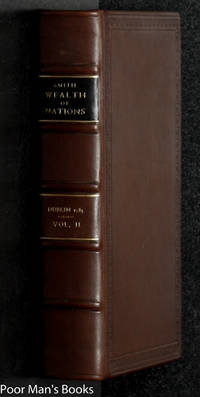
178534376Dublin: W. W. Colles R. Montcrieffe G. Burnet Et Al. Near Fine with no dust jacket. 1785. Fourth Edition. Hardcover. 8vo 8" - 9" tall; 4894 59 pages; Rebound in rich full calf leather. Contents clean and bright with minor water stains at inner upper spine. Vol II of 2 4th edition but 2nd Dublin edition. Light owner name at top of title. Exceptional. . W. W. Colles, R. Montcrieffe, G. Burnet, Et Al. hardcover
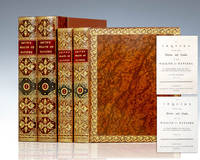
1776144265London: Printed for W. Strahan; and T. Cadell 1776. First edition of Adam Smith's magnum opus and cornerstone of economic thought. Quarto 2 volumes bound in full brown calf elaborately gilt-decorated spines front and rear panels red morocco spine labels marbled endpapers. In near fine condition. Remarkably clean throughout with some light toning. Housed in a custom half morocco calf clamshell box elaborately gilt decorated spines. An exceptional example of this landmark work. First published in 1776 Adam Smith's masterpiece The Wealth of Nations is the foundation of modern economic thought and remains the single most important account of the rise of and the principles behind modern capitalism. It took Smith ten years to produce An Inquiry into the Wealth of Nations. His commentary during such an incremental time the first years of the Industrial Revolution sought to reform outdated theories of mercantilist and physiocratic economic thought with broader concepts that we are all familiar with today such as the division of labor productivity and free markets. An important theme that persists throughout the work is the idea that the economic system is automatic and when left with substantial freedom able to regulate itself. This is often referred to as the “invisible hand.†The ability to self-regulate and to ensure maximum efficiency however is limited by a number of external forces and “privileges†extended to certain members of the economy at the expense of others. The 1776 publication of An Inquiry into The Wealth of Nations was the first of only five editions that were published in Adam Smith’s lifetime and greatly influenced a number of economists and philosophers of his time and those that followed including Jean-Baptiste Say Alexander Hamilton Thomas Malthus and Ludwig von Mises. "The history of economic theory up to the end of the nineteenth century consists of two parts: the mercantilist phase which was based not so much on a doctrine as on a system of practice which grew out of social conditions; and the second phase which saw the development of the theory that the individual had the right to be unimpeded in the exercise of economic activity. While it cannot be said that Smith invented the latter theory.his work is the first major expression of it. He begins with the thought that labour is the source from which a nation derives what is necessary to it. The improvement of the division of labour is the measure of productivity and in it lies the human propensity to barter and exchange.Labour represents the three essential elements-wages profit and rent-and these three also constitute income. From the working of the economy Smith passes to its matter -'stock'- which encompasses all that man owns either for his own consumption or for the return which it brings him. The Wealth of Nations ends with a history of economic development a definitive onslaught on the mercantile system and some prophetic speculations on the limits of economic control.The Wealth of Nations is not a system but as a provisional analysis it is complete convincing. The certainty of its criticism and its grasp of human nature have made it the first and greatest classic of modern economic thought" PMM. Printed for W. Strahan; and T. Cadell unknown
1786173725London: printed for A. Strahan; and T. Cadell 1786. An uncut copy Fourth edition of "the first and greatest classic of modern economic thought" PMM an uncut and partly unopened copy in a contemporary binding a reprint of the third edition of 1784 with minor variations. In his Wealth of Nations Smith "begins with the thought that labour is the source from which a nation derives what is necessary to it. The improvement of the division of labour is the measure of productivity and in it lies the human propensity to barter and exchange The Wealth of Nations ends with a history of economic development a definitive onslaught on the mercantile system and some prophetic speculations on the limits of economic control" PMM. "The Wealth of Nations had no rival in scope or depth when published and is still one of the few works in its field to have achieved classic status meaning simply that it has sustained yet survived repeated reading critical and adulatory long after the circumstances which prompted it have become the object of historical enquiry" ODNB. "The 'Advertisement to the Fourth Edition' announces that no alterations of any kind have been made. Cannan noted some small variations which can be attributed to small misreadings or unauthorised corrections by the printers. The division between volumes is identical to that in the 3rd Edition and Vol. II Bk. IV Ch. 8 is this time included in the Table of Contents" Tribe. Provenance: engraved armorial bookplate of Talbot of Gonvile's Hall in Wymondham Norfolk to each front pastedown; earlier ownership signature of B. C. Hingham dated June 1787 above. Binder's note in ink on front blank endpaper of vol. I: "3 V. 0.18.0 in hf bind." 3 vols octavo 228 x 138 mm pp. Complete with the conjugate blank leaf before title in vol. III the top edge unopened. viii 499 1; vi 518 6; v iv-v 1 465 1 50 index. Contemporary half calf and marbled boards red morocco spine labels. Housed in a brown leather entry slipcase by the Chelsea Bindery. Spines with some surface wear and vertical cracks consolidated at the head one joint partly cracked but sound minimal loss of the marbled paper covering; very occasional light spotting and the odd short marginal tear; a lovely example of a modest provincial binding entirely uncut and partly unopened. Goldsmiths' 13148; Kress B.1129; Tribe 30; Vanderblue p. 3. See Printing and the Mind of Man 221; Loudon J. H. James Scott and William Scott bookbinders Scolar Press 1980. hardcover
1778001569London: W. Strahan and T. Cadell 1778. Two volumes complete - Volume One - 9 2-510pp and Volume Two - 9 2-589pp 1. Full contemporary calf smooth back divided into six panels by gilt rule title label to second panel contrasting volume label to third. Rebacked with original back strips laid on volume label of first volume chipped with some loss some wear to outer joints with a couple of minor splits corners bumped. Closed tear to fore edge margin of G1 in volume one O-P2 lightly foxed a few notes in pencil to margins former owner's name and address in ink to ffep William Philip Haslewood. Signature N in the second volume is lightly foxed the bottom corner of 3U4 is torn away not affecting text and there is a minor worm trail to lower pastedown and rear free endpapers. Half title to volume two only as called for but both volumes lack the final blank. With a modern cloth slipcase. An attractive copy one of five hundred printed of the second edition of Smith's magnum opus the only other quarto edition after the first of 1776. Smith did slightly revise this edition with Todd noting "a number of alterations large and small some providing new information some correcting matters of fact some perfecting the idiom and a large number now documenting references in footnotes" Todd 'The Text and Apparatus' in volume one of the 1976 edition of the 'Wealth of Nations' page 62. Einaudi 5329; Goldsmith's 11663; Kress B.154; see PMM 221 for the first edition. Second Edition. Hardback. Good. 4to. W. Strahan and T. Cadell Hardcover
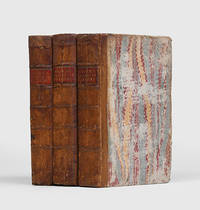
1789178702London: Printed for A. Strahan; and T. Cadell 1789. Political economy at the time of the French Revolution Fifth edition the last to be published in Smith's lifetime of this foundational work of political economy. "The Wealth of Nations had no rival in scope or depth when published and is still one of the few works in its field to have achieved classic status meaning simply that it has sustained yet survived repeated reading critical and adulatory" ODNB. The work "begins with the thought that labour is the source from which a nation derives what is necessary to it. The improvement of the division of labour is the measure of productivity and in it lies the human propensity to barter and exchange. The Wealth of Nations ends with a history of economic development a definitive onslaught on the mercantile system and some prophetic speculations on the limits of economic control" PMM. Smith's ultimate aim was to provide legislators with a set of principles to guide their regulation of commerce. Some of these principles advocated improvements in existing policies others aimed to alter the overall climate within which these policies operated. 3 vols octavo 205 x 126 mm. Tables in the text. Contemporary tree calf spines ruled and decorated in gilt and with red and green morocco labels edges yellow. Extremities professionally restored and labels replaced. With 20th-century bookplate of "T & M James" to front pastedowns. Light rubbing and scuffing very minor foxing and offsetting to contents: a very good copy. Goldsmiths' 13794; Kress B.1722; Tribe 33 Vanderblue p. 3. See Printing and the Mind of Man 221 first edition. unknown
1796180931Philadelphia: Printed by Thomas Dobson 1796. In an unrestored binding from the early years of the republic Second American edition of the "greatest classic of modern economic thought" PMM a key influence on the founding fathers and the development of the young republic. First published in 1776 the Wealth of Nations includes several sections focusing on specifically American concerns. The work analyses the deteriorating British-American relationship at length and reflects approvingly on several aspects of American life most particularly the colonial separation between church and state. The work consequently won praise and attention from the founding fathers: Madison included it in his list of core items for the proposed congressional library while Jefferson judged it "the best book extant" on political economy quoted in Fleischacker p. 903. For Fleischacker the influence was still more fundamental: "America has a Constitution that in the functions it gives to government the structure its sic provides for the military and the strict separation it proclaims between religious and secular powers fits Smith's conception of politics better than any government of his day" p. 924. 3 vols duodecimo 172 x 103 mm. Contemporary tree sheep spines ruled in gilt and with red and green morocco labels. Light wear slight loss to spine ends minor browning foxing and offsetting to contents: a very good copy. ESTC W13002; Evans 31196; Kress B3288; Vanderblue p. 20; not in Tribe. Samuel Fleischacker "Adam Smith's Reception among the American Founders 1776-1790" William and Mary Quarterly Vol. 59 No. 4 Oct. 2002. unknown
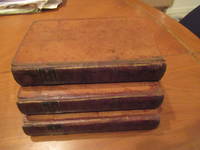
1789149720London: Printed for A. Strahan and T. Cadell in the Strand 1789-1793. Mixed early edition set of Adam Smith's magnum opus and cornerstone of economic thought. Octavo 3 volumes bound in one quarter modern calf over cloth-covered boards with gilt titles and five raised bands to the spine. Volumes I and III are seventh editions 1793 Vol. II is a fifth edition 1789. In near fine condition. An attractive set. Adam Smith's masterpiece first published in 1776 is the foundation of modern economic thought and remains the single most important account of the rise of and the principles behind modern capitalism. "The history of economic theory up to the end of the nineteenth century consists of two parts: the mercantilist phase which was based not so much on a doctrine as on a system of practice which grew out of social conditions; and the second phase which saw the development of the theory that the individual had the right to be unimpeded in the exercise of economic activity. While it cannot be said that Smith invented the latter theory.his work is the first major expression of it. He begins with the thought that labour is the source from which a nation derives what is necessary to it. The improvement of the division of labour is the measure of productivity and in it lies the human propensity to barter and exchange.Labour represents the three essential elements-wages profit and rent-and these three also constitute income. From the working of the economy Smith passes to its matter -'stock'- which encompasses all that man owns either for his own consumption or for the return which it brings him. The Wealth of Nations ends with a history of economic development a definitive onslaught on the mercantile system and some prophetic speculations on the limits of economic control.The Wealth of Nations is not a system but as a provisional analysis it is complete convincing. The certainty of its criticism and its grasp of human nature have made it the first and greatest classic of modern economic thought" PMM. Printed for A. Strahan and T. Cadell, in the Strand hardcover
179655618London: Printed for A. Strahan; T. Cadell jun. and W. Davis 1796. Eigth edition/ Seventh edition Vol.s 2 3. Hardcover. Fair to good condition. Octavo. x 499 vi 512 5 v. 465 50pp. Original brown leather marbled for vols. 2 and 3 with gilt lettering and ruling on spine Vol. 1 volumes two and three with gilt lettering on black and red labels of spine gilt ruling and tooling. <br /> <br /> Magnus opus of Scottish economist and philosopher Adam Smith reflecting on economics at the beginning of the industrial revolution. Contains index of fifty pages at rear of vol. 3. Smith was one of the commissioners of his Majesty's Customs in Scotland; and formerly Professor of Moral Philosophy in the University of Glasgow.<br /> <br /> Binding of volume one with wear along edges front joint cracked back joint partially cracked both holding together. Volumes two and three with light to medium wear along edges and three to four inches of front joints cracked. Binding of volume one rubbed some light damp-staining of first and last few pages. Front free endpapers of volume one with some staining. Initials and name inked to title page of all volumes name offsetting to facing page. Printed for A. Strahan; T. Cadell jun. and W. Davis hardcover
1791188047London: Printed for A. Strahan; and T. Cadell 1791. An appealing copy in tree calf Sixth edition of Smith's magnum opus and the first to be published after his death in 1790. "The first and greatest classic of modern economic thought" PMM first published in 1776 offers a persuasive manifesto for free markets and free trade. It is no exaggeration to say that all major economic works which followed were written to advance or challenge the principles of Smith. 3 vols octavo 208 x 129 mm pp. 2 x 499 1; 2 vi 518 6; 2 v 1 465 51: collates complete with initial blanks. Contemporary tree calf red morocco labels volume numbers in gilt to spines. Joints and extremities neatly restored a few marks to calf splash mark to volume I p. 19 scattered light foxing else clean and fresh. A very attractive copy. ESTC T95383; Goldsmiths' 14612; Kress B.2209; Tribe 41; Vanderblue p. 3. See Printing and the Mind of Man 221 first edition. unknown