Schmidt, Johann AdamBiblio.com
252 résultats
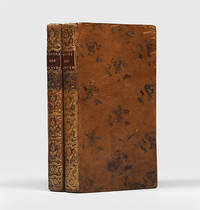
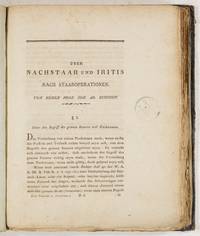
180048396ca. 1800. Abh. k.k. med.-chir. Josephs-Acad. 2. - Wien Bey Albert Camesina 1801 4° 16 435 1 Frontispice Pappband d.Zt.; St.a.Tit. u. Seitenränder; feies Expl. Frist Edition! "Inflammation of the iris was named iritis by Johann Adam Schmidt 1759-1809. In 1801 with Himly he founded the first journal devoted to ophthalmology the ophthalmolische Bibliothek." Further by Johann Adam Schmidt: Reflexionen über die Phänomene einer geschwächten Lebensthätigkeit bey lymphatischen Geschwülsten und über den grund der Tödlichkeit derselben pp.327-324. Ueber eine neue durch Verusche zuverlässig bestättigte Heilungsart der Augenliedlähmung und des Augenliedkrampfes pp.365-386. Garison & Morton No.5836 unknown
1787BOOKS236137London UK: Printed for Harrison and Co. printer unknown. FR/No Dustjacket. 1787. . Leather. Illustrated with numerous plates. . 8vo. 490pp. 96pp. As Is: front cover removed but present binding worn; wormholes at bottom front corners; bookplates on front cover & back of titlepage; occas. stains/foxing; owners signatures and notes in ink on back endpaper; some corners turned . Printed for Harrison and Co. (printer unknown) hardcover
17271510220001Amsterdam: Michel Charles Le Cene 1727-01-01. Hardcover. Very Good. Folio. 2 12 439 pp.; 2 pp. 445-808p pagination continuous 43 of 44 plates. 2 Volumes in One Bound in contemporary vellum. 7 raised bands. Leather spine label. Good binding and cover. Spine and hinges restored. Faint soiling to vellum. Pages tanned with a several pages with some offsetting and foxing. Lacks frontis and added title. All 27 plates & 16 maps are present. Brunet IV 178; Cordier Japonica 367-68; Cordier Sinaca 2077; Lust 342 <br><Br> Jean Albert Mandeslo set out in 1636 with the Embassy that the Duke of Holstein sent to Russia and Persia. He visited India Ceylon Madagascar West Africa Congo and returned four years later. His story gives a very vivid picture of luxury vices curiosity and absolute disregard for life under the despotic tyranny of the Moghul Empire under Shah Jahan. In the port of Surat he arrived in April 1638 after he went to Ahmedabad and Agra. Although his observations of life in the capital are useful he apparently did not hear anything about the Taj Mahal which at that time was in the sixth year of building. Amsterdam: Michel Charles Le Cene hardcover
17834143DB1783. 2 Teile in 1 Band von 2. Augsburg Wolf 1783. 4 Bl. 566 S. Mit zahlr. Textholzschnitten Moderner Halblederband. Nissen 1218. Äusserst erfolgreiches Destillier- und Kräuterbuch erschien erstmals 1557 in Frankfurt. Es fehlt der zoologische und der mineralogische Teil. Das Papier durchgehend stockfleckig. Das Titelblatt mit grösserem Titenfleck. unknown
17831277019Augsburg Bavaria Germany: Joseph Wolffischen 1783. Hardcover. Folio 750 pages 24 pages 136 pages. In Very Good condition. Bound in brown leather with blank paneled spine. Front board with metal corner pieces and metal diamond-shaped ornament to center of board. Remnants of clasps present: two metal hooks on fore edge of front board and two torn leather strips affixed to rear board. Boards moderately rubbed. Front free end paper partially detached. Title page shows 1.25 in-long area of damage to lower edge repaired but resulting in loss of publication information. Title page also shows small tear repaired to center of page minimally impacting legibility. Minor repairs to pages 165/166 571/572 633/634 649/650 687/688 701/702 705/706 719/720.<br> <br> Plates preface Parts Two and Three pp. 165 and 567 respectively. Profusely illustrated with over 800 black and white woodcut illustrations including genre scenes individual plants and animals and distilling apparatus. Shelved in Case 4. Adam Lonicer was a German botanist who studied at Marburg and the University of Mainz obtaining his Magister degree at sixteen years of age. After becoming a Doctor of Medicine in 1554 he became the town physician in Frankfurt am Main. His true interest though was herbs and the study of botany. His first important work on herbs the Kräuterbuch was published in 1557 with a large part dealing with distillation. He married Magdalena Egenolff the daughter of Christian Egenolff his Frankfurt publisher and a printer who specialized in herbals. The work that made his name famous is this popular herbal the Kräuterbuch. Lonicer provides us with one of the early descriptions of local flora as well as being one of the first to differentiate deciduous trees from conifers. <br> <br> Complete collation: page 110 misprinted as 100 160 as 142 217 as 21 271 as 217 523 as 532 524 as 534 554 as 454 732 as 571. Pagination consistent with this edition. 1277019. Shelved Dupont Bookstore. Joseph Wolffischen hardcover
173045983Edinburgh / London.: Printed for Adam Black and J. & J. Robertson . T. Underwood and J. Taylor &c. 1730. c.1730 - 1740 / 1762 / 1811. Contemporary calf-backed marbled paper boards later protective box. Large folio. 550 x 384 mm. Printed title two leaves with 'List of the Plans &c.' in double columns listing 160 plates and 180 engraved plates numbered 1 - 160 including the unnumbered plates 71 and 148 and 20 'bis' plates with duplicate numbers 20 double-page and one large folding plate on two sheets; plates mounted on paper tabs from sheets of the same work throughout the title and text leaves on wove paper with the watermark '1809' the plates on laid paper with the watermark 'LLAR' and a fleur-de-lys countermark and others as per RIBA the sheets retaining deckle edges throughout. Sheet size: c. 534 x 356 mm; double-page plates: c. 534 x 712 mm; title and text: 518 x 358 mm. An excellent unsophisticated copy of the notoriously rare Vitruvius Scoticus.What was to become William Adam's 1689 - 1748 magisterially-intentioned yet still mysterious Vitruvius Scoticus was first mentioned in a letter in 1726 and by late 1727 Adam was issuing subscription receipts for a book of 'My Designs for Buildings &c. in 150 Plates'. Initially proposed as a book in the manner of James Gibbs' 'Book of Architecture' 'the first book in England to be devoted entirely to the designs of a living architect' Adam intended clearly to rival Gibbs to publicise his own work and to seek promotion and patronage from the new King George II. By 1733 Adam had found an Edinburgh-based engraver suitable for the task and one who may have shouldered some of the cost in Richard Cooper a student of John 'Friar' Pine and 'an acknowledged teacher and connoisseur of the fine arts'. Indeed it may have been Cooper who was the first to suggest a generalisation of the work and the assumption of a distinct Scottish character with the new title Vitruvius Scoticus. Cooper worked solely from the limited resource of Adam's own designs and under the stricture that there would be no theoretical work in the publication and was therefore limited and slow in what he was able to achieve. It is clear that Cooper's engravings were finished by the early 1740s but the reasons the work was then abandoned - not for the last time - are rather less so.It has been suggested that William Adam hesitated to publish for a number of reasons: financial pressure and the inherent costs of paper printing and publication; the curtailment of opportunities for promotion and patronage; a conflict of copyright; the 1745 Jacobite rising; Adam's advancing age; and finally the possibility of unflattering comparisons to Colen Campbell's Vitruvius Britannicus. At William's death in 1748 his son John revised the project adding additional plates including several taken from designs by his brothers Robert and James and it seemed at least briefly that the book would finally appear. At the time of the crash of the Fairholme brothers' bank in 1764 all was in readiness but the added financial burden on all of the brothers led John to sell the publishing rights to the London-based Andrew Millar and his partner Thomas Cadell; they issued subscription proposals in 1766. The agreement between John and the Londoners stipulated that of the existing sheets adequate for 950 copies they would require material for 750 and would allow the remainder to be retained by John for the existing subscribers. No copies were issued - it has been suggested that the reason was related to copyright although Robert and James Adam's opposition to a family association with 'outmoded taste' has been offered as more compelling - and on Millar's retirement in 1767 the sheets were in storage where they remained for 40 years.In 1804 Thomas Cadell's son wrote to John Adam's son another William that he was no longer able to store the sheets but that a scrap-paper merchant had offered £100 for them. Cadell's advice was to accept and it has been assumed subsequently that William did not: a story likely to be apocryphal states that the unused sheets were returned to Edinburgh and stored in a garret at the Royal Infirmary. It seems rather likelier that William did accept the £100 for the paper and his ongoing negotiations to have Vitruvius Scoticus published in 1808 - 1810 involved only those sheets that remained in Scotland. That the eventual publisher Adam Black issued only 120 copies - a very small run for a book of more than limited appeal - supports very strongly the idea that the remaining sheets were pulped an idea that the present copy with the plates mounted on paper guards composed of sections of those same plates corroborates. The final word on the mystery and indeed on the publication belongs to Eileen Harris: 'It is ironical that to be commercially viable Vitruvius Scoticus clearly the grandest of any architectural book published in Scotland had to be sold in the end as a remainder … '.'A resounding silence greeted Adam Black's announcement in the 'Edinburgh Weekly Chronicle' on 29 May 1811 that 'Vitruvius Scoticus' was 'this day . completed in fifteen numbers'. Not only was William Adam's book Vitruvius Scoticus a century too late to have the bearing on Scottish architecture that its title promised; but with no preface explanatory text or date of publication it was silent also about itself about the intentions of its author and above all about its complicatred past.' Eileen Harris.'The best and most jinxed of all the great 18th century British architectural books William Adam's Vitruvius Scoticus was three times abandoned by successive generations of the Adam family before finally in 1811 a young Edinburgh bookseller named Adam Black . published an edition of 'only 120 complete sets' hastily assembled from sheets printed nearly 50 years before . Ill-planned and muddled as the book was from its inception it was a sad irony that Vitruvius Scoticus should end up as an obscure bookseller's remainder totally unremarked upon at the time and only quite recently recognised as the paramount source document for the history of classical architecture in Scotland.' Weinreb. 'We are left therefore with the virtually inescapable conclusion that a decision to publish 'Vitruvius Scoticus' was definitely made almost certainly in the early 1760s; that this decision was modified after the Fairholme crash to the extent that a London publisher agreed to buy the unsubscribed portion of the edition; and finally that the entire edition was deliberately withheld under the pretence that the work was undergoing revision by the engraver. Such an extraordinary fiasco might seem more far-fetched were it not possible to detect behind the scenes as it were the influence of Robert and James Adam's rising star south of the border where any publication connected with the family name might do more harm than good if it failed to evince the most advanced and novel taste of the day.' BAL RIBA.Of the utmost scarcity on the market we can trace very few copies at auction or in institutions and of those copies that can be traced many appear to be incomplete; it is worth noting that Weinreb priced the example in his catalogue 2 'Books and Drawings Before 1800' at £285 in contrast the 1485 first edition of Alberti's De Re Aedificatoria was £845 and in catalogue 58 'Fine Architectural Books Part 2' in 1988 at £28000.BAL RIBA 30 incomplete; Millard 3 disbound and mounted; Harris 8; Weinreb 2:4 & 58:1; see 'British Architectural Books and Writers 1556 - 1785' by Eileen Harris Cambridge 1990 pp. 94 - 104. Printed for Adam Black, and J. & J. Robertson ... T. Underwood, and J. Taylor &c. hardcover
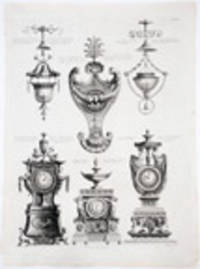
177517121London 1775. Engraving by P. Begbie. In excellent condition with the exception of being trimmed just outside the platemark on the left margin. An elegant engraving depicting various furnishings designed by Robert and James Adam including decorative clocks an ornamental knocker and two elaborate hanging lights.<br/> <br/> Robert and his brother James Adam forever changed the face of British architecture by introducing innovative Classical design ideas. From 1754-57 Robert lived in Italy where he had a long productive friendship with Piranesi which was inspirational for both men. Adam's first book on Diocletian's palace in Dalmatia is clearly very like the archaeological investigations Piranesi was making at the same time of similar ruins. Piranesi's friendship and passion for Roman Classicism were seminal influences on Adam and the greatest single factor other than his own talent in the work Adam produced on his return to England. Upon his return the brothers launched their career by building the Adelphi from the Thames to the Strand in London which although not a commercial success at the time included one of London's most cherished buildings the Adlephi Theatre. Together the Adam brothers designed and built some of the most famous buildings in England including such bastions of English architecture as Kenwood House Keddlestone Manor and Syon House. To the interiors of their English country houses the Adams brought wonderful ornamental elements in niches lunettes festoons and reliefs. Their classically designed buildings were so numerous in London that they changed the prevailing feel of the city and established their brand of neo-Classicism as the model of elegance and importance. It is asserted that the brothers originated the concept of the uniform facade attached to the typical English row house an architectural device that distinguishes London buildings. This monumental contribution is evidenced in the Adams' designs for Portland Place and Fitzroy Square and these were used as architectural models for the whole city. The brothers brought their talents into other areas by designing furniture to complement their beautiful interiors and by creating and publishing a treatise of design entitled 'Works in Architecture'. The work was published in three volumes over an extended span of time beginning in 1773 with the final volume being published posthumously in 1822.<br/> <br/> Cf. Brunet I.47; cf. Lowndes I p.8; DNB; Wilton-Ely The Mind and Art of Giovanni Battista Piranesi. unknown
177517574London 1775. Engraving by P. Begbie. In excellent condition with the exception of being trimmed just outside the platemark on the left margin. An elegant engraving depicting various furnishings designed by Robert and James Adam including decorative clocks an ornamental knocker and two elaborate hanging lights.<br/> <br/> Robert and his brother James Adam forever changed the face of British architecture by introducing innovative Classical design ideas. From 1754-57 Robert lived in Italy where he had a long productive friendship with Piranesi which was inspirational for both men. Adam's first book on Diocletian's palace in Dalmatia is clearly very like the archaeological investigations Piranesi was making at the same time of similar ruins. Piranesi's friendship and passion for Roman Classicism were seminal influences on Adam and the greatest single factor other than his own talent in the work Adam produced on his return to England. Upon his return the brothers launched their career by building the Adelphi from the Thames to the Strand in London which although not a commercial success at the time included one of London's most cherished buildings the Adlephi Theatre. Together the Adam brothers designed and built some of the most famous buildings in England including such bastions of English architecture as Kenwood House Keddlestone Manor and Syon House. To the interiors of their English country houses the Adams brought wonderful ornamental elements in niches lunettes festoons and reliefs. Their classically designed buildings were so numerous in London that they changed the prevailing feel of the city and established their brand of neo-Classicism as the model of elegance and importance. It is asserted that the brothers originated the concept of the uniform facade attached to the typical English row house an architectural device that distinguishes London buildings. This monumental contribution is evidenced in the Adams' designs for Portland Place and Fitzroy Square and these were used as architectural models for the whole city. The brothers brought their talents into other areas by designing furniture to complement their beautiful interiors and by creating and publishing a treatise of design entitled 'Works in Architecture'. The work was published in three volumes over an extended span of time beginning in 1773 with the final volume being published posthumously in 1822.<br/> <br/> Cf. Brunet I.47; cf. Lowndes I p.8; DNB; Wilton-Ely The Mind and Art of Giovanni Battista Piranesi. unknown
178956256Hamburg 1789. With four folding charts in vol. I. Pp.2 xxx 14 contents 578; xii 2 contents 556. 2 vols. 8vo. Contemporary quarter calf and boards. Rubbed. About very good. With four folding charts in vol. I. Pp.2 xxx 14 contents 578; xii 2 contents 556. 2 vols. 8vo. First and only edition of this important documentary source publishing letters and papers of Frederick IV of Denmark Queen Anna Sophia of Dänemark correspondence with the King of Prussia as well as texts concerning Copenhagen the judiciary police and city council changes in the Danish language etc.<br /> <br /> A further continuation volume appeared in 1790. unknown
179161368No place nor printer 1789 - 1791. 8vo. Uniformly bound in three contemporary full calf bindings with five raised bands and richly gilt spines. Light wear to extremities internally nice and clean. XII 2 556 pp.; XXXIV 4 526 pp.; 4 608 pp. <br/><br/><em>First edition complete with all three volumes of Gaspari’s political history of the Scandinavian countries. </em> hardcover
178618378Hamburg 1786-89 Volume 1 bound in cont. hcalf with gilt back top and bottom of spine taped and 2 fine cont. full calf richly gilt backs. XXX16678;XII2556;XXXIV526 pp. and folded tables. <br/><br/><em>Indeholder bl.a. "Ausführliche Cameralistisch=Ökonomische Beschreibung des Amtes Tondern" af D. Hemmings 192 pp. og "Für Island und des nördlichen Norwegen" pp. 332-379 som omhandler handelen og fiskeriet ved Hvidehavet og Finmarken etc. etc. </em> unknown
177860523Leipzig Weidmann 1776-78. 8vo. Bound in two nice uniform contemporary half calf bindings with five raised bands black title-label and gilt lettering to spine. Small paper-label to upper compartment Catalogue-number from an estate-library. Light wear to extremities otherwise a very nice set. VIII 632 pp; XII 740 pp. <br/><br/><em>First German edition also being the very first overall translation of Adam Smith's ground-breaking main work the "Inquiry into the Nature and Causes of the Wealth of Nations". This seminal first translation of the work was undertaken by J.F. Schiller who finished the first part of the translation in time for it to appear as soon as 1776 the same year as the original English edition. The second part appeared in 1778 the same year as the exceedingly scarce first French translation. This first German translation has been of the utmost importance to the spreading of Smith's ideas throughout Europe and after the true first this must count as the most important edition of the work."The influence of the Wealth of Nations . in Germany . was so great that 'the whole of political economy might be divided into two parts - before and since Adam Smith; the first part being a prelude and the second a sequel." Backhouse Roger E. The Methodology of Economics: Nineteenth-Century British Contributions Routledge 1997."The first review of the translation which appeared in the Göttingische gelehrte Anzeigen for March 10 1777 by J. G. H. Feder professor of Philosophy at the University of Göttingen was very favorable. In the words of the reviewer: "It is a classic; very estimable both for its thorough not too limited often far-sighted political philosophy and for the numerous frequently discursive historical notes" but the exposition suffers from too much repetition." Lai Cheng-chung. Adam Smith Across Nations: Translations and Receptions of The Wealth of Nations Clarendon Press UK 2000.Until 1797 . the work of Adam Smith received scant attention in Germany. While Frederick II was living Cameralism held undisputed sway in Prussia and the economic change which began with the outbreak of the French Revolution had still not gained sufficient momentum to awake the economic theorists from their dogmatic slumber." Lai Cheng-chung. Adam Smith Across Nations: Translations and Receptions of The Wealth of Nations Clarendon Press UK 2000.Various German economist read the german translations and was inspired by it."Christian Garve . must be considered as among the important contributors to the spread of Smith's views. Himself a popularizer of philosophical doctrines he was early attracted by the Scotch writers and became one of their foremost exponents in Germany." In 1791 Garve began a second translation of the Smith's work and in the introduction to the the translation he wrote: "It Smith's work attracted me as only few books have in the course of my studies through the number of new views which it gave me not only concerning the actual abject of his investigations but concerning all related material from the philosophy of civil and social life". Georg Sartorius August Ferdinand Lueder and perhaps the most important economist of the period Christian Jacob Kraus were all important figures in the spread of Smith's thought. "The most significant of Kraus' works and that also which shows his conception of economic science most clearly is the five-volume work entitled State Economy. The first four volumes of this work are little more than a free paraphrase of the Wealth of Nations". Kraus was: "to a large extent responsible for the economic changes which took place in Prussia after 1807 in so far as they can be ascribed to Smithan influence." Lai Cheng-chung. Adam Smith Across Nations: Translations and Receptions of The Wealth of Nations Clarendon Press UK 2000.Kraus wrote of the present volume: "The world has seen no more important book than that of Adam Smith. Certainly since the times of the New Testament no writing has had more beneficial results than this will have. Smith's doctrines form the only true great beautiful just and beneficial system." Fleischacker Samuel A Third Concept of Liberty Princeton University Press 1999._____________Hailed as the "first and greatest classic of modern thought" PMM 221 Adam Smith's tremendously influential main work has had a profound impact on thought and politics and is considered the main foundation of the era of liberal free trade that dominated the nineteenth century. Adam Smith 1723-1790 is considered the founder of Political Economy in Britain mainly due to his groundbreaking work the "Wealth of Nations" from 1776. The work took him 12 years to write and was probably in contemplation 12 years before that. It was originally published in two volumes in 4to and was published later the same year in Dublin in three volumes in 8vo. The book sold well and the first edition the number of which is unknown sold out within six months which came as a surprise to the publisher and probably also to Smith himself partly because the work "requires much thought and reflection qualities that do not abound among modern readers to peruse to any purpose." Letter from David Hume In: Rae Life of Adam Smith 1895 p. 286 partly because it was hardly reviewed or noticed by magazines or annuals. In spite of this it did evoke immense interest in the learned and the political world and Buckle's words that the work is "in its ultimate results probably the most important book that has ever been written" and that it has "done more towards the happiness of man than has been effected by the united abilities of all the statesmen and legislators of whom history has preserved an authentic account" History of Civilisation 1869 I:214 well describes the opinion of a great part of important thinkers then as well as now. Kress S. 2567Goldsmith 11394Menger 521Not in Einaudi </em> hardcover
1794177518Breslau: Wilhelm Gottlieb Korn 1794-96. The Wealth of Nations in the German Enlightenment First edition of the German translation by Garve 1742-1798 the second overall after Schiller's edition of 1776-8. Of the two this second was arguably the more influential in disseminating Smithian economics throughout the German-speaking world as it built on a wider overall familiarity with Scottish philosophy. Garve was a prominent Enlightenment philosopher in his own right and a respected opponent of Kant. 4 vols bound in 2 octavo 204 x 119 mm. Tables in the text woodcut headpieces. Contemporary half sheep spines ruled and lettered in gilt and with yellow morocco labels marbled sides and pastedowns edges green. Light wear to extremities minor browning and foxing short tear to head of spine of first volume contents otherwise clean: a very good copy. Tribe 52. Vanderblue p. 26. Kenneth E. Carpenter: Dialogue in Political Economy 1977 p. 46. unknown
177648982Leipzig Weidmann 1776-78. 8vo. Bound in two nice uniform contemporary half calf bindings with five raised bands and gilt lettering to spine. Ex-libris pasted on to pasted down front free end-papers and a small embossed stamp to front free end paper on volume 1 "Buchhändler u. Antiquar Carl Helf". Stamp to p. 1 of both volumes. Spines with light soiling and capital on volume 1 lacking a small part of the leather. A few light brown spots throught. A fine set. VIII 632 pp; XII 740 pp. <br/><br/><em>First German edition also being the very first overall translation of Adam Smith's ground-breaking main work the "Inquiry into the Nature and Causes of the Wealth of Nations". This seminal first translation of the work was undertaken by J.F. Schiller who finished the first part of the translation in time for it to appear as soon as 1776 the same year as the original English edition. The second part appeared in 1778 the same year as the exceedingly scarce first French translation. This first German translation has been of the utmost importance to the spreading of Smith's ideas throughout Europe and after the true first this must count as the most important edition of the work."The influence of the Wealth of Nations . in Germany . was so great that 'the whole of political economy might be divided into two parts - before and since Adam Smith; the first part being a prelude and the second a sequel." Backhouse Roger E. The Methodology of Economics: Nineteenth-Century British Contributions Routledge 1997."The first review of the translation which appeared in the Göttingische gelehrte Anzeigen for March 10 1777 by J. G. H. Feder professor of Philosophy at the University of Göttingen was very favorable. In the words of the reviewer: "It is a classic; very estimable both for its thorough not too limited often far-sighted political philosophy and for the numerous frequently discursive historical notes" but the exposition suffers from too much repetition." Lai Cheng-chung. Adam Smith Across Nations: Translations and Receptions of The Wealth of Nations Clarendon Press UK 2000.Until 1797 . the work of Adam Smith received scant attention in Germany. While Frederick II was living Cameralism held undisputed sway in Prussia and the economic change which began with the outbreak of the French Revolution had still not gained sufficient momentum to awake the economic theorists from their dogmatic slumber." Lai Cheng-chung. Adam Smith Across Nations: Translations and Receptions of The Wealth of Nations Clarendon Press UK 2000.Various German economist read the german translations and was inspired by it."Christian Garve . must be considered as among the important contributors to the spread of Smith's views. Himself a popularizer of philosophical doctrines he was early attracted by the Scotch writers and became one of their foremost exponents in Germany." In 1791 Garve began a second translation of the Smith's work and in the introduction to the the translation he wrote: "It Smith's work attracted me as only few books have in the course of my studies through the number of new views which it gave me not only concerning the actual abject of his investigations but concerning all related material from the philosophy of civil and social life". Georg Sartorius August Ferdinand Lueder and perhaps the most important economist of the period Christian Jacob Kraus were all important figures in the spread of Smith's thought. "The most significant of Kraus' works and that also which shows his conception of economic science most clearly is the five-volume work entitled State Economy. The first four volumes of this work are little more than a free paraphrase of the Wealth of Nations". Kraus was: "to a large extent responsible for the economic changes which took place in Prussia after 1807 in so far as they can be ascribed to Smithan influence." Lai Cheng-chung. Adam Smith Across Nations: Translations and Receptions of The Wealth of Nations Clarendon Press UK 2000.Kraus wrote of the present volume: "The world has seen no more important book than that of Adam Smith. Certainly since the times of the New Testament no writing has had more beneficial results than this will have. Smith's doctrines form the only true great beautiful just and beneficial system." Fleischacker Samuel A Third Concept of Liberty Princeton University Press 1999._____________Hailed as the "first and greatest classic of modern thought" PMM 221 Adam Smith's tremendously influential main work has had a profound impact on thought and politics and is considered the main foundation of the era of liberal free trade that dominated the nineteenth century. Adam Smith 1723-1790 is considered the founder of Political Economy in Britain mainly due to his groundbreaking work the "Wealth of Nations" from 1776. The work took him 12 years to write and was probably in contemplation 12 years before that. It was originally published in two volumes in 4to and was published later the same year in Dublin in three volumes in 8vo. The book sold well and the first edition the number of which is unknown sold out within six months which came as a surprise to the publisher and probably also to Smith himself partly because the work "requires much thought and reflection qualities that do not abound among modern readers to peruse to any purpose." Letter from David Hume In: Rae Life of Adam Smith 1895 p. 286 partly because it was hardly reviewed or noticed by magazines or annuals. In spite of this it did evoke immense interest in the learned and the political world and Buckle's words that the work is "in its ultimate results probably the most important book that has ever been written" and that it has "done more towards the happiness of man than has been effected by the united abilities of all the statesmen and legislators of whom history has preserved an authentic account" History of Civilisation 1869 I:214 well describes the opinion of a great part of important thinkers then as well as now. Kress S. 2567Goldsmith 11394Menger 521Not in Einaudi </em> hardcover
1799216336Frankfurt und Leipzig 1799. Hardcover kartoniert Zustand: Exemplar einer Privatbibliothek mit Kennungen. Keine Beschädigungen keine Eintragungen. Rücken Ecken Kanten leicht berieben/bestoßen. Frankfurt und Leipzig, hardcover
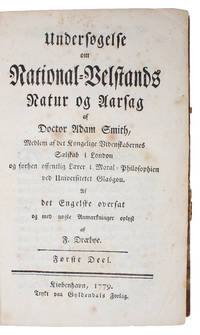
1779158759Copenhagen: Gyldendal 1779-80. Adam Smith in Danish First edition in Danish of The Wealth of Nations translated from the first edition of 1776 by Frants Draebye published together with a translation of Thomas Pownall's critical Letter. to Adam Smith of the same year. Draebye had been in England in 1776 as part of his role of tutor on a continental tour to two sons of a Norwegian merchant James Collett. Smith acknowledged the translation in two letters of 1780 the first written to Andreas Holt Commissioner of the Danish Board of Trade and Economy to whom he wrote "it gives me great pleasure to hear that Mr Dreby has done me the distinguished honour of translating my book into the Danish language." the second to Peter Anker Consul General of Denmark in Great Britain sending him three copies of the second edition of 1778 and asking him to forward them to Draebye and Holt. 2 vols octavo 192 x 114 mm pp. xii 575 1; viii 775 3. Contemporary sprinkled sheep spines decorated in gilt between five raised bands yellow paper labels lettered in gilt marbled paper pastedowns red edges. Joints of vol. I strengthened head and tail of both vols repaired gilt decoration to vol. II largely eroded; marginal tear to one leaf occasional light spotting; a very good set. Tribe 19: Vanderblue p. 23. Mossner & Ross The Correspondence of Adam Smith 1987. hardcover
177947455Kiøbenhavn Copenhagen 1779-80. 8vo. Two very nice contemporary brown half calf bindings with raised bands gilt ornamentations and gilt leather title- and tome-labels. Volume two with a bit of wear to upper capital. Corners slightly bumped. Pencil annotations to verso of title-page in volume one; title-page in volume two mounted to cover up a small hole caused by the removal of an old owner's name. Internally very clean and bright. All in all a very nice clean fresh and tight copy. Engraved by Weise 1784 armorial book plate to inside of front boards Gregorius Christianus Comes ab Haxthausen. 12 575; 8 775 3 - errata pp. <br/><br/><em>The extremely scarce first Danish edition of Adam Smith's seminal main work "the first and greatest classic of modern economic thought" PMM 221 the main foundational work of the era of liberal free trade. This publication constitutes the first Danish work worth mentioning in the history of economic thought - in spite of the great interest in political economy that dominated Danish political thought in the last quarter of the 18th century. The value of Smith's work was not immediately recognized in Denmark at the time of its appearance and a quarter of a century had to go by for its importance to be acknowledged and for Danish political economy to adapt the revolutionizing theories of Adam Smith. Few copies of the translation were published and sold and the book is now a great scarcity. As opposed to for instance the German translation of the work Smith concerned himself a great deal with this Danish translation. As is evident from preserved correspondence about it he reacted passionately to it and was deeply concerned with the reaction to his work in Scandinavia see "Correspondence of Adam Smith" Oxford University Press 1977.- As an example Smith writes in a letter to Andreas Holt on Oct. 26th 1780: "It gives me the greatest pleasure to hear that Mr. Dreby has done me the distinguished honour of translating my Book into the Danish language. I beg you will present to him my most sincere thanks and most respectful Compliments. I am much concerned that I cannot have the pleasure of reading it in his translation as I am so unfortunate as not to understand the Danish language." The translation was made by Frants Dræby 1740-1814 the son a whiskey distiller in Copenhagen who mastered as a theologian and was then hired by the great Norwegian merchant James Collett as tutor to his son. There can be no doubt that Dræbye's relation to the Collett house had a great impact upon his interest in economics. In the middle of the 1770'ies Dræbye accompanied Collett's son on travels throughout Europe which took them to England in the year 1776 the same year that the "Wealth of Nations" was published for the first time. Through the Colletts Dræbye was introduced to the mercantile environment in England and here became thoroughly acquainted with English economics and politics at the time. It is presumably here that he gets acquainted with Adam Smith's freshly published revolutionary work. When Dræbye returned to Denmark at the end of 1776 he was appointed chief of the Norwegian secretariat of the Board of Economics and Trade. He began the translation of the "Wealth of Nations" that he brought back with him from England immediately after his return."WN i.e. Wealth of Nations was translated into Danish by Frants Dræbye and published in 1779 three years after the first English edition. The translation was initiated by Andreas Holt and Peter Anker who were acquainted with Smith. Dræbye was a Dane who lived mainly in Norway reflecting the fact that Norway was much more British-oriented than Denmark proper Denmark and Norway were united until 1814 when Sweden took Norway away from the Danes; in 1905 Norway became an independent state. Norwegian merchants lived from exporting timber to Britain and tended on the whole to be adherents of a liberal economic policy whereas the absolutist government in Copenhagen was more German-oriented and had economic views similar to those in contemporary Prussia." Cheng-chung Lai edt.: "Adam Smith Across Nations" p. 37. The last quarter of the eighteenth century in Denmark was dominated by a lively discussion of monetary policy and the institutional framework best suited to realize that policy. There was a vital interest in questions of economic concern and contemporary Danish sources refer to the period as "this economic age" and state things such as "never was the world more economically minded" both from "Denmark and Norway's Economic Magazine". During this period Smith's revolutionary ideas did not play a major role however and only at the beginning of the 19th century did Danish politicians and economists come to realize the meaning of Smith's views. "Without exaggeration it can essentially be said that a quarter of a century was to pass from the time of the publication of the book in Denmark before Danish political economy fully made Adam Smith's theories and points of view its own. It took so long a time because the economic conditions as a whole in the years from 1780-1800 did not make desirable or necessary the changing of their concepts. That glorious commercial period had to pass before it was understood that we had altogether too little help in our own natural resources and that a different course was therefore necessary. Only when one had come so far could the new thinking find a nourishing soil so that it could develop strength with which to push aside the old ideas."Hans Degen: "On the Danish Translation of Adam Smith and Contemporary Opinion Concerning It." Translated by Henrietta M. Larson. In: Adam Smith Across Nations p. 51. This first Danish translation is one of the very earliest translations of "Wealth of Nations"; it is only preceded by the German 1776-78 and the extremely scarce French 1778-79. As a comparison the Italian translation does not appear until 1790-91 the Spanish 1792 the Swedish 1800-1804 the Russian 1802 etc.Adam Smith Across Nations: A4 - nr. 1. "All five books were translated; appears to be a complete translation. The long letter from Governor Pownall to Adam Smith 25 Sept. 1776 is added as the Appendix vol. 2 pp. 683 ff."PMM 221 - first edition </em> hardcover
177950523Kiøbenhavn Copenhagen 1779-80. 8vo. Two nice contemporary half calf bindings with four raised bands and gilt leather title label to spines. Volume one lacking one cm of upper part of spine. Volume two with a small tear to lower part of spine. Both volumes with light brown spotting throughout however mainly affecting first and last five leaves of both volumes. A fine set. 12 575; 8 775 3 - errata pp. <br/><br/><em>The extremely scarce first Danish edition of Adam Smith's seminal main work "the first and greatest classic of modern economic thought" PMM 221 the main foundational work of the era of liberal free trade. This publication constitutes the first Danish work worth mentioning in the history of economic thought - in spite of the great interest in political economy that dominated Danish political thought in the last quarter of the 18th century. The value of Smith's work was not immediately recognized in Denmark at the time of its appearance and a quarter of a century had to go by for its importance to be acknowledged and for Danish political economy to adapt the revolutionizing theories of Adam Smith. Few copies of the translation were published and sold and the book is now a great scarcity. As opposed to for instance the German translation of the work Smith concerned himself a great deal with this Danish translation. As is evident from preserved correspondence about it he reacted passionately to it and was deeply concerned with the reaction to his work in Scandinavia see "Correspondence of Adam Smith" Oxford University Press 1977.- As an example Smith writes in a letter to Andreas Holt on Oct. 26th 1780: "It gives me the greatest pleasure to hear that Mr. Dreby has done me the distinguished honour of translating my Book into the Danish language. I beg you will present to him my most sincere thanks and most respectful Compliments. I am much concerned that I cannot have the pleasure of reading it in his translation as I am so unfortunate as not to understand the Danish language." The translation was made by Frants Dræby 1740-1814 the son a whiskey distiller in Copenhagen who mastered as a theologian and was then hired by the great Norwegian merchant James Collett as tutor to his son. There can be no doubt that Dræbye's relation to the Collett house had a great impact upon his interest in economics. In the middle of the 1770'ies Dræbye accompanied Collett's son on travels throughout Europe which took them to England in the year 1776 the same year that the "Wealth of Nations" was published for the first time. Through the Colletts Dræbye was introduced to the mercantile environment in England and here became thoroughly acquainted with English economics and politics at the time. It is presumably here that he gets acquainted with Adam Smith's freshly published revolutionary work. When Dræbye returned to Denmark at the end of 1776 he was appointed chief of the Norwegian secretariat of the Board of Economics and Trade. He began the translation of the "Wealth of Nations" that he brought back with him from England immediately after his return."WN i.e. Wealth of Nations was translated into Danish by Frants Dræbye and published in 1779 three years after the first English edition. The translation was initiated by Andreas Holt and Peter Anker who were acquainted with Smith. Dræbye was a Dane who lived mainly in Norway reflecting the fact that Norway was much more British-oriented than Denmark proper Denmark and Norway were united until 1814 when Sweden took Norway away from the Danes; in 1905 Norway became an independent state. Norwegian merchants lived from exporting timber to Britain and tended on the whole to be adherents of a liberal economic policy whereas the absolutist government in Copenhagen was more German-oriented and had economic views similar to those in contemporary Prussia." Cheng-chung Lai edt.: "Adam Smith Across Nations" p. 37. The last quarter of the eighteenth century in Denmark was dominated by a lively discussion of monetary policy and the institutional framework best suited to realize that policy. There was a vital interest in questions of economic concern and contemporary Danish sources refer to the period as "this economic age" and state things such as "never was the world more economically minded" both from "Denmark and Norway's Economic Magazine". During this period Smith's revolutionary ideas did not play a major role however and only at the beginning of the 19th century did Danish politicians and economists come to realize the meaning of Smith's views. "Without exaggeration it can essentially be said that a quarter of a century was to pass from the time of the publication of the book in Denmark before Danish political economy fully made Adam Smith's theories and points of view its own. It took so long a time because the economic conditions as a whole in the years from 1780-1800 did not make desirable or necessary the changing of their concepts. That glorious commercial period had to pass before it was understood that we had altogether too little help in our own natural resources and that a different course was therefore necessary. Only when one had come so far could the new thinking find a nourishing soil so that it could develop strength with which to push aside the old ideas."Hans Degen: "On the Danish Translation of Adam Smith and Contemporary Opinion Concerning It." Translated by Henrietta M. Larson. In: Adam Smith Across Nations p. 51. This first Danish translation is one of the very earliest translations of "Wealth of Nations"; it is only preceded by the German 1776-78 and the extremely scarce French 1778-79. As a comparison the Italian translation does not appear until 1790-91 the Spanish 1792 the Swedish 1800-1804 the Russian 1802 etc.Adam Smith Across Nations: A4 - nr. 1. "All five books were translated; appears to be a complete translation. The long letter from Governor Pownall to Adam Smith 25 Sept. 1776 is added as the Appendix vol. 2 pp. 683 ff." </em> hardcover
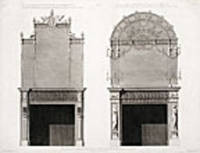
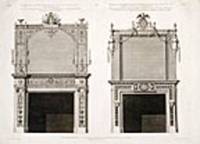
177517123London 1775. Engraving by Joshua Record. In excellent condition. An elegant engraving showing the two chimneys in Lord Derby's house in Grosvenor Square London.<br/> <br/> Robert and his brother James Adam forever changed the face of British architecture by introducing innovative Classical design ideas. From 1754-57 Robert lived in Italy where he had a long productive friendship with Piranesi which was inspirational for both men. Adam's first book on Diocletian's palace in Dalmatia is clearly very like the archaeological investigations Piranesi was making at the same time of similar ruins. Piranesi's friendship and passion for Roman Classicism were seminal influences on Adam and the greatest single factor other than his own talent in the work Adam produced on his return to England. Upon his return the brothers launched their career by building the Adelphi from the Thames to the Strand in London which although not a commercial success at the time included one of London's most cherished buildings the Adlephi Theatre. Together the Adam brothers designed and built some of the most famous buildings in England including such bastions of English architecture as Kenwood House Keddlestone Manor and Syon House. To the interiors of their English country houses the Adams brought wonderful ornamental elements in niches lunettes festoons and reliefs. Their classically designed buildings were so numerous in London that they changed the prevailing feel of the city and established their brand of neo-Classicism as the model of elegance and importance. It is asserted that the brothers originated the concept of the uniform facade attached to the typical English row house an architectural device that distinguishes London buildings. This monumental contribution is evidenced in the Adams' designs for Portland Place and Fitzroy Square and these were used as architectural models for the whole city. The brothers brought their talents into other areas by designing furniture to complement their beautiful interiors and by creating and publishing a treatise of design entitled 'Works in Architecture'. The work was published in three volumes over an extended span of time beginning in 1773 with the final volume being published posthumously in 1822.<br/> <br/> Cf. Brunet I.47; cf. Lowndes I p.8;DNB; Wilton-Ely The Mind and Art of Giovanni Battista Piranesi. unknown
177717125London 1777. Engraving by J. Zucchi. In excellent condition. An elegant engraving depicting two chimneys in Lord Derby's celebrated house in Grosvenor Square London.<br/> <br/> Robert and his brother James Adam forever changed the face of British architecture by introducing innovative Classical design ideas. From 1754-57 Robert lived in Italy where he had a long productive friendship with Piranesi which was inspirational for both men. Adam's first book on Diocletian's palace in Dalmatia is clearly very like the archaeological investigations Piranesi was making at the same time of similar ruins. Piranesi's friendship and passion for Roman Classicism were seminal influences on Adam and the greatest single factor other than his own talent in the work Adam produced on his return to England. Upon his return the brothers launched their career by building the Adelphi from the Thames to the Strand in London which although not a commercial success at the time included one of London's most cherished buildings the Adlephi Theatre. Together the Adam brothers designed and built some of the most famous buildings in England including such bastions of English architecture as Kenwood House Keddlestone Manor and Syon House. To the interiors of their English country houses the Adams brought wonderful ornamental elements in niches lunettes festoons and reliefs. Their classically designed buildings were so numerous in London that they changed the prevailing feel of the city and established their brand of neo-Classicism as the model of elegance and importance. It is asserted that the brothers originated the concept of the uniform facade attached to the typical English row house an architectural device that distinguishes London buildings. This monumental contribution is evidenced in the Adams' designs for Portland Place and Fitzroy Square and these were used as architectural models for the whole city. The brothers brought their talents into other areas by designing furniture to complement their beautiful interiors and by creating and publishing a treatise of design entitled 'Works in Architecture'. The work was published in three volumes over an extended span of time beginning in 1773 with the final volume being published posthumously in 1822.<br/> <br/> Cf. Brunet I.47; cf. Lowndes I p.8; DNB; Wilton-Ely The Mind and Art of Giovanni Battista Piranesi. unknown
1782143496London: Printed for J. Murray 1782. First edition of this anonymously published epistolary account in 72 letters written during the course of a trip to India dealing largely with the government and economies of the East Indies and with notes on Adam Smith's Wealth of Nations. At the Cape of Good Hope in April 1799 one Daniel Barwell lent the author his copy of Adam Smith's Wealth of Nations - 'a work of great labour and ingenuity; I had heard of it and anxiously desired to see it because it treated of such commercial and political matters as have long furnished a subject of speculation in my solitude. It is a performance that every statesman and legislator should study and digest. - Yet I have presumed to differ in opinion in a few instances from that great source of knowledge' I 206-7. The 'Observations' written 'on a cursory reading' of Smith are provided in an lengthy two-column appendix in volume II pp. 432-479 which juxtaposes quotations with insightful commentary especially on the relationship of labour and value and real and nominal prices. Macintosh presented a copy of his Travels to Smith 'With Mr. MacIntosh's compliments. Mr. M - having been abroad when these letters were printed had not an opportunity of transmiting sic them in manuscripts'. The Travels' authorship although attributed by DNB Halkett & Laing Kress and Allibone to William Thomson 1746-1817 who was a clergyman in Perthshire until October 1778 and whose role was most probably editorial has also been credited to the Irish-born British politician and pamphleteer Sir Philip Francis 1740-1818 who was also the chief antagonist of the first Governor-General of Bengal Warren Hastings. It is however generally accepted as being William MacIntosh's: "the author was given out to be one Macintosh whose name occurs in Philip Francis's Indian journal. But it runs so minutely into defence of Francis and vituperation of his enemies especially of Hastings. that some assigned the authorship of these portions of it to Francis in person" Parkes. In his Memoirs of Sir Philip Francis 1867 Parkes notes "some people indeed denied the existence of Macintosh altogether. But one of Captain Price's grotesque pamphlets describes him as 'a swarthy and ill-looking man'. of colour born in the West Indies" p. 206. These Travels were translated into German Des Herrn Macintosh's Reisen in 1785 and twice so in French: 1786 and 1792. This copy has the crested bookplate of the banker Thomas Coutts "Strand London" one of the wealthiest men in Britain to the front pastedowns transposed over from an earlier binding. 2 vols octavo 211 x 126 mm. Recent quarter calf red and green morocco labels marbled sides vellum tips. Bindings fine interior remarkably clean and fresh occasionally foxed; a very good copy. ESTC T97734; Goldsmiths' 12256; Kress B.523; Mizuta "Adam Smith's Library" 1660; Joseph Parkes "Memoirs of Sir Philip Francis K.C.B." vol. 2 pp. 205-6; Sowerby E.M. Catalogue of the Library of Thomas Jefferson 3934; Zachs 314; not in Vanderblue. hardcover
17337893CB1733. Paris Chéz la Veuve Saugrain & P. Prault 1733. 8°. 462 10 S. Pappband der Zeit. Barth 23956. Haller VI 1807. HBLS VII 286 für die Erstausgabe und für den Verfasser. Zweite Ausgabe erschien erstmals 1731. Franz Adam Vogel 1749 war Grossrichter der Schweizergarde in Paris. Seine erste Ausgabe von 1731 war in Frankreich verboten. Vorliegende Ausgabe gemäss Haller nicht in Paris sondern in Bern «gesondert» verlegt «und auch mit den Bündnissen selbst abgedruckt worden». Das Papier durchgehend stockfleckig. Der Einband berieben und bestossen. unknown
1789283741789. A Reims chez Jeunehomme PÂre et Fils 1789 - A Paris chez Allut 1806. 2 ouvrages reliÂŽs en un fort vol. au format in-8 203 x 128 mm de 1 f. bl. 7 ff. n.fol. et 251 pp. ; xiv - 304 pp. Reliure XIXÂme de demi-chagrin maroquinÂŽ violine dos lisse ornÂŽ de filets gras en noir doubles filets maigres dorÂŽs titre dorÂŽ tranches mouchetÂŽes. Deux ouvrages reliÂŽs en un volume le second est ici amputÂŽ de son deuxiÂme tome. Edition originale pour le premier ; imprimÂŽ ˆ Reims. ''Je n'ai eu d'autre objet en composant cet ÂŽcrit que de substituer une vÂŽritÂŽ prÂŽcieuse ˆ une erreur funeste. Car l'inoculation a toujours beaucoup de sectateurs et d'ennemis mais ne cesserai de dire que ses bienfaits en sont certains.'' LÂŽgÂres altÂŽrations superficielles affectant la reliure. Claires rousseurs dans le corps d'ouvrage du second volume. Du reste belle condition. Rare. b42961 unknown
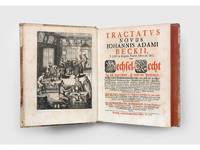
1729173121Nuremberg: Johann Georg Lochner 1729. Currency conversion First edition of this manual of the law and practice of currency exchange in the Holy Roman Empire including a striking frontispiece showing a busy exchange office overseen by Mercury the patron of trade. It covers promissory note and bills of exchange and demonstrates the strictness of imperial exchange law. Quarto 208 x 166 mm pp. 8 512. Engraved frontispiece folding table title page printed in red and black. Contemporary half vellum and marbled boards spine lettered in gilt red edges. Very slight soiling and rubbing to binding light browning and foxing to contents. A very good copy. hardcover
1774146600Paris: Chez Valade 1774-75. First edition of the second French translation of Scottish moral philosopher and economist Adam Smith's ground-breaking first work The Theory of Moral Sentiments London 1759 in an attractive contemporary binding. This work introduced the concept of the "invisible hand" guiding individuals to advance community interest laying the philosophical ground work for his Wealth of Nations. Smith evidently dissatisfied in the quality of the first French translation Metaphysique de l'ame Paris 1764 made by Marc-Antoine Eidous and based on the second English edition is reported by the translator of this edition as having been "mortified" by the first attempt. Jean-Louis Blavet 1719-1809 translator and librarian of the Prince de Conti was recommended to Smith by Madame des Boufflers the Prince's mistress and duly undertook this entirely new translation from the third English edition of 1767 adding an extensive table of contents. The work was far from a commercial success which according to Dugald Stewart Smith blamed on Blavet leading to the eventual commission of a third French translation by Sophie de Grouchy the prominent salon hostess during the early French Revolution and under Napoleon and was the wife of the philosopher the Marquis de Condorcet. 2 vols duodecimo 168 x 97 mm. Contemporary cat's paw calf titles in gilt to red morocco spine labels floral motifs tooled in gilt direct to spine French curl marbled endpapers blued mottled edges. A hint of wear to extremities the bindings otherwise firm and unrestored very occasional faint damp staining else internally fresh; a very good set indeed. Tribe 7; Vanderblue p. 41. unknown