252 résultats
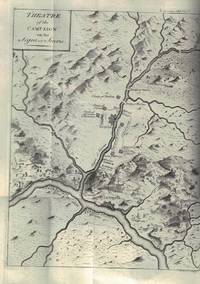
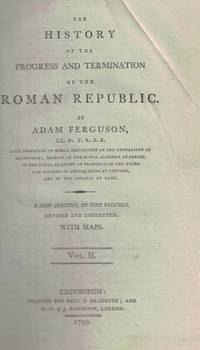
1799241669Bell & Bradfute 1799. Hardcover. Very Good. Five volumes small 8vo original or contemporary full calf red leather spines with gilt titles and devices six folding maps Very Good: rubbing at the corners spine ends and gutters; bindings tight and firm text blocks mildly toned with minimal offsetting. Bell & Bradfute hardcover
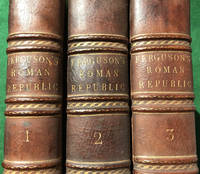
178358904<p>FINE COPY IN A CONTEMPORARY BINDING - PROBABLY BY HENRY WALTHER</p><p>first edition 3 vols. large 4to. 28.3 x 23.5 cms. 12 461 1 blank; 4 548; 8 574pp. 6 engraved maps 4 folding contemporary rich tan lightly-diced russia calf over thick boards gilt fillet border on sides spines panelled by double gilt bands highlighted by gilt fillets and with a twisted gilt roll between them one panel with a dark brown morocco title label and another direct gilt numbered deep turn-ins on the doublures decoratively gilt rolled board edges with a double gilt line and twining frond gilt roll marbled endpapers edges dyed yellow minor paper flaw in the lower marginal corner of vol. 3 L4 slight rubbing to joints and a circa 6 cm. crack at foot of joints of vol. I a few minor scuffs at spine ends else a remarkably well preserved and internally fresh copy.</p><p>Ferguson 1723-1816 Professor at Edinburgh first of Natural Philosophy and later of Moral Philosophy was a significant member of the important eighteenth century Scottish school of enlightenment philosophers. He was a friend of such as David Hume Adam Smith Dugald Stewart and Black.<br />Ferguson's 'An Essay on the History of Civil Society' 1767 established his "reputation as a British and a European historian with a Scottish edge. It enabled him to deal with questions which concerned Enlightenment thinkers throughout Europe: the nature of political society differences between nations reflecting temporal and geographical variations patterns of progress and decline types of government and the tension between the 'private' man involved in commerce and polite conversation and 'public' man the politically active citizen. It made its author famous throughout Europe" O.D.N.B.<br />His "'History of the Progress and Termination of the Roman Republic' narrating the rise and fall of the republic as a story of civic virtue and its corruption appeared in 1783 . It won praise from Edward Gibbon and went through two more English-language editions in 1799 and 1813. In the mid-nineteenth century it was still favourably mentioned by John Stuart Mill and reissued in the United States where Ferguson's spirited discussion of Rome's republican heyday appealed to two generations of readers. Two French translations appeared in Paris in 1784–91 and in 1803–10. A German translation appeared in Leipzig in 1784–6. . Although the fame of his Roman Republic was short-lived . it did more than any of Ferguson's books to determine its author's image as latter-day Roman a worthy if somewhat quaint lover of virtue and liberty in their classical republican sense. Contemporaries and posterity came to view him as a moralist of stout but old-fashioned Stoic convictions" O.D.N.B.<br />The binding is not signed but is certainly a contemporary English one probably the work of Henry Walther fl. 1775-1815 as it has his very characteristic double raised bands on the spines. Walther was one of the group of highly skilled emigré German binders' who worked in Britain at this period. He had in his earlier years in London worked for J. Baumgarten another member of that group before he set up there on his own as a high quality binder. In this binding the boards project about 7 to 8 mm. beyond the text block at the top and bottom to expose the gilt rolled tooling on the turn-ins. The double raised bands themselves are separated by 8 mm. are defined by a gilt fillet above and below the pair have a narrow gilt roll along their tops and have a twisted-pair gilt roll in the space between the two bands. The binding was probably intentionally designed to echo the spirit of its content - serious sombre magisterial and definitely not showy.</p> Printed for W. Strahan, T. Cadell ,,, and W. Creech in Edinburgh hardcover
1799r4450bcLondon: Bell & Bradfute; G G & J Robinson. G : in good condition without dust jacket. 1799. New edition. Brown hardback leather cover. 210mm x 140mm 8" x 6". vi 416pp maps. 3 fold-out maps. . Bell & Bradfute; G G & J Robinson hardcover
1799r4450bbLondon: Bell & Bradfute; G G & J Robinson. G : in good condition without dust jacket. 1799. Revised edition. Brown hardback leather cover. 210mm x 140mm 8" x 6". vii 449pp. . Bell & Bradfute; G G & J Robinson hardcover
1799r4450bLondon: Bell & Bradfute; G G & J Robinson. G : in good condition without dust jacket. 1799. Revised edition. Brown hardback leather cover. 210mm x 140mm 8" x 6". xxx 422pp; vii 449pp; vi 416pp; vi 451pp; vi 420pp maps. 6 b/w fold-out maps. Heraldic bookplate on front paste-downs. Heavy item - shipping supplement may apply for overseas. . Bell & Bradfute; G G & J Robinson hardcover
178328002Dublin: printed for Price Whitestone Colles et al. 1783. First Dublin edition 3 vols. 8vo pp. 10 492 2; 8 608; 8 600; first page of table of contents in vol. I misbound at the back; all else very good in contemporary full calf red and brown morocco labels on spines. This edition is printed the same year as the first London edition. printed for Price, Whitestone, Colles, [et al.] unknown
1777c1907London: Printed for G. Kearsley; et al. G: in good condition. Cover rubbed and scuffed. Handwritten list of contents on pastedown with heraldic bookplate. Occasional notation within. Loss to two leaves impinging on text but content in overall good condition. 1777. First Editions and Reprints. Half-leather hardback with marbled boards. 260mm x 220mm 10" x 9". iv 24pp 16pp iv 38pp iii 23pp 22pp 68pp 42pp 38pp. Title page engraving for 'The Senators'. . 'a Very Satirical Copy of Verses Highly Reflecting on Mrs 's Poetical-Assembly at Bath-Easton'. An interesting selection of 18th century satire erotica and horticulture. Published 1772-7. . Printed for G. Kearsley; et al hardcover
1791015762London: Printed for John Stockdale Piccadilly. 1791. Hardcover. Very Good. Volume I only. Full leather with gilt title on spine; gilt ruled borders; dentelle. Spine scuffed; corners lightly worn. Starting crack to inner front hinge. Marbled endpapers. Armorial bookplate on front pastedown. Interior is clean with some occasional light foxing. pp. 2 3-271. A volume of letters by Anne Berkeley c. 1707-1786 wife of philosopher Bishop Berkeley George Berkeley addressed to Adam Gordon c. 1745-1817. The matter includes her arguments against the free-thinkers who here husband also attacked and references Shaftesbury Hume Voltaire Bolingbroke and Rousseau. In addition to addressing various theological and philosophical matters Anne largely waxes upon the importance of Christian education and morality. According to the Berkeley scholar Stefan Gordon Storrie Anne's correspondence here started around 1764 when Anne was approaching her sixties and Adam Gorden was still a young man. Volume I is divided into two parts: a the Preface by the editor Rev. Adam Gordon Rector of Hinxworth which is dated December 18 1790; and b 31 of the 41 letters by Anne Berkeley. For reference Volume II which is not offered included a the final ten letters by Anne b the ''Anniversary Addresses from a father to his son on his birthday'' by Adam Gordon and c ''Six letters to a Lady of Quality'' by the historian and Christian mystic Nathaniel Hooke. Printed for John Stockdale, Piccadilly. hardcover
173233240-153Amsterdam Janssonius van Waesberge 1732. With 27 of 28 engr. folding plates numbered II-XXVIII lacks plate 1: frontispiece illus. 16/17 and 22/23 equalling two plates woodcut end-pieces. 2 cols. 6 unn. leaves incl. title 179 10 leaves. 8vo. Contemp. calf slightly rubbed. Sm. stamp J.A. Schmid on title. Amsterdam Janssonius van Waesberge 1732. A work on anatomy for medical students by the Danzig physician J. A. Kulmus or Kulm 1689-1745 first published in Latin in 1722. Incorporated are the latest researches of Verheyen Bartholinus and others. The author's sources in what amounts to a history of anatomy are detailed in the first chapter. The remaining 28 sections are given to a detailed description and illustration of anatomy and histology. With its detailed plates this work attained a wide circulation all over Europe; there were numerous editions and translations wiht partly new plates. It was the first Western book to be translated and published in Japan 1774. A final German edition was done by Carl Gottlob Kühn in 1814.- Slightly foxed throughout. - Cf. Choulant History and bibliography of Anatomic Illustration p. 34. SCIENCE: MEDICINE ; ANATOMY ; MED ; Amsterdam, Janssonius van Waesberge unknown
1732398561732. Amsterdam Janssonico-Waesbergios 1732 8° 12 179 19 1 Erores pp. mit 28 Frontisp. = 1.Taf. 1617 2223 Doppeltafeln Ledereinband d.Zt; feines Expl. Seltene und frühe lateinische Ausgabe der "Anatomischen Tabellen" des bekanntesten Kompendium der Anatomie des 18.Jhdts. Dieses Werk "stellte den ersten erfolgreichen Versuch dar den Wissensstoff der Anatomie der in den vergangenen zwei Jahrhunderten seit dem Erscheinen des Buches von Andreas Vesals "De corporis humani fabrica" im Jahre 1543 gewaltig angewachsen war in übersichtlicher und leicht lernbarer Form zusammenzufassen und mit Bildern zu erläutern." H.Goerke Die Beziehungen Japans zur europäischen Medizin im 18.Jhdt. J.Jap.Soc.Med.Hist. 20 1974 p.418-388 Johann Adam Kulmus 1689-1745 aus Breslau war Schüler von Herman Boerhaave 1668-1738 und des Anatomen Bernhard Albinus 1833-1721 in Leiden. Nach einer Studienreise durch Holland war er als Arzt in Danzig tätig und Professor für Medizin und Physik am Gymnasium in Danzig und hatte dort für seine Schüler und für Wundärzte die "Anatomischen Tabellen" verfaßt. Durch holländische Seefahrer gelangte sein Werk auch nach Japan und wurde übersetzt und unter dem Titel "Kaitai shinsho" von R. Mayeno herausgegeben. Dieses Buch war der Grundstein westlicher Medizin in Japan. Foundation of western Medicine in Japan! The rare Latin edition printed in Amsterdam of "Die Anatomische Tabellen". The Compendium became very well-known and wide-spread and it was the first anatomical compendium of modern medicine v. Goecke. The first edition is extremely rare since it was only designed for the use of Kulmus' students. The "Anatomische Tabellen" were even translated into Japanese. After the Japanese physicians MAYENO RYOTAKU 1723-1804 GENPAKU SUGITA 1733-1817 and JUN'AN NAKAGAWA 1739-1786 had convinced themselves the 4th of March 1771 in Kotsukappara near Edo by the dissection of an executed about 50 years old Japanese woman Aocha-Baba Mother Green Tea that those "Tabellen" presented the true anatomical relations thus demonstrated that anatomy as it had been taught in Japan up to that time was false. "The book in no way differed from what we saw before us. If we could translate parts of this Tâheru Anatomia we could gain a clear understanding entirely and advance medicine beyond its present level." Genpaku Sugita Rangaku katohajime 1815. So Kaitai Shinsho New Book on Human Dissections was the first complete translation of a medical work which originated on a German text. It represented an empirical approach to nature which was undermining the prestige of Chinese medicine in Japan. It took about 4 years and eleven attempts to translate it and was edited by GENPAKU SUGITA in 1774. The translator MAYENO RYOTAKU didn't sign it because of his extreme modesty. -cf. Hirsch-H. III 632; Heinrich Vianden Die Einführung der deutschen Medizin in Japan der Meiji-Zeit p.23ff.; Y. Fujikawa Der Arzt in der Japanischen Kultur p.58. Vorgebunden / bound in the front: DOUGLAS James 1675-1742. Bibliographiae anatomicae specimen: sive catalogus omnium pene auctorum qui ab Hippocrate ad Harveaum. Leiden: Gisbert Langerak 1734 8° Title printed in red and black 24 263 13 pp. Second edition enlarged of "the first attempt at a systematic medical bibliography" Garrison-Morton 6745 1st ed. 1715. This bio-bibliography which is also the first bibliography of anatomy describes about 2000 titles. Nachgebunden / bound in the back: DEL PAPA Giuseppe 1648-1735: De praecipuis humoribus qui humano corpore reperiuntur deque eorum historia qualitatibus et officiis exercitatio . . . Accedit Hieronymi Barbati exercitatio de sanguine et eius sero. Leiden: Conrad Wishoff 1736 8° 4 203 1 pp. Work on humoral pathology first published in 1733 also reprinting the 1667 tract on the blood by Girolamo Barbato announcing the discovery of serum. See Hirsch I 284. unknown
17341409656Amsterdam: Janssons à Waesberge 1734. First French Edition. Hardcover. Octavo 14 227 7 pages plus frontispiece and plates iii-xvi xviii-xxii xxiv-xxvi xxviii 24 total. In Very Good minus condition. In plum leather quarter binding with marbled paper boards; spine with gilt fillets ant titling. Mild shelf wear to boards with some rubbing along edges of leather elements and shallow chipping to the head of the spine. Text block shows light wear along edges. Lightly age toned and sparsely foxed throughout. Faint stain on front endpaper with some other scattered faint stains throughout. Shelved in Room A. 1409656. Special Collections - Upstairs. Janssons à Waesberge hardcover
1791140073Viennae: Impressum Typis Josephi Hraschanzky 1791. 1st edition. Very Good. small octavo. cloth boards 238pp. language tables Hebrew Grammar. LATIN TEXT. Occasional foxing o/w a nice copy bound in 19th Century boards with a paper spine label Impressum Typis Josephi Hraschanzky hardcover
1790mon00001161321790-01-01. Unknown Binding. Good. in x in x in. Volume III only printed by G. Robinson MDCCIXXVIII published from the orfgional manuscripts by John Derby on worn calf leather - collectable unknown
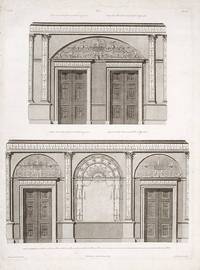
177931060London 1779. Engraving by T. White. A fine engraving of a grand hallway at Syon House from Robert Adam's seminal work on British architecture.<br/> <br/> Robert and his brother James Adam forever changed the face of British architecture by introducing innovative Classical design ideas. From 1754-57 Robert lived in Italy where he had a long productive friendship with Piranesi which was inspirational for both men. Adam's first book on Diocletian's palace in Dalmatia is clearly very like the archaeological investigations Piranesi was making at the same time of similar ruins. Piranesi's friendship and passion for Roman Classicism were seminal influences on Adam and the greatest single factor other than his own talent in the work Adam produced on his return to England. Upon his return the brothers launched their career by building the Adelphi from the Thames to the Strand in London which although not a commercial success at the time included one of London's most cherished buildings the Adlephi Theatre. Together the Adam brothers designed and built some of the most famous buildings in England including such bastions of English architecture as Kenwood House Keddlestone Manor and Syon House. To the interiors of their English country houses the Adams brought wonderful ornamental elements in niches lunettes festoons and reliefs. Their classically designed buildings were so numerous in London that they changed the prevailing feel of the city and established their brand of neo-Classicism as the model of elegance and importance. It is asserted that the brothers originated the concept of the uniform facade attached to the typical English row house an architectural device that distinguishes London buildings. This monumental contribution is evidenced in the Adams' designs for Portland Place and Fitzroy Square and these were used as architectural models for the whole city. The brothers brought their talents into other areas by designing furniture to complement their beautiful interiors and by creating and publishing a treatise of design entitled 'Works in Architecture'. The work was published in three volumes over an extended span of time beginning in 1773 with the final volume being published posthumously in 1822.<br/> <br/> Cf. Brunet I.47; cf. Lowndes I p.8; DNB; Wilton-Ely The Mind and Art of Giovanni Battista Piranesi. unknown
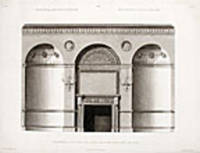
17745385London 1774. Engraving by J. Zucchi. A fine architectural engraving of the interior of Kenwood House in Hampstead London re-modelled in 1761-1773 and now home to the Iveagh Bequest picture collection.<br/> <br/> Robert and his brother James Adam forever changed the face of British architecture by introducing innovative Classical design ideas. From 1754-57 Robert lived in Italy where he had a long productive friendship with Piranesi which was inspirational for both men. Adam's first book on Diocletian's palace in Dalmatia is clearly very like the archaeological investigations Piranesi was making at the same time of similar ruins. Piranesi's friendship and passion for Roman Classicism were seminal influences on Adam and the greatest single factor other than his own talent in the work Adam produced on his return to England. Upon his return the brothers launched their career by building the Adelphi from the Thames to the Strand in London which although not a commercial success at the time included one of London's most cherished buildings the Adelphi Theatre. Together the Adam brothers designed and built some of the most famous buildings in England including such bastions of English architecture as Kenwood House Keddlestone Manor and Syon House. To the interiors of their English country houses the Adams brought wonderful ornamental elements in niches lunettes festoons and reliefs. Their classically designed buildings were so numerous in London that they changed the prevailing feel of the city and established their brand of neo-Classicism as the model of elegance and importance. It is asserted that the brothers originated the concept of the uniform facade attached to the typical English row house an architectural device that distinguishes London buildings. This monumental contribution is evidenced in the Adams' designs for Portland Place and Fitzroy Square and these were used as architectural models for the whole city. The brothers brought their talents into other areas by designing furniture to complement their beautiful interiors and by creating and publishing a treatise of design entitled 'Works in Architecture'. The work was published in three volumes over an extended span of time beginning in 1773 with the final volume being published posthumously in 1822.<br/> <br/> Cf. Brunet I.47; cf. Lowndes I p.8; DNB; Wilton-Ely The Mind and Art of Giovanni Battista Piranesi. unknown
177517124London 1775. Engraving by Joshua Record. In excellent condition with the exception of some minor foxing across the sheet and some waterstaining along the upper margin. A decorative engraving by the celebrated architect Robert Adam depicting an elegant room in Lord Derby's house in Grosvenor Square London.<br/> <br/> Robert and his brother James Adam forever changed the face of British architecture by introducing innovative Classical design ideas. From 1754-57 Robert lived in Italy where he had a long productive friendship with Piranesi which was inspirational for both men. Adam's first book on Diocletian's palace in Dalmatia is clearly very like the archaeological investigations Piranesi was making at the same time of similar ruins. Piranesi's friendship and passion for Roman Classicism were seminal influences on Adam and the greatest single factor other than his own talent in the work Adam produced on his return to England. Upon his return the brothers launched their career by building the Adelphi from the Thames to the Strand in London which although not a commercial success at the time included one of London's most cherished buildings the Adlephi Theatre. Together the Adam brothers designed and built some of the most famous buildings in England including such bastions of English architecture as Kenwood House Keddlestone Manor and Syon House. To the interiors of their English country houses the Adams brought wonderful ornamental elements in niches lunettes festoons and reliefs. Their classically designed buildings were so numerous in London that they changed the prevailing feel of the city and established their brand of neo-Classicism as the model of elegance and importance. It is asserted that the brothers originated the concept of the uniform facade attached to the typical English row house an architectural device that distinguishes London buildings. This monumental contribution is evidenced in the Adams' designs for Portland Place and Fitzroy Square and these were used as architectural models for the whole city. The brothers brought their talents into other areas by designing furniture to complement their beautiful interiors and by creating and publishing a treatise of design entitled 'Works in Architecture'. The work was published in three volumes over an extended span of time beginning in 1773 with the final volume being published posthumously in 1822.<br/> <br/> Cf. Brunet I.47; cf. Lowndes I p.8; DNB; Wilton-Ely The Mind and Art of Giovanni Battista Piranesi. unknown
177517122London 1775. Engraving by Joshua Record. In excellent condition. An elegant engraving showing the chimney in the anteroom of Lord Derby's house in Grosvenor Square London.<br/> <br/> Robert and his brother James Adam forever changed the face of British architecture by introducing innovative Classical design ideas. From 1754-57 Robert lived in Italy where he had a long productive friendship with Piranesi which was inspirational for both men. Adam's first book on Diocletian's palace in Dalmatia is clearly very like the archaeological investigations Piranesi was making at the same time of similar ruins. Piranesi's friendship and passion for Roman Classicism were seminal influences on Adam and the greatest single factor other than his own talent in the work Adam produced on his return to England. Upon his return the brothers launched their career by building the Adelphi from the Thames to the Strand in London which although not a commercial success at the time included one of London's most cherished buildings the Adelphi Theatre. Together the Adam brothers designed and built some of the most famous buildings in England including such bastions of English architecture as Kenwood House Keddlestone Manor and Syon House. To the interiors of their English country houses the Adams brought wonderful ornamental elements in niches lunettes festoons and reliefs. Their classically designed buildings were so numerous in London that they changed the prevailing feel of the city and established their brand of neo-Classicism as the model of elegance and importance. It is asserted that the brothers originated the concept of the uniform facade attached to the typical English row house an architectural device that distinguishes London buildings. This monumental contribution is evidenced in the Adams' designs for Portland Place and Fitzroy Square and these were used as architectural models for the whole city. The brothers brought their talents into other areas by designing furniture to complement their beautiful interiors and by creating and publishing a treatise of design entitled 'Works in Architecture'. The work was published in three volumes over an extended span of time beginning in 1773 with the final volume being published posthumously in 1822.<br/> <br/> Cf. Brunet I.47; cf. Lowndes I p.8; DNB; Wilton-Ely The Mind and Art of Giovanni Battista Piranesi. unknown
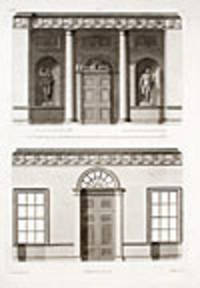
177817136London 1778. Copper engraving. Engraved by P. Mazell. In excellent condition. An elegant engraving the Porter's Lodge at Shelburne House in Berkeley Square in London.<br/> <br/> Robert and his brother James Adam forever changed the face of British architecture by introducing innovative Classical design ideas. From 1754-57 Robert lived in Italy where he had a long productive friendship with Piranesi which was inspirational for both men. Adam's first book on Diocletian's palace in Dalmatia is clearly very like the archaeological investigations Piranesi was making at the same time of similar ruins. Piranesi's friendship and passion for Roman Classicism were seminal influences on Adam and the greatest single factor other than his own talent in the work Adam produced on his return to England. Upon his return the brothers launched their career by building the Adelphi from the Thames to the Strand in London which although not a commercial success at the time included one of London's most cherished buildings the Adlephi Theatre. Together the Adam brothers designed and built some of the most famous buildings in England including such bastions of English architecture as Kenwood House Keddlestone Manor and Syon House. To the interiors of their English country houses the Adams brought wonderful ornamental elements in niches lunettes festoons and reliefs. Their classically designed buildings were so numerous in London that they changed the prevailing feel of the city and established their brand of neo-Classicism as the model of elegance and importance. It is asserted that the brothers originated the concept of the uniform facade attached to the typical English row house an architectural device that distinguishes London buildings. This monumental contribution is evidenced in the Adams' designs for Portland Place and Fitzroy Square and these were used as architectural models for the whole city. The brothers brought their talents into other areas by designing furniture to complement their beautiful interiors and by creating and publishing a treatise of design entitled 'Works in Architecture'. The work was published in three volumes over an extended span of time beginning in 1773 with the final volume being published posthumously in 1822.<br/> <br/> Cf. Brunet I.47; cf. Lowndes I p.8; DNB; Wilton-Ely The Mind and Art of Giovanni Battista Piranesi. unknown
175556661Kiöbenhavn uden ang. af trykker 1755-80. 4to. 11 samt. ensartede hellæderbind af flammet kalv. Rig rygforgyldning og ophøjede bind på rygge. Tome-og titelfelter i skind. Forgyldte bordurer på permer. Kapitæler på nogle få bind bind lidt slidte nogle hjørner lidt stødte. 10 kobberstukne titelblade og 1 bogtrykt. Trykt på svært skrivepapir. Indvendig ren og frisk. Pragteksemplar af "Fundationerne" som har tilhørt Adam Gottlob Moltke til Bregentved og til hvem flere af bindene er dediceret. På alle for-og bagpermer er Moltke's store forgyldte kronede hjerteskjold. <br/><br/><em>Komplet eksemplar af Hans de Hofmans store værk som indeholder en del plancher i form af portrætter kort og genealogiske tabeller bl.a. portræt af Tycho Brahe store vignetter m.m. </em> unknown
1727P1225Leiden 1727. Excellent. Notes: from the book "Voyages tres-curieux et tres-renommez faits en Moscovie Tartarie et Perse." Image Size : 270x360 mm 10.625x14.125 Inches Platemark Size : 275x365 mm 10.875x14.375 Inches Paper Size : 312x392 mm 12.25x15.375 Inches Coloring: Black & White Medium: Copper Engraving Categories: Views Asia Middle East Iran; unknown
1764ST17496-042London: Printed for the Author 1764. FIRST EDITION. 520 x 365 mm. 20 3/4 x 14 1/4". iv 8 subscribers list 33 pp. <br/> Attractive modern light green half morocco gilt by J. F. Newman of Dublin his ticket on front pastedown raised bands spine panels with central patera ornament two darker green morocco labels reinforced hinges edges untrimmed. WITH 61 SPLENDID ENGRAVINGS 14 plans and elevations 47 views ON 54 PLATES eight double-page six folding by Bartolozzi and others. Front flyleaf with ink signature of Francis D. Bedford dated October 1886. Cicognara 3567; Fowler 2. Spine sunned to a light olive shade one corner bumped one plate with a little browning along the fold occasional mild marginal foxing or trivial smudges but A FINE COPY--fresh bright and clean internally with deep impressions of the type rich impressions of the plates and generous margins in a binding with few signs of wear.<br/> <br/> This is an extremely appealing copy of one of the great architectural books of the 18th century described by Cicognara as a "magnificent and grandiose work." Scottish architect Robert Adam 1728-92 was a product of the Scottish Enlightenment and moved in intellectual circles that included historian William Robertson who wrote the introduction here David Hume and Adam Smith. His interest in architectural drawing was stimulated by books in his father's extensive library which DNB tells us contained "a working collection of illustrated architectural books in English French and Italian and a series of manuals on architectural draughtsmanship." This curiosity developed into a passion during his 1755-57 tour of Italy which "was in every way a period of intense professional training during which the skills learned in Scotland were tested and given an international gloss by the Roman circle in which he now moved." DNB At the center of this circle was French architect antiquarian and artist Charles-Louis Clérisseau 1721-1820 the leading authority on Roman antiquities and architecture who introduced Adams to among others the great Piranesi. With Clérisseau as guide and tutor he explored and sketched various sites before arriving at the un-surveyed fortress palace built by the former emperor Diocletian at Spalatro the modern-day Croatian city of Split. Adam undertook a survey of the building and drew the architectural plans and elevations for this work while Clérisseau sketched views of the ruins. Adam planned this book as a way of promoting his career as an architect and worked with Clérisseau to have engravings made for it. According to Thom "while the traditional plans elevations and sections--what Robert Adam called the 'Geometricals'--were generally supplied by English engravers like Rooker Patton and Walker the all-important picturesque views and perspectives which Adam thought were essential to convey the emotional impact of the remains of Diocletian's Palace were engraved in Italy mostly by Bartolozzi Paolo Santini and Zucchi." Adams also wrote the architectural commentary. The publication was a success praised by the "Critical Review" in October 1864 as possessing "a taste and execution that has never been equalled in England." As DNB observes "during these two Roman years Adam succeeded in transforming himself from a provincial and rather green Scottish architect into a cosmopolitan figure ready indeed to put into effect 'the Antique the Noble & Stupendous.'" Now based in London he embarked on a distinguished career specializing in country houses and townhomes that reflected the deep influence classical architecture and his Italian sojourn had on his work. Our copy was once owned by another artist Francis Donkin Bedford 1864-1954 who exhibited landscapes at the Royal Academy and illustrated books during the Golden Age of children's book illustration in the late 19th and early 20th century. Printed for the Author unknown
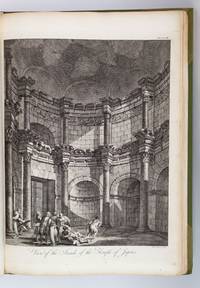
17641721551764. ADAM Robert. Ruins of the Palace of the Emperor Diocletian at Spalatro in Dalmatia. vi 8 33 1 pp. with 61 engraved plates on 54 sheets some double-page. Folio 525 x 370 mm. bound in full contemporary calf. London: For the author 1764. First edition. "The book incorporated the first encyclical of Britain's most popular architect of the day who had now been in practice for several years with an immense patronage. Adam makes it quite plain that the great palace of Diocletian forms the source of his ideas upon domestic building and he modestly claims that it is the first private dwelling-house of the Romans to have been illustrated and described." Adam's account was based on his five-week visit to Spalatro in Croatia now known as Split; the sixty-one superb plates were executed after Clerisseau Zucchi and others some of the drawings survive at the Hermitage St. Petersburg. In his introduction Adam expresses his conviction that Diocletian had revived a taste in Architecture superior to that of his own times. Adam's "observance on unusual detail throughout is remarkable. Nothing is too minute to escape his notice. A careful reading of the descriptions shows whence Robert Adam derived his theories for the planning of his domestic buildings on a monumental scale like Syon and Kedleston" James Lees-Milne The Age of Adam pp. 67-69. A fine copy of this landmark book. Millard British 1. Harris British Architectural Books 4. Fowler 2. Berlin Katalog 1893. Cicognara 3567. John Fleming Robert Adam and His Circle 1962 pp. 235-240. Georg Kowalczyk Denkmäler der Kunst in Dalmatien 1910 reproducing 22 plates. unknown
176455620London: for the Author 1764. First edition. Modern full morocco. Very good. Large folio 53.0 by 38.0 cm. iv 7 subscribers' list 1 blank 33 1 blank pp; 53 of 54 leaves comprising 60 of 61 engraved plates 7 double-suite 6 folding each numbered according to the descriptive list on pp. 19-33. Plate I serves as frontispiece; five leaves each contain two or three smaller plates. Plate VI a floor plan of the palace restored is lacking. Recent full speckled light brown morocco boards lightly rubbed at extremities gilt dentelles spine with raised bands and gilt morocco lettering piece. A touch of mild soiling at the title; light foxing and staining almost exclusively confined to the margins throughout; adhesive at the joins in the large folding plates sometimes a bit darkened. A very good amply-margined copy.<br /> <br /> First edition of this magnificently illustrated work with views elevations sections and architectural details of the emperor Diocletian's palace at Spalato today known as Split. While the modern town was built into the ruins of the palace precinct the two temples the inner peristyle and most of the encircling walls remain. <br /> <br /> The origin story of the work is notable. Upon the death of William Adam 1689-1748 the leading architect in Scotland Robert Adam 1728-1792 and his two brothers succeeded to their father's practice. In order to remedy his deficiencies in architectural understanding Robert decided upon a Grand Tour of the monuments of classical antiquity so as "to acquire a proper manner and taste and an elegant style of drawing" Millard. Being the only significant unexplored classical sites in southern Europe Spalato would prove ideal for such a project. After meeting Charles-Louis Clérisseau 1721-1820 in Florence in 1755 Adam chose to engage the young French architect as guide and drawing instructor for the next two years. Clérisseau accompanied Robert Adam during the five weeks of the summer of 1757 devoted to exploring Spalato. The engravings were probably based on drawings by Clérisseau six of which are preserved in the Hermitage Museum who would also go on to supervise much of the engraving. The Critical Review October 1764 offered high praise for these illustrations which exhibited "a taste and execution that has never been equalled in this country." In his Decline and Fall chap. 12 Edward Gibbon offered a pithy critique: "There is reason to suspect that the elegance of his designs and engravings has somewhat flattered the objects which it was their purpose to represent."<br /> <br /> Adam clearly hoped the project would generate publicity as he sought to emulate the success of such works as Dalton's Antiquities and Views in Greece and Egypt 1751-1752 and Robert Wood's The Ruins of Palmyra 1753. The format of the present work is in fact modeled on Palmyra though Adam has included a far greater proportion of picturesque views than appear in Wood's opus. "The plates engraved by F. Bartolozzi E. Rooker F. Patton P. Santini A. Walker K. Cunego J. Bassire and Antonio Zucchi are of interest not only as fine examples of architectural engraving but as showing the source of some of the motives of the Adam style" Fowler. Adam's cousin the scholar and historian William Robertson wrote the proposal the dedication and the preface. Digital Cicognara Library 3567; ESTC T46923; Fowler 2; Millard British Books 1. for the Author unknown
1764145764London: for the author 1764 . Robert Adam's magnificent folio on the ruins of ancient Spalatro First and only contemporary edition of this superb work "one of the pioneering archaeological studies of the period" Thom which describes the villa - or rather fortress-palace - of the Emperor Diocletian built at Split the ancient Aspalathos on his abdication in 305 CE. During a five week detour from his Grand Tour Adam joined by the renowned French draughtsman Charles-Louis Clérisseau set about studying measuring and recording the grand ruins at Spalatro the plates finely rendered by a team of the best engravers are a mixture of plans sections and elevations 14 plates and views 47 plates. Self-published to promote the author's career the influence these designs had upon their author is evident throughout Adam's hugely successful and influential career. This folio represents the author's primary exposure to the inspirations that would define his own pervasively influential neo-classical "Adam Style". Provenance: gilt leather armorial book label of Granville Hastings Wheler 1780-1827 grandson of the experimental philosopher Granville Wheler 1701-1770; his label dated 1725 the year that his grandfather purchased Otterden Place Kent a house that was remodeled and enlarged by Granville Hastings who commissioned the architect William Pilkington. "It is said that the designs were based on Wheler's sketches of the 16th century house made from memory but it is far from clear that his influence extended beyond mandating the choice of the Tudor style for the new elevations" landedfamilies blog retrieved 4 January 2021. Folio 525 x 360 mm. 61 engraved plates complete 14 double-page or folding on 54 sheets including the pictorial title page by Francesco Bartolozzi Antonio Zucchi Edward Rooker and others after Charles-Louis Clérisseau. Early 19th-century half russia flat spine with six low raised bands decorated with gilt fillets closed by foliate finials gilt lettered direct in the second compartment others richly gilt with foliate and geometrical decoration sides and corners trimmed with a pretty gilt foliate roll Spanish on Turkish pattern marbled sides edges and endpapers. Binding professionally and judiciously refurbished. A very good copy handsomely bound with strong impressions of the plates. Colin Thom "'This Knoty Business': The making of Robert Adam's Ruins of the Palace of the Emperor Diocletian 1764 revealed in the Adam brothers' Grand Tour correspondece". hardcover
179735232Edinburgh: A. Strahan and T. Cadell. Very Good with no dust jacket. 1797. Fourth Edition. Hardcover. Full leather binding with innner denteles. Provenance-armorial bookplate John Martin Cripps ad collectore's J W Marsden. ". A guide to Roman government and culture with continuous references to classical literature. ." Contents unusually clean and bright. "Explaingin words and phrases from rites and customs. Government Magistacy Military Dress Exercises Gardens etc etc." 5.75" x 8.75". Marbled eps with matching text block edges. Nice copy. . A. Strahan and T. Cadell. hardcover