1 199 résultats
1972183093New York: ASMP - The Society of Photographers in Communications 1972. First edition. Softcover. The highlight of this issue is an article on Diane Arbus with text by Marvin Israel. Includes with the covers a total of 9 of Arbus' photographs along with a small black and white portrait of Arbus by Gideon Lewin. Also includes black and white images on Republicans by Abner Symons and Fred McDarrah on Democrats. A near fine copy in stapled wrappers with some minor wear some slight toning to the edges and mailing address on the rear cover. One of the better issues of this magazine with the Arbus article timed to coincide with the major retrospective at The Museum of Modern Art and the publication of the related monograph. ASMP - The Society of Photographers in Communications unknown
1973A116983Jerusalem: Keter Books 1973-74. 1st editions. Very Good. small octavo. softback with stiff wrappers 147 306 340 180 214 232pp. b/w pls. text ills. maps bibliogs. indexes Israel Pocket Library series Keter Books unknown
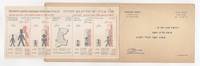
1952207360Tel Aviv-Jaffa: Yehuda Nedivi Town Clerk 1952. Evenly toned; corners a bit wrinkled. Bifolium approx. 6 x 4-3/4 in with tipped-in folding plate. Card issued in the name of the Tel Aviv town clerk with a graphic isotype chart tipped in titled "Tel-Aviv Jaffa Marches With the State" showing statistics on the development of the city in the four years since the founding of the state in areas of Population & Housing Education Municipal Area Social Welfare and Taxation. Yehuda Nedivi, Town Clerk unknown
1951205242N.P. New York: n.p. 1951. First edition. Edges lightly toned; light wrinkling to front wrapper. 8vo 117pp; wrappers. Among the scholars and leaders contributing to these proposals were Archibald MacLeish Reinhold Niebuhr and Sumner Welles. n.p. unknown
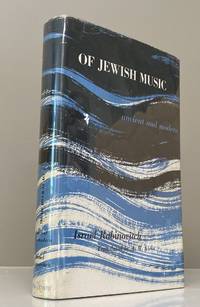
195229020Montreal: The Book Center 1952. 1st Edition. Hardcover. Dust Jacket Included. 1st Edition. Hardcover. Signed by Author. First Edition. Number 108 of 200 Numbered Copies Signed by Israel Rabinovitch and translated from the Yiddish by Governor General Award winning poet A.M. Klein. A fine copy in black cloth gilt titles to the spine and front board in a near fine pictorial dustwrapper with some light overall use. 8vo. 321 pp. An engrossing history of Jewish music past and present. The Book Center hardcover
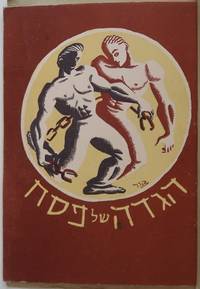
195043267Be'eri Beeri: Hotsa'at Be'eri 1950. 1st edition. Original illustrated color paper wrappers with outer protective cover added 8vo 31 pages. All pages are illustrated with illustrations created specifically for this hagadah. 24 cm. In Hebrew. 1st edition of the Hagadah produced by the Kibbutz where Hamas killed 100 Israelis on October 7 2023. Apparently several editions were produced between 1950-1981. <br> The cover depicts two muscle-bound shirtless men ripping their shackles off a classic passover depiction using Zionist "New Jew" imagry showing the strength of the young Jewish state emerging from the Holocaust. <br> The front cover as well as the inside illustrated pages are identical to the later 1953 UToronto copy whose pages can be seen at https://archive.org/details/druck00148/page/n35/mode/2up though our copy retains the original text which theirs has replaced on pages 15-16 and lacks their the tipped in colophon. The rear cover has also changed with their 1953 edition compare our illustration to theirs. <br> Be'eri is a kibbutz in southern Israel. Located in the north-western Negev desert near the eastern border with the Gaza Strip. During.the 2023 Hamas attack on Israel 100 people were killed." Jerry Seinfeld famously visited in December following the attack to show support. <br> “Kibbutz Be'eri was established on 6 October 1946 as one of the 11 points in the Negev. It was located near Wadi Nahabir a few kilometres south of Be'erot Yitzhak. Its founders were members of the HaNoar HaOved VeHaLomed movement who had been preparing in Maoz Haim as well as some Hebrew scouts. It was named after Berl Katznelson as Be'eri Beeri a biblical name was his pen name.<br> In 1947 Be'eri had a population of over 150. The early settlers engaged in land reclamation and tree planting. The group was enlarged by young Jews from Iraq who arrived by desert trek. The Jewish National Fund reported that for months the kibbutz was completely isolated 'but the settlers held their ground until the liberation of the Negev in October 1948.'<br> After Israeli independence the kibbutz moved three kilometres southeast to its present location. It is considered one of Israel's wealthiest kibbutzim" Wikipedia. <br> Commemorating members of Kibbutz Be’eri who were killed in the second intifadah Miriam Holtzman reflected on the kibbutz and it’s hagadah:<br> “In 1950 the members and members of Kibbutz Be’eri produced the Hagadah for Passover. Less than two years after the end of the War of Independence in which they paid a terrible price for the fulfillment of their life's vision - the establishment of a Jewish state in the Land of Israel the members of the kibbutz designed holiday content relevant to their values and lifestyles. In those years the kibbutz Hagadot fulfilled the mitzvah ‘A person must see himself as if he had come out of Egypt’ by incorporating the history of the nation of Israel at that time. <br> The Hagadah told the story of exile immigration pioneers fighting and settlement in the areas of the book as a direct continuation of the struggle of the Israelites for freedom and as part of their journey back to the Land of Israel .In contrast to the traditional Hagadah the Kibbutz Hagadahs put a deep emphasis not only on leaving the slavery of Egypt but also on arriving in the Promised Land and settling in it.<br> In those days of the beginning of the state the kibbutz Seder night also included content that today we incorporate into the Holocaust Day Remembrance Day and Independence Day ceremonies. The Kibbutz Hagadah combined the local and national story with passages from the traditional Hagadah verses from the Bible passages of Zionist thought and self-creation - both in painting and writing. The War of Independence became in Be’eri's Hagadah another chapter in the story of the Exodus from Egypt….<br> In the chapter ‘We will remember' the victims of the Holocaust and the refugees who fell on their way to Israel are mentioned alongside those who fell in the War of Liberation. The message is one of remembrance but also of mission:<br> 'And let us not forget because it was only because of them and because of the whole multitude of the House of Israel that we have come to this day and because it was for their sake and for the sake of the rest of Israel that we are at peace now….Prepare yourselves for the enemies of all generations - for a great evil.'<br> The emphasis in remembrance is on finding meaning and belief in the righteousness of the path in the face of the paralyzing pain. A topical reading of Be’eri's passages of the Hagadah places the reality we face in a historical context - not a single point but a long and continuous line of our existence in this land.<br> The Hagadah ends with the return of Zion and includes verses such as 'Keep your voice from weeping and your eyes from tears there is a reward for your work and return from the land of the enemy' as well as 'while your son is built and built virgin of Israel there is hope for your future and sons return to their borders'.<br> The Hagadah ends with a description of Ari's who was killed in the 2nd Intifadah life in that year. It is impossible not to hear the call carried to us from the main day:<br> 'Come out and see our work in the first year of our sabbath at Beri Hadasha….Let us plow and sow and let the blessings of God visit our fields. We planted fruit trees and vines and increased the herds of cattle and more priests and priests were added to our dwelling and we are only at the beginning of the journey. There is still a lot of need and a lot of longing to improve our home from the inside.<br> Indeed today is a joyous holiday for us. . The silence and the peace are with us and now because we have yet to stand the test and we have yet to be girdled we have vowed to stand on the soul of our work. . And with anxious anticipation we wait for the day when we will give our hands to the effort of the great liberation here at our rejected point we will rush to the redemption of the people and the world.'†www.chagim.org.il<br> "No group… has taken the reinterpretation of the traditional Haggadah more seriously than the kibbutz movement which over the years has produced an estimated 1000 different versions. Taken together these Haggadot offer a fascinating perspective on the still evolving social movement. Of all Jewish texts the Haggadah had special significance for the early kibbutz pioneers because it dealt with concepts important to their ideology: national freedom and socialist ideals… The staggering number of kibbutz Haggadot can be attributed to the fact that few were actually printed; most were simply stenciled in small numbers to be used in a particular year by a particular kibbutz. It was only later that official kibbutz federations published a standard version" Carol Novis in The Forward. <br> SUBJECTS: Kibbutz haggadot. Haggadot -- Texts. Passover -- Liturgy -- Texts. Haggadah Non-traditional Secular haggadot. Paque -- Liturgie -- Textes. OCLC: 1030800415. OCLC lists only 2 institutions with holdings for any of editions NLI holding several editions and Stanford holding the 2nd edition of 1951 as well as UToronto 4th edition of 1953. Very Good Condition. Rare and powerful. BK5 HAG-26-4K-VV. Be'eri [Beeri]: Hotsa'at Be'eri unknown
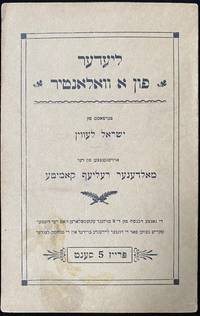
191942896No Place Malden MA: Maldener Relief Komite 1919. No Date 1919. 1st Edition. Original printed paper wrappers 8vo 14 pages. 21 cm. In Yiddish. Title translates as “Verses of a Volunteer.†No city or date listed but clearly published during or immediately after WW I with the Leksikon suggesting Malden MA 1919 OCLC suggests Boston the location of the printer and a clearly incorrect date of 1900 perhaps intending "1900s". Malden the poet’s home town just outside of Boston and clearly the home of the "Maldener Relief Komite" makes much more sense making this is the first documented yiddish publication in Malden MA north of Boston.<br> "The poet dedicated the entire income of 5 thousand copies to the brothers suffering from hunger in the countries at war†Translated from the front cover. Includes 4 poems: Der Volontir; Ikh Zukh a Vort; Nach der Milhome; Hazkharot Neshimot. The final poem is “in memory of the fallen Jewish heroes in all the war-torn lands.â€<br> Israel Levine 1878-1970 “was born in a village in Minsk district Byelorussia. In 1895 he arrived in the United States lived in various cities worked as a teacher in Talmud Torahs and was secretary for Mizrachi in the town in which he lived Malden Massachusetts. <br> He debuted in print in 1904 in Fraye arbeter-shtime Free voice of labor in New York with a poem entitled ‘Funken shpritsn’ Sparks fly and from that point he went on to contribute poetry and translations from Tanakh and from ethical books to: Yidishes tageblat Jewish daily newspaper Forverts Forward Dos yudishe folk The Jewish people Di varheyt The truth and Idisher kemfer Jewish fighter—in New York; Idishe shtime Jewish voice in Boston; and more. He published in book form: Lider fun a volontir Poems of a volunteer Malden 1919 16 pp.; Sefer naim zemirot tehilim Naim Zemirot on Psalms translated into a poetic form with short prefaces by Dr. Meir Vaksman and Aharon Kaminska Jerusalem 1934 19 pp†Khayim Leyb Fuks in Leksikon Fun Der Nayer Yidisher Literatur<br> OCLC: 19307496. OCLC lists 4 copies worldwide YIVO Brandeis Harvard NYBC none outside the northeast. A few stains & discoloring Very Good Condition an excellent copy. Scarce. B YID-45-9XX-LE-’. No Place [Malden, MA]: Maldener Relief Komite unknown
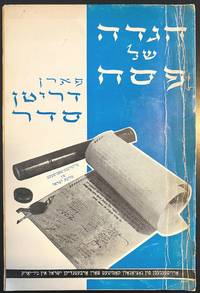
195443290Nyu-York New York: Aroysgegebn fun Natsyonaln komitet farn arbetndikn Yisroel 1954. 2nd edition 1st was 1953 the year prior. Original Color photographic paper wrappers designed by Pinchas Schuldenrein showing the Israeli declaration of independence a cover design used on other 1950s-60s editions as well. 8vo 3 25 3 pages. In Yiddish and occasional Hebrew with 1-page introduction in English and 3 pages with song lyrics in transliterated Hebrew. Text primarily in Yiddish typescript i.e. Yiddish typewriter. <br> Title translates as “Hagadah for Passover for the Third Seder from the Histadrut Campaign.†With a few photos illustrations and calligraphic headings. <br> Date and edition based on the introduction which explains the third seder as if it were a new concept to the audience. It continues “The ‘Hagadah for the Third Seder’ was written under the impact of the great event in jewish history which took place six years ago in 1948– the creation of the State of Israel….The National Committee for Labor Israel in its thirtieth anniversary year proudly presents the ‘Hagadah for the Third Seder’ to all its friends in the United States and Canada.â€<br> <br> Opens with Chaim’s Weitzmann’s 1941 Speech to the Histadruth in America during the Holocaust where he tells the labor organization:<br> <br> I do not want to deny to you that perhaps many of our troubles and difficulties stem from the fact that our work in the Land of Israel is so successful. If she had been less careful perhaps people would not have looked at what the Jews had done in the Land of Israel with such green eyes with the eyes of envy. Yesterday…<br> The former High Commissioner of the Land of Israel said to England that after the war the groups in the Land of Israel would be considered as a model for the construction of the world. There he pointed out forms of life were formed which after all the crisis and search that Europe is going through it has not yet been achieved through the sacrifices of the Histadrut and the people who understood the role that the Histadrut played in the construction of Israel….<br> My few words are enough as a greeting in the difficult and unfortunate time we are living through. Right here in this country which is perhaps not yet as connected personally through people with the Land of Israel as you would like it to be.<br> Your very own want and as I would want it and as the Histadrut would want it just in this country America which is led with such great and spirited people…many of the Jewish workers have well understood where their debt lies.<br> These days I met with an unseen labor leader. I told him that now everyone has to work together for the Land of Israel he replied that all Jewish workers in America are already working together and that the leftist leftists are all for the Land of Israel….<br> To the work and sacrifices for Jewish establishment. I know we will still have bitter times. the world unfortunately it did not understand that while the dark forces attacked the Jews they attacked the Ten Commandments without which a civilized society cannot exist. But the new dark Egypt will also end.<br> The sun will begin to shine again and it will shine for us too. But until the sun appears again we will still have to go through a difficult long and dark night. At Passover a count is taken. Today if I don't move any error is the foundation of grace in salvationâ€<br> <br> The Histadrut Third Seder was a public communal event organized by the American Histadrut the Israel labor federation that took place annually in the United States particularly in New York City for several decades. It was a secular Yiddish cultural alternative to traditional Passover seders using the Seder structure to commemorate events in Jewish history often focusing on the 20th-century return of Jews to Israel and the founding of Histadrut itself. <br> <br> The Third Seder was an American secular and politically motivated interpretation of the Passover Seder tradition particularly associated with the Labor Zionist movement and institutions like Farband. Evolved from earlier educational models these public events combined Passover's themes of freedom and social justice with socialist ideals and support for Histadrut in Eretz Israel. They featured speakers Zionist and Yiddish songs and fundraising for labor projects creating a unique cultural and political Passover ritual for immigrant communities.<br> For an interesting history of the third seder see Jenna Weissman Joselit’s A Passover Do-Over: The third Seder was once an American tradition with a sense of community and politics that set it apart from the first two in Tablet April 5 2017 https://www.tabletmag.com/sections/belief/articles/a-passover-do-over<br> T he National Committee for Labor Israel NCLI founded in 1923 as the National Committee for Labor Palestine was an American fundraising organization that supported the Histadrut Israel's labor federation. The organization closely linked to the Labor Zionist movement solicited funds from American labor unions and Jewish communities to finance the Histadrut's educational health and social programs. NCLI also aimed to strengthen ties between American and Israeli labor sectors and promote public support for Labor Israel. The committee eventually faced financial difficulties and dissolved. <br> “NCLI was headquartered in New York City and oversaw regional fundraising offices in other cities such as Boston Chicago Cleveland Detroit Los Angeles Miami and Philadelphia…. <br> In spite of their close association the relationship between NCLI and the Histadrut was complicated….The labor involved in cataloging and assigning thousands of sponsorship opportunities transmitting monies between countries producing evidence of ongoing projects and attaching the correct names and acknowledgments to finished projects was considerable—especially in light of the fact that the organizations operated in different languages in a mostly pre-computer workplace. The two periodically accused each other of mishandling funds and disagreed about which of them had the authority to resolve their disputes….operations were ceased in 2006†Center for Jewish History. <br> <br> OCLC: 713758489 & 1284891527. OCLC locates only 2 copies of this edition worldwide NLI Ben Gurion U none outside Israel.<br> Crease to cover at staples at spine as expected. Otherwise very good condition. Scarce. B Hag-26-12-LG. Nyu-York [New York]: Aroysgegebn fun Natsyonaln komitet farn arbetndikn Yisroel unknown
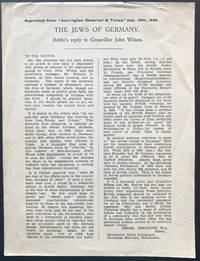
193640010Manchester Accrington Observer And Times 1936. Single sheet of paper. 1st separate edition. 8vo. 1 page. Offprint from Accrington Observer and Times Sept. 19 1936. <br> “Chief Rabbi Prof. Israel Abrahams of The Great Synagogue Cape Town South Africa was the Chief Rabbi of the United Council of Orthodox Hebrew Congregations Cape Province and South West Africa and also Northern Rhodesia from 1937 to 1968 after which he and his wife made Aliyah to Israel. He was the head of the department of Jewish Studies at The University of Cape Town. He was one of the founders of Herzlia School. In South Africa he wrote several books of sermons including ‘Pathways in Judaism’ ‘Living Waters’ and ‘The Birth of a Community’ - a history of Western Province Jewry from its earliest times to the end of the South African War 1902. He translated the scholarly works of Prof Umberto Cassuto from Hebrew to English both while in South Africa and later in Jerusalem. <br> In Israel he went on to translate works by Prof Urbach and others until his death after a short illness in October 1973. Chief Rabbi Prof Abrahams was born in Vilna and came to London as a small child where he later received his Rabbinic Ordination from Jews College. He received his degrees at University of London. He came to Cape Town after serving as the Rabbi of the Great Synagogue in Manchester. †telfed.org <br> Abrahams was responding to an article in which he claimed that some “facts†from Coun. John Wilson and Mr. Barnes were inaccurate and anti-Semitic. He refutes that claims that “In the post-war ie post WW I years Germany was over-run by Jews from Russia and Poland †and that “some 90 per cent of the official posts in the country were occupied by Jews. †<br> He does not take an attacking tone rather stating that “It is a thousand pities that Councillor Wilson and Mr. Barnes did not take the trouble to verify all their facts before giving their impressions Press publicity. British sympathy should be extended to the Jew who is the helpless victim in Germany and the convenient scapegoat for all its tribulations not to Hitler the aggressor who has shown neither Christian charity nor a sense of ordinary justice and humanity in his persecution of a community that has not only lived in Germany since earliest times but has performed yeoman service in its country’s behalf.†The US Holocaust Museum houses their copy in their Rare Book Collection. <br> SUBJECTS: Jews -- Germany -- History -- 20th century. -- Politics and government -- Juifs -- Politique et gouvernement -- 20e sie`cle. OCLC: 1088420602. OCLC lists only 1 copy worldwide USHMM. Very Good Condition. Very Rare. BK5 HOLO2-140-24. Manchester, Accrington Observer And Times unknown
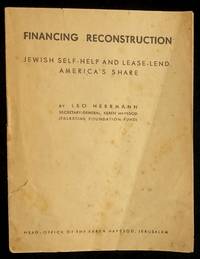
194240029Tel-Aviv: No Publisher 1942. Paperback. 1st separate edition. Original wrappers 12mo 15 pages 15 cm.<br> Holocaust-era plea for continued support for the war in Europe from both the US government as well as from the Yishuv and world Jewry in general. Reprinted from: Palestine and Middle East October 1942.<br> The author Leo Herrmann was Secretary-General of Keren Hayesod Palestine Foundation Fund. He writes “The historical foundation of our demands the moral basis which we must establish by our way of life in the country the unparalleled needs of Jewry today particularly suffering Continental Jewry-all these are absolutely fundamental elements in the call we must make for the world’s aid. This is the point that we reach by careful and systematic consideration of our position. We need self-help; we need the Keren Hayesod. Things cannot and will not remain as they are. We shall maintain our claim for inclusion in the great measures of aid for the whole world which have begun in the Lease and Lend policy that first step towards the world of freedom and democracy in which alone the Jewish People and Eretz Israel have a future.†<br> SUBJECTS : World War 1939-1945 -- Civilian relief -- Palestine. Lend-lease Keren Hayesod. Middle East -- Palestine. OCLC: 13175680 OCLC lists 3 copies worldwide YIVO HUC NLI.<br> Pages are toned some staining on cover small rip on spine side edge that goes through all pages else Good Condition. Scarce. BK5HOLO2-141-8. Tel-Aviv: No Publisher paperback
192343438Frankfurt am Main: Verlag "Omonuth" Omonut Omanut Omanuth 1923. 1st German-printed Edition. Original boards horizontal 8vo 1 score xv 177 pages. 13 x 21 cm. In Hebrew. Title translates as "Rhyme: Songs and Games for Kindergarten and School."<br> Book of songs for children written by Levin Kipnis. Includes musical settings unaccompanied for the poems by various composers. Hebrew text of each entire poem printed on page corresponding to strophic melody. Originally issued in Jerusalem and republished in this edition in Germany by the publishing house Omonuth.<br> "Kipnis was born in Ushomyr Volhynia.In 1913 he moved to Palestine to study at the Bezalel Academy of Art and Design. He later studied pedagogy for two years in Germany and thereafter became a teacher in Levinsky's Teacher's College in Tel Aviv 1923-1952. He debuted in print in 1911 with a poem in the children's magazine Heperaim The flowers and from that point published over one hundred Hebrew books for children and edited children's newspapers textbooks and the like. He is considered the founder of Hebrew-language children's literature in Israel. Leksikon fun der Nayer Yidisher Literatur<br> "A year after opening and before a single book had even been published Omanut closed its doors in Moscow and moved to Odessa a bustling port on the Black Sea located in the Ukraine and as yet untouched by the Revolution. Odessa was already a flourishing center of Jewish culture home to such luminaries of Modern Hebrew literature as Mendele Mocher Sforim and Chaim Nachman Bialik. But the events of 1917 sent even more Jewish writers and artists pouring in. With such a stable of local talent from which to draw Odessa was to prove fertile ground indeed for Omanut.<br> As the Bolsheviks advanced on the Ukraine Olamenu's female founder Shoshana Persitz relocated again this time to Frankfurt-am-Main in Germany. There she republished the beautiful picture books illustrated by the young art students in Odessa and also began publishing the polished Hebrew translations of world literature for children by which the press was to become famous. In 1925 Omanut left Europe altogether establishing itself once and for all in Tel-Aviv." LOC <br> SUBJECTS: Children's songs Hebrew. Singing games. Children's songs Hebrew. Singing games. OCLC: 18897325.<br> "Printed in Germany" stamp on title page. Some wear to spine and discoloration of cloth binding. Good Condition. GER-61-5-XX-'elggxcc. Frankfurt am Main: Verlag "Omonuth" [Omonut, Omanut, Omanuth] unknown
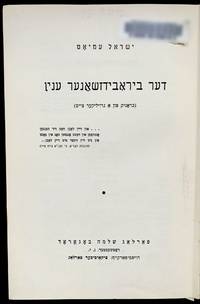
196043104Rochester N.Y.: Sol Bogorad 1960. First edition. Original boards 8vo 191 pages. 24 cm. In Yiddish. Title also appears in English as “The Birobidjan Case.â€<br> Inscribed by the author. Memoir of the author's time as a journalist in Birobidzhan and his stint in a Soviet labor camp in Siberia. Later issued in English as "The Birobidzhan Affair."<br> “Emiot was born in 1909 in Ostrow Mazowiecka then part of Congress Poland within the Russian Empire…Emiot published his first writing in 1926 and brought out four books of poetry during the 1930s.<br> When Germany invaded Poland in 1939 Emiot and his wife and children fled east to the Soviet Union; his mother remained and was killed during the war. In 1944 he was sent to work as a journalist in Birobidzhan the autonomous region set up for Jews in Siberia. Within a few years as the climate for Jewish writers in the Soviet Union worsened he was convicted of trumped-up crimes and sentenced to ten years of hard labor which he served at a camp near Taishet.<br> After his release he returned to Poland and soon after emigrated to the United States where his wife and children were living in Rochester. He spent his last decade and a half as writer-in-residence at Rochester's Jewish Community Center.†Wikipedia <br> SUBJECTS: Political prisoners -- Russia Federation -- Biography. Authors Yiddish -- Biography. Jews -- Russia Federation -- Birobidzhan. Ethnic relations. Imprisonment.Jews. Political prisoners. OCLC: 11234764<br> Ex-library with usual markings. Good Condition. YID-46-34-. Rochester, N.Y.: Sol Bogorad unknown
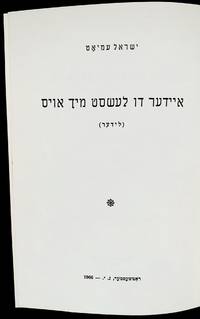
196643105Rotshester Rochester: Israel Goldwasser Emiot 1966. First edition. Original illustrated printed boards 8vo 64 pages. 23 cm. In Yiddish. Title appears in English as “Before I Am Extinguished.â€<br> Collection of Yiddish poems by Israel Emiot written while he was a writer-in-residence at the Jewish Community Center in Rochester New York.<br> “Emiot was born in 1909 in Ostrow Mazowiecka then part of Congress Poland within the Russian Empire…Emiot published his first writing in 1926 and brought out four books of poetry during the 1930s.<br> When Germany invaded Poland in 1939 Emiot and his wife and children fled east to the Soviet Union; his mother remained and was killed during the war. In 1944 he was sent to work as a journalist in Birobidzhan the autonomous region set up for Jews in Siberia. Within a few years as the climate for Jewish writers in the Soviet Union worsened he was convicted of trumped-up crimes and sentenced to ten years of hard labor which he served at a camp near Taishet.<br> After his release he returned to Poland and soon after emigrated to the United States where his wife and children were living in Rochester. He spent his last decade and a half as writer-in-residence at Rochester's Jewish Community Center.†Wikipedia<br> SUBJECTS: Yiddish poetry. OCLC: 10983110.<br> Contains marking in pen but otherwise excellent. Very Good Condition. YID-46-33-. Rotshester [Rochester]: Israel Goldwasser (Emiot) unknown
192863340Los Angeles CA: Jake Zeitlin Books 567 Hope Street 1928. 12mo. 48 pp unpaginated. Art Deco grasshopper motif logo on front cover light dustsoiling minor shelfwear still a VG bright copy from the library of Anne Bobrow 1916-1996 longtime cataloguer with Zeitlin & Ver Brugge 1948-1986 and then with B & L Rootenberg Rare Books. First edition of this first fine & rare books catalogue from the famed Los Angeles bookseller who issued this just three months after setting up his bookstore in a space designed by Frank Lloyd Wright in April 1928 at 567 Hope Street. Zeitlin 1902-1987. At the time the ever confident Zeitlin had already published his first poetry attracted the friendship of Carl Sandburg and within a short time at the end of the 1920’s attracted a coterie of local writers painters photographers printers graphic designers and architects drawn in by his Grasshopper sign which adorned the store. The Western Americana section in this sports such items as Paul Allen’s Lewis & Clark 1814 No. 2 for $ 40.00; Brooks & Bryant Among the Gold-finders 1849 No. 8 for $ 10.00; Greenhow’s Memoir 1840 No. 22 for $ 32.50; and a superb copy of Manly’s Death Valley in ‘49 1894 No. 29 for 15.00. Also featured wre Frank Harris’s 2 vol. Oscar Wilde 1916 limited edition inscribed with 4 original letters for $ 85.00 and the splendid Nonesuch Press Divine Comedy 1928 for $ 100.00. Jake Zeitlin, Books, 567 Hope Street, unknown
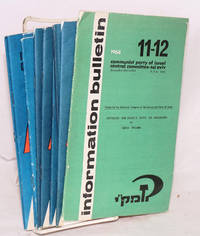
1981152273Tel Aviv: the party 1981. Eleven issues staplebound 8.25 x 5.25 inch booklets generally very good. Text in English. Issues present are 11-12/68 9/80 10-11/80 12/80 1/1981 2/81 3/81 special issue for June 1981 11/81 1-2/91 and 5-6/91. the party unknown
193614357New York: Communist Party of the USA N.d. ca 1936. First Edition. Quarto 27.5cm. Printed self-wraps; 15pp. Margins slightly browned else Very Good. Issued as a broadside against the Socialist Party of America on the eve of their annual convention. Includes excerpts of speeches and essays by Earl Browder Israel Amter M.J. Olgin and others as well as two cartoons by Fred Ellis. Much on the COMINTERN's stance towards the Spanish Civil War. SEIDMAN C-465: "Communist Party leaders warn the Socialist Party against Trotskyite influence and invite socialists to collaborate in a people's front. Communist Party of the USA unknown
1934311724London England: Henry Colburn 1934. Hardcover. Good. London: Henry Colburn 1834. 5 volumes in 4 Volumes I & II in one; Volume III Volume IV and Volume V. It was first published in 1826. This appears to be a second edition. Set is neatly disbound without endpapers. Text is very good. Foxing to endpapers. No former owner marks. One of the first if not the first in this series the title page reads: "Colburn's Modern Novelists Vivian Grey in Five Volumes." No author is named. Disraeli's first novel was published anonymously. In it he told the story of a failed business dealing with his father's friend the notable London publisher John Murray. After talking Murray into launching The Representative a daily newspaper Disraeli unable to pay his promised share of the capital quarreled with Murray and others. In Vivian Grey he lampooned Murray while telling the story of the failure. Disraeli was unmasked as the author and was widely criticized. Copies of the anonymous editions are rare. The series of Colburn's Modern Standard Novelists noted as 1835–41 in 19 vols. contained works by Thomas Campbell Bulwer Lytton Theodore Hook and Harrison Ainsworth Lady Morgan Robert Plumer Ward Horace Smith Marryat Thomas Henry Lister G. P. R. James and George Robert Gleig. Colburn also numbered among "my authors" Disraeli John Banim and fashionable novelists of the day. Among his most notable accomplishments as a publisher were the publication of the first edition of John Evelyn's Diary in 1818 and Pepys's Diary in 1825. Not available for priority/expedited shipping. Due to the size/weight of this book extra charges may apply for international shipping. Henry Colburn hardcover
195054848Cincinnati OH: The Melville Company ca. 1950. 4to. 39 8.5 x 11 in. fashion plates with 97 tipped-in fabric samples including cotton cotton blends cotton-rayon blends satin nylon for men & women’s fashions dresses lingerie pants suits skirts. order blank booklet preserved in original cardboard portfolio w/ company design logo on rear flap an excellent collection. First edition of this scarce and unusually complete salesman sample sales kit for women’s dresses fashions coats lingerie as well as men’s overcoats underwear & socks and even women’s outerwear rubber pocket books and overcoats in post-World War II America. The Melville Company was a coordinated direct-sales fashion company supplied by Harford Frocks Inc. which maintained a large mail order tailoring operation in Ohio from the early 1920s up through the 1970s employing 100s of tailors and seamstresses to fill orders together with J.C. Field & Son Inc. direct marketing firm. The company focused on “plus sizes†while maintaining how these fashions emphasized trim appearances survived on a constant sales force composed primarily of young women and house wives earning extra money willing to peddle door-to-door and created a high-quality product. The catalogue offers invaluable illustrated historical reference for the colours styles and fabrics during the explosion and impact of Christian Dior’s new designs reflecting the refined femininity with severely cinched waists extra padding to the hips longer and decidedly more romantic skirts and dresses as well as nicely fitted jacket-and-skirt tailored suits. Israel 1901-1991 built and ran this very successful mail order dressmaking operation which also owned the Fashion Frocks Dress Company as well and operated out of the Oesterlein Machine Company historic building in Cincinnati OH now home to the American Sign Museum. The Melville Company, unknown
1958207315Jerusalem: The Government Printer 1958. First Edition. Neat vertical crease to rear wrapper; slightly bumped; very good bright. 12mo unpag. in printed pictorial wrappers. Extensively illustrated booklet issued for the Israel pavilion at the Universal Exposition in Brussels coinciding with the tenth anniversary of the country's founding. An interesting association copy inscribed on the half title page to the journalist and photographer Ruth Gruber and her husband by Channa Ruppin with her inscribed calling card laid in. Channa or Chana Ruppin was the widow of Arthur Ruppin an early Zionist leader who had emigrated to Palestine in 1907 and became a key figure in laying the groundwork for the future state by acquiring land. The Government Printer unknown
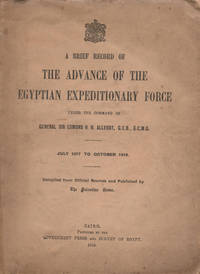
191933317Cairo: The Palestine News; Produced by the Government Press and Survey of Egypt 1919. First Edition First Issue of the text. Illustrated with an engraved frontispiece of General Allenby signed in the plate and a profusion of colour maps 56 in all. 4to publisher’s original tan wrappers lettered in black on the upper cover and on the burnt-orange linen spine. iv 112 pp. A very well preserved copy handsome with some light wear to the wrappers a light bit of foxing to the end-leaves as usual the text-block clean throughout all maps in fine order. FIRST EDITION FIRST ISSUE THE TRUE CAIRO PRINTING FOR THE PALESTINE NEWS. A core text for understanding the modern Middle East and the fall of Ottoman dominion over the land. This primary document gives a largely day-by-day progression of the events between July 1917 and October 1918 that led up to the Arab revolt against the Ottoman rule in Arabia the defeat of the Ottoman Turks and ultimately the fall of Damascus. This important work is one of the very best documents for understanding the conflict and the subsequent agreements settling the affairs of Syria Lebanon Palestine Arabia Yemen Iraq Jordan and greater Arabia at the end of the First World War. Included are two pieces by T.E. Lawrence the famous “Lawrence of Arabia†and arguably the most important of all the individuals involved with leading the revolt see Seven Pillars of Wisdom. The two articles compiled from Lawrence's own writing concern the 'Sherifian Co-operation in September' and the 'Story of the Arab Movement' that accompany plates 49-50 and 51-53 concerning the Arab Revolt and the fall of Damascus as well as various military reports and numerous maps marking the daily positions of the troops as the final showdown grew nearer. This document was created so that “members of the Force may be able to take home with them an acceptable account of the great advance in which they have played a part†preface. This is one of the earliest accounts of that campaign its details being still “fresh in the memory.†A fascinating and comprehensive record. Much of what is covered in the text is important in the establishment of the modern Middle East including Israeli statehood and the various events leading up to it: the Balfour Declaration and the British Mandate. The Palestine News; Produced by the Government Press and Survey of Egypt unknown
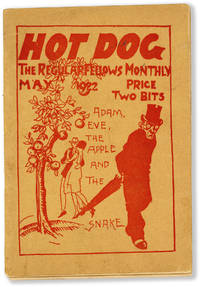
192281727Cleveland: Merit Publishing Co 1922. First Edition. 12mo. Staple-bound pictorial wrappers; 40pp; illus. Light external wear and soil; internally complete sound and unmarked; Very Good. <br /> <br /> Single issue of this low-budget interwar men's magazine an amateur potpourri of off-color jokes double-entendres wink-wink nod-nod anecdotes anti-Prohibition nostrums and photo illustratons of scantily clad by 1920s standards Hollywood starlets with captions such as: "Here she is fellers. This is the kind of lady who breaks up homes.how'd you like to have her break up yours" And so on. Though the contents of Hot Dog never ventured beyond the palest shades of blue its notional audience - American G.I.s who'd returned from the boites of Europe with suddenly "advanced" notions of sexuality and morality - were clearly appreciative as Dinsmore's outfit kept up publishing at least until 1933. Merit Publishing Co unknown
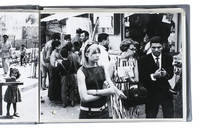
1967ABC_47179Israel 1967. Oblong album ca. 20 x 26 cm; photographs in slightly varying sizes ca. 18.5 x 24 cm. Grey faux-leather photo album with a small white label on the front board: "42 x Israël 1967 23-24-25 Juli". 44 silver gelatin photographs including 2 duplicates and 1 other loosely inserted. 44 photographs in an album with 30 clear plastic inserts. A rare collection of fascinating original photographs capturing the first Western tourists in Israel and Israeli captured territories approximately a month after the Six-Day War in 1967 by Dutch journalist and photographer Bianca Maria Dony. The 44 photos in the album show the passenger ship SS Pegasus soldiers local people in the streets of Jerusalem and other cities an early war monument checkpoints destroyed military vehicles and other remnants of the war. The album is from the archive of the photographer; some of these photographs were sold to and published in national Dutch and international newspapers and magazines while others remained unpublished.Bianca Dony was part of a group of 150 Christian tourists from various European countries who were now - after the Israeli capture of these areas - able to visit the holy places in the old city of Jerusalem Bethlehem and other places that had previously been inaccessible. The tourists in the present photographs were the first of many and Dony took this opportunity to not only document the trip itself but also the general aftermath of the war.With an additional leaf in the inside front pocket of the album containing notes of how many photographs were sold to different newspapers and magazines including 10 to the "Haagsche Courant" written in blue and red ink and in pencil. Added to the first photograph in the album is a newspaper clipping from the "Jerusalem Post" with the headline "Haifa direct to old city for first time" about the first tourists visiting Israel after the Six-Day War. Some of the clear plastic inserts have small round white stickers on them with different abbreviations connecting the photographs to the newspapers and magazines that possibly printed them for example "HC" for Haagsche Courant etc. 3 photographs are loosely inserted and 2 of these are duplicates of other photo's in the album the 2 duplicates contain a blue stamp "foto bianca dony 147 Malakkastraat Den Haag - Tel. 5582540 Giro 303814" and a manuscript caption in red ink on the back. Most other photographs are simply numbered in pencil on the back. This rare collection of 44 historically significant photographs is in very good condition.l Cf. Rebecca L. Stein "Souvenirs of conquest: Israeli occupations as tourist events" International Journal of Middle East Studies vol. 40 no. 4 2008 pp. 647-669. hardcover
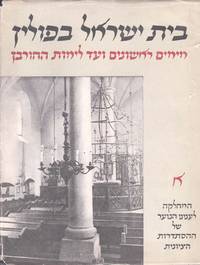
195342814Jerusalem; Youth Dept. Of The Zionist Organisation 1953. 1st edition. Clothbound with dust jackets. 4to. 215 10 288 pages. 28 cm. In Hebrew. With 14 black and white illustrations. Title translates as: "House of Israel in Poland; from the earliest days to the Holocaust. " A two volume Yizkor for Polish Jewish community history. Bound in red cloth. Subjects: Jews - Poland - History. Light shelf wear to cloth jacks show wear very good condition in good jackets. YIZ-15-20A-E. Jerusalem; Youth Dept. Of The Zionist Organisation unknown
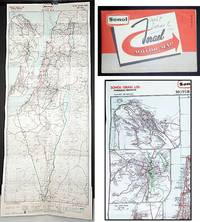
196021074Tel Aviv: Merkaz le-mipui Yiśraʼel.; Sonol Israel ltd. 1960. Second Edition. Folding color road map. Very Good. <br /> <br /> A mid-century Israeli motor map produced for motorists during the country's early statehood years prior to the territorial changes of 1967. Issued by Sonol Israel Ltd. as a petrol-station distribution piece the map reflects the period's reliance on branded service-station maps as practical navigation tools rather than decorative souvenirs. <br /> <br /> Its bilingual Hebrew and English presentation suggests use by both domestic drivers and international visitors during a formative phase of national infrastructure development. <br /> <br /> Physical Description: Color folding road map printed on period paper stock with tabbed sections directing users to informational panels. Includes inset city maps of Haifa Jerusalem and Tel-Aviv-Yafo along with extensive tables of distances road signs service stations and general motoring information. Scale 1:500000. Measures approximately 8 × 5.25 inches folded opening to approximately 15.5 × 38 inches. <br /> <br /> Condition: The bindings are tight and square. Map is clean and fully intact with light even age-toning consistent with mid-century paper stock. No splits or tears. Minor ink notation on the front panel. Second Edition. <br /> <br /> Scarcity Note: Petrol-company road maps from Israel's early decades were produced for utilitarian use and were rarely preserved. WorldCat/OCLC records document few surviving examples of Sonol-issued motor maps with limited representation in map and ephemera collections. This map documents Israel's highway network urban approaches and service infrastructure at a moment when private motoring was expanding rapidly and cartographic standards were still being established. <br /> <br /> The combination of national road coverage city insets and practical reference tables places it firmly within the tradition of mid-century commercial cartography where petroleum companies functioned as informal navigational publishers. As a pre-1967 issue the map also preserves a geopolitical snapshot valued by collectors of modern Middle Eastern cartography. <br /> <br /> Contextual / Historical Significance: Produced during Israel's first two decades of statehood the map reflects early efforts to standardize transportation signage and intercity travel. Sonol founded in 1953 and later sold by Mobil in 1969 was among the country's leading fuel brands and its cartographic material forms part of the visual and commercial record of Israel's early infrastructure development. There is no film adaptation or fictional tie-in. <br /> <br /> Subjects: Israel road system pre-1967 borders petrol-company advertising bilingual maps service-station ephemera mid-century travel cartography urban inset plans Cartography Middle Eastern History Transportation Ephemera.<br /> <br /> Bibliographic References: OCLC/WorldCat: record no. 1014137604 Comparative Sonol and regional petrol-company road maps 1950s-1960s on Roma cartographic listings online reference Merkaz le-mipui Yiśraʼel.; Sonol Israel, ltd. unknown
197012268France Navarrenx Sus: Twelve Tribes of Israel 1970. First Edition. Original Wraps. Very Good in Wraps. First Edition. Original Wraps. A ecumenism community in the Pyrennes of Frances promoting the concept and principle that Christians who belong to different Christian denominations should work together. The community called the Tribe of Reuben belongs to the Twelve Tribes of Israel an international communal messianic movement that began in Chattanooga Tennessee in the mid-1970s. The Twelve Tribes' eighteenth-century chateau in Sus known as "Tabitha's Place" and focuses mainly on France's branch of this NRM. The journal offers a useful account of the origins and history of the group and describes the characteristics of the much larger international movement. Extremely scarce. Toning creasing and chipping else tight bright and unmarred. Tabloid fold-out newsprint. No issue stated. Twelve Tribes of Israel unknown