22 résultats
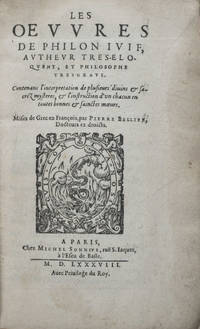
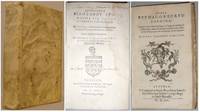
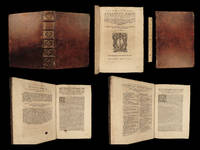
158848057Paris: Michel Sonnius 1588. Early edition. Softcover. fair to good- condition. Duodecimo 6 1/2 x 4 1/2". 8 528 32 leaves. Original soft calf with title stamped onto spine. Engraved title page. Decorative headpieces and initials. Engraving on verso of table of contents. Marginalia. Printed by Charles Roger.<br /> <br /> Originally published in 1575 this first French language edition of the works of Philo a first-century Alexandrian philosopher known for his mostly allegorical interpretations of the Torah known in the Hellenic world as the Pentateuch. His works also include histories and comments on philosophy. <br /> <br /> Many of the titles by which texts and text groups are known as modern conventions and not inventions of Philo.<br /> <br /> This book contains no less than 24 titles including the following:<br /> <br /> - De la Création du Monde On The Creation of the World<br /> - Allégories des Saintes Lois Allegorical Expositions of the Holy Laws<br /> - Du Plantement On Planting<br /> - De la Vie de Moïse On the Life of Moses<br /> - De la Charité et de l'Amour de son Prochain On Charity and Love for Others<br /> - De l'État et Devoir du Juge On a Judge's Duty<br /> - De l'Érection et Création du Prince <br /> - De la Force et Grandeur de Courage On the Power and Grandeur of Courage<br /> - Les Dix Commandements The Ten Commandments<br /> - Des Lois Particulières On the Specific Laws<br /> - De la Circoncision On Circumcision<br /> - De la Monarchie On Monarchy<br /> - Quels doiuent estre les loyers & honneurs des Sacrificateurs Rents & Honors of Priests<br /> - Des animaux qui sont propres aux Sacroifices: & quelles sont les elpeces des Sacrifices Elements of Animal Sacrifices<br /> - De ceux qui offrent les hosties au Sacrifice Hosts of Sacrifices<br /> - Qu'il ne faut point receuoir au temple le loyer & gain de la paillarde Rent and Profit of the Merchants<br /> - Que tout homme de bien est libre Every Good Man is Free<br /> - De la vie contemplariue ou des vertus des personnes deuotes Contemplative Life and Virtues<br /> - De la Noblesse On Nobility<br /> - Des loyers & peines Rents and Penalties<br /> - Des maledictions Curses<br /> - Que le monde n'est perissable That the World isnot Perishable<br /> - Contre Flaccus: ou de la prouidence Against Flaccus: or the Providence<br /> - Des vertus & ambassade fait à Caius Virtues & Embassy to Caius<br /> <br /> Text in old French. Front cover curling with spots and scratches. Endpapers age-toned and with creasing. Small tear to title page engraving and chips along bottom edge. Some light staining and starting lightly at pages 177 265 and 425. Block age-toned. Binding in overall fair interior in good- condition. Michel Sonnius unknown
155131289Lugduni Lyon Lyons: Apud Seb. Gryphium Sebastien Gryphe 1551. Hardcover. Very Good. 3 X 5 inches high. 1092 pages complete. Contemporary vellum binding with 4 raised bands on spine handwritten title on spine. Condition of the book is Very Good; Vellum is cracked on spine and is peeling see photo small ownership inscription on title page " Ex Libris Robwitch 1713" the name is hard to make out - probably English Gryphe 'Griffin' colophon on title page ink stains on pages 129 & 609 some pages have very light waterstains in the corners otherwise pages are very clean binding is tight. Military Rare RGR Apud Seb. Gryphium [Sebastien Gryphe] hardcover
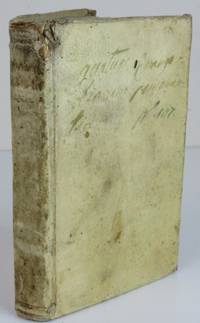
158843973Paris: Michel Sonnius 1588. Early edition. Hardcover. f to vg. 12mo 7 x 4 3/4". 8 528 32 leaves. Contemporary full vellum with handwritten title to spine. Publisher's title vignette. Decorative headpieces and initials. <br /> <br /> Originally published in 1575 this first French language edition of the works of Philo a first-century Alexandrian philosopher known for his mostly allegorical interpretations of the Torah known in the Hellenic world as the Pentateuch. His works also include histories and comments on philosophy. <br /> <br /> Many of the titles by which texts and text groups are known as modern conventions and not inventions of Philo.<br /> <br /> This book contains no less than 24 titles including the following:<br /> <br /> - De la Création du Monde On The Creation of the World<br /> - Allégories des Saintes Lois Allegorical Expositions of the Holy Laws<br /> - Du Plantement On Planting<br /> - De la Vie de Moïse On the Life of Moses<br /> - De la Charité et de l'Amour de son Prochain On Charity and Love for Others<br /> - De l'État et Devoir du Juge On a Judge's Duty<br /> - De l'Érection et Création du Prince The creation and elevation of the Prince<br /> - De la Force et Grandeur de Courage On the Power and Grandeur of Courage<br /> - Les Dix Commandements The Ten Commandments<br /> - Des Lois Particulières On the Specific Laws<br /> - De la Circoncision On Circumcision<br /> - De la Monarchie On Monarchy<br /> - Quels doiuent estre les loyers & honneurs des Sacrificateurs Rents & Honors of Priests<br /> - Des animaux qui sont propres aux Sacroifices: & quelles sont les elpeces des Sacrifices Elements of Animal Sacrifices<br /> - De ceux qui offrent les hosties au Sacrifice Hosts of Sacrifices<br /> - Qu'il ne faut point receuoir au temple le loyer & gain de la paillarde Rent and Profit of the Merchants<br /> - Que tout homme de bien est libre Every Good Man is Free<br /> - De la vie contemplariue ou des vertus des personnes deuotes Contemplative Life and Virtues<br /> - De la Noblesse On Nobility<br /> - Des loyers & peines Rents and Penalties<br /> - Des maledictions Curses<br /> - Que le monde n'est perissable That the World isnot Perishable<br /> - Contre Flaccus: ou de la prouidence Against Flaccus: or the Providence<br /> - Des vertus & ambassade fait à Caius Virtues & Embassy to Caius<br /> <br /> Binding age-toned. Book block separating from binding but still holding. Fore-edge of front free endpaper and fly leaf creased and torn. Clear and sporadic water-staining along upper margin of pages throughout. Text in old French. Binding in overall fair to good interior in good to very good condition. Michel Sonnius hardcover
15836293Lutetiae Paris E Typographia Steph. Prevosteau . 1583-85. Two works bound in one volume: 12mo pp. xxiv 347 i. 12mo pp. ii 11 xi 90. Old ink-burn D11-E9 in the first work ie pp. 93-114 particularly noticeable E3-E6. Second work lacks two of the final leaves of text. Text concludes with the errata on verso of H1; H2 and H3 have been extracted; H4 blank as called for by Adams is present. Greek and Latin text. Contemporary limp vellum. Two early ownership inscriptions on title. The clearer of the two reads Ex libris Ioa. Maussaci in an early seventeenth century hand possibly Philippe Jacques de Maussac 1590-1650 president in Montpellier and a Greek scholar he edited Harpocration in 1614 cf. Sandys II p. 287. First edition of the commentary on the Golden Verses of Pythagorus by the fifth-century Neoplatonist Hierocles discovered in the library of François de la Rochefoucauld-Randan and edited and translated by Curterius; bound here with the first edition of Théodore Marcile's Latin translation. Both works were printed by Stephan Prevosteau - he is credited in the colophon of the first work and a variant title page carries his imprint Adams P2312 rather than Nivelles - and pairings of the works are not unknown. The example in the recently dispersed Macclesfield library lot 2711 in part 8 October 2006 was similarly bound in limp vellum and issuing them together may have been Prevosteaus own recommendation to his clients.Adams P2313 & P2314; Brunet III 154-155; Sandys II 105. Book hardcover
156424296<p><strong>1564 Saint Athanasius of Alexandria Egypt 1ed Holbein Durer Style Bible Woodcuts</strong></p><p>Athanasius the Great of Alexandria was a 4th-century church father who was known as being one of the greatest Egyptian leaders in Christianity. He is often best remembered for his opposition to Arius and Eusebius of Nicomedia which ultimately relegated him to exile multiple times. </p><p>Athanasius's works mostly include letters though the letters are greatly in defense of Christianity. He sought to defend the Holy Trinity as well as decrees made at the Council of Nicaea. This Nicaean defense 367AD is one of the first-known written examples of the listings of the New Testament books. </p><p>The writings of Athanasius serve two purposes – attack paganism and defend teachings of Christian redemption. This mindset is fulfilled throughout his works including his Old Testament exegeses where he defends the truth of the Holy Spirit.</p><p>This 1564 Basel edition was published by Nicolas and Eusebius Episcopios in an impressive leather-bound tome. </p><p>Item number: #24296</p><p>Price: $1250</p><p>ATHANASIUS of Alexandria</p><p><strong><em>Athanasii Magni Alexandrini Episcopi graviss. scriptoris et sanctiss. martyris Opera : in quatuor tomos distribute</em></strong></p><p>Basileae: Ex officina Episcopiana per Nicolaum et Eusebium Episcopios 1564. First edition.</p><p><u>Details</u>: </p><p><!-- if !supportLists-->· <!--endif-->Collation: Complete with all pages</p><p><!-- if !supportLists-->o <!--endif-->8 730 142 24</p><p><!-- if !supportLists-->o <!--endif-->Numerous illustrated initials throughout</p><p><!-- if !supportLists-->· <!--endif-->References: USTC 613803</p><p><!-- if !supportLists-->· <!--endif-->Language: Latin </p><p><!-- if !supportLists-->· <!--endif-->Binding: Leather; tight and secure</p><p><!-- if !supportLists-->· <!--endif-->Size: ~12.75in X 9in 32cm x 22.5cm</p><p><!-- if !supportLists-->· <!--endif-->Very rare and desirable </p><p>Our Guarantee:</p><p>Very Fast. Very Safe. Free Shipping Worldwide.</p><p>Customer satisfaction is our priority! Notify us with 7 days of receiving and we will offer a full refund without reservation!</p><p>24296</p><p>Photos available upon request. </p> officina Episcopiana, per Nicolaum et Eusebium Episcopios], hardcover
153212434Cologne: Eucharius Cervicornus Eucharii Cervicorni. Very Good with no dust jacket. 1532. Vellum. 16 240 ie 238 32 pp. In 8s R8 is the last blank. Small octavo 6" x 4" 15 cm x 10 cm full vellum with yapp edges all edges stained dark blue. Beautiful engraved title page with architectural frame and Cleopatra and the asp at the bottom done by Holbein. Wonderful engraving of St. Jerome in his study with his lion and his book the facing page has a spectacular initial with a Roman head along with a small intricately engraved illustration of a saint with a swan with Mary and the infant Jesus in the background St. Hugh . Tables of concordance at the rear. Condition is very good. General light age and patina to the vellum old shelf marks in brown ink to the front cover handwritten spine title quite faded. Interior end papers have an Italian book seller's label some small brown ink marks. Title page has an owner's inscription in old ink of Flavius Floriani Fulginatis occasional small marks or underlinings all seem to be quite old. Paper is a bit toned with some foxing occasional other small flaws which don't hinder reading or appreciation. Entirely in Latin. A quite scarce book. Ammonius of Alexandria was a 3rd century Christian philosopher who is thought to have developed one of the earliest gospel harmonies. The Ammonius text here was said to have been translated by Victor de Capua a 6th century bishop who also worked with the Syriac gospel harmonies the Diatesseron of Tatian. According to a note on a University of Ghent copy Victor de Capua was hesitant whether to ascribe the work to Tatian or to Ammonius. Appears to be a re-setting of the also very hard to find 1524 Mainz edition which identifies Michael Memlius as the modern editor. Very hard to find. Only 3 copies at auction in the last 60 years none for sale now not many in libraries. USTC 689184 VD16 B 4634 ; 8vo 8" - 9" tall . Eucharius Cervicornus (Eucharii Cervicorni) hardcover
1566002448Venice: Curtio Troiano 1566 Bound in vellum with hand written spine titles 351 632 pp. numerous illustrations. Title page dated 1565 colophon dated 1566. Second Tataglia translation with the first Tatarglia translation being the first translation of Euclid into a modern language. This copy with cancel between pages 8 and 9 few marginal notes marginal worming affecting at most two letters and that on few pages front cover first nine leaves and last leaves from page 309 to end with damp stain light intermittent damp stain between. Otherwise still a very good copy. Curtio Troiano hardcover
152232993-1175Strasbourg Johannes Knobloch March 1522. Title within fine wide woodcut border of numerous scenes from the lives and miracles of Saints Peter and Phillip. 6 314 ff. Folio. 17th vellum. small monastery library stamp on title. Strasbourg Johannes Knobloch March 1522. Important collections of Athanasius' works preceded only in 1519 and 1520 by non-identical editions printed by Jean Petit in Paris. Editors of the present book were Christopher Porsena St. Ambrosius of Camaldoni Johannes Reuchlin and Angelo Poliziano. St. Athanasius Magnus 295-373 bishop of Alexandria "Father of Orthodoxy" is one of the greatest Church Fathers. He played a leading role against Arianism in the first Council of Nicaea. His "Disputatio contra Arrium" is printed here on ff. CCLXIIr-CCLXXIv as well as Eramus' "Paraclesis ad lectorum plum" on ff. 2-5 at the beginning VD 16 E 3288 which was printed for the first time in 1516 as the introduction to his NT translation. A.o. the Wolfenbüttel copy lacks index and additional 6 leaves incl. title at the beginning. In this present copy the 10 ff. index was originally not bound in.- Some old ms. annotations in the text otherwise a fine copy. - VD 16 A 3977; Index aur. 109.392; Muller 340; Hoffmann Griech. I 389; Adams A-2080; not in Kristeller. Strasbourg, Johannes Knobloch hardcover
15541506230049Venice: Apud Hieronymum Scotum 1554-01-01. Hardcover. Good. Folio. Original vellum. Minor soiling to cover. Good binding and cover. Later leather binding straps. Later end pages. Printer's device on title page. Text generally clean a few lines of early marginal notation and underlining. Collated: A-L8 M-M6 N-N4 in 8's with the title as leaf A1. Faint stain on first few leaves. Edito princeps 1535. Refs: British Museum p. 44. STC Italy Vol I. p. 99; Not in Brunet. <br><br> Johannes Philoponus John the Grammarian or John of Alexandria was an important Aristotelian commentator and Christian theologian. John's commentaries on Aristotle were influential on medieval and early modern thinkers in Europe such as Gianfrancesco Pico della Mirandola and Galileo. Philoponus has been seen as an important precursor to the establishment of empirical philosophy. <BR> In this book Philoponus comments on Aristotle's De Anima On the Soul and substantially modifies Aristotle's ideas. His commentary deals specifically with Aristotle's theory of light "Philoponus contends that Aristotle' view fails to account both for the laws of optics. Philoponus modifies the theory so as to save the phenomena he proceeds to re-interpret the term Energeia not as a state of actuality but rather as an 'incorporeal activity' which besides constituting the transparency of the medium is also capable of warming bodies.Due to this novel interpretation of Aristotle's terminology light is now understood not statically but as something dynamical." - Stanford Philosophical Encyclopedia. <BR>It should also be noted that since Michael Hayduck's edition Berlin 1897 it is generally assumed by scholars that the third book of the commentary that had been ascribed to John Philoponus wasoriginally written by Stephanus of Alexandria as is attested in the manuscript Parisinus gr. 1914 11th/12th cent. An important early work in physics and natural philosophy. Venice: Apud Hieronymum Scotum hardcover
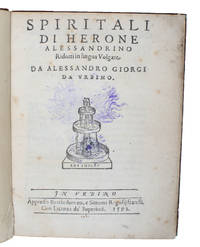
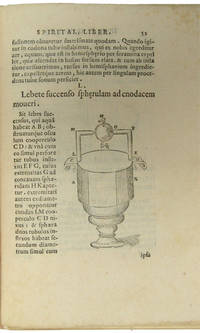
159254283Urbino Bartholomeo e Simone Ragusij fratelli 1592. Small 4to. Hcalf 19th century gilt spine raised bands titlelabel with gilt lettering. Spine a little rubbed and fronthinge weakening. Corners strenghtened with vellum. Ff 482. With around 90 woodcuts in the text including one on the title-page. A stamp on verso of titlepage the Salamander Collection. Title-page with light browning. A few scattered brownspots but internally clean. Verso of last leaf with errata. Light fraying to the first 3 leaves. <br/><br/><em>Second Italian edition of Heron's main work Spiritalium being his first publication. The work stimulated and contributed substantially to the interest in pneumatics that arose suddenly in the late 16th century and led to the work of Toricelli and Boyle. The "Pneumatics" was not published in Greek until 1693. It is one of the major sources to our knowledge of the techniques and mechanics of Antiquity and the many hydraulic and mechanical inventions by Hero are here depicted for the first time in print. The work includes studies of pneumatics and mechanics and include 89 illustrations of different inventions such as siphons fountains engines an account of a small stationary steam-engine which is of the form now known as Avery's patent the double-force pump etc. which "by the union of compressed air earth fire and water and the concurrence of.elementary principles. supply the most pressing wants of the human life or produce amazement and alarm." The book describes many gadgets and magical tricks and includes the first suggestion of a steam engine see f. 53 verso. Sarton Introduction.Vol. I pp. 208 ff. - Adams H:372 - Poggendorff I: 1084. - Brunet III129. </em> hardcover
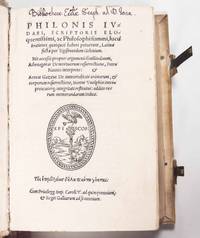
155848886Basel: Nikolaus Episcopius the Younger 1558. Hardcover. Fine. Two volumes octavo. I: a-z8 blank a8 A-Z8 alpha-gamma8 delta4 396 leaves pp. 14 2 blank 774 1 blank 1 printer’s device. II: Aa-Zz8 AA-ZZ8 Aaa-Ggg8 blank Aaa8 Hhh4 428 leaves pp. 2 779-1526 2 blank 103 index 1 colophon 1 blank 1 printer’s device. Imprint from colophon vol. 2. Woodcut printer’s devices at titles and final leaves both volumes; woodcut historiated initials open each book. Contemporary paneled pigskin over beveled wooden boards tooled in blind. Spines with raised bands in four compartments library tickets at bottom compartment. Brass clasps and caches intact. Spines cleaned with later library shelf marks and traces of older manuscript titling. Very occasional faint touches of marginal foxing or soiling. A fine amply-margined set of an uncommon edition.<br /> <br /> Second Episcopius edition and the first Latin version of Philo’s complete works here in octavo format and augmented with treatises translated from the Greek on the resurrection of the dead and the immortality of the soul by Athenogorus of Athens and Aeneas of Gaza. Sigmund Gelen’s 1497-1554 version had first appeared from the press of Episcopius as a single folio volume in 1554. The first volume contains no imprint data apart from the device’s at the title and final leaf. The colophon of the second volume provides the complete information while the imprint at the title omits Episcopius’ name. <br /> <br /> Provenance: Old manuscript entries of “Bibliotheca Eccta Scaph. ad D. Joan.†at titles both volumes. References: Adams P-1029; Fürst 3:89; Goodhart & Goodenough 451. Hofmann 3:70. VD16 ZV 12448/12449 total of only 5 libraries located between the two entries.<br /> <br /> Full titles and imprint: Philonis Iudaei scriptoris eloquentissimi ac philosophi summi lucubrationes quotquot haberi potuerunt Latinae factae per Sigismundum Gelenium. His accessit propter argumenti similitudinem Athenogoras De moruorum resurrectione Petro Nannio interprete et Aeneas Gazaeus De immortalitate animarum et corporum resurrectione Ioanne Vuolphio interprete uterque integritati restitutus addito rerum memorandarum Indice. vol. 2: Tomus II Philonis Iudaei Commentariorum Sigismundo Gelenio interprete. from colophon: Basileae apud Nic. Episcopium Iun. M.D.LVIII. Nikolaus Episcopius the Younger hardcover
157531751Urbini D. Frisolini 1575. Small 4to. Fine recent full vellum in old style with written title on back. Titlepage 80 leaves title unnumb. F 1-80 with 4 leaves misnumb. e.g. F70 instead of 80. The dedicationleaf unnumb. after title missing. Text complete fine and clean with broad margins. One large initial in woodcut and 89 large textillustrations in woodcut. <br/><br/><em>First edition of Heron's main work being his first publication. The work stimulated and contributed substantially to the interest in pneumatics that arose suddenly in the late 16th century and led to the work of Toricelli and Boyle. The "Pneumatics" was not published in Greek until 1693. It is one of the major sources to our knowledge of the techniques and mechanics of Antiquity and the many hydraulic and mechanical inventions by Hero are here depicted for the first time in print. The work includes studies of pneumatics and mechanics and include 89 illustrations of different inventions such as siphons fountains engines an account of a small stationary steam-engine which is of the form now known as Avery's patent the double-force pump etc. which "by the union of compressed air earth fire and water and the concurrence of.elementary principles. supply the most pressing wants of the human life or produce amazement and alarm." The book describes many gadgets and magical tricks and includes the first suggestion of a steam engine see f. 52. - Sarton Introduction.Vol. I pp. 208 ff. - Adams H:369 - Poggendorff I: 1084. </em> hardcover
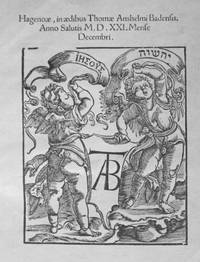
1521D6762Haguenau: Thomas Anshelm Badensis December 1521. First Edition. Hardcover. Very Good. Folio 319 x 203mm. Signatures: a-z in 8s; A-B in 6s. Double column numbered to 776 text in Greek. Woodcut initial beginning letter A. Large woodcut printers device on final leaf by Hans Baldung Grien d.1545 German artist and printmaker is called one of his best works Butsch I p. 48 pl. 75. Period limp vellum neatly rebacked remnants of old index tabs; light staining or wear with use otherwise very good. Few instances of marginalia in Greek mostly in letter A; Armorial bookplate of Reverend William B. Hayne Master of the free grammar school of Hinton Maurice in Devon; sold by Thomas Baker to Cuthbert H. Turner 1860-1930 English ecclesiastical historian and Biblical scholar his ownership inscription dated 1919 Magdalen College Oxford; John Waynflete Carter 1905-1975 English author diplomat and book collector his book label on front pastedown; BL early emblematical bookplate on front pastedown; gilt monogram on covers CML. <br/><br/>First edition printed in a German speaking country of Hesychius Lexicon of obscure Greek words this copy with an interesting scholarly provenance. First Edition printed in a German-speaking country correcting the Aldine edition of 1514. The Lexicon suffered substantial alterations including abridgements and additions on its way from the author to the only surviving manuscript of the fifteenth century. This production gives all-important information about the manuscript and the work of earlier scholars. Hesychius of Alexandria lived in the fifth century A.D. and compiled this dictionary of unusual or difficult Greek words with explanations in Greek. Approximately 51000 entries make it the richest surviving Greek lexicon compiled until the invention of printing. Hesychius Lexicon is of great importance to Ancient Greek studies because it contains countless words and expressions from poetry administration medicine and so on that are otherwise unknown or insufficiently explained. In particular this work preserves numerous words from the Greek dialects that are important not only for Greek but also for Indo-European philology. Staikos says A unique source book Hesychius Lexicon deals mainly with words that exist in unusual forms or have more than one meaning that is to say rare words that were not in everyday use. It also quotes a great many passages from lost works by orators poets historians and medical writers. Excellent survival and passed through many learned hands. Adams H509; Staikos I 348. Thomas Anshelm Badensis hardcover
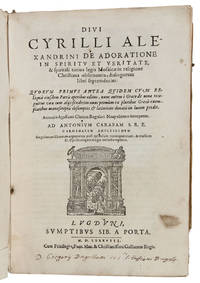
1588F4CBKZTH4G5BLyon 1588. 4to. Sybille de la Porte Contemporary limp calf parchment sewn on 2 tanned leather thongs manuscript title on spine remnants of tanned leather ties. With Porta's woodcut device on title-page showing Samson carrying the doors of Gaza with the motto "Libertatem meam mecum porto" Baudrier VII pp. 350 no. 3 a woodcut headpiece also incorporating an illustration of Samson with the doors Baudrier VII pp. 350 no. 1 several woodcut tailpieces numerous decorated woodcut initials at least 3 series and decorations built up from cast fleurons. 24 454 25 1 blank pp. First edition of Agelli's translation and first separate edition of any version of Cyril's "the adoration and worship of God in spirit and in truth" a commentary on the Old Testament concerning Mosaic law written in the form of a dialogue between Cyril and Palladius. It is the first commentary by the patriarch of Alexandria Cyril of Alexandria ca. 376-444 whose "precision accuracy and skill as a theologian has often been remarked" The Oxford Dictionary of Saints. "St. Cyril uncovers this mysterious allegorical and immutable sense of Mosaic Law and adds a coherent sketch of Old Testament foundations of spiritual preparation. In particular he dwells on the Old Testament prototypes of the Church" Florovsky. It is published by the female printer Sybille de la Porte 1540-1608 widow of the printer Henry de Gabiano.With 17th-century owner's inscription on title-page. In very good condition with a minor water stain in the outer margin of ca. 20 leaves some small stains from the ties of the binding through the first few leaves. Binding also very good only slightly chipped in the lower spine and ca. 10 tiny wormholes.l Baudrier VII pp. 355-356; French vernacular books 63857; USTC 156678; cf. Florovsky The Byzantine Fathers of the fifth century p. 186. hardcover
15084444Paris: Printed by Wolfgang Hopyl for himself Jean Petit and Thielmann Kerver 1508. First Complete Edition. Very good. Folio. a-o8 p3 A101 B-G8 H10 q-z8 A-C8 D4 COMPLETE. Inconsistent foliation: 115 64 116-223 i.e. 222 ff. With Wolfgang Hopyl's elegant title-page woodcut Sylvestre Marques typographiques 1066 depicting two eagles displayed in their beaks a circle crowned with letterpress title in the center in their claws a second circle early ownership canceled evidence of what may have been MS notes surrounding it in the margins are fine renderings of trees and plants. Slight foxing or toning occasional minor stains or wormholes in blank margins inexplicable 2 cm. tears in lower blank margins of a number of consecutive leaves 55-126 second numbering none affecting text. Occasional marginal notes and notes of chapter parts. Contemporary Italian blind stamped leather heavily restored SEE IMAGES modern smooth spine with portions of original spine laid down four deerskin ties replacements original pastedowns and endleaves retained 3 at the front and 3 at the back. The binding and annotations are INTRIGUING and the paper stock is VERY CRISP AND CLEAN. FIRST EDITION OF CYRIL'S COMMENTARY ON THE GOSPELS OF SAINT JOHN. OUR COPY WAS EXPORTED TO ITALY AT AN EARLY DATE WHERE IT WAS BOUND POSSIBLY IN ROME AND BEARS AN EXTREMELY INTRIGUING APOCALYPTIC POEM IN MANUSCRIPT AS WELL AS A MANUSCRIPT COPY OF A LITTLE KNOWN POEM BY PETRARCH. <br /> <br /> The Apocalyptic Prophecy: <br /> <br /> On the rear pastedown is following 14-line poem dated 1529: <br /> <br /> "Bella fames pestis fraudes Saturnia regna <br /> Sternent et veteres pellentur ubique tyranni. <br /> Monstra loquor tunc cum pariet bos rubeus hydram <br /> Nec Deus extinguet flammas nec deseret iram <br /> Ni prius Ausoniae feriant mala singula gentes. <br /> Poenae Tempus erit prope lustrum. Mox aliger ingens <br /> Surget et issomno rostro metuendus et ungue. <br /> Colla bovis caedet sitibundus iniqui draconis <br /> Viscera depascet. Gallorum insignia flores <br /> Sternet humi; reduces statuetque in propria reges. <br /> Galatia genitus terra Vir Justus et aequus <br /> Pastor erit coeli claves non sceptra gubernans. <br /> Pax erit: et toto surget Concordia Mundo. <br /> Una fides unus regnabit in omnia Princeps." <br /> <br /> TRANSLATION: "War famine pestilence and deceit shall prostrate the Saturnian i.e. ancient Italian kingdoms and the old tyrants shall everywhere be expelled. A shepherd will hold the keys not the one governing kingdoms. I speak of monsters! When the red cow shall give birth to the hydra God will not extinguish the flames nor abandon his anger until all these calamities shall have stricken the people of Ausonia. This state of affairs shall last about five years. Then an enormous bird shall awaken as from a sleep and with its terrible beak and claws shall cut off the neck of the ox and shall feed on the entrails of the thirty wicked dragon. He shall spread the insignia and flowers of the Gauls on the ground and restore the legitimate kings. Born in the land of Galatia is a just and equitable man he will lead as a shepherd with the keys of heaven not govern with scepters. There will be peace and harmony shall rise throughout the world. One faith one ruler shall reign over all." <br /> <br /> A number of variants of this extraordinary apocalyptic prophecy exist and its authorship remains unconfirmed. Petrus Galatinus Pietro Galatino has been proposed for which see Sharon Ann Leftley Millenarian Thought in Renaissance Rome with Special Reference to Pietro Galatino c. 1465- c. 1540 and Egidio da Viterbo c. 1469-1532 Univ. Bristol thesis 1995. Jennifer Britnell mentions Boethius Severinus in conjunction with Galatinus for which see "Jean Lemaire de Belges and Prophecy" in: Journal of the Warburg and Courtauld Institutes 42:1 p. 160 & n. 86. A revisionist political version of the poem was published in "I futuri destini degli stati e delle nazioni ovvero Profezie e predizioni" 1860 pp. 135-136 and it is presumably this that appears uncredited in R. Gerald Culleton's The Reign of Antichrist 2009 no. 347.<br /> <br /> The Petrarch Poem:<br /> <br /> On the front binder's blanks are written by the same hand as the preceding two poems the second and longer one being a copy of Francesco Petrarch's beautiful but little known 36-line "Dulcis amica Dei" Petrarch Seniles XV 15. 6 in hexameters in praise of and supplication to Mary Magdalen:<br /> <br /> "Dulcis amica dei lacrimis inflectere nostris<br /> Atque humiles attende preces nostræque saluti <br /> Consule namque potes. Nec enim tibi tangere frustra <br /> Permissum gemituque pedes perfundere sacros <br /> Et nitidis siccare comis ferre oscula plantis <br /> Inque caput Domini pretiosos spargere odores" etc.<br /> <br /> Petrarch had made a pilgrimage to the shrine of Mary Magdalene in Sainte Baume near Marsailles and wrote several Latin hymns in her honor. Petrarch here commences with a brief imprecation to Magdalen to "look kindly" on his tears. Michael Haag explains: "In a manner suggesting at once the spiritual and the carnal Petrarch is calling on Mary Magdalene who soaked the wounds of Jesus with her tears to soak his own wounds with her tears also" see The Quest for Mary Magdalene: History and Legend. Petrarch then reflects upon Mary Magdalene as a contemplative hermit in her cave where her "hunger cold and hard bed of stone were sweetened by her love and hope." <br /> <br /> THE WATERMARKS: On three of the six binder's blanks appear a very distinctive Bull's Head with 5-leaf flower above being a distorted version of Briquet 14950 which he recorded at Ferrara in 1505 and Constance in 1507. <br /> <br /> THE BINDING: At least one tool on this binding is reproduced by De Marinis i.a. the unmistakale corner ornaments which are shared on BAV R.I.II.1069 Vipera Rome 1517 and which De Marinis attributed to Rome. <br /> <br /> THE PUBLISHERS: Responsible for printing and publishing this book was a multinational consortium acting in Paris: Wolfgang Hopyl was from the Low Countries Thielmann Kerver was German and Jean Petit Parisian. Roger Chartier described the latter as "a capitalist who without question was at the head of the Paris book trade at the end of the 15th century and in the early 16th century. From 1493 to 1530 he published more than a thousand books most of them of major importance amounting to one tenth of the entire output of the Paris trade" The Coming of the Book p. 121. Our publishers engaged Judocus Clichtoveus Josse van Clichtove as the editor who utilized the Latin translation by Georgio Trapezontio. <br /> <br /> THE PRINTING TYPE: This was Wolfgang Hopyl's "English-bodied Roman" r 98 which was apparently used here for the first time and was apparently proprietary to him. Records of his 1523 estate list an entry for "texte romyn" almost certainly the type used for printing this book according to Vervliet "Early sixteenth-century Parisian Roman types" in: De Gulden Passer 83 2005 p. 27 and fig. 10. <br /> <br /> BIBLIOGRAPHICAL NOTE: Two so-called issues of this first edition exist; our copy belongs the second and obviously most complete issue "with fresh material inserted" according to Adams. This so-called "fresh material" consists of an additional 64 ! folios which literally constitute Books 5-8 of the total 12 books thereby rendering ours the first complete edition of Cyril's Commentary on the Gospels of Saint John. <br /> <br /> CATALOGUER'S NOTE: We believe that in this instance the term "issue" has been wrongly employed by bibliographers. "Issue" is a conscious publishing effort i.e. issued on fine paper special binding etc. Here however Hopyl's press made a series of colossal errors in which only Books 1-4 and 9-12 were printed and then sold. Was that intentional We find it to be very unlikely.<br /> <br /> RARITY ON THE MARKET. Rare Book Hub which currently lists more than 15 million records in the Rare Book Transactions database lists just three copies at auction in over a century:<br /> <br /> 1. Gonnelli Casa Daste 3/12/25 lot 340 lacking fols. A2 and A7 or p8; this copy is currently being offered on by a British dealer;<br /> 2. Bonhams 12/2/12 lot 1006 Serendipity copy;<br /> 3. Sotheby's 12/5/1991 lot 95 in a Sammelband of two other titles printed by Hopyl.<br /> <br /> Ours is currently the only complete copy on the market. <br /> <br /> § Adams C-3177. Moreau Inventaire chronologique 1508 no. 59. Index Aureliensis 149.143. Bibliographie des oeuvres de Josse Clicthove Gand 1888 pp. 401-402. Printed by Wolfgang Hopyl for himself, Jean Petit and Thielmann Kerver unknown
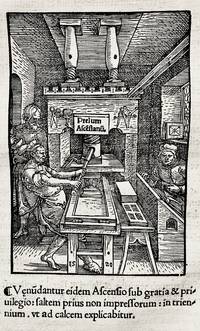
1520909<p>Paris: Joanne Paruo i.e. Jean Petit with Venundantur eidem Ascensio i.e. Badius Ascensius 1520. Bound in Alum-tawed pigskin elaborately tooled in blind over wooden boards with metal and leather clasps; one clasp perished. Binding with one corner tip broken off; small hole in leather on rear board; dust-soiled. Inside some early marginalia and underlining in red; narrow arc of old light water staining to fore-edges of one part. Pages generally very clean. This is a pleasing copy of two substantial books edited and assembled by very notable scholars_ _contemporary to the publications of the works. Two Folios bound together; leaf size: 32 x 22 cm. Signatures: ad. I a-z8&8A-H8I6K8 aaa-ggg6hhh4iii6iii6 is blank & present ad. IIA¹0 a-x⸠yⶠzⴠBoth are first editions of quite influential books. Moreau II Nr. 2242m; P. Renouard Bibliographie des impres Paris I908s II I46 and BL STC France 16th cent.; Ind Aur III 311; Wierda 2006; p. 210 nr. 40 p. 42; Moreau 1511-1520: 2246; Imprimeurs et libraires parisiens du 16. sie_̀cle . Bade-438/. St. Athanasius's text was translated into Latin by three noted Renaissance scholars and edited by Nicholas Beraldus and has the added prestige of apparatus by Erasmus. The title-page is printed within a four-piece woodcut border with the title in red and black and the page bears the famous Petit printer's device. The St. Basil is from Badius Ascensius's press and he acted as the editor the translators having been Johannes Argyropoulos Georgius Trapezuntius and otherssee above and below . The title-page uses the same four-part woodcut title-page border as found on the St. Athanasius bound in at the front which makes much sense given the familial relationship between Ascensius and Petit. <br />Moreau II Nr. 2242m; P. Renouard Bibliographie des impres Paris I908s II I46<br /><br />Athanasius was the greatest champion of Catholic belief of Incarnation that the Church has ever known and in his lifetime earned the characteristic title of "Father of Orthodoxy" by which he has been distinguished ever since. "Athanasius the Apostolic was the 20th bishop of Alexandria as Athanasius I. His intermittent episcopacy spanned 45 years c. 8 June 328 – _2 May 373 of which over encompassed five exiles when he was replaced on the order of four different Roman emperors. Athanasius was a Christian theologian a Church Father the chief defender of Trinitarianism against Arianism and a noted Coptic Christian Egyptian leader of the fourth century. Athanasius' earliest work Against the Heathen – _On the Incarnation written before 319 bears traces of Origenist Alexandrian thought such as repeatedly quoting Plato and using a definition from Aristotle's Organon but in an orthodox way. Athanasius was also familiar with the theories of various philosophical schools and with the developments of Neo-Platonism. Ultimately Athanasius would modify the philosophical thought of the School of Alexandria away from the Origenist principles such as the "entirely allegorical interpretation of the text". Still in later works Athanasius quotes Homer more than once Hist. Ar. 68 Orat. iv. 29. Athanasius was not a speculative theologian. As he stated in his First Letters to Serapion he held on to "the tradition teaching and faith proclaimed by the apostles and guarded by the fathers." He held that not only was the Son of God consubstantial with the Father but so was the Holy Spirit which had a great deal of influence in the development of later doctrines regarding the Trinity. <br /><br />Athanasius' "Letter Concerning the Decrees of the Council of Nicaea" De Decretis is an important historical as well as theological account of the proceedings of that council and another letter from 367 is the first known listing of all those books now accepted as the New Testament.<br />With <br />Basil the Great is sapientissimus potentissimus sanctissimus piissimus. <br />This volume includes the following works: the Hexameron translated by Argyro- pulos for Sixtus IV; Adversus Eunomium translated by George of Trebizond at the re- quest of Cardinal Bessarion and sent by him to Eugenius IV; Gregory Nazianzen's funeral oration on Basil the Great in the translation of Raphael Volaterranus; a large selection of Basil's sermons and several letters also translated by Volaterranus; and finally the De institutis monarchorum RuEinus' transation adaptation and fusion of Basil's two monastic rules the Regulaefusius tractatae and Regulae brevius tractatae. Texts in Migne P.G. XXIX XXX XXXI and F. Boulenger Gre'goire de NazEanze. Dis- coursfunebres en l'honneur de sonfrere Ce'saire et de Basile de Cesarete Paris I908 pp. S8-23I. Argyropulos' Hexameron was sent to Badius from Rome by Lefevre fol. Ir and Badius' preface: 'Nuper autem divi Basilii vere magni monumenta aeterna cedro dignissima ab urbe Roma ad nos usque perlata hinc ad negocia sua profecturus prelo nostro commisit'. It and the translations of Volaterranus had been printed in Rome by Mazochius in September and December ISIS Panzer vm 255 no. 92 and 256 no. 9S; inJune ISo8 Matthias Schurer had printed Basilfi Oratio de invidia Nic. Perotfo interprete in Strasbourg Panzer VI 42 no. I3I; the letters on reading the pagan classics and on the solitary life were well known; but Badius' is the first printing of so important a collection of Basil's works.</p> Joanne Paruo [i.e., Jean Petit] with Venundantur eidem Ascensio [i.e., Badius Ascensius
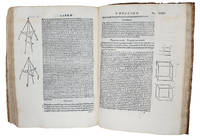
154334704Colophon: Venice Venturino Rossenelli 1543. Folio. 305x22 cm. Contemporary full Italian limp vellum. Remains of ties. Old handwritten title on spine. Upper part of front cover slightly creased. A few small nicks to hinges at cords. Vellum with brownspots. 242 leaves 2-241 numb. II-CCXXXIX. Misnumbering of leaves in sign. A 10 lvs. due to the insertion of corrections on f A5. Collation corresponds to that given by Thomas-Stanford No. 34. Large margins profusely illustrated with diagrams. Upper right corner of title gone with loss of of 3 letters "NSE" in MEGARENSE f A2-A6 with upper right corners and a wormtract-hole in lower margin repaired. A wormtract in lower margin on the next 11 lvs. A1-A6 mounted skillfully on thin opaque parchment-paper. A rather faint dampstain in upper right corner throughout. Last 5 leaves with a small nick in right margin no loss. Otherwise remarkably clean and printed on good strong paper. On the title a large woodcut device with arms with G.T. Gabriele Tadino to whom the work is dedicated. Colophon with large woodcut device with the letters .P.Z.F. and this repeated on verso of last leaf. <br/><br/><em>Scarce first edition of the first translation of Euclid into any modern language by the famous Niccolo Tartaglia. The translation and Tartaglia's commentaries strongly accelerated the development of physics and mechanics in the 16th century as it showed how mathematics could be applied to dynamics and mechanics as well as to architecture construction and perspective. More than 20 years should elapse before the next language would receive the privilege of displaying Euclid among their goods this was the French translation published by Pierre Forcadel Paris 1564. "When Tartaglia submits that his redaction was made "secondo le due tradittioni" there is no question that Campanus - who appears to be heavely favored - and Zamberti are meant. When Campanus has added propositions or premises Tartaglia has approriately translated them and noted their absence "nelle seconda tradittione" while things omitted by Campanus but included by Zamberti receive the reverse treatment" John Murdoch in DSB. Niccolo Fontana Tartaglia of Brescia has a great name in the history of mathematics. A cut in the face from a French soldier caused him to stammer and as a consequence of this he was called 'Tartaglia' the stammerer. He is famous for his solution of third-degree equations which occasioned a long polemic with Cardano about priority. He is also known for "Tartaglia's Triangle" later known as "Pascal's Triangle" and he is well-known for his Archimedes-edition of 1543 and 1551 with his commentaries. "The most famous source of Greek geometry is the monumental work of Euclid of Alexandria called the "Elements" around 300 B.C. No other book of science had a comparable influence on the intellectual development of mankind. It was a treatise of geometry in thirteen books which included all the fundamental results of scientific geometry up to his time. Euclid did not claim for himself any particular discovery he was merely a compiler. Yet in view of the systematic arrangement of the subject matter and the exact logical procedure followed we cannot doubt that he himself provided a large body of specific formulations and specific auxiliary theorems in his deductions. It is no longer possible to pass judgement on the authorship of much of this material; his book was meant as a textbook of geometry which paid attention to the material while questions of priority did not enter the discussion." Cornelius Lanzos in "Space through the Ages". Max Steck III:40 - Thomas-Stanford: 34 - Riccardi Euclideana 1543 1 - Adams E:992. - Brunet II:1090. Premiere edition de ce travail estimé. - Graesse II:513. </em> hardcover
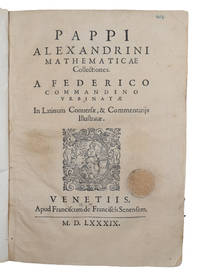
158862780Colophon: Pisauri Pesaro Hieronymum Concordiam 1588. Having the reprinted title-page: Venetiis Franciscum de Franciscis Senemsem 1589. Folio. Contemporary limp vellum. Repairs to upper part of spine and small nicks to back repaired. Edges of covers with tiny loss of vellum. Covers slightly soiled. Calligraphed title on back. Title-page with and old partly erased stamp. Woodcut printer's device on title-page. Ff 3 334 332 = 664 pp. Numerous woodcut diagrams and illustrations in the text. Printed on good paper. Ff. 2-3 with an old repair to inner margin no loss. F2 browned but otherwise remarkably clean with only a few brownspots. A few small worm-tracts to some margins. In spite of its flaws a very good copy of this monumental work. <br/><br/><em>First edition title-issue with the fresh title-page stating 1589 but with nothing else reprinted and otherwise through and through the 1588-printing of Commandino's seminal Latin translation of the work that constitutes the culmination of Greek Mathematics. This printing which contains the complete extant text of Pappos in Latin translation is responsible for reviving ancient mathematics in the Renaissance and shaping much modern mathematics profoundly influencing the likes of Descartes and Newton. "Pappos was the greatest mathematician of the final period of ancient science and no one emulated him in Byzantine times. He was the last mathematical giant of antiquity." George Sarton Ancient Science and Modern Civilization. p.82. "Pappus of Alexandria in ab. 320 composed a work with the title Collection Synagoge which is important for several reasons. In the first place it provides a most valuable historical record of parts of Greek Mathematics that otherwise would be unknown to us. For instance it is in Book V of the Collection that we learn of Archimedes' discovery of the thirteen semiregular polyhedra or "Archimedian solids". Then too the Collection includes alternative proofs and supplementary lemmas for propositions in Euclid Archimedes Appolonius and Ptolemy. Finally the treatise includes new discoveries and generalizations not found in any earlier work. The Collection Pappus' most important treatise contained eight Books but the first Book and the first part of the second Book are now lost" Boyer A History of Mathematics p. 205. "Each book 8 is preceded by general reflexions which give to that group of problems its philosophical and historical setting. The prefaces are of deep interest to historians of mathematics and therefore it is a great pity that three of them are lost . Book VII is far the longest book of the Collection . and here we find in it the famous Pappo's problem: "given several straight lines in a plane to find the locus point such that when straight lines are drawn from it to the given lines at a given angle the products of certain of the segments shall be in a given ratio to the product of the remaining ones". This problem is important in itself but even so because it exercized Descartes' mind and caused him to invent the method of coordinates explained in his Geométrie 1637. Think of a seed lying asleep for more than thirteen centuries and then helping to produce that magnificent flowering analytical geometry . The final Book VIII is mechanical and is largely derived from Heron of Alexandria. Following Heron Pappos distinguished various parts of theoretical mechanics geometry arithmetic astronomy and physics. The Book is considered the climax of Greek mechanics and helps us to realize the great variety of problems to which the Hellenistic mechanicians addressed themselves. If Book VIII is the climax of Greek mechanics we may say as well that the whole collection is a treasury and to some extent the culmination of Greek mathematics. . The ideas collected or invented by Pappos did not stimulate Western mathematicians until very late but when they finally did they caused the birth of modern mathematics- analytical geometry projective geometry centrobaric method. That birth or rebirth from Pappos' ashes occurred within four years 1637-40. This was modern geometry connected immediately with the ancient one as if nothing had happened between." Georg Sarton op.cit. - It is from Pappus we have the famous words of Archimedes: "Give me a place to stand and I will move the earth" Se PMM No 72. - "Without pretending to great originality the whole work shows on the part of the author a thorough grasp of all the subjects treated independent of judgement mastery of technique; the style is terse and clear; in short Pappus stands out as an accomplished and versatile mathematician a worthy representative of the classical Greek geometry." Heath A History of Greek mathematics Vol. II: p.358. Adams P 224 The sheets of the Pisauris edition with a fresh title. </em> hardcover
1538126667Basel: Johann Walder 1538. Theon's valuable commentary on the Almagest Editio princeps. Theon father of the celebrated female mathematician and philosopher Hypatia composed his commentary on the Almagest as a redaction of his lectures said to have been given at the Museum in Alexandria. Edited by Joachim Camerarius 1500-1574 the commentary is of particular value to modern scholars because it preserves information about now-lost mathematical and astronomical treatises. The book was issued as a companion volume to the editio princeps of the Almagest published the same year by Walder. Folio 316 x 203 mm 1 vol. only of 2. Contemporary limp vellum sewn on three cords yapp edges ties lacking. Housed in a vellum-backed folding case spine lettered in gilt. Bookplate of Elizabeth Sprague. Light dampstain at head some gatherings lightly browned still a very good copy. hardcover
15883991588. Numerous woodcut illus. & diagrams in the text. 4 p.l. the last a blank 334 i.e. 332 pp. Folio cont. limp vellum title a bit soiled last two leaves with some light dampstaining ties gone. Pesaro: H. Concordia 1588.<br/> <br/> First edition and a very fine and fresh copy of this uncommon book; this edition providing the complete extant text was the final work to be edited by Commandino and completes his life's work of reviving Renaissance mathematics by making available the best mathematical writings of antiquity. <br/> <br/> "In the silver age of Greek mathematics Pappus stands out as an accomplished and versatile geometer. His treatise known as the Synagoge or Collection is a chief and sometimes the only source for our knowledge of his predecessors' achievements. The Collection is in eight books perhaps originally in twelve of which the first and part of the second are missing. <br/> <br/> "Book VII is the most fascinating in the whole Collection not merely by its intrinsic interest and by what it preserves of earlier writers but by its influence on modern mathematics."D.S.B. X p. 293-95and see pp. 294-98 for a full discussion of the contents. <br/> <br/> This concerns in a passage on Apollonius' Conics the attempt to conceive of the product of more than three straight lines as geometrical entities known as "Pappus' Problem." Descartes devoted a major part of his own Géométrie to this and solved it by the use of algebraic notation. "Pappus' problem thus inspired the new method of analytical geometry that has proved such a powerful tool in subsequent centuries. In his Principia 1687 Newton also found inspiration in Pappus; he proved in a purely geometrical manner that the locus with respect to four lines is a conic section which may degenerate into a circle."D.S.B. X p. 296. <br/> <br/> Topics discussed in the other books include astronomy and mechanics. <br/> <br/> A very fine copy preserved in a green morocco-backed box. <br/> <br/> Rose The Italian Renaissance of Mathematics p. 214"Within 25 years of Commandino's death the first step in founding the mechanics of the seventeenth century was to be taken by Galileo when in criticising the inclined plane theorem of Pappus the Tuscan mathematician adumbrated the notion of inertia. This step was not taken in an intellectual vacuum but represents the culmination of the mathematical renaissance that had been achieved by the Restauratores."& see the whole of Chap. 9 for Commandino and this book. Smith History of Mathematics I pp. 136-37. unknown
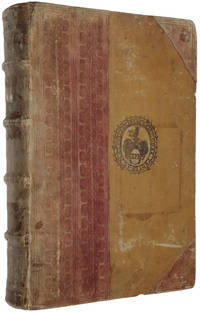
15885234Pesaro: Girolamo Concordia 1588. <p>First edition of Pappus' Collection translated with commentary by Federico Commandino a princely copy from the notable collection of the great Papal family and patrons of learning the Piccolomini Dukes of Amalfi thence by marriage to the German nobleman von Troilo. The Collection is "by far the most important of Pappus' works . without it much of the geometrical achievement of his predecessors would have been lost forever" DSB.</p>. GREEK GEOMETRY - A CRUCIAL INFLUENCE ON DESCARTES. <p>First edition of Pappus' Collection translated with commentary by Federico Commandino a princely copy from the notable collection of the great Papal family and patrons of learning the Piccolomini Dukes of Amalfi thence by marriage to the German nobleman von Troilo. The Collection is "by far the most important of Pappus' works . without it much of the geometrical achievement of his predecessors would have been lost forever . The Collection deals with the whole body of Greek geometry mostly in the form of commentaries on texts which it is assumed the reader has to hand. It reproduces known solutions to problems in geometry; but it also frequently gives Pappus' own solutions or improvements and extensions to existing solutions. Thus Pappus handles the problem of inscribing five regular solids in a sphere in a way quite different from Euclid; gives a broader generalization than Euclid to the famous Pythagorean theorem and provides a demonstration of squaring the circle which is quite different from the method of Archimedes who used a spiral or that of Nicomedes who used the conchoid.<br /> Perhaps the most interesting part of the Collection measured by its influence on modern mathematics is Book VII which is concerned with the problems of determining the locus with respect to three four five six or more than six lines. Pappus' work in this field was called 'Pappus' problem' by René Descartes who demonstrated that the difficulties which Pappus was unable to overcome could be got round by the use of his new algebraic symbols. Pappus thus came to play an important if minor role in the founding of Cartesian analytical geometry. And it is another mark of his originality and skill that he spent much time working on the problem of drawing a circle in such a way that it will touch three given circles a problem sophisticated enough to engage the interest centuries later of both François Viète and Isaac Newton. For his own originality even if his chief importance is as the preserver of Greek scientific knowledge Pappus stands with Diophantus as the last of the long and distinguished line of Alexandrian mathematicians" Hutchinson Dictionary of Scientific Biography. "He formally defined analysis and synthesis as they are still commonly applied in the solution of geometrical riders. Pappus stumbled upon the projective invariance of the cross-ratio of four collinear points and other related results reclaimed by modern projective geometry; and he gave the first recorded statement of the focus-directrix property of the three conic sections. He formulated the 'centrobaric' theorems frequently attributed to Paul Guldin 1577-1643 for calculating the volume and surface generated by a plane figure rotating about an axis in its own plane. He discussed theoretical mechanics the equilibrium of a heavy body on an inclined plane the use of the mechanical powers and the construction of mechanical toys" Biographical Dictionary of Scientists.</p> <br /> <p>Provenance: Ex libris inscription of Princess Maria Piccolomini and signature of Count Franz Gottfried von Troilo on title; shelfmark on front free endpaper.</p> <br /> <p>Pappus of Alexandria c.  290 - c.  350 AD was the most important mathematical author writing in Greek during the later Roman Empire. Other than that he was born at Alexandria in Egypt and that his career coincided with the first three decades of the 4th century AD little is known about his life.</p> <br /> <p>"In the silver age of Greek mathematics Pappus stands out as an accomplished and versatile geometer. His treatise known as the Synagoge or Collection is a chief and sometimes the only source for our knowledge of his predecessors' achievements. The Collection is in eight books perhaps originally in twelve of which the first and part of the second are missing . The several books of the Collection many well have been written as separate treatises at different dates and later brought together as the name suggests . A. Rome concludes that the Collection was put together about AD 340 but K. Ziegler states that . the Collection may have been compiled soon after AD 320. It has come down to us from a single twelfth-century manuscript Codex Vaticanus Graecus 218 from which all the other manuscripts are derived .</p> <br /> <p>"The portion of book II that survives beginning with proposition 14 expounds Apollonius' system of large numbers expressed as powers of 10000. It is probable that book I was also arithmetical.</p> <br /> <p>"Book III is in four parts. The first part deals with the problem of finding two mean proportionals between two given straight lines the second develops the theory of means the third sets out some 'paradoxes' of an otherwise unknown Erycinus and the fourth treats of the inscription of the five regular solids in a sphere but in a manner quite different from that of Euclid in his Elements XIII. 13-17.</p> <br /> <p>"Book IV is in five sections. The first section is a series of unrelated propositions of which the opening one is a generalization of Pythagoras' theorem even wider than that found in Euclid VI.31 . The second section deals with circles inscribed in the figure known as the άÏβηλος or 'shoemaker's knife.' It is formed when the diameter AC of a semicircle ABC is divided in any way at E and semicircles ADE EFC are erected. The space between these two semicircles and the semicircle ABC is the άÏβηλος. In a series of elegant theorems Pappus shows that if a circle with center G is drawn so as to touch all three semicircles and then a circle with center H to touch this circle and the semicircles ABC ADE and so on ad infinitum then the perpendicular from G to AC is equal to the diameter of the circle with center G the perpendicular from H to AC is double the diameter of the circle with center H the perpendicular from K to AC is triple the diameter of the circle with center K and so on indefinitely. Pappus records this as 'an ancient proposition' and proceeds to give variants. This section covers as particular cases propositions in the Book of Lemmas that Arabian tradition attributes to Archimedes.</p> <br /> <p>"In the third section Pappus turns to the squaring of the circle. He professes to give the solutions of Archimedes by means of a spiral and of Nicomedes by means of the conchoid and the solution by means of the quadratrix but his proof is different from that of Archimedes. To the traditional method of generating the quadratrix Pappus adds two further methods 'by means of surface loci' that is curves drawn on surfaces. As a digression he examines the properties of a spiral described on a sphere.</p> <br /> <p>"The fourth section is devoted to another famous problem in Greek mathematics the trisection of an angle. Pappus' first solution is by means of a νευσις or verging-the construction of a line that has to pass through a certain point-which involves the use of a hyperbola. He next proceeds to solve the problem directly by means of a hyperbola in two ways; on one occasion he uses the diameter-and-ordinate property as in Apollonius and on another he uses the focus-directrix property. This property is proved in book VII. Pappus then reproduces the solutions by means of the quadratrix and the spiral of Archimedes; he also gives the solution of νευσις which he believes Archimedes to have unnecessarily assumed in On Spirals proposition 8.</p> <br /> <p>"In the preface to book V which deals with isoperimetry Pappus praises the sagacity of bees who make the cells of the honeycomb hexagonal because of all the figures which can be fitted together the hexagon contains the greatest area. The literary quality of this preface has been warmly praised. Within the limits of his subject Pappus looks back to the great Attic writers from a world in which Greek had degenerated into Hellenistic. In the first part of the book Pappus appears to be reproducing Zenodorus fairly closely; in the second part he compares the volumes of solids that have equal surfaces. He gives an account of thirteen semiregular solids discovered and discussed by Archimedes but not in any surviving works of that mathematician that are contained by polygons all equilateral and equiangular but not all similar. He then shows following Zenodorus that the sphere is greater in volume than any of the regular solids that have surfaces equal to that of the sphere. He also proves independently that of the regular solids with equal surfaces that solid is greater which has the more faces.</p> <br /> <p>"Book VI is astronomical and deals with the books in the so-called Little Astronomy-the smaller treatises regarded as an introduction to Ptolemy's Syntaxis Almagest. In magisterial manner he reviews the works of Theodosius Autolycus Aristarchus and Euclid and he corrects common misrepresentations. In the section on Euclid's Optics Pappus examines the apparent form of a circle when seen from a point outside the plane in which it lies.</p> <br /> <p>"Book VII is the most fascinating in the whole Collection not merely by its intrinsic interest and by what it preserves of earlier writers but by its influence on modern mathematics. It gives an account of the following books in the so-called Treasury of Analysis those marked by an asterisk are lost works: Euclid's Data and Porisms Apollonius' Cutting Off of a Ratio Cutting Off of an Area Determinate Section TangenciesInclinationsPlane Loci and Conics. In his account of Apollonius' Conics Pappus makes a reference to the 'locus with respect to three or four lines' a conic section. He also adds a remarkable comment of his own. If he says there are more than four straight lines given in position and from a point straight lines are drawn to meet them at given angles the point will lie on a curve that cannot yet be identified. If there are five lines and the parallelepiped formed by the product of three of the lines drawn from the point at fixed angles bears a constant ratio to the parallelepiped formed by the product of the other two lines drawn from the point and a given length the point will be on a certain curve given in position. If there are six lines and the solid figure contained by three of the lines bears a constant ratio to the solid figure formed by the other three then the point will again lie on a curve given in position. If there are more than six lines it is not possible to conceive of solids formed by the product of more than three lines but Pappus surmounts the difficulty by means of compounded ratios. If from any point straight lines are drawn so as to meet at a given angle any number of straight lines given in position and the ratio of one of those lines to another is compounded with the ratio of a third to a fourth and so on or the ratio of the last to a given length if the number of lines is odd and the compounded ratio is a constant then the locus of the point will be one of the higher curves .</p> <br /> <p>"In 1631 Jacob Golius drew the attention of Descartes to this passage in Pappus and in 1637 'Pappus' problem' as Descartes called it formed a major part of his Géométrie. Descartes begins his work by showing how the problems of conceiving the product of more than three straight lines as geometrical entities which so troubled Pappus can be avoided by the use of his new algebraic symbols. He shows how the locus with respect to three or four lines may be represented as an equation of degree not higher than the second that is a conic section which may degenerate into a circle or straight line. Where there are five six seven or eight lines the required points lie on the next highest curve of degree after the conic sections that is a cubic; if there are nine ten eleven or twelve lines on a curve one degree still higher that is a quartic and so on to infinity. Pappus' problem thus inspired the new method of analytical geometry that has proved such a powerful tool in subsequent centuries.</p> <br /> <p>"In his Principia 1687 Newton also found inspiration in Pappus; he proved in a purely geometrical manner that the locus with respect to four lines is a conic section which may degenerate into a circle .</p> <br /> <p>"Pappus observes that the study of these curves had not attracted men comparable to the geometers of previous ages. But there were still great discoveries to be made and in order that he might not appear to have left the subject untouched Pappus would himself make a contribution. It turns out to be nothing less than an anticipation of what is commonly called 'Guldin's theorem.' Only the enunciations however were given which state:</p> <br /> <p>'Figures generated by complete revolutions of a plane figure about an axis are in a ratio compounded a of the ratio of the areas of the figures and b of the ratio of the straight lines similarly drawn to sc. drawn to meet at the same angles the axes of rotation from the respective centers of gravity. Figures generated by incomplete revolutions are in a ratio compounded a of the ratio of the areas of the figures and b of the ratio of the arcs described by the respective centers of gravity; it is clear that the ratio of the arcs is itself compounded 1 of the ratio of the straight lines similarly drawn from the respective centers of gravity to the axis of rotation and 2 of the ratio of the angles contained about the axes of rotation by the extremities of these straight lines.'</p> <br /> <p>"Pappus concludes this section by noting that these propositions which are virtually one cover many theorems of all kinds about curves surfaces and solids 'in particular those proved in the twelfth book of these elements.' This implies that the Collection originally ran to at least twelve books.</p> <br /> <p>"Pappus proceeds to give a series of lemmas to each of the books he has described except Euclid's Data presumably with a view to helping students to understand them. He was half a millennium from Apollonius and elucidation was probably necessary. It is mainly from these lemmas that we can form any knowledge of the contents of the missing works and they have enabled mathematicians to attempt reconstructions of Euclid's Porisms and Apollonius' Cutting Off of an Area Plane Loci Determinate Section Tangencies and Inclinations. It is from Pappus' lemmas that we can form some idea of the eighth book of Apollonius' Conics" DSB.</p> <br /> <p>Adams P223; Pietro and Bonelli Catalogo della Biblioteca Mediceo-Lorense 151; Riccardi I 364 11.</p> <br/> <br/> Folio 307 x 204 mm ff. 4 including blank 334 recte 332 with woodcut printer's device on title several historiated woodcut initials and numerous woodcut diagrams in text small wormhole through blank area of last two leaves. Contemporary German half-pigskin over yellow boards pigskin dyed rose pink somewhat faded small split in upper joint and small wormhole in lower board with blind floral rolls gilt silver arms of Count Franz Gottfried von Troilo on upper cover and a phoenix surrounded by flames within a wreath on lower cover. A fine clean crisp copy. Girolamo Concordia unknown
15756346Basel: Eusebius Episcopius & Heirs of Nikolaus Episcopius 1575. First edition. <p>First edition of Diophantus - the first printing of the Arithmetica in any language in any form - owned annotated and signed by Giovanni Camillo Gloriosi 1572-1643 Galileo's successor in the chair of mathematics at the University of Padua. Gloriosi's mathematical annotations dating from 1611 and 1612 revise and correct the calculations of Diophantus and of his Latin translator Xylander; the long note at page 59 against Proposition II.19 is the working source for Gloriosi's 1613 Ad theorema geometricum Venice Baglioni whose publication with Galileo's recommendation secured the Padua chair in October of that year. After Gloriosi's death the library passed for five hundred gold coins to Ramiro de Guzmán Viceroy of Naples who bound the books in red morocco with his armorial. Bouza's 2024 catalogue of thirty-five Gloriosi books surviving in Madrid libraries records signatures only; this copy stands apart by the density of its 1611-1612 marginalia and by the direct textual link between the note at page 59 and pages 28-29 of the printed Ad theorema geometricum.</p>. Hardcover. Giovanni Gloriosi's Signed and Annotated Copy of the First Systematic Treatise on Algebra. <p>First edition of Diophantus - the first printing of the Arithmetica in any language in any form - owned annotated and signed by Giovanni Camillo Gloriosi 1572-1643 Galileo's successor in the chair of mathematics at the University of Padua and subsequently acquired from Gloriosi's estate for five hundred gold coins by Ramiro de Guzmán Duke of Medina de las Torres and Viceroy of Naples who bound the book in red morocco with the combined armorial of himself and his wife Anna Carafa de Stigliano on the covers. When Antonio Favaro undertook his 1904 study of Gloriosi in the series on Galileo's acquaintances and correspondents he posed what seemed a straightforward question - what had become of the mathematician's books and papers - and reported that every effort he had made to trace them had been entirely in vain. The present copy bound in the viceroy's unmistakable red morocco and carrying Gloriosi's signature on the last leaf with extensive mathematical annotations in his hand is distinguished among the now-identified survivors of that library by the density of the annotations and by their demonstrable bearing on Gloriosi's own published mathematical work.</p> <br /> <br /> <p>Gloriosi was a Neapolitan Jesuit-trained and came to mathematics through the algebraic tradition rather than through natural philosophy. In 1604 a friar asked Galileo to write on his behalf for a lectureship in mathematics; the appointment did not materialise but the correspondence opened a cordial if occasionally pointed relationship between the two men. By 1606 Gloriosi was in Venice moving in the circle around Paolo Sarpi and Giovanfrancesco Sagredo where he also met Antonio Santini and Marino Ghetaldi who introduced him to the algebra of François Viète - the immediate and decisive influence on his reading of Diophantus. In October 1613 with Galileo's recommendation and on the strength of his first publication Ad theorema geometricum Venice: Tommaso Baglioni 1613 Gloriosi was nominated to the chair Galileo had just vacated at Padua. He held the post until 1622 returning thereafter to Naples where he lived as a private gentleman maintained correspondence with the mathematical communities at Padua Venice Bologna and the Roman College and continued to exchange letters with Galileo until at least 1635. He died in January 1643 leaving four surviving letters to Galileo as the record of a thirty-year intellectual acquaintance.</p> <br /> <br /> <p>Gloriosi's annotations transform the copy from a bibliographical rarity into a document of working mathematical scholarship. Dating from 1611 and 1612 - the two years immediately preceding the Ad theorema geometricum and the Padua appointment - they fall into two kinds. Many are brief marginal identifiers a single Latin word most often Theorema placed beside the statement of a particular proposition to fix its status in the flow of Diophantus's argument. The majority however are substantive mathematical calculations in Gloriosi's fine italic hand revising extending and in a number of cases correcting the work of Diophantus and of the book's Latin translator and commentator Wilhelm Holtzmann of Augsburg Xylander. They are concentrated in Book II and in the later books in which the more intricate indeterminate problems occur and they are dense enough in places to fill margins on both sides of the printed page. Where Xylander's own calculation has gone astray Gloriosi writes out the corrected arithmetic to several orders of fractional precision; where a proposition requires a generalisation Diophantus had not offered he supplies it.</p> <br /> <br /> <p>The most consequential of these annotations occupies the lower margin of page 59 against Proposition 19 of Book II - the problem that asks a given number to be divided into three parts such that each part on donating a specified fraction of itself plus a fixed number of units to the next yields three equal results. For the number 80 with the fractions one-fifth one-sixth and one-seventh and the added units 6 7 and 8 respectively Xylander's solution failed: the parts summed to 80 but the distribution did not in fact satisfy the equations. Gloriosi noted the failure precisely - aequatio facta est ad 16 2/3 cum fieri debebant ad 26 2/3 the equation had been set at 16 2/3 when it should have been set at 26 2/3 - and then in the same annotation recorded the three correct fractional parts 1N 9530/363 10200/363 and 9310/363 obtained from the corrected equation. He rejected the possibility that Diophantus himself had erred insisting that the Alexandrian would not have proposed a problem without knowing its solution and argued instead that the Greek text had been mutilated in transmission. The task he set himself was to recover a solution using as Diophantus's method required a single hypothesis. This is exactly the reconstruction carried out on pages 28-29 of the Ad theorema geometricum of 1613 - the annotation and the printed text correspond point by point in the equation in the numerator 9530 over the common denominator 363 and in the subsequent reasoning - and the book prints no other source for the reconstruction. The margin of the present copy is the working source.</p> <br /> <br /> <p>The causal chain is tight. The marginal notes of 1611-1612 fed into the printed argument of 1613 the printed argument of 1613 supplied the published credential on which Galileo's recommendation built and the appointment to the Padua chair followed in October of the same year. The book at hand is therefore not merely an annotated copy of a famous mathematical work but the physical support for the single published achievement that elevated Gloriosi into the most visible Italian chair of mathematics. That it emerged from a library thought lost - and emerged intact bound by a seventeenth-century viceroy with the annotations complete and legible - is among the more unusual recoveries of the last generation of rare-science-book scholarship.</p> <br /> <br /> <p>Favaro's search had run up against a problem he could not solve from the evidence then available. Gloriosi had died a private gentleman in Naples; his nephew in Tomasini's words in the 1644 Elogia was a stranger to the study of letters who disposed of the entire library at a single stroke for five hundred gold coins to the viceroy. The viceroy then transferred the books to Spain and after his own death in 1668 the collection dispersed into the Madrid book trade where the Gloriosi association was no longer visible to anyone not already looking for it. Fernando Bouza working from Tomasini's text and from the catalogue records of Spanish libraries reconstructed the trajectory in a 2024 article in Galilæana and catalogued thirty-five printed books once belonging to Gloriosi almost all of them in Madrid - at the Biblioteca Nacional de España the Biblioteca Histórica of the Universidad Complutense the Biblioteca Francisco de Zabálburu and the Real Academia de Bellas Artes de San Fernando - together with a further two outside Madrid a 1521 Alfonsine Tables rebound in the eighteenth century and a 1545 Cardano Ars Magna sold at the 1861 Guglielmo Libri auction at Sotheby's. In each of the thirty-five Madrid books Gloriosi is identified by his characteristic signature alone set on the title verso or after the colophon; Bouza does not describe any of them as carrying substantive mathematical annotation. The present copy stands apart from that group in two respects: the density of Gloriosi's 1611-1612 marginalia and the specific point-for-point correspondence between the note on page 59 and pages 28-29 of the printed Ad theorema geometricum which ties this particular volume to a particular publication in a way no other survivor has yet been shown to do.</p> <br /> <br /> <p>Ramiro Núñez de Guzmán 1600-1668 second Duke of Medina de las Torres by marriage to Anna Carafa and son-in-law of the Count-Duke of Olivares served as Viceroy of Naples from 1637 to 1644 and was one of the most powerful Spanish grandees of his generation. His library-building followed the pattern common to seventeenth-century Italian viceregal courts in which the acquisition of a scholar's entire legacy was an act of cultural prestige as well as of intellectual collecting. The red morocco binding with his armorial stamps - exclusive bindings known to collectors as medines combining the viceroy's quartered arms on one cover with those of Anna Carafa REVOLUTA FOECUNDANT the Carafa stars and crescent on the other - was presumably executed in Naples or in Madrid after the purchase. Of the small number of these bindings that survive the one on the present volume is identical in tool format and armorial layout to that on the Bodleian sammelband Rigaud.e.148 which contains Gloriosi's own copies of Galileo's Sidereus nuncius 1610 and Il Saggiatore 1623 Giulio Cesare La Galla's 1612 De phoenomenis in orbe lunae Francesco Sizzi's 1611 Dianoia astronomica and Mario Guiducci's 1620 Lettera al padre Tarquinio Galluzzi. Taken together the sammelband and the present copy demonstrate that the viceroy bound the mathematical and the Galilean-astronomical portions of Gloriosi's library in a single uniform style and that Gloriosi himself had studied Galileo's principal works at first hand.</p> <br /> <br /> <p>After Medina de las Torres's death in 1668 the library began to disperse. The principal buyer was William Godolphin c. 1634-1696 the English diplomat and Catholic convert then resident at the court in Madrid whose prominent ownership inscriptions identify a substantial block of former Guzmán books. The present Diophantus was not among them. A second buyer identified only as 'Ãlvarez' signed his name on the title page; the inscription survives covered by a contemporary paper slip that has been preserved in place. The same 'Ãlvarez' signature appears on three other former Guzmán books currently traceable in the Spanish antiquarian market and in one of them - a 1600 Brescia edition of Alessandro Manerba's Moralis sylva - Godolphin's own title-page inscription overlaps Ãlvarez's showing that the two were contemporaries and that Ãlvarez transferred part of his collection on to Godolphin. The absence of Godolphin's characteristic title-page or colophon signature from the present copy indicates that Ãlvarez acquired the book directly from the viceroy's dispersal and retained it and that it never entered Godolphin's library. Ãlvarez is therefore the third known owner standing between Guzmán and the Earls of Macclesfield from whose library at Shirburn Castle the book came to the market as lot 636 in the 2005 sale.</p> <br /> <br /> <p>The edition Gloriosi annotated was in 1611-1612 the only printed Diophantus in existence. Wilhelm Holtzmann of Augsburg 1532-1576 who Hellenised his name as Xylander was a classical philologist and professor of Greek at Heidelberg and his Latin Arithmetica of 1575 was the first complete European rendering of the text. The Greek editio princeps would not appear for another forty-six years when Bachet de Méziriac printed it in Paris in 1621 item 20 in this catalogue Bachet's own large-paper copy. Xylander worked from a single Byzantine manuscript derived like every surviving Greek witness from a single lost archetype and the manuscript was in André Weil's phrase marred throughout by the numerical errors of professional scribes who had not been mathematicians. He laboured for several years under these conditions supplied the text with a running Latin commentary - the Xylandri sections set beneath each Diophantine proposition in the present volume - and dedicated the book to his pupil Prince Ludwig of Württemberg. Thomas Heath writing in 1910 observed that Xylander's achievement had been inadequately appreciated by later commentators largely because the book itself was so rare: Nesselmann preparing his 1842 Algebra der Griechen was unable to find a copy at all. The translation's immediate and enormous influence on the shaping of European algebra as Heath put it ran through Bombelli Stevin Viète and - through Bachet's 1621 reprinting with improvements - Pierre de Fermat. Xylander himself did not live to see that influence take hold: he died the year after publication.</p> <br /> <br /> <p>The Arithmetica itself composed at Alexandria in approximately AD 250 is the first systematic treatise on algebra and the founding text of the tradition now called Diophantine analysis: the search for rational or integer solutions to polynomial equations in several unknowns. Diophantus introduced the earliest sustained symbolism in Greek mathematics - a character for the unknown for its powers up to the sixth and for the operations of addition and subtraction - and treated roughly two hundred and sixty problems whose solutions though always given in specific numerical terms tend to suggest general methods. The work was originally in thirteen books. Six survived in Greek transmitted by Byzantine scholars from Michael Psellus through Maximus Planudes whose scholia on the first two books Xylander prints alongside the text to the codex Cardinal Bessarion rescued before the fall of Constantinople and that Regiomontanus discovered at Venice; four further books surfaced in 1968 in a ninth-century Arabic translation by QustÄ ibn LÅ«qÄ dispersing the suspicion that the ancient numbering had corresponded straightforwardly to the surviving Greek sequence. Three books remain lost. The Arab reception had in fact been considerable: al-NadÄ«m's index of the sciences 987-988 lists commentaries by QustÄ ibn LÅ«qÄ and by AbÅ«'l-WafÄ' and a substantial fraction of the problems in al-KarajÄ«'s algebra are drawn directly from Diophantus's first three books.</p> <br /> <br /> <p>Xylander's volume prints at the end a fragment of the only other surviving work by Diophantus - a treatise on polygonal numbers which is differentiated from the Arithmetica by its use of geometric proofs and which breaks off in the middle of its investigation of the number of ways in which a given number can be expressed as a polygonal. The full transmission history of both texts from Bessarion and Regiomontanus through Bombelli's partial assimilation in his 1572 Algebra 271 problems of which 147 were taken directly from Diophantus to Viète's Zetetica of 1593 and on to Bachet's definitive 1621 edition runs entirely through this 1575 volume. It was in the margins of a copy of Bachet's 1621 reprint that Pierre de Fermat in the mid-1630s wrote the forty-eight observations that founded modern number theory - among them on page 85 against Problem II.8 on the decomposition of a square into two squares the proposition now known as Fermat's Last Theorem whose proof by Andrew Wiles in 1995 closed a gap that had stood for three hundred and fifty-eight years. The 1670 reprint of Bachet's edition with Fermat's observations printed in the margins the book that carried the Last Theorem into circulation is item 19 in this catalogue.</p> <br /> <br /> <p>Auction records since Honeyman list only three other copies of the 1575 Xylander; each is in a nineteenth- or twentieth-century binding and none has significant provenance. OCLC records eight copies in North American libraries. Copies in contemporary armorial bindings with identifiable early mathematical ownership are essentially unrecorded in commerce of the last century and the present volume - the Gloriosi copy in the Medina de las Torres binding standing as the material support for the 1613 Ad theorema geometricum and for the Padua appointment that followed it - is without known parallel.</p> <br /> <br /> <p>Almost nothing is known of the life of Diophantus. He quotes Hypsicles and so must have worked after roughly 150 BC; he is quoted in turn by Theon of Alexandria and so must have worked before AD 364. The conventional placement around AD 250 rests on a single passage in an eleventh-century Byzantine letter and on the absence of Diophantus's name from the commentaries of Pappus. His place of birth is unknown his teachers unknown and the fourteen-line Greek epigram in the Palatine Anthology that purports to record his age at death is generally regarded as a mathematical exercise rather than a biographical document.</p> <br /> <br /> <p>References: Adams D-652 - DSB IV 110-19 - Honeyman 890 - Norman 641 - Macclesfield 636 this copy - Bouza 'The mathematician and the viceroy' Galilæana XXI 1 2024 pp. 201-220 - Favaro Amici e corrispondenti di Galileo Galilei. IX. Giovanni Camillo Gloriosi 1904 - Tomasini Elogia virorum literis et sapientia illustrium 1644 - Heath Diophantus of Alexandria: A Study in the History of Greek Algebra 2nd ed. 1910 - Heath A History of Greek Mathematics 1921 vol. II pp. 448-517 - Weil Number Theory: An Approach Through History from Hammurapi to Legendre 1984 - Katz & Parshall Taming the Unknown 2014 ch. 4 - Schappacher 'Diophantus of Alexandria: a text and its history' IRMA Strasbourg - Smith Rara Arithmetica p. 348.</p> <br /> <br/> <br/> <br /> <p>Folio 307 × 200 mm pp. xii 152. Printer's device on title legend Episcop woodcut initials printed marginal notes. Occasional foxing light damp stains to blank corners of some leaves. Mid-seventeenth-century red morocco with gilt arms of the Duke of Medina de las Torres and his wife on the covers elaborate gilt borders and corner fleurons spine gilt; damage to upper edge of front board affecting gilt border.</p> . / Hardcover. Eusebius Episcopius & Heirs of Nikolaus Episcopius unknown