65 résultats
192576017Brisbane: Lutheran Mission Tract 1925. First edition reprinted in 1986. Octavo. 22 pp. Publisher's light orange wrappers with a photographic illustration of Bai on the front and a map on the rear. Small yellow sticker to upper margin of front wrapper. very small closed tear to margin of first leaf. Only 8 copies recorded by OCLC. A very good copy.Scarce booklet on the evangelical work of Christian Keyser Lutheran missionary of the Neuendettelsau Mission Society in New Guinea and his conversion of Bai an individual he publicly accuses of sorcery and then converts to Christianity. Keysser first met Bai in 1905. This book details his long-suffering though finally fruitfull attempts to convert the sorcerer Bai. "Soon after the first few lessons he came to my room to make a confession. So I listened. That WAS a confession. He named eleven women with whom he had committed adultery besides many "minor matters" seven murders. over thirty verses of witchcraft innumerable thefts and other thing" p. 6. Lutheran Mission Tract unknown
2000Q-0834212609Springer 2000-02-29. Hardcover. New. New. In shrink wrap. Looks like an interesting title! Springer hardcover

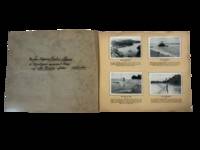
1939124917c.1939. Very Good. quarto. Cloth photo album 20pp. 108 photographs of PNG scenes & people; natives patrol officers etc. also many of ships & sailing boats inc. several named vessels. Many appear to be Rabaul area hardcover
194613093Madrid: Blass S. A. Very Good in Good dust jacket. 1946. First Edition. Hardcover. The covers of the book are faded at the top. The DJ is badly chipped at the top & lower spine. ; 4to 11" - 13" tall; 388 pages . Blass, S. A. hardcover
1999x-0834212609Aspen Pub 1999. Hardcover. New. 1st edition. 432 pages. 10.25x7.25x1.25 inches. Aspen Pub hardcover
1923233431923. Very good condition. Original publicity photograph by James Francis Frank Hurley 1885-1962 the Australian photographer filmmaker and writer known for his Antarctic photographs including the destruction of Ernest Shackleton's ship 'Endurance'. Hurley undertook two long expeditions to the Torres Strait and New Guinea between 1920 and 1923. From this he developed a successful anthropological film 'Pearls and Savages' and the book by the same title. He documented the people their rites houses villages artifacts and mountain scenes. Although reviews in Australia were strong one critic called it "probably the most beautifully photographed pictorial of the kind that has ever been screened" the film release in America resulted in a financial loss for Hurley retitled "The Lost Tribe". <br /> <br /> The b&w 8 x 10" Hurley print is stamped International Newsreel 226 William Street New York City on the verso. Manuscript note in pencil "New Guinea Island Pacific" on verso. unknown
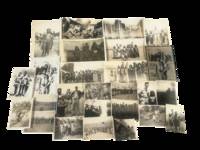
1944221181944. Papua New Guinea Photo Archive of 33 original silver gelatin photographs taken in Papua New Guinea circa 1944-1945 as dated in pencil on several versos. The images document traditional village life among Indigenous New Guineans many shown in ceremonial attire performing subsistence labor or posed outside grass-thatched huts. Several photos include White men in Western dress likely visiting for military anthropological or missionary purposes during the World War II Pacific campaign a period that brought foreign occupation and anthropological interest to many previously uncolonized or semi-isolated Papuan regions. Each measure approximately 3.5" x 2.5". Many images showcase Indigenous men and women wearing elaborate ritual regalia: skirts of plant fibers necklaces of shell and bone nose and ear ornaments and headpieces adorned with feathers. In some photos male villagers are shown carrying large slit-gong drums strapped over their shoulders with rope-likely part of a ceremonial performance as these drums were used in both musical and communicative traditions across the Sepik and Highlands regions One series captures local men holding American Esquire magazines and smoking cigarettes suggesting both the imposition of and interaction with the visiting Westerners. The historical context of these photographs is rooted in the Allied occupation of Papua New Guinea during World War II particularly by U.S. and Australian forces. While combat operations were widespread in New Guinea from 1942 to 1945 the final years of the war saw increased documentation by visiting soldiers anthropologists and missionaries many of whom sought to capture what they perceived as "vanishing" cultures. Indigenous Papuans during this era lived primarily in small clan-based villages practicing subsistence horticulture ritual exchange and complex oral traditions. The intrusion of Westerners especially during the war had deep and lasting impacts on social structures religious practices and material culture and this archive reflects the tension between visibility objectification and resilience. Minor curling and edgewear overall very good condition. A rich and rare visual record of traditional Indigenous life in Papua New Guinea on the cusp of dramatic wartime and postwar transformation with significant documentary value for visual anthropology Pacific studies and the wartime colonial encounter. unknown
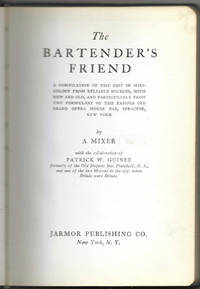
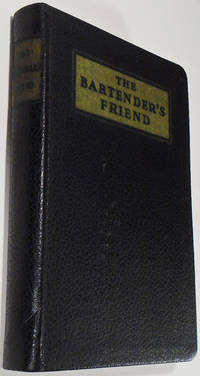
193310329New York: Jarmor Publishing Co.; copyright by F.I. Brown 1933. Octavo 21 x 13.5 cm. 170 22 pages. Illustrated. Index. FIRST EDITION. "By a mixer with the collaboration of the author formerly of the Old Iroquois Bar Plainfield N.J. and one of the best mixers in the days when drinks were drinks." A neatly organized cocktail manual with descriptions of various liquors and other ingredients. Publisher's black morocco titled on the front panel. Very light abrasion to edges otherwise near fine. Small gift inscription to a front preliminary. The cleanest copy we've handled. OCLC locates six copies. Jarmor Publishing Co.; [copyright by F.I. Brown] unknown
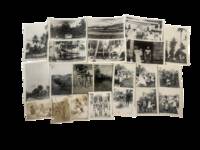
1910230071910. New Guinea photo archive group of 22 photographs dating to the early twentieth century documenting Indigenous communities and the colonial environments imposed around them. The material captures village life family groups communal activity and built spaces associated with missionary and administrative expansion providing direct visual evidence of how Indigenous people in New Guinea were photographed during a period of accelerating colonial intervention. These images are historically significant for the study of Indigenous life under colonial rule especially where domestic ceremonial and communal scenes appear alongside roads chapels and other introduced structures.<br /> <br /> Twenty-two black-and-white photographs including real photo postcards and original prints depicting Indigenous men women and children in both portrait and wider landscape formats. The archive includes captioned views such as "Native Huts New Guinea" "A Chapel in New Guinea" "One of Many New Guinea Highways" and "A Native Family of New Guinea." Several images focus on Indigenous dwellings family groupings and village settings while others show larger gatherings outdoor performances or dances communal scenes domestic labor and construction activity. A second grouping centers on colonial-built environments including palm-lined roads formal structures mission buildings and organized settlements. Closer portraits emphasize bodily presentation hairstyle adornment posture and dress while broader views show the spatial relationship between Indigenous communities and the altered colonial landscape. Sizes vary with the group consisting of postcard-format and similarly sized original photographs.<br /> <br /> Produced during a period of intensified missionary presence road building and colonial administration in New Guinea these photographs document the coexistence of Indigenous continuity and imposed colonial systems. The images show how photography was used to record classify and circulate views of Indigenous people and colonial development while also preserving visual evidence of community structure and daily life under conditions of outside control. The archive supports research into Indigenous history colonial visual culture missionary activity and the transformation of built and social environments in the Pacific. Minor handling wear and light edge wear; overall very good condition. A cohesive visual record of Indigenous life and colonial transformation in early twentieth-century New Guinea. unknown
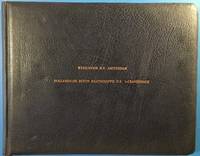
195426605The Hague: N.V. Nederlandsche Nieuw Guinee Petroleum Maatschappij 1954. Very good condition modest wear to corners of spine. Oblong 14" x 11" padded artificial leather gilt title on front cover. Site map with legend pasted in Twenty stiff pages with 82 black-and-white photographs tipped in with captions with fancy spiderweb patterned separating tissue guards. One additional site photo laid-in. Photo-record featuring in chronology the so-called Moetoeri-Project the construction of a pressure oil pipeline in the former territory of Dutch New Guinea taking place from October 1952-August 1954 from Wasian via Mogoi-Temboeni; further to Moetoeri Terminal with Gravity loading. Introduction supplies extensive technical information on materials applied. Construction carried-out by Werkspoor Ltd. Amsterdam and Hollandsche Beton Maatschappij Ltd. The Hague by order of the Dutch New Guinea Petroleum Company Ltd. N.V. Nederlandsche Nieuw Guinee Petroleum Maatschappij unknown
193335486New York: Jarmor Publishing Co 1933. First Edition. Original printed faux leather over boards octavo 170 pages plus blank note pages. Large formatted cocktail recipe guide book published immediately after the demise of prohibition. WorldCat locates six library holdings. The anonymous author's collaborator Patrick W. Guinee is described on title page as being "formerly of the Old Iroquois Bar Plainfield New Jersey and one of the best Mixers in the days when drinks were Drinks." Very Good attractive volume Jarmor Publishing Co hardcover
1960153973London: Contemporary Films 1960. Eight vintage double weight studio still photographs from the 1960s UK re-release of the 1934 French film. Manuscript ink annotations identifying scenes on the versos. <br /> <br /> From the archive of film historian and author Joel Finler. <br /> <br /> A classic of French cinema Jean Vigo's only theatrical feature a film that in the minds of many including Francois Truffaut predicted and even helped define the French New Wave that would come 20 years later. <br /> <br /> Shot on location in Paris Yvelines and Seine-Maritime France. <br /> <br /> 10 x 8 inches. Four Near Fine four Very Good plus with faint dampstains to the bottom edges.<br /> <br /> Ebert I. Rosenbaum 1000. Contemporary Films unknown
193057796Paris: Société d'Éditions Géographiques Maritimes et Coloniales 1930. First edition. Folding map. 114 pp plates 350 pp. 1 vols. 4to. Original wrappers. Bottom third of spine missing else Near Fine. First edition. Folding map. 114 pp plates 350 pp. 1 vols. 4to. Société d'Éditions Géographiques, Maritimes et Coloniales unknown
1940230081940. Photographs of Indigenous communities in New Guinea during World War II document direct encounters between local populations and United States military personnel as Allied forces established operational infrastructure across the island beginning in 1942. Taken in the early to mid 1940s these images record the presence of Indigenous men women and children alongside uniformed servicemen situating them within a major Pacific theater of war where military expansion reshaped local environments and social conditions. The archive supports research into Indigenous history wartime contact zones and the impact of global conflict on colonial territories.<br /> <br /> Archive consists of 26 original black and white photographic prints likely silver gelatin depicting group portraits staged encounters and environmental views in New Guinea. Multiple images show Indigenous individuals arranged in lines or clusters often positioned with U.S. servicemen standing behind or among them indicating organized or facilitated photographic documentation. Dress and adornment vary with women wearing traditional skirts and beadwork and men and children appearing in customary attire. Several photographs include visible military infrastructure including aircraft fuselages transport planes and trucks suggesting proximity to airstrips supply depots or forward bases. A group of images captures a ceremonial dance or ritual with participants wearing elaborate headdresses and woven garments photographed in mid action.<br /> <br /> These photographs were produced during a period when New Guinea became a strategic center of Allied military operations in the Pacific bringing new systems of transportation labor demands and administrative control into Indigenous regions. Wartime conditions altered patterns of daily life through the introduction of foreign personnel the construction of military facilities and the expansion of colonial oversight. Visual documentation of these encounters reflects both the logistical realities of military presence and the asymmetrical relationships between Indigenous communities and external authority. Minor handling wear and edge wear with occasional fading; overall very good condition. This archive provides primary visual documentation of wartime contact between Indigenous populations and Allied forces in New Guinea during World War II. unknown
1936230101936. Neuendettelsau Mission publisher. Bilder aus der Neuguinea Mission late 1920s-mid 1930s documents German Protestant missionary activity and Indigenous life in New Guinea during the interwar period following the end of formal German colonial rule. Produced as a cigarette card album with printed German captions the work records village life subsistence practices missionary institutions and ceremonial activity situating Indigenous communities within a visual framework shaped by religious and colonial perspectives. The album supports research into Pacific history missionary networks and the role of photography in documenting and interpreting Indigenous societies under colonial influence.<br /> <br /> Oblong album containing a substantial series of mounted photographic cigarette cards on captioned leaves with printed German text throughout. The cover title reads "Bilder aus der Neuguinea-Mission" and includes a commemorative image captioned "Gedenkt des 50 jährigen Jubiläums der Neuendettelsauer Mission auf Neuguinea!" depicting three Indigenous men in traditional dress with spears. The album includes numerous images of daily life in coastal New Guinea including fishing hunting boat building village environments and ceremonial gatherings with captions such as "Mit Pfeil und Bogen" and "Mit dem Jagenetz" describing subsistence practices. Additional images depict mission infrastructure including churches schools workshops and settlements alongside scenes of education labor and communal activity. Photographs are systematically arranged and mounted presenting both ethnographic subjects and missionary-built environments within a unified visual sequence.<br /> <br /> The album was produced during a transitional period when German missionary societies continued operations in New Guinea under Australian administration after World War I maintaining institutional presence despite the loss of formal colonial control. The Neuendettelsau Mission founded in Bavaria in the nineteenth century had established networks of religious and educational institutions in the region contributing to broader systems of cultural transformation and documentation. The images reflect both local practices and the interpretive framework imposed by missionary observers revealing how photography functioned within colonial and religious contexts to classify record and disseminate knowledge about Indigenous populations. Mild toning foxing and edge wear to covers and pages; cards remain securely mounted with images largely clean and crisp; overall very good condition. This album provides sustained visual documentation of missionary activity and Indigenous life in New Guinea during the interwar period. unknown