4 résultats
189737040New York: Fleming H. Revell Co. 1897. 8vo. 316 pp. Frntsp. numerous photos plates 1 large folding map. Green cloth gilt lettrng & decrtn mnr soilng shlfwr frnt hnge startng still VG- copy. First edition of this excellent biography of A.C. Good who was the first white to penetrate far into the Bulu region of German Congo. There he was initiated into the tribe preached in the language and even translated the Gospel. Fleming H. Revell Co., hardcover
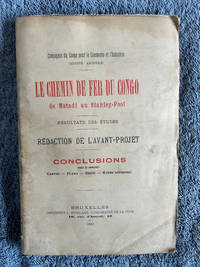
18891250325.28<p>L. Bourlard Bruxelles 1889. . Very Good. 8vo paperback. Vg condition. Covers lightly soiled. contents clean no marking or writing: appears unread - most pages still uncut. . Binding square and tight. 127 pp. text plus maps and charts. An interesting original publication outlining the ambitious project to ultimately traverse the Congo by rail line.</p> L. Bourlard, Bruxelles paperback
1900235051900. Belgian colonial Congo photo archive depicting European officials Indigenous Congolese adults and children public ceremony domestic labor and railway grounds between the early twentieth century and 1950. Belgium formally ruled the Congo from 1908 until June 30 1960 after King Leopold II's Congo Free State became notorious for forced labor and violence against Congolese people. A few scenes highlight colonial hierarchy as one photo shows white men in suits helmets and uniforms pose formally in chairs while Congolese men women and children appear as attendants or anthropological subjects surrounding the trio. A 1947 inscription identifying "le régent Charles" places part of the group during the Belgian prince regent's postwar tour of the Congo eight years before King Baudouin visited in 1955 and thirteen years before Congolese independence on June 30 1960.<br /> <br /> Photo archive of 12 silver gelatin photographs ranging from 3" x 4" to 3.5" x 4.75" Belgian Congo 1900-1950. French inscriptions include "Congo Belge août 1950"; "le régent Charles 1947"; "lundi le 18 janvier 1943 avec notre meilleur bonjour de tous les trois"; and "travailleur portant à l'eau" meaning "worker carrying water." Other scenes show a uniformed colonial procession outside a brick building helmeted men posed in the bush an elephant captioned with French notes Congolese children at a water spout men carrying water a compound walkway a railway yard and Congolese drummers and dancers assembled before mixed local and colonial audiences. The dichotomy of colonists occupying the pose of command travel inspection and ownership while Indigenous Congolese people appear in the surrounding labor ceremony and service spaces make for a compelling collection.<br /> <br /> Belgian rule in the Congo depended on racial separation administrative paternalism extraction mission education and controlled public ceremony while Congolese political demands intensified after the Second World War and culminated in independence on June 30 1960. Light toning handling and corner wear; photos remain clear and several inscriptions legible en verso; overall in very good condition. This archive gives Belgian colonialism a concrete human scale through officials posed with indigenous children workers ceremonial performers industrial railway spaces and royal reception scenes arranged around the unequal encounter between European power and Indigenous Congolese life. unknown
189075399Boston: Baptist Missionary Society 1890. Original stiff printed cad. The front shows a steam-powered stern-wheel riverboat steaming up the Congo Rive . There are two local people standing on the shore seeming to cheer them on. On the top right in an image of Adam McCall "one of the first missionaries to the Congo." In the upper left in the circular seal of the American Baptist Missionary Union. Someone has penciled "Winter of 1890" on the left margin. The recto contains a map of the Congo and its environs. Some old glue reside on the map side else a very good copy."It is generally known that the American Baptist Missionary Union has a steamer on the Upper Congo River for the purpose of aiding in carrying on the missionary work in Central Africa. The funds for building the steamer were furnished by a benevolent lady in Tasmania and it was named the “ Henry Reed†in memory of her deceased husband. It is a beautiful vessel and has proved very serviceable and well adapted to the navigation of the Upper Congo and its tributaries which furnish an uninterrupted navigable waterway of five thousand miles in the interior of Africa. To support the steamer and to carry on the missionary work which it is intended to do will require several thousand dollars annually. To provide these funds "The Henry Reed Steamboat Company†has been formed. Ten cents will constitute any one a stockholder in the company for one year; and all annual stockholders will receive a certificate with a picture of the steamer and a map of the Congo Free State. The payment of one dollar will constitute any one a stockholder in the Steamboat Company for life and a neat certificate will be given. Those who have been stockholders in the Company for ten years will receive a certificate of life membership on returning their ten annual certificates and the annual certificates will also be receivable at any time for ten cents each toward a life membership. Any one who has been a stockholder for five years can become a life stockholder by returning their five annual certificates and paying fifty cents; or any number of annual certificates may be sent which will be counted at ten cents each toward a life membership the remainder of the one dollar to be paid in cash.We are confident this Steamboat Company will be received with great favor especially by the boys and girls in the Sunday schools and mission bands. Superintendents teachers and leaders of mission bands are invited to receive payments for certificates and forward them and the certificates will be sent in return" Baptist Missionary Magazine vol. 67. Baptist Missionary Society unknown