139 résultats
1834151220097Stereotyped and published by C. Alexander & Co 1834-01-01. Hardcover. Acceptable. Stereotyped and published by C. Alexander & Co hardcover
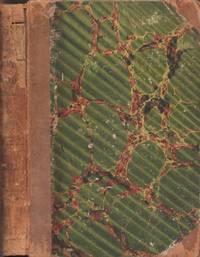
187230930Augusta: Chronicle and Sentinel Publishing Company 1872. First Edition. Hardcover. Fair. Octavo. vi 1 page blank 3 224 pages. LXVI "Supplement to the City Code. Marbled paper covered boards with brown leather spine and corners. Leather is dry and rubbed. Spine is chipped and flaking. Edge wear to the boards. Outer joint and inner front hinge cracked and cover loose but attached. Title faded on the spine. Light soiling to the front and rear end papers. Fair.<br /> <br /> Note: this code contains a resolution numbered "Forty-Fifth" on page 170 that was adopted October 14th 1870 honoring Robert E. Lee. This city code is the first pasted after the end of reconstruction in Georgia 1871. Scarce. 4 copies located in OCLC. Chronicle and Sentinel Publishing Company hardcover
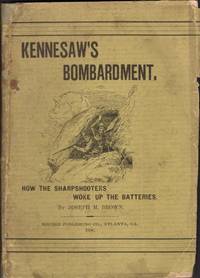
189034729Atlanta: Record Publishing Company 1890. Wraps. Fair. Stapled wraps. Approx. 7" x 5". 172 pages. Illustrated. Yellow illustrated paper covers with title printed on the front. Restored. Fragile paper covers and end sheets reattached. Paper tears repaired with mulberry paper. Text is lightly damp stained in the middle portions. A few pages with insect damage on the corners and edges. No loss of print. A few small pencil margin notes inside. <br /> <br /> The author Joseph Makay Brown was the son of the Georgia's Civil War Governor Joseph Emerson Brown. Joseph M. Brown was elected Governor of Georgia twice serving 1909-11 and 1912-13. This book is historical fiction. <br /> <br /> Scarce in the trade. One copy currently held in OCLC Rice. Not in Georgia Derenne catalog and not in Nevins. Record Publishing Company unknown
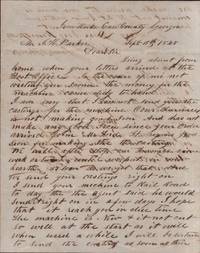
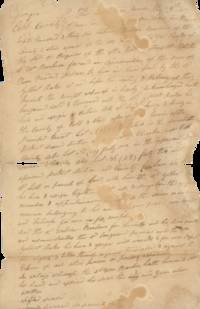
184835414Cass County Bartow County Georgia: n.p. 1848. Letter. Good. Letter. Approx. 10" x 8". 4 pages. 2 pages of content and one page with address. Paper is folded. A couple of light red partial wax seals on the address side. Letter transcribed as best as possible:<br /> <br /> Iron Works Cass County Georgia Sept 15 1848<br /> <br /> Mr J. H. Parker<br /> <br /> Dear Sir<br /> <br /> Being absent from home when your letters arrived at the Post Office Is the cause of me not writing you sooner. The money for the machine came duly to hand I am sorry that I can not send you the castings for the machine Our Furnaces is not making good Iron And has not make any good Iron since your Order arrived from Mr Ford It requires good Iron for making the castings We will after stop our Furnances since week or two until we put in new hearth as soon as we get that done we send your castings right on I send your machine to Rail Road to day the the repeated agent said he would send it right on in a few days I hope that it reach you in due time The machine is New & it not cut so well at the start as it will when used a while I will be sirtain to send the casting as soon as their are made write to me soon as convient and to let know whether you have received the machine or not <br /> <br /> Very Respectfully Yours signed Jacob D Shoup<br /> <br /> N B<br /> <br /> The castings you spoke of for Buggs &c cant be furnished at a short notice if you will send the pattens for the same when we get our Furnance in good fix again Your J D S<br /> <br /> We will send them to Rail Road four four cents per pound that will be much better than buying them in Augusta at 18 cts per pound Ours will be as neat any you can get from Augusta J D H<br /> <br /> On the back side is the address<br /> <br /> Iron Works Ga Sept 18th <br /> <br /> Mr Isaac H Parker Newborn P O Newton Co Georgia END<br /> <br /> Georgia business man and industrialist Mark Anthony Cooper formed the Etowah Iron Works in present day Bartow County with Ironmakers Moses and Jacob Stroup in the 1840's. Etowah was located just north of Cartersville Georgia in former Cass County. The Iron Works were destroyed by the Union Army in 1864 and after the War the area remained in ruins. <br /> <br /> From from the Dictionary of North Carolina Biography 6 volumes edited by William S. Powell:<br /> <br /> "Moses Stroup the eldest son of Jacob was born in Lincoln County N.C. With little formal schooling he was brought up in the iron business. Many contemporaries considered him to be one of the "most expert furnacemen" in the South and a "remarkable genius" in the iron business as well as a good money-maker but a "poor keeper." He accompanied his father to South Carolina about 1815 and when Jacob moved to Georgia in the late 1820s Moses stayed behind. But in 1843 he joined his father at Cass County Ga. and bought him out. Moses built a rolling mill and rolled some of the first railroad iron made in Georgia some of which was used on the state-owned Western and Atlantic. In 1847 he sold the Cass County works to Mark Anthony Cooper and Company and shortly moved to Alabama where he bought ore lands from the government and began the Round Mountain Furnace in 1849". <br /> <br /> From wikipedia:<br /> <br /> Bartow County was created from the Cherokee lands of the Cherokee County territory on December 3 1832 and named Cass County after General Lewis Cass 1782–1866 Secretary of War under President Andrew Jackson Minister to France and Secretary of State under President James Buchanan3 who was instrumental in the removal of Native Americans from the area. However the county was renamed on December 6 1861 in honor of Francis S. Bartow because of Cass's support of the Union4 even though Bartow never visited in the county living 200 miles 320 km away near Savannah all of his life. Cass had supported the doctrine of popular sovereignty the right of each state to determine its own laws independently of the Federal government the platform of conservative Southerners who removed his name. The first county seat was at Cassville but after the burning of the county courthouse and the Sherman Occupation the seat moved to Cartersville where it remains. n.p. unknown
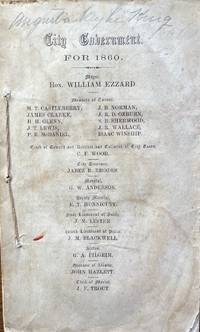
186036730Atlanta: Atlanta 1860. First Edition. Wraps. Fair. Stitched wraps. Pages 3-131 x. Missing the front cover that may identify the printer and location. Light soil and toning to the wraps. Light damp stains to the back pages. Last index page torn in half with content missing on page ix. Contents include rules for Slaves and free people of color. Previous owner name top of page 3 Augusta Wylie King. Early Atlanta imprint. Atlanta unknown
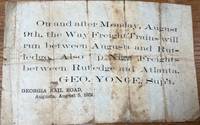
185836085Augusta: Georgia Rail Road 1858. Broadside. Fair. Broadside. Approximately 5" x 7.5". Paper is folded creased toned with two small holes. Tears at the splits. Tape repair on the blank reverse side. Fair condition only. Obscure. No other copies of this advertisement were found during a recent search. Georgia Rail Road unknown
187434803Albany New York: Joel Munsell 1874. First Edition. Wraps. Very good. Wraps. x errata slip 184 pages. Original printed green stitched wraps. Black title on the front cover. Pages uncut and untrimmed. Appears unused. Light wear to the covers and foredge. A small chip and paper split on the spine. <br /> <br /> Howes J 205; Derenne Georgia catalog volume 2 page 747. Joel Munsell unknown
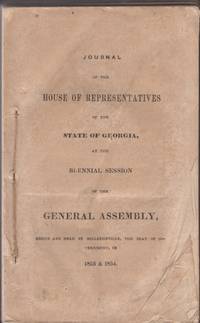
185335359n.p.: Georgia 1853. Wraps. Fair. String bound wraps. 1011 pages 1 page blank 1 37 page Index 1 page blank 1. Title page is page 1. Page 1 is toned and creased. Rear wrap is lightly toned with a few spots. Text block is not trimmed and the pages are uncut at the top edge. Moderate toning and foxing to the contents. <br /> <br /> Contents include a section on Slave and Free Persons of Color laws. Printer information or location not provided on the title page. A similar copy held by Emory University states the 1853 & 1854 Journal was printed in Savannah by S. T. Chapman. Emory's copy is has 904 pages while this copy has 1011 pages. Also Emory's copy does not have the hyphen in the word Biennial on the printed title page. Georgia unknown
187233737Savannah 1872. Letter. Very good. Manuscript letter written on 4 lined sheets of paper on the front sides. Folded. Addressed to former Republican Governor of Georgia Benjamin Conley Atkin's starts the letter by stating "I have written to Hon. Jno. G. New with request for him to submit it to the heads of the party in Washington for suggestions the Following Viz: - Propositions for Republican Adjustment." Atkins outlines the proposal in these 4 pages. Signed at the bottom of page 4 "Yours Truly James Atkins."<br /> <br /> Benjamin Conley was the last Republican Governor of Georgia during the Reconstruction period. From wikipedia: Conley's previous political service included the office of mayor of Augusta Georgia from 1857 to 1859. Conley served as the 47th Governor of Georgia from October 30 1871 to January 12 1872 during Reconstruction and was the second Republican governor of Georgia. Conley was serving as the president of the Georgia Senate when his predecessor Rufus B. Bullock was forced to resign. As the Senate president Conley assumed the governorship and served for only two months. unknown
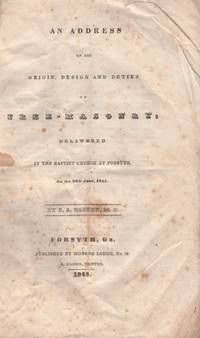
184531059Forsyth Gorgia: Published by Monroe Lodge No. 18. S. Harris Printer 1845. First Edition. Wraps. Good. Wraps. Plain outer yellow stitched wraps. 15 pages. Title on page 1. Light edge wear and creases to outer wraps. Light scattered foxing to the text. Scarce. No copies located in OCLC. Published by Monroe Lodge, No. 18. S. Harris, Printer unknown
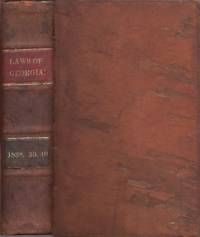
184131331Milledgeville: P L Robinson; Grieve & Orme; William S Rogers 1841. First Edition. Leather bound. Fair. Octavo. A sammelband of 3 separate bound acts: 1838: 285 pages 35 page appendix xiv index; 1839: 224 pages; 1840: 219 pages 11 page index to laws 110 page index to Resolutions. Brown calf leather binding. Title stamped on red and black leather spine labels. Front hinge glued. Rear hinge is in good condition. Leather is rubbed and scuffed in spots. Moderate toning to the contents. Some of the top edge margins cut too close resulting in slight loss of page headings. <br /> <br /> Previous owner ink stamp "Lawrence B. Custer Attorney At Law Marietta Georgia" on the right front flyleaf. Katherine H. Custer 1999 written below the first inscription on the right front flyleaf. Many Acts inside relate to Slavery Railroads Infrastructure etc. P L Robinson; Grieve & Orme; William S Rogers unknown
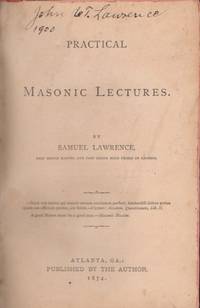
187431554Atlanta: Self published. Stereotyped at Franklin Type Foundry Cincinnati 1874. First Edition. Hardcover. Good. 12mo. xiv 407 pages. Book has been rebound at a later period. Dual cloth hardcover with green cloth covered boards and light brown cloth spine. All edges shaded red. Probably missing the front blank end sheet or half title. Inscribed in 1900 by John deT Lawrence son of Samuel Lawrence at the top of the title page. This copy includes an inscribed cabinet photograph cabinet card taken at the "T. B. Blackshear Photograph Artist 13 Cotton Ave. Macon Georgia". The inscription reads "Hon. Samuel Lawrence Marietta Ga. Grand Master and High Priest of Masons of Georgia 1880". Scarce. Self published. Stereotyped at Franklin Type Foundry, Cincinnati hardcover
1868109410New York: Scribner Armstrong & Company 1868. First Edition; First Printing. Hardcover. Good in boards. 2 Library ink stamps. Soiling and staining. Brown spotting and darkening to pages.; 24mo 5" - 6" tall. Scribner, Armstrong & Company hardcover
183935764Milledgeville: P L Robinson; Grieve & Orme; William S Rogers 1839. First Edition. Leather bound. Fair. Octavo. A collection of 3 separate bound acts with 3 title pages. Collated as follows: 1838 285 pages 35 page appendix xiv index; 1839 224 pages; 1840 219 pages 11 page index to laws 110 page index to Resolutions. Brown calf leather binding. Title stamped on red and black leather spine labels. Front hinge glued. Rear hinge in good condition. Leather binding rubbed and scuffed. Outer joints cracked. First title page has light bug damage upper left edge. Moderate toning to the text. Part of the text block was trimmed resulting in minor loss of page headings. Previous owner ink stamp "Lawrence B. Custer Attorney At Law Marietta Georgia" on the right front flyleaf. Katherine H. Custer 1999 written below the first inscription on the right front flyleaf. Many Acts relate to Slavery Railroads Infrastructure etc. Fair only. P L Robinson; Grieve & Orme; William S Rogers unknown
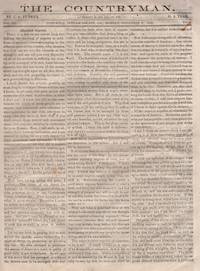
186235238Putnam County Ga: J. A. Turner 1862. First Edition. Newspaper. Good. 12" x 9" newspaper. Pages 57-64. Pages uncut at top edge. Very light toning to the issue. Front page lead article is titled "Educated Negroes." Other contents include stories misc. news and several advertisments. In March of 1862 Joel Chandler Harris future folklorist author of Uncle Remus and several other works started as a a typesetter for the newspaper "The Countryman". Harris lived at Turnwold Plantation near Eaton Georgia throughout the War. The paper ceased in 1866. In 1876 Henry Grady of the Atlanta Constitution hired Harris as a journalist. J. A. Turner unknown
1860825171860. GEORGIA. Minutes of the Union Society: Being an Abstract of Existing Records From 1750 to 1858. Comprising also Chronological lists of its Officers Members and Beneficiaries with the Anniversary Addresses of Hon. T.U.P. Charlton Col. Howell Cobb etc. Savannah: John M. Cooper & Co. 1860. 29 4 206 9 1 22 24 28pp. Orig. cloth. Very good or better. DE RENNE II p.615. PARRISH & WILLINGHAM 7930. OCLC 5634157 ref. A useful survey of Union Society records. There seems to be a question surrounding potential later issues. De Renne cites 1860 as the only publication date while Parrish & Willingham claim 1861. It is almost certain there were two issues of the present work the present copy being the earlier one without the latest entry dated "1861." An early Confederate imprint. Scarce. Parrish & Willingham locate only seven copies of the later issue. OCLC does not differentiate between potential issues. unknown
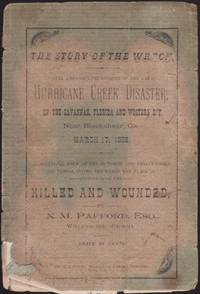
188836170Savannah: Byck & Selig 1888. First Edition. Wraps. Fair. Wraps. Approximately 7.5" x 4". 11 pages 1 page blank. Front cover faded with small edge tears chips and corner creases. Illustrated back cover lightly soiled creased torn and edge chipped. Fragile title and preface pages are spotted edge torn chipped creased and detached no loss of print. Entire booklet creased with several small puncture holes. Very minimal loss of partial letters in the text<br /> <br /> The poem tells the story of one of the worst the train wrecks in Georgia on the Savannah Florida and Western Railway. It lists the people who died and brief information about them and their families. Oddly this wreck is not listed during an internet search of the biggest train wrecks in Georgia. Not in Derenne Georgia catalog. Scarce and obscure. Fair only. Byck & Selig unknown
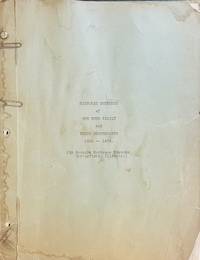
189415751894. Edwards Georgie Hortense <br /> Manuscript for a Noted Genealogy Authored by a Descendant of Mary Todd Lincoln circa 1894<br /> 19 pp. typed carbon leaves printed rectos only plus title page inside pale green thin card wrappers originally three brad-bound only one brad remaining held with paper clips. About good as wrappers are moderately chipped and stained.<br /> <br /> This is a typed draft with copious handwritten amendments for an oft-reprinted genealogical history “Historic Sketches of the Edwards and Todd Families and Their Descendants 1523-1895.†Originally printed in 1894 and updated several times afterward the book was authored by Georgie Hortense Edwards secretary of the Springfield Illinois Chapter of the National Society Daughters of the American Revolution and a granddaughter of Elizabeth Todd Edwards sister of Mary Todd Lincoln. The history goes back to Georgie’s “great great great great grandfather Robert Todd†and argues that “what is known of the antecedents of the Todd family is most honorable.â€<br /> <br /> Small collection also includes two first person accounts as relayed to Edwards as passed down through her family regarding "Lincoln and Duff Armstrong Murder trial.the information I have my Father and Mother has told me." The Duff Armstrong trial is a well-known case where Abraham Lincoln proved in court that a witness was lying when that witness claimed to have seen the murder take place "under the light of the moon." Lincoln produced an almanac which showed the moon that night had already set at the time of the "witnessed murder". Edwards backed up this account saying ".Father and Mother had been to a camp meeting and had gotten home around eleven p.m. and the moon had gone down it is true Abe secured an almanac and prove to the court that there was no moon shining at that time when this happened." <br /> <br /> A rare set of manuscripts. OCLC shows that only two institutions have the first printing of "Historic Sketches" and about 30 have later reprints while none have any drafts. We find no record of the anecdotal re-telling of the Duff Armstrong case. unknown
183434357New York: Thomas Illman 1834. First Edition. Map. Good. Map. Approximately 15" x 13" wider margins than other copies. Colored map shows Cherokee Tribal lands in North Georgia. A couple of very small edge tears on the right center edge not affecting content. Map is clean and in good condition. Entered according to an act of Congress in the year 1834 by Thos. Illman. Pencil note in the upper left corner on the verso states "From Burr's "A New Universal Atlas" Phillips No. 771 New York 1835 D.S. Stone/Thomas Illman Plate No. 52." Drawn before the forced removal of the Cherokee Indian Tribe in North Georgia. Thomas Illman unknown
1850354298Milledgeville 1850. 34pp. Dbd. Scattered foxing. Very good. 34pp. Dbd. Consists largely of a discussion of the recently proposed "act for the admission of California into the Union" and the effects such a move would have on slavery. The main thrust of the resulting resolutions was an affirmation of the need for the fugitive slave law. An important part of the debates over the fate of the Union in 1850. DE RENNE p.532 unknown
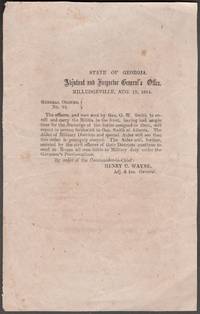
186435142Milledgeville: State of Georgia 1864. First Edition. Broadside. Very good. Broadside 9.5" x 6". Printed on the front side only. Light toning and wear to the paper. <br /> <br /> Parrish and Willingham 2888 . 2887 states No. 24 issued at Atlanta but gives no date. 2888 states Nos. 1-31; 7 January - 13 October 1864. Order reads; "The officers and men sent by G. W. Smith to enroll and carry the Militia to the front having had ample time for the discharge of the duties assigned to them will report in person forthwith to Gen. Smith at Atlanta. The Aides of Military Districts and special Aides will see that this order is promptly obeyed. The Aides will further assisted by the civil officers of their Districts continue to send to Macon all men liable to Military duty under the Governor's Proclamations."<br /> <br /> By order of the Commander-in-Chief Henry C. Wayne Adj. & Ins. General. [State of Georgia] unknown
185435614Griffin Georgia: Self published 1854. Hardcover. Good. 12mo. 1 vi 180 pages 1. Brown cloth hardcover with blind stamped designs on the covers and gilt lettered title on the spine. Cloth lightly worn on the edges. A small bit of brown staining to the bottom corner edges of some of the pages. Old pencil inscription by the previous owner on the yellow right front flyleaf. Scarce and obscure publication. Not listed in the Georgia Derenne catalog. <br /> <br /> Sabin 80104. From the New Georgia Encyclopedia Jennie Knight Emory Univ.<br /> <br /> Before the Civil War 1861-65 the only Unitarian churches in Georgia were located in Augusta and Savannah. Following disagreements with the national association of Unitarians over the abolition of slavery the Augusta church closed in the 1840s while the Savannah church closed in 1859. Similarly southern Universalists often differed with their northern counterparts about abolition. There were more small active Universalist churches than Unitarian churches in Georgia before the war yet no congregations remained active afterward. A large Universalist missionary effort in the Southeast began in 1891 and attracted many new converts but after the Great Depression of the 1930s Universalist membership declined again. Self published hardcover
1836List2949Clarke Cobb and Harris Counties Georgia 1836. Three documents. One four-page document measuring 5 x 8 ¾ inches likely previously a single sheet; water stained with some tearing at folds very good. One double-sided document measuring 8 x 10 inches; water stained and folded with large tears at folds possibly with part missing good. One single-sided document measuring 7 ¾ x 12 ¾ inches. Water stained and folded with large tears at folds much damage to margins good. Overall good. Three legal documents in which William Barber buys and sells plots of land shortly following the establishment of Cobb County. In 1834 and 1835 Barber buys plots from John Gann and Elizabeth Kennon for $100 each and in 1836 sells land to Gilbert Rake for $500. Gann is possibly the plantation owner Cobb County pioneer and State Senator. <br /> <br /> These land contracts date to a time at which a small number of Cherokee—whose territory included present-day Cobb County—had voluntarily left the area following the Indian Removal Act of 1830 while a majority had not done so. The Indian Removal Act required Indigenous people east of the Mississippi River to cede their land to Euro-Americans and move west of it to so-called Indian Territory now Oklahoma. In 1835 the US government met with a group of Cherokee claiming to represent the tribe in New Echota Georgia and signed a removal treaty. When the majority of the tribe viewing the treaty as illegitimate refused to move voluntarily the US government sent the military to intervene.<br /> <br /> Of interest to historians of Cobb County and land dealings between its early Euro-American residents during the removal of its Indigenous population. unknown
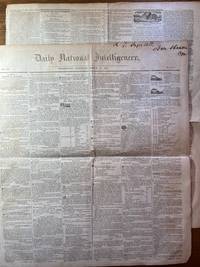
183236785Washington DC: Gales & Seaton 1832. Newspaper. Good. Newspaper. Approx. 21" x 18." 4 pages. Two folds. Sheets are detached. Newspaper has light toning. Name of R. J. Ingersoll New Haven Con" written top of issue. Possibly the same Ingersoll that served 4 terms in Congress from 1825-1833. <br /> <br /> Entire contents of page 2 concern "The Cherokee Case. Opinion of the Supreme Court delivered by Mr. Chief Justice Marshall January Term 1832. Samuel A. Worcester vs. The State of Georgia." The case is also printed on the first column of page 3. Supreme Court case of Samuel Worcester. From the Brittannica website: <br /> <br /> Worcester v. Georgia involved a group of white Christian missionaries including Samuel A. Worcester who were living in Cherokee territory in Georgia. In addition to their missionary work the men were advising the Cherokee about resisting Georgia's attempts to impose state laws on the Cherokee Nation a self-governing nation whose independence and right to its land had been guaranteed in treaties with the United States government. In an effort to stop the missionaries the state in 1830 passed an act that forbade "white persons" from living on Cherokee lands unless they obtained a license from the governor of Georgia and swore an oath of loyalty to the state. Worcester and the other missionaries had been invited by the Cherokee and were serving as missionaries under the authority of the U.S. federal government. They did not however have a license from Georgia nor did they swear a loyalty oath to that state. Georgia state authorities arrested Worcester and several other missionaries. After they were convicted at trial in 1831 and sentenced to four years of hard labour in prison Worcester appealed to the U.S. Supreme Court.<br /> <br /> Worcester argued that Georgia had no right to extend its laws to Cherokee territory. He contended that the act under which he had been convicted violated the U.S. Constitution which gives to the U.S. Congress the authority to regulate commerce with Native Americans. The Constitution also bars the states from passing laws that alter the obligations of contracts-in this case treaties. Several treaties between the Cherokee and the U.S. government recognized the independence and sovereignty of the Cherokee Nation. Furthermore Worcester argued that the Georgia laws violated an 1802 act of Congress that regulated trade and relations between the United States and the Indian tribes.<br /> <br /> The Supreme Court agreed with Worcester ruling 5 to 1 on March 3 1832 that all the Georgia laws regarding the Cherokee Nation were unconstitutional and thus void. Writing for the court Chief Justice John Marshall held that "the Indian nations had always been considered as distinct independent political communities retaining their original natural rights as the undisputed possessors of the soil." Even though Native Americans were now under the protection of the United States he wrote that "protection does not imply the destruction of the protected." Marshall concluded:<br /> The Cherokee Nation then is a distinct community occupying its own territory.in which the laws of Georgia can have no force and which the citizens of Georgia have no right to enter but with the assent of the Cherokees themselves or in conformity with treaties and with the acts of Congress. The whole intercourse between the United States and this Nation is by our Constitution and laws vested in the Government of the United States.<br /> <br /> Georgia however ignored the decision keeping Worcester and the other missionaries in prison. Eventually they were granted a pardon and were released in 1833. Pres. Andrew Jackson declined to enforce the Supreme Court's decision thus allowing states to enact further legislation damaging to the tribes. The U.S. government began forcing the Cherokee off their land in 1838. In what became known as the Trail of Tears some 15000 Cherokee were driven from their land and were marched westward on a grueling journey that caused the deaths of some 4000 of their people.<br /> <br /> The Supreme Court agreed with Worcester ruling 5 to 1 on March 3 1832 that all the Georgia laws regarding the Cherokee Nation were unconstitutional and thus void. Writing for the court Chief Justice John Marshall held that "the Indian nations had always been considered as distinct independent political communities retaining their original natural rights as the undisputed possessors of the soil." Even though Native Americans were now under the protection of the United States he wrote that "protection does not imply the destruction of the protected." Marshall concluded:<br /> The Cherokee Nation then is a distinct community occupying its own territory.in which the laws of Georgia can have no force and which the citizens of Georgia have no right to enter but with the assent of the Cherokees themselves or in conformity with treaties and with the acts of Congress. The whole intercourse between the United States and this Nation is by our Constitution and laws vested in the Government of the United States.<br /> <br /> Georgia however ignored the decision keeping Worcester and the other missionaries in prison. Eventually they were granted a pardon and were released in 1833. Pres. Andrew Jackson declined to enforce the Supreme Court's decision thus allowing states to enact further legislation damaging to the tribes. The U.S. government began forcing the Cherokee off their land in 1838. In what became known as the Trail of Tears some 15000 Cherokee were driven from their land and were marched westward on a grueling journey that caused the deaths of some 4000 of their people. Gales & Seaton unknown
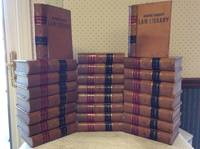
18471233456Georgia 1847. 1st Edition. Leather bound. Fair. A complete run of the first 24 volumes of the State of Georgia's offical law reports. FIRST EDITIONS FIRST PRINTINGS OF THESE RARE PRE-CIVIL WAR GEORGIA IMPRINTS. Vol. I was published in New York but Vol. II was published in Savannah Vols. 3-20 in Athens GA and Vols. 21-24 in Columbus GA. The set is bound in matching leather but some bindings are damaged. Each volume has a law library name stamped on the covers; the front boards of Vols. I and VI are detached; the spines of Vols. I IX and XX are torn; most volumes have a strip of brown cloth tape across the top of the spine. ATTENTION: many bindings are fragile so one can expect other covers to detach. Other than some very minor foxing scattered throughout the set the interior pages are clean tight and unmarked. Offered as-is and no returns accepted. Buyer should understand they may need to rebind these books. These reports on various law cases were standard volumes in Georgia courts but the vast majority were destroyed during the Civil War As with other works from this era antebellum printings from Georgia are today rarely found. unknown