[Georgia Confederate Newspaper]Biblio.com
139 résultats
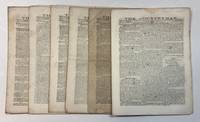
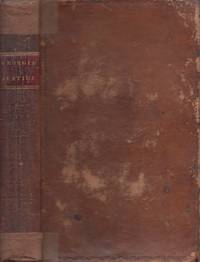
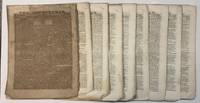
186241733Turnwold Putnam County Ga. 1862. Each issue a folio sheet folded to 8 pp. Each page 9-1/4" x12." Each number printed in three columns per page. No. 1 is browned. Very Good.<br /> <br /> Crandall does not record Numbers 4 and 5; but AAS which says The Countryman was "suspended intermittently" evidently owns them. Its first printing was March 18 1862. With the opening issue of this volume III Turner trumpets the "remarkable" success of The Countryman which has received a "universal acclaim of approbation" and has been financially successful. The articles cover an array of subjects including of course much on the War: Why the Hessians Enlist; the "worst provincialisms of the Yankees;" John Adams; observations on the War; the printing of The Countryman; poetry "The Old Plantation"; advertisements; President and leaders of the Confederate States; Iron; "Teaching Negroes to Read." <br /> This interesting Confederate weekly was printed at Turnwold Turner's Putnam County plantation probably the only wartime newspaper so printed. "Joel Chandler Harris was an apprentice for Joseph Addison Turner. In 1862 Turner decided to produce a newspaper from his home at Turnwold Plantation. In fact in a more-than-semi-autobiographical book Harris wrote called On the Plantation he explains that the printing office for The Countryman was established 'in an outhouse.'. . . As was the typical arrangement for the time Harris worked for Turner in exchange for clothing and boarding at the Turnwold Plantation for the four plus years he apprenticed there. As a printer's devil Harris was responsible for setting and inking the type for the paper on the hand-press individually placing the letters so they were spaced appropriately for printing" "Joel Chandler Harris and The Wren's Nest" December 3 2020 Blog site of American Writers Museum accessed May 01 2026. <br /> Crandall 5152. Not in Parrish & Willingham. Lomazow 687. unknown
186241734Turnwold Putnam County Ga. 1862. Each issue a folio sheet folded to 8 pp. Each page 9-1/4" x12." Each number printed in three columns per page. No. 12 with a persistent corner chip and occasional small loss. Light foxing. Very Good. EACH ISSUE $250 OR THE ENTIRE RUN FOR $1000<br /> <br /> Crandall does not record Numbers 4 and 5; but AAS which says The Countryman was "suspended intermittently" evidently owns them. Its first printing was March 18 1862. The articles cover an array of subjects including of course much on the War: <br /> This interesting Confederate weekly was printed at Turnwold Turner's Putnam County plantation probably the only wartime newspaper so printed. "Joel Chandler Harris was an apprentice for Joseph Addison Turner. In 1862 Turner decided to produce a newspaper from his home at Turnwold Plantation. In fact in a more-than-semi-autobiographical book Harris wrote called On the Plantation he explains that the printing office for The Countryman was established 'in an outhouse.'. . . As was the typical arrangement for the time Harris worked for Turner in exchange for clothing and boarding at the Turnwold Plantation for the four plus years he apprenticed there. As a printer's devil Harris was responsible for setting and inking the type for the paper on the hand-press individually placing the letters so they were spaced appropriately for printing" "Joel Chandler Harris and The Wren's Nest" December 3 2020 Blog site of American Writers Museum accessed May 01 2026. <br /> Crandall 5152. Not in Parrish & Willingham. unknown
183830021New York: Harper and Brothers 1838. First Edition. Leather bound. Fair. Octavo. 2 2 pages advertisements vii 414 pages 4 pages ads 2. Illustrated with 59 maps by James Smith. plates. Brown polished leather binding with leather title label on the spine. Rear joint split lower spine. Light edge wear to the boards. Leather spine is dry scratched and darkened. Heavy toning to the end papers. Moderate foxing to the text. Georgia historian Charles C. Jones Jr. illustrated book plate on the front paste down. <br /> <br /> De Renne p.462; Willingham and Harwell Georgiana #30. Harper and Brothers unknown
183830020New York: Harper and Brothers 1838. First Edition. Full calf. Fair. Octavo. 2 vii 414 pages 2 pages ads. Illustrated with 59 maps by James Smith and printed by N. Currier's Lith. N. Y. Brown leather binding with leather title label on the spine. Leather is lightly rubbed on the edges and joints. Front hinge cracked. Rear flyleaf removed. Light to moderate foxing and damp-stains to the text. Old ink inscription of "Marcus A. Bell Atlanta Geo. Oct. 14th 1854" written on the front paste down. Rubber stamp of "A. H. Waite Jr. 1701 W. Paces Ferry Rd. N.W. Atlanta Georgia" located below the inscription. Marcus Bell's name is also written top of the preface page page 2 and page 8 map section. Marcus A. Bell was an attorney from Atlanta and is listed in the book "Pioneer Citizens History of Atlanta" published in 1902. His name was listed on the 1851 Atlanta register. <br /> <br /> Derenne p.462; Willingham and Harwell Georgiana #30. Harper and Brothers unknown
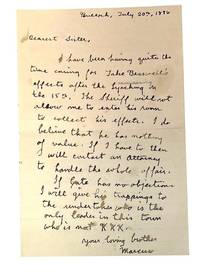
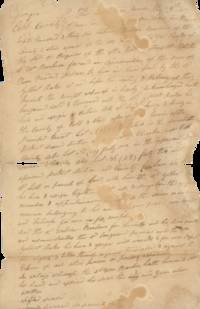
1886954441886. Very Good. Small single sheet. 17 x 11 cm. Handwritten in ink. Single horizontal fold in center with 2 cm. tear on right end. Several individual letters are smeared tears perhaps toward the bottom of the letter. Envelope not present. Text of the letter: "Dearest Sister I have been having quite the time caring for Jake Braswell's effects after the Lynching in the 15th. The Sheriff will not allow me to enter his room to collect his effects. I do believe that he has nothing of value. If I have to then I will contact an attorney to handle the whole affair. If Cate has no objections I will give his trappings to the undertaker who is the only leader in this town who is not KKK. Your loving brother Marcus" Above the word "Lynching" murdering is penciled in. Handwritten in pencil on back and signed in pencil. "Letter to the Hon. Gov. Henry D. McDaniel about Jake Braswell's murder in Bullock Georgia 1886 was Returned un-answered. Marcus." A contemporary newspaper account in an Indiana newspaper reported that Braswell had "horribly mistreated" Dolly Woods a 6 year old white girl who identified Braswell as her assailant after his capture. Braswell reportedly was given the choice of being burned or hanging himself. When he did not follow through on hanging himself Braswell was involuntarily hung and his body riddled with bullets. It is unclear how Marcus and his sister were related or otherwise connected to Braswell. unknown
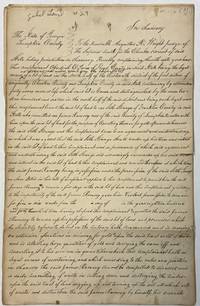
184441397Lumpkin County Georgia 1844. Folio 8" x 12-3/4". Three leaves: 1 1 blank 1 1 blank 2 pp. Completely in ink manuscript. Light tanning old folds minor wear and some short splits at fold edges. Prepared and signed by William H. Underwood as Solicitor for the complainant. Very Good.<br /> <br /> From 1805 through 1832 Georgia used a lottery system to distribute land taken from the Cherokee and Creek Indians. The Georgia Gold Rush began in 1829 and continued through the early 1840s. Separate Gold Lotteries in 1832 and 1833 divided lots into 40 acres and distributed them. The Georgia Gold Rush was the second significant gold rush in the United States and was particularly significant in the county seat of Dahlonega Lumpkin County where it began soon spreading through the North Georgia Mountains. Due to the significant amount of mined gold Congress established the Dahlonega Mint in 1838. By the early 1840s gold became less plentiful and many miners migrated to California for the California Gold Rush. "Dahlonega Gold Museum" Roadside Georgia website accessed on Wayback Machine Internet Archive October 2025; Wikipedia.<br /> Judge A. R. Wright issued a ruling 15 April 1844 enjoining Ramsey "from committing future waste spil or destruction in and upon the lot of land" until further order of the Court and required him to appear and respond to the complaint.<br /> Obadiah E. Payne a/k/a Paine 1807-1892 was a farmer from Floyd County Seth Strange c.1804-1881 was a farmer from Franklin County and James Ramsey c.1798-1869 was a farmer from Cherokee County doing gold mining in Lumpkin County for a time. United States Federal Census records on Ancestry website.<br /> William Henderson Underwood 1779-1859 was a Georgia lawyer a Captain in the War of 1812 and was elected Judge of the Western Circuit of Georgia in 1825. "Sketches of Georgia Lawyers. . . William Henderson Underwood" The Weekly Telegraph 14 June 1867 page 2.<br /> Augustus Romaldus Wright 1813-1894 was an American politician and lawyer who served in the U.S. House of Representatives from 1857-1859 served in the First Confederate Congress organized "Wright's Legion" of Georgia Volunteers and served as a colonel in the Georgia 38th Infantry C.S.A. President Lincoln offered him a position of provisional governor of Georgia in 1864 if the state withdrew from the Confederacy which it did not. "Wright Augustus Romaldus" online Biographical Directory of the United States Congress. unknown
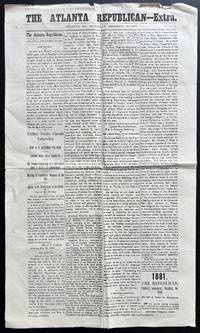
18805904Atlanta: December 18 1880. About very good. Broadside newspaper extra 19 x 11.25 inches. Old folds and creases a bit wrinkled minor soiling minor fraying and light staining to top edge tiny hole at center crossfold. An extraordinarily rare broadside newspaper extra from the only Republican paper in the state of Georgia to survive the end of Reconstruction. The Atlanta Republican was issued weekly between 1874 and 1886 and was devoted to Republican Party causes during Reconstruction. The present extra issue is a ringing endorsement of Hon. Amos T. Akerman 1821-1880 the Republican nominee to a recent open circuit judgeship in the state. Akerman was a Dartmouth-educated jurist who moved south to practice law. He settled in Georgia in 1850 and true to his surroundings owned several slaves and served as a colonel in the Confederate Army. Following the war Akerman became an advocate for Reconstruction and freedmen's rights served as U.S. Attorney for Georgia and eventually worked as President Grant's attorney general crusading against the first incarnation of the Ku Klux Klan during the early 1870s. Though a Republican in Reconstruction Georgia Akerman remained a largely popular figure in the state.<br /> <br /> The present broadside documents a meeting by the Atlanta Bar in which they speak glowingly about the "ability learning and integrity" of Akerman praise his "unswerving fidelity to the Republican Party at the most stormy and trying periods of the struggles of the South" and note both his "manly services in the cause of the true national and human and sentiments and principles in the trying days of reconstruction" and "valuable services to the cause of Republicanism during the last fifteen years." The work also mentions Akerman's volunteer services during a supposed "negro insurrection" in Georgia in the mid-1870s in which Akerman's work "resulted in restoring peace and satisfying the impassioned and infuriated whites that there was no insurrection attempted or contemplated." The Bar calls for united support for Akerman and the broadside concludes with an article about a "Committee of Lawyers appointed to press the claims of Mr. Akerman for the Circuit Judgeship." Despite the strong support statewide Akerman was never able to accept the judgeship had it been offered to him; unfortunately he died three days after the issuance of the present newspaper extra. Still the broadside remains an interesting example of the waning though remaining Republican influence in very late-to-post-Reconstruction Georgia.<br /> <br /> The present newspaper extra is not in the collection of the American Antiquarian Society nor in OCLC but one is apparently located at the University of Georgia's broadside collection. December 18 unknown
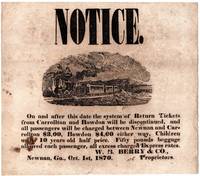
187012823Newnan Ga: October 1 1870. Broadside 7.75 x 9 inches with engraved vignette at center. Old folds moderate foxing and dust-soiling light staining. Short closed tear to bottom edge. Overall very good. A delightful mid-19th-century Georgia railroad broadside advertising changes to the ticketing system for one of the southern rail lines owned by William Byrd Berry. Here rates for travel between Berry's hometown of Newnan and Carrollton or Bowdon are specified and the rates for children under the age of 10 are noted as half price. Further the broadside stipulates baggage is capped at fifty pounds and the excess will be charged "Express rates." The work is signed in type by "W.B. Berry & Co." and dated October 1 1870 in Newnan. The text is enhanced with a striking central vignette of a locomotive pulling several railcars through a mountainous region. William Byrd Berry 1831-1902 was a prominent businessman and landowner born and raised in Newnan Georgia. He served as president of various banks and was involved in a number of railroad interests in the state. As far as we can tell the present broadside is unrecorded. October 1 unknown
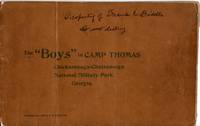
189813100Chattanooga TN: Sidebottom & Kerr 1898. 48pp. Slim oblong octavo. Original orange-tan wrappers printed in black stapled. Wrappers soiled creased and chipped with contemporary ownership inscription on front wrapper. First and last leaves detached from text block text block itself detached from wrappers. Good only. A scarce historical photobook that doubles as a catalogue for a Chattanooga photography studio at the outset of the Spanish-American War. Named after Union General George H. Thomas Camp Thomas was a massive temporary military training facility established at the Chickamauga Battlefield in Georgia during the Spanish-American War. The camp hosted up to 70000 troops but became a national scandal after deadly disease outbreaks. The work features seventy total monotone photographs from third-page to full-page with brief printed captions and plate sizes memorializing various scenes at Camp Thomas in 1898. The subjects of the photographs include military structures scenes on the training ground soldiers from various state units in small and large groups soldiers hosting local visitors the large corral of horses at the camp monuments inside the camp / national park views of the natural scenery and more. According to explanatory text on the inside front wrapper "the main idea is to show by photograph such scenes of every day occurrence; routine work both on and off duty as will give nearest a correct idea of what the life of a soldier in camp is made of or as you would see him were you on the grounds in person."<br /> <br /> The rear wrapper reveals an additional motivation for the publication of the work in the form of instructions for ordering any of the photographs featured within. Such is the reasoning behind the plate sizes listed by each example. The Chattanooga studio Sidebottom & Kerr states that "Every Plate in this Book was made expressly for it and having the negative can furnish upon short notice photograph of any plate." The company offers to send the catalogue free of charge to anyone east of the Rocky Mountains. A scarce and unusual photobook that does double duty as a Tennessee photographic studio's order book. OCLC reports just eight total institutional holdings. Sidebottom & Kerr unknown
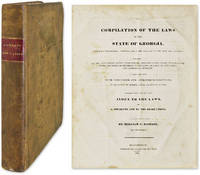
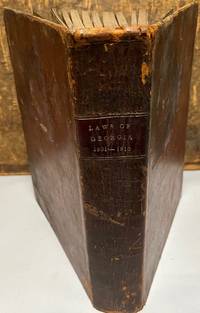
1831589071831. Milledgeville 1831. 1st ed. Milledgeville 1831. 1st ed. 1831 Compilation of Georgia Law Georgia. Dawson William C. Compiler. A Compilation of the Laws of the State of Georgia Passed by the General Assembly Since the Year 1819 to the Year 1829 Inclusive: Comprising All the Laws Passed Within Those Periods Arranged Under Titles With Marginal Notes And Notes of Reference to the Laws Or Parts of Laws Which are Amended or Repealed: To Which are Added such Concurred and Approved Resolutions As are Either of General Local or Private Nature: Concluded With a Full and Ample Index to the Laws and a Separate One to the Resolutions. Milledgeville: Published by Grantland and Orme 1831. 488 150 xxix pp. Text in parallel columns. Quarto 10" x 8". Contemporary sheep blind fillets to boards lettering piece and blind fillets to spine. Light rubbing to boards and extremities corners bumped a few minor scuffs and stains to boards hinges starting. Toning and light foxing to text faint dampstaining in places to margins internally clean. A desirable copy. $600. First edition. This was the fifth digest of Georgia state laws preceded by others from 1801 1802 1812 and 1821. It is digested alphabetically by topic. Babbitt Hand-List of Legislative Sessions and Session Laws 87. unknown
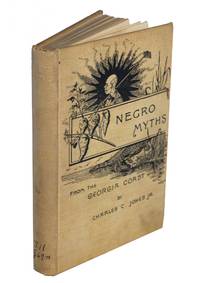
1888177281888. Jones Charles C. Negro Myths from the Georgia Coast 1888 presenting a late nineteenth-century compilation of African American folklore recorded in the Gullah dialect of the Georgia and South Carolina coastal region with direct relevance to the study of Black oral traditions linguistic history and post-emancipation cultural expression. The volume gathers fable-like narratives often centered on anthropomorphic animals that reflect storytelling traditions rooted in African diasporic heritage and adapted within enslaved and freed communities of the coastal South. Its use of Gullah a Creole language shaped by West African linguistic structures and English situates the work within ongoing efforts of the period to document vernacular speech and preserve forms of cultural expression that had developed under slavery and persisted into Reconstruction and beyond.<br /> <br /> Jones Charles C. Negro Myths from the Georgia Coast. Boston and New York: Houghton Mifflin and Company 1888. First edition. The text is rendered in Gullah dialect reflecting the linguistic patterns of African American communities along the Georgia and South Carolina coasts including areas around Savannah and Charleston. Jones raised in a plantation environment and familiar with the regional speech patterns compiled these narratives as part of a broader nineteenth-century interest in folklore and dialect studies contributing to early written records of Gullah language and storytelling traditions.<br /> <br /> Single volume. Ex libris. Minor foxing to the front pastedown and bumped corners; overall very good condition. A late nineteenth-century printed record of African American folklore and language from the coastal South documenting narrative forms and speech patterns that remain central to the study of Gullah culture and linguistic history. unknown
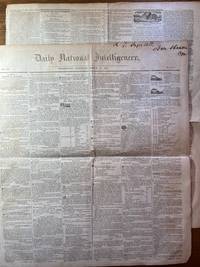
183236785Washington DC: Gales & Seaton 1832. Newspaper. Good. Newspaper. Approx. 21" x 18." 4 pages. Two folds. Sheets are detached. Newspaper has light toning. Name of R. J. Ingersoll New Haven Con" written top of issue. Possibly the same Ingersoll that served 4 terms in Congress from 1825-1833. <br /> <br /> Entire contents of page 2 concern "The Cherokee Case. Opinion of the Supreme Court delivered by Mr. Chief Justice Marshall January Term 1832. Samuel A. Worcester vs. The State of Georgia." The case is also printed on the first column of page 3. Supreme Court case of Samuel Worcester. From the Brittannica website: <br /> <br /> Worcester v. Georgia involved a group of white Christian missionaries including Samuel A. Worcester who were living in Cherokee territory in Georgia. In addition to their missionary work the men were advising the Cherokee about resisting Georgia's attempts to impose state laws on the Cherokee Nation a self-governing nation whose independence and right to its land had been guaranteed in treaties with the United States government. In an effort to stop the missionaries the state in 1830 passed an act that forbade "white persons" from living on Cherokee lands unless they obtained a license from the governor of Georgia and swore an oath of loyalty to the state. Worcester and the other missionaries had been invited by the Cherokee and were serving as missionaries under the authority of the U.S. federal government. They did not however have a license from Georgia nor did they swear a loyalty oath to that state. Georgia state authorities arrested Worcester and several other missionaries. After they were convicted at trial in 1831 and sentenced to four years of hard labour in prison Worcester appealed to the U.S. Supreme Court.<br /> <br /> Worcester argued that Georgia had no right to extend its laws to Cherokee territory. He contended that the act under which he had been convicted violated the U.S. Constitution which gives to the U.S. Congress the authority to regulate commerce with Native Americans. The Constitution also bars the states from passing laws that alter the obligations of contracts-in this case treaties. Several treaties between the Cherokee and the U.S. government recognized the independence and sovereignty of the Cherokee Nation. Furthermore Worcester argued that the Georgia laws violated an 1802 act of Congress that regulated trade and relations between the United States and the Indian tribes.<br /> <br /> The Supreme Court agreed with Worcester ruling 5 to 1 on March 3 1832 that all the Georgia laws regarding the Cherokee Nation were unconstitutional and thus void. Writing for the court Chief Justice John Marshall held that "the Indian nations had always been considered as distinct independent political communities retaining their original natural rights as the undisputed possessors of the soil." Even though Native Americans were now under the protection of the United States he wrote that "protection does not imply the destruction of the protected." Marshall concluded:<br /> The Cherokee Nation then is a distinct community occupying its own territory.in which the laws of Georgia can have no force and which the citizens of Georgia have no right to enter but with the assent of the Cherokees themselves or in conformity with treaties and with the acts of Congress. The whole intercourse between the United States and this Nation is by our Constitution and laws vested in the Government of the United States.<br /> <br /> Georgia however ignored the decision keeping Worcester and the other missionaries in prison. Eventually they were granted a pardon and were released in 1833. Pres. Andrew Jackson declined to enforce the Supreme Court's decision thus allowing states to enact further legislation damaging to the tribes. The U.S. government began forcing the Cherokee off their land in 1838. In what became known as the Trail of Tears some 15000 Cherokee were driven from their land and were marched westward on a grueling journey that caused the deaths of some 4000 of their people.<br /> <br /> The Supreme Court agreed with Worcester ruling 5 to 1 on March 3 1832 that all the Georgia laws regarding the Cherokee Nation were unconstitutional and thus void. Writing for the court Chief Justice John Marshall held that "the Indian nations had always been considered as distinct independent political communities retaining their original natural rights as the undisputed possessors of the soil." Even though Native Americans were now under the protection of the United States he wrote that "protection does not imply the destruction of the protected." Marshall concluded:<br /> The Cherokee Nation then is a distinct community occupying its own territory.in which the laws of Georgia can have no force and which the citizens of Georgia have no right to enter but with the assent of the Cherokees themselves or in conformity with treaties and with the acts of Congress. The whole intercourse between the United States and this Nation is by our Constitution and laws vested in the Government of the United States.<br /> <br /> Georgia however ignored the decision keeping Worcester and the other missionaries in prison. Eventually they were granted a pardon and were released in 1833. Pres. Andrew Jackson declined to enforce the Supreme Court's decision thus allowing states to enact further legislation damaging to the tribes. The U.S. government began forcing the Cherokee off their land in 1838. In what became known as the Trail of Tears some 15000 Cherokee were driven from their land and were marched westward on a grueling journey that caused the deaths of some 4000 of their people. Gales & Seaton unknown
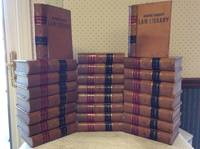
18471233456Georgia 1847. 1st Edition. Leather bound. Fair. A complete run of the first 24 volumes of the State of Georgia's offical law reports. FIRST EDITIONS FIRST PRINTINGS OF THESE RARE PRE-CIVIL WAR GEORGIA IMPRINTS. Vol. I was published in New York but Vol. II was published in Savannah Vols. 3-20 in Athens GA and Vols. 21-24 in Columbus GA. The set is bound in matching leather but some bindings are damaged. Each volume has a law library name stamped on the covers; the front boards of Vols. I and VI are detached; the spines of Vols. I IX and XX are torn; most volumes have a strip of brown cloth tape across the top of the spine. ATTENTION: many bindings are fragile so one can expect other covers to detach. Other than some very minor foxing scattered throughout the set the interior pages are clean tight and unmarked. Offered as-is and no returns accepted. Buyer should understand they may need to rebind these books. These reports on various law cases were standard volumes in Georgia courts but the vast majority were destroyed during the Civil War As with other works from this era antebellum printings from Georgia are today rarely found. unknown
181935648Milledgeville: S. Grantland 1819. First Edition. Leather bound. Fair. Octavo. iv 463 pages. Polished sheepskin leather binding with red leather title label on the spine. A brown piece of linen tap used at the top and at the bottom of the spine. Covers rubbed. Internal hinges in good condition. Some arithmetic written on the right front flyleaf. "Augusta Wylie King 1929" written in blue pen on the verso of the right front flyleaf. Light toning and foxing to the contents. A few pages have ink splotches. Newspaper clipping stored between pages 342 343 has left stains to the pages. <br /> <br /> Contents include sections on "Free Negroes" and a section on "Slaves". 11 page list of subscriber names by county located in the back. Subscriber names are listed alphabetically by county. List includes the name of Daniel Ross of the Cherokee Nation. Fair.<br /> <br /> Shaw & Shoemaker 47639; Not in Sabin; Derenne Georgia Catalog Vol. I page 366 - "Probably printed in Philadelphia for notice of copyright on Sept. 28 1819 by Mathew Carey & Son as proprietors in Eastern District of Pa. appears on verso of the title page. S. Grantland unknown
181332691Augusta: Adams & Duyckinck 1813. Leather bound. Good. Large quarto. 6 708 pages 20 page index. Brown calf leather binding with gilt stamped red label on spine. Leather binding is worn with a small area of dried ink on the spine partially obscuring the title on the red label. Old ink inscription of "Madison County Georgia" hand written on right front free end paper. Right front free end paper starting to come loose. Moderate to heavy toning and foxing to pages. Contents include laws regarding slaves and Thomas Jefferson's peace treaty at Fort Wilkinson in 1802 with the Creek Indians. <br /> <br /> Derenne Vol. I page 346; Sabin 13574. Adams & Duyckinck unknown
181235763Augusta: Printed by Adams & Duyckinck 1812. First Edition. Leather bound. Fair. Quarto. 4 708 pages 18 page index. Full brown calf leather binding with gilt stamped title on red leather spine label. Leather boards rubbed on the edges and scuffed on the back. Boards are slightly bowed. Darkened section of leather on the front cover. Leather head of spine is edge worn. Moderate toning to the text. Previous owner inscription on right front flyleaf. <br /> <br /> Contents include laws relating to Slavery and free Negroes. Also included is a Creek Indian treaty - "Treaty at Fort Wilkinson in 1802". This treaty was signed during the Thomas Jefferson administration by James Wilkinson Benjamin Hawkins Andrew Pickens and several of the Creek Chiefs Warriors etc. Fair. <br /> <br /> Derenne Vol. I page 346; Sabin 13574. Printed by Adams & Duyckinck unknown
1836List2949Clarke Cobb and Harris Counties Georgia 1836. Three documents. One four-page document measuring 5 x 8 ¾ inches likely previously a single sheet; water stained with some tearing at folds very good. One double-sided document measuring 8 x 10 inches; water stained and folded with large tears at folds possibly with part missing good. One single-sided document measuring 7 ¾ x 12 ¾ inches. Water stained and folded with large tears at folds much damage to margins good. Overall good. Three legal documents in which William Barber buys and sells plots of land shortly following the establishment of Cobb County. In 1834 and 1835 Barber buys plots from John Gann and Elizabeth Kennon for $100 each and in 1836 sells land to Gilbert Rake for $500. Gann is possibly the plantation owner Cobb County pioneer and State Senator. <br /> <br /> These land contracts date to a time at which a small number of Cherokee—whose territory included present-day Cobb County—had voluntarily left the area following the Indian Removal Act of 1830 while a majority had not done so. The Indian Removal Act required Indigenous people east of the Mississippi River to cede their land to Euro-Americans and move west of it to so-called Indian Territory now Oklahoma. In 1835 the US government met with a group of Cherokee claiming to represent the tribe in New Echota Georgia and signed a removal treaty. When the majority of the tribe viewing the treaty as illegitimate refused to move voluntarily the US government sent the military to intervene.<br /> <br /> Of interest to historians of Cobb County and land dealings between its early Euro-American residents during the removal of its Indigenous population. unknown
1850354298Milledgeville 1850. 34pp. Dbd. Scattered foxing. Very good. 34pp. Dbd. Consists largely of a discussion of the recently proposed "act for the admission of California into the Union" and the effects such a move would have on slavery. The main thrust of the resulting resolutions was an affirmation of the need for the fugitive slave law. An important part of the debates over the fate of the Union in 1850. DE RENNE p.532 unknown
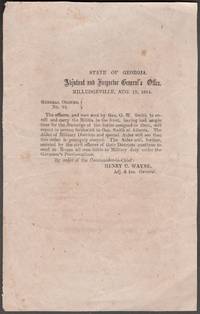
186435142Milledgeville: State of Georgia 1864. First Edition. Broadside. Very good. Broadside 9.5" x 6". Printed on the front side only. Light toning and wear to the paper. <br /> <br /> Parrish and Willingham 2888 . 2887 states No. 24 issued at Atlanta but gives no date. 2888 states Nos. 1-31; 7 January - 13 October 1864. Order reads; "The officers and men sent by G. W. Smith to enroll and carry the Militia to the front having had ample time for the discharge of the duties assigned to them will report in person forthwith to Gen. Smith at Atlanta. The Aides of Military Districts and special Aides will see that this order is promptly obeyed. The Aides will further assisted by the civil officers of their Districts continue to send to Macon all men liable to Military duty under the Governor's Proclamations."<br /> <br /> By order of the Commander-in-Chief Henry C. Wayne Adj. & Ins. General. [State of Georgia] unknown
185435614Griffin Georgia: Self published 1854. Hardcover. Good. 12mo. 1 vi 180 pages 1. Brown cloth hardcover with blind stamped designs on the covers and gilt lettered title on the spine. Cloth lightly worn on the edges. A small bit of brown staining to the bottom corner edges of some of the pages. Old pencil inscription by the previous owner on the yellow right front flyleaf. Scarce and obscure publication. Not listed in the Georgia Derenne catalog. <br /> <br /> Sabin 80104. From the New Georgia Encyclopedia Jennie Knight Emory Univ.<br /> <br /> Before the Civil War 1861-65 the only Unitarian churches in Georgia were located in Augusta and Savannah. Following disagreements with the national association of Unitarians over the abolition of slavery the Augusta church closed in the 1840s while the Savannah church closed in 1859. Similarly southern Universalists often differed with their northern counterparts about abolition. There were more small active Universalist churches than Unitarian churches in Georgia before the war yet no congregations remained active afterward. A large Universalist missionary effort in the Southeast began in 1891 and attracted many new converts but after the Great Depression of the 1930s Universalist membership declined again. Self published hardcover
183434357New York: Thomas Illman 1834. First Edition. Map. Good. Map. Approximately 15" x 13" wider margins than other copies. Colored map shows Cherokee Tribal lands in North Georgia. A couple of very small edge tears on the right center edge not affecting content. Map is clean and in good condition. Entered according to an act of Congress in the year 1834 by Thos. Illman. Pencil note in the upper left corner on the verso states "From Burr's "A New Universal Atlas" Phillips No. 771 New York 1835 D.S. Stone/Thomas Illman Plate No. 52." Drawn before the forced removal of the Cherokee Indian Tribe in North Georgia. Thomas Illman unknown
1860825171860. GEORGIA. Minutes of the Union Society: Being an Abstract of Existing Records From 1750 to 1858. Comprising also Chronological lists of its Officers Members and Beneficiaries with the Anniversary Addresses of Hon. T.U.P. Charlton Col. Howell Cobb etc. Savannah: John M. Cooper & Co. 1860. 29 4 206 9 1 22 24 28pp. Orig. cloth. Very good or better. DE RENNE II p.615. PARRISH & WILLINGHAM 7930. OCLC 5634157 ref. A useful survey of Union Society records. There seems to be a question surrounding potential later issues. De Renne cites 1860 as the only publication date while Parrish & Willingham claim 1861. It is almost certain there were two issues of the present work the present copy being the earlier one without the latest entry dated "1861." An early Confederate imprint. Scarce. Parrish & Willingham locate only seven copies of the later issue. OCLC does not differentiate between potential issues. unknown
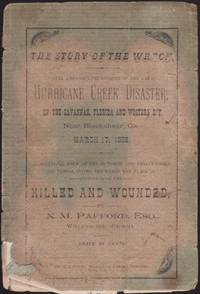
188836170Savannah: Byck & Selig 1888. First Edition. Wraps. Fair. Wraps. Approximately 7.5" x 4". 11 pages 1 page blank. Front cover faded with small edge tears chips and corner creases. Illustrated back cover lightly soiled creased torn and edge chipped. Fragile title and preface pages are spotted edge torn chipped creased and detached no loss of print. Entire booklet creased with several small puncture holes. Very minimal loss of partial letters in the text<br /> <br /> The poem tells the story of one of the worst the train wrecks in Georgia on the Savannah Florida and Western Railway. It lists the people who died and brief information about them and their families. Oddly this wreck is not listed during an internet search of the biggest train wrecks in Georgia. Not in Derenne Georgia catalog. Scarce and obscure. Fair only. Byck & Selig unknown
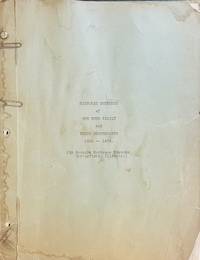
189415751894. Edwards Georgie Hortense <br /> Manuscript for a Noted Genealogy Authored by a Descendant of Mary Todd Lincoln circa 1894<br /> 19 pp. typed carbon leaves printed rectos only plus title page inside pale green thin card wrappers originally three brad-bound only one brad remaining held with paper clips. About good as wrappers are moderately chipped and stained.<br /> <br /> This is a typed draft with copious handwritten amendments for an oft-reprinted genealogical history “Historic Sketches of the Edwards and Todd Families and Their Descendants 1523-1895.†Originally printed in 1894 and updated several times afterward the book was authored by Georgie Hortense Edwards secretary of the Springfield Illinois Chapter of the National Society Daughters of the American Revolution and a granddaughter of Elizabeth Todd Edwards sister of Mary Todd Lincoln. The history goes back to Georgie’s “great great great great grandfather Robert Todd†and argues that “what is known of the antecedents of the Todd family is most honorable.â€<br /> <br /> Small collection also includes two first person accounts as relayed to Edwards as passed down through her family regarding "Lincoln and Duff Armstrong Murder trial.the information I have my Father and Mother has told me." The Duff Armstrong trial is a well-known case where Abraham Lincoln proved in court that a witness was lying when that witness claimed to have seen the murder take place "under the light of the moon." Lincoln produced an almanac which showed the moon that night had already set at the time of the "witnessed murder". Edwards backed up this account saying ".Father and Mother had been to a camp meeting and had gotten home around eleven p.m. and the moon had gone down it is true Abe secured an almanac and prove to the court that there was no moon shining at that time when this happened." <br /> <br /> A rare set of manuscripts. OCLC shows that only two institutions have the first printing of "Historic Sketches" and about 30 have later reprints while none have any drafts. We find no record of the anecdotal re-telling of the Duff Armstrong case. unknown
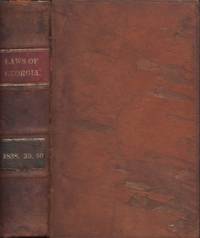
183935764Milledgeville: P L Robinson; Grieve & Orme; William S Rogers 1839. First Edition. Leather bound. Fair. Octavo. A collection of 3 separate bound acts with 3 title pages. Collated as follows: 1838 285 pages 35 page appendix xiv index; 1839 224 pages; 1840 219 pages 11 page index to laws 110 page index to Resolutions. Brown calf leather binding. Title stamped on red and black leather spine labels. Front hinge glued. Rear hinge in good condition. Leather binding rubbed and scuffed. Outer joints cracked. First title page has light bug damage upper left edge. Moderate toning to the text. Part of the text block was trimmed resulting in minor loss of page headings. Previous owner ink stamp "Lawrence B. Custer Attorney At Law Marietta Georgia" on the right front flyleaf. Katherine H. Custer 1999 written below the first inscription on the right front flyleaf. Many Acts relate to Slavery Railroads Infrastructure etc. Fair only. P L Robinson; Grieve & Orme; William S Rogers unknown