545 résultats
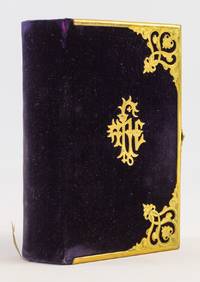
1855ST19567-044London: Printed by G. E. Eyre and W. Spottiswoode 1855. 121 x 78 mm. 5 x 3". 532 leaves. <br/> Attractive contemporary dark purple velvet covers edged in brass brass corner pieces upper cover with a central brass "IHC" Christogram smooth spine brass clasp all edges gilt white silk endleaves. Housed in a probably contemporary black pebble-grain morocco case with brass clasp lined with white silk a little wear to case silk a little discolored in places. Front endleaf with a gilt gift inscription: "Presented to Jessie Cooper / from her affectionate Uncle / Alfred John Tubb. / Oct. 29. 1856." Verso of front free endpaper with the book label of Anthony David Estill. Velvet ever so slightly worn miniscule separation at top and bottom of joints a couple of pages with short marginal tears or nipped corners but very close to pristine condition.<br/> <br/> This is an unusually well-preserved example of a Victorian gift binding little changed since the day it left the bindery. Judging from the charming gilt inscription on the silk endleaf stating that it was a present from an "affectionate uncle" to his niece it seems likely that the book was intended as a gift in honor of the girl's confirmation. The luxurious purple velvet delicate brass fittings and bright gilt edges connote treasure and opulence and it is clear the that the young female recipient--and generations of later owners--took scrupulous care of it over the years. Velvet can be worn down quite easily but here it remains fresh and richly colored having been carefully stored away in its custom-made protective leather case. Printed by G. E. Eyre and W. Spottiswoode unknown
18904623Cambridge: Printed by C.J.Clay and Son at the University Press for the SPCK. n.d. c1890 1890. Bound with Hymns Ancient and Modern. London: William Clowes. 178x140mm. The Prayer Book is unpaginated but collates pi1; A16-O16. Hymnal pp. xv ibl 681 1. Bound by "Watson Binder Marylebone" signed at foot of front pastedown in beige cloth decorated with inlaid silver quatrefoil and flower motifs. Calf turn-ins tooled in gilt. Silk endpapers. Gauffred edges. Two silver pillar and heart-shaped silver clasps one engraved with the letters "I.J" and the other with the date "1760". Both have the silver mark "IL". Most of the silver decorative inlay has worn off as has some of the calf on the turn-ins but otherwise the binding is in very good condition. Edward Watson worked at 239 Marylebone Road in the late nineteenth century. His work was exhibited at the first Arts and Crafts Exhibition Society in 1888 where he showed "five specimens of book-binding in hand-coloured calf: antique style and finish". There is no date on this lovely Prayer Book and Hymnal binding but it has the air of the Arts and Crafts Movement with its decorative flair and repurposed Georgian silver clasps. Cambridge: Printed by C.J.Clay and Son at the University Press for the SPCK. n.d. [c1890] hardcover
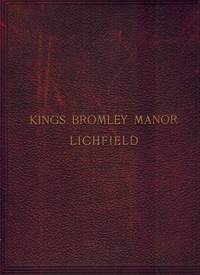
188027161AB1880. Oxford Printed at the University Press no year ca.1880. 4°. 473 unnumbered pages. Full Morocco-binding on 5 raised band with gilt lettering on spine and gilt lettering "Kings Bromley Manor - Lichfield" on frontcover. Very good condition with only minor signs of wear. Bookplate on pastedown. unknown
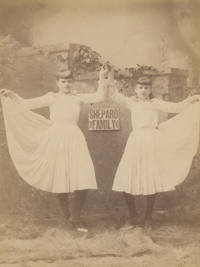
1890List1620Mostly New England: Various Photographers 1890. Cabinet cards measuring 6 ½ x 4 ¼ inches. Various settings showing the band members posed with their instruments including banjos violins trumpets drum and tubas. Varying wear but generally very good with some normal age-related fading. Very Good. Originally from Lawrenceville New York the Shepard Family Band toured throughout the Northeast in the 1880s and 1890s eventually settling in South Royalton Vermont. All members of the family were apparently musically inclined: “In addition to Minnie mother and matriarch Mary “Minnie†Shepard and her husband patriarch James Monroe Shepard all of the children were pressed into service. Daughter Laura Belle the ‘violiniste’ was getting better all the time under the instruction of a ‘competent master.’ Her fans “will be astonished at the improvement in style tone and expression.†It was said of little Lessie that ‘Among lady cornetists she has no equal.’ The darling little son of the family Master Burtie could not help but please for he was well-known to be ‘The youngest Tuba soloist in the world; only nine years of age; scarcely larger than the instrument he plays.’ He was also a ‘clever comedian singer and character artist.†The baby little Flossie “a sweet little miss of four summers’ was said to be a “wonderful mimic and impersonator…a veritable little fairy.’ Daughters Kittie and Georgia were also part of the troupe.†- Henry Sheldon Museum. A very nice collection. Various Photographers unknown
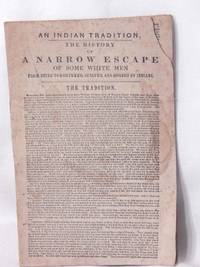
18504492<p>No date Ca. 1850. Good softcover. Center-stitched pamphlet in self-wraps. First page/front cover is age darkened with some soiling and staining and has a 3/4 x 1.5 inch chip missing at top fore corner - 1st page text not affected 2nd page missing 1st letter of first three lines; last page/rear cover is age darkened with light foxing and few small pencil marks at top fore corner and has contemporary black stamp 'For Sale in Williamsville Vt. By W. L. Williams.' ; tightly bound; few interior pages are age darkened with foxing most are fairly bright and clean but for some pencil marginalia; all text is easily legible; all leaves remain supple. Consists of 4 page narrative about captivity by Indians and white man William Wallace's exposure to Indian remedies; remaining 12 pages are ads for 'Brant's Indian Pulmonary Balsam' and 'Brant's Indian Purifying Extract' which cure scrofula fevers liver complaints abscesses consumption piles mercurial diseases female complaints etc. Not dated but some advert testimonials are dated 1844 - 1849 and pencil note in a margin is dated 1850. 8vo 16 pp; illustrated adverts. Cf Sabin #34480; OCLC #765809491. Note that caption title on this work is exactly as stated and differs from Sabin which includes 'no fiction' in title and 'Taro-way Indians' as well as differing from OCLC which has 'no fiction' and 'Taw-way Indians'.</p> New York: Wallace & Co. paperback
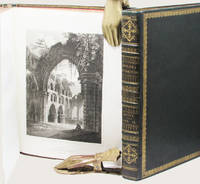
181434227London: Printed for Longman Hurst Rees Orme and Brown 1814. 2 volumes. First Edition. With fine antique family crest to each pastedown. Very handsomely illustrated with two elaborately engraved title-pages and ninety additional full-page engravings. Quarto handsomely bound in period full dark-green grained morocco the spines with raised bands separating the compartments which are elaborately decorated in gilt in elaborate multi-tooled designs two compartments lettered in gilt the covers with gine gilt rolled borders surrounded by triple gilt filleted rules gilt rolled turnovers rose endleaves all edges gilt. cxxvii 92; 93-209 ci 12 Index and Colophon pp. A fine set very pleasingly preserved the bindings strong and handsome the text and illustrations crisp clean and unpressed some very occasional spotting to some fore-edges but an unusually nice set of the first edition. FIRST EDITION. 'The work of the poet and novelist Sir Walter Scott 1771–1832 frequently reflected his interest in Scottish history and he is regarded as having written some of the most influential historical fiction of the nineteenth century. His literary works include the poem The Lady of the Lake and the novels Waverley and Ivanhoe. Originally published in these two volumes in 1814–17 is a work of non-fiction that illuminates Border history as revealed through architecture and artefacts. Scott was not the sole author but his substantial introduction sets the historical scene for the entries on various castles churches and other historic structures on both sides of the border. Illustrative extracts of his poetry are also included along with many detailed engravings of the evocative scenes and buildings described.' Cambridge University<br> The Border Antiquities of England and Scotland was initially published in 1814 co-authored by John Greig and William Mudford with contributions from Sir Walter Scott notably in the substantial introductory essay. The book is a survey of “specimens of architecture and sculpture and other vestiges of former ages†from the border regions of Scotland and England with historical descriptions accompanied by Greig’s engravings. The illustrations prioritise the empirical details of the architecture monuments and objects discussed in the text but at the same time in a typically nineteenth-century fashion they contextualise the historical monuments within romanticised landscapes.<br> Capturing the historic buildings and sculptures in as much detail as possible the images present complex three-dimensional structures in all of their depth and detail using only lines and hatching on a two-dimensional frame. Paying minute attention to the damage on the structures the weathering and the differing textures of building materials these engravings are executed with scientific precision but without the flatness and sterility of a diagram.<br> Not only do the engravings present clean and clear renderings of the structures described in the text they also incorporate elements of the same romanticism that infuses Scott’s literature. Almost every one of Greig’s illustrations incorporates staffage which gives a sense of scale and depth whilst also an adding allegorical side notes to each illustration. The figures serve a dual purpose technical and aesthetic directing the viewer’s eye to significant points in the image while also creating a romantic context for the scene. A natural abundance is emphasised in each engraving with lush trees and shrubbery framing the historical monuments within a romantic landscape while also acting as a device to create atmospheric recession. Greig even includes incidental details like birds over water and interactions between figures which also help to create the sense that the scene captures a specific place and time. In contextualising the scenes for the viewer these stylistic elements aid in the struggle towards achieving the illusion of three-dimensional space on the two-dimensional surface. ArSciTech 2018 Printed for Longman, Hurst, Rees, Orme and Brown hardcover
182032724Oxford: printed at the Clarendon Press by J. Cooke and S. Collingwood 1820. Thick 8vo; inserted engraved title-p.; bound with A New Version of the Psalms of David 1825; contemporary full red straight-grain morocco covers with elaborate gilt borders gilt lettered direct on gilt-decorated spine a.e.g.; hinges strengthened extremities rubbed and worn 2 small ink spots on back cover; all else very good. With a large fore-edge painting showing Oxford from the countryside. printed at the Clarendon Press, by J. Cooke and S. Collingwood unknown
1807216301807 SECRET Fore-Edge Painting ART Captain John Smith America New England MAP An incredible stunning and highly desirable early 19th-century Book of Common Prayer! While many examples of this Book of Common Prayer are available from this era few if any are as coveted as this example. This 1807 printing features a hidden fore-edge painting only revealed when the pages are fanned. The secret painting depicts a portrait of Captain John Smith and a map of the New World – a beautifully colored detailed painting.Item number: #21630Price: $1500Church of EnglandThe Book of common prayer : and administration of the sacraments and other rites and ceremonies of the ChurchLondon: Published for John Reeves Nicol 1807.Details: • Collation: Complete with all pageso Unpaginated• Language: English• Binding: Leather; tight and secureo Fine black Moroccan leather• Size: ~9.25in X 5.75in 23.5cm x 14.5cmOur Guarantee:Very Fast. Very Safe. Free Shipping Worldwide.Customer satisfaction is our priority! Notify us with 7 days of receiving and we will offer a full refund without reservation! 21630Photos available upon request. for John Reeves, Nicol hardcover
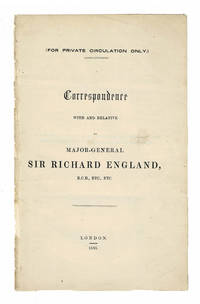
185599570<p>London 1855. 1855. Good. - Octavo 8 inches high by 5 inches wide. Softcover bound in printed self-wraps. Once likely bound in with other pamphlets the book is disbound with the cover page and last page detached. 14 pages. The pages are slightly soiled and the pamphlet was folded twice horizontally. Good.</p><p>Exceedingly RARE. First only edition.</p><p>On December 11 1854 The Times of London editorialized: "We felt it our duty a few days ago to call attention to the fact that if disease or wounds were to incapacitate Lord Raglan for continuing his labours in the Crimea the command of our army would devolve upon Sir Richard England and we suggested that such a change ought by all means to be provided against." The Times goes on to forcefully attack England for his actions as commander of the Scinde field force during the Afghan wars in 1842. "In the beginning of the year 1842 Sir Richard England commanded the Scinde field force. It was extremely important to reinforce General Nott at Candahar where he was in want of men money and ammunition. Near the village of Hykulzye at the foot of the Bolan Pass General England was encountered by some Asiatic troops and repulsed with the loss of nearly 100 killed and wounded. It was of the utmost importance that he should advance or at any rate not retreat for General Nott had written to him that either halting or retiring would have the worst effect throughout Afghanistan and would be more injurious to his present position than 20000 of the enemy in the field. But General England did retreat. His troops were eager to renew the attack; Colonel Stacy the political agent who accompanied him undertook to storm the position with a hundred or even eighty men - thrice he begged for permission and thrice he was refused. General England retired to Quettah and there began to intrench himself leaving Nott the honour of England and the destinies of India to their fate. The defences before which he retreated were not formidable. They were thrown up in a few hours and when afterwards taken some of our officers rode over them without knowing where they were. General England wrote that the enemy were a hundred to one stronger than any one expected though they were fewer than he was informed that they would be. Finally he strove to throw the blame on the Sepoys whom he would not allow to renew the attack. 'The seeming unwillingness of England' says Mr. Kaye 'to redeem his character by a vigorous movement in advance irritated General Nott more than the disaster itself.'"</p><p>In this letter to his brother-in-law A.F.W. Montagu England describes his actions at that time in great detail and proffers a defense of them. Following his letter of December 28 1854 from Sebastopol are published letters written in 1842 defending him from Major-General Charles Napier the Governor General of India Lord Ellenborough and a letter from his Secretary T.H. Maddock. Finally there is an 1855 letter praising England from General Sir George De Lacy Evans.</p><p>The British army officer General Sir Richard England 1793-1883 was born at Fort Detroit at a time when it was part of Upper Canada. In 1841 he took command of the Bombay Army division and was dispatched to the relief of Colonel Palmer at Ghuznee and General Nott at Kandahar. In 1854 he was placed in command of the 3rd Division in the Crimean war.</p> London, 1855. paperback
1840068803Oxford: Printed at the University Press by Samuel Collingwood and Co. Printers to the University; Sold by E. Gardner at the oxford Bible Warehouse Paternoster Row and by G. B. Whittaker Ave-Maria Lane London; By H. Mozley and Sons Derby; and by T. Wilson and Sons York 1840. First Edition. Hardcover. Very Good. 8vo. FIRST EDITION 1840. REBACKED BY GEORGE BAYNTUN. INCLUDES COLOR FOREDGE PAINING. Oxford University Press. Hardcover. Bound in full burgundy leather with intricate gilt ornamentation spanning across the entire cover. Hubbed spine bears five raised bands also heavily ornamented and lettered in gilt. All edges gilt. A hidden/surprise full color hand painted illustration of a town with boats at the coast line is delightfully present at the foredge. Inner boards are meticulously tooled in a gilt border. Includes "Proper Lessons to be Read at Morning and Evening Prayer on the Sundays and Other Holy Days Throughout the Year" and an accompanying calendar and tables. Main text is large print. 413 pp. 91. <br><br>CONDITION: This book is classically beautiful. The Bayntun rebinding is tight and feels solid and comfortable in hand. Ornamentation and foredge painting are exquisite. Large print and binding strength makes for easy reading. Cover shows only light wear particularly at the edges. Gilt edging is vibrant. Front inner hinge is barely starting yet has not compromised the integrity of the boards which are firmly attached. Light chipping at some page edges yet text remains unaffected. Leaves are bright and bear very little foxing. Completely free from marginalia or annotation with the exception of two owner's names and notation within the front flyleaves dated from the period 1841. A magnificent copy evoking great devotion and reflection of God's glory with it's heavy and mysterious ornamentation. Full refund if not satisfied. Printed at the University Press by Samuel Collingwood and Co., Printers to the University; Sold by E. Gardner, at the oxford Bib hardcover
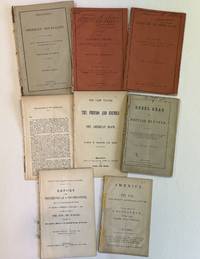
186441261Boston: Little Brown and Company 1864. 1. Bemis George: PRECEDENTS OF AMERICAN NEUTRALITY IN REPLY TO THE SPEECH OF SIR ROUNDELL PALMER ATTORNEY-GENERAL OF ENGLAND IN THE BRITISH HOUSE OF COMMONS MAY 13 1864. Boston: Little Brown. 1864. viii 83 1 blank pp. Disbound original printed front wrapper. Clean text. Good. <br /> <br /> England's reception and fitting out of Confederate privateers is inconsistent with its professed neutrality. The U.S. a neutral in earlier European wars prohibited such collaboration in American ports. <br /> FIRST EDITION. Sabin 4626. Bartlett 394. II DAB 174. Not in Harv. Law Cat. Marke.<br /> <br /> 2. Cordner Rev. John: CANADA AND THE UNITED STATES: AN ADDRESS ON THE AMERICAN CONFLICT DELIVERED AT MONTREAL ON THURSDAY EVENING DECEMBER 22 1864. Manchester: A. Ireland and Co. 1865. Original printed wrappers spine wear. ix 1 blank 30 pp. Disbound else Very Good.<br /> <br /> Published by the antislavery Union and Emancipation Society the pamphlet demonstrates that "the supposed hostile designs of the United States upon Canada" is merely an attempt to turn British sentiment against the Union. The rear wrapper is a two-column list of the officers of the Society including a two-column list of more than one hundred fifty Vice Presidents.<br /> Sabin 16762 Montreal printing only. Not in Bartlett.<br /> <br /> 3. Free Man's Aid Society: THE FRIENDS OF THE FREED-MEN. London: 1864. 7 1 pp. Caption title as issued. Disbound else Very Good.<br /> <br /> This rare pamphlet was written by John Curwen Secretary to the Free Man's Aid Society. He lauds the abolitionists- - British and American-- who aid the Union cause recognizing "instinctively that this must become an anti-slavery war." They have enlisted in fighting regiments organized the education of freedmen at Port Royal. The pamphlet describes the freedmen's schools the freed children's eagerness to learn and the observations of the teachers some of whom were women. <br /> OCLC 644153331 1- U Manchester as of August 2025.<br /> <br /> 4. Massie James W.: THE CASE STATED: THE FRIENDS AND ENEMIES OF THE AMERICAN SLAVE. Manchester: Union and Emancipation Society. 1863. 8pp. Disbound. Good.<br /> <br /> England's Union and Emancipation Society was committed to the abolition of Slavery. "What darker or more dreary calamity could threaten any nation or people on earth than the successful establishment of a Republic whose corner-stone shall be 'that the negro is not equal to the white man and that slavery- subordination to the superior race- is his natural and normal condition'."<br /> Bartlett 3040. Sabin 46186 note. Not in LCP or Dumond.<br /> <br /> 5. Owls-Glass pseud.: REBEL BRAG AND BRITISH BLUSTER; A RECORD OF UNFULFILLED PROPHECIES BAFFLED SCHEMES AND DISAPPOINTED HOPES WITH ECHOES OF VERY INSIGNIFICANT THUNDER VERY PLEASANT TO READ AND INSTRUCTIVE TO ALL WHO ARE CAPABLE OF LEARNING. New York: American News Co. 1865. Original printed wrappers the rear wrapper advertising 'The Martyr's Monument.' vi 7-111 1 blank pp. Clean text. Disbound else Very Good.<br /> <br /> Sabin and the Library Company suggest Richard Grant White as the author. The book "a curious study" of British elite opinion is a commentary on articles from British intellectuals which had supported the Confederacy. The author's close examination of British public opinion is a scathing condemnation of British turpitude. <br /> These were "undeniably able and dextrous writers and politicians who to please the public for whom they wrote and spoke opposed ridiculed and contemned our people and our government during the tremendous struggle for the worthy and honorable existence of our country. It would not be very easy for us to forget these efforts of our inimical kinsfolk or indeed desirable that we should lose sight of so instructive a warning. . ." <br /> Sabin 68317. LCP 11149. Bartlett 4012.<br /> <br /> 6. Potter Thomas Bayley: UNION AND EMANCIPATION SOCIETY. REPORT OF THE PROCEEDINGS AT A CONVERSAZIONE HELD IN THE MANCHESTER ATHENAEUM ON MONDAY EVENING FEBRUARY 1 1864 TO RECEIVE THE REPORT OF THE REV. DR. MASSIE RESPECTING HIS ANTI-SLAVERY MISSION TO THE AMERICAN CLERGY AND CHURCHES. Manchester: Alexander Ireland. 1864. 33 3 pp. Disbound without wraps Clean text. Good.<br /> <br /> Potter was the President of the Society a British organization based in Manchester and supporting the North in its war against Slavery. The pamphlet reports on "a very interesting conversazione" concerning Dr. Massie's trip to America. <br /> He met with President Lincoln "a man of integrity whose word is to be believed whenever he speaks. I came away with the conviction that he is the friend of the negro and the man of colour and that he has a firm resolution that whatever power he has shall be constitutionally exerted for the emancipation of every slave in the United States." Massie also met with Seward "again and again" and with Chase and other civil and military leaders all of whom favorably impressed him.<br /> "The day is not far off when the coloured regiments of America will be the safeguard of her negro freedom and the security for all the freedom that belongs to men of whatever colour" <br /> Not in LCP Bartlett Dumond Monaghan or Sabin. OCLC notes about fifteen institutional holdings.<br /> <br /> 7. Siemms F. D.: AMERICA. THE WAR: PAST PRESENT AND PROBABLE FUTURE. BEING THE SUBSTANCE OF A DISCOURSE DELIVERED AT THE CONCERT HALL LIVERPOOL. BY F. D. SIEMMS A NATIVE OF LIVERPOOL WHO SERVED AS AN OFFICER IN THE ARMY OF THE SOUTHERN CONFEDERACY FROM THE COMMENCEMENT OF HOSTILITIES TO A VERY RECENT PERIOD BEING AN EMBODIMENT OF HIS EXPERIENCES AND OBSERVATIONS DURING A PERIOD OF EIGHTEEN MONTHS AS AN OFFICER OF ARTILLERY. Liverpool 1864. 24pp. Disbound with wrapper remnants along spine. Good.<br /> <br /> Siemms says "Without any previous intention of being a soldier either in the army of the North or South yet I found myself one fine day an officer in the army of the Southern Confederacy." He gives some details of his unit's movements and briefly discusses different engagements while noting his frustration at the North's exaggeration in reporting its successes. His war experience was brief: "My military life ended" when he was taken prisoner "at Bull's run" and held as a prisoner until the British flag brought his release. <br /> Presenting himself as something of an expert he says "the negroes are far better off than a certain class of poor people in many European countries." He says 'Uncle Tom's Cabin' is filled with exaggeration and "downright untruths." He exposes "the false pretence that the North was fighting for liberty" and says the press has greatly exaggerated the North's progress in the field.<br /> Frederick David Samson Siemms 1844-1907 was born in England but it is unclear how he ended up in the United States or fighting for the Confederate Army. His military records show that he enlisted on May 13 1861 at the age of 17 years for a period of 12 months as a private with 1st Artillery Virginia Confederate with Capt. Johnson H. Sands' Company Co. B Henrico Artillery Virginia Light Artillery. His occupation was dentist and optician. Company muster rolls show he was discharged on July 20 1862. Military records of Frederick D. Siemms Fold3 website; Soldier and Sailor's Database at National Park Service website; The Commercial Gazette of London June 4 1890 Page 6. <br /> OCLC 4844821 1- U Rochester as of March 2025. Not in Bartlett or Sabin.<br /> <br /> 8. Smith Goldwin: ENGLAND AND AMERICA: A LECTURE DELIVERED BY GOLDWIN SMITH BEFORE THE BOSTON FRATERNITY DURING HIS RECENT VISIT TO THE UNITED STATES. . . Manchester: A. Ireland and Co. 1865. x 36 pp. Disbound original printed front wrapper. "With Thomas B. Potters Complts" written on front wrapper. Good.<br /> <br /> An odd combination of sympathies Smith supported the Union opposed imperialism and woman suffrage and disliked Jews. His lecture was first published in The Atlantic and was also printed in Boston. <br /> Sabin 82678. Bartlett 4507. Little, Brown and Company unknown
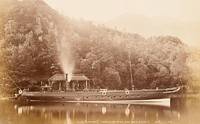
188229153AB1882. Scotland / England 1882-1885. Quarto. 53 photographs on original boards. Original Hardcover. Very good condition with only minor signs of external wear. Some minor signs of foxing only. Images include: - Buxton - The Lovers Leap / Buxton Public Pavilion Gardens / Buxton Ashwood Dale / - Hastings - Lovers Seat and Fairlight Glen in the year 1881 / The Dripping Well / - Hollington Church / Ecclesbourne Glen / Filey Brig in 1881 / - Sir Walter Scott's Monument in Edinburgh in 1881 / Edinburgh Castle from the Esplanade / Holyrood / - Ellens Isle in Loch Katrine / S.S.Rob Roy / Falls of Inversnaid from the Loch Lomond / Callander Bridge and Ben Ledi / - Falls of Bracklinn / Loch Lomond / The Trossachs / Loch Achray and Ben Venue / - Nelson's Mount on Carlton Hill / Peterborough Cathedral in 1882 / Peterborough Cathedral Interior / - Glossop Road in December 1882 with snow / The Priory Church - Bridlington 1883 / - Battle Abbey in 1883 / Guest Chamber / Court Gate / - Abbots Hall at Battle Abbey with Modern Library / Abbots Hall - The Cloisters / Battle Church / Old Hastings / Normanhurst / - Cambridge in 1883: Kings College and Chapel / Kings Chapel - Interior / Cambridge - Caius College / Cambridge - New Courts / - Trinity College Cambridge / Old Court / Clare College / Clare Bridge / Trinity Gate / John's New Buildings / Bridge of Sighs - Cambridge - Trinity Hall Chapel / - Stonehenge in 1884 / Christ Church Cathedral / in Oxford in 1884 / - Magdalen College Oxford Chapel and Window / Magdalen Tower / Court at Magdalen College / The Broad Walk / All Saints Chapel / - Window in the New College Chapel / The Major Oak at Sherwood Forest in 1885 // hardcover
1809640612Published for John Reeves Esq. Sold by G. and W. Nicol and Scatcherd and Letterman 1809. First Thus. Leather Binding. Near Fine. Includes a fine fore-edge painting of the City of Philadelpia shown ca. 1770 as seen from the water showing the harbor and shipping in the foreground. Attractively bound in full period black straight-grained morocco known as 'Russia' spine decorated with floral designs in gilt and gilt ruled compartments covers bordered with twin gilt fillets enclosing a repeating gilt scroll gilt inner dentelles all edges gilt expertly rebacked in matching leather with original spine laid down light wear to boards; some foxing to first and last few leaves. The fore-edge painting appears to be of some age and must be pre-1950 at the minimum due to the presence of a UK dealer's catalog entry for this copy with an exchange rate of 4 pounds to the dollar which last occurred in 1950. Published for John Reeves, Esq., Sold by G. and W. Nicol, and Scatcherd and Letterman unknown
18871172191887. BRITISH ISLES PHOTOGRAPHIC ALBUM. Tourist photographic album of cathedrals in England Scotland and Ireland. No place circa 1887. Folio 11 by 14 inches contemporary full white parchment elaborately gilt-decorated spine and covers patterned endpapers all edges gilt cloth dust jacket; 40 leaves. $2400.Original late 19th-century photographic album containing 116 albumen prints depicting views of notable cathedrals in England Scotland and Ireland mounted on thick blue card in a beautiful parchment-gilt binding by Giulio Giannini of Florence Italy.Presumably compiled by a tourist this album contains prints of such sites as Canterbury St. Paul's Durham Exeter Westminster Abbey Tintern Abbey and others. Most prints measure 5-1/4 by 8 inches placed two on a sheet though one measures 7-1/2 by 11-1/2 inches; each is titled in the print along the lower edge. With Giulio Giannini's publicity card laid in. Owner ink signature dated 1887.Cloth dust wrapper with mild soiling; parchment-gilt album beautiful and fine. hardcover
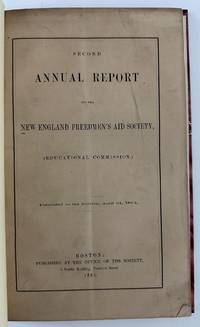
186412679Boston: Published at the Office of the Society 1864. 86pp. Original printed wrappers bound into modern quarter morocco over marbled boards gilt spine titles. Light chipping and soiling to wrappers. Contemporary notation to header of title else internally clean. Very good plus. An account of the second year of the activities of the New England Freedmen's Aid Society NEFAS an activist group formed to assist emancipated Black Americans in may aspects of life especially with gaining academic and practical educations following the Civil War. The present work is especially important for the long section titled "Condition of the Freedmen" which occupies pages 11 to 51 about half of the total work. This section details the population state of education labor and industry opportunities general condition and more of free African Americans in several regions of the country namely the Military Department of the South Key West and the Tortugas Military Department of Virginia and North Carolina the District of Columbia the Mississippi Valley Middle Tennessee Western Arkansas and Louisiana. Interestingly a substantial subsection of the section on the Department of the South is devoted to a discussion of arable lands available to freed slaves around Beaufort and Port Royal known to modern audiences as "Forty Acres and a Mule." Regarding the land in this area the report states that "It was a matter of course that the lands should all be taken for those blacks who did not wish to turn cultivators were perfectly aware that they could sell their 40 acres for many times the government price."<br /> <br /> The organization was also notable for its mission specifically aimed at education and for the critical role women played in its work. "The New England Freedmen's Aid Society was founded in Boston in 1862 in response to an appeal.on behalf of 8000 formerly enslaved people at Port Royal SC. Originally named the Educational Commission its mission was to provide teachers and other aid for 'the industrial social intellectual moral and religious' advantage of freedmen" Massachusetts Historical Society. As was the case with many abolition and aid groups women were in the vanguard of the NEFAS. They recruited trained and even served as educators in the program. For much of the twentieth century if historians wrote about the first teachers among freed people at all they characterized them as foolish even dangerous women.who bore a heavy responsibility for the racial tension after the Civil War and whose work caused Southern educators to avoid Black education" The Freedmen's Teacher Project. Yet scholars in the 1960s and after -- particularly women and Black researchers -- have returned to the documents of the Society to uncover the serious and often intersectional work being done by both white and Black activists in Port Royal reframing "the freedmen's education movement as not primarily a gift of northern largess.but as autonomous actions of hundreds of Black communities across the South demanding access to literacy and numeracy" The Freedmen's Teacher Project. In this sense those "dangerous" women were troubling because they heard the call of Black peoples took their needs seriously and reacted accordingly. The movement was thus "largely Black-inspired abetted by female missionary teachers" whose shared goals were to prepare "former slaves for lives of freedom in a democratic America" The Freedmen's Teacher Project.<br /> <br /> The present Annual Report shows the early efforts of this Society including fundraising allocation of funds educational programs and educational gains and future goals. Included in the list of Officers are eleven white women in leadership roles; indeed women were the majority in the Committee on Teachers and the Committee on Clothing and Supplies. Among them are more well-known activists who appear in American Abolitionists and Antislavery Activists i.e. Ednah Cheney and Sarah Barrett Cabot who had raised her daughter to become a leader in the movement. Most however are lesser or unknown denoted largely by their husbands' names rather than their own. Even less visible but even more important were the unlisted Black women who were members of the group and contributors to the grassroots work. "Nearly one-fifth of the Northern teachers were Black.Black teachers were fifteen times more likely to give a few years of their lives to Southern Black education.the rest of the recruited teachers were native to the South; many had been enslaved while others were Southern free Black women and other men of color" The Freedmen's Teacher Project. The accomplishments in the report -- fundraising equipment educational gains -- can largely be attributed to their efforts.<br /> <br /> The report for the first year of the organization is exceedingly rare with only one example listed in OCLC; twelve copies of the present report appear in OCLC though no copies have appeared in modern auction records and no other copies are currently in trade. An important and scarce historical document preserving the accomplishments of a fairly short-lived intersectional activist group with vital reports on the activities of freed slaves throughout the southern part of the country. Published at the Office of the Society unknown
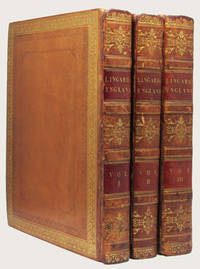
181933323London: Printed for J. Mawman in Ludgate Street; Printed for Baldwin and Cradock Paternoster-Row and Joseph Booker New Bond Street 1819 - 1830. 8 volumes. Rare First Edition Complete. A copy with fine provenance coming from the library of the Duke of Westminster with his coat of arms to the book plates and dating to 1884. Quarto contemporary polished and paneled calf the spines with raised bands gilt ruled separating the compartments two red morocco lettering labels gilt remaining compartments with elaborate gilt tooling the covers with triple gilt fillet rules surrounding inner and elaborate roll tooled borders in gilt and blind central panels of triple gilt fillets and corner pieces in blind marbled endleaves and marbled edges to match. A very handsome set some hinges starting the textblocks clean fresh crisp and unpressed. RARE FIRST EDITION COMPLETE OF THIS IMPORTANT HISTORY OF ENGLAND FROM THE FIRST INVASION OF THE ROMANS PRESENTED IN HANDSOME CONTEMPORARY BINDINGS. John Lingard 5 February 1771 – 17 July 1851 was an English Roman Catholic priest and historian the author of The History of England From the First Invasion by the Romans to the Accession of Henry VIII an eight-volume work published in 1819. Lingard was a teacher at the English College at Douai and at the seminary at Crook Hall and later St. Cuthbert's College. In 1811 he retired to Hornby in Lancashire to continue work on his writing. <br> The principal object of his major work The History of England is to emphasise the disastrous effects of the Reformation. The book was later expanded by the author and the title changed to reflect the period covered. As each additional volume appeared the History's reputation increased while Lingard continued to revise and improve the whole work.<br> Lingard himself argued that one of his chief duties as an historian was: "to weigh with care the value of the authorities on which I rely and to watch with jealousy the secret workings of my own personal feelings and prepossessions. Such vigilance is a matter of necessity to every writer of history . Otherwise he will be continually tempted to make an unfair use of the privilege of the historian; he will sacrifice the interests of truth to the interests of party national or religious or political." J. Lingard "History of England" vol 1 6th edition London: Charles Dolman 1854 p. 6.<br> Lingard adopted a non-controversial and sober approach to history with the emphasis on incontrovertible fact and using primary rather than secondary sources. Lingard's History is also an apt demonstration of the advantages a Catholic historian of the time may have had in terms of impartiality. Lingard's religion had to a large extent isolated him from the mainstream nationalism which surrounded Protestant historians as well as from the growing "providentialist" concept of history. Lingard's strength of argument however continued to be popular and the influence of Protestant animosity for Catholic apologetic also led him to develop a keen critical judgment. He was devoted to absolute accuracy and detail and the History was a groundbreaking work in its use of primary sources. Lingard made extensive use of Vatican archives and French Italian Spanish and English dispatches document collections and state papers – the first British historian to do so. The peripheral nature of English Catholicism put him in a position of "outside observer" to much of English intellectual culture and this is reflected in his historical works. Despite this distancing effect however Lingard maintained an active interest in politics all his life and was a noted pamphleteer. <br> History of England is a substantial scholarly work which gave full treatment to the history of England. From 1811 until his death in 1851 Lingard spent most of his life in the village of Hornby near Lancaster where he devoted himself to his study and writing. A quiet gentle man he was well liked by the residents. Lingard's popularity as an historian had its day but his contribution to historical method came at a critical point in British intellectual history. Printed for J. Mawman in Ludgate Street; Printed for Baldwin and Cradock, Paternoster-Row and Joseph Booker, New Bond Street hardcover
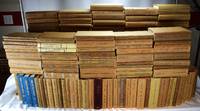
18961812240048Boston Mass. : Published by the New-England Historic Genealogical Society 1896. First Edition. Hardcover. Very Good. Signed. The Tan Book series: Massachusetts Genealogy 182 volume set. Hardcovers. A massive collection of many of the towns in Tan Book series. Census information births marriages deaths. Contains the Vital Records of the following Massachusetts towns: Acton; Alford; Amesbury; Andover vols 1-2; Arlington; Ashfield; Ashburnham; Athol; Barre; Becket; Bedford; Beverly vols 1-2; Billerica; Brimfield; Bolton; Boxford; Bradford; Brockton; Brookfield; Burlington; Canton; Carlisle; Cambridge Vols 1-2; Charlemont; Charlestown Vol 1. Newer printing; Charlton; Chatham NP 1991; Chelmsford; Chelsea NP; Chester; Cohasset; Conway; Dalton; Danvers vols 1-2; Dartmouth Vos. 1-3; Deerfield; Dennis Vols. 1-3 np; Dorchester South; Douglas; Dracut; Dudley; Dunstable; Edgartown 2 vols; Essex; Falmouth Picton Press 1993; Framingham; Gardner; Gloucester vols. 1-3; Grafton; Granville; Great Barrington; Greenfield; Groton vols. 1-2; Hamilton; Harvard; Harwich Harwick Historical Soc 1982; Haverhill vols. 1-2; Heath; Hinsdale; Holden; Holliston; Hopkinton; Hubbardston; Hull; Ipswich Vols. 1-2; Lee; Leicester; Leominster; Lexington; Lowell Vols. 1-4; Lynn Vols. 1-2; Kingston; Malden; Marblehead Vols. 1-3; Marlborough; Manchester; Medford; Methuen; Middleborough Mass. Soc. Mayflower Desc. 1986 Vols 1-2; Middleton; Middlefield Vols. 1-4; Nantucket Vols. 1 3-5; New Ashford; New Bedford Vols. 1-2; New Braintree; Newbury vols. 1-2; Newton; Northbridge; Norton; Oakham; Palmer; Pelham; Pembroke; Petersham; Phillipston; Princeton; Plympton; Reading; Richmond; Rowley; Roxbury Vols. 1-2; Royalston; Rutland; Salem Vols. 1-6; Salisbury; Saugus; Shelburne; Shirley; Shrewsbury; Southborough; Southbridge Holbrook NP; Spencer; Stoneham; Stoughton; Stow; Sturbridge; Sudbury; Sutton; Taunton Vols. 1-3 vol 1; Templeton; Tewksbury; Tisbury; Topsfield; Tyngsborough; Tyringham; Webster Holbrook np; Wakefield; Warren; Washington; Wayland; Wenham; Westborough; West Bridgewater; West Boylston; Westford; Westminster; West Newbury; Westport; West Stockbridge; Weymouth Vols. 1-2; Winchendon; Windsor; Williamstown; Worthington; Upton; Uxbridge. Note: 9 of the volumes later printings as indicated. This is an oversized or heavy book which requires additional postage for international delivery outside the US. Boston, Mass. : Published by the New-England Historic Genealogical Society, hardcover
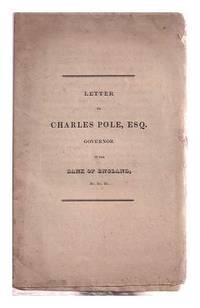
1820342776Publisher; Unknown 1820. First edition. Softcover. Specimen color/red plates 1 5 & 10 pound notes printed on single and double sides loosely inserted. Good copy; edges slightly nicked and dust-dulled as with age. An unread example with unopened pages. Remains particularly well-preserved overall; bright and clean. Additional scans and bibliographic detail on request. Date of publication is suggested. Physical description; 14 pp. Dis-bound as issued. Subjects; Bank of England.1800-1850. Bank notes - original currency samples -Great Britain. Banks and banking Central Great Britain. Currency - counterfeit and fraudulent - currency - forgery - nineteenth century. Currency printing - authentic registers. Pole served as Bank governor from 1820-1822 only. Publisher; Unknown paperback
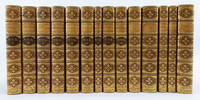
1809ST19496London and Hafod 1809-11. 300 x 240 mm. 11 3/4 x 9 1/2". 14 volumes. Froissart translated by John Bouchier Lord Berners. Monstrelet translated by Thomas Johnes. Rastell edited by Thomas F. Dibdin. <br/> HANDSOME CONTEMPORARY SPRINKLED CALF GILT covers with French fillet border corners with floral spray topped by a coronet raised bands spine compartments with central floral sprig surrounded by small tools acorn and oak leaf cornerpieces one tan and one brown morocco label marbled endpapers all edges gilt. Monstrelet with 51 plates one double page; Rastell with numerous woodcuts in the text and 18 full-page portraits of English kings. Lowndes III 1586; Cave "Private Press" pp. 43-44 Monstrelet; Cox III 380; Lowndes II 924 Grafton; Cox III 375; Lowndes II 843 Froissart; Cox III 378; Lowndes II 984 Hall; Cox III 374; Lowndes I 72 Arnold; Cox III 377; Lowndes IV 2051 Rastell; Cox III 375; Lowndes II 773-774 Fabyan; Cox III 378; Lowndes II 994 Hardyng. Spines lightly sunned top label more affected a dozen boards with small patches of lost patina from insect activity light rubbing to extremities other insignificant defects but the bindings lustrous with very little wear and making an imposing presence on the shelf. Illustrations lightly foxed occasional minor foxing or browning to text more prominent on a dozen or so openings but never severe other isolated negligible imperfections but a fine set inside and out the amply-margined text clean bright and fresh.<br/> <br/> Tall uniformly bound and a striking ornament to any library these volumes contain important histories first published in the 15th and 16th centuries covering events in England France and western Europe from the first century A.D. through the mid-1500s. The famed "Chronicles" of Jean Froissart ca. 1337 – ca. 1405 are a key resource for the Hundred Years' War and for the chivalric culture of the 14th century. Monstrelet ca. 1400 – 1453 picked up where Froissart left off reporting on the years 1400-44. The works by Robert Fabyan d. ca. 1512 and John Hardyng 1378–1465 look at English history from the first century Roman occupation through the Plantagenet and Tudor dynasties ending in the 15th and 16th centuries respectively. Printer John Rastell d. 1536 compiled and published "Pastime" which looks at England from 1066-1485. The "Chronicle" by Edward Hall 1497-1547 covering the years 1399-1547 was a key source for Shakespeare's history plays and according to A. W. Rosenbach's 1938 catalogue was "the second book printed in English and written by an Englishman referring to America as well as the first English historical work mentioning a voyage to America." King's printer to Henry VIII and Edward VI Richard Grafton ca. 1506/7 or 1511 – 1573 produced an abridgement of earlier Chronicles and a continuation of Hall's work notable according to DNB for "his description of the accession of Queen Elizabeth her welcome in London and the pageants held along the route—from the Tower to Westminster—which Grafton helped to oversee." "Customs of London" attributed to Richard Arnold d. ca. 1521 lists mayors sheriffs and bailiffs of that city from the time of Richard I to that of Henry VI and contains its articles charters and ordinances. It is easy to picture the present set on the shelves of a stately home---which given their "country house" condition is quite possibly where they resided for many years. unknown
188155698London 1881. Very good. Twelve monthly parts quarto 22 by 17.5 cm. 379 leaves 8 final blank. Original manuscript penned in several neat hands including 40 original illustrations mostly tipped-in on heavier paper. Title pages for vol. 1 January-June and vol. 2 July-December; index for vol. 1. Recent foliation in pencil; 75 pages with contemporary numeration in ink. Navy blue polished calf lettered and tooled in gilt marbled endleaves. Covers lightly chafed at extremities; occasional mild smudging else text about fine.<br /> <br /> Privately circulated magazine comprising essays often on historical subjects travel accounts short stories poetry riddles and puzzles along with some letters to the editor. This particular collection affords a unique perspective on a Victorian-era co-ed literary project born of youthful enthusiasm. Many of the pieces unfold serially across several issues. Floral themes depictions of girls and landscapes abound among the watercolor and ink illustrations most of which are on heavier paper and have been tipped-in. All but the last issue contain an opening illustration invoking the month. The illustrations and written pieces are pseudonymously signed by no fewer than sixteen contributors many of whom are women: Ad Lucem; Amicus; Beth; Constancy; Daphne; Elaine; Gh; Granta; Hope; Iris; Ivy; Mezereon a species of Daphne; M'one; M:zone; One of the Mob; Sinon the cousin of Odysseus who persuaded the Trojans to open the gate for the Trojan Horse; Viola. The editor's introduction and subsequent addresses attest to the ephemeral nature of the project including financial pressures. In the address to the members which appears at the opening of the second volume the editor raises the issue of increasing the subscription rate for 2 to 5 shillings per annum. <br /> <br /> "At a meeting of a few friends it was suggested that a publication of a Magazine to be circulated among the members only should be undertaken. Two members undertook to draw up a code of rules and issue a circular inviting members to join the Society the magazine of which was to be called 'The Folia Peripatetica.' The encouragement which the proposal received was quite equal to the anticipation of the promoters and many hailed with joy the advent of the Folia as a pastime and an occupation for the long winter evenings and sunny days of summer. All the contributors it is needless to say were born authors and though perhaps some were comparatively young in years yet their light was no longer to remain dimly burning under the bushel. Poets Musicians Novelists Historians all found here the medium they had long wished for. Joy joy unspeakable joy reigned supreme in the Editors office and for a season all went on as 'merry as a cricket.' But alas! vain are the hopes of man. Time was when lo a change came oer the spirit of my dream. Members finding they were after all condemned to 'blush unseen' and waste their fragrance on the limited circle of the Folia's members began to find that other and more important duties claimed their time. Some retired into distant parts of the country others went abroad or got married. In vain fresh nurses were called in and a change of Doctors -- I mean Editors -- effected Hope for a short while revived but this soon gave place to despondency. A change to Sidmouth and Plymouth only accelerated the malady. But the Folia was not to perish in this obscure way. Fate had ordained a fairer destiny. The two volumes now handsomely bound will remain for many a long year to come a fitting monument to the memory of the 'Folia Peripatetica'" editor's preface. vol. 1. <br /> <br /> "Granta" contributes several notable pieces: "University Degree Day" an eye-witness account of the 1877 ceremony where Charles Darwin received an honorary degree at Cambridge; "Jesuit Schools" prompted by the "advent of a colony of Jesuits in our secluded valley;" and "Capital Punishment" in which the author argues against "a practice entirely barbarous horrible in its details and brutalising in its effects." A piece on "Women's Rights" written under the pseudonym "Ad Lucem" is illustrated with pen drawings of butterflies. An account of Autumn maneuvers with the 20th Yorkshire Amateur Carabineers written by a participant is provided by Gh. "Hope" writes about "Shakespeare's Heroines" and "Viola" explores the lives of "Some of Our King's Wives." "One of the Mob" offers an account of "two bachelors of limited incomes" visiting Paris on the cheap. An anonymous writer compares "the translations of the old and revised versions of the New Testament" that appear in the Gospel of Matthew. "Music in Worship" by "Amicus" includes a score entitled "Augusta." An ultra-miniature 30 cm text penned within a circle and requiring magnification to read includes The Lord's Prayer a Creed and the Ten Commandments the final line noting "St. John's College Cambridge 1881."<br /> <br /> Provenance: Editorial note at close of first monthly issue noting that subscriptions for the current half year are now due and should be forwarded to No. 43 Oakley Street Chelsea.<br /> <br /> Binding: ticket of Macmichael. Stationer to the Queen. 207 Kings Road. Chelsea<br /> <br /> Watermark: Jordan Superfine. unknown