DA©szpa, MihA¡ly LorA¡ndBiblio.com
200 résultats
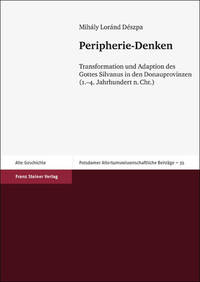
201215860Franz Steiner Verlag. 2012. Softcover. Very Good. Faint bump to base of spine. Very light shelfwear else fine.; Silvanus war einer der populärsten Götter in den Donauprovinzen. Er prägte das religiöse Leben verschiedener sozialer Schichten der Provinzialbevölkerung vor allem in den wichtigsten Städten in diesem Teil des Imperium Romanum. Silvanus unterscheidet sich dabei allerdings radikal von seinem italischen Archetypus. Dies wurde in der Forschung mit dem Phänomen des Synkretismus zwischen dem italischen Gott und einem illyrischen gallischen sowie dakischen Gott erklärt. In Peripherie-Denken wird für diese Differenz eine neue Erklärung angeboten. Hierbei liegt der analytische Fokus nicht auf dem 'ontologischen' "Warum" der Begründung sondern auf dem funktionalen "Wie" der Beschreibung: Die Prozesse die die Transformationen des italischen in den Silvanus der Donauprovinzen strukturieren stehen im Zentrum der Untersuchung. Ein anderer Schwerpunkt liegt in der Analyse des Beitrages der Religion für die soziale Integration in einer globalen Konstellation. Das Buch stellt nicht nur religiöse Prozesse in einem imperialen Kontext dar es leistet auch einen Ansatz für eine neue methodologische Herangehensweise an das System Religion.; Potsdamer Altertumswissenschaftliche Beiträge Pawb Band 35; 340 pages . 351509945X . Franz Steiner Verlag paperback
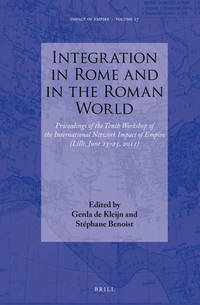
201316130Brill Academic Pub. 2013. Hardcover. Very Good in No Dust Jacket dust jacket. Lower corners bumped.; Integration in the empire under the political control of the city of Rome her princeps and the different authorities in the provinces and cities includes processes of inclusion and exclusion. These multifaceted processes take place at various levels in society and at different places over a long period of time. In this volume these processes are analysed and reflected on from different perspectives. Juridical political social and religious points of view are articulated elaborating on epigraphic literary juridical and numismatic evidence. Notions of personal and collective identities have been linked to relevant Roman realia so that various contents of Romanitas can be defined through contextualization.; Impact of Empire Volume 17; 302 pages . 9004255982 . Brill Academic Pub hardcover
200815571Éditions Latomus. 2008. Softcover. Near Fine. Very light bump to bottom of spine. Else fine.; A. KOPTEV Reconsidering the Roman King-List - p. 5 J. H. RICHARDSON Rome's Treaties with Carthage: Jigsaw or Variant Traditions - p. 84 L. L. HOLLAND Diana Feminarum Tutela The Case of Noutrix Paperia - p. 95 C. SAYLOR Inclusion and Exclusion of Characters in the New Comic Society in Plautus and Terence - p. 115 J. CLARKE Mourning and Memory in Catullus 65 - p. 131 M. DE WIlDE Catullus' Coma Berenices. An Investigation of a True Interpreter's Poetic Licence and its Reception by Apuleius - p. 144 M. B. CHARLES and P. RHODAN Reconsidering Thapsus: Caesar and the Elephants of Scipio and Juba - p. 177 A. PEER Cicero's Last Caesarian Speech. The Pro Rege Deiotaro as a Final Warning before the Ides of March - p. 189 B. KELLY Dellius the Parthian Campaign and the Image of Mark Antony - p. 209 L. BABLITZ The Platform in Roman Art 30 BC - AD 180: Forms and Functions - p. 235 J. BENNEIT The Auxilia of Lycia and Pamphylia : Identity Deployment and Function - p. 283 D. WOODS Concealing Caligula's Epilepsy - p. 306 Y. MAES Neronian Literature and the Grotesque - p. 313 Chr. VESTER Mis Remembering Magnus in Lucan's de Bello Ciuili - p. 324 A. AUGOUSTAKIS An Insornniac's Lament: the End of Poetic Power in Statius' Siluae 54 - p. 339 F. JONES Juvenal and the Hexameter - p. 348 B. S. HOOK Umbricius caligatus : Wordplay in Juvenal 3322 - p. 365 M. T. BOATWRIGHT Tacitus and the Final Rites of Agrippina: Annals 149 - p. 375 B. -Z. ROSENFELD and J. MENIRAV The Use of Advertising in Jewish Society in Roman Palestine - p. 394 G. D. DUNN Anicius Hermogenianus Olybrius - p. 429 M. THOMSON Logodaedalia : Ausonius and the Historia Augusta - p. 445 J. MOORHEAD Hearers and Readers of Christian Latin Texts in Late Antiquity - p. 476 S. GREBE Mercury's Search for a Bride: Arithmological Observations to Martianus Capella's De nuptiis Philologiae et Mercurii - p. 500 D. PRAET Horus and Osiris as Hermeneutical Keys to the King's Riddle in the Historia Apollonii Regis Tyri - p. 505 C. DEROUX The Franks and Bacon according to Doctor Anthimus De obs. Cib. 14 - p. 518; Collection Latomus Volume 315; 14; 529 pages . 2870312563 . Éditions Latomus paperback
201015570Latomus. 2010. Softcover. Fine. A. Koptev Timaeus of Tauromenium and Early Roman Chronology; R. Moore Roman Women in the Castra : Who’s in Charge Here; M. H. Williams The Disciplining of the Jews of Ancient Rome: Pure Gesture Politics; R. K. Ehrman Hope from the Sea in Plautus’ Rudens; D. P. Kubiak An Erotic Epigram of Cicero ; M. B. Charles Caesar and the Maritime Troop Transport in the Civil War 49-45 B. C. ; D. Engels Prodigies and Religious Propaganda: Seleucus and Augustus; H. Snijder The Cosmology of Octavian’s Divine Birth in Vergil’s Fourth Eclogue; L. Fratantuono Seraque terrifici: Archery Fire and the Enigmatic Portent of Aeneid V; Y. Nadeau Naulochus and Actium the Fleets of Paris and Aeceas and the Tree-felling of C Iulius Caesar Erysichton; D. Lowe Burnt Offerings and Harpies at Nasidienus’ Dinner-Party Horace Satires 2 8 ; R. T. Scott There’s Nothing Wrong with Horace Odes 4; B. J. Kavanagh The Marriages Motives and Legacy of Vistilia; G. Mader regno pectus attonitum furit: Power Rhetoric and Self-division in Seneca’s Phoenissae; S. M. Kershner Statius as Horatian Priest of the Muses in Siluae 2 7; C. Deroux More on the Subject of Cordus in Juvenal’s Third Satire; L. Foubert Literary Constructions of Female Identities: the Parallel Lives of Julio-Claudian Women in Tacitus’ Annals; C. A. Perkins Looking in the Mirror: Caecina and His Army in the Histories of Tacitus; K. R. Bradley The Exemplary Pliny 384-422J. Bennett Auxiliary Deployment during Trajan’s Parthian War: Some Neglected Evidence from Asia Minor; B. Baldwin ‘Contemporary’ Allusions in the Historia Augusta; A. Quiroga Quid est gloria si tacetus Silence in Ambrose’s De Officiis; N. Adkin Further Supplements to Marangoni’s Supplementum Etymologicum : Servius and Sevius Auctus on Virgil; R. E. Colton Echoes of Juvenal in Claudian’s In Eutropium; R. J. Cormier After Virgil’s Aeneid : a Medieval Variation on the Monster Dog Cerberus.; Collection Latomus Volume 323; 15; 528 pages . 2870312644 . Latomus paperback
201215565Éditions Latomus. 2012. Softcover. Near Fine. Light bump to lower front corner. Else fine.; Chr. Reitz Of Arms and Men : Arming Scenes in the Epic Tradition and in Vergil’s Aeneid 5-22; A. Koptev From the Tarquin Kingship to the Republic : Three Versions of the Graeco-Roman Historiography 23-93; R. Cowan Valerius Cato Callimachus and the Very Large Girl Ticida fr 103 FRP 94-100; A. Vergados and Sh. O’ Bryhim Reconsidering Catullus’ Passer 101-113; R. J. Starr Catullus 14 and Catullus 1 : Gift Books Booksellers and Poetic Statements 114-125; M. S. Marsilio Catullus 36 : Love and Literary Criticism 126-133; D. A. Phillips Potestas and Auctoritas : Augustus and Elections 27-17 B. C. 134-150; D. Engels Dionysius of Halicarnassus on Roman Religion Divination and Prodigies 151-175; L. Rivero García Notes on the Text of Virgil’s Aeneid. Apropos the New Teubner Edition 176-197; L. Fratantuono and C. Susalla Virgil’s Camilla and the Authenticity of the Helen Episode 198-210; N. Adkin Virgil and the Etymology of « Tiger » 211-219; W. Liebeschuetz Propertius 1 1 : Introducing the Monobiblos 220-234; M. F. Williams Old and New Geography : Propertius on Alexander and the Hypanis Caspian and Araxes Prop. I 12 3-4 ; II 30 19-20 ; IV 3 7-10 35-40 235-258; B. P. Weinlich Virtus and Élite Identity in Propertius 259-276; B. Buxton A New Reading of the Prima Porta Augustus : the Return of the Eagle of Legio V Alaudae 277-306; P. Murgatroyd Wit and Humour at Ovid Metamorphoses 3.316-338 307-312; G. Mader Name Game Blame Game : Rhetoric and Identity Management in Ovid’s Myrrha Episode Met. X 298-502 313-338; L. Fulkerson Sad Ovid Angry Augustus 339-366; A. -M. Lewis Reconsidering Ovid’s Relationship to Perilla Tristia III 7 367-397; R. Edwards His Father’s Son and His Son’s Father : Augustus and Germanicus in Tiberian Documents 398-414; B. Levick Some Renewals of imperium : Timing and Wording 415-426; M. Gray-Fow I. N. R. I. 427-436; D. Woods Seven Notes on the Reign of Caligula 437-471; S. Van Overmeire Nero the Senate and People of Rome. Reactions to an Emperor’s Image 472-491; J. K. Newman Notes on Lucan’s Epic 492-529; M. B. Charles and E. Anagnostou-Laoutides Vespasian Caenis and Suetonius 530-547; B. Mulligan Animal Play : Bilingual Onomastics and the Arrangement of Statius Silvae 2 548-581; K. Bradley The Birthplace of Hadrian : Pursuing Ghosts 582-613; L. Van Abbema Ammianus Marcellinus 28 4 : Juvenalian Vice and Writing of History 614-638; M. Vannesse Ammianus Marcellinus on Julian’s Persian Expedition363 A. D. : a Note on the Supply Chain 639-645; A. Dupont A « Status Quaestionis » on Recent Debates on the Chronology and the Dating Methodology of Augustine’s Sermones ad Populum 646-659; C. Deroux Concerning an Alleged Enigmatic “Hapax” : iott icus Life of Saint Eligius II 16 MGH Scr. Rer. Mer. IV p. 70513 660-667; Collection Latomus Volume 338; 16; 670 pages . 2870312849 . Éditions Latomus paperback
200516104Latomus. 2005. Softcover. Very Good. Light rubbing to wraps. Else minor shelfwear.; A. Koptev: Exploring the Tripartite Archetype in the Historical Tradition on Archaic Rome; D. Dzino: late Republican Illyrian Policy of Rome 167-60 BC: the Bifocal Approach; N. Adkin: Some additions to Maltby's Lexicon of Ancient Etymologies; E. Karakasis Totum ut te faciant Fabulle nasum: Catullus' XIII reconsidered; R. Stem Nepos' Atticus as a Biography of Friendship; H. Akbar Khan: Surface and Substance: a Reading of Horace Odes 18; C. J. Simpson The Fasces and the 'Custom of Alternation' Retrojection not Restoration R. Cormier Who Bears the Golden Bough before Charon Aeneid VI 405-407 -- a Correction; L. Fratantuono Posse putes: Virgil's Camilla and Ovid's Atalanta; M. Berry Propertian Ambiguity and the Elegiac Alibi; F. Cairns The Triumphal Motif of Propertius 3417-18 adn its Political Associations: Sculptural and Numismatic Evidence; J. Marincola marcellus at Syracuse Livy XXV 2411-15 : a Historian reflects; B. T. Reeves adn P. Murgatroyd Europa in ovid's Fasti; S J Huskey Quaerenti plura legendum: Ovid on the Necessity of Reading Tr. I 121-22 ; K. Hasegawa The Collegia domestica in the Elite Roman Households: the Evidence of Domestic Funeral Clubs for Slaves and Freedmen; B. L. Wickkiser: Augustus Apollo and an Ailing Rome: Images of Augustus as a Healer of State; B. Buxton and R. Hannah: OGIS 458 the Augustan Calendar and the Succession; B. Baldwin Nero the Poet; B. Halvonik: the Ethos of Vrbanitas in the Satyricon; c. Chandler first Impressions: Eschatological Allusion in Petronius Satyrica 28-29; R A Faber: The adaptation of Apostrophe in Lucan's Bellum Civile; M Erasmo Mourning Pompey: Lucan and the Poetics of Death Ritual; Y Z Liebersohn Seneca Philosophia Medicus. De Constantia Sapientis: a proposed Interpretation; S. Tzounakas: Echoes of Lucan in Tacitus: the Cohortationes of Pompey and Calgacus; V. E. Pagan: The Pannonian Revolt in the Annals of Tacitus; A. Griffith: Slander thy Neighbours : Mithraism's Escape from Invective ad corpora; G D Dunn: Mavilus of hadrumetum African proconsuls and Mediaeval Martyrologies; J S Edwards: the Carmina of Publilius Optatianus Porphyrius and the Creative Process; M Kahlos: Pompa Diaboli. The Grey area of Urban Festivals in the fourth and fifth centuries; C. Deroux: the allusion by Anthimus the Physician to the Cauterisation of Horses De obs. Cib. praef. p.3 1. 6-8 Liechtenhann.; Collection Latomus Volume 287; 12; 496 pages . 2870312288 . Latomus paperback
200310673Latomus. 2003. Softcover. Near Fine. Faint crease to front wrap. Very Light shelfwear. Else fine.; Bingham S. "Life on an Island: a Brief Study of Places of Exile in the First Century AD" ; Brown R. "The Terms 'Bellum Sociale' and 'Bellum Civile' in the Late Republic" ; Castner C. J. "The 'Fulmen' and Sicily: Imagery in Lucretius' Sixth Book" ; Dauster M. "Roman Republican Sumptuary Legislation: 182-102" : Deroux C. "Archias: Maker of Furniture or Phantom Figure Horace Epist.1.5 " ; Gil Egea M. E. "Warrior Retinues in Late Antiquity: The Case of Pelagia" ; Hull W. D. "Coriolanus and the Homeric Tradition" ; Kavanagh B. J. "Two Families from Vienne and the Effect of their Rivalry" ; Khan H. Akbar "Venus' Intervention in the Dido-affair: Controversies and Considerations" Koglou V. Fynti "Caecus Clodia Metellus: Theatre and Politics in 'pro Caelio'" ; Koptev A. "Lucretia's Story in Literature and the Rites of 'Regifvgivm' and 'Equivrii'" ; MacDonald J. "Dueling Contests: Theocritus and Virgil's Third and Seventh 'Eclogues'" ; Maurer K. "'Notiora Fallaciora': Exact Non-allusive Echoes in Latin Verse" ; Merriam C. U. "'Acrior est nostra plusque furoris habet': Erotic Madness of Women in Latin Poetry" ; Morello R. "Place and Road: Neglected Aspects of Livy 9 1-19" ; Nathan G. "'Pudicitia Plebeia': Womanly Echoes in the Struggle of the Orders"; Nice A. "The Persona of Umbricius and Divination in Juvenal 'Satires' Three and Six" ; Opsomer Th. "'Referre aliter saepe solebat idem': The Relation between Ovid's 'Amores' and 'Ars Amatoria'"; Perkins C. A. "Truth in Tacitus: The Case of Livia Augusta" ; Rees R. D. "Talking to the Tetrarchs: The Dynamics of Vocative Address" ; Roche P. A. "Mixed Messages: Trajan and the Propaganda of Personal Status" ; Strachan J. C. G. "A Literary Crisis A Reassessment of the Symbolism of Propertius 1 17" ; Williams Mary F. "Lawgivers and the Rule of Law in the 'Aeneid'"; Collection Latomus Volume 272; 11; 506 pages . 287031213X . Latomus paperback
200610675Latomus. 2006. Softcover. Fine. F. Jones names and naming in 'soft' poetry; L S. Fotheringham: Gliding transitions and the Analysis of Structure: Cicero's Pro Archia; D. Kozak Outing Venus: Textual Liaisons in De Rerum Natura 122-40; G L Fain Composition in Catullus and Horace; C Deroux a Fresh Look at the Joke in Catullus' Poem LIII; D R Sweet Catullus 65: Grief and Poetry; J Warden Catullus in the Grove of Callimachus; J A Stevens: The Imagery of Cicero's Somnium Scipionis; P Erdkamp Valerius Antias and Livy's Casualty Reports; R P Duncan-Jones Who were the Equites J Whitehorne: the Significance of the City in Virgil's Aeneid I-VI; Tsakiropoulou-Summers Dido as Circe and the Attempted Metamorphosis of Aeneas; L Fratantuono Tros Italusque: Arruns in the Aeneid; M F Williams Propertius on Art: Epigram Aristotle and the New Posidippus; A Ramirez de Verger A new edition of Ovid's Metamorphoses; S J Huskey Ovid's Metamorphoses in Tristia I 1; J M Pfundstein The Idea of Order at Thebes: Astronomy in Seneca's Hercules Furens; J M Nunez Gonzalez On the Meaning of bella plus quam civilia Lucan 11. A relevant Hyperbole; R Marks En reddo tua tela tibi: Crista and Sons in Silius Pun. X 92-169; J Garthwaite: the Context and Content of Martial Book 3; M Gray-Fow neither Virgin nor Martyr; D Woods Libanius Bemarchius and the Mausoleum of Constantine I; M Vitielllo Neofitus iit ad Deum: some observations on the Sarcophagus of Junius Bassus; N Adkin Further Additions to maltby's Lexicon of Ancient Latin Etymologies: Priscian; E Bohlin: Critical and Interpretative Notes on Boethius arithm. II 30; Collection Latomus Volume 301; 13; 495 pages . 2870312423 . Latomus paperback
200511451Latomus. 2005. Softcover. Very Good. Faint crease to top corner of front wrap and top corner of rear wrap and first and last few pages. Tear to bottom of spine cover 1 cm. Very light soiling to top corner of pg 14.; A. Koptev: Exploring the Tripartite Archetype in the Historical Tradition on Archaic Rome; D. Dzino: late Republican Illyrian Policy of Rome 167-60 BC: the Bifocal Approach; N. Adkin: Some additions to Maltby's Lexicon of Ancient Etymologies; E. Karakasis Totum ut te faciant Fabulle nasum: Catullus' XIII reconsidered; R. Stem Nepos' Atticus as a Biography of Friendship; H. Akbar Khan: Surface and Substance: a Reading of Horace Odes 18; C. J. Simpson The Fasces and the 'Custom of Alternation' Retrojection not Restoration R. Cormier Who Bears the Golden Bough before Charon Aeneid VI 405-407 -- a Correction; L. Fratantuono Posse putes: Virgil's Camilla and Ovid's Atalanta; M. Berry Propertian Ambiguity and the Elegiac Alibi; F. Cairns The Triumphal Motif of Propertius 3417-18 adn its Political Associations: Sculptural and Numismatic Evidence; J. Marincola marcellus at Syracuse Livy XXV 2411-15 : a Historian reflects; B. T. Reeves adn P. Murgatroyd Europa in ovid's Fasti; S J Huskey Quaerenti plura legendum: Ovid on the Necessity of Reading Tr. I 121-22 ; K. Hasegawa The Collegia domestica in the Elite Roman Households: the Evidence of Domestic Funeral Clubs for Slaves and Freedmen; B. L. Wickkiser: Augustus Apollo and an Ailing Rome: Images of Augustus as a Healer of State; B. Buxton and R. Hannah: OGIS 458 the Augustan Calendar and the Succession; B. Baldwin Nero the Poet; B. Halvonik: the Ethos of Vrbanitas in the Satyricon; c. Chandler first Impressions: Eschatological Allusion in Petronius Satyrica 28-29; R A Faber: The adaptation of Apostrophe in Lucan's Bellum Civile; M Erasmo Mourning Pompey: Lucan and the Poetics of Death Ritual; Y Z Liebersohn Seneca Philosophia Medicus. De Constantia Sapientis: a proposed Interpretation; S. Tzounakas: Echoes of Lucan in Tacitus: the Cohortationes of Pompey and Calgacus; V. E. Pagan: The Pannonian Revolt in the Annals of Tacitus; A. Griffith: Slander thy Neighbours : Mithraism's Escape from Invective ad corpora; G D Dunn: Mavilus of hadrumetum African proconsuls and Mediaeval Martyrologies; J S Edwards: the Carmina of Publilius Optatianus Porphyrius and the Creative Process; M Kahlos: Pompa Diaboli. The Grey area of Urban Festivals in the fourth and fifth centuries; C. Deroux: the allusion by Anthimus the Physician to the Cauterisation of Horses De obs. Cib. praef. p.3 1. 6-8 Liechtenhann.; Collection Latomus Volume 287; 12; 496 pages . 2870312288 . Latomus paperback
2012x-0754678997Ashgate Pub Co 2012. Hardcover. New. 299 pages. 9.00x6.25x1.00 inches. Ashgate Pub Co hardcover
2026x-1041137389Taylor & Francis Ltd 2026. Hardcover. New. 172 pages. 9.18x6.12x9.45 inches. Taylor & Francis Ltd hardcover
201039747Johns Hopkins University Press. 2010. Hardcover. Very Good in No Dust Jacket dust jacket. Minor shelfwear to book.; Stephen L. Dyson has spent a lifetime studying and teaching the history of ancient Rome. That unparalleled knowledge is reflected in his magisterial overview of the Eternal City. Rather than look only at the physical development of the city-its buildings monuments and urban spaces-Dyson also explores its social economic and cultural histories. This unique approach situates Rome against a background of comparative urban history and theory allowing Dyson to examine the dynamic society that once thrived there. In his personal effort to reconstruct the city Dyson populates its streets with the hurried politicians hawking vendors and animated students that once lived worked and studied there bringing the ancient city to life for a new generation of students and tourists. Dyson follows Rome as it developed between the third century BC and the fourth century AD dividing the great megalopolis into distinct neighborhoods and locales. He shows how these communities each with its own unique customs and colorful inhabitants eventually grew into the great imperial capital of the Italian Empire. Dyson integrates the full range of sources available-literary artistic epigraphic and archaeological-to create a comprehensive history of the monumental city. In doing so he offers a dramatic picture of a complex and changing urban center that despite its flaws flourished for centuries.; Ancient Society And History; 6 X 1.39 X 9 inches; 488 pages . 0801892538 . Johns Hopkins University Press hardcover
2001014497London: Kluwer Academic Publishers 2001. Cloth/Laminated Boards. Like New/No d/j as Published. 8vo - over 7¾" - 9¾" tall. Type: Book It is universally recognised that Venice and its lagoon are of such value that they constitute an international public good that must be preserved for humanity as a whole. But such an ambitious task requires a diversified sustainable set of economic activities mostly focused on the production of services and non-material goods. This complex issue is analyzed using different approaches with a discussion of the case of Venice as an example of some of the most relevant problems concerning the relation between the environment and development in the contemporary world: the trade-off between preserving an ecosystem and considering it as an economic resource; the evolution of different urban growth scenarios and the preservation of a physical habitat; the role of immaterial production in urban economic development; the nature of tourism as a sustainable activity considered from both from the environmental and cultural angles; the institutional aspect of governing a process of sustainable urban development. 269pp. Kluwer Academic Publishers hardcover
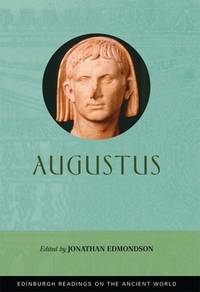
200925488Edinburgh University Press. 2009. Hardcover. Fine in Near Fine dust jacket. Book is fine. DJ has very light shelfwear.; Augustus 63 BC - AD 14 the first Roman emperor brought peace and stability to Rome after decades of strife and uncertainty. He put in place a new institutional framework for the Roman Empire and inspired the ideology that sustained it for the next three hundred years. This book presents a selection of the most important scholarship on Augustus and the contribution he made to the development of the Roman state in the early imperial period. Chapters include: Augustus' dramatic rise to prominence following the death of Julius Caesar in 44 BC and the nature of his powers first as triumvir then as Princeps; his policy regarding overseas wars and expansion his administrative and military reforms of the Roman state; the role of his own family his wife Livia his son-in-law Agrippa and his adopted sons Gaius and Lucius Caesar and then Tiberius in public life; his concern to reinforce Roman religion and family life; the development of an ideology that helped bolster his authority as ruler of an expan; Edinburgh Readings on the Ancient World; 576 pages . 0748615946 . Edinburgh University Press hardcover
2001x-3540419330Springer Verlag 2001. Paperback. New. 1st edition. 309 pages. 9.00x6.00x0.75 inches. Springer Verlag paperback
20036107Unisa Press. 2003. Softcover. Fine. Contents: Section 1: The Great Men. I. The Military Reputation of Gaius Marius; II. Pompey in the 70s; III. Caesar's use of tribuni plebis; A comparision of Marius Pompey and Caesar. Section 2: The Lesser Figures. IV. Saturninus and Glaucia: a quest for power; V. The Characters of Drusus and Sulpicia; VI. Clodius and Milo: more equals than opposites; A comparison of Saturninus and Glaucia Drusus and Sulpicius Clodius and Milo.; 221 pages; The reputations of a great many figures in history have been established by chance and opportunity: a single victory on the battlefield a political triumph in domestic affairs. This statement is equally applicable for that century between 146 and 31 BC which today is usually designated the Late Roman Republic. On the basis of often rather meagre facts reputations have been constructed and as a result whole careers became mythologised by later writers even in antiquity. The main aim of this volume is to question certain reputations in order to place into a more realistic historical context the subjects under discussion. . 1868881989 . Unisa Press paperback
200638317Oxford University Press. 2006. Hardcover. Near Fine in No Dust Jacket dust jacket. Digitally reprinted; 364 pages; The Roman World of Cicero's De Oratore aims to provide an accessible study of Cicero's first and fullest dialogue on the ideal orator-statesman. It illustrates the dialogue's achievement as a reflection of a civilized way of life and a brilliantly constructed literary unity and considers the contribution made by Cicero's recommendations to the development of rhetoric and higher education at Rome. Because Cicero deliberately set his extended conversation in the generation of his childhood teachers a study of the dialogue in its historical setting can show how the political and cultural life of this earlier period differed from Cicero's personal experience of the collapse of senatorial government when the overwhelming power of the "first triumvirate" forced him into political silence in the last decade of the republic. After an introductory chapter reviewing Cicero's position on return from exile chapters include a comparative study of the careers of M. Antonius and L. Licinius Crassus protagonists of the dialogue a discussion of Cicero's response to Plato's criticisms of rhetoric in the Gorgias and Phaedrus and his debt to Aristotle's Rhetoric analysis of the dialogue's treatment of Roman civil law existing Latin literature and historical writing Strabo's survey of the sources and application of humor political eloquence in senate and contio theories of diction and style and the techniques of oral delivery. An epilogue looks briefly at Cicero's De re publica and Tacitus' Dialogus de oratoribus as reflections on the transformation of oratory and free if oligarchic republican government by debate to meet the context of the new autocracy. . 0199263159 . Oxford University Press hardcover
200743032Cambridge University Press. 2007. Softcover. Near Fine. Xx 337pp. The ancient Romans are usually thought of as a monolithic ethnic group though in fact they formed a self-consciously pluralistic society. In this book Gary D. Farney explores how senators from Rome's Republican period celebrated and manipulated their ethnic identity to get ahead in Rome's political culture. He examines how politicians from these lands tried to advertise positive aspects of their ethnic identity how others tried to re-create a negative identity into something positive and how ethnic identity advertisement developed over the course of Republican history. Finally in an epilogue Farney addresses how the various Italic identities coalesced into a singular Italian identity in the Empire and how Rome's experience with Italic groups informed how it perceived other groups such as Gauls Germans and Greeks.; 337 pages . 0521151805 . Cambridge University Press paperback
200722163Cambridge University Press. 2007. Hardcover. Very Good in Very Good dust jacket. Upper corner very slightly bumped else book is fine. Very light shelfwear to DJ.; Xx 337pp. The ancient Romans are usually thought of as a monolithic ethnic group though in fact they formed a self-consciously pluralistic society. In this book Gary D. Farney explores how senators from Rome's Republican period celebrated and manipulated their ethnic identity to get ahead in Rome's political culture. He examines how politicians from these lands tried to advertise positive aspects of their ethnic identity how others tried to re-create a negative identity into something positive and how ethnic identity advertisement developed over the course of Republican history. Finally in an epilogue Farney addresses how the various Italic identities coalesced into a singular Italian identity in the Empire and how Rome's experience with Italic groups informed how it perceived other groups such as Gauls Germans and Greeks.; 337 pages . 0521863317 . Cambridge University Press hardcover
2002018742<p>This book is the definitive guide to the looks designed and in these photographs worn by Leigh Bowery. One of Britain's most heroically ambitious yet underappreciated designers and performance artists Bowery remains an inspiration to many contemporary fashion designers though few are willing to admit it. In Leigh Bowery Looks you can easily see why: it contains more than 150 previously unpublished photographs of Bowery an extraordinary body of work that was the outcome of his collaboration with British photographer Fergus Greer between 1988 and 1994 the year of Bowery's death. 175 pages : chiefly color illustrations ; 21 cm. Slight shelf wear to edges gift inscription on half-title page to previous owner tight and square binding. Photographs available on request. All books dispatched same or next working day in robust packaging.</p> Thames & Hudson in association with Violette Editions paperback
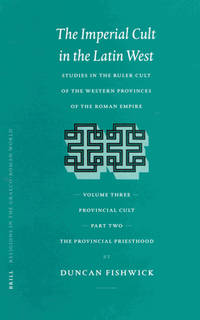
20026126Brill Academic Publishers. 2002. Hardcover. Near Fine in No Dust Jacket dust jacket. Very slight bump to bottom back corner else Fine.; Religions in the Graeco-Roman World 146; 3.2; 0.9 x 9.7 x 6 Inches; 256 pages; This volume analyzes the priesthood of the provincial cult in every province of the Latin west where evidence has survived in the period from Augustus down to the mid third century. Particular attention is paid to the epigraphic record notably the Testimony of honorific statues especially at provincial centres but discussion also focusses on the origin and background of provincial priests their office and duties and their careers both before and after holding provincial office. Of special interest are the sixteen tables that list the main facts preserved by the epigraphic record also a concluding overview that summarizes the principal features of the institution including the office of priestess and the role of administrative officials. Some fifty plates illustrate the text. . 9004125396 . Brill Academic Publishers hardcover
2020BIBLB0021363962020. Leather Bound. New. Size: 14.60 x 22.86 cms This book is available in 5 different Leather color without any extra cost. Explore More Options by Clicking on 'More Images' and Notify Us of Your Choice via Email within 24 hours of placing the order. Presenting an Exquisite Leather-Bound Edition expertly crafted by the prestigious organization Rare Biblio with Original Natural Leather that gracefully adorns the spine and corners. The allure continues with Golden Leaf Printing that adds a touch of elegance while Hand Embossing on the rounded spine lends an artistic flair. This masterpiece has been meticulously reprinted in 2020 utilizing the invaluable guidance of the original edition published many years ago in . The contents of this book are presented in classic black and white. Its durability is ensured through a meticulous sewing binding technique enhancing its longevity. Imprinted on top-tier quality paper. A team of professionals has expertly processed each page delicately preserving its content without alteration. Due to the vintage nature of these books every page has been manually restored for legibility. However in certain instances occasional blurriness missing segments or faint black spots might persist. We sincerely hope for your understanding of the challenges we faced with these books. Recognizing their significance for readers seeking insight into our historical treasure we've diligently restored and reissued them. Our intention is to offer this valuable resource once again. We eagerly await your feedback hoping that you'll find it appealing and will generously share your thoughts and recommendations. Lang: - Italian Vol:- Pages:- 208 If it is a multi-volume set then it is only a single volume. Product Disclaimer: Kindly be informed that owing to the inherent nature of leather as a natural material minor discolorations or textural variations may be perceptible. Explore the FOLIO EDITION 12x19 Inches: Available Upon Request. hardcover
2010AME_9781848163294IMPERIAL COLLEGE PRESS 2010. 1st. Hardcover. New/New. IMPERIAL COLLEGE PRESS hardcover
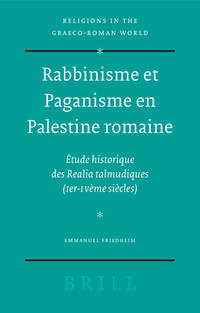
20061425Brill Academic Publishers. 2006. Hardcover. Fine in Fine dust jacket. New in plastic wrapping; Religions in the Graeco-Roman World 157; 9 x 2.5 x 5 Inches; 447 pages; This study deals essentially with the knowledge of the Palestinian Rabbis concerning paganism in the days of Mishna and Talmud. The Late Professor Saul Lieberman wrote that "Many isolated items on idolatry and idol worshippers are scattered all over rabbinic literature. It would require a large volume to treat this topic". This valuable and exhaustive study proves methodically that the Rabbis had deeper knowledge about Syrian Arabian Anatolian and Graeco-Roman Pagan cults than is commonly believed. Clear accessible and displaying considerable scholarship this work will undoubtedly provide an important challenge to both historians archaeologists and scholars of Rabbinic texts. Cette étude traite essentiellement du niveau de connaissances des Rabbins de Judée et de Galilée concernant les cultes païens dans le sens le plus large du terme. Le Professeur Saul Lieberman affirmait : "Many isolated items on idolatry and idol worshippers are scattered all over rabbinic literature. It would require a large volume to treat this topic" Ce travail exhaustif à travers l’ensemble du corpus talmudique et au regard de la réalité historique propre à la Palestine romaine montre méthodiquement que les connaissances des Sages tant sur les divinités du paganisme que sur des rites syriens arabes anatoliens voire gréco-romains étaient bien plus vastes et approfondies que ce qu’il est communément admis aujourd’hui par la recherche historique. De part sa clareté et son accessibilité ce livre intéressera aussi bien les historiens du peuple juif que ceux des religions antiques. Les archéologues les historiens du Levant à l’époque romaine ainsi que les spécialistes de la littérature talmudique y trouveront également un vif intérêt en vertu de son aspect extrêmement novateur. . 9004146431 . Brill Academic Publishers hardcover
2026x-1032713240Taylor & Francis Ltd 2026. Paperback. New. 198 pages. 6.14x0.42x9.21 inches. Taylor & Francis Ltd paperback