65 résultats
187859791Paris Rome & Vienna: E. Neurdein; G. Castelli Via Condotti 30; C. Decoix; Fotografia Falcetti e Ci.; Maison Giacomo Brogi; Oscar Kramer Photograhie ca. 1878. Thirty-one albumen cabinet photographs most approx. 4 x 6 in. mounted on 4.25 x 6.5 in. studio boards a couple colour-tinted on verso 23 for Paris & Versailles nearly all featuring manuscript ink annotations on verso both Fannie & C.P. Bishop; 8 for Italy & Austria featuring photographer’s imprints at lower fore-edges and a few on verso minor edgewear dustsoiling slight curving still VG collection of images from the library of Fannie Kay Thomas Bishop 1857-1944 and Charles Pleasant Bishop 1854-1941 founding owners of the Pendleton Woolen Mills. Twenty-three of these Grand Tour souvenir albumen cabinet card photos depict many of the popular sights in Paris during the opening decade of the Belle Epoque. These include the “Colonne de Juillet†commemorating the 1830 Revolution; the Palais de l’Industrie erected for the 1855 Exposition Universelle on the Champs-Elysees designed by Jean-Marie-Victor Viel & Alexis Berrault later demolished for the 1900 Paris World’s Fair; the Palace of Versailles fountain of Apollo; the “Grandes Eux de Versailles;†the famed Vendome Column torn down in 1871 by the Paris Commune but then re-erected by 1874; view of the Louvre from across the Seine; the Arc de Triomphe and others. The remaining 8 albumen photos include three Castelli souvenir shots of the Colosseum Trajan’s Column and the Vatican Library interior while a shot by Brogi captures the basilica and tower in Pisa. Oscar Kramer fl. 1860-1880 produced the two photographs from Vienna of the statue of Emperor Josef II and the Royal Opera House bearing the overlaid corrected address for Graben No. 7 where he moved after 1870. E. Neurdein; G. Castelli, Via Condotti 30; C. Decoix; Fotografia Falcetti e Ci.; Maison Giacomo Brogi; Oscar Kramer, Photograhie hardcover
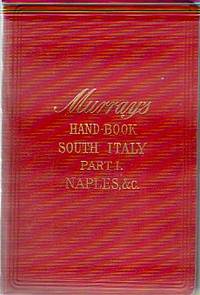
186821107London: John Murray. 1868. Sixth Edition. Hardcover. Very Good. Vellum boards with gilt spine decoration and red spine label with gilt lettering. Steel-engraved large front map. Steel-engraved plan of Naples Environs of Naples and fold-out of Pompeii. Lister 205; 16mo 6" - 7" tall; xlv 470 pages . John Murray hardcover
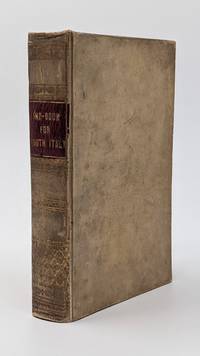
189212320London: John Murray. 1892. Ninth Edition. Hardcover. Very Good. Wear to extremities and slight dampstaining to volume one; Comprising the description of Naples and its environs Pompeii Herculaneum Vesuvius Sorrento; The Islands of Capri and Ischia; Amalfi Paestum and Capua The Abruzzi and Calabria; Palermo Girgenti The Greek Temples and Messina. Part II Comprising the descriptions of: Palermo Girgenti The Greek Temples Syracuse Catania Messina and the Lipari Islands. Including bound-in slip: "Information about hotels etc. Will be found in the index and directory at the end of the book." Decorative bookplate; 16mo 6" - 7" tall; 41821481152 pages . John Murray hardcover
1861biblio69<p>Elegant collectible copy of an early English edition of Sentimental Journey with a Frontispiece Portrait of the author with tissue guard intact. First published in 1768 this autobiographical work established travel writing as a popular genre in the latter half of the 18th century. Gilt title on spine. Blue cloth over blue and white mottled boards. No wear to corners. Slight bumping to spine. Binding tight. </p> BERNHARD TAUCHNITZ hardcover
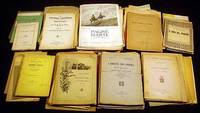
184035561Various. Good with no dust jacket. 1840-1930. Pamphlet. About 80 Items in this large collection of antique Italian ephemera range from the mid-19th century into the 1920s. Included are some academic and scholarly papers many memorial recollections and some material on the arts. Topics range from literature history and philosophy to medicine and geology including an 1886 paper monitoring volcanism in Italy. Numerous prominent people of the period are remembered in obituary pamphlets. Range from Fair to Very Good but generally most are Good. About 15 pounds. . Various unknown
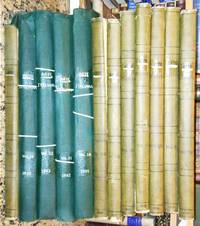
18991511030139Milano : Ulrico Hoepli; Instituto Italiano d'Arti Grafiche 1899-01-01. Hardcover. Acceptable. 12 volumes. Contains: vols. 8-19. Folios. Publisher's boards with later spines. Hardcover. 4 volumes with portfolio style binding. 8 volumes in full buckram. Soiling to covers. Some wear gash in cover edge where twine was too tightly bound in the portfolio volumes. Library stamps and markings. Primarily illustrated. Lovely color chromolithographic plates. An important periodical of decorative art in folio format; first published in 1890. <br> Milano : Ulrico Hoepli; Instituto Italiano d'Arti Grafiche hardcover
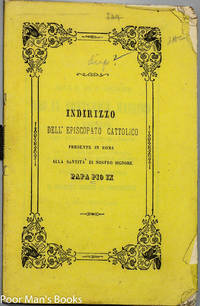
185734801Rome Italy: Il Solenne Giorno Di Pentecoste. Very Good with no dust jacket. 1857. Pamphlet. B&W Illustrations; 7.125"; 24 pages; No copies located. Some wear to yellow cover sound and complete. Picture on back . From the turbulent period of the Risorgimento when the different states on the peninsula were struggling to unite into a single country while many Papal States resisted. May offer valuable insight into a critical historical era . Il Solenne Giorno Di Pentecoste unknown
1877750406New York: Claxton Remsen & Haffelfinger 1877. 1st Edition. Hardcover. Very Good/None. 188 pages. Hardcover. Purple cloth boards with gilt titles to spine gilt & black printed decoration to cover. Light foxing to endpapers toning throughout. Sunfading to cover edges & spine. Illustrations in bw. Frontis illustration protected by tissue guard. Clean unmarked copy. Record # 750406 Claxton, Remsen & Haffelfinger hardcover
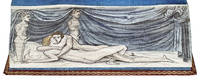
1820TK0306Parma:: Dalla Duclae Tipografia 1820. 1820. 8vo. iv III 1 312 pp. Original full dark red richly gilt-stamped calf all edges gilt blue silk endleaves; rubbed. Very good. With a modern erotic fore-edge painting applied to these civil codes of Parma civil penal code somewhat a sound-alike for 'penis'. This fore-edge painting supports two nude male statues each with matching erect penises two either side of a lover's mattress both in a naked embrace. While it is possible to think this is a homosexual scene if maybe also a heterosexual one – just that it is not painted in quite an identifiable way. Perhaps as the artist intended. Perhaps a hidden joke is the 'penal code' aspect of this text the Romanesque style of the painting would further support the homosexual display a known Roman relationship. c340/113 Dalla Duclae Tipografia, 1820. unknown
1898BOOKS074913INew York: The Macmillan Company 1898. HC. good green cloth hardcover fading to spine owner inscription. 336pp 341pp. The Macmillan Company unknown
18864464S. Hirzel. 1886. Second Edition. Hardcover. Very Good. Half leather spine over cloth boards. Leather is slightly worn at spine ends. Worn corners. Former owner's name stamped on ffep. Former owner's name on titlepage. Light foxing to ffeps. Very mild tanning to pages.; Handbuch Der Römischen Alterthümer Von Joachim Marquardt Und Theodor Mommsen; 887 pages . S. Hirzel hardcover
18829161Druck Und Verlag Von Carl Gerold's Sohn. 1882. First Edition. Hardcover. Very Good in No Dust Jacket dust jacket. Appears to have been rebound in black boards with gilt lettering to spine. Light rubbing to boards. Light sunning to spine. Scholar's name to ffep E. Badian.; 2 maps at back / Mit zwei Karten.; Abhandlungen Des Archäologisch-Epigraphischen Seminares Der Universität Wien; Heft 3; 214 pages . Druck Und Verlag Von Carl Gerold's Sohn hardcover
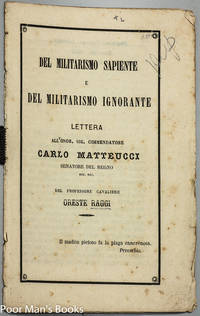
186634803Milano: Tipi Della Gazzetta Di Milano. Very Good with no dust jacket. 1866. Pamphlet. 6.625"; 22 pages; Italy -- History Military. Italy -- History -- 1815-1870. From the turbulent period of the Risorgimento when the different states on the peninsula were struggling both militarily and politically to unite into a single country while many of the Papal States were resisting. May offer valuable insight into a critical historical era. Located but one copy in Zurich OCLC Number: 637294026 . Tipi Della Gazzetta Di Milano, unknown
1894058395New York: Sampson Low Marston & Company 1894. 2nd Edition . Hardcover. Near Fine. Frontispiece. Xxiv 196 Pp 3 Pp Ads. Green Cloth Gilt Black Endpapers 18940 Date On Title Page. Second Edition Stated. Slight Wear All Gilt Brilliant Cloth Evenly Colored As Issued. Previous Owner's Signature On Front Pastedown And Another On Verso Of Front Free Endpaper. Per Wikipedia Paolo Sarpi O.S.M. 1552 - 1623 Was An Italian Servite Friar And Catholic Priest Who Was A Notable Historian Scientist Canon Lawyer Polymath And Statesman Active On Behalf Of The Venetian Republic During The Period Of Its Successful Defiance Of The Papal Interdict 1605-1607 And Its War 1615-1617 With Austria Over The Uskok Pirates. His Writings Frankly Polemical And Highly Critical Of The Catholic Church And Its Scholastic Tradition "Inspired Both Hobbes And Edward Gibbon In Their Own Historical Debunkings Of Priestcraft." Sarpi's Major Work The History Of The Council Of Trent 1619 Was Published In London In 1619; Other Works: A History Of Ecclesiastical Benefices History Of The Interdict And His Supplement To The History Of The Uskoks Appeared Posthumously. Organized Around Single Topics They Are Early Examples Of The Genre Of The Historical Monograph. As A Defender Of The Liberties Of Republican Venice And Proponent Of The Separation Of Church And State Sarpi Attained Fame As A Hero Of Republicanism And Free Thought And Possible Crypto Protestant.4 His Last Words "Esto Perpetua" "May She I.E. The Republic Live Forever" Were Recalled By John Adams In 1820 In A Letter To Thomas Jefferson When Adams "Wished 'As Devoutly As Father Paul For The Preservation Of Our Vast American Empire And Our Free Institutions' As Sarpi Had Wished For The Preservation Of Venice And Its Institutions." Sarpi Was Also An Experimental Scientist A Proponent Of The Copernican System A Friend And Patron Of Galileo Galilei And A Keen Follower Of The Latest Research On Anatomy Astronomy And Ballistics At The University Of Padua. His Extensive Network Of Correspondents Included Francis Bacon And William Harvey. Sarpi Believed That Government Institutions Should Rescind Their Censorship Of The Avvisi-The Newsletters That Started To Be Common In His Time-And Instead Of Censorship Publish Their Own Versions Of The News To Counter Enemy Publications. In That Spirit Sarpi Himself Published Several Pamphlets In Defence Of Venice's Rights Over The Adriatic. As Such Sarpi Could Be Considered As An Early Advocate Of The Freedom Of The Press Though The Concept Did Not Yet Exist In His Lifetime. On 5 October 1607 Sarpi Was Attacked By Assassins And Left For Dead With Three Stiletto Thrusts But He Recovered. His Attackers Found Both Refuge And A Welcome Reception In The Papal Territories Described By A Contemporary As A "Triumphal March" And Papal Enthusiasm For The Assassins Cooled Only After Learning That Brother Sarpi Was Not Dead After All. Sarpi Wrote Notes On François Viète Which Established His Proficiency In Mathematics And A Metaphysical Treatise Now Lost Which Is Said To Have Anticipated The Ideas Of John Locke. His Anatomical Pursuits Probably Date From An Earlier Period. They Illustrate His Versatility And Thirst For Knowledge But Are Otherwise Not Significant. His Claim To Have Anticipated William Harvey's Discovery Rests On No Better Authority Than A Memorandum Probably Copied From Andreas Caesalpinus Or Harvey Himself With Whom As Well As With Francis Bacon And William Gilbert Sarpi Corresponded. The Only Physiological Discovery Which Can Be Safely Attributed To Him Is That Of The Contractility Of The Iris. Sarpi Wrote On Projectile Motion In The Period 1578-84 In The Tradition Of Niccolò Fontana Tartaglia; And Then Again In Reporting On Guidobaldo Del Monte's Ideas In 1592 Possibly By Then Having Met Galileo Galilei. Galileo Corresponded With Him. Sarpi Heard Of The Telescope In November 1608 Perhaps Before Galileo. Details Then Came To Sarpi From Giacomo Badoer In Paris In A Letter Describing The Configuration Of Lenses. <br/> <br/> Sampson Low, Marston & Company hardcover
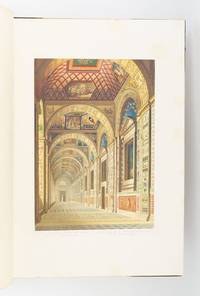
1854ST19418London: Thomas McLean 1854. New Edition "largely augmented by numerous plates plain and colored. 578 x 406 mm. 22 3/4 x 16". 4 p.l. comprising an engraved title page printed dedication preface and list of plates; xvi 76 pp. all of the text in the second work inlaid to size. Two related works a large folio plate volume and a quarto text volume bound in one volume. <br/> Decorative contemporary dark brown half morocco marbled paper sides broad decorated raised bands spine elaborately gilt in compartments featuring a very large and complex lozenge composed of antique tools as well as large scrolling cornerpieces marbled endpapers all edges gilt joints possibly but not certainly with very expert repairs. First work with illustrated title page and 56 LARGE-FOLIO PLATES NINE OF THEM ATTRACTIVE CHROMOLITHOGRAPHS original tissue guards. Avery Architectural Library p. 414 citing the edition of 1844. Corners and portions of the board rather rubbed and chafed some occasional light foxing and other trivial imperfections internally but still quite an attractive copy the text and plates clean and pleasing the binding completely solid with joints only slightly worn and the spine quite well preserved.<br/> <br/> This volume combines a visual survey of major decorative art of the Italian Renaissance with a scholarly account of the same the latter text published in quarto and here inlaid to the giant folio size of the plate volume. The plates picture some of the best wall decorations and architectural elements of palaces and churches constructed in Italy in the 15th and 16th centuries. Works of Raphael in Rome are featured here in particular the decoration of the loggias of the papal apartments at the Vatican and of the Villa Madama. The three chromolithographs of the loggias are little short of magnificent. Also included are the wall treatments of the Ducal Palace and Palazzo Te both in Mantua by Raphael’s pupil the mannerist painter Giulio Romano. Among churches pride of place is given to the elaborately decorated Carthusian monastery the Certosa of Pavia by Ambrogio da Fassano and others. The plates are for the most part adapted from the work of two German architects Thürmer and Gutensohn executed two decades previously and completed and explicated by Gruner. The final two plates display in brilliant color many small sections of the previous black and white plates the idea being that purchasers should try their hands at coloring using this elaborate and colorful chart as a guide an early owner seems to have made a tentative effort in that direction with some success in plates 20 and 44. Wilhelm Heinrich Ludwig Gruner 1801-81 was an art historian specializing in the Italian Renaissance and a designer of great houses gardens and furniture who came to England to advise Prince Albert the German consort of Queen Victoria on his decorative projects. The second part of the present volume contains an essay comparing Roman and Renaissance wall painting. Its author called J. J. Hittorff on the title page was Jacques Ignace Hittorff 1792-1867 an architect and archaeologist and the first person to argue that ancient statuary had been brightly colored. Thomas McLean unknown
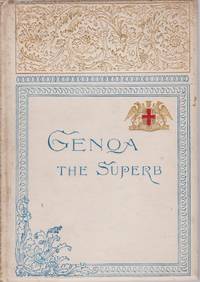
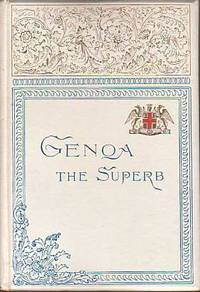
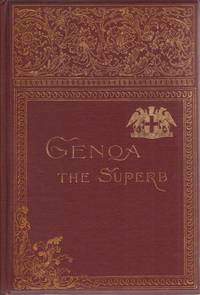
189220558Boston: Estes & Lauriat. 1892. Hardcover. Very Good. Boards with light rubbing to extremities. Back boards with very light soiling. A few pages unopened. ; Top edge gilt. Decorative boards. Numerous tissue guarded illustrations from photographs. ; 8vo 8" - 9" tall; 298 pages . Estes & Lauriat hardcover
18921881Boston: Estes & Lauriat. 1892. Hardcover. Very Good in Very Good dust jacket. Some minor rubbing to DJ. Former owner's name to front free endpaper; Top edge gilt. Decorative boards. Numerous tissue guarded plates from b&w illustrations; 8vo 8" - 9" tall; 298 pages . Estes & Lauriat hardcover
18925752Boston: Estes & Lauriat. 1892. Hardcover. Very Good in Very Good dust jacket. DJ lightly rubbed and darkened. Endpapers a bit browned; Top edge gilt. Decorative boards. Numerous tissue guarded plates from b&w illustrations. A "superb" gift ; 8vo 8" - 9" tall; 298 pages . Estes & Lauriat hardcover
1839052209London: William S. Orr & Co. 1839. 1st Edition 1st Printing. Hardcover. Very Good. Xxiii 356 Pp. First Printing 1839. Full Morocco Gilt And Stamped In Blind Yellow Endpapers All Edges Gilt. Plates Tissue Guards With Subject Titles. Slight Usage Tiny Repairs To Corners Furbished. Captions Printed On The Tissue Guards. Binding Is Early Or Original Wear But Nicely Refurbished New Morocco Spine Label Hinges Intact And Solid. Contents Very Clean Light Foxing To A Few Plates But Almost All Are Entirely Clean And With Clean Intact Tissue Guards. Wordsworth Was The Youngest Son Of The Rev. Dr. Christopher Wordsworth Master Of Trinity And A Nephew Of The Poet William Wordsworth. He Was The Younger Brother Of The Classical Scholar John Wordsworth And Charles Wordsworth Bishop Of Saint Andrews Dunkeld And Dunblane. He Was Educated At Winchester And Trinity Cambridge. Like His Brother Charles He Was Distinguished As An Athlete As Well As For Scholarship. He Won The Chancellor's Gold Medal For Poetry In 1827 And 1828. He Became Senior Classic And Was Elected A Fellow And Tutor Of Trinity In 1830; Shortly Afterwards He Took Holy Orders. He Went For A Tour In Greece In 1832-1833 And Published Various Works On Its Topography And Archaeology The Most Famous Of Which Is "Wordsworth's" Greece 1839. In 1836 He Became Public Orator At Cambridge And In The Same Year Was Appointed Headmaster Of Harrow A Post He Resigned In 1844. In 1844 Sir Robert Peel Appointed Him As A Canon Of Westminster 1844-1869. He Was Vicar Of Stanford In The Vale Berkshire 1850-1869 And Archdeacon Of Westminster 1864-1869. In 1869 Benjamin Disraeli Appointed Him Bishop Of Lincoln Which He Retained Until His Death In 1885. <br/> <br/> William S. Orr & Co. hardcover
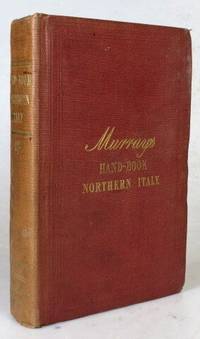
186051887London: John Murray 1860. Eighth edition small 8vo xxxiv ii 556 pp. 21 plans several folding plus a folding map in a pocket at the end small private ink accession label to the corner of the paste down. Original gilt titled cloth spine sunned otherwise an attractive and well preserved copy. London: John Murray unknown
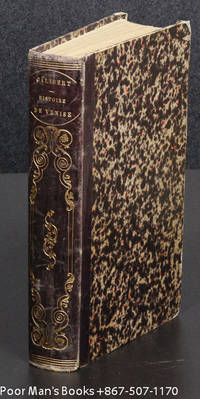
184732583Paris: Furne Et C. Ie. Very Good with no dust jacket. 1847. Nouvelle. Hardcover. French Language; Italy Venice; royal 8 vo; Plates and textural illustrations. Foldout frontis. Very occasional minor foxing. Contents generally VG. With plates. 1/2 calf leather over marbled boards. . Furne Et C. Ie, hardcover
18654702Henri Plon. 1865-6. Hardcover. Very Good. Mild foxing to textblocks. Black boards with red leather spines. Spines have scratches and there is wear to spine ends with slight fraying.; 2 Volume Set. COMPLETE . Henri Plon hardcover
18837708B. G. Teubner. 1883. Hardcover. Very Good. Minor shelfwear. Former owner's name to inner cover in pencil. Light browning to endpapers.; Bibliotheca Scriptorum Graecorum Et Romanorum Teubneriana TEUBNER; 12mo 7" - 7½" tall; 428 pages . B. G. Teubner hardcover
1893194London: Henry and Co. . 1893. First Edition. Hardcover. Very Good-. Mild burn mark on top edge of volume II. Moderate rubbing to boards and spine ends with light chips. Outer hinge covering weak. Boards with extremely light bubbling. Endpapers with light foxing. Former owner's name on front free endpaper. A bit of play to the hinges. ; Large limited edition of 165 copies this one not numbered. Casada 88 ; 8vo 8" - 9" tall; 562 pages . Henry and Co. hardcover
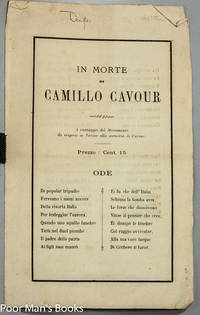
186134802Paris: Augros. Very Good with no dust jacket. 1861. Leaflet. 8.5 X 10.5; 3 pages; A single folded leaf with 3 pages of printing. Leaflet. Small dog ear. From the turbulent period of the Risorgimento when the different states on the peninsula were struggling to unite into a single country while many of the Papal States were resisting. May offer valuable insight into a critical historical era. 21 cm. OCLC Number: 797438302. Single copy located. . Augros, unknown