ARDENE, Jean Paul de Rome d'.Biblio.com
27 résultats
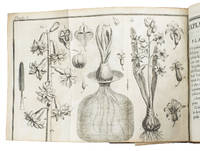
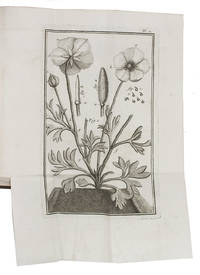
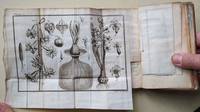
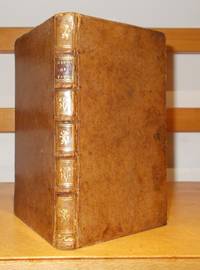
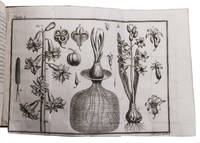
1759K7AA589DB8GQAvignon 1759. 12mo. Louis Chambeau Contemporary calf gold-tooled spine marbled endpapers red edges. With 2 engraved folding plates. 156 pp. First edition of a book on hyacinths printed in 1759 by the French priest and botanist Jean Paul Rome dArdène. "Jean Paul Rome d' Ardène retired about 1750 from his duties as 'supérieur' of the college at Marseilles to the Château d' Ardène diocese of Sisteron where he created a botanical garden and gave himself to the study of flowers" Hunt. DArdène is famous because of his studies on flowers. In 1746 he had already published a book on ranuncula titled Traité des renoncules. It went through 3 further editions in French and 1 in German so it apparently proved popular. After this work DArdène wrote the present book on hyacinths. Its 12 chapters discuss different aspects of hyacinths including the etymology of the name the right conditions for cultivating the flower and its common diseases. The book ends with two engraved folding plates with hyacinths followed by an explanation of what we can see on those plates. The book was reprinted in French in 1765 and an Italian translation of this hyacinth study was printed in Viterbo Italy in 1763. After this book DArdène also wrote books on tulips 1760 and carnations 1762. The present first edition of the Traité sur la connoissance et la culture des jacintes seems to be very rare: the botanical literature mentions it only in the catalogue of the Lindley Library and a note in Hunt. Nissen and BMC NH note only the Traité des renoncules and Hunt describes only that book. We know only other copies of the present first edition: in the Lindley library the Bibliothèque Municipale de Lyon and the Bibliothèque Nationale de France. In very good condition.l Cat. Lindley libr. p. 10; Hunt II 526 note; WorldCat 2 copies; cf. BMC NH I p. 58; Nissen BBI S. 5 45na. unknown
1765L3IEIGJIR4NJ1765. 252 4; 156 pp. Convolute containing the rare second editions of two botanical books one on tulips and the other on hyacinths written by the French priest and botanist Jean Paul Rome dArdène 1689-1769 famous for his studies of flowers which demonstrate his vast erudition as well as providing practical advice. His work is therefore full of information addressed not only to florists and gardeners but to scientists flower lovers and cultivated persons generally and infused with the authors profound love for his subject Oak Spring Flora. The same printer-publisher published the first editions in 1760 and 1759 respectively.Ad 1: Traité des tulipes is an extensive work exclusively devoted to tulips discussing their origin name different varieties cultivation and beauty in 12 chapters. It ends with two folding plates illustrating tulips with an explanation for each plate.Ad 2: Traité sur la connoissance et la culture des jacintes similarly discusses .different aspects of the hyacinth once again in twelve chapters. It covers etymology the right conditions for cultivation and common diseases that affect hyacinths. Like the tulips it ends with two folding plates illustrating hyacinths with an explanation for each plate. It was translated into Italian in 1763. Both first editions are very rare: WorldCat records two copies of each but also only three and four copies of the present second editions of 1765.With a small crease in the first folding engraved plate of Traité des tulipes and a small tear in one text leaf but overall in very good condition.l Ad 1: Hunt 587; Oak Spring flora 76 note p. 294; WorldCat 3 copies; cf. Cat. Lindley libr. p. 10 1760 ed. Ad 2: Oak Spring flora 76 note p. 294; WorldCat 4 copies; cf. Cat. Lindley libr. p. 10 1759 ed.; Hunt 526 note 1759 ed.; neither in: BMC NH; Nissen BBI; Bradley. unknown
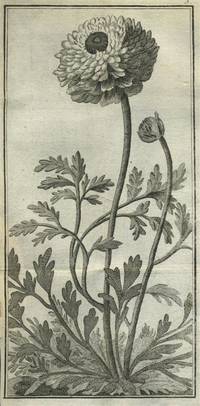
1763K7AAI1IR0DS2Avignon 1763. 12mo. Louis Chambeau Contemporary mottled calf richly gold-tooled spine. With 6 folding engraved plates. 6 16 342 pp. Third and last edition of a manual on ranunculi by the French priest and botanist Jean Paul Rome d'Ardène 1689-1769. "Ardène retired about 1750 from his duties as sepérieur of the college at Marseilles to the Château d' Ardène diocese of Sisteron where he created a botanical garden and gave himself to the study of flowers" Hunt.Ranunculus is a genus of toxic flowering plants including buttercups spearworts and water crowfoots. It is divided into two parts. The first pp. 1-30 deals with the history of ranunculi how they got their name and where they originated and gives a description of the physical appearance of the plant. The second part pp. 31-336 deals in great depth with its cultivation commenting on the perfect soil how and when to water them and place them in sunlight how to get rid of aphids and plant diseases etc. followed by descriptions of the plates. A very good copy binding rubbed at the foot.l Nissen BBI supplement 45na; cf. Cat. Lindley libr. p. 10 1st ed.; Hunt 526 1st d. unknown
1759021234Avignon: Louis Chambeau 1759. Small 12mo measures 153mm x 92mm pp 156 a little browned and age-toned but very sound internally two folding engraved plates a little frayed and creased at the margins and again age-toned full contemporary calf worn at corners the spine dull joints a bit worn but still very sound. A delightful provenance - with the bookplate of C. Harman Payne author of The Florist's Bibliography. This is the only book I have seen from what must have been a notable library. Also with the bookplate of the naturalist Edward Heron-Allen. The plates are great fun showing florists' tools as well as hyacinths a bulb vase and something which looks more like a crocus planter. "Jean Paul Rome d' Ardène retired about 1750 from his duties as 'supérieur' of the college at Marseilles to the Château d' Ardène diocese of Sisteron where he created a botanical garden and gave himself to the study of flowers" - Hunt Catalogue. D'Ardene wrote similar works dealing with Ranunculus Tulips and Carnations It is interesting that Hunt had copies of those three but only mention this work in passing - they did not have a copy. Indeed it seems extremely rare - I can only trace three copies two in WorldCat and the Lindley Library copy. First Edition. Full Leather. Good. Louis Chambeau Hardcover
175426004AB1754. Nürnberg Raspe 1754. Gestochenes Frontispiz 6 gefaltete Kupfertafeln 7 Bl. 460 S. 10 Bl. Dekorativer Halblederband im Stil der Zeit mit dezenter Rückenvergoldung. Erste deutsche Ausgabe. - Nissen BBI Suppl. 45nb; Dochnahl 8. - Interessante Monographie über Geschichte und Zucht der Ranunkeln. Fünf der hübschen Tafeln mit Blüten- und Pflanzendarstellungen. - Sehr gut erhaltenes Exemplar. unknown
1723214670London: Printed for Abel Roper 1723. First edition. 6 352 31 pp. 1 vols. 8vo. Original full calf. Spine label intact upper hinge and joint roughly repaired rear hinge and joint cracked. Internally Fine. First edition. 6 352 31 pp. 1 vols. 8vo. Printed for Abel Roper unknown
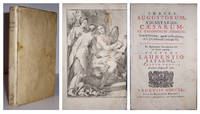
1740000157Venice: Jo. Baptistam Recurti 1740. Hardcover. See Description. Third Edition. 8vo. pp. XXXX 246 14. Including engraved frontispiece and numerous numismatic portraits of Roman emperors with the text. Title printed in red and black. Bound in contemporary full vellum. A couple of very faint library stamps in the bottom and outer title margins. Pages are generally clean with occasional mild spots of soiling. Small area of staining on the frontispiece. Name and date or shelf number printed in an old hand on front paste-down. Patarol's History of Roman Byzantine and Holy Roman Emperors from Julius Caesar to Carolus VI. Text in Latin. Lipsius II p. 307; Cicognara 2961 - lists the first edition of 1702. <br/> <br/> Jo. Baptistam Recurti hardcover
18004585<p>Single broadsheet 60 x 44.5 cm folded. A very good copy.<br /></p><p>A rare survival of such an ephemeral piece unrecorded on ICCU: a large broadside issued during the nine-month occupation of Rome following the fall of the Roman Republic and proclaiming a complete revision of the running of the city's public market to prevent "hoarders and scalpers" from inflating food prices beyond the means of the "most sensitive" members of the populace during this tumultuous period.</p><p>The edict instructs for example all retailers of vegetables and fruits to arrange contracts exclusively during daylight hours and only under their official banners; any retailers found bringing or intending to bring wholesalers into the marketplace will be considered in contravention of the law. Retailers are also prohibited from forming collective buying groups which lead to 'infamous monopolies'. Further regulations touch on sellers of poultry interactions between retailers and wholesalers and the physical locations of permitted activities. The trades in domestic pigeons and wild game however are exempted from these stringent regulations.<br /><br />The broadsheet also gives details of the enforcement of the new rules. Anyone not complying with the regulations after three days of their posting will suffer the consequences and trials of the accused will take place between 22 and 24 hours and for 1 hour the following morning in the market square itself. The penalties are stiff: for the first offence 25 scudi; for the second 50 scudi and a public beating; while the third warrants a 100 scudi fine and 5 years of public labor. Fines will also be imposed for passing false currency. The edict ends with a stern public hygiene order reminding all retailers of the prohibition of fish-selling in the marketplace. The public is also ordered to make use of the fountains in a civilised manner and not to throw rubbish into the fountain or onto the streets.</p><p>The Piazza Navona became the official market square of Rome in the 15th century and remained so until the 1860s when the site was transferred to the Campo de' Fiori. Produced during a period of tremendous political upheavel the present document provides us with a surprisingly intimate insight into the problems of running such an enormous concern. As the broadside notes the Papal Government had formerly been responsible for the orderly running of the marketplace but in 1798 the short-lived Roman Republic based upon the principles of the French Revolution had seized power and exiled the Pope. According to the document many "abuses" were committed during the "so-called" Republican tenure and indeed the "greed and malice of those who have been able to evade the rules" has led to the need for tighter regulation. Today it complains many dealers hoard more than they sell rendering public markets 'inutili' and driving food prices far higher than they should be in turn affecting the "most sensitive" segment of the population. The present edict was issued under the authority of His Excellency Diego Naselli a Neapolitan commander whose troops had invaded the Republic in September 1799. However by July 3rd seven months after the edict's publication the city was returned to the authority of the Pope.</p><p> Unrecorded in ICCU or OCLC.</p> Lazzarini
175446429London: Printed for W. Innys J. and P. Knapton S. Birt et al. 1754. Very Good. London: Printed for W. Innys J. and P. Knapton S. Birt et al. 1754. Twelfth Edition Corrected and Improved. Octavo; bound in modern quarter calf with five raised bands and gitl stamping to spine; new endpapers; 16; xxx; 375; 26 appendices collated and complete. 14 plates 8 of which are folding includes frontispiece. Light wear and some light spotting to boards; binding sound; tear to top edge of front free endpaper; shorter tear and light wear along top of frontis page; pages age-toned else unmarked; a Very Good copy of Kennett's impressive work on Ancient Rome which remained popular and in print for decades after its original publication in 1696. Printed for W. Innys, J. and P. Knapton, S. Birt et al. unknown
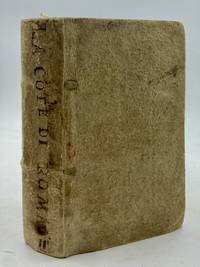
170214415Venezia: Antonio Bortoli 1702. Buon esemplare in barbe e nell’originale cartonatura rustica; carta di guardia posteriore con lacuna ritagliata la porzione superiore per un’altezza di circa tre centimetri e annotazione antica sulla collezione di stampe del Vaticano. Legatura coeva d’attesa con titolo manoscritto sul dorso in dodicesimo cm 16.5 x 10 pp 260 106 184 16. Buon esemplare in barbe e nell’originale cartonatura rustica; carta di guardia posteriore con lacuna ritagliata la porzione superiore per un’altezza di circa tre centimetri e annotazione antica sulla collezione di stampe del Vaticano. Grazioso «omnibus» d’inizio Settecento che racchiude in un’unico agile volumetto alcuni best seller dell’editoria dedicata alla Città Eterna del Secolo XVII. Il primo dei trattati raccolti è la «Relatione della Corte di Roma» redatta da Girolamo Lunadoro per incarico di Cristina di Lorena la quale voleva fornire una valida istruzione al figlio Carlo de’ Medici destinato al cardinalato. L’opera «fornisce un quadro dettagliato dell'organizzazione della corte pontificia delle gerarchie delle mansioni di ciascun funzionario di governo dei riti delle cerimonie e delle forme da rispettare in ogni situazione» e fu «considerata a lungo il manuale del cerimoniale pontificio» Crucitti DBI conoscendo numerose ristampe fino all’Ottocento. Il lavoro ebbe inizialmente circolazione manoscritta e nel 1621 Francesco Sestini ne rielaborò i materiali al limite del plagio pubblicando a proprio nome «Il Maestro di Camera»; solo nel 1635 Romolo Lunadoro nipote dell’autore ne fece stampare una versione integrale finalmente attribuita all’antenato. Il trattatello di Sestini ebbe comunque fortuna propria e occupa la parte centrale del volume qui proposto. Terzo e conclusivo trattato è «Roma ricercata nel suo sito» l’opera più nota di Fioravante Martinelli inizialmente apparsa nel 1644 e poi rielaborata dall’autore fino al 1658. La guida si distinse dalle precedenti enumerazioni dei monumenti di Roma per l’agilità del testo e l’innovativa struttura in dieci giornate di visita; rivolta «Al Lettore Forestiero» Roma ricercata conobbe un’immediata e duratura fortuna editoriale ed ebbe un’enorme rilevanza nella costruzione dell’immagine della città per il pubblico europeo dalla metà del Seicento e per tutto il periodo del Grand Tour. I tre testi vennero proposti per la prima volta in un unico volume da Paolo Fambrotto Padova 1650 e da allora più volte presso diversi editori sempre in economici piccoli formati e con dettagliati indici costituendo una sorta di enciclopedia pratica della città rivolta a quanti per i più svariati motivi dovessero orientarsi rapidamente tanto tra i monumenti quanto nell’amministrazione e nel cerimoniale dell’urbe. Fossati Bellani I 724; Melzi III p. 60 per edizione precedente nota il plagio «vendicato da Romolo Lunadori»; Vinciana 965; Olschki 17441; Rossetti 6360; Fogelberg Rota Rome and the guidebook tradition p. 163: «Its importance with regard to how Rome was presented to foreign travellers throughout the seventeenth and eighteenth centuries can therefore hardly be overestimated.». Antonio Bortoli unknown
1747015985Paris: Ph.N.Lottin & J.H.Butard 1747. With ink inscription "Ex dono authoris. Book measures 17x10.cm. viii188pp. Bound in full period mottled calf spine gilt in compartments with alternating lions and flowers and red morocco label full red edges marble endpapers. Calf lightly rubbed minor abrasion wear. Binding in very good clean condition. Internally minor light browning. Pages in good clean condition. A very nice copy. Presentation copy of a scarce book of fables by a poet from Marseilles. Housed in a modern cloth drop-back box.F. First Edition. Full Calf. Very Good. Small 8 Vo. Ph.N.Lottin & J.H.Butard Hardcover
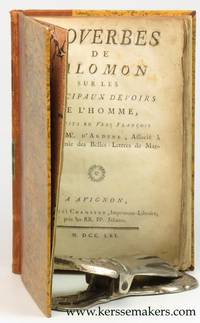
176140467Avignon: Louis Chambeau 1761. Small 8vo 18x125 cm. 20th century halfcalf spine gilt with red and green morocco labels marbled endpapers. The original blind wrappers preserved inner margin first and last leaf renewed. xx120 ii: blank pp. a few leaves incl. title soiled. Bound with new endpapers by Robert Stevens at Brussels. Nice poetry: Each line of the proverbs in Latin accompanied with a quatrain in French by he theologian d'Ardene Mane Provence 1690-1769 who became also a well-known botanist. Louis Chambeau unknown
1781DEMO016042IParis: Chez le Veuve Duchesne 1781. New Enlarged edition. 16mos. Good. 16mos contemporary full calf hinges repaired; x-library with stamps; bookplate of Charles Bevan. <br/><br/>Curne de Saint-Palaye has been acclaimed "the most influential of the enlightenment Medievalists". This standard work this classic on chivalry first appeared in 1759. Chez le Veuve Duchesne unknown
1766565Paris: Lacombe 1766. Soft cover. Good. 8vo - over 7¾ - 9¾" tall. 8vo. 19 x 10 cm 58 pp. including title-page first leaf blank. Bound in red marbled wrappers. Title toned and a bit soiled with two small ink-spots not affecting text toning in the margins of some leaves; nevertheless generally good with some leaves uncut and with original deckle edges. Very rare first and sole edition of the first treatise published by the pioneering French mineralogist Jean-Baptiste Romé de L'Isle 1736-1780 and his sole work on marine biology concerning the "movement generation and nature" of the freshwater polyp. In the present work Romé hypothesizes drawing on observations by the naturalist "M. Bazin" that polyps are a kind of living hive built of thousands of tiny separate units 'petits grains' that nonetheless work harmoniously to feed move and regenerate the entire body. Though Romé's hypothesis is not entirely off the mark-polyps may reproduce asexually by budding for instance-it was eventually disproven by the observations of the naturalist Justin Girod-Chantrans 1750-1841.OCLC: No American copies. Lacombe paperback
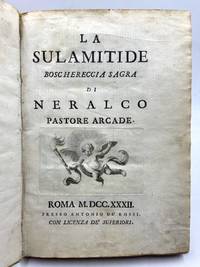
173213875Roma: Presso Antonio de Rossi 1732. Qualche alone e sbavatura sulle prime carte sparsi arrossamenti lievi segni d’uso sulla legatura. Legatura coeva in piena pergamena rigida con titoli dorati entro riquadro sul dorso tagli marezzati in rosso in ottavo cm 22 x 15.5 pp 12 119 1 con fregi capolettera e vignette incise. Qualche alone e sbavatura sulle prime carte peraltro buon esemplare. Edizione originale di questo dramma pastorale in cinque atti del poeta marchigiano Giuseppe Maria Ercolane pastore arcade col nume di Neralco Castrimeniano che nei «calibratissimi» versi della Sulamitide offre uno dei più apprezzati esempi di gusto arcadico settecentesco e di purismo linguistico toscaneggiante che gli valse la citazione nell'edizione del 1786 del Vocabolario della Crusca. La «sagra boschereccia apparsa in un'elegante edizione romana nel 1732 e numerose volte ristampata nel corso del secolo» Miano DBI è ispirata al Cantico dei Cantici e alla vicenda di Sulamitide figlia del re d'Egitto e sposa di Salomone che rifiutata dai Giudei si ritira nei giardini fuori di Gerusalemme conducendo umile vita pastorale prima di essere accolta come regina. Da pagina 87 inizia la Allegoria ed esposizione della Cantica sopra l'assunzione di Maria in cielo in cui l'autore esplicita l'analogia neotestamentaria tra Sulamitide e l'ascensione e incoronazione della Vergine - al culto mariano è peraltro ispirata la maggior parte della produzione poetica dell'autore. La pregevole edizione è ornata di fregi testatine e cul-de-lampe finemente incisi da Jean Charles Allet Parigi 1668 - Roma post 1732 su invenzione di Saverio Scilla Messina 1673 - Roma 1748. Gamba 2228. Presso Antonio de Rossi unknown
177014421Roma: Nella stamperia di Marco Pagliarini 1770. Discreto-buon esemplare privo come altri del ritratto del pontefice all’antiporta per il resto completo seppur legato in ordine non corrispondente all’indice con lievi occasionali arrossamenti; brunito il frontespizio calcografico piccola lacuna difetto di cartiera sul margine interno di quello tipografico. Genuina legatura coeva in cartone con dorso in pergamena rivestito di carta marezzata con titoli manoscritti su tassello cartaceo tagli spruzzati in quarto grande cm 33x23 1 carta di antiporta frontespizio calcografico 4 carte non numerate frontespizio dedica prefazione imprimatur pp I-XXVIII Prospettiva glossario 1 carta non numerata indice pp 1-58 saggio di geometria vita dell’autore prefazione testo dei cinque ordini I-IV tavole geometriche I-XXXXI tavole di ordini 10 tavole veduta di vestibolo con al centro figura di Clemente XIV in trono 9 di prospettive. Oltre le tavole due incisioni nel testo vita e prefazione di Vignola e una sul frontespizio iniziali testatine e finalini xilografici. Segnatura: 1 carta di antiporta 4 a-c4 d1 1 A-G4 H1 55 carte di tavole. Discreto esemplare privo come altri del ritratto del pontefice all’antiporta per il resto completo seppur legato in ordine non corrispondente all’indice con lievi occasionali arrossamenti; brunito il frontespizio calcografico piccola lacuna difetto di cartiera sul margine interno di quello tipografico. Bella edizione settecentesca del più celebre e importante trattato di didattica architettonica italiano apparso per la prima volta nel 1562 e divenuto per semplicità ed efficacia dell’esposizione il manuale per eccellenza sulla materia. I Cinque Ordini di Architettura sono qui accompagnati come in altre edizioni da Le due regole della prospettiva pratica annotate «non coi soliti commentari del P. Danti ma con altri affatto nuovi del P. Gaudio delle Scuole Pie e del sig. Francesco Pannini architetto i quali si sono molto più del p. Danti approssimati al gusto e alle capacità de’ moderni giovani studiosi dell’architetura» Comolli; gli autori aggiungono inoltre una dedicatoria una prefazione la vita del Vignola il Saggio di geometria per introduzione allo studio dell’architettura civile e un interessante seppur sintetico Vocabolario de’ Termini di Architettura. Firmati il frontespizio allegorico e una delle vignette nel testo: «Fran. Smuglewicz Polonus del. - Carolus Antonini sculp.» a quest’ultimo Graesse attribuisce tutte le figure. Fowler p. 301; Graesse VII p. 314; Brunet V 1219 «assez bonnes les éditions de Rome 1732 1765 1770»; Comolli IV p. 109 definisce questa edizione «la migliore di tutte» quelle italiane esaminate; Riccardi I 88 I11 «bellissima edizione». Nella stamperia di Marco Pagliarini unknown
170413275Lione: Anisson Posuel 1704. Difetti sulla legatura fessurate le cerneire sbucciature antica firma sul frontespizio complessivamente ben conservato nonostante gli ovvi segni del tempo. Legatura coeva in piena pelle fessure alle estremità delle cerniere con dorso a cinque nervi arricchito da titoli e fregi dorati in quarto cm 23x16 pp 56 692 ritratto all’antiporta 4 figure silografiche nel testo e una tavola incisa. Difetti sulla legatura fessurate le cerneire sbucciature antica firma sul frontespizio complessivamente ben conservato nonostante gli ovvi segni del tempo. Sesta edizione delle opere del medico dalmata allievo di Malpighi “maestro dei clinici italiani†e convinto fautore della preminenza dell’osservazione e della prassi sulla teoria in medicina. Numerose dettagliate descrizioni di malattie e fenomeni naturali in particolare nei libri del De Praxi Medica e nel trattato De Fibra Motrice et Morbosa prime due parti del volume mostrano le teorie meccaniciste e i metodi di fisiologia sperimentale dell’autore evidenti anche nelle numerose dissertazioni raccolte nella terza parte del volume: De anatome fibrarum de motu muscolorum et de morbis solidorum; De experimentis circa salivam; … circa bilem;… circa sanguinem; interessanti poi la relazione dell’autopsia di Marcello Malpighi i capitoli sul valore terapeutico della musica dell’esercizio fisico della caccia e della dieta pitagorica le lunghe note sul terremoto dell’Aquila del 1703 e il trattato De anatome morsu & effectibus Tarantulae con la celebre tavola che raffigura la tarantola e la carta della Puglia. Wellcome II p. 85 edizioni successive; Garrison-Morton 68; Blake p. 27; la successiva settima edizione in Graesse p. 275 e Brunet c. 610 “ouvrage estiméâ€; Vinciana 1831 in nota a edizione ben più tarda: «citiamo solo l’edizione originale stampata a Lione dall’Anisson nel 1704». Anisson, Posuel unknown
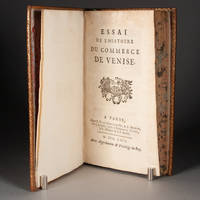
172900518<p>FIRST HISTORY OF VENETIAN TRADE --- xxiv 200 4 p. a8 b4 A-Q8/4 R6 166 x 95 mm --- First and only edition of this history of Venetian trade through 1290 which Barbier attributes to one "Roma"—and which appears to be the first printed survey of Venetian trade altogether. Barbier records the anonymous author's connections in Parisian law and finance but we know little else of him except that he perhaps took his text from a larger three-volume manuscript on the history of business in Italy. ¶ As the history of trade goes few European cities will be as synonymous with the subject as Venice. The Middle Ages saw it become one of the continent's most important ports the vital crossroads of trade between East and West. The author divides his history into three parts: the years 421-697 which he calls the age of the <em>Tribuns</em>; 697-1173 the age of elected doges; and 1173-1290 the age of sovereign doges. He covers the early development of the Rialto Venice's strategic location as a boon for international trade competition in fabric production silk especially—these and many other issues that historians continue to cite in discussions of early Venetian trade. ¶ We fully expected to identify earlier histories of trade in Venice a task we summarily failed at. The author himself complains of "the silence that historians of Venice have kept on this subject" xiij. True enough of the earlier <em>commercio</em> titles in both Cicogna and Soranzo's continuation none could be construed as a comprehensive historical survey of Venetian trade nor have our subject searches in WorldCat turned up anything earlier. Given Venice's tremendously influential role in the history of business the gap this work fills should be an important one. ¶ Hardly a common book and this may be the only copy recorded at auction; it matches the binding description of a copy offered in 2013. --- PROVENANCE: Bookplate removed from the front paste-down and a few efforts at obliterating small marks from the endleaves. --- CONDITION: Contemporary leather spine and board edges tooled in gold; marbled edges and endpapers. ¶ First and last few leaves a little dusty. Leather a bit discolored in spots; front paste-down skinned from removal of bookplate. A nice solid copy in a contemporary binding. --- REFERENCES: Emmanuele Antonio Cicogna <em>Saggio di bibliografia veneziana </em>1847 v. 1 p. 211 #1461; Ant.-Alex. Barbier <em>Dictionnaire des ouvrages anonymes</em> v. 2 col. 209;<em> Kress Library of Business and Economics</em> suppl. p. 196 ¶ Paola Lanaro "Introduction" <em>At the Centre of the World: Trade and Manufacturing in Venice and the Venetian Mainland 1400-1800</em> Toronto: Centre for Reformation and Renaissance Studies 2006 p. 34 "The Venetian Republic is still considered to be one of the first European states to accept the drastic change in mentality and in capitalistic practice brought about by the great maritime commerce between the Levant and the East above all in terms of international commerce in transit"; Edwin S. Hunt and James M. Murray <em>A History of Business in Medieval Europe 1200-1550</em> Cambridge Univ 2005 p. 60 "it was the international merchants who spearheaded the development of the techniques that transformed medieval commerce…The earliest techniques appeared in Genoa and Venice during or even before the twelfth century" 90 "One of the special characteristics of Venice and a source of its lasting power was its role as entrepôt and staple"</p> Pierre Gilles Le Mercier and A. Morin hardcover
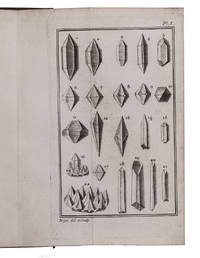
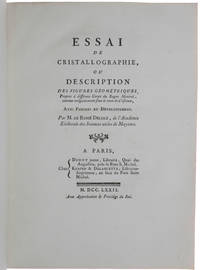
1772899Paris: Didot Jeune; Knapen & Delaguette 1772. <br /> <br /> A landmark work in the history of mineralogy and crystallography by Jean-Baptiste Louis Romé de l'Isle 1736-1790 one of the principal founders of scientific crystallography. Published in Paris in 1772 Essai de Cristallographie represents one of the earliest systematic attempts to classify minerals according to the geometry of their crystal forms rather than solely by chemical composition or external appearance. Romé de l'Isle sought to demonstrate that crystals obey fixed geometric laws helping establish crystallography as a rigorous scientific discipline during the Enlightenment. The work discusses numerous classes of crystals including quartz mica feldspars zeolites metallic crystals pyrites and gemstones accompanied by detailed geometric analyses and descriptions.<br /> <br /> Particularly notable are the engraved folding tables and plates illustrating crystal forms polyhedra and geometric developments. These illustrations provided one of the earliest visual systems for understanding mineral structures and became highly influential among eighteenth-century natural philosophers mineralogists and geologists. The volume includes an extensive bibliography of earlier authors on crystallization and mineralogy reflecting Romé de l'Isle's attempt to synthesize contemporary scientific knowledge. Also present is an attractive engraved armorial bookplate of Lord Sandys adding desirable provenance and evidence of ownership by an eighteenth-century British noble family. A highly important scientific work that marks the transition from descriptive mineralogy to the quantitative study of crystal geometry.<br /> <br /> Condition & Binding: Bound in contemporary full calf with gilt roll-tooled borders marbled endpapers and all edges gilt. Binding remains attractive and solid showing moderate rubbing scuffing and wear to boards corners and spine. Spine lettering has largely faded though decorative tooling remains partially visible. Internally remarkably clean and bright for the period with light scattered foxing and occasional minor spotting. Folding engraved plates and the large folding crystallographic table appear present and in very good condition with no significant tears observed in the supplied photographs. Overall- very good. Didot Jeune; Knapen & Delaguette unknown
1772L3LEN89INLTKParis 1772. 8vo. Didot Knapen & Delaguette Contemporary mottled calf gold-tooled spine with red title-label red edges marbled endpapers. With 2 folding letterpress tables and 10 folding engraved plates I-X. XXXII 427 2 1 blank pp. First edition of an influential work on geometrical crystallography by the French mineralogist Jean-Baptiste Louis Romé de l'Isle 1736-1790 one of the founders of modern crystallography. "In 1772 he published his first important technical work a one volume essay on crystallography in which he identified 110 crystal forms. This was a major expansion upon the work of Linnaeus . The Essai made Romé de l'Isle a prominent name among Parisian scientists of his day" Wilson. Romé is best known for his "law of constancy of interfacial angles" now the first law of crystal habit. The preliminaries contain an annotated bibliography by the author of the principal works on crystals. The plates depict numerous crystal forms as well as some geometric figures.Occasionally some very faint foxing or a small spot. Binding only slightly rubbed along the extremities. Overall in very good condition.l Hoover 2681; Ward & Carozzi 1906; Wilson The history of mineral collecting p. 52. unknown
17725371Paris: Didot jeune and Knapen & Delaguette 1772. First edition. <p>First edition a magnificent and very rare large paper copy both larger and printed on thicker paper than the octavo issue of one of the fundamental works of modern crystallography; it appeared 12 years before Haüy's Essai d'une Théorie sur la Structure des Cristaux. "Very scarce. The Cristallographie ranks as one of the great contributions to the science of crystals. In it Roméde L'Isle attempted to make a comprehensive classification of crystals" Schuh.</p>. A FUNDAMENTAL WORK OF MODERN CRYSTALLOGRAPHY - VERY RARE LARGE PAPER COPY. <p>First edition a magnificent and very rare large paper copy both larger and printed on thicker paper than the octavo issue of one of the fundamental works of modern crystallography; it appeared 12 years before Haüy's Essai d'une Théorie sur la Structure des Cristaux. Romé de L'Isle established that various shapes of crystals of the same natural or artificial substance are all closely related to each other. Measurements he took with a goniometer enabled him to determine that the angles between corresponding faces of a crystal are always the same which earlier had only been described in specific cases in particular by Niels Steno this is often described as the first law of crystallography. In addition he demonstrated that these angles are a characteristic of mineral type introduced the concept of truncation and also enlarged the crystallographic vocabulary. He "identified 110 crystal forms drawing upon Linnaeus who had listed forty and described in minute detail the minerals that exhibited them. He subdivided the various substances into salts stones pyrites and metallic minerals stating that he agreed with Linnaeus that geometrical form is the chief characteristic by which minerals may be classified. Also like Linnaeus he held that saline principles imprinted their own geometrical form upon the earthy constituent of each mineral" DSB. "Very scarce. The Cristallographie ranks as one of the great contributions to the science of crystals. In it Romé de L'Isle attempted to make a comprehensive classification of crystals. By the time he wrote his volume he was extremely familiar with the subject and this work greatly surpassed all previous works in scope and detail. To apply his classification he adopted a morphological approach in which he attempted to relate the diverse forms of crystals of the same substance. As a general morphological concept he introduced the idea of the 'primitive form'. All crystals of the same inorganic substance no matter how different in appearance had a fundamental and common geometrical form - the primitive form - to which their actual crystal shapes related . In this first edition of the Cristallographie Romé de L'Isle identifies 110 crystal forms by which minerals crystallize. Grouped under each of these shapes are describe the minerals that exhibit similar habits including the approximate angles between crystal faces. These forms were all derived from a common saline ingredient in every mineral that worked at a molecular level" Schuh. Pages xii-xxviii contain an annotated bibliography of the principal works on crystals. The only large paper copy listed by ABPC/RBH is the Norman-Freilich copy but our copy is significantly larger than even that copy 265 x 205mm versus 249 x 193mm.</p> <br /> <p>"Romé the son of a lieutenant in the cavalry studied humanities at the Collège Ste. Barbe in Paris. In 1756 he entered the Royal Corps of Artillery and Engineering which he accompanied as a secretary to the French Indies in the following year. From 1758 until 1761 he was in the enclave of Pondicherry French India. When it fell to the English in 1761 Romé was taken prisoner and transported to China where he stayed until 1764 when he returned to France" DSB. </p> <br /> <p>"Romé de L'Isle had started collecting minerals during his travels as a naval officer. Back in Paris after the Indian Wars he was introduced into mineralogy by the apothecary chemist and mineralogist Balthazar Georges Sage 1740-1824 who became his friend. It was very fashionable at the time in Paris to have a mineral collection. The owner of an important private collection Pedro Francisco Davila wanted to sell his. At Sage's suggestion he asked Romé de L'Isle to draw up the inventory. Romé made a very thorough job of it the inventory running up to three thick volumes. This was his first work on mineralogy published in 1767 Catalogue systématique et raisonné des curiosités de la nature et de 1'art qui composent le cabinet de M. Davila. It gave him the opportunity to study crystalline forms in detail and led to his Essai de Cristallographie 1772 .</p> <br /> <p>"The context of the time was not very favourable for such studies for had not the famous French naturalist Buffon written in his Natural history of Minerals volume 1 1783: 'One has pretended that rhombohedra constitute a specific character of calcareous spar without being attention to the fact that some vitreous or metallic substances also crystallize in rhombohedra and that if calcareous spar does crystallize often in rhombohedra it also takes different other forms; and our crystallographers when trying to borrow from geometricians the way to transform a rhombohedron into an octahedron a pyramid or a lens have done nothing more than substitute ideal combinations to the real facts of Nature. This crystallization in rhombohedra like all others will never have a specific character. Not only is there no crystalline form common to different substances but conversely there are few substances which do not present different crystallization forms as shown by the prodigious variety of forms of calcareous spar itself' .</p> <br /> <p>"In the preface Romé noted that 'of the curious phenomena of the mineral kingdom those which struck him most were the regular and constant forms taken by some bodies designated by the name of crystals.' He was encouraged by the works of Linnaeus he added to undertake the study of the angular forms of crystals and of their transformations. Their polyhedral shape was only known from the Ancients only for quartz diamond and a few others and Romé widely extended this observation. Minerals were divided by him into four classes: salts stony pyritic and metallic. For each mineral the most frequent forms observed are described with a reference to Linnaeus's classification in Systema naturae . Steno's ideas relative to the growth of quartz layer by layer are quoted at length and Romé de L'Isle felt that they could be applied to all crystals. The book was a success acclaimed by Linnaeus himself and brought international fame to Romé de L'Isle . The importance of Romé de L'Isle's work was stressed by Haüy who wrote Leçons de Physique 1795: 'To the exact descriptions he gave of the crystalline forms he added the measure of the angles and which was essential showed that these angles were constant for each variety. In one word his crystallography was the fruit of an immense work almost entirely new and most precious for its usefulness.'</p> <br /> <p>"Romé de L'Isle was also the first mineralogist to give a rational description of twins . He described for instance the dovetail twin of gypsum and the feldspars twins. He introduced the term macle to designate a crystal in which 'one half is produced by the inversion in the opposite sense of the other half of the same crystal' - a property which he demonstrated by the concordance of angles" Authier pp. 313-6. </p> <br /> <p>"Romé's friendship with Sage brought him membership in a number of learned societies including the academies of Mainz Stockholm Berlin and St. Petersburg. But it did him no service with the Paris Académie des Sciences which rejected him on the ostensible grounds that he was a mere 'catalogue maker.' It is likely that Romé's controversies with Buffon also played a part in his rebuff by the Academy" DSB.</p> <br /> <p>Freilich sale 460; Hoover 2681; Norman 1847; Schuh Mineralogy & Crystallography: A Bibliography 1469 to 1920 4151; Ward & Carozzi 1906; Wellcome IV p. 553. Authier Early Days of X-ray Crystallography 2013. </p> <br/> <br/> 4to 265 x 205 mm pp. v viii-xxxii 427 3 including half-title with 2 folding letterpress tables and 10 folding engraved plates. Contemporary calf spine gilt in compartments with red morocco lettering-piece red edges. Didot jeune and Knapen & Delaguette unknown
176333176-1314Rome Marco Pagliarini 1763. Title with vign. head- and tail-pieces decorative initials. XII 487 pp. 1 blank leaf 108 pp. 12mo. Contemporary boards worn. Rome Marco Pagliarini 1763. First published c. 90 years earlier under the title: Studio di pittura scoltura et architettura this is the first pocket guide for amateurs to the art and architecture of Rome. Aimed at an audience of secular tourists rather than religious pilgrims this guide is organized from the standpoint of geographical rather than devotional convenience. It is of the greatest interest to the historian of Baroque art and architecture as it provides a descriptive inventory of the contents of over 240 churches and monasteries and contains information relevant to attribution building history patronage and contemporary taste. Includes bibliogr. references and indexes. Most copies of this pocket guide were working copies by their very nature and have been used to pieces. According to Schlosser it remained the standard guide to Rome in the eighteenth century and as such was one of the formative sources for the trend of the "Grand Tour".- A clean copy. - Schlosser pp. 544 600; cf. Cicognara 3891; Marco Lattanzi "La prima grande vera guida di Roma" in F. Prinzi ed. Filippo Titti Descrizione delle pitture 1978 pp. 5-10; OCLC 3880564. ART & ARCHITECTURE & ARCHAEOLOGY ; ITALY ; GEOGRAPHY:TRAVEL ; Rome, Marco Pagliarini hardcover
17481167<p>Lugdunum Batavorum: Samuelem Luchtmans1748. Illustrated with folding map. Thick 8vo full calf upper cover detached blindstamp and ink notation to titlepage part 2 titlepage misbound some staining along foredges otherwise very good. BMC Vol 17 p. 172; For a similar map see the Samourka Map Collection #A9109 cartouche is different. Mela was an early Roman geographer originally from Spain. He theorized that the world was divided into five parts of which only two were habitable. The map is particularly odd showing an oversized Indian subcontinent and a much widened Africa. Below Africa is a very large land mass. Mela's De Situ Orbis was originally published in 1471 and saw many subsequent editions published.</p>
17732107010031Romae : Typis reverendae Camarae apostolicae 1773. First Edition. Hardcover. Good. Catholicism in Latin America Bound in contemporary vellum. Good binding. Minor dampstaining mostly along bottom margin. Text printed in two columns. v 1 308 1 pages. Frontispiece plate provided in facsimile. Marca de fuego on top edge. Palau 37038; Sabin 9122. <br> This volume contains a compilation of the papal bulls relating to the Orden de los Hermanos de Nuestra Senora de Bethlehem or Bethlehemite Brothers a Catholic religious order founded in 1653. The Bethlehemites were the first monastic order to be founded in the New World. They spread throughout Latin America and focused on care for the sick. The order was suppressed in 1820. Romae : Typis reverendae Camarae apostolicae hardcover
178120101Altona J.D.A. Eckhardt 1781. 4to. Cont. blue boards. Back worn. 1435616 pp. and 15 folded engraved plates of which 3 are maps. Printed on good paper. hardcover