27 résultats
1703013968<p>London: printed by A. and J Churchill at the Black Swan in Pater Noster Row 1703 Book. Good. Hardcover. viii 154 pages. Either ESTC N17836 without the errata slip mentioned there; or also issued as part of Vol 3 of the Collection of Voyages and travels published by Awnsham and Churchill in 1704. Most likely the second. Star chart on page 42. Some pages have ink stains. Damp staining to the lower part of the first 8 pages. Small amount of worming to the lower inner corners of pages 89-154 but well clear of the text. In modern half leather binding with a lightly faded spine. New end papers.</p> printed by A. and J Churchill at the Black Swan in Pater Noster Row hardcover
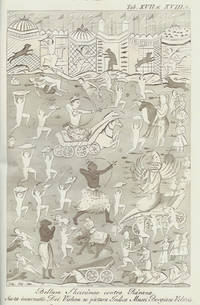
179177<p>4° mm 250x190; pp. XII 326. Al frontespizio vignetta incisa raffigurante Ganesha e <strong>32 tavole fuori testo</strong> di cui una a doppia pagina. Nel testo <strong>caratteri in sanscrito</strong>. Legatura coeva in piena pelle marezzata. Bell'esemplare.</p><p>First edition.</p><p>As the title well explains the Systema Brahmanicum by the Indologist Paulinus of St. Bartholomew - valuable compendium of Brahmanism - is closely based on the collection of <em>Indica reperta</em> from the famous Borgia Museum in Velletri <strong>profusely illustrated by the engravings. The volume therefore can be browsed as a kind of 'exegetical catalog' of the Hindu collection</strong>.<br /><br />The ancient Borgia Museum in Velletri formed between the 17th and 18th centuries by the Roman branch of the Borgia family was greatly enriched and enlarged in the second half of the 18th century by Cardinal Stefano Borgia 1731 – 1804 a man of vast culture who was a scholar of history and ethnology. The Museum famous throughout Europe for the variety and the rarity of the <em>reperta</em> as well as the singularity of the collections included artifacts from all parts of the world and was divided into nine sections one of which dedicated to Hindu manuscripts and relics.</p><p>Paulinus of St. Bartholomew Leithaberge in Lower Austria 1748 - Rome 1806 was an Austrian Carmelite missionary and Orientalist of Croatian origin. <strong>He is credited with being the author of the first Sanskrit grammar to be published in Europe and for being one of the first Orientalists to remark upon the close relationship between Indian and European languages</strong> followed by others such as William Jones and Gaston-Laurent Coeurdoux.<br /><br />Having entered into the seminary of the missions of his order at Rome he did Oriental studies at the College of St Pancratius. He was sent in 1774 as missionary to Malabar India. After spending fourteen years in India he was appointed vicar-general of his order and apostolic visitor. He was very well versed in languages: he spoke German Latin Greek Hebrew Hungarian Italian Portuguese English Malayalam Sanskrit and some other languages of India. He became known in Kerala as Paulinus Paathiri. He was one of the first to detect the similarity between Sanskrit and Indo-European languages though the very first was likely Fr Thomas Stephens SJ.</p><p>Recalled in 1789 to Rome to give an account of the state of the mission in Indostan he was charged with editing books – to correct the Catechisms and elementary books printed at Rome – for the use of missionaries.</p><p>In Rome he came into contact with Cardinal Stefano Borgia 1731 – 1804 Secretary of Propaganda Fide antiquarian scholar and patron who had set up in Velletri his native city the very well-endowed Museo Borgiano. Cardinal Borgia appointed him his private secretary and financed the publication of many volumes of indology including the first European grammar of the Sanskrit language <em>Sidharubam seu Grammatica Samscrdamica</em> published in Rome in 1790.</p> Apud Antonium Fulgonium