[STATES OF HOLLAND AND WEST-FRIESLAND].Biblio.com
9 résultats
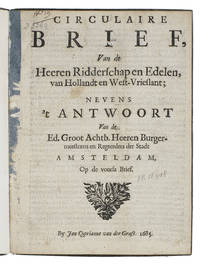
1685ABC_46231Amsterdam: Jan Cyprianus van der Graft = Jacobus Hackius 1685. No wrappers sewn. 4to. With a woodcut title vignette. Letter of the members of the Ridderschap the Knighthood in the States of Holland and West-Friesland to the Burgomasters and City Council of Amsterdam on the high costs of the defense - at land and at sea - of the Dutch Republic. The States were the representation of the two Estates standen: Nobility and Commons burghers of the 18 cities of Holland and West-Friesland of which Amsterdam was by far the most important and rich. The answer of Amsterdam dated 14 February 1685; pp. 22-24 is not disobliging: their representatives are certainly willing to further discuss the matter especially the amelioration if the navy.Untrimmed edges slightly browned but overall in good condition.l Knuttel 12408; STCN 86168706X; Tiele 8264. Jan Cyprianus van der Graft [= Jacobus Hackius?], unknown
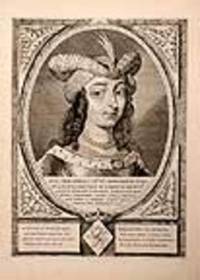
165815329Haarlem 1658. Engraving. Printed on laid paper. Collector's mark on verso of sheet. In excellent condition. Image size: 15 3/4 x 11 1/2 inches. This striking engraving comes from a series of portraits executed by Cornelis de Visscher one of the greatest seventeenth century Dutch engravers.<br/> <br/> Visscher was born in Haarlem between 1628 and 1629 and remained in the city for his whole life. He studied the art of engraving from Pieter Soutman one of the most celebrated printmakers of the Dutch School. In 1653 he entered the Haarlem guild and earned a reputation as a talented and precise engraver. A prolific printmaker Visscher published maps and charts as well as decorative plates but it is for his lovingly etched portraits that he is best remembered. This handsome portrait is a superb example of his considerable skill. Ada's life as the Countess of Holland in the early 13th century exemplifies the challenges faced by women in positions of power throughout history. As the only surviving daughter of Count Dirk VII of Holland and Adelaide of Cleves Ada inherited her father's title. However her uncle William I quickly contested her right to rule setting the stage for a tumultuous period in Holland's history. To strengthen her position Ada married Count Louis II of Loon. This strategic union caused scandal particularly as it took place even before her father's burial. The tension between Ada and her uncle erupted into the Loon War which lasted from 1203 to 1206. Unfortunately Ada was captured by William's supporters and imprisoned in various locations including in England. However her resilience and determination allowed her to regain her freedom in 1206 and she and Louis returned to Loon. Their rule was brief as Emperor Otto IV declared that William had a stronger claim to the title of Count of Holland in 1208. The lines of Latin verse below the portrait is in the first person giving voice to Ada to tell her own story of following her father's footsteps fighting with leaders alongside her husband Louis and to emphasize her experience as a foemina or "woman." From the collection of Frederic R. Halsey a famous New York print collector who was active during the latter part of the 19th century.<br/> <br/> Benezit Dictionnaire des Peintres Sculpteurs Dessinateurs et Graveurs; Lugt Les Marques de Collections 1308. unknown
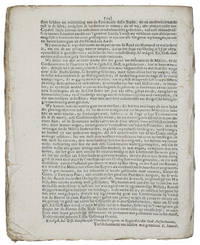
1685ABC_46232Amsterdam 1685. 4to. Jan Cyprianus van der Graft = Jacobus Hackius Blue modern wrappers new endpapers. With a woodcut title vignette. 24 pp. Letter of the members of the Ridderschap the Knighthood in the States of Holland and West-Friesland to the Burgomasters and City Council of Amsterdam on the high costs of the defense - at land and at sea - of the Dutch Republic. The letter dated 11 February 1685; pp. 2-22 is a plea for improvement of the deplorable financial state of the defense especially at the land side after the Rampjaar 1672 and the subsequent wars with France which ended in the Peace of Nijmegen in 1678-79. The answer of Amsterdam dated 14 February 1685; pp. 22-24 is not disobliging: their representatives are certainly willing to further discuss the matter especially the amelioration if the navy.With the bookplate of the city library of Dordrecht on the front board. With a stain on the title-page overall in good condition.l Knuttel 12408; STCN 86168706X; Tiele 8264. unknown
1646200094AG1646. Antwerp Ian Cnobbaert 1646. Original Engravings. Plate Size: 32 cm x 25.5 cm. Sheet Size: 34 cm x 29 cm. In very good condition with only minor traces of browning to outer margins. A fascinating collection of six engravings of battle scenes from Famiano Strada's De Thien eerste Boecken der Nederlandtsche Oorloge - a Dutch translation from the original Italian 'De Bello Belgico'. Strada's monumental work covered the epic Eighty Years War15681648 a religiously influenced war of liberation fought by the Seventeen Provinces of the Spanish Netherlands against the forces of the Habsburg Spanish Empire. Preceding and then forming part of the pan-European Thirty Years Wars the Dutch War of Independence ended with the Dutch Republic recognized by Spain and the major European powers. The independent Dutch were then to embark upon their remarkable Golden Age of the 17-18th centuries. The series of engraving presented here show some of the major engagements that helped shape the course of the war. They are rich in detail capturing the rush and horror of the clash of armies in the early modern period - to a degree where one can almost hear and feel the blasts of cannon and muskets crash of iron roar of men and the sound of excited horses leaping from the page. The decorative cartouches accompanying each scene provides explanatory notes on the unfolding dramas. A remarkable group of images. The titles of the scenes - in order of appearance in Famiano's are as follows: ''TGhevecht van Oosterweel Onder de Governante Margarita. Ann.1567'' ''Den Veldtlagh Van Heyligherless in Vrieslandt onder den Hertoghe Van Alba. Anno1658.'' ''De Belegeringhe Van Valencyn Onder de Govvernante Vrow Margarita Van Oostenryck Hertoghinne Van Parma. A.1567.'' ''Den Veldtslagh Van Heminghen in Vrieslandt Onder Den Hertoghe Van Alba. Anno 1568.' ''TGhevlecht Byde Riviere Gheete in Brabandt Onder den Heroghe Van Alba. Anno 1568.' 'De Belegeringhe Van Berghen in Henegovw Onder den Hertogh van Alba. Anno 1572.' Frans van den Wyngaerde or Frans van den Wijngaerde 1614 1679 was a Flemish printmaker draughtsman and publisher. One of the leading print publishers in 17th-century Antwerp he created and published multiple reproductive prints after Peter Paul Rubens Anthony van Dyck as well as foreign artists. Famiano Strada 1572 - 1649 was an Italian Jesuit historian and moralist. Strada taught at the Collegio Romano of the Jesuits in Rome. He taught rhetoric and Latin to among others Bishop Lorenzo della Robbia and Pope Clement IX . He was fiercely anti- Tacitus because he thought that this Roman writer stood for undermining the authority of the king and gave rise to a loss of confidence in leadership. The most famous work by Famiano Strada is De Bello Belgico decades duae 1555-1590 Dutch : The War in the Low Countries and was written with the help of Alexander Farnese 1545-1592 around 1602. It was published in 1632 and translated into Dutch in 1646. unknown
1634R202304Printed Adam Islip London: . 1634 Two Volumes. 614 42; 632 86 pp. Large printer's device on the title pages. First title page age stained and chipped at fore edge and detached. Large 4to sewn in sixes. 330 x 220 mm. Disbound. Pliny the Elder was born 23 CE at Novum Comum Transpadane Gaul now in Italy. He died August 24 79 Stabiae near Mount Vesuvius. He was a great Roman savant and famed author of this celebrated Natural History an encyclopaedic work that was an authority on scientific matters up to the Middle Ages even though it is today known to be of uneven accuracy. The translator - Philemon Holland 1552-1637 was an English schoolmaster physician and translator. He is best known for the first English translations of several works by Livy Pliny the Elder and Plutarch and also for translating William Camden's Britannia. PRICE JUST REDUCED! W150. No Binding. Good. Printed Adam Islip, London: . unknown
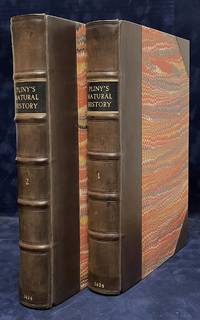
163478666London: Adam Islip 1634. Hardcover Quarto. Hardcover. Fair. 2 volumes rebound half leather decorated papered boards five raised bands to spine gilt lettering on black label two new blank end papers front and rear 614 42 632 86 pp 2 vol. signature of owner John Griffiths Jesus College Oxford 1947 glued to front pastedown of both volumes title page and preface missing in volume one first pages of both volumes with tears on corners edges trimmed in both volumes paper slip with contemprary description laid in volume 1light damp stains to edges and corners <br /> <br /> <br /> Standard shipping no tracking / Priority with tracking / Custom quote for large or heavy orders. Adam Islip hardcover
160184London: Adam Islip 1601. First Edition in English second issue. Very Good . Folio 11 3/4 x 8 inches 298 x 203 mm 2 VOLUMES bound into one. Pp. 58 614 42; 12 632 84 2. Title pages with woodcut devices present in both parts lacking blanks pi1 and Ppp8 woodcut initials head and tailpieces copious indexes of both volumes final errata sheet. Full later calf re-jointed extra-gilt spine with 5 raised bands some rust spots marginal tears and paper flaws eight leaves with expertly repaired corners with resulting small loss of text; occasional marginalia; paper supple and evenly toned; binding somewhat scuffed but firm and square. Armorial bookplate of James Backnell Praed pasted inside front cover.<br /> <br /> Carter 5; Pforzheimer 496; ESTC 006187259. A handsome and rare copy of the first full English translation of Pliny's Naturalis Historia by Philemon Holland the greatest translator of the Elizabethan age.<br /> <br /> «The 'Natural History' of Pliny the Elder is more than a natural history: it is an encyclopaedia of all the knowledge of the ancient world. The famous story of Pliny's death while trying to observe the eruption of Vesuvius at closer quarters than was prudent is often and justly cited as an example of the devoted curiosity on which the furthering of knowledge depends and to the Romans his writing on the natural sciences was pioneer work held in small esteem as he modestly says by his countrymen. He was a compiler rather than an original thinker and the importance of this book depends more on his exhaustive reading he quotes over four hundred authorities Greek and Latin than on his original work. All the spare time allowed him by a busy administrative career was devoted to reading ; he began long before daybreak his nephew the younger Pliny recorded and grudged every minute not spent in study; no book was so bad he used to say as not to contain something of value. When he died the 'Natural History' the sole extant work out of one hundred and two volumes from his pen was still incomplete. It comprises thirty-seven books dealing with mathematics and physics geography and astronomy medicine and zoology anthropology and physiology philosophy and history agriculture and mineralogy arts and letters. He is scrupulous in his acknowledgement of his sources you must he wrote with honest humility declare those from whom you have profited and the whole of the first book is devoted to the tables of con tents and authorities which bear witness to his method. The Historia soon became a standard book of reference. One of the earliest books to be printed at Venice the centre from which so much of classical literature was first dispensed it was later translated into English by Philemon Holland in 1601 and twice reprinted a notable achievement for so vast a text.» Carter John. Printing and the Mind of Man. New York: Holt Rinehart & Winston 1967. Adam Islip unknown
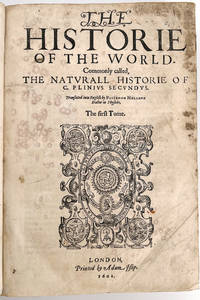
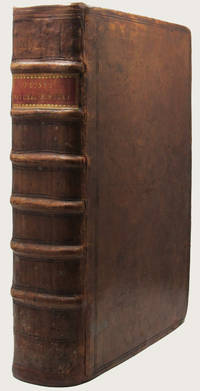
163434275London: Printed by Adam Islip and to be sold by John Grismond in Ivy-lane and to be sold at the Signe of the Gun 1635 1634 1634. The first Tome. The second Tome. The second printing with numerous corrections of the first English translation. Printed by Adam Islip in 1634 the first volume contains the title-page dated 1635 which was offered for sale by John Grismond the second volume retains the 1634 title-page. Elaborate woodcut printer's device to title engraved floriated initials and fine head and tail pieces throughout. Folio in 6s 2 vols. bound in one an excellent copy bound in full contemporary polished calf in original state the back with raised bands over cords covers with double fillet rules in blind. 56 614 42; 12 632 86. Advertisement leaf at end of vol. II pp. Collated complete. An especially desirable copy of this highly important book. In its rare original state this book is seldom encountered. The textblock is crisp and unpressed and remains in a very pleasing state of preservation some minor evidence of damp in a few places as to be expected the spine with expert restoration at the head and tail of the panel a beautiful copy. IMPORTANT EARLY ISSUE OF THE GREAT TRANSLATION OF PLINY INTO ENGLISH BY PHILEMON HOLLAND. The second printing of the first full English translation of this important book. First published in Venice in 1469 “The ‘Natural History†of Pliny the Elder is more than a natural history: it is an encyclopaedia of all the knowledge of the ancient world. .He was a compiler rather than an original thinker and the importance of this book depends more on his exhaustive reading he quotes over four hundred authorities Greek and Latin than on his original work. All the spare time allowed him by a busy administrative career was devoted to reading; he began long before daybreak his nephew the younger Pliny recorded and grudged every minute not spent in study; no book was so bad he used to say as not to contain something of value. When he died the 'Natural History' the sole extant work out of one hundred and two volumes from his pen was still incomplete. It comprises thirty-seven books dealing with mathematics and physics geography and astronomy medicine and zoology anthropology and physiology philosophy and history agriculture and mineralogy the arts and letters. He is scrupulous in his acknowledgment of his sources you must he wrote with honest humility declare those from whom you have profited and the whole of the first book is devoted to the tables of contents and authorities which bear witness to his method.<br> The HISTORIE soon became a standard book of reference: abstracts and abridgments appeared by the third century. Bede owned a copy Alcuin sent the early books to Charlemagne and Dicuil the Irish geographer quotes him in the ninth century. It was the basis of Isidorets Etymologiae and such medieval encyclopedias as the Speculum Majus of Vincent of Beauvais and the Catholicon of Balbus. One of the earliest books to be printed at Venice the center from which so much of classical literature was first dispensed it was later translated into English by Philemon Holland in 1601 and twice reprinted a notable achievement for so vast a text. .<br> More recently scholars as various as Humboldt and Grimm have praised and acknowledged their debt to it. Over and over again it will be found that the source of some ancient piece of knowledge is Pliny. PMM<br> The standard of reference for scholars since the 15th century Holland’s translation made it available to the English speaking world for the first time. Although not strictly scientific itself mingling a good deal of the author's fancy with fact Pliny's NATURALL HISTORIE was important in stimulating scientific thought in succeeding generations. "It is an encyclopedia of all the knowledge of the ancient world set out in an orderly fashion. It was the source of much medieval knowldege--and legend--and the model for such works as the SPECULUM MAJUS of Vincent of Beauvais. The high regard in which it was held in the world of the Renaissance can be seen by its early appearance in print 1472" PMM.<br> The HISTORIE divided into 37 libri or "books" was completed except for finishing touches in 77 CE. In the preface dedicated to Titus who became emperor shortly before Pliny's death Pliny justified the title and explained his purpose on utilitarian grounds as the study of "the nature of things that is life" "Preface" 13. Heretofore he continued no one had attempted to bring together the older scattered material that belonged to "encyclic culture" <br>egkyklios paideia the origin of the word encyclopaedia. Disdaining high literary style and political mythology Pliny adopted a plain style--but one with an unusually rich vocabulary--as best suited to his purpose. A novel feature of the NATURALL HISTORIE is the care taken by Pliny in naming his sources more than 100 of which ae authors and sometimes the titles of the books many of which are now lost from which Pliny derived his material.<br> The HISTORIE properly begins with Book II which is devoted to cosmology and astronomy. Here as elsewhere Pliny demonstrated the extent of his reading especially of Greek texts.<br> Books VII through XI treat zoology beginning with humans VII then mammals and reptiles VIII fishes and other marine aninmals IX birds X and insects XI. In Books XII throuogh XIX on botany Pliny came closest to making great contributions to science. He drew heavily upon Theophrastus and still made important independent observations particularly those made during his travels in Germany. Pliny is one of the chief sources of modern lknowledge of Roman gardens early botanical writings and the introduction into Italy of new horticultural and agricultural discoveries.<br> Born at Como in 23 Pliny died while observing the eruption of Vesuvius in 79 A.D. His NATURALIS HISTORIA is a scientific encyclopedia often uncritical but very elaborate and of great value. Pliny attached to each book the list of his authorities 146 Roman and 327 Greek being quoted. He explained that people may be living at the antipodes and stated that the speed of light is greater than that of sound. His work includes the oldest account of ancient art. In addition it contains a remarkable amount of early information on Asia and Africa. Its influence throughout the Middle Ages was very great.<br> This is an especially nice copy of the second offering of the work in English. This issue corrected the many errors of the first English edition. As with the copy listed in the British Museum the first tome has a new title page dated 1635. Further this is a variant issue with “and are to be sold by John Grismond†after Adam Islip on the imprint. Dedicated to Sir Robert Cecil. Printed by Adam Islip and to be sold by John Grismond, in Ivy-lane and to be sold at the Signe of the Gun hardcover
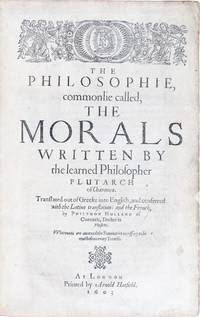
16031168London: Printed by Arnold Hatfield 1603. First Edition. Very good. First complete edition in English containing everything you’d ever want to know of what Romans thought about private daily life. An essential balancing compendium for all the Roman history books the historiographer’s question is always what else was going on. It’s a spectacular read but you better wipe off your magnifying glasses because this book is 1400 pages of well-spaced but small type. Full mottled calf by Riviere & Son signed on the verso of the front free endpaper morocco labels marbled endpapers all edges gilt woodcut initials and headpieces rebacked a few faint scratches tiny chip paper flaw from the title page’s edge but fine and complete with the errata. The condition is exceptional for this book. Ugly copies abound but no copy like ours has sold at auction or in the trade since this one sold at Sotheby’s in 1989 for $4675 expensive then and expensive now but the finest of copies usually are. Ex–James Hale Bates 1845–1901 the American travel writer with his armorial bookplate upside down on the rear endpaper. Ex–The Garden Limited see below their bookplate also upside down next to Bates’ the error in placement certainly made by Bates The Garden owners intentionally followed suit. 4 p.l. 1363 1 pp. 32 leaves. Ref: STC 20063. ESTC S115981. Harris p. 116. Lowndes III 1891. The exalted Elizabethan translator Philemon Holland 1552–1637 was a physician and Latinist whose love of the classics prompted his devotion to rendering ancient authors into the language of Shakespeare and his output was prodigious. His first project was a translation of the Roman historian Livy published in 1600. The next year Holland tackled Pliny’s massive Natural History he also translated significant historical works of Suetonius 1606 and Ammianus Marcellinus 1609. The contents of the Morals are amazing. They confront a wild range of topics embracing fortune exile animal intelligence health advice for newlyweds the education of children benefitting from one’s enemies the value of having few or many friends how to recognize a flatterer and 10 times as many more. And though Catullus’ neoteric poems and some documents survive the primary only other source of the private details of Roman daily life beyond this book is just graffiti on the walls of Roman ruins like at Pompeii. Individual Plutarch treatises had been previously translated into English some more liberally than others but this is the first translation of the entire sequence of essays that make up the “Moralia.†Further the value of the collection is enhanced because Plutarch borrows from lost Greek works some of which would otherwise be unknown to us.<br /> <br /> The modern provenance here is at the zenith. It’s no hyperbole to say that the collection of The Garden Ltd. was the most outstanding American library of notable books put together in the second half of the 20th century. It was comprised of high spots from all periods breathtaking in their impeccable condition. It included the last 1st edition seen of Cervantes’ 1605 Don Quixote and a set of Shakespeare’s 4 folios bought by Dick Manney and then bought by us from Sotheby’s by private treaty in 1991. Does this collection have a backstory It does. Haven O’More was a genial narcissist with an autobiography fattened on bombastic exaggeration. His oft asked question was “Do you know who I am†It should have been “Do you know who I think I am†He found a rich investor Michael Davis and with Davis’ loot he built a staggering library in awe-inspiring condition that he planned to place at the center of his zanily conceived “new sacred city.†But O’More was holding aces and eights and after a public confrontation at Christies over a Gutenberg Bible Davis got bored with O’More’s antics and forced a 1989 sale at Sotheby’s titled The Garden Ltd. Printed by Arnold Hatfield unknown