12 résultats
1778AQ11936s.i.: s.n. 1778. 2 78pp. Early paper boards. Slight rubbing and some browning to extremities. Occasional spots of light foxing and mild marginal damp-staining. A letter concerning the War of the Bavarian Succession of 1778-1779 which saw a Saxon-Prussian alliance in conflict with the Habsburg Monarchy of Austria in order to prevent the latter acquiring the Electorate of Bavaria. . Quarto. [s.n.] hardcover
171013126Granada 1710. 195x138mm. 7¾x5½". Granada s.a. c.1710. En 4º 195 x 138mm. Texto a dos columnas. 8 pp. Portada y texto dentro de orla tipográfica. Primera edición. El final de las pretensiones de archiduque al trono. Carta de la mujer del archiduque Carlos de Austria a su marido tras la derrota del ejército en la famosa Brihuega en diciembre de 1810 y la huida del ejército austrÃaco a Barcelona. De interés. unknown
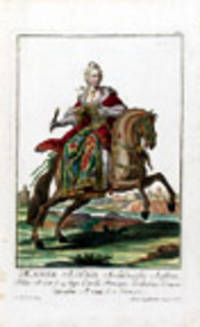
174515093Augsburg: Published by Martin Engelbrecht 1745. Engraving with thick early colour with gold highlights. Printed on laid paper. In excellent condition with the exception of some minor foxing in the margins. Image size: 10 1/8 x 7 1/8 inches. A lovely portrait with stunning early colour of Maria Anna Archduchess of Austria by the celebrated Augsburg engraver Martin Engelbrecht.<br/> <br/> Martin Engelbrecht was one of the most prolific engravers and printsellers in Augsburg at the close of the 17th century. Along with his brother Christian Martin dominated the print trade producing some of the finest prints of his day. His outstanding portraits and landscape studies are beyond compare and his religious and allegorical engravings display a technical aptitude superior to many of his contemporaries. Martin had great success with his optical prints which were used in perspective boxes. He is best remembered for his equestrian portraits depicting European nobility and his engravings of Queen Elizabeth and Joseph II are numbered amongst his best work. This stunning portrait of Maria Anna is a rare example with vibrant early colour and is a wonderful example of Engelbrecht's superior work. Archduchess Maria Anna Eleonore Wilhelmine Josepha of Austria born into the prestigious House of Habsburg played a significant role in governing the Austrian Netherlands during the reign of her elder sister Empress Maria Theresa. Despite the initial reluctance of her father Holy Roman Emperor Charles VI towards her birth Maria Anna and her sister Maria Theresa were the only children to survive to adulthood. Their upbringing took place within the opulent confines of the Imperial Court in Vienna. Maria Anna's life was marked by pivotal negotiations for a political marriage. One prospective match was with Philip Duke of Parma a marriage intended to mend relations with Spain. However this alliance was disrupted by the Anglo-Spanish War and the Treaty of Seville in 1729. Maria Anna then entered a relationship with Charles Alexander of Lorraine the younger brother of Maria Theresa's husband. The marriage met resistance given her father's desire for a politically advantageous match. Eventually they wed in January 1744 after her father's death and were soon appointed as governors of the Austrian Netherlands. Their rule was cut short as Charles had to leave for war while Maria Anna expecting their first child remained in Brussels. Tragically Maria Anna passed away in December 1744 just months after giving birth to a stillborn daughter. Her legacy endures as a remarkable woman who briefly governed a significant realm in the name of her sister Empress Maria Theresa. Published by Martin Engelbrecht unknown
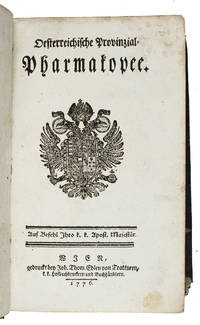
1776I14AUD0VK13VVienna 1776. 8vo. Johan Thomas Edlen von Trattnern Contemporary calf light brown morocco spine label with title in gold red sprinkled edges. With a woodcut coat-of-arms on the title-page and typographical head- and tailpieces. 10 384 18 pp. First edition of the German version of the Pharmacopoeia Austriaco-Provincialis first published in 1774. Many editions of both the original Latin and German translation followed. Based on a thorough analysis it can be determined that pharmaceutical care was on a high level in the area of South-Eastern Europe and that it followed the scholarly pharmacy in the Habsburg monarchy.The necessity to publish the pharmacopoeia in German was because it was used by minor medical professions without knowledge of Latin such as surgeons. A Dutch translation of the pharmacopoeia entitled Apotheek der Oostenrijksche Staaten which was based on the edition of 1775 was published in Rotterdam in 1780. The content and the format of the new pharmacopoeia had changed dramatically compared to the former one. While the Viennese Dispensatory represented a Baroque pharmacopoeia in size and in its abundance of recipes the new Pharmacopoeia Austriaco-Provincialis was a rather small booklet with a drastically reduced number of formulations.Two sections built up the body of the pharmacopoeia. The first one cited the Materia Pharmaceutica minerals crude drugs of plant and animal origin in separate chapters mentioning the Latin name the scientific identification and the Austrian local name of all items. Another chapter listed the chemical characters some of them still representing alchemical signs. The second part consisted of formulated preparations in alphabetical order followed by an index. The pharmacopoeia had a new concept and for the first time specified the medicinal ingredients alphabetically and listed the formulations in alphabetical order according to the recipes names.Corners slightly bumped otherwise in very good condition.l Christa Kletter The civil Pharmacopoeias of Austria Paper Austrian International Society for the history of Pharmacy 2015 pp. 7-8. unknown
179132654Napoli: Militare 1791. First Edition. Hardcover. Lv pp. Contemporary full speckled calf binding with gold decorations along the edges of the front and rear panels and on the spine. Engraved title vignette. Head-pieces initials and tail-pieces. A beautiful publica gratulatio dedicated to Ferdinand IV and Maria Carolina of Austria King and Queen of Naples and Sicily. Front and rear endpapers recently replaced. Toning to title light scattered foxing some wear to extremities. A near fine copy. Uncommon. ; Quarto. Militare hardcover
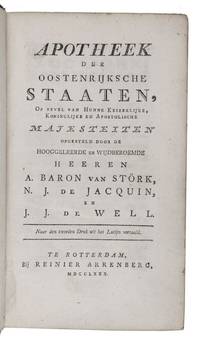
1780I17GIFR0YPPRRotterdam: Reinier Arrenberg 1780. Contemporary tanned sheepskin gold-tooled spine. Large 8vo 21 x 12.5 cm. First and only edition of the Dutch translation of the pharmacopoeia for the Habsburg Monarchy published as part of the medical reforms instigated by Gerard van Swieten 1700-1772 and based on the second edition of 1775.With the owner's inscription of J.J. Verlinden dated "1802" on the front and back flyleaves. Binding worn with an imprint circle at the front and the head of the spine damaged; a few spots throughout and ink stains in the lower margin of p. 226 but otherwise a good copy.l Blake p. 347; STCN 7 copies; Kletter "The civil pharmacopoeias of Austria" International society for the history of pharmacy - history of pharmacopoeias histpharm.org; Wellcome VI 356; WorldCat 10 copies. Reinier Arrenberg, unknown
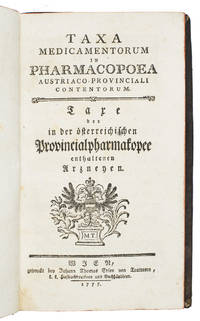
1777I14F46A1C75MVienna: Johann Thomas Edlen von Trattner 1777. Mottled calf gold-tooled spine brown morocco spine label marbled endpapers red edges. 8vo. Medical ordinances and a list of the new taxes on nearly 2000 named medicinal components. As the Habsburgs in the 1770s attempted to strengthen their control over the professional standards and business activity of pharmacists and medical personnel in their realms the authorities imposed new taxes on behalf of Empress Maria Theresa covering all components of medicaments described and prescribed in the Pharmacopoea Austriaco-Provinciali the official book of pharmacological recipes for the entire Habsburg empire with editions published almost every year from 1776 to ca. 1822. The ordinance on the subject was promulgated on 25 November 1775 and took affect on 1 January 1776 so the 1776 edition was clearly the first but the 1790 edition calls itself the second. It is therefore not certain whether the present copy is the true second edition or a reissue of the first. The ordinance pp. 3-8 of the preliminaries is signed by Christian August Graf von Seilern Statthalter and Thomas Ignaz Freiherr von Pöct Kanzler and contains seven points including sanctions and criminal procedures in case of fraud. Trattner was printer and bookseller to the Imperial Court.Foot of spine damaged otherwise in good condition.l Cf. Blake p. 24 1776 ed. Johann Thomas Edlen von Trattner, unknown
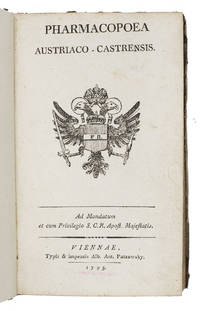
1795I17BBOP2JSB6Vienna 1795. 8vo. Albert Anton Patzowsky Half calf spine label lettered in gold red sprinkled edges. 4 102 pp. First edition in Latin of the first military pharmacopoeia for Habsburg Austria with the privilege for 10 years in German dated 29 September 1795 and granted to the publisher Albert Anton Patzowsky on behalf of the last Holy Roman Emperor Franz II Joseph 1768-1835 who was to become Franz I the first Emperor of the Austrian Empire in 1804.Until 1794 the Austrian army met its pharmaceutical needs with help from civilian pharmacists. Problems with the quality of the services provided led to the establishment of a professional military pharmaceutical service in 1794. To provide the medical support that the army needed garrison hospital pharmacies were built. Patzowsky published a German edition of the present pharmacopoeia in the same year: Oestrreichischen Militär-Pharmacopoea zum Gebrauche der Oestrreichischen Fieldärzte Vienna A.A. Patzowsky 1795. In spite of the privilege a pirated edition appeared in the same year in Pavia.Spine slightly worn otherwise in good condition.l Blake p. 347; cf. Wellcome IV p. 356 1795 edition Pavia. unknown
1704241802Vienna: Gedruckt bey Leopold Voight 1704. First edition. Parts 1 & 2 only. Additional engraved general title page and two large beautiful woodcut tailpieces. 8 788; 2 547 10 pp. 1 vols. Folio. Contemporary pigskin. Title page defective with loss including loss of imprint otherwise fine. First edition. Parts 1 & 2 only. Additional engraved general title page and two large beautiful woodcut tailpieces. 8 788; 2 547 10 pp. 1 vols. Folio. Although this massive compilation of laws alphabetically arranged with a final Index was updated throughout the century until Pars 6 of 1770 this first volume of 1704 is complete albeit with a defective title page in and of itself. Subsequent additions were added thus: Pars 3 1704-1720; Pars 4 1721-1740; Pars 5 1740-1758; Pars 6 1759-1770. Gedruckt bey Leopold Voight unknown
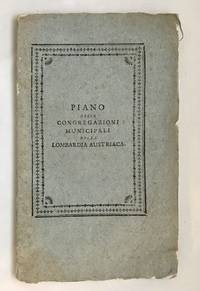
178610570Milan: s.n. 1786. Original printed wrappers spine slightly defective uncut. <p>These thirty-three articles propose municipal administrative reforms in Austrian Lombardy - Milan Mantua Cremona Pavia Lodi Como Gallarate and Bozzolo. This covers zoning street and building maintenance quartering of troops price caps police sanitation fire companies victuals investigatory powers. Penalties are set for various transgressions. The folding tables with printed paste-over corrections are to be completed by the person in charge of transportation. A folio edition appeared the same year. I have located one example of either outside Italy Regensburg.<br /> ¶Bibliografia delle edizioni giuridiche antiche in lingua italiana II3: 1024; Bertarelli Inventario I: 170.</p> s.n. unknown
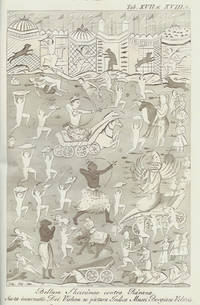
179177<p>4° mm 250x190; pp. XII 326. Al frontespizio vignetta incisa raffigurante Ganesha e <strong>32 tavole fuori testo</strong> di cui una a doppia pagina. Nel testo <strong>caratteri in sanscrito</strong>. Legatura coeva in piena pelle marezzata. Bell'esemplare.</p><p>First edition.</p><p>As the title well explains the Systema Brahmanicum by the Indologist Paulinus of St. Bartholomew - valuable compendium of Brahmanism - is closely based on the collection of <em>Indica reperta</em> from the famous Borgia Museum in Velletri <strong>profusely illustrated by the engravings. The volume therefore can be browsed as a kind of 'exegetical catalog' of the Hindu collection</strong>.<br /><br />The ancient Borgia Museum in Velletri formed between the 17th and 18th centuries by the Roman branch of the Borgia family was greatly enriched and enlarged in the second half of the 18th century by Cardinal Stefano Borgia 1731 – 1804 a man of vast culture who was a scholar of history and ethnology. The Museum famous throughout Europe for the variety and the rarity of the <em>reperta</em> as well as the singularity of the collections included artifacts from all parts of the world and was divided into nine sections one of which dedicated to Hindu manuscripts and relics.</p><p>Paulinus of St. Bartholomew Leithaberge in Lower Austria 1748 - Rome 1806 was an Austrian Carmelite missionary and Orientalist of Croatian origin. <strong>He is credited with being the author of the first Sanskrit grammar to be published in Europe and for being one of the first Orientalists to remark upon the close relationship between Indian and European languages</strong> followed by others such as William Jones and Gaston-Laurent Coeurdoux.<br /><br />Having entered into the seminary of the missions of his order at Rome he did Oriental studies at the College of St Pancratius. He was sent in 1774 as missionary to Malabar India. After spending fourteen years in India he was appointed vicar-general of his order and apostolic visitor. He was very well versed in languages: he spoke German Latin Greek Hebrew Hungarian Italian Portuguese English Malayalam Sanskrit and some other languages of India. He became known in Kerala as Paulinus Paathiri. He was one of the first to detect the similarity between Sanskrit and Indo-European languages though the very first was likely Fr Thomas Stephens SJ.</p><p>Recalled in 1789 to Rome to give an account of the state of the mission in Indostan he was charged with editing books – to correct the Catechisms and elementary books printed at Rome – for the use of missionaries.</p><p>In Rome he came into contact with Cardinal Stefano Borgia 1731 – 1804 Secretary of Propaganda Fide antiquarian scholar and patron who had set up in Velletri his native city the very well-endowed Museo Borgiano. Cardinal Borgia appointed him his private secretary and financed the publication of many volumes of indology including the first European grammar of the Sanskrit language <em>Sidharubam seu Grammatica Samscrdamica</em> published in Rome in 1790.</p> Apud Antonium Fulgonium
1769elala199Vienna: Johann Thomas Edlen von Trattnern 1769. 1769. folio. pp. 8 p.l. 282 lvi. 27 engravings in the text & 3 folding engraved plates incl. in pagination. woodcut ornaments & initials. full contemporary dark brown morocco lettered in gilt on upper cover: Constitutio Criminalis Theresiana Spectans Ad Antiquam Civitatem Voitsbergensem 1773 Antonius Josephus Schilcher P.T. Judex Civitatis Voitsberga bit rubbed some browning & foxing marginal dampstain to last section containing engravings folding plates dampstained & repaired -1 with some loss of text. Inscribed on front blank: "Mathias SchuemackerSuperioris Austriae Jo. J. Syndrins Voitsberga 1773". First Edition of the famous criminal code of Maria Theresa which redefined torture as "a subsidiary means of eliciting truth". Torture could be applied to obtain confessions only in cases where condemnation would have involved capital or severe corporal punishment. A remarkable publication including graphic illustrations of instruments and methods of torture thumb-screws stocks racks burning candles leg vices winches the Viennese shoe with detailed and precise instructions on their use. According to the Encyclopaedia Britannica 11th Edn. this illustrated edition was suppressed by Prince Kaunitz chancellor of state and advisor to the Empress a few days after its appearance. Torture was formally abolished in the empire in 1776. Signed by Authors. 1st Edition. Vienna: Johann Thomas Edlen von Trattnern, 1769. hardcover