PORTUGAL, Marcos 1762-1830Biblio.com
15 résultats
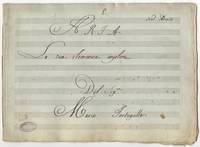
180040184France 1800. Oblong folio 228 x 317 mm. Sewn. i title 8 ii blank pp. Notated in black ink on 10-stave rastrum-ruled paper. <br /> <br /> With small oval handstamp of the Glasgow Society of Musicians to title and final page of music; "81" in contemporary manuscript to upper center of title; "480" in contemporary manuscript to lower inner corner of final blank page.<br /> <br /> Blank margins of title and final blank page soiled; occasional stains; minor loss to lower outer corner of title; small tear to blank lower margin of final leaf. Drawn from the opera "Adrasto re d'Egitto" to a libretto by G. de Gamerra first performed in Lisbon at the Teatro S Carlos on 21 December 1800. <br /> <br /> "Marcos Portugal was not only one of the most prolific Luso-Brazilian composers ever but also the most successful. His European fame rests above all on his comic operas especially Le confusioni della somiglianza Lo spazzacamino principe La donna di genio volubile Le donne cambiate and L'oro non compra amore and on the prima donna showpiece arias in La morte di Semiramide and Gli Orazi e i Curiazi. However he was equally famed in Portugal and Brazil as a composer of sacred music which he composed throughout his working life apart from the Italian period. His three best-known works remained in the repertory until the early 20th century: the Missa Grande c1790 the Matinas da Conceição 1802 and the Te Deum 1802.<br /> <br /> Portugal's operas were rooted in the Neapolitan style of Cimarosa. Yet as early as 1794 in Le donne cambiate he was more melodious and forward-looking using such devices as a 'stupefaction ensemble' and certain turns of phrase more readily associated with Rossini. His Lisbon operas were perhaps less adventurous musically relying more on Catalani's virtuosity. In his church music the elaborate stile concertato of his early years for the Patriarcal gradually developed into a pompous grandiloquent style fit to exhibit royal power. This is particularly so with the works for male voices and six organs at the Mafra Basilica many of which were reworked for mixed voices and orchestra for the Royal Chapel in Rio de Janeiro where the virtuosi castrati much appreciated by the King played a very influential role." António Jorge Marques and David Cranmer in Grove Music Online. unknown
175819230Paris: Chez la Veuve Didot Nyon.Brocas 1758. New Edition reviewed and enlarged. 1 vols. 8vo. Contemporary mottled calf morocco label. Some rubbing small holes and chips at head and tail of spine. New Edition reviewed and enlarged. 1 vols. 8vo. This historian is best known for his history on the knights of Malta. Chez la Veuve Didot, Nyon...Brocas unknown
176410531Lisbon 1764. Disbound. Very Good binding. Folio. 1 ff. Removed from binding. Light staining; early manuscript number at the top corner; a couple instances of later notation in the margin. A nice example of this Alvará in which the king address matter related to the port of Belem in Brazil. Dated in print 28 September 1764. unknown
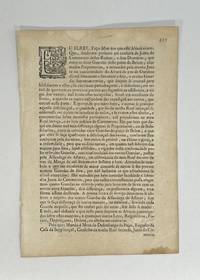
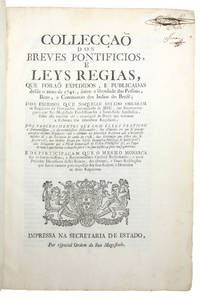
175943057Lisboa: Impressa na Secretaria de Estado dos Negocios do Reino 1759. Removed from a larger volume. A very good fresh crisp copy tiny stain to fore edge pinprick to upper margin. 7 1 pp. 11.5 x 8 inches. Issued on the anniversary of the supposed plot against the King of Portugal by the Jesuits the "Lei de expulsão da Companhia de Jesus de Portugal e seus Domínios" of September 3 1759 promugated on October 3 1759 condemned the Jesuits as rebels and traitors banishing them from all Portuguese territiories under pain of death along with anyone who either helped or communicated with them. It was the culmination of a long list of actions by the Marquês de Pombal who was behind these laws and who had written in a letter to Conde de Unhão in February before the law was published that "nothing can be omitted or ought to be omitted to disarm the Jesuits' diabolical machinations so that they may not be reborn and any hidden roots remain in our land." This was reflected in the document which accused the Jesuits of attempting to assassinate the king ruin the kingdom destroy Portugal and "clandestinely pursuing the usurpation of the entire state of Brazil with such an artificial and so violent progress that if it was not promptly and effectively shut down".the Company of Jesus' goal would be accomplished. "within a space of less than ten years and become inaccessible and insurmountable." Dated and signed in print: "Dada no palacio de Nossa Senhora da Ajuda aos tres de setembro de mil setecentos cincoenta e nove. Rey." And then "Lisboa 3 de outubro de 1759 Rodrigo Xavier Alvares de Moura. Foi impressa na Secretaria de Estado dos Negocios do Reino." Printed as Section XIX of "Collecçaõ dos Breves Pontificios e Leys Regias . sobre a liberdade das pessoas . dos Indios do Brasil" Lisbon Impressa na Secretaria de estado por especial ordem de Sua Magestade 1759. See Gauz: Portuguese and Brazilian Books in the John Carter Brown Library 759/1. Impressa na Secretaria de Estado dos Negocios do Reino unknown
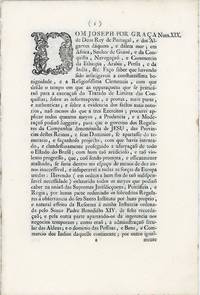
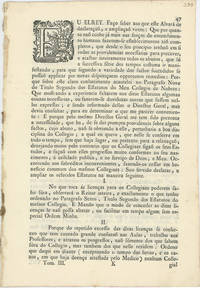
177241404Lisboa: impresso na officina de Miguel Rodrigues 1772. First edition. Removed. Very good clean copies both removed from larger volumes with numerals noted on top edge of each leaf. 4 pp.; 6 pp.203-208. Approx 8 x 11 1/2 each. Two documents five years apart concerning the needed educational reform in Portugal at the Collegio de Nobres. The first document concerns rules to tighten up the procedures of the College of Nobles instituted by Sebastião José de Carvalho e Melo Marquês de Pombal just a year earlier to strengthen scientific education and the second with further reforms to educate the sons of the nobility with useful and practical knowledge shortly before the school's failure. Pombal's attempt "was not a successful enterprise: among the main causes for its failures were financial difficulties the attitude of the Portuguese nobility who antagonized such an educational programme disciplinary questions and the inappropriateness of the course to students who were too young to profit from them. Scientific teaching lasted for 5 years 1766-1772 " In The Sciences in the European Periphery During the Enlightenment p. 11. It would be the reforms of the University of Coimbra to which the focus was transferred that would finally succeed. OCLC locates a copy of the first document at the BN Espana. Delgado da Silva: Collecção da legislação Portugueza II pp. 318-20 & pp. 585-7. OCLC: 740377909. impresso na officina de Miguel Rodrigues unknown
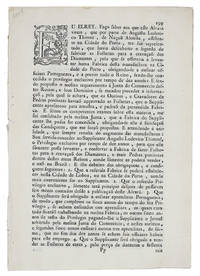
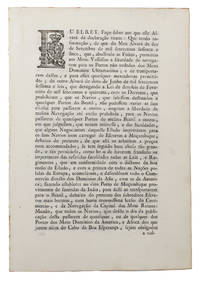
1766ABC_46586Ajuda district of Lisbon 1766. Folio. Palacio de Nossa Senhora "reprinted by Miguel Rodrigues" Disbound folded. With a large decorated woodcut initial E with the coat of arms of Portugal opening the text. pp. 199-201 blank 202. Rare royal proclamation issued 22 August 1766 by King Joseph I of Portugal 1714-1750-1777 and registered and certified by his secretary Joaquim Joseph Borralho granting August Ludwig Thimne the exclusive privilege and patent for ten years to set up a factory in Porto or Lisbon to produce foil from silver and other metals for setting diamonds and other precious stones. The proclamation forbids the import of contraband foil into Portugal giving Thimne the sole rights to the production and sale of the foil. Thimne discovered how to manufacture foil to set diamonds and other gems and stones in 18th-century Portugal where the setting of diamonds and gems and the creation of spectacular jewellery became more and more important.A highly interesting proclamation on the Portuguese diamond and gemstone industry especially on underlaying with foil as an appearance modification technique used for 18th-century Portuguese jewelry not only granting Thimne a privilege but also regulating the production for the Portuguese market.The bifolium is almost completely torn into two leaves on the fold line but otherwise in very good condition.l Portuguese and Brazilian books in the John Carter Brown Library 1537 to 1839 2009 766/5; WorldCat 81024902 no copy listed; 460587852 1 copy of the whole ed. unknown
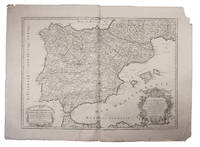
1708E7GCJJB1RUYXParis 1708. Hubert Jaillot Engraved map on 2 assembled sheets 55.5 x 78 cm engraved by Cordier. With title in decorated cartouche on the bottom right corner scales and privilege in decorated cartouche on the bottom left corner and a few lines coloured in green. Large map of Spain and Portugal this state with a privilege for 20 years granted in 1708. Engraved by Cordier after the map by Nicolas Sanson.Strengthened fold damaged corners but map in very good condition.l Cf. Pastoureau Jail. II A map 91. unknown
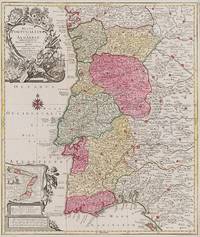
1762200016AG1762. Augsburg Georg Friderich Lotter 1762. Original hand-coloured Engraving. Plate Size: 49 cm x 57.7 cm. Sheet Size: 51.6 cm x 59.6 cm. Original map. Very good condition. Clean and crisp. Map orientated to the North. Slight roughness to top right corner edge. Border with longitudinal and latitudinal information. A richly detailed and very interesting map showing the Kingdom of Portugal and the Algarves. Relief shown pictorially with rivers mountains and major and minor settlements depicted through keys. The internal subdivisions of the kingdom are also highlighted as are the religious bishoprics and Archdioceses administrative areas of the Catholic Church. Lisbon is shown at the mouth of the 'Tajo' Tagus River. Cartouche in lower left corner decorated with Classical allusion encloses inset map showing the coastal region of Brazil then a Portuguese colony. The Captaincies of Brazil which were the administrative divisions and hereditary fiefs of the colony are delineated. Interior of Brazil carries inscription 'Brasilia Regnum in America Merido' with allegorical scene with native figures. Relief shown pictorially with rivers mountains and settlements depicted. Beneath inset map are map legends and a triple bar scale. Large decorative title cartouche located in the top left corner of map. Portugal's tradition of maritime exploration and conquest and naval strength are alluded to with the depiction of the canon lances accompanying the coat-of-arms of the House of Aviz and naval vessels and the mythological figure in the foreground. Above the title lies the coat-of arms of the Kingdom of Portugal and the Algarves. The year that the map was published 1762 saw the Seven Years War spread in the Iberian Pennisula as Franco-Spanish forces staged an unsuccessful invasion of Portugal which was then in alliance with Britain. Tobias Lotter was a German publisher and engraver who married the daughter of the elder Matthaus Seutter in Augsburg. Largely under his own responsibility but still under Seutter Lotter created the 'Atlas Minor' which was created between 1740 and 1744. He engraved many of Seutters maps and eventually succeeded to the business in 1756 becoming one of the better-known cartographers in the eighteenth-century German School. After his death the business was carried on by his son M.A. Lotter. Wikipedia unknown
1772ABC_48853Lisbon 1772. Folio ca. 29 x 20 cm. Na Regia Officina Typografica Disbound and subsequently mounted in a modern black stiff paper folder with a printed label mounted on the front wrapper. With a large decorated woodcut initial E incorporating the Portuguese royal coat of arms. 3 1 blank pp. Very rare first issue of two of a late 18th-century decree by the Portuguese King José I 1714-1777 dealing with difficulties in the transportation of enslaved people from Mozambique to Brazil. This text dated 12 December 1772 and signed Rey King at the end is also signed by the notorious Portuguese nobleman and diplomat Marquez de Pombal. Sebastião José de Carvalho e Melo 1st Marquis of Pombal 1699-1782 who was the Secretary of State of the Kingdom during the reign of Dom José I in the period of 1750-1777. It is concluded with a formal text dated 18 December 1772 and signed by João Baptista de Araújo a senior officer of the Secretariat of State.In 1761 Marquez de Pombal prohibited the importation of enslaved people in Portugal and Portuguese India not for humanitarian reasons but because they were needed for labour in Brazil. He stimulated the trade of mostly African enslaved people for that colony and with his support two companies for slave trade were founded the Companhia Geral de Comércio do Grão-Pará e Maranhão and the Companhia Geral de Comércio de Pernambuco e Paraíba. Both companies were privileged and had a monopolistic character. Their lists of shareholders included many Portuguese noblemen and clergy. Between 1757 and 1777 more than 25000 enslaved people were imported to Pará and Maranhão from West African ports.The two issues can be identified by their catchwords on p. 1: issue one shows the catchword as a vol- that catchword was changed in the second issue to a.The inner margin shows some signs of the previous binding. Otherwise in very good condition.l Gauz Portuguese and Brazilian books in the JCB 772/1; WorldCat 1045359449 3 copies; cf. Porbase 2301650 and no copies. unknown
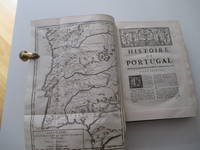
173519061AB1735. 2 volumenes Paris Chez Pierre-Francois Giffart 1735 26 : 19 cm. 14 leaves 783 pages; 18 leaves 844 pages with three many folded maps. Contemporary calf spine richly decorated in gold 2 back labels. The history of Portugal by Nicolas de La Clede 1689-1736 describes from the beginning the customs and wars of the Lusitians there state during the domination of the Romans the invasion of the Goth and Moors the creation of the state of Portugal under the reign of Henry and Alfonse until the reign of Rey Jean V. "On n' a rien de plus complete ni de plus exact sur ce royaume. L'origine les moeurs et las usages des Portugais les differentes revolutions qu'ils ont éprouvées leurs conquètes dans les Indes y sont rapportées avec autant de Fidélité que d'exactitude" Querand Biographie universelle. - Title with small stamp ocassionally in the lower right part small stains; the beautiful binding only a bit rubbed. unknown
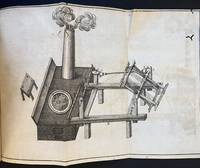
17874368Lisbon: press of the Royal Academy of Sciences 1787. Narrow 4to 209 x 118 mm. 8 xiii 3 175 pages. Title-leaf fol. 2 present in duplicate. Folding engraved plate of a mechanical silk loom; titles with woodcut arms of the Portuguese Royal Academy of Sciences woodcut and typographic headpieces occasional slight discoloration small wormtrack in the folding plate. Contemporary cat’s-paw polished sheep covers with gilt border spine in six gold-tooled compartments the second gilt lettered edges gilt and gauffered recased endpapers renewed defect in top spine compartment a dozen small wormholes. Provenance: António Romão dos Passos 1866-1951 signature in ink Antonio Passos / agronomo or Anto R. Passos scrawled across both titles the first with price note and on six text leaves. <br /> <br /> Only edition of a comprehensive overview of the Portuguese silk industry by the judicial magistrate of the Moncorvo district and author of several works on political economy and history of law. José Antonio de Sá d. 1819 a native of Bragança was an important proponent of modernization of the industry and later served as director of the Royal Silk Factory Real Fábrica das Sedas founded in 1802 in Lisbon. He was one of the earliest members of the Academia Real das Sciencias of Lisbon.<br /> <br /> Silkworms were raised in Portugal as early as the 13th century. Sericulture and silk production were concentrated in the northeastern province of Trás-os-Montes its largest center being the city of Bragança which from the 15th to 17th century was known throughout Europe for its luxurious velvets. Because of the lack of government support for industry frequent wars and above all the persecutions of the Inquisition which decimated an industry in all sectors of which Jews or converted Jews cristãos-novos played a major role Portuguese silk production suffered from intermittent crises and was even periodically decimated. Starting in the 1770s efforts to revive the industry began to have an effect: <br /> <br /> “By the end of the 18th century the Trás-os-Montes silk industry had dragged itself out of the crisis that had begun in 1750-1755 coinciding with the last incursion of the Inquisition into Bragança and embarked upon a period of great development accompanying the industrial expansion that was then taking place not only in that particular region but throughout the Portuguese kingdom. After the Inquisition’s systematic persecution of businessmen weavers and throwers had finally come to an end the continuity and expansion of the silk industry seemed to be a viable prospect. In the last two decades of the 18th century a remarkable process of modernization took place thanks to the efforts of the businessmen involved in this economic activity such as António José Lopes Fernandes who installed 200 silk looms in Bragança magistrates such as José António de Sá and Pereira de Barros and politicians such as Martinho de Melo e Castro and Rodrigo de Sousa Coutinho the latter being the Portuguese ambassador to Piedmont Italy. These efforts included the adoption of Piedmontese methods and techniques namely the organzine mill and the spinning-jenny the most advanced ones at that time in Europe in an operation led by experts coming to Portugal from that Italian region.†Sousa p. 6<br /> <br /> Sá’s work is in three parts. The first part comprises an overview of the history of silk production starting with Antiquity and summaries of the industry and government policies toward it in other countries followed by a detailed recommendation with responses to projected objections that the Portuguese government undertake a campaign to plant mulberry trees and promote the industry generally. Part two is a treatise on the silkworm and part three a technical survey of “the art of silk spinning.†Explained in the text pp. 142-148 is the letter- and number-keyed engraving of a rather fanciful machine showing a vat for softening the cocoons heating on the left from which a thread-unwinding mechanism feeds a loom on the right. <br /> <br /> The reason for the duplicated title-leaf in this copy is not clear. Perhaps one functioned as an upper wrapper — but as both titles are preceded by a half-title that appears unlikely. The book collector Antonio Romão dos Passos b. February 28 1866 was an engineer and agronomist. Other books from his library all on practical subjects are recorded; four are digitized by the Biblioteca Nacional Digital de Portugal. One a treatise on hemp has a similar indelicately scrawled signature across the title. <br /> <br /> OCLC gives six US locations. Innocencio Diccionario bibliographico portuguez IV: 246 no. 2658; Kress Luso-Brazilian Economic Literature Before 1850 p. 4. Cf. F. Sousa “The Silk Industry In Trás-Os-Montes During The Ancient Regime†E Journal of Portuguese History Vol. 3 no. 2 Winter 2005 digitized. press of the Royal Academy of Sciences unknown
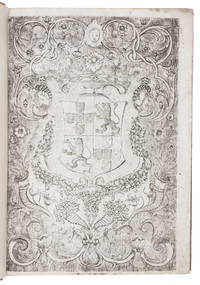
1711I17ERD520PLVLisbon 1711. Small folio 29 x 21 cm. Monastery of São Vicente de Fóra Modern sheepskin gold-tooled spine red morocco title-label. With engraved arms as fronstipiece and a title-page printed in red and black. 28 494 29 1 blank pp. Rare second edition of the first Portuguese pharmacopoeia first published in 1704 by the friar D. Caetano de Santo António d. 1730 an apothecary of the Monastery of Santa Cruz of the city of Coimbra who upon publication of the second volume was working at Lisbon in the Monastery of São Vicente de Fora. "The Pharmacopeia Lusitana shows how important the convent pharmacy was at that time in Portugal. The Portuguese religious apothecaries were very knowledgeable on pharmaceutical matters" Pita. With a few manuscript annotations in the margins. Ca. 50 leaves with a waterstain at the head of the gutter margin an occasional smudge and two leaves with a small hole and small tears otherwise in very good condition.l J.R. Pita Brief history of Portuguese pharmacopoeias pp. 1-5; Porbase 1 copy; Wellcome IV p. 369 incomplete; WorldCat 5 copies. unknown
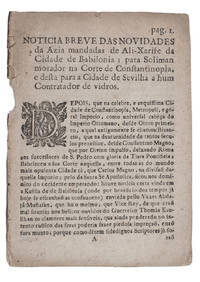
1742I14GSHQ8NCJEColophon: Madrid 1742. 4to 20 x 14.5 cm. heirs of Juan Garcia Infanzon Disbound. With a woodcut initial. 7 1 blank pp. Rare pamphlet satirising several Portuguese notables. According to this pamphlet presented as a fictional letter from "Ali-Charif of the city of Babylon" to "Suliman the Moor at the court of Constantinople" these notables are part of a Turkish regiment that might be sent off to fight "Thomas Kaulikan" Tahmasp Qoli Khan better known as Nader Shah. A follow-up to the pamphlet was published a week later and once again describes the regiment now in a letter "from Mecca to Holland to the city of The Hague" and from there to Cambrai in France" cf. Rossi 2392.Nader Shah was one of the most powerful rulers in Persian history and waged several military campaigns in Afghanistan and India. Although not at war with Portugal his war against the Islamic Mughal Empire in India culminating in the capture of Delhi in 1739 led indirectly to Portugal's loss of its colonial territory in India in the war with the Hindu Marathas 1737-1741.Browned throughout with the spine damaged; a fair copy.l Braga da Cruz Catalogo da collecçaõ de miscelânes V 7066; Porbase 2 copies; Rossi "La Spagna nella 'Livreria do Convento de Nossa Senhora de Jesus' in Lisbona" in: Annali-Sezione Romanza XXIII 1 1981 2391; WorldCat 1 additional copy. unknown
1759ABC_48500Lisbon: Secretaria de estado 1759. Contemporary calf gold-tooled spine marbled endpapers. Folio 21.3 x 30.5 cm. With al large woodcut vignette showing the Portuguese coat of arms on the title page and on one of the divisional title pages and with woodcut decorated initials. A publication of 21 Portuguese documents plus 1 handwritten addition detailing the first stages of the expulsion of The Society of Jesus commonly known as the Jesuits. Published by the special order of King José I of Portugal this book was intended to explain and defend the expulsion citing the Jesuits control over the affairs of the indigenous population of Brazil the "Indios do Brasil" and their alleged involvement in the "horroroso insulto de 3 de Setembro do anno de 1758". This September Insult is a reference to the Távora Affair the attempted assassination of King José I which resulted in the execution of the entire Távora family including Josés mistress Teresa Leonor wife of the heir of the Távoras. Teresa Leonors personal confessor was Gabriel Malagrida a Jesuit missionary who had spent time in Brazil; Malagridas tenuous involvement indeed the Távora as a whole are often considered scapegoats was utilised in anti-Jesuit rhetoric. This copy is of particular interest as a manuscript addition in an elegant contemporary hand has been added to the verso of the title page for document XII the sentencing of the Távoras and presents a copy of the speech made by the Judge of the People to the king: "O Juiz do Povo tem a honra de pedir a N.Ex.a ponha na Real prezença de S. Mag. que oseu justifismo Edital foi lido pelo fiel Povo de Lisboa com muitas lágrimas que todo elle pede justiça contra humatentado de que não há exemplo nage delidade Portuguese e que para avingar espera com impaciência as Reas ordens de S. Mag; pois todo elle dezeja anciozamente derramar até a última gota de sangue pela glória e serviço do Mesmo". Recorded just below is the reply of the King: "Reposta de S. Mag.e. Cu não esperava menos de fidelidade dos meus fiéis Vassalos a quem heide corresponder como bom Rey e Pay".With contemporary manuscript notes in brown ink. Each section with separate pagination and occasionally with a divisional title page bound together as issued. Gentle wear and dampstaining to the last few leaves lacking the back endpapers otherwise bright and clean.l Borba de Moraes I 165. Secretaria de estado, unknown
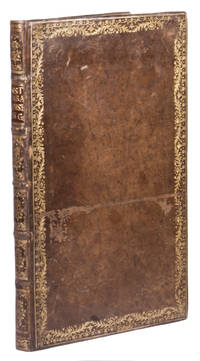
1774ABC_49591Lisbon 1774. Contemporary gold-tooled brown calf with a red morocco title label on the spine lettered in gold an elaborate border on both boards gold-tooled boards edges marbled edges. Folio. Manuscript on paper written in a neat secretarial hand. Rare contemporary manuscript of a royal letter addressed to the newly appointed Archbishop of Goa and Primate of the Orient the Augustinian hermit Dom Frei Francisco da Assunção e Brito just prior to his departure from Portugal to take up his new post. It outlines a set of ecclesiastic reforms arranged in six instructions. These were part of a series of major reforms introduced by the Portuguese king relating to the governance of the Estado da India: the same day royal instructions were also sent to the Governor and Captain General of Portuguese India D. José Pedro da Câmara regarding military political and economic reforms.The instructions to the Reverendo Arcebispo de Goa were drafted by the Marquês de Pombal Sebastião José de Carvalho e Melo 1st Marquis of Pombal 1st Count of Oeiras 1699-1782. Carvalho was one of the most influential Portuguese statesmen of the eighteenth century: it was during his term as prime minister earlier in the reign of José I that Portugal had abolished slavery both in Portugal itself and in the Portuguese colonies in India but not however in other parts of its empire and that autos-de-fé and the Limpeza de Sangue had been phased out. He had also been largely responsible for having the Jesuit Order expelled from Portuguese domains and he does not conceal his antipathy towards the Order in these instructions to the new Archbishop. Of great interest also are Carvalhos insistence on the removal of any distinction between natives of India and natives of Portugal second and third instructions and his condemnation of the level of censorship imposed by the Inquisition and by the Jesuits fifth instruction.An edited version of the present letter and of the letter dated the same day addressed to Câmara were published much later on in Pangim in 1841. The printed version of the ecclesiastical letter includes neither the index nor the second four-page royal letter which are both present in this manuscript.With a contemporary ownership inscription "Pertence do snr. Dez. Anst. Felis Contreiras." on the second free flyleaf. The edges of the boards are lightly scuffed the boards have been scratched with some loss of material. The bookplate mounted on the second free flyleaf has been cut off the work is lightly browned and foxed throughout. Otherwise in good condition. hardcover