(Florida)Biblio.com

64 résultats
18872347741887. 26 leaves with 63 mounted albumen prints most 4-1/2 x 7-7/8 inches all captioned in ink. 1 vols. 4to. Recent red morocco and original red cloth over boards. One photograph with clean split across image no loss. Some fading generally fine and clear. 26 leaves with 63 mounted albumen prints most 4-1/2 x 7-7/8 inches all captioned in ink. 1 vols. 4to. Assembled by a party of men on an extended tour and hunting expedition in the area the album documents numerous locations in southwest Florida in the period immediately following the extension of the Florida Southern Railroad into the Peace River region in 1886. All of the photographs are captioned in ink and all but the first nine which were taken at Interlachen near Gainesville relate to southwest Florida. The album includes scenes of the grounds of Charles Francis Jr. at Interlachen and the residence of Goerge Long; the railway station an office car and a street scene at Trabue; views of the Hotel Punta Gorda under construction; waterfront scenes along the Punta Rassa; views of Fort Myers; a Spanish Fishing village; a "Cracker" family and their orange grove; Judge Ziba King and his house at Fort Ogden; scenes of the Myakka River Bartow and Zolfo Springs and a number of hunting and camping scenes. Nineteenth century photographic albums of Florida are very scarce; the present album shows the rural landscape of southwest Florida at the dawn of the modern age. unknown
1882678131882. FLORIDA. Illustrated Florida. Buffalo. 1882. Nineteen chromolithographed views. In original illustrated slipcase. Original retail sticker on back cover small previous owner's label to each side. One chromolithograph creased others in excellent condition. A beautiful series of small chromolithographs of vacationing scenes in northern Florida from the early days of its tourist era. Scenes are in and around Jacksonville along the St. John's River Palatka St. Augustine along the Ocklawaha River and generic southern scenes. The Dodge Company of Buffalo made similar portfolios for other vacation spots. unknown
1837370450New York 1837. First edition. 16pp. 8vo. Original printed yellow wrappers repairs to small chips and separation at fold. Provenance: Thomas W. Streeter booklabel on inner rear wrapper pencil notes on front wrapper and first page of text. First edition. 16pp. 8vo. Comprising 1.4 million acres of land on the Gulf of Mexico between the Apalachicola and Wakulla Rivers in West Florida the Forbes land grant was ceded by the Seminoles and Lower Creeks to John Forbes & Company in payment for debts. With trade with Native Americans unprofitable during the War of 1812 Forbes sold the claim. The treaty transferring Florida to the United States did not go into effect until 1821 and private title under Spanish land grants with the territory was questionable. Decades of lawsuits ensued going as high as the Supreme Court. After the resolution of claims the title was reorganized as the Apalachiocola Land Company in 1835. The present report by the President of the Board of Directors of the New York-based company describes the geography of the region and outlines the plan for its division into lots for dwellings and businesses. The report summarizes the surveys of the region and describes the land and its resources and flora. Sabin calls for a map in this report although Servies does not note one. However the text references a map on page 7 which was likely not issued with all copies. <br /> <br /> The development of the land was not successful and the company eventually folded. "As an object of speculation the Forbes Purchase not only originated in a chaotic era but was hampered for many years by uncertain title to the land. Its development was also hindered by a lack of good agricultural land as well as by competition from the United States itself which was selling new lands in the American West at the same time the Apalachicola Land Company was getting started" Upchurch.<br /> <br /> This Streeter copy is the only example appearing in auction records and the only one we can trace in the market. Streeter purchased it from Rosenbach in 1936 for $50 and it was acquired at the Streeter sale for $65 by dealer and former Rosenbach employee John Fleming. It was eventually acquired by the collector Jay Kislak. Servies 2010; Streeter sale 1240 this copy; Sabin 5878; American Imprints 43274. See John C. Upchurch "Aspects of the Development and Exploration of the Forbes Purchase" Florida Historical Quarterly Vol. XLVIII No. 2 October 1969 unknown
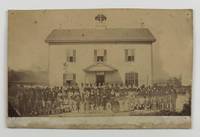
18804993N.p. but likely Live Oak FL 1880. Very good. Albumen photograph 4.5 x 7.75 inches mounted on card. Card trimmed with pinholes at corners remnants of printed caption in bottom margin slight surface soiling and spotting. Penciled annotation on verso. A stunning original photograph featuring Rev. Joseph Leroy Atwell Fish 1828-1890 and his wife and children posed amongst their African-American students at an unnamed "colored school" which was very likely the Florida Baptist Institute. The images captures Fish his wife and probably his daughters in the middle of the frame standing in front of a large two-story schoolhouse surrounded by about eighty young Black men and women in suits and dresses. Revered Fish was a graduate of Amherst College and the Newton Theological Seminary who was ordained a Baptist minister in 1856. Fish was also a teacher who helped found Florida Memorial University Florida Baptist Institute in Live Oak in 1880 where he served as first president of the institution until his death there on March 26 1890. Florida Memorial University is the only HBCU in the southern part of the state. The penciled annotation on the present photograph provides some information on the photograph but is probably ultimately misleading in one regard: "Rev. J.L.A. Fish & wife In Virginia teaching a colored school -- He married my Father & Mother Mr. & Mrs. Milan Hills Lucy M. Williams Dec. 21 1875."<br /> <br /> The latter part of this inscription is indeed true. Reverend Fish married Milan Hills and Lucy Williams on December 21 1875 in Hebron New York where he was serving as a church pastor. But the historical record does not indicate that Reverend Fish ever taught at an African-American school in Virginia if he did it was so brief that it is now lost to history. Fish's first known foray into teaching African American students was a brief six-month stint in Natchez Mississippi in 1879. Immediately thereafter Fish was appointed to the Florida Baptist Institute where he served the last decade of his life. As such it is far more likely that the inscriber here meant to say that Reverend Fish and his wife were "In FLORIDA teaching a colored school."<br /> <br /> Reverend Fish's work at the Florida Institute is covered in the Obituary Record of Graduates of Amherst College for the Academical Year ending June 27 1883: "His chief work was with the Freedmen as he brought Florida Institute out of all its troubles financial and social changed the feeling of the whites from hatred to sympathy with his work and put the school on a permanent foundation. His aim was to educate leaders for the race and the principal effort of his school was to train teachers and preachers to go out through the state and by their example to lift up and educate both intellectually and morally the colored people. His influence was felt throughout the state both through his training of teachers and preachers and through his counsels given at conventions associations and other gatherings of the colored men and in private. He is mourned by both white and black. By the whites because they knew his teachings would help the colored people without causing trouble to them. By the latter because they miss their leader teacher and friend. unknown
1882345842Braidentown Florida: Published by the author 1882. Second edition. Presentation copy inscribed by the author on the upper part of the front coverr. Frontispiece and illustrations. 83pp. 12mo. Original printed wrappers staining minor wear. Provenance: Thomas W. Streeter booklabel. Second edition. Presentation copy inscribed by the author on the upper part of the front coverr. Frontispiece and illustrations. 83pp. 12mo. "This is an early piece on the beginnings of settlement on the west coast of Florida below Tampa. The tract says that the railroad from Palatka on the St. John's River should be completed "within two years" and that "a narrow-gauge railroad from Tampa to the Manatee and thence to Sarasota Bay will soon follow" Streeter. The portrait is of "Madam Julia Atzeroth The Lady who raised the first coffee grown in the United States." Clark New South I:231; Streeter 1264 this copy Published by the author unknown
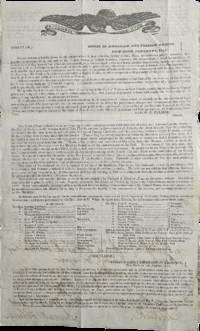
1831List3518New York City 1831. Two-page printed circular measuring 7 ¾ x 12 ¾ inches with manuscript note from Aaron H. Palmer. Folded with some small tears larger tear at seal not intersecting with text. Overall excellent. Aaron Haight Palmer 1779–1863 was the director of the “American and Foreign Agency for Claimsâ€â€”essentially a high-end collections agency—and later Consul General of the Republic of Ecuador. He was extremely well-connected and his activities included a tour of Europe and Asia to gather information about commerce there for the Rothschilds.1 <br /> <br /> Offered here is an 1831 circular from Palmer’s Agency signed by Palmer and sent to A. Lang Esq. in Selkirk Scotland. The circular advertises the sale of “a large tract of land lying on the Gulf of Mexico in East Florida†which “is owned in sole propriety by Richard S. Hackley Esq. an American citizen.†Hackley 1770–1843 a merchant and later US Consul in Spain had been deeded twelve million acres of land around present-day Tampa by the Duke of Alagon in 1819—who himself had been granted the land by Ferdinand VII in 1817. The circular extols the virtues of the land for sale especially Tampa as “a favorable site for the foundations of a great maritime city†and Chatham Bay’s “proximity to the West India marketsâ€. At the time Florida was in the midst of the Seminole Wars; the Treaty of Payne’s Landing would soon demand that all Indigenous people in Florida leave for Indian Territory. It is not clear what came of Palmer’s attempt to sell Hackley’s land; the latter’s heirs’ claims to his estate were settled in 1908 when the US Supreme Court decided that the Kingdom of Spain had annulled the grant prior to the Adams-OnÃs Treaty giving Florida to the US.<br /> <br /> We find one copy of the circular on OCLC. Of interest to historians of the settlement of Florida.<br /> <br /> 1 Jessica Lepler “‘There is no need for anyone to go to America’: commercial correspondence and nineteenth-century globalisation†Rothschild Archive https://www.rothschildarchive.org/materials/no_need_to_go_to_america.pdf accessed February 12 2026. unknown
186439285Tallahassee and Quincy Florida; Charleston Columbus 1864. Each a single leaf varying lengths in ink manuscript. Occasional light wear Very Good.<br /> <br /> Shipments of cattle and salt beef to Confederate troops in the field are the primary subject of these letters. Logistic and administrative matters railroad availability and other aspects of supplying the troops are discussed. <br /> Pleasants Woodson White "was born in Georgia in 1820 the son of a Methodist minister who soon moved his family to Quincy Florida. Young White studied at Emory and began practicing law in Quincy in 1848. He was commissioned a major in the Confederate Army in 1861 and as Chief Commissary Officer for Florida commanded the important depot at Quincy. In 1863 despite his attempts at secrecy White's difficulties in supplying beef cattle to the army became known. The shortages thus revealed influenced the military campaign of 1864. White became active in politics after the war and served as Judge of the Second Judicial Circuit 1869-79. He also served as Commissioner of Lands and Immigration from 1881 to 1885 a period of railroad expansion in which his office was deeply involved. He became an attorney for the Florida Coast Line Canal and transport Company which controlled vast acreage near Miami. White became an ardent booster of the South Florida climate and divided his last years between his citrus groves in Lemon city and his civic and business interests in Quincy. He died in 1919" online University of North Florida Digital Commons. unknown
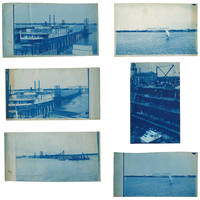
18953633601895. Five views of Lake Worth Beach and Palm Beach in 1895.<br /> <br /> The images are:<br /> <br /> 1 Ferry at Lake Worth with the Royal Poinciana Hotel in the distance. Captioned in the negative "L.W.B. 9.14.95";<br /> 2 Lake Worth with the Royal Poinciana Hotel in the distance. Captioned in the negative "L.W.B. 9.24.95";<br /> 3 View of Lake Worth with a pier in the foreground possibly taken from a boat. Captioned in the negative "L.W.B. 10.9.95";<br /> 4 Sail boat in front of the Royal Poinciana captioned in the negative "Lake Worth" two versions with different exposure times<br /> 5 View of the Palm Beach Inn later renamed The Breakers under construction with the Royal Poinciana in the background not dated but the hotel opened in December 1895.<br /> <br /> The negatives these views were printed from are of somewhat unusual size measuring roughly 4-3/4 by 7-3/4 inches. All but one view have a horizontal orientation. Given that this size does not seem to conform to the standard halfplate negative usually 5-1/2 to 6-1/2 inches in the long direction one might speculate that the photographer made their own camera. The photographs are handcut with somewhat uneven edges and of varying finished sizes all roughly 5 by 8 inches. They are generally very good or better with some toning and spotting. Uncommon subject matter. unknown
1822339148Washington D.C.: Gales & Seaton 1822. 17th Congress 1st Session House Report No. 47. 35 1 blankpp. 8vo. Disbound. 17th Congress 1st Session House Report No. 47. 35 1 blankpp. 8vo. A request that the association formed by Chazotte be allowed to purchase land in the Key Largo area for the purpose of cultivating coffee cocoa and tropical fruits. Pages 13 through 30 comprise a separate section with its own caption title: Facts and Observations on the Culture of Vines Olives Capers Almonds &c. in the Southern States and of Coffee Cocoa and Cochineal in East Florida. This section first published separately in Philadelphia in 1821. Shoemaker 11210 [Gales & Seaton] unknown
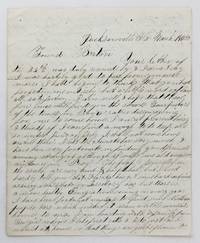
18584106Jacksonville Fl: March 15 1858. Very good plus. 4pp. on a single folded sheet. Old mailing folds. An informative dispatch from antebellum Florida from A.C Scranton to "Friend Barton" in 1858. In his letter Scranton reports that despite some problems he is enjoying southern people and general life in Florida: "The people generally in the south are very kind & hospitibal but I need hardly to tell you that Florida has got some hard times as every new state or Territory has but thare is a more healthy Emigration coming in every year I have been fortunate anough to find some Northern people here which makes it seam a little more like home to me. I am boarding with a family from Georgia whome I like first rate & I do just as I would at home so that things are quite pleasant here considering I am amongst strangers."<br /> <br /> He then provides information on Jacksonville and then two disasters that hit his adopted hometown: "Jacksonville is the largest place in Florida & had at one time about 3000 inhabitants it is not as large as it was once some three years ago it was visited by a very destructive fire & burned nearly half of the town. Last summer there was some kind of Fever here that almost prostrated the place some called it the Yellow Fever & some the African but none could tell for certin.about a hundred & fifteen or twenty that died here in 3 months & a grate many left the town nearly all the stors wer closed not a sound of a hammer was to be heard. When cold weather came it stoped the sickness and it seams quite lively now. It has been for many years a grate resort in the winter season for invaleds but on account of the sickness last summer thare are but few this winter if it continus healthy this summer the place will revive but if not it will kill it entirely."<br /> <br /> Scranton also discusses the transportation system that served Jacksonville and the recent winding down of the Seminole Wars: "It is situated on the Johns River about 23 miles from the mouth and is connected with Charleston & Savana by a regular line of steamers that runs up the river a hundred miles to a place called Platka whare Emigrants land & then travel by land to the interior to settle the country thare is a railroad building from this place to Tallahasse the capital of the state a distance of a hundred & eighty miles which wen completed will be a little help to this place. There is also another in progress from Fernandina a new town that lays in the North East corner of the state to a place called cedar keys on the gulf side whare they intend to carry the US mail direct from New Orleans to New York insted of going round by Key west & will shorten the time considerable. Florida has cost Uncle Sam a large some of money.the government.will make a treaty with them & send them into the Indian Territory & then close the Indian war in Florida." Almost all of the Seminoles remaining in Florida relocated to Indian Territory in the year this letter was written.<br /> <br /> A wonderfully-detailed firsthand account of Jacksonville and its development and challenges during the late 1850s. A printed transcription accompanies the letter. March 15 unknown
184635409Pensacola 1846. Letter. Very good. Letter. 4 pages. Lined paper folded. 4 pages of content. Postal mark and address written center of the 4th page. Two small wax seals on the edges of page 4. <br /> <br /> Letter is addressed to William Roney Jr. Corner of Third & Branch Sts Philadelphia Pa. Letter written aboard the U.S. Frigate "Raritan" off Pensacola Navy Yard April 3rd 1846 and has a Pensacola post mark and date of April 6 . Written on the eve of the Mexican War April 24 1846 to February 2 1848. Content summarized:<br /> <br /> Thomas Roney Midshipman writes a lengthy letter to his brother about his situation in Pensacola and requests his brother's help with family debts. He writes:“There is very little news from Mexico the latest is that Mr. Slidell has been informed that the government could not receive a Minister from the United States but that there were ready to receive a Commissioner for the settlement of the Texas question. We had consequently demanded his passports and is expected here very shortly in the Ship Manzo. The Mexicans have been making every preparation for a war…were preparing to place Santa Anna at the head of the government again….†Roney had been transferred from the U.S. Brig Bainbridge back to the Raritan. He was relieved as “master†and appointed "midshipman". Roney has no problem with this because the Raritan is more comfortable. Roney recently returned from Rio de Janerio and had to take large advance to pay off debts. The only regret of his demotion to midshipman is that he can’t send money home to Mother any more hopes brothers can make it up. He complains of the cost of his “mess bill†and outfitting upon leaving the coast of Brazil. He writes "Any place is better than the coast of Brazil unknown
187231647Tallahassee: Charles H. Walton State Printer 1872. Stitched untrimmed and uncut. 350 2 blanks 76 pp. Except for a spotted title page which is chipped at the blank corners a clean Very Good copy.<br /> <br /> An informative Journal recounting Floridians' resistance to Radical Reconstruction. Governor Harrison Reed's Message addresses ongoing disturbances and "fatal and disgraceful violence. Nine-tenths of the suffering induced has fallen upon Republicans and mainly upon colored citizens-- giving unerring evidence that these excesses have been strongly tinctured by if they have not entirely originated in political prejudice." Many murders and disruptions had occurred in Calhoun and Jackson Counties forcing citizens to flee their homes and seek shelter in other parts of the State. A Committee of Five was appointed "to examine into the cause of said murders and to ascertain why the perpetrators have not been brought to justice." <br /> The Committee concluded that "there exists an organized band whose object is to resist the laws and who are the supposed authors of the many murders and outrages committed in the county." Threats of violence and a "reign of terror" had deterred witnesses from coming forward. In Jackson County "no less than one hundred and eighty -four murders fifteen of the number being women and children and almost the entire number being colored people brutally assassinated by this band of outlaws for daring to think for themselves." Similar outrages occurred in Lafayette and other counties. <br /> Governor Reed Florida's governor from 1868-73 faced impeachment charges from this Assembly as he had in 1868 and 1870. He was later charged in sixteen Articles with illegally issuing state bonds embezzlement and bribery. The charges were dismissed. The Assembly treated other matters of government including special elections marred by violence; "an act to incorporate Brown's Theological Institute" now Edward Waters College founded in 1866 to educate former slaves and considered the oldest historically black college in Florida. Senate Bill No 82 "to be entitled an act to incorporate the Buckingham Smith Asylum for the colored people of St. Augustine" was passed. Charles H. Walton, State Printer unknown
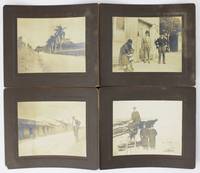
18905287Various locations in Cuba and Florida 1890. Very good. Twelve cabinet card photographs each measuring 3.5 x 4.5 inches on matching mounts measuring 5.25 x 6.5 inches all with manuscript captions on verso. Moderate dust-soiling minor overall wear a few small unobtrusive chips to corners. A dozen original photographs picturing a group of men traveling in Florida and Cuba around the turn of the 20th century. The men seem relatively well-to-do and visit several different locations in each place. Four of the photos emanate from Florida while the remainder picture scenes in Cuba. The photographs are all captioned on the verso which read as follows:<br /> <br /> 1 "In the Court of Ponce De Leon Hotel St. Augustine"<br /> 2 "A frozen fountain in St. Augustine Florida - the white is ice"<br /> 3 "Fishing in St. Augustine"<br /> 4 "A Tree in Tampa Florida where one tree runs up on another takes root up in tree then runs down & takes root in the ground again"<br /> 5 "A Street in Nevaelas Cuba"<br /> 6 "A Country Road in Cuba"<br /> 7 "Natives in Havana"<br /> 8 "In Morro Castle Havana Cuba. Prisoners braking sic rocks"<br /> 9 "On top of Morro Castle Havana Cuba"<br /> 10 "Country Scene in Cuba"<br /> 11 "Country Scene in Cuba" different image<br /> 12 "Plaza at south of the Prado Havana unknown
184635410Pensacola 1846. Letter. Very good. Letter. Folded to make 4 pages. 1 page of content 2 blank pages 1 page with address and postal mark from Pensacola Florida dated August 20 1846. Letter addressed to "Dear Sister" and signed "W Conway". Multiple folds and some creasing and toning to the paper. Red wax seal left edge page 1. Small paper tear from opening the letter. Good condition. Letter content summarized:<br /> <br /> US Frigate Potomac. W. Conway Pensacola Florida writes to sister Camden Goose River Maine while involved in the Blockade of Vera Cruz. USS Potomac sailed w/ships Cumberland Missippy sic Princeton Falmouth Truxton Somers Reefer Bonito and Petrel to mouth of river Alvarado off of Veracruz. Describes bombardment: “…the Commodore made rig to get spring word the cable to bring the broadsides to bear on the fort at 6 PM the firing Commenced and Continued about 2 hours we didi not land the next day we got under weigh and came back to our anchorage. we are waiting for orders from Washington to Attack the Castle of St. Juan Ola Fort San Juan de Ulúa offshore opposite Veracruz. unknown
18103213311810. unbound. very good. Three newspapers with pieces on the declaration of independence of West Florida.<BR> <BR> I: The Boston Patriot. Volume IV No. 19. 4 pages measuring 19 x 13-1/2 inches; minor horizontal fold bisecting all pages. Boston: Isaac Munroe November 3 1810. Lightly rubbed with some fading to the masthead but otherwise a clean clear and easily readable -- a very good copy.<BR> <BR> II: New-England Palladium. Volume 36 No. 48. Friday December 14 1810. 4 pages measuring 21 x 13 inches; minor horizontal fold bisecting all pages lightly toned and foxed but in very good condition. <BR> <BR> III: Portsmouth Oracle. Volume XXII No. 5. Saturday November 3 1810. Four pages measuring 19 x 13.5 inches. Usual folds with light toning and foxing contemporary ink notation upper margin. A very good copy.<br/> <br/> The Boston Patriot contains the declaration of independence of West Florida issued issued by John Rea president of the West Florida convention on September 26 1810. The New-England Palladium has public statements from President James Madison Secretary of State Robert Smith John Rhea etc. on the independence of West Florida. The Portsmouth Oracle has two pieces: an account of the seizure of the fort at Baton Rouge signed by Philemon Thomas and John Rhea and the official statement of independence issued and signed by John Rhea and the members of the Convention. West Florida made up of the Florida Parishes of Louisiana declared independence from Spain in September 1810 and was absorbed into the United States by mid December becoming part of the state of Louisiana.<br/> <br/> unknown
187937868Savannah: Morning News Steam Printing House 1879. 1879. FLORIDA GEORGIA. Sixth edition. 7 1/2" x 5" pictorial wrappers 80 pp. illustrated maps advertisements. A small green slip has been affixed to the title page advising the the Savannah Florida & Western Railway has purchased the Atlantic and Gulf Railroad Company and is now the successor. Folding map is of the Atlantic & Gulf Railroad and shows the lines from Savannah to Bainbridge spur to Albany and connections in Florida from Tallahassee to Baldwin and Jacksonville and to Cedar Key. The booklet describes stations and points of interest in southern Georgia and Florida as well as other railroads towns and points of interest in Florida and southern Georgia. Moderate wear to the spine rear cover becoming loose but still intact covers lightly soiled interior clean else a very good copy. Morning News Steam Printing House, 1879. unknown
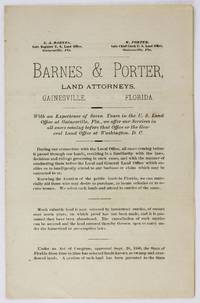
18903620Gainesville Fl: Daily Advocate Job Print 1890. Very good. 4pp. on a single folded sheet. Mild soiling minor toning old folds. A seemingly unrecorded real estate promotional leaflet issued by Louis A. Barnes and Watson Porter local land attorneys working in and around Gainesville Florida. The pair is seeking prospective purchasers for "much valuable" homestead lands now available for settlement again after being abandoned "under the homestead or pre-emption laws." They also offer services for claims on "Spanish Grants" land warrants soldiers' homestead rights and more. Interestingly one of the two lawyers here Watson Porter previously served as a surgeon in the Third U.S. Colored Troops. In Florida Porter and his wife Olivia established O.A. Porter's Addition to Gainesville selling lots exclusively to African-American people who did not have ready access to land or financing; the neighborhood survives today in Gainesville as Porters Quarters. Porter also served as the Principal of the Union Academy a freedman's school and was a strong supporter of Josiah T. Walls the only African-American man from Gainesville to be elected and seated twice to the U.S. House of Representatives. Some of the land and services in question in the present pamphlet were almost certainly provided to African-American settlers. The pamphlet was printed by the Gainesville-area Daily Advocate which operated in the area between 1884 and 1890. No copies located in OCLC. Daily Advocate Job Print unknown
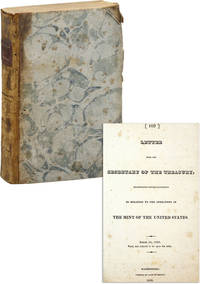
182045290Washington DC: Gales & Seaton 1820. First Edition. Fourteen volumes bound in one; contemporary sheep-backed marbled boards red gilt-lettered spine label. Boards rubbed and leather rather dried and flaking late 19th-century rubberstamp of the Patten Free Library to front free endpaper else Very Good internally fine. State papers covering a myriad of topics including a proposed law to deter kidnapping though the majority of the contents devoted to the cession of the Floridas to the Spanish government and the court martialing of Colonel William King Governor of West Florida. Contents as follows:. 1. William H. Crawford 109. Letter from the Secretary of the Treasury Transmitting Sundry Statements in Relation to the Operations of the Mint of the United States. April 10 1820. Read and ordered to lie upon the table. 6pp.; two folding table plates. SHAW & SHOEMAKER 3830.<br /> <br /> 2. John C. Calhoun 110. Letter from the Secretary of War Transmitting Pursuant to a Resolution of the House of Representatives of the 25th ultimo Statements of the Amounts and Costs of Goods Furnished Annually to Indian Trading Houses Since the Year 1815. Specifying also the kinds and quantities of furs &c. &c. annually received since that period of said factories. April 13 1820. Read and ordered to lie on the table. 4pp.; one folding table plate. SHAW & SHOEMAKER 3852.<br /> <br /> 3. Return J. Meigs Jr. 111. Letter from the Postmaster General Transmitting a List of Unproductive Post Roads for the Year 1819. April 14 1820. Read and ordered to lie upon the table. 20pp. SHAW & SHOEMAKER 3771. <br /> <br /> 4. John Quincy Adams 112. Letter from the Secretary of State Transmitting a Copy of an Act of the Legislature of the State of Pennsylvania entitled an Act to Prevent Kidnapping. April 18 1820. Referred to the Select Committee appointed on the 18th of March last to consider of providing more effectually for reclaiming persons held to service. 8pp. SHAW & SHOEMAKER 3775. <br /> <br /> 5. Louisiana Legislature 113. Memorial of the General Assembly of the State of Louisiana. April 18 1820. Referred to the Select Committee appointed on the 13th of January last to enquire into the expediency of continuing in force for a limited time "An act regulating the currency within the United States of the gold coins of Great Britain France Portugal and Spain and the crowns of France and five franc pieces" as relates to the gold coins of those countries. 4pp. SHOW & SHOEMAKER 3887.<br /> <br /> 6. Albert Gallatin 114. Regulations for the Granting of Land Under the Spanish Government of Louisiana and Mr. Gallatin's instructions to the land commissioners in Louisiana and Missouri. April 19 1820. Printed by order of the House of Representatives. 20pp. SHAW & SHOEMAKER 3936.<br /> <br /> 7. John Quincy Adams 115. Letter from the Secretary of State to the Chairman of the Committee on Commerce Transmitting documents shewing the proceedings of the Executive hitherto in negotiating with Great Britain in relation to the commercial intercourse between the United States and the British American colonies and with France in relation to the general commerce between that country and the United States. April 22 1820. Laid before the House by the Chairman of the Committee on Commerce and ordered to be printed. 55pp. SHAW & SHOEMAKER 3774.<br /> <br /> 8. American Society of the City of New York 116. Memorial of the American Society of the City of New York for the Encouragement of Domestic Manufacture. April 24 1820. Read and referred to the Committee of the Whole House to which is committed the Bill laying duties on sales of merchandize at auctions. 4pp. SHAW & SHOEMAKER 3878.<br /> <br /> 9. John Johnson Jr. 117. Memorial of John Johnson Junior. April 24 1820. Referred to the Committee of the Whole House on the "Bill to regulate the duties on imports and tonnage and for other purposes." 4pp. SHAW & SHOEMAKER 3866.<br /> <br /> 10. William H. Crawford 118. Letter from the Secretary of the Treasury Transmitting Statements of Importation of Goods Wares and Merchandize in American and Foreign Vessels for the year ending on the 30th Sept. 1818. March 22 1820. Read and ordered to lie upon the table. 96pp. SHAW & SHOEMAKER 3827.<br /> <br /> 11. John C. Calhoun 119. Letter from the Secretary of War Transmitting a Copy of the Proceedings of a Court Martial for the Trial of Colonel William King of the Fourth Infantry and Sundry Orders and Documents Connected Therewith. May 3 1820. Read and referred to the Committee of Military Affairs. 128pp. SHAW & SHOEMAKER 3834. <br /> <br /> 12. Jame Monroe 120. Message from the President of the United States Communicating the Correspondence Which has Lately Taken Place Between the Secretary of State and General Vives the Spanish Minister in Relation to the Treaty for the Cession of the Floridas. May 9 1820. Read and ordered to be printed by the House of Representatives. 32pp. SHAW & SHOEMAKER 3900.<br /> <br /> 13. James Monroe 121. Message from the President of the United States Communicating Translations of Letters from the Minister of Spain to the Secretary of State Received Since the Message of the 9th Instant. May 12 1820. Read and ordered to lie upon the table. 8pp. SHAW & SHOEMAKER 3901.<br /> <br /> 14. James Monroe 122. Message from the President of the United States. Transmitting a Report of the Secretary of State on the Subject of Claims of Citizens of the United States for Spanish Spoliations Upon Their Property and Commerce. May 12 1820. Read and ordered to lie upon the table. 4pp.; 27 folding table plates. SHAW & SHOEMAKER 3908. Gales & Seaton unknown
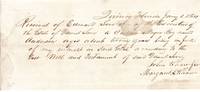
186413103Quincy FL: January 1 1864. 1p. of manuscript docketed on verso. Old crease minor staining. Very good. A short but impactful and somewhat unusual document memorializing the inheritance of a young slave named "Anderson aged about twenty years" from a Florida estate in the penultimate year of the Civil War. Anderson was formerly owned by Daniel Love of Gadsden County and is here inherited by "John Shaw for Margaret E. Shaw" by Love's executor and likely brother Edward Love. The document is dated New Year's Day 1864. An unusual occurrence of a Florida slave being transmitted to a woman through inheritance. January 1 unknown
1859354316St. Augustine: Kernan & Alba 1859. Large folding plate 50 x 5 inches short numbered key on verso of front wrapper. Original printed front wrapper rear wrapper lacking. Wrappers dampstained. Old tape marks on some folds. Folding view torn neatly in half. Moderate soiling and edge wear. Good. Large folding plate 50 x 5 inches short numbered key on verso of front wrapper. A large folding view looking towards St. Augustine from the Matanzas river. Executed by John S. Horton this is one of the variant issues with the key. It is possible the latter half of the key is lacking because only a portion of the buildings numbered are described in the text. "The drawing from which the woodcuts were made dates from the late 1850's; the names of several individuals are found in the St. Johns County census of 1850 and others are given in the 1860 census.The view was sold separately for many years and was apparently inserted haphazardly in various other works" - Servies. According to Servies Kernan & Alba were not printers but local pharmacists offering the item for sale. A nice Florida item. Not on OCLC. SERVIES 4398. EBERSTADT 128:249 Kernan & Alba unknown
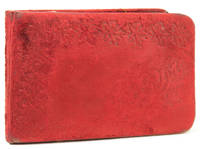
1896310060Ocala Fla 1896. Oblong 12mo. Red velvet over boards. Minor wear. Oblong 12mo. The album contains sketches some dried flowers letters and a number of ribbons including ones from C.C. Gold Camp the Florida State Teacher's Association and ribbons and receipts to the National Republican League convention in Denver in 1894 as well as a ticket to the top of Pike's Peak.<br /> Sketches include one of three Chinese children and 2 black children. Miss Green married Mr. Burnett in 1898. unknown
187823581Louisville KY: Richmond and Lousville Medical Journal Book and Job Steam Press 1878. Paperback. Mr. Livingston's signed copy of a pamphlet pertaining to Florida as a suitable "health resort" for Northern patients by Frederick Lente MD. Dr. Lente 1823 - 1883 was the primary surgeon at the West Point Foundry Cold Spring NY during the Civil War. He served at the Foundry from 1851 to 1870; later he was head of gynecology and children's health at the University of the City of New York and founder of the American Academy of medicine.<br /> <br /> Livingston was a member of a family of the Hudson River Valley which at one point owned some 900000 acres of land and about three dozen mansions in the area giving the area the nickname "Livingston Valley".<br /> <br /> 8vo 56pp errata slip bound in. Printed paper wrappers. Wrappers chipped at edges and marked. Good condition but fragile. OCLC: 1648852. Richmond and Lousville Medical Journal Book and Job Steam Press paperback
1854308253Tallahassee FL: Office of the Floridian & Journal Printed by Dyke & Williams 1854. First Edition. Hardcover. Very good. A nicely-bound volume collecting the Florida House and Senate proceedings for 1854–55.<br/> <br/> Each journal—the message of Governor James E. Broome to the legislature and a daily report of the activities of the legislative bodies—are followed by the same appendix of "Documents Accompanying the Governor's Message." <br/> <br/> House Journal pagination: 340 Journal 54 Documents pages.<br/> <br/> Senate Journal pagination: 337 Journal 54 Documents pages. With a final blank leaf. Contents generally very good no separate wrappers as issued. Pages tanned and foxed as usual. This volume is finely bound in three-quarter's leather and marbled paper-covered boards. The spine has raised bands and is stamped in gilt. A truly lovely period-style binding. Office of the Floridian & Journal, Printed by Dyke & Williams hardcover
1858361605Tallahassee FL: Office of the Floridian & Journal Printed by Jones & Dyke 1858. First Edition. Hardcover. Very good. With most of the legislature's time taken up with questions of infrastructure particularly the Florida railroad Governor Madision S. Perry uses his annual address to warn of coming conflict with the north and to encourage the spread of slavery. This is a nicely-bound volume of the daily legislative log and the accompanying state office reports. The session ran from November 22 1858 to January 15 1859.<br/> <br/> In his prescient call for funding a militia an action that the legislature does not appear to have discussed seriously Gov. Perry warns that "the late elections in the non-slaveholding States forebode no good to us in the South. He would be a false sentinel who under the present aspect of affairs would cry peace" pp. 27–28. He then observes that many White Floridians are ambivalent about slavery and he encourages the legislature to make changes in the law to encourage slaveholding another action the lawmakers seem to have not spent much time on.<br/> <br/> Another subject that Perry devotes time to is the forcible removal of Native Americans from Florida. After twenty years of conflict the federal government had recently declared victory and ended the war. Both the governor and the legislature make appeals in this document to continue the effort until all the Seminoles and other tribes are gone from the state.<br/> <br/> 456 journal 70 reports pages. According to the daily log the print run of this issue was 700 copies. Contents heavily foxed; title page laid down on paper; some loss to the margins; fifth gathering duplicated in error; corner loss to final leaves of the reports section with no loss of text. Finely bound in three-quarter's leather and marbled paper-covered boards. The spine has raised bands and is stamped in gilt. A truly lovely period-style binding. Office of the Floridian & Journal, Printed by Jones & Dyke hardcover
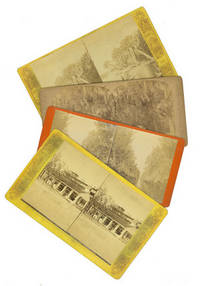
18802391081880. Albumen prints on thick printed card curved corners. A trifle dusty one card with adhesive burn else images near fine. Albumen prints on thick printed card curved corners. Views include Palemettos on the St. John's River St. Augustine market and entrance to the city a staged hunting scene with a heron and alligator a canals and a wagon hitched to a cow titled "The Lightning Express; Or the Team of a Florida Cracker". unknown