16 résultats
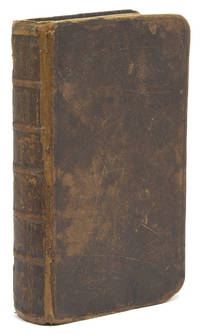
1796LV1892Edinburgh:: Printed by Schaw and Pillans for the Reverend Joseph Johnston 1796. 1796. Second edition. Volume II of III. Small 4to. 495 pp. Lacks front ffep; leaves soiled stained and a bit worn with small gutter tear near p. 6. Original full calf; extremities heavily worn. As is. Printed by Schaw and Pillans, for the Reverend Joseph Johnston, 1796. unknown books
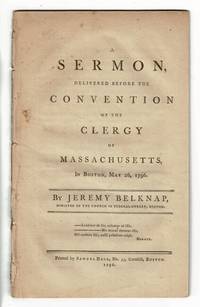
179657661Boston: printed by Samuel Hall no. 53 Cornhill 1796. 8vo pp. 29 1; removed from binding half-title wanting; very good. BAL 937; Evans 30052; Sabin 4438. <br/><br/> printed by Samuel Hall, no. 53, Cornhill unknown books
177027373Glasgow: Robert and Thomas Duncan 1770. Attractive original calf with raised spine bands light wear. 407 1 blank pp. Rear free endpaper torn contemporary ownership signature of Thomas Manning. Scattered light foxing modern bookplate Very Good.<br/>ESTC T74880. Robert and Thomas Duncan unknown books
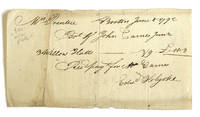
1792228522Boston 1792. 1 pp pen and ink on paper. 7 x 4 inches. Old folds minor tears VG. 1 pp pen and ink on paper. 7 x 4 inches. "BOT" OF A FORMER SPY. A quaint record of Federal era Boston which includes a handwrtiien list of 17 artisan and craftsman on the verso reading in part: "Receipt to Mrs. Prentice Bot of John Carnes Junr for 3 Willow Hatts 3/9 L11.3 rec'd pay't for. Edward Holyoke"<br/><br/>Edward Holyoke 1770-1802 was the son of famed Sale physician Dr. Edwrad Augustus Holyoke. <br/><br/>John Carnes Jr. was a failed minster turned shopkeeper and one of George Washington's earliest spies of the American Revolution. unknown books
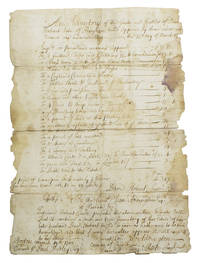
170817903Boston 1708. 1 vols. Folio. Folded some tears and repairs in margins and along folds some staining with smearing of ink but generally legible. 1 vols. Folio. Early Eighteenth-century Boston Probate. An interesting record showing the probate methods of early eighteenth century Boston from the listing of the goods including some "homespun stuff made by ye widow for her own ware" bedding and "wearing apparel" to the confirmation by the widow of the contents and presenting the listing for probate where the whole was copied the copies examined for accuracy and witnessed. unknown books
179911026Boston: John Russell 1799. 13pp stitched contemporary plain blue wrappers verso of front wrap and front endpapers heavily foxed as usual. Text clean crisp and Very Good. <br/><br/> "Surprisingly this is one of the most beautifully printed 18th century American pamphlets with a woodcut ship on the title page and a splendid variety of type fonts conservatively arranged." Jenkins. An early example of American incorporations. <br/>FIRST EDITION. Evans 35221. III Jenkins 887. NAIP w033188 4. 68 NUC 0676349 2. Not in Cohen. John Russell unknown books
1768WRCAM16469Boston: Mein and Fleming 1768. 8pp. newspaper. Somewhat soiled and slightly browned else good. An interesting issue of this Boston newspaper mostly devoted to the actions of Gov. Hutchinson and the Council with regard to a riot against Custom House officers and unrest over shipping in and out of Boston. Mein and Fleming unknown books
1752303500Edinburgh: William Duncan 1752. The Sixth Edition carefully corrected from the Author's Own Copy. viii 448 pp. 1 vols. Contemporary sheep front hinge repaired. VG copy. The Sixth Edition carefully corrected from the Author's Own Copy. viii 448 pp. 1 vols. William Duncan unknown books
1799WRCAM16528Boston 1799. 13pp. Woodcut of ship on titlepage. Blue wrappers. Front endpapers foxed else a very good copy. An early and scarce example of an act of incorporation for an American insurance company. Only two copies are located by the NUC. EVANS 35221. unknown books
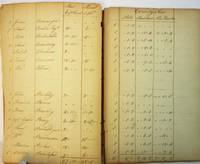
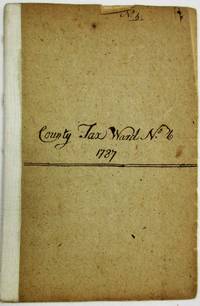
178726593Boston 1787. 5 1/2" x 8 1/2". 18 leaves each with vertical columns. 20 pages are completed in manuscript. Plain contemporary wrappers with inner margins and spine reinforced by tape; wrappers separated from text and the leaves are loose. Else lightly worn and Very Good. <br/><br/> This list of county taxpayers has names of more than one hundred residents; tables report their personal and real property assessments and their poll real estate and personal property taxes paid. A few of the people were Ebenezer Hancock younger brother of John Hancock and Deputy Paymaster-General of the Continental Army; Thomas Pemberton antiquarian and historian of the Revolution; James Tewksbury who had been a Minute-Man; Dr. Amos Winship a naval surgeon and acquaintance of John and Abigail Adams; Samuel Austin a Boston selectman in 1774. unknown books
178726656Boston 1787. 5 1/2" x 8 1/2". 18 leaves each with vertical columns. 22 pages completed in manuscript. Plain contemporary wrappers inner margins and spine reinforced by tape; wrappers separated from text several leaves loose. A clean and Very Good text. <br/><br/> This list of county taxpayers has names of more than one hundred residents; tables report their personal and real property assessments and their poll real estate and personal property taxes paid. Some well-known Revolutionary figures include Major William Bell Captain of the Ancient and Honorable Artillery Company; Benjamin Austin political writer; Jonathan Loring Austin secretary to the Massachusetts Board of War until October 1777; Capt. Nathaniel Goodwin of the 1st Plymouth Co. Regiment; and Dr. Thomas Welch one of the founders of the Massachusetts Medical Society and a surgeon in the Continental Army. Also listed are Dr. James Pecker first vice-president of the Massachusetts Medical Society and Dr. Joseph Whipple also a founder of the Massachusetts Medical Society. unknown books
1793218222Boston: Belknap and Hall 1793. pamphlet. good. Folio 4 pages light foxing lower right corner of front page with seven inch expertly repaired tear with partial loss of some words center fold repaired in margin. Boston: Belknap and Hall 1793.<br/><br/> An entire issue of a Boston newspaper with mostly political content. The American Apollo was only published from January 6 1792 to December 25 1794. The entire front page is an article by William Fox the political reformer pamphleteer and bookseller from London entitled " Thoughts on the Death of the King of France". Most of the 2nd and 3rd pages consists of a reprinting of a letter from Thomas Jefferson as Secretary of State to Gouverneur Morris Minister Plenipotentiary to France. Jefferson writes against French provocations during the "Citizen Genet Affair" and other maritime actions that go against George Washington's policy of neutrality during the War between France and Great Britain. Jefferson writes extensively of the visit of French Minister Edmond Genet to the United States including Genet's attempts to enlist American ships in Charleston South Carolina as privateers against English ships. Jefferson mentions frequently how opposed he is to Genet's actions in America.<br/><br/> Belknap and Hall unknown books
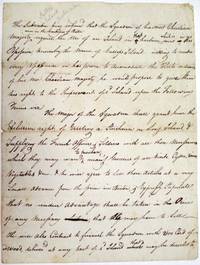
177832766Boston 1778. Unsigned manuscript document folded to 9-1/2" x 7-1/4". 2pp plus integral blank. 25 lines. Old folds light foxing Very Good.<br/><br/> "The Subscriber being informed that the Squadron of his most Christian Majesty now in the harbour of Boston require the use of an island in that harbour which is now in his possession known by the name of Gallops Island-- willing to render every assistance in his power to accomodate the Fleets or Army of his most Christian Majesty he would propose to give them his rights to the Improvements of said Island upon the Following Terms viz.<br/> "The major of the Squadron shall grant him the exclusive rights of Erecting a Storehouse on Long Island & Supplying the French Officers & Soldiers with all those necessaries which they may want to purchase ---- viands Groceries of all kinds. Cyder wines vegetables &c & he will agree to sell those articles at a very small advance from the price of Boston & expressly Stipulate that no undue advantage shall be taken in the Price of any necessary that he may have to sell.<br/> "He will also Contract to furnish the Squadron with 2000 Cord of wood delivered at any part of said Island that may be directed to at 28 Lives money of France per Cord payable upon the delivery of each 100 Cords.<br/> "He will supply the Squadron with any Quantity of Fresh water delivered along side the Ships at 7 deniers money of France per Gallon provided that there be no delay in hoisted the water from the Boats on Board the Ships of the Cask are furnished for Transporting the water in ------ here the document ends in the middle of page 2. <br/> Elisha Leavitt Jr. and/or James Brackett owned Gallops Island at this time; historical records are ambiguous. Some sources indicate that the French erected earthworks at Gallops Island in 1778 to defend their fleet anchored in the harbor; others assert that the earthworks were on George's Island bought by Leavitt Jr. in 1768. Leavitt was a Tory a fact well known in town: people burned down his barn and surrounded his home at one point. The story goes that the pleasant elegantly dressed Mrs. Leavitt invited the mob in for cakes and wine which calmed everyone down. unknown books
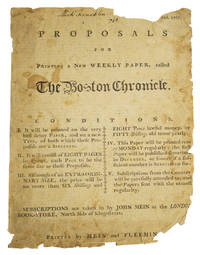
1767313300Boston: Printed by Mein and Fleeming 1767. 2 pp. prospectus printed recto and verso of a single sheet. 4to 10-1/2 x 8 inches. Damage at edges with loss to text month October missing from heading lower corner torn away with loss to"G" in Fleeming in imprint a few letters lost from right margin on recto and 12 lines affected on verso toned and stained. Signed "Mich. Franklin 1768" at top of recto. 2 pp. prospectus printed recto and verso of a single sheet. 4to 10-1/2 x 8 inches. Early American newspaper prospectus. Rare early American newspaper prospectus announcing publication of The Boston Chronicle a weekly Loyalist paper. "John Mein a bookseller was the publisher and John Fleeming the printer. With the beginning of the second year the size of the paper was enlarged to folio and it was publihsed every Monday and Thursday and was the first newspaper to be published twice a week in New-England. To avoid popular resentment of his political views Mein was forced to leave the country before the close of its second year and the paper was continued by Fleeming in the name of the firm until its publication ceased on the 25th of June 1770" Evans.<br/><br/>The five "conditions" listed on the recto detail the general design of the paper - that it will be printed on high quality demy paper with specially designed type 8 pages in quarto priced at 6 shillings and 8 pence printed every Monday and delivered to subscrribers with care. The verso with text in three columns outlines a plan of the contents of the paper including coverage of current events and issues essays on moral subjects notices on newly published books poetry etc. Ford Broadsides 1418; Shipton-Mooney 41736; Bristol B2787 recording 4 copie; Evans 10565 for newspaper Printed by Mein and Fleemin[g] unknown books
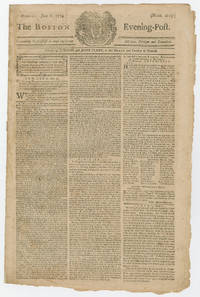
177424806<p>Early report in the local Boston newspaper on implementation of Parliament's Boston Port Act the first of the Intolerable Acts and the reaction to it in Massachusetts and beyond. Taking effect on June 1 1774 rather than punishing individuals the Act besieged the entire city until the colonists paid for the tea destroyed in the Tea Party December 16 1773.</p><p>"<i>the Act of Parliament for blocking up the Port of Boston is now in all its Parts carrying into Execution with the greatest Severity many Vessels being already prevented from coming in and Fishing boats and other small Craft strictly search'd; so that we have reason to expect that in a little time this Town will be in a truly distressed and melancholy Situation.</i>" p3/c1</p> <b>BOSTON PORT ACT.</b>Newspaper. <i>The Boston Evening-Post</i> June 6 1774 No. 2019. Boston: Thomas and John Fleet. 4 pp. 9¾ x 15⅜ in.<p><br /></p><p>The majority of this paper is devoted to patriotic content. The front page features a series of Questions and Answers from New York "<i>being conceived in some measure calculated to advance the cause of freedom in the present critical situation of affairs.</i>" It goes on to note that "<i>A Congress of Deputies from the several Colonies is thought to be absolutely necessary to devise means of restoring harmony between Great Britain and the Colonies and prevent matters from com</i>ing <i>to extremities</i>" p1/c1-2.</p><p>"<i>A Friend to Mankind</i>" wrote to the publishers "<i>When I first read the barbarous Act for shutting up the port of Boston; an act made with the pious design to starve the poor; make the industrious idle; the happy miserable; and as an entering wedge to the horrid purpose of enslaving America although I was transported beyond measure I could not help reflecting that bitter as it was for the present it would absolutely be of happy tendency to America in the result.</i>" p2/c1.</p><p>This issue prints a May 25 address from 33 Marblehead loyalists congratulating Massachusetts Gov. Thomas Hutchinson on his administration and wishing him a safe return trip to Great Britain p1/c3. On the other hand a public meeting in Marblehead denounced the address and declared Hutchinson "<i>an inveterate Enemy to the Liberties of the Province</i>" p2/c3.</p><p>This issue also announces from Boston "<i>the Corporation of <b>Harvard College</b>have voted that considering the present dark Aspect of our public Affairs—There be no public Commencement this Year—and that the Candidates for the first and second Degrees shall receive their Degrees in a general Diploma</i>" p3/c1. On May 1 1775 less than two weeks after the Battles of Lexington and Concord the faculty of Harvard dismissed the undergraduates early for the summer vacation again without a public commencement. Classes did not resume until October in Concord twenty miles away where students boarded with local residents and college courses were held in a deserted grammar school the courthouse and the First Parish meetinghouse. Meanwhile the five buildings of the college's campus in Cambridge housed 1600 American soldiers. After the British surrendered Boston in March 1776 and the American troops moved south to defend New York the college was permitted to reoccupy its buildings in June. Of 190 freshmen entering between 1775 and 1778 only 30 left prior to graduation.</p><p>An advertisement is included for a just-published pamphlet <i>Observations on the Act of Parliament commonly called the Boston Port Bill with Thoughts on Civil Society and Standing Armies</i>p2/c1. From September 1774 to March 1775 Josiah Quincy II 1744-1775 was in England arguing the American cause to sympathetic British politicians. He died of tuberculosis on the return voyage within sight of Massachusetts.</p><p><b>Historic Background</b></p><p>Relief for Boston was sent from as far away as South Carolina and the First Continental Congress convened in Philadelphia three months later to coordinate a colonial response to the Intolerable Acts.</p><p>Parliament finally repealed the Boston Port Act in 1783 after fighting ceased in the American Revolutionary War but before the Treaty of Paris officially ended the war and recognized American independence.</p><p><b>Condition</b></p><p>Near fine; several professional mends to gutter margin. A bright and attractive issue of an important colonial newspaper.</p> Thomas and John Fleet books
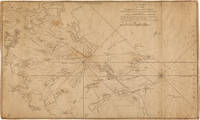
1800WRCAM52103London: R. Laurie and J. Whittle 1800. Engraved map sheet size approximately 21 x 34 3/4 inches. Backed with linen. Mid-19th-century ownership inscription near title. A few small chips and minor closed tears at edges light soiling and scattered faint foxing. Very good. Framed. An extremely scarce nautical chart of Boston Harbor from the second edition of the important 18th-century American atlas the NORTH AMERICAN PILOT. The chart depicts the state of the harbor just after the start of the Revolution having been reprinted from the first edition published in 1776 and 1777. The Boston peninsula and the "Ruins of Charlestown" are located in the west / far left of the chart area which follows the mainland coast as far south as Dorchester and Milton and out to Point Shirley and the Shirley Cut to the northeast in the upper center of the image; the Hull peninsula and Point Allerton are also visible in the lower right-hand quadrant of the map. In the center of the chart are the numerous islands that dot Boston Harbor as well as depth measurements and clearly marked shallow areas such as the shoals formerly known as the Dorchester Flats now a populated area of reclaimed land. Additionally there are a number of guidelines showing the best routes through the harbour to various points and markings for various points on land to aid in navigation. <br> <br> The second edition of the PILOT contained seven more maps than the first for a total of seventeen charts of which this plan of Boston Harbor was the seventh. The first edition was published by Robert Sayer and John Bennett who were succeeded by Laurie and Whittle before the publication of this atlas. The original chart engravings were executed by Thomas Jefferys. Rare in any form or edition OCLC traces only one copy of this individual map from the 1800 printing located at the State Library of Massachusetts. OCLC 843954569. PHILLIPS ATLASES 1220 ref. HOWES J84 ref. SABIN 55557 ref. R. Laurie and J. Whittle unknown books