9 résultats
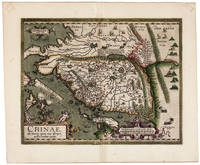
1606602014 3/8 x 18 3/8 inches. Fine original hand color; slight split at centerfold fine condition. <br /><br /><p>A brilliant example in rich original hand color of the rare and only English language edition of the earliest printed folio-size western map specifically of China and "the first to show the Great Wall"Nebenzahl. "This map remained the standard type for the interior of China for over sixty years" Tooley. Although 2 pocket-sized English language editions of an abbreviated version of Ortelius' <i>Theatrum</i> entitled <i>Epitome</i> were published previously in 1601 and 1603 with brief texts in English the English text in the present edition runs to 2 large folio pages printed on the back of the map giving an extensive description of China drawn from recent publications of observations by European travelers to the area particularly Jesuits. With its three lushly designed cartouches and many illustrations of indigenous shelters modes of transportation i.e. the famous wind wagons and animals this is one of Ortelius's richest engravings and among his rarest. </p><p>Nebenzahl <i>Mapping the Silk Road and Beyond </i>4.6; van der Krogt 8410:31:051; Tooley <i>Maps and Mapmakers</i> p. 106 pl. 78 p. 108; Walter <i>Japan: A Cartographic Vision</i> 11F p. 186.</p>
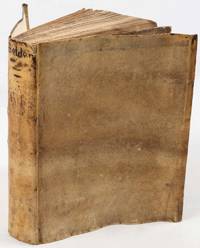
1618214886London.: No pubisher. 1618. 6 xxii 12 491 5 pages title page printed in red and black dedication preface contents references errata 18.4 x 14.8 cms endpapers renewed with the original front endpapers laid down aged-toned and chipped title-page toned and a little faded upper corner chipped with the inked owners' inscription of Thos. Bryan Richards 1798 and Wm. Cooke early inked marginalia and underlining; contemporary hollow-backed vellum manuscript author and title on the spine tidemark to the lower corner of the text leaves affecting the margin only a good sound copy. First edition of an antiquarian classic by John Selden 1584-1654 eminent jurist polymath prolific scholar and in recent times celebrated for his ownership of the earliest surviving Chinese merchant map of East Asia re-discovered with justifiable fanfare as a treasure of the Bodleian Library by Robert Batchelor in 2008. <br> <br>At the time of its release Selden's "The History of Tithes": "gave great offense to the clergy and was vigorously refuted in a number of volumes to which Selden was forbidden the right to print replies" Pforzheimer. It has been noted that the absence of the printer's name and the place of publication showed that Selden anticipated an unfavourable reaction to his denial of divine right of tithes. He was not disappointed. The work was suppressed and Selden was forced to apologize for having given offense-- and the book was withdrawn from circulation. His work was much studied: this copy with early marginalia: "by this Historie the Right of tithing belong not to ye profession of ye Canonist Civilian or Divine but with Lawyers." the last three words hastily crossed out. <br> <br>Early owners include London Antiquary Thomas Bryan Richards whose extensive Library was sold by King & Lochée in 1812. . [No pubisher, hardcover
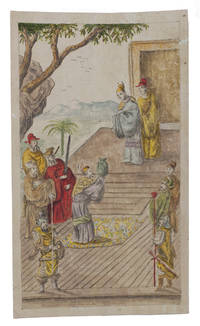
1670E9PF9I9C81WOChina 1670. A series of 8 Chinese drawings ca. 24 x 14.5 cm: 5 coloured 1 also highlighted in gold showing scenes from a Chinese novel many military or diplomatic plus a Chinese watercolour drawing and a Japanese woodblock print. A series of 8 pen and ink drawings 5 coloured 1 also highlighted in gold drawn from Chinese books possibly the 14th-century Sanguo yanyi or Romance of the Three Kingdoms. All mounted on European paper 6 on 3 different patterns of decorated paper. The paper of the drawings ranges from 23.5 x 14 cm to 24 x 15 cm. They show the following outdoor and indoor scenes:1 2 warriors on horseback one of whom has just beheaded the other and carries his head away the beheaded warrior has not yet fallen from his horse while his superior watches on horseback with 2 attendants.2 a man standing with a spear in the prow of a boat while 2 men and a woman sit at a tea table in the boat which flies a flag and pennant.3 5 people on 2 boats one flying a flag and pennant.4 4 soldiers bringing a woman to a dignitary at his house.5 a delegation visiting a dignitary.6 2 men playing go with 4 attendants and a guard.7 a dignitary at a writing table with attendants and visitors.8 a seated dignitary with 6 standing figures 1 with a document at a table.In the backing paper of number 7 one can make out an Amsterdam coat of arms watermark. It is difficult to see clearly but seems to follow the general style of Laurentius 71-95 1662-1675. The 3 patterns of decorated backing paper show: a flower pattern printed in gold on green; 2 patterns with more abstract decorations in a diamond pattern printed in gold on white.With this series we include a watercolour drawing and a woodblock print:9 watercolour drawing of irises along a stream with hills in the background 17 x 22.5 cm.10 rectangular woodblock print of a Samurai at a tea ceremony 14 x 10 cm possibly derived from a Japanese book.Some edges of the drawings a little frayed but otherwise in very good condition. unknown
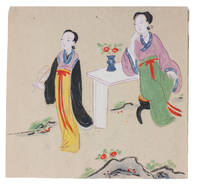
1655E9PFZ6Y3Z0MCChina 1655. Colour drawings 3 ca. 28 x 18 cm the 4th cut down to 16.5 x 17.5 cm apparently showing Manchurian scenes. A series of 4 colour drawings of Manchurian scenes. All mounted on Dutch paper probably from the period 1650-1660. The paper of the drawings themselves ranges in three cases from 27 x 16 cm to 30 x 19.5 cm; the fourth has been cut down to 16.5 x 17.5 cm. The drawings show the following all outdoor scenes:1 a dignitary on horseback with his attendant on foot carrying a parasol.2 2 ladies 1 holding the other's sleeve with a flowering tree and an octagonal stone basin.3 a lady with a flowering plant in a basket with a deer at her side.4 2 ladies: 1 with a fan; the other leaning on a table with a vase of flowers.All 4 backed with matching European paper watermarked with a 7-point foolscap above "4" and 3 balls. The closest matches in the literature Laurentius 431-437 especially 431 and 435 date from 1651 to 1658. unknown
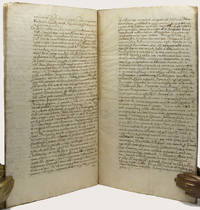
162134518Lisbon and Hangzhou China: Manuscripts ca.1623 and 1621. Very Rare A Similar Manuscript Exists in Brussels. We know of no others. The Latin text of both letters is written in a neat uniform cursive hand in brown. Folio leaves 33 x 20.5 cm The transcripts bound in 18th Century stiff blue wrappers the blank paste-downs and endpapers are late 18th century most likely the third quarter between 1745/1753 and 1776 since they contain a clear "lion/vryheit/pro patria" watermark with a crowned GR countermark which resembles Heawood 3148 3149 and 3154. The paper used for the manuscript contains a faint double-headed eagle watermark and it has been reinforced in the gutters. A very pleasing survival very well preserved edges slightly mellowed the wrappers show some signs of wear. VERY RARE MANUSCRIPT TRANSCRIPTS. Chrysostomus Johann Gall 1586-1643 was a German Jesuit and scholar. He left Ingolstadt Germany to teach astronomy mathematics and navigation in Lisbon fro 1620to 1627 before leaving to work in the Jesuit missions in India. The Colégio de Santo Antŕo benefitted from the arrival of many foreign mathematicians and other scholars as Lisbon serves as a gateway for all missionaries departing for Asia. The original letter by Gall was written in Lisbon September 1623 and concerns a newspaper style description of various events including details of the perseution of Christians in Japan particularly the execution of large numbers of the Christian community in Nagasaki in 1622.<br> The second letter in the present work is especially interesting as the original was written by Johannes Terentius also known as Johannes Schreck an Deng Yuhan Hanpo 1576-1630. Terentius was a prominent Jesuit scholar specialized in natural science and mathematics. Before joining the Jesuits as a novice1611 he already enjoyed a grea reputation in Germany as a scholar. In 1621 Terentius left for China to join the Jesuit mission. The original letter by Terentius was written in Hangzhou China on 30 August 1621 to the rector of teh Jesuit College in Munich Jakob Keller 1568-1631. He discusses his journey to China which he started in 1618 his intentions to participate in the planned calendar reform in China and his impressions of the city of Hangzhou which he reached in 1621 Terentius wrote several works on european medicine mathematics and technology in Chinese and together with Johann Adam Schall von Bell and G. Roho introduced European tigonometry and European astronomical instruments to China. In 1629 he began to reform the calendar which J.A. Schall von Bell ocmpleted after Terentius' early death a year later.<br><br>Backer & Sommervogel VII col. 1929-F<br> Manuscripts unknown
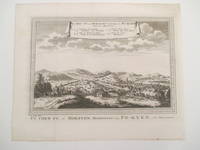
167156331Atlas Chinensis; Being a Second Part of a Relation of Remarkable Passages in two Embassies from the East India Company of the United Provinces to the Vice-Roy Singlamong and General Taising Lipovi and to Konchi Emperor of China and East Tartary. John OGILBY. 1671. This fascinating copperplate engraving comes from a famous work originally published in Dutch by the trade diplomat Jan Nieuhoff translated into English by the British mapmaker and publisher John Ogilby. The images provide a document of early western contact with China and come from the account written by the diplomat Jan Nieuhoff who was the steward of the first Dutch trade Ambassadors to China. The Dutch East India Company was keen to persuade the Emperor to open up the Chinese ports to the Dutch and Nieuhoff joined Pieter van Goyer and Jacob de Keyser on the mission to visit the Emperor Chun-Chi. The work includes many remarks on Chinese manners and customs together with a second part comprising a general description of the Chinese Empire. The fine plates and illustrations show town views in China Tibet and Tartary together with subjects such as costumes and natural history. Atlas Chinensis is a superb work on China noteworthy not only for text bringing notice of the mysteries of the East to English readers but for the magnificent engraved illustrations and plates. Copper engraving. Very good condition; some light age toning of sheet and slight foxing not affecting the image; a crease along the centrefold and tear to the bottom margin. Uncoloured. Size: 36 x 29 cm. 14 x 11½ inches unknown
167156329London 1671. This fascinating copperplate engraving comes from a famous work originally published in Dutch by the trade diplomat Jan Nieuhoff translated into English by the British mapmaker and publisher John Ogilby. The images provide a document of early western contact with China and come from the account written by the diplomat Jan Nieuhoff who was the steward of the first Dutch trade Ambassadors to China. The Dutch East India Company was keen to persuade the Emperor to open up the Chinese ports to the Dutch and Nieuhoff joined Pieter van Goyer and Jacob de Keyser on the mission to visit the Emperor Chun-Chi. The work includes many remarks on Chinese manners and customs together with a second part comprising a general description of the Chinese Empire. The fine plates and illustrations show town views in China Tibet and Tartary together with subjects such as costumes and natural history. Atlas Chinensis is a superb work on China noteworthy not only for text bringing notice of the mysteries of the East to English readers but for the magnificent engraved illustrations and plates. Copper engraving. Very good condition; some light age toning of sheet and slight foxing not affecting the image. Uncoloured. Size: 30 x 22 cm. 12 x 8½ inches unknown
163515590AB1635. ca. 1635. 245 : 30 cm Cooper engraviing by G.v. Schley after Montanus. unknown
169442217Amsterdam Gerardi Valk et Petri Schenk n.d. around 1694. 465 x 52 cm. Engraved map China in orig. handcolouring. Showing all the Chinese provinces Korea and the island of Formosa in the south. Ships in the sea and cartouche with Chinese costumes. A small rupture in a border due to etching from the colour used no loss. Left margin with a small tear no loss. Right very broad margin with a tear not reaching the image. <br/><br/><em>This fine decorative map was first printed in "Atlas Novus" by J. Janssonius in 1658. This issue bearing the names of Valk and Schenck was published around 1694. </em> unknown