105 résultats
19184224Shanghai: Presbyterian Mission Press 1918. First edition. Near Fine. Quarter cloth over pictorial drab boards. Early ownership signature to upper front board and some faint soiling mostly to spine and edges. Textblock firm and square measuring 210 x 130mm. Internally a surprisingly fresh copy collating complete with adverts to front and rear: 12 138 16. Introducing a range of "native products" to Americans living in the region the cookery reflects a growing need for nutritious recipes and supply chain substitutions in wartime. The sole copy on the market OCLC reports only 7 copies.<br/><br/>The only Chinese-published cookbook "to deal only with native products and recipes that could be made from them." In their preface to this new cookery the committee for the Women's Auxiliary explains in clear terms what sets their cookery apart. "This book was definitely war product. It was prepared with two ideas in view: that of utilizing local products as substitutes for the home imported foodstuffs and secondly that of reducing the cost of living. It was different from all other cook books that had been published in China for foreigners' use in that it dealt only with native products and recipes that could be made from them." While some recipes are titles in English only the compilers included Cantonese translations wherever possible in addition to including a glossary at the rear called Hints for the Housekeeper as well as a List of Terms Necessary in Food Preparation which both provide translations and pronunciations for Cantonese words related to food and household cleaning products. During and after WWI Shanghai had become a space of rich and problematic interactions between cultures. In addition to rising Western military forces its reputation as the "Paris of the East" drove in American and British tourists while later large residential areas were being built in the north due to war concessions. Opium smuggling prostitution and a spreading wealth gap caused friction. The Women's Auxiliary composed of intelligent and educated members with a cultural appreciation for these fluctuations as well as for the culture into which they had migrated sought to use the kitchen as a positive space for the exchange of food language and ideas. Near Fine. Presbyterian Mission Press unknown books
1940006910Helsinki Finland: Suomalais-Ugrilainen Seura 1940. Two volumes in original dustjackets. Both volumes are Fine Vol.I dustjacket Very Good 1 1/2" triangular chip bottom edge at spine tears at spine folds and 2 tears horizontally at spine Vol. II jacket Near Fine small chips bottom edge of spine. List of donors laid in. One folding plate map index 15 folding maps at rear Vol. II. Numerous black and white photographs in text. A classic scholarly text ''In the spring of 1906 I received orders from the Russian General Staff to undertake a journey from Russian Turkestan through Chinese Turkestan and Western China and the provinces of Kan Su Shensi and Shansi to Peiping as the final goal. The object of this expedition was to study the conditions in the interior of Northern China collect statistical materials and perform various tasks of a military nature'' Preface. Mannerheim also collected archaeological and ethnographic materials and manuscripts and studied little-known peoples and tribes in Norther China. Mannerheim later became the 6th President of Finland after serving as Commander-in-Chief of the Finnish armed forces during WWII. . First Edition. Cloth. Fine/Very Good. Folio - over 12" - 15" tall. Suomalais-Ugrilainen Seura Hardcover books
1940008960Tientsin China: Reprinted in China 1940. Four volumes bound in blue/grey cloth Good the cloth worn and soiled one hinge each in Vols. I and II and both in Vol. IV broken the bindings still holding well. Faint damping bottom edges Vol. III. Interiors clean and unmarked. Prior owner name stamp of Richard W. Powell noted University of Hawaii anthropologist. From the collection of noted East Asian scholar Ruth Meserve her business card for The Mongolian Society which she served as Secretary laid in. The 1940 Chinese reprint of the original 1834 first edition SCARCE in either edition. The first serious study of Genghis Khan. Three folding genealogical charts one in Vol.I and two in Vol. IV; large 1824 folding map of Asia in the13thcentury in pocket at rear of Vol. IV. The charts and the map are Fine. A sturdy and usable set of this important history. . Reprint. Cloth. Good/No Jacket. Small 8vo - over 7¾" - 9¾" Tall. Reprinted in China Hardcover books
1936318267N.p. China 1936. illustrated from photographs. 50 pp. 1 vols. Square 12mo. Green cloth titled in gilt. Very good plus minor wear and soiling to cloth. Chinese bookseller's ticket at back. illustrated from photographs. 50 pp. 1 vols. Square 12mo. Only known copy. Only known copy of this engaging account of the month-long cruise of the Lark in the Woosung mudflats in November and December 1935. The party comprised four sportsmen Len Biggs the chronicler Bob Biggs Bob Whitmore and Dick Martin and a crew of four and their bag was more than 200 birds shot and retrieved chiefly duck and teal. The party travelled on the motor cruiser Lark with a sailing sampan Victor and converted lifeboat Marion in tow. The book takes the form of a diary with notes on expenses and other practical aspects of organizing the outing. Biggs acknowledges H.T. Wade's With Boat and Gun in the Yangtze Valley 1895; 2nd ed. 1910: "Although the enormous flocks of geese swan and duck that used to be a really wonderful sight seem to have decreased in numbers considerably there are still ideal spots for the wildfowler to shoot from still so many bird ." <br/>The typesetting and paper points to a local Chinese production and a handful of typographical errors are lightly corrected in pencil.<br/>RARE and interesting. Not in OCLC unknown books
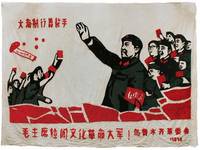
196716838Urumqi XinJiang Uyghur Autonomous Region: Cultural Revolution Committee of Urumqi / Xinjiang Army Divisioni 1967/8. Two extraordinary hand-crafted parade banners ca. 110" x 84" 9 feet x 7 feet one slightly smaller. Each entirely composed of hook-work with colored yarns on white muslin backing. Slight age-toning and soil; a few threads loose but no significant losses; Near Fine condition overall. Folded and stored in original velvet draw-string carrying bags as found. Both banners bear the inscription "Chairman Mao Reviewing the Great Army of the Cultural Revolution" and depict the August 1966 mass rally at Tiananmen Gate where more than 10 million Red Guards from all over China converged to express their solidarity with Mao and his second-in-command Lin Biao. Additional text on the lower banner reads "Long Live Chairman Mao for ten thousand years" and "Sailing in the ocean requires a helmsman" -- both quotes from Lin Biao. The agencies responsible for the banners are identified in lower right of each: "Cultural Revolution Committee of Xinjiang Army Division 1968" upper banner and "Cultural Revolution Committee of Urumqi 1967" lower. <br/><br/>The presence of Biao the figure to the right of Mao holding the Little Red Book in the top banner is of particular interest. Biao compiler of The Quotations of Chairman Mao popularly known as the "Little Red Book" and coiner of the phrase "Maoism" was probably more responsible than any other figure for creating the cult of personality around Mao particularly at the time of the Cultural Revolution. He quickly ascended Party ranks and was widely seen as Mao's obvious successor. But in 1971 Biao was exposed in the process of an apparent coup attempt the details of the event have never been made public. He died in an airplane crash attempting to leave China and from this point forward was officially condemned as a traitor by the Communist Party; any record of his achievements on behalf of the Revolution was expunged from the official record and any positive image of Biao would have been confiscated and destroyed as a matter of course -- suggesting either that these banners left China prior to 1971 or that they remained out of sight until some later date. The second possibility is plausible given whence the banners issued - both were created by Red Guard branches in the Xinjiang Uyghur Autonomous Region an extremely remote province in China's northwest corner and for many years the center of a militant independence movement for Uyghur and other Turkic minorities. In any case the precise manner in which these banners left China will likely never be known; they surfaced at a New England antiques show in 2011. Cultural Revolution Committee of Urumqi / Xinjiang Army Divisioni unknown books