GERMAN FORCES IN CHINABiblio.com
154 résultats
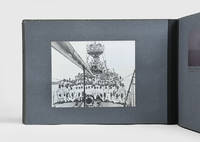
1898178920China Japan and at sea: 1898-99; 1911-13. The "scramble for China" An important visual record of Germany's empire-building in China and naval life in East Asia before the First World War including early views of Qingdao. It was assembled by Hermann Mörsberger a future rear-admiral who served at Kiautschou Bay during the 1897-8 crisis and commanded the East Asia Squadron's SMS Nürnberg between 1911 and 1913. The murder of two missionaries in Shandong in 1897 offered Germany an excuse to deploy troops to Kiautschou Bay and press its case for a concessionary area - and strategically positioned port - on Chinese soil. Attached to the Matrosenartillerie-Detachement Kiautschou as a leutnant zur see Mörsberger 1872-1940 shipped out to China in late 1897 on the screw steamer Darmstadt. The ship's arrival off Qingdao in January 1898 and the rapid deployment of its marines confirmed Germany's de facto control of the territory and left the Qing government with little option but to grant a concession. The first album opens with a photograph of Darmstadt and superb photographs of the cruiser SMS Kaiserin Augusta - ordered to China to brandish its dozen guns - and other powerhouses of the squadron including Cormoran Irene and Prinzess Wilhelm. Images show the parade on 27 January 1898 to welcome the future governor Rear-Admiral Ernst Otto von Diederichs 1843-1918 and Qingdao's artillery dump and yamen. Missionaries were hot on the navy's heels the album containing a group portrait of Joseph Freinademetz and other visiting Catholic missionaries in February 1898 as well as several pieces of red paper with their Chinese and Western signatures. After the legal takeover of the concession Mörsberger transferred to Kaiserin Augusta visiting Shanghai Hong Kong and Tokyo. More standard tourist views of Shanghai including a nicely composed image of a junk moored in the river are arranged alongside photographs of the unveiling of the city's ltis Monument on 21 November 1898. In a more relaxed moment Mörsberger poses playfully with other junior officers. German power did not take long to bed in. Within a decade and a half Mörsberger - now a fregattenkapitän - returned to Qingdao with Nürnberg a Königsberg-class light cruiser and the squadron's newest member. A panorama shows the armoured cruiser SMS Scharnhorst the flagship of squadron commander Count Maximilian von Spee docked in newly built facilities the recently christened Prince Heinrich Hill in the background. Nürnberg moves between ports as part of its Yangtze patrol duties Mörsberger obtaining panoramas taken from the river of Shanghai Zhenjiang Jiujiang Nanjing and Hankou as well as shots of other squadron vessels. Alongside official events including the welcoming of official dignitaries and the parade to celebrate the 25th anniversary of the Kaiser's coronation there is time for tourism parties and an international rowing contest. Four unusual photographs capture the illuminated buildings of Shanghai at night. A small proportion of material concerns Japan Thailand Honolulu and Mexico. Many of the professionally executed photographs concerning China were clearly circulated only within the German military and in small numbers. 2 albums landscape folio. With 195 mounted albumen platinum and gelatin silver photographs including 31 large portraits and views c. 145 x 205 to 205 x 280 mm 26 panoramas c. 90 x 290 to 110 x 340 mm and 138 small photographs c. 55 x 80 to 145 x 210 mm. Together with other laid-down material: 17 items of printed ephemera documents menus etc. 14 ms. items some in Chinese ms. map watercolour 110 x 140 mm. With 4 ms. maps printed map photographic panorama and printed passport loosely inserted. Neat German captions. First album: original black half sheep green cloth sides decorative linings card leaves hinged with black cloth. Second album: original green cloth lettered "S.M.S. Nürnberg" in gilt on front cover decorative linings black cloth rear pocket card leaves hinged with black cloth. Material well preserved occasional offsetting fading and yellowing to some photographs but detail still readily discernible one photograph splitting along old horizontal fold binding of first album worn second sunned and with a few abrasions: very good. hardcover
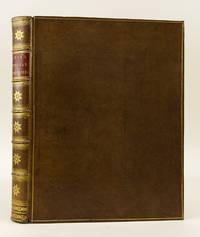
1803ST15927London: Cadell and Davies 1803. ONE OF 60 LARGE PAPER COPIES of the "considerably enlarged" Fourth Edition ours a variant retaining the date of 1803 on the title-page rather than 1804. 330 x 252 mm. 13 x 9 7/8". xviii 4 xix 1 380 pp. Two leaves usually bound at the end and containing the "List of Principle Books Referred to in this Work" and "Works by the same Author" bound between pp. xvii and xix here. <br/> VERY FINE CONTEMPORARY SPRINKLED CALF raised bands flanked by plain and decorative gilt rules and chain roll spine panels with star centerpiece red morocco label marbled endpapers. With six engravings: five maps two folding and one view. A Large Paper Copy. Front pastedown with engraved armorial bookplate of Marcus Gage; title page with ink inscription at head: "M. Gage's Book got from Mr. Asperne London April 15th 1805." Lada-Mocarski 29 note; Howes C-834; Sabin 17309; Streeter VI 3501; Cordier Bibliotheca Sinica pp. 2447-48. ◆Small chip to tail of spine corners a bit rubbed flyleaves somewhat foxed the usual minor foxing to plates and a bit of offsetting to adjacent pages otherwise A VERY FINE COPY OF AN ESPECIALLY DESIRABLE EDITION clean and fresh internally with vast margins and the binding firm lustrous and with only very minor wear to the joints.<br/> <br/> This is an extremely well-preserved copy in an elegant contemporary binding of the most sought-after edition of a key source on Russian exploration and that country's efforts to expand trade with China and Alaska. Eminent historian William Coxe 1747-1828 studied the voyages and exploration by Bering and others to the regions of Kamchatka the Aleutian Islands and Siberia to prepare this overview of the geography and cultures of the lands between Russia and North America and to analyze the economic potential of trade--particularly in furs--with the region. According to Sabin "Mr. Coxe's book contains many curious and important facts with respect to the various attempts of the Russians to open a communication to the New World." The 1780 first edition of this work covered Russian voyages of discovery between 1740 and 1769; the 1787 third edition added a supplement comparing these explorations to those of Captains Cook and Clerke. Our much-expanded fourth edition gives in the words of the Preface "a complete series of voyages from 1711 to 1792 comprising all that is known on the subject." Some of this supplementary information was gleaned from earlier accounts by German historians G. F. Muller and P. S. Pallas and some from Coxe's own travels in Russia. According to Lada-Mocarski Coxe "also succeeded in securing additional material: for instance the narrative and maps of Krenitzin and Levashev's 'secret' expedition the first official Russian government expedition since Bering's 2nd expedition of 1741. He was able to secure this particular information not widely known at the time even in Russia from Dr. Wm. Robertson who in turn obtained it through his friend Dr. Rogerson first physician to the Empress Catherine II. . . . In view of the above additions one should consider the fourth edition of 1803 as the most desirable." He concludes: "Coxe's work particularly the fourth edition is a result of contemporary and authoritative sources translated into English not to be overlooked by scholars and collectors alike." There are also distinct aesthetic advantages to the present Large Paper version over the octavo printing. Not only is the type beautifully re-set and laid out as well as surrounded by vast margins but as Streeter notes there are two charts here that are not included in the octavo issue of 1803. The original owner of this volume Marcus Gage is known to have assembled a substantial library of beautifully cared-for books on travel and discovery see for example "Exploration & Discovery 1576-1939 Books from the Library of Franklin Brooke-Hitching" passim. Gage notes that he got the book from "Mr. Asperne"—no doubt the London publisher and bookseller James Asperne 1757-1820. ABPC and RBH find just four other Large Paper copies at auction in the past 45 years two of which had condition issues. One could wait a considerable time to find a copy as attractive and desirable as the present one. Cadell and Davies unknown
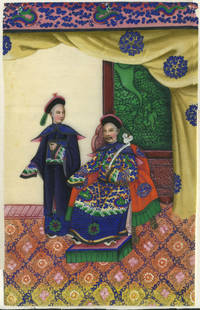
187027200China 1870. Fine. A splendid series of pith paintings from the Doheny collection. The watercolor and gouache paintings are splendidly preserved displayed and housed. The bookplates of Carrie Estelle Doheny and Edward Laurence Doheny are mounted on acid free board which sits atop the images and the totality fits snugly into the box. <br /> <br /> The images are in the traditional format in this case illustrating nine subjects - <br /> Royal Procession 6 images; Birds 11 images; Ships & Barges 5 ; Tea Cultivation 7; Punishments 11; Butterflies & Flowers 2 ; Butterflies & Insects 8; Court life 5; Flowers Camellias etc. 9. Each is protected in an archival paper sleeve 13 x 8.25 inches and numbered in pencil on the wrapper. Images 33 x 21 cm. <br /> <br /> The stability of these images is greatly enhanced by their conservation. Each pith image has been backed on acid free tissue supporting the pith which is quite fragile. The vast majority of the images are complete and undamaged. A minority have small marginal cracks or small corners missing. A couple have slight browning. Each image is preserved in a numbered acid-free folder and the whole is housed in a custom brown and black leather solander box numbered XI on the front board. <br /> <br /> Pith paintings are notoriously fragile. Crossman states "The other paper commonly used for watercolors and gouaches after 1800 was pith. The pith paper is a very fragile medium to work on and many of those watercolors which have survived are cracked and broken. Crossman "The China Trade" pp 95-97.<br /> <br /> A splendid collection. unknown
186166<p>Original rubbing for the Stele of Second Opium War Arrow War in China during 1856-1860. Stele erected in 1861 in Canton Guangzhou City in GuangTong Province in China.</p><p>Very big size on a whole thick rice paper 152cm X 98cm The original stone had been demolished long long ago. This rubbing is the only one found in the world. Folded a few wears at edges. Both text and pictures were fine copied and undamaged but had some folds.</p><p>Rubbing is an ancient Chinese method to copy text and pictures on stone or on bronze wares by hand.</p>