3 résultats
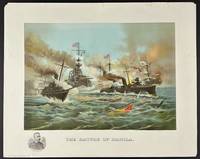
189813092New York: Muller Luchsinger & Co 1898. Color chromolithograph 16 x 20 inches printed on thick glossy paper. Corners a bit chipped several short closed edge tears minor surface wear. Image area still vibrant and clean. Very good overall. A striking and very rare lithograph capturing an important moment during the Spanish-American War specifically the American Navy's assault on Manila Bay in the Philippines in 1898. In the present scene three U.S. warships from the Asiatic Squadron in the left and middle including Admiral Dewey's flagship the U.S.S. Olympia fire their guns toward a few retreating ships flying the Spanish flag. A Spanish ship at middle right is almost completely sunken with just a portion of the flag peaking above the water. The scene depicts the first major engagement of the Spanish-American War a decisive victory for the American Navy that stands as one of the most lop-sided naval battles in history. During the course of the encounter the Spanish Pacific Squadron was destroyed and effectively ended Spanish colonial rule in the Philippines. The bombardment was commanded by Rear Admiral George Dewey 1837-1917 whose head-and-shoulders portrait appears in the bottom left corner.<br /> <br /> The work was accomplished by the New York firm of Muller Luchsinger & Company a prolific but still somewhat obscure producer of prints lithographs and chromolithographs in the latter-19th and early-20th centuries. OCLC records just two institutional copies at the Library of Congress and the Clements Library. A dynamic and patriotic American naval scene picturing the United States Navy's obliteration of the Spanish Navy in Manila. Muller, Luchsinger & Co unknown
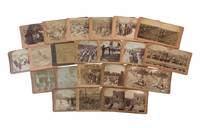
1898231301898. Spanish-American War stereoview archive circa 1898-1899 documenting how the war was pictured through mass-produced photographic views that followed U.S. mobilization battlefield action occupation and military life across both Cuba and the Philippines. These stereoviews preserves the visual system by which the war was circulated to American audiences showcasing camp organization troop movement burial hospital care naval power and overseas deployment. Particularly notable is the archive's coverage of the Rough Riders the Santiago campaign in Cuba and U.S. presence in Manila and Malate showing how stereoview photography helped normalize the war's expansion from anti-Spanish conflict into a broader American imperial presence.<br /> <br /> Archive of 21 stereoviews Various publishers. Spanish-American War stereoview archive. Cuba the Philippines and the United States circa 1898-1899. each measuring 3" x 7". The views are drawn from multiple phases and theaters of the war including camp and drill scenes in the United States embarkation and troop arrivals at Tampa battlefield and occupation imagery from Cuba and extensive and some grisly scenes from Manila and surrounding areas in the Philippines. Captions and images show soldiers in formation cavalry drill military reviews naval artillery hospital interiors encampments burial grounds and troops in active position. Cuban views include Morro Castle after bombardment dead and wounded on the battlefield of Santiago U.S. soldiers preparing to invade Cuba and troops dining near Cabañas Fortress. Philippine views include a departure for Manila American pickets routing a Filipino reconnoitering party the 18th Infantry engaged by Filipino outposts volunteers awaiting orders under the tropical sun Army Hospital Manila and "Our Boys in Camp at Malate P.I." One stereoview identifies Roosevelt's Rough Riders in the mobilization phase linking the archive to one of the war's most publicly mythologized units.<br /> <br /> As a group the stereoviews demonstrate the process by which the Spanish-American War was framed not simply as a short military victory over Spain but as a sustained structure of U.S. troop deployment and occupation extending from Cuba into the Philippines. The Manila and Malate scenes are especially important in this regard since they place American soldiers within the opening phase of the Philippine conflict where U.S. military presence quickly moved beyond liberation rhetoric into imperial control. The archive's mixture of battlefield casualties camp routine naval spectacle and celebratory review scenes shows how stereoscopic publishing converted war into a domestic viewing experience while reinforcing the legitimacy of American expansion abroad. Wear to mounts some toning; overall very good condition. A strong cross-theater visual archive of the Spanish-American War and the emergence of U.S. imperial power in Cuba and the Philippines. unknown
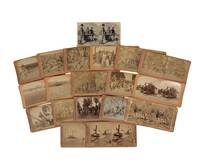
1898231701898. Stereoview archive documenting the rapid overseas deployment of American troops at the moment the Spanish American War gave way to a longer and more revealing imperial presence in the Philippines. This archive marks the transition from the 1898 defeat of Spain to the far more sustained American military occupation that followed. After the U.S. victory over Spain the Treaty of Paris transferred the Philippines to the United States for $20 million. This resulted in a battle between American forces and Filipino nationalists under Emilio Aguinaldo in February 1899 when Filipino hopes for independence collided with the reality of a new colonial ruler. This collection of photos preserves the process of colonialism through troop deployment provisioning medical treatment and the routines of military presence.<br /> Archive of 19 stereoview cards most published by B. W. Kilburn and James M. Davis centered on American military activity in the Philippines with additional views from Puerto Rico Cuba and the United States. Each measure 3.5" x 7". The core of the images remain in Philippine occupation; "The 17th Infantry crossing the river P.I." shows movement through tropical terrain; "Our Volunteers awaiting orders under the tropical sun in the Philippines" captures the idleness and bodily strain of expeditionary service; "2nd Division Hospital established in Angeles Church P.I." reveals improvised medical infrastructure inside a colonial religious building; "Dealing out pork and beans to the Oregon Volunteers P.I." appears in multiple variants and preserves the logistics of feeding American troops in camp; and "The Insurgent House of Congress on Fire Malolos P.I." places the war directly in relation to the destruction of Filipino political institutions. The remaining cards broaden that story outward: "Troop D 5th U.S. Cavalry lining up for dinner Mayaguez P.R." points to U.S. military operations in Puerto Rico; "Modern Krupp Gun Morro Castle Havana Cuba" preserves the Spanish imperial military landscape at Havana just as U.S. power displaced it; and the exhibition drill cards including "The Little Commodore" Boston '98 and "Grand Stand Exhibition Drill Boston '98" connect the overseas war to patriotic spectacle and military display at home. Stereographs were a common late nineteenth century format for circulating military imagery and was used to render mobilization and drill into mass-viewed visual media. <br /> Minor toning edge wear and rubbing; images and printed captions remain legible; overall very good condition. This collection preserves the American campaign in the Philippines not as abstract policy but as a contemporary visual record of how troops were deployed housed fed and sustained while the United States transformed victory over Spain into colonial rule in the Pacific. unknown