(Japan) Dekobra, MauriceBiblio.com
8 489 résultats
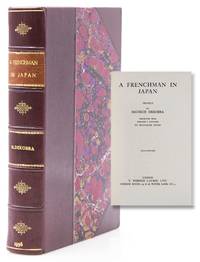
1936316722London: T. Werner Laurie Ltd 1936. Bound ion three quarters modern polished crimson calf and marbled baords. Fine. T. Werner Laurie, Ltd unknown
19392092902143300063Not Available 1939. Soft Cover. Fine. The book is in fine condition. Not Available paperback
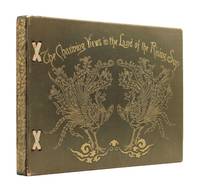
1904353246Tokyo: K. Ogawa 1904. Illustrated with photos by Ogawa. 177 ff. 1 vols. Oblong folio. Publisher's decorated green silk-covered boards with titles and decorations in gold embroidery fine silk-backed endpapers decorated with gold inner hinges strengthened bound at the spine with cream ribbon in Japanese style. Green calf backed folding box. Illustrated with photos by Ogawa. 177 ff. 1 vols. Oblong folio. K. Ogawa unknown
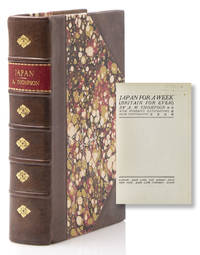
1904316723London: Anthony Treherne & Co. Ltd 1904. Second Impression. Color frontispiece 6 color plates and 30 iillustrations after Hokusai. 443pp. 1 vols. 8vo. Bound in three quarters modern mottled brown calf and marble boards red title label. Fine. Second Impression. Color frontispiece 6 color plates and 30 iillustrations after Hokusai. 443pp. 1 vols. 8vo. Anthony Treherne & Co., Ltd unknown
1911317553London: John Lane 1911. First edition stamped in blind a review copy. 8vo. Bound in modern brown mottled calf and marbled boartds leather title label. Fine. First edition stamped in blind a review copy. 8vo. <br/><br/> John Lane hardcover
19812092902141203359Chinese folk literature 1981. Soft Cover. Fine. Volume: 1 Chinese folk literature paperback
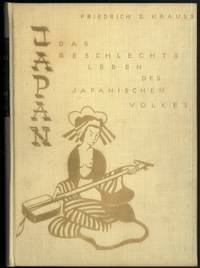
193175475Leipzig 1931. Leks8vo. Dekorerte originale helshirtingbind. I originale esker. 431 ; 653 s. Illustrert i teksten og med illustrasjoner utenom pagineringen. “Anthropophyteia†Verlag für Urtriebekunde. Tysk. <br/><br/><em>Gulldekoren noe slitt. Bind I : Das Geschlechtsleben in Sitte Brauch Glauben und Gewohnheitsrecht des japanischen Volkes. Allgemeine Einführung in das Studium des japanischen Geschlechtlebens. Mit zahlreichen Abbildungen im Anhang. Bind II : Abhandlungen und Erhebungen über das Geschlechtsleben des japanischen Volkes. Folkloristische Studien von Tamio Satow. Bearbeitet von Hermann Ihm. Mit 164 Abbildungen im Texte. </em> unknown
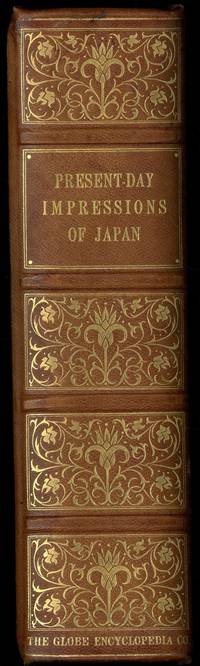
191972087London 1919. Stor 4to. Originalt helskinnbind med rik ryggforgylling svakt opphøyde ryggbånd gulldekor på fordekkelen helt gullsnitt. 931 s. Gjennomillustrert. Med noen farveillustrasjoner. Med et farvetrykt foldekart. The Globe Encyclopedia Company Engelsk. <br/><br/><em>Med noen små skriblerier på forsatsene. Fremre snitt en tanke misfarvet. En side med lang rift. Et praktverk om Japan. </em> unknown
196074819Tokyo: Kokusai Bunka Shinkokai Society for International Cultural Relations 1960. First edition. Octavo. 20 page introductory booklet by Garfias bound at front hinge 6 fanfold cardstock pages housing 36 color slides of dancers costumes masks musical instruments stage etc. bound at rear hinge. Publisher's Japon vellum red lettering to spine and front mulberry endpapers. Old stain to lower front corner about a quarter of an inch and general rubbing but still a very handsome copy with all the slides still present. Only one copy located by OCLC.Gagaku is a type of Japanese classical music that was created by the fusion of music brought to Japan from continental Asia and Japanese original music and dance. It was developed as court music of the Kyoto Imperial Palace and was established in the Heian period around the 10th century. It remains much like its 10th century iteration. In many ways it is simply the music of the Imperial Court. The popularity of gagaku reached its peak in the 9th century to the 10th century when court aristocracy began to hold private concerts but declined in the Kamakura period 1185-1333 when the power of the court aristocracy became diminished while that of the samurai rose. Gagaku was played by musicians who belonged to hereditary guilds. During the Kamakura period military rule was imposed and gagaku was performed rarely at court. At this time there were three guilds based in Osaka Nara and Kyoto.Because of the Onin War a civil war from 1467 to 1477 during the Muromachi period gagaku ensembles ceased to perform in Kyoto for about 100 years. In the Edo period the Tokugawa Shogunate revived and reorganized the court-style ensembles the direct ancestors of the present gagaku ensembles. After the Meiji Restoration of 1868 musicians from all three guilds came to the capital and their descendants make up most of the current Tokyo Imperial Palace Music Department. Ethnomusicologist Robert Garfias worked in Japan Korea The Philippines Mexico Burma Romania Portugal Puerto Rico and Turkey. He was a past President of the Society for Ethnomusicology and was appointed by the White House to the Council of the National Endowment for the Arts. Kokusai Bunka Shinkokai (Society for International Cultural Relations) hardcover
192475093Tokyo: N.p. 1924. A charming and chatty letter from Miss Takeuchi of Tokyo to Miss Clapman of Arlington MA. The sheets are of onion-skin paper and tinted blue. Each sheet measures 11 x 7 inches and each sheet has a finely executed gouache of a Japanese woman in traditional garb on the right margin. Original canceled envelope still present. The expected fold-lines else a wonderful survivor.The letter was penned in late June of 1924. We know Berith Clapman was born in in 1904 and thus she was twenty when she received this letter. Hana Takeuchi writes of how much she enjoyed her stay in Boston so that is likely where the two met and thus became pen pals The letter is full of the trivial things new pen pals write to each other but the real highlight of this item are the gouaches painted by Hana Takeuchi on the left margin of every sheet. All four of the paintings are of high society Japanese women in kimonos. A sentence from Hana's letter lays out the obvious - "I am studying a little of Japanese painting and should I become more of an artist some day I will send you one of my works." N.p. unknown
190273783Tokyo: Post Office 1902. First and only edition. Octavo. Accordion-fold book containing 8 panels. On four of them are to be found original Japanese postage stamps. Publisher's green brocade silk with printed paper cover label. An excellent copyOnly one copy located by OCLC British Museum. This little book was issued by the postal authorities to celebrated the 25th anniversary of Japan's entry into the Universal Postal Union. It was issued in conjunction with the opening of the Postal Museum Yuubin Hakubutsukan on the grounds of the Ministry of Communications and Transportation at what was then Kobikicho Kyobashi-ku Tokyo current site of the Ginza Branch of Japan Post Inc. 8-chome Ginza Chuo-ku Tokyo. Post Office unknown
194275667Toyohasi and others: V.p. 1942. A fine album photographically recording the life of a Japanese soldier during the Second World War. Soldiers albums abound and are usually crammed with pictures of family members loved places in Japan battle scenes fellow soldiers etc. They are not uncommon. This album is quite different and we believe it is something of an official album. It is a professionally bound quarto album 10 x 12 inches string tied and with printing on the cover that reads "Toyohashi Rikugun Kyodo Gakko 1942"’ Imperial Japanese Army Academy. Toyohashi being a city in Aichi prefecture near Nagoya. The album contains 52 original silver gelatin photographs with all but three nicely mounted in the album almost always just one to a page making it more of an aesthetic album more like a tribute. The majority of the photographs are 6 x 4 1/2 inches and are nicely composed. It feels that these particular photos were well chosen as opposed to most albums that have a confusion of photographs. The first five leaves are almost assuredly the same in every album. The first leaf bears the lyrics of the school song; the photo of text on the following leaf are the “Five Teachings†of Heihachiro Togo 1838-1934 who was the highest-ranking officer in the Japanese Imperial Navy. On the following page is a photographic portrait of Hideki Tojo 1884-1948 General of the Japanese Imperial Army during World War II. Beneath this portrait is the text of an address written and signed by officials of the Ministry of the Army which is dated December 8 1941 - just one day after the Japanese attack n Pearl Harbor. Nest comes a photograph of Isoruku Yamamoto Marshal Admiral of the Imperial Japanese Navy IJN and the commander-in-chief of the Combined Fleet. Two further portraits of Japanese leading military figures follow. At the end of the album is a list of all the men who graduated from that training camp and one of names is checked off; a man named Yamanaka. We may deduce from this that this album is devoted to his activities in the war. There are a few photographs of the school in Toyohashi e.g. an officer addressing the entire platoon. Yamanaka seems to have been assigned to a tank brigade and there are a number of pictures of tanks in action the men crossing small rivers camping in the open etc. Quite a few seem like actual battle scenes although we can never see the opposing army. It is impossible to tell the location but from the flora it seems to be one of the many islands in the South Pacific. There are a few photographs of aircraft one of the controversial Yasukuni Temple and a few artistic commercial photos of battle paintings. The very last photograph is smaller than any other in the album 2 x 3 inches and just shows one soldier kneeling in the grass helmet on and rifle in hand. One gets the very strong impression that this is Soldier Yamanaka as his parents wanted to remember him. On a purely conjectural basis we think that early in the war these albums were given to the families of enlisted men and all of the albums came with the same first 6 photographs. Presumably the intention was for their sons to mail back pictures of their activities overseas and Soldier Yamanaka apparently did so as would any dutiful Japanese son giri or duty is a powerful idea in Japan. That there are no pictures of him reunited with his parents or even back in Japan leads to the inevitable conclusion that he died overseas. A rather sad album that just seems to echo loss. V.p. unknown
191073978Meadville: Keystone ca. 1910. Ten Keystone Magic Lantern Slides concerning silk farming in Japan. Reputedly by photographer William Rau. All are numbered and with printed captions. Many have longer descriptions issued by Keystone excised from the booklet that accompanied the entire set. Slides offered here are; 525-Fujiyama; 527-Girls Putting the Finishing Touches on Bamboo Baskets; 534-A Charming Outlook Over Fertile Fields and Cozt Homes at Kiriu Japan; 535-A Japanese Garden; 536-Silkworm Incubator; 537-Gathering Mulberry Leaves for Silkworms; 538-Feeding Mulberry Leaves to Silkworms; 539-Cocoons of Silkworms; 540-Reeling Silk from Cocoons; 541-One of Japan's Largest Silk Weaving Plants kiriu. All are sleeved and in excellent condition. Keystone unknown
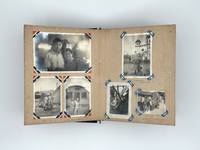
1949370387Kobe or Fukuoka Japan 1949. Approx. 145 photographs mostly 3x2 inches some 1-1/2x1 and a few 4-1/2x3 inches or larger. Inserted on photo corners or with small strips of cellotape at the corners. Many captioned in English or Japanese. Some images missing a few loose photographs inserted. Signed by Tadao Maeda on the rear endpaper. Approx. 7x6 inches. Contemporary dark green cloth minor wear. Approx. 145 photographs mostly 3x2 inches some 1-1/2x1 and a few 4-1/2x3 inches or larger. Inserted on photo corners or with small strips of cellotape at the corners. Many captioned in English or Japanese. Some images missing a few loose photographs inserted. Signed by Tadao Maeda on the rear endpaper. Approx. 7x6 inches. The snapshots comprise mostly images of Japanese soldiers attached to the U.S. regiment outside of barracks or on bases but also street scenes family members unknown
1989267375Tokyo: Toppan 1989. hardcover. fine/very good. Text in English and Japanese. 561 pages thick square 4to grey cloth black glossy French fold dust wrapper. Tokyo: Toppan 1989. A fine copy in a very good dust wrapper just some light surface rubbing to wrapper.<br/> <br/> In protective cardboard sleeve<br/> <br/> Toppan unknown
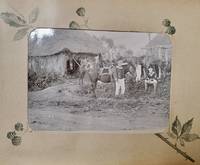
191075221Japan: N.p. ca. 1910. Oblong octavo 8 1/2 x 6 1/4 inches with a total of 25 stiff leaves mounted to stubs. Each leaf has a window on each side all bearing original photographs or early postcards. All windows have printed floral borders. There is total of 23 original albumen and silver gelatin photographs many hand-colored and 27 very early Japanese postcards again some with hand coloring. Contemporary padded burgundy morocco with gilt cover lettering floral endpapers. A few of the window frames with a tear rear joint of album starting but still strong. An unusual gathering of material.The majority of the photographs are of women and most of them are hand colored. The two most interesting postcards of battle scenes from the Russo-Japan war with captions in English and Japanese. There is also a rather rare photograph of Yoshiwara the famous prostitute section of Tokyo. The women in Yoshiwara are all behind bars as usual. There are a couple of books about Yoshiwara but precious few postcards. The seeming obsession with Japanese women is likely explained by the fact that this album was almost surely assembled by a sailor in the German Navy.The two most interesting photographs in the album are of German naval personnel riding horses in the countryside of Japan. These are rather confusing as Japan is justifiably famous for it's unwelcoming posture toward foreigners especially mere naval soldiers of no great distinction. But all becomes clear when we read the name of their ship on their cap: SMS Hansa. The Hansa served in the East Asia Squadron during the Boxer Rebellion of 1900 along with SMS Hertha SMS Iltis and SMS Gefion bombarded the Taku Forts. Her sailors then took part in the successful storming of the forts. During the Russo-Japanese War SMS Hansa along with the protected cruiser SMS Furst Bismarck the gun boats SMS Tiger and SMS Luchs and the cruisers Hertha and Geier took part in the forcible internment of the Russian battleship Tsesarevich and three destroyers at Tsingtao in 1904. SMS Hansa was a protected cruiser of the Victoria Louise class launched in 1898. As a gesture of appreciation the Japanese government probably allowed a number of the sailors to travel the country. abaa-ny-2022 N.p. unknown
19822092902137403253Kodansha 1982. Soft Cover. Fine. Volume: 1 Kodansha paperback
19392083002115804119Kenkosha Archives Reprint 1939. Soft Cover. Fine. The book is in fine condition. Kenkosha Archives Reprint paperback
193561713E-105: Japan Times and Mail. Very Good in Good dust jacket. 1935. First Edition; First Printing. Hardcover. Hardcover. 4to. Published by The Japan Times & Mail Tokyo Japan. 1936. 294 pgs. Illustrated with Black and White Plates. First Edition/First Printing. DJ has chipping shelf-wear and rubbing present to the DJ especially around the extremities. Bound in cloth boards with gilt titles present. Boards have shelf-wear present to the extremities edges of the boards faded and discolored. No ownership marks present. Previous owner's name present to the FFEP. Foxing Present. Text has marks and notes present in the text. Text is clean and free of marks. Binding tight and solid. A look at Pre-War Japanese Modern as well as classical Architecture. In some cases these are the only records of buildings destroyed during WWII. ; 4to 11" - 13" tall; 294 pages . Japan Times and Mail hardcover
19552110502150414186Asahishinbunsha 1955. Soft Cover. Fine. Volume: 1 Asahishinbunsha paperback
19592110502150415054Housewife and Seikatsusha 1959. Soft Cover. Fine. Volume: 1 Housewife and Seikatsusha paperback
19542110502150413650Asahishinbunsha 1954. Soft Cover. Fine. Volume: 1 Asahishinbunsha paperback
19572110502150414816Asahishinbunsha 1957. Soft Cover. Fine. Volume: 1 Asahishinbunsha paperback
19562110502150414184Asahishinbunsha 1956. Soft Cover. Fine. Volume: 1 Asahishinbunsha paperback
19552110502150414185Asahishinbunsha 1955. Soft Cover. Fine. Volume: 1 Asahishinbunsha paperback