447 résultats
19232080302106803171Governor-General of Korea 1923. Soft Cover. Fine. The book is in fine condition. Governor-General of Korea paperback
19732091502135420913Hara shobo 1973. Soft Cover. Fine. Number of books: 2 Hara shobo paperback
1988Alibris.0002970Seoul: National Unification Board Republic of Korea. 1988. Trade paperback. Very good. No dust jacket as issued. 571 p. National Unification Board Republic of Korea paperback
19752091202133105584Republic of Korea Academy 1975. Soft Cover. Fine. Volume: 1 Republic of Korea Academy paperback
1956215131956. African American Military History Korean War Unidentified photographer African American soldiers in South Korea 1956 documents Black military service within the early post armistice U.S. occupation of Korea and provides visual evidence of desegregation in practice following Executive Order 9981. Produced three years after the Korean Armistice Agreement the images situate African American enlisted men within the operational landscape of U.S. military engineering and logistical support during the Cold War consolidation of American presence on the Korean peninsula. The archive documents the role of Black soldiers in infrastructure maintenance transport and base security while also recording their proximity to Korean civilian life in a recovering war zone. The identification of the 376 Engineer Battalion places the material within the institutional framework of the U.S. Army Corps of Engineers whose work underpinned military mobility and reconstruction during this period.<br /> <br /> South Korea 1956. Archive of 22 black and white silver gelatin photographs most measuring approximately 5 x 4 inches depicting African American soldiers stationed near a U.S. military installation likely in the Uijeongbu or Dongducheon corridor north of Seoul where engineering and support units were concentrated. Multiple images include signage identifying the "376 Engineer Battalion" while others show mixed-race groups of soldiers gathered near convoys of M35 2½ ton cargo trucks and smaller support vehicles used for personnel and supply transport. One photograph includes a Fairchild C-119 Flying Boxcar aircraft in the background confirming the logistical environment of cargo movement and aerial supply. Soldiers appear in standard issue fatigues with visible non commissioned officer insignia engaged in routine duties such as transport checkpoint supervision and base operations. Several photographs depict Korean civilians moving through nearby marketplaces and village spaces including women wearing traditional hanbok passing through areas of visible economic strain characterized by unpaved roads and temporary structures. English and Hangul signage including a storefront labeled "Kind Shop" further situates the images within a localized commercial environment shaped by U.S. military presence.<br /> <br /> The archive documents a transitional period in both U.S. military policy and Korean society as the formal desegregation of the armed forces intersected with the realities of overseas deployment in a recently devastated region. While integrated units are visible the clustering of Black soldiers within shared duties and informal groupings indicates the persistence of racialized social structures within the ranks. At the same time the photographs establish the everyday presence of American troops within civilian Korean spaces during early Cold War reconstruction linking military labor to broader geopolitical objectives in East Asia. Light surface wear including minor creasing and scattered abrasions; images remain clear with strong contrast. Overall very good condition. A cohesive visual record of African American military labor postwar occupation and cross cultural contact in Korea during a formative phase of U.S. global military expansion. unknown
1964197821964. Anonymous photographs of African American soldiers stationed in Korea and Europe produced c. 1960s document Black military service during the Cold War and provide primary-source evidence for the study of U.S. Army deployments racial integration in the post-World War II military and lived experience within forward operating environments near geopolitical flashpoints. The images place African American servicemen at installations including Camp Kaiser in South Korea located within proximity to the Korean Demilitarized Zone and in European urban and alpine settings indicating rotational or multi-theater deployment. The archive supports research into the role of Black soldiers in Cold War containment strategy as well as the everyday conditions mobility and social environments encountered by enlisted personnel across Asia and Europe during a period of sustained global military presence.<br /> <br /> Archive of 24 original black and white silver gelatin photographs c. 1960s primarily measuring approximately 4" x 3". At least half of the images are identified as taken in Korea with multiple captions including "Camp Kaiser" "Korean Home" "Village" and "CO Area" situating the group within a U.S. Army installation environment composed of cinder block structures and Quonset huts approximately 60 miles north of Seoul and within range of North Korean artillery positions. One overhead view shows the full layout of Camp Kaiser while other images depict African American soldiers in field conditions described as "Cold Wet" trekking and camping in rugged terrain. Additional Korean scenes include a soldier leaning against a tank marked "Kimchee" and an airfield photograph showing a chrome fighter jet surrounded by personnel alongside additional aircraft including a biplane. European photographs include a parade observed from an apartment window in a German-speaking alpine town featuring a float labeled "General Knuller" as well as street-level images of crowds deployed fire engines and soldiers observing from a Volkswagen Beetle. One image shows an African American soldier standing outside a synagogue marked by a Star of David with a flag bearing the inscription "Troop Att 1964" indicating interaction with local religious or commemorative sites.<br /> <br /> The photographs align with the global positioning of U.S. forces during the Cold War particularly in South Korea following the Korean War armistice and across Western Europe as part of NATO-aligned defense strategy. African American soldiers serving in an officially desegregated military after 1948 participated in these deployments while navigating both military hierarchy and broader social transformations associated with the Civil Rights era. The archive captures a range of activities from patrol and training environments to civic encounters and public events offering a geographically dispersed visual record of Black military presence within U.S. Cold War operations. Light wear and minor handling present; captions and details remain legible; overall very good condition. unknown
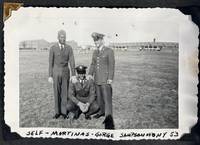
1953212881953. African American military photo album 1953-1960 documenting the service and personal life of a Black U.S. Air Force serviceman across multiple postings during and after the Korean War. The album records military duty daily routines and interpersonal relationships within an increasingly integrated armed forces providing visual evidence of African American participation in Cold War military infrastructure. The material captures both overseas deployment in Korea and domestic life across U.S. bases situating individual experience within broader patterns of military service and social change following desegregation.<br /> <br /> Album comprises 101 black-and-white silver gelatin photographs most measuring approximately 3.5" x 3.5" mounted on black pages with corner mounts. Early images place the serviceman at Kessler Air Force Base in Mississippi followed by extensive documentation of his time in Korea likely associated with the 650th Aircraft Control and Warning Squadron as indicated by a tent marked with unit insignia. Photographs show military encampments with tents and barracks vehicles including trucks and jeeps and groups of soldiers engaged in daily routines. One caption identifies "Our home in Korea" accompanying images of base infrastructure. Additional scenes include a USO performance at "K-6 Korea 54" where servicemen gather beneath a "Camp Shows" banner. The album continues with postings at Ellsworth Air Force Base in South Dakota and locations in Alaska where winter conditions specialized vehicles and outdoor activities are visible. Social and interpersonal life is extensively documented with repeated appearances of individuals identified as "Daril" "Bunky" "Peanuts" and others shown in uniform at leisure and in group settings. Domestic scenes include family gatherings such as "Roger's Birthday Party June 59" and images of women and children identified as "Mary" "Rochelle" and "Teresa" indicating sustained family connections. Travel photographs include roadside markers such as "Welcome to Illinois" and "Entering Indiana" while Alaska-based images depict community events including dog sled races and local festivals.<br /> <br /> Created during the transitional period following the desegregation of the U.S. military these photographs provide a sustained record of African American service members operating within integrated units while maintaining personal and family networks across geographic distances. The combination of overseas deployment domestic postings and family life offers a comprehensive view of military and social experience during the 1950s. Album pages show some loss and covers are detached; photographs remain sharp with strong tonal quality and are largely well-preserved; overall very good condition. This album offers an extensive documentary record of African American military life and community formation in the Korean War and early Cold War period. unknown
19322091502135403752Not Available 1932. Soft Cover. Fine. Volume: 37 Not Available paperback
19722091502135406826future company 1972. Soft Cover. Fine. Number of books: 1 future company paperback
19802081502111907135Tori-gawa bunka-sha 1980. Soft Cover. Fine. The book is in fine condition. Tori-gawa bunka-sha paperback
19752090202120700992Gakuseisha 1975. Soft Cover. Fine. Number of pages: 87 points Size: AB size Gakuseisha paperback
19262091502133904136Not Available 1926. Soft Cover. Fine. Volume: 1 Not Available paperback
19712081502111703272foreign publication 1971. Soft Cover. Fine. The book is in fine condition. foreign publication paperback
20002091502135419544Not Available 2000. Soft Cover. Fine. Number of books: 12 Not Available paperback
19612091502135415129Not Available 1961. Soft Cover. Fine. Volume: 23 Not Available paperback
19872091502135415051National Museum of Korea 1987. Soft Cover. Fine. Number of books: 9 National Museum of Korea paperback
19672091502135417197Not Available 1967. Soft Cover. Fine. Number of books: 3 Not Available paperback
1980KOS03100057TBD 1980. Soft Cover. Fine. KOS03100057 TBD paperback
19792091502135403417Banseisha 1979. Soft Cover. Fine. Number of books: 1 Banseisha paperback
19842092902141900101Minzoku en 1984. Soft Cover. Fine. Size: 23cm Number of books: 3 in total Minzoku en paperback
1980KOS01204881Kawade Library 1980. Soft Cover. Fine. KOS01204881 Kawade Library paperback
19722091502133904698Kokusho Publishing Association 1972. Soft Cover. Fine. Volume: 1 Kokusho Publishing Association paperback
19702091502135414392Seongsa Seoul 1970. Soft Cover. Fine. Number of books: 1 Seongsa (Seoul) paperback
19822091502135416144Not Available 1982. Soft Cover. Fine. Number of books: 1 Not Available paperback
19992091502133905976Korea Cultural Heritage Foundation 1999. Soft Cover. Fine. Volume: 1 Korea Cultural Heritage Foundation paperback