Archaeological Survey of IndiaBiblio.com
142 résultats
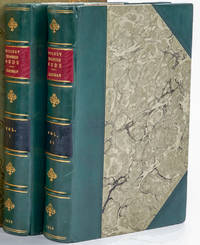
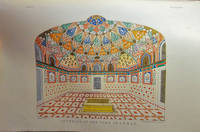
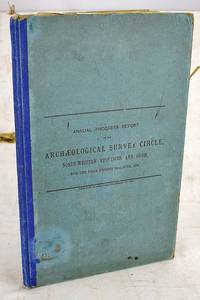
18932305250019Roorkee: Thomason College Press 1893. First Edition. Hardcover. Good. Plate book of Indian Archeology Bound in publisher's blue cloth-backed boards. Scattered foxing. 47 pp. folding lithographic plan of Fatehpur Sikri 6 large albumen print photographs 24 x 17 cm mounted 3 folding lithographic plates of frescoes. Roorkee: Thomason College Press hardcover
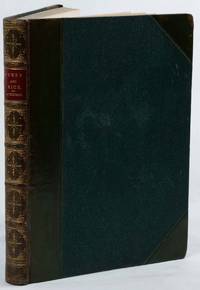
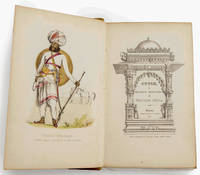
1860223307London.: Day & Son Lithographers to the Queen. 1860. Additional tinted lithographed title 39 tinted lithographs each with 2 pp of descriptive text contemporary half green morocco elaborately gilt decorated spine with raised bands red gilt-lettered title label pebbled green cloth boards 28.5 x 20.3 cms marbled fore edges and endpapers the binding a little scuffed and worn the prelims rather browned the first three leaves loose at the lower hinge scant spotting and to the margins of the plates occasional pencilled marginalia but a very good complete copy in a handsome binding. George Francklin Atkinson 1822–1859 was a captain in the Bengal Engineers and a skilled artist. He drew directly from his personal experiences in India and here he intended to offer a humorous satirical look at the lives of British colonials in India especially in the wake of the Sepoy Rebellion set in the fictional village of "Kabob" . The author's dedication is to the Victorian novelist and man of letters William Thackeray himself born in India and begs him to "accept this salute of my little craft as a trifling token of congeniality admiration and esteem". . Day & Son, Lithographers to the Queen. hardcover
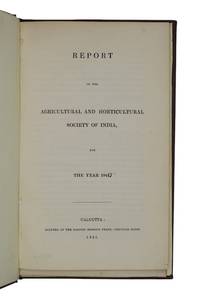
1841AQ32634Calcutta: Printed at the Baptist Mission Press 1841. 35pp 1. Bound with: Drop-head title: List of members of the Agricultural & Horticultural Society of India. January 1st 1841. Calcutta. Bishop's College Press 1841. 2 23pp 1. 8vo. Modern brown cloth lettered in gilt to spine. Two early manuscript corrections to first mentioned work title and drop-head title. The second located copy of the annual report of the Agricultural & Horticultural Society of India for the year 1840 together with a contemporary list of members printed at the Baptist Mission Press at Calcutta which operated from 1818 until the 1970s. The Society was founded by orientalist and missionary William Carey 1761-1834 in 1820. The report records the progress of the work done by the society including efforts to promote and improve cotton cultivation in the country the introduction of a new species of mulberry plant the promotion of tea culture in Assam and revision of discriminating duties on rum and tobacco. OCLC and COPAC record copies of each work at a single location BL. . First edition. Printed at the Baptist Mission Press hardcover
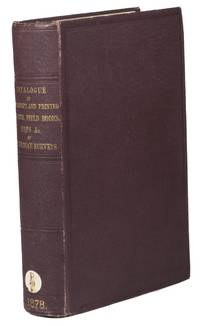
1878ABC_45484London: George E. Eyre & William Spottiswoode colophon 1878. Contemporary cloth title in gold on spine. Large 8vo. First and only edition of a catalogue of the material held in the London India Office that was produced by the Indian Surveys for the East India Company. The catalogue was printed by order of her Majesty's Secretary of State for India in council. It is a key reference work for all studies on the East India Company era in Indian and British history.Shelf mark on spine library plate on front paste-down Scheepvaartmuseum Amsterdam. Slight foxing on the first and last couple pages. Otherwise in very good condition.l Kaul Early writings on India: a union catalogue of books on India in the English language published up to 1900 and available in Delhi libraries 1975 92. George E. Eyre & William Spottiswoode (colophon), hardcover
1900100865c. 1900. 54 diapositive glass lantern slides 3-1/4 x 4 and 3-1/4 x 3-1/4 inches six hand-colored bound at edges with gummed paper or metal frame some with manufacturer's printed label and manuscript caption; a few with hairline cracks. Housed in contemporary wooden box with lid. A varied collection of ethnographic and architectural scenes largely from Northern India with a few of Ceylon Sri Lanka tea production. Some of the locations include Darjeeling Mumbai Bombay Kakinada Elephanta Caves Mumbai Calcutta including many of the Hooghly River Dehli Sinla Ceylon Kashmir as well as one scene of European tourists scaling pyramids in Egypt. The collection appears to have been gathered from various sources with plates manufactured by T.H. McAllister New York William Garrison Reed Boston J. Moore Birmingham and William H. Rau Philadelphia. unknown
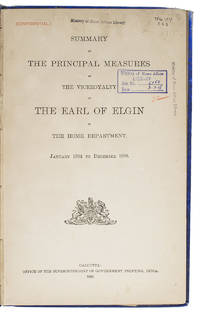
1898ABC_45361Calcutta: Office of the Superintendent of Government printing India 1898. Blind-stamped blue cloth title in gold on spine blue decorated endpapers. Folio. With armorial vignette on the title page. The official Summary always published at the end of a Viceroy-ship by the Office of the Superintendent of Government printing in Calcutta containing the narrative of proceedings of the Home Department in this case from January 1894 to December 1898 the time the 9th Earl of Elgin served in that function. The extensive contents pp. i-iv refers always to the pages in the appendices pp. 1-6156 ! not present.During his time as Viceroy famine broke out in India in which Elgin reportedly admitted that up to 4.5 million people died. Other estimates have put the death toll at 11 million people. His administration in India was otherwise notable for the Afridi frontier uprisings of 1897-1898.With the label of the Home Department Juridical Branche on the front board and a second label with the shelfmark and stamps of the Ministry of Home Affairs on the title page and elsewhere including a Confidential stamp. Head of both boards damaged and damp-stained front hinge worn front endpapers loose slightly browned throughout.l Bence-Jones Mark. The Viceroys of India London 1982. Office of the Superintendent of Government printing, India, hardcover
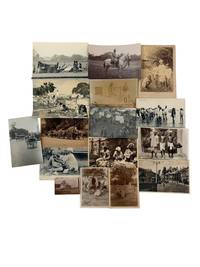
1890234981890. Colonial Indian labor photo archive depicting street work informal commerce transport labor and social hierarchy under British rule circa 1890s-1920s. British India depended on low-paid manual labor to move people goods food and raw materials through cities ports hill stations and military cantonments. The group contrasts workers seated on the ground with baskets tools tents carts and roadside goods against riders on horseback and passengers carried by rickshaw carriage and bullock cart. <br /> <br /> Photo archive of 16 silver gelatin photographs and black-and-white real photo postcards various sizes India circa 1890s-1920s. Marketplace sellers sit among baskets cloth tents and on the ground goods; families and workers gather beside tents and rough encampments; men pull or guide rickshaws carriages and ox-drawn carts through colonial streets. A mounted man sits formally on a white horse while views of Simla show pedestrians commercial buildings and hill-station streets associated with British administration and seasonal elite life. Additional scenes show an outdoor "Hindu barber" "Indian coolies" carrying large baskets men seated by stonework near a Gothic-style building children posed in white garments some hand written captions en verso identify locations or tasks.<br /> The archive records the everyday labor that supported colonial India before independence when caste landlessness debt and imperial wage economies shaped who carried cleaned hauled shaved sold and served. Ligh toning handling and edge wear; overall in very good condition. A late colonial documentation of Indian labor and social separation grounded in street work transport marketplace survival and the visible privileges of those being carried or served. unknown
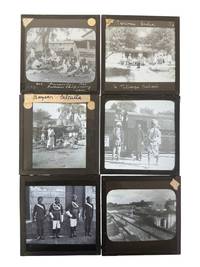
1900232871900. India glass lantern slide archive documenting class hierarchy dichotomy in British India with scenes of village labor bazaar exchange railway movement industrialization Sikhs and colonial cavalry circa 1900-20. Images clearly depict the class divid and Cast system; villagers and laborers are shown seated on bare ground in carpentry work men and goats occupy an unpaved settlement space Sikh men stand beside a railway carriage tied to imperial transport networks a factory scene introduces mechanized industry and a formal portrait of turbaned cavalry soldiers.<br /> Photo archive of 8 glass lantern slides 3.25" x 3.25" India circa 1900 to 1920. Several slides retain manuscript captions on the mounts including "Central India" "Village School" "Bazaar Calcutta" and "MV. parannis an Indian carpentry clas." "Parannis" is probably a misspelling or misreading of "Pariahs" a historical caste/community term used in colonial-era descriptions of South Indi The British largely preserved formalized and exploited the Indian caste system rather than dismantling it. Their relationship with caste was pragmatic: caste became a tool for administration taxation labor control military recruitment and social organization across British India. The "Village School" slide shows a line of children and adults posed before a low building under dense tree cover with one figure standing forward in the open yard. The carpentry slide shows a large group of Indian boys outdoors beneath a tree seated or crouched on the ground around planks and hand tools with timber laid across the foreground and simple structures behind. The Calcutta bazaar scene places vendors baskets and goods in an open market setting under palms while the village scene presents men in loose garments in what seems to be a cattle farm setting. One slide shows Sikh men beside a railway carriage one barefoot in the foreground and others gathered near the rail car doors linking Indian bodies to the movement of goods troops and passengers through the colonial rail system. Another slide presents four uniformed soldiers in turbans possibly the Madras cavalry posed formally with boots sashes and weapons before a masonry wall. The factory view shows smoking industrial works with long roofs tracks and an extended production yard further cementing colonial industrialization within the archive.<br /> <br /> British rule in India relied on linked systems of extraction transport discipline and military force and these slides place those systems beside the people who bore their unequal social effects. Railways expanded under colonial finance and administration to move troops raw materials and commercial goods; industrial sites grew beside older economies of hand labor and bazaar trade; Indian soldiers and cavalry units served within an army organized to secure imperial control; and rural schools workshops and village scenes expose the local social world that existed under those pressures rather than outside them. Light edge wear some mount loss to several slides; no cracks or chips. Overall very good condition. British colonialism widened India's class divide by concentrating wealth transport and military power in imperial systems while leaving many Indians in village labor and low paid market work. unknown
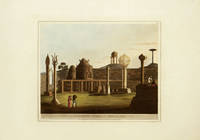
1804204071London.: Edward Orme. Circa1804. Handcoloured aquatint engraving measuring 27.8 x 34cm. Sheet including platemark and generous margins measures 41.8 x 58.8cm. Very slight toning at the platemark but the plate in very bright clean condition. A beautifully executed aquatint from the series 'Picturesque Scenery in the Kingdom of Mysore' by James Hunter first published in 'A Brief History of Ancient and Modern India' by Francis William Blagdon in 1805 the engraving is dated on the plate June 4 1804. This may be from a subsequent edition see Abbey #425. . Edward Orme. unknown
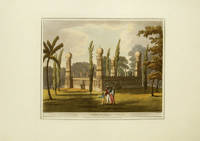
1804204074London.: Edward Orme. 1804 but circa1834. Handcoloured aquatint engraving 29.6 x 37.5 cm platemark; 41.2 x 58.6 cm sheet very good clean condition. A beautifully executed aquatint from the series "Picturesque Scenery in the Kingdom of Mysore" by James Hunter first published in "A Brief History of Ancient and Modern India" by Francis William Blagdon in 1805 the engraving is dated on the plate June 4 1804. This copy is from a subsequent edition the sheet watermarked "Whatman Turkey Mill 1834" see Abbey 425. . Edward Orme. unknown
1870302484London: The London Printing and Publishing Company Limited 1870. 37 plates with 3 prints laid in and a portrait of Dr. Colin Rogers with notation on verso " Superintending Surgeon Madras Med. Dept. who married my Aunt Mary Anne. J.T.C. Ross.". 1 vols. Oblong 8vo. Contemporary green morocco 2 minor tears to the tail of the first leaf not affecting illustration 1-1/2 inch tear to the tail of the second leaf affecting bottom center of image some staining and soiling but overall very good. Various artists including S. Austin Clarkson Stan. 37 plates with 3 prints laid in and a portrait of Dr. Colin Rogers with notation on verso " Superintending Surgeon Madras Med. Dept. who married my Aunt Mary Anne. J.T.C. Ross.". 1 vols. Oblong 8vo. A wonderful album containing images of India drawn during the first two decades of the British Raj signed by "J.T.C. Ross as belonging to Aunt Jini ." <br /> <br /> J.T.C. Ross 1823-1897 recieved his medical education at St. George's Hospital and was admitted as a member of the Royal College of Surgeons in 1845. He served as Surgeon Major with the British Bengal Army Medical Service and was eventually promoted to Deputy Surgeon General and Surgeon-General. He was also the first editor of the Indian Medical Gazzette. The London Printing and Publishing Company, Limited unknown
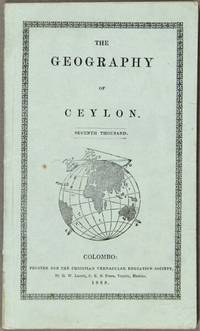
186845516Colombo: printed for the Christian Vernacular Education Society 1868. 12mo pp. 30; engraved title page; original stiff blue pictorial wrappers; spined ends cracked else very good. Despite the title this small pamphlet covers not only the geography of the island of what is now the country of Sir Lanka but also the people commerce and government. Only the NYPL copy in OCLC which locates no other editions. printed for the Christian Vernacular Education Society unknown
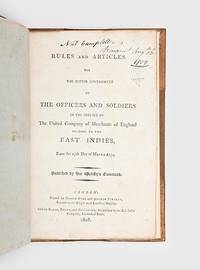
1808177936London: Printed by George Eyre and Andrew Strahan for Black Parry and Kingsbury 1808. Later edition following the first of 1754. This volume was owned by Lieutenant Colonel Neil Campbell 1788-1848 with his signature dated 12 August 1809 on the title page. Campbell joined the Bengal Army that same year and likely used it as part of his training. Nonetheless within six months he was tried by court martial. Soon after landing in India as an ensign Campbell was tried for ill-treating a civil Indian official imprisoned for eight months and fined. "This little incident does not however seem to have interfered with his military promotion for he was a Lieutenant in 1814 and retired as a Lieut.-Colonel in 1841 sharing in the Bhurtpore prize-money in 1825" Campbell p. lvi. In addition he volunteered for the campaign to annex Kalinfar Fort 1812 helped to hunt down the chief of Bundelkhand Gopal Singh and fought in the Anglo-Nepalese War 1814-16. He had 13 children with Isabella Campbell née Anne. The original front free endpaper is signed and inscribed: "This belonged to Major Neil Campbell Kilmartin of the H.E.I.C.S 1787-1848 my great grandfather". We have traced one copy in the Saraswathi Mahal Library. Octavo 181 x 115 mm pp. 48 bulked with blanks. With 4 pp. of publisher's advertisements following text. Modern sprinkled half calf black spine label brown cloth boards with borders tooled in blind original front free endpaper bound in ticket of Period Binders Bath tipped in at rear. Contents lightly browned: a very good copy. This edition not in NCSTC. Duncan Campbell Records of Clan Campbell in the Military Service of the Honourable East India Company 1600-1858 1925 hardcover
1844223122London.: J. Hatchard and Son. 1844. Two volumes hand-coloured chromolithograph portrait frontispiece to each volume 30 plates including 6 botanical plates in the second volume lacking the tissue guards: xii 475 pp ; vii List of Illustrations 459 pp; contemporary half calf spine gilt-ruled between compartments raised bands gilt lettered title labels edges fully gilt 23.5 x 16 cms professionally re-backed mounting the original spine corners a little rubbed and bumped title and frontispiece to each volume rather spotted and affecting a number of the plates some age toning but a good handsome copy. Sir William Henry Sleeman 1788–1856 was a British soldier and administrator in India and "his most memorable achievement was an exposure of the practices of the thugs an organised fraternity of professional murderers.In February 1839 additional duties being assigned to his office he became commissioner for the suppression of Thuggi and dacoity. During the next two years he was actively engaged in investigating and repressing criminal organisations in Upper India. During 1826 and 1835 over fourteen hundred thugs were hanged or transported for life." DNB. At the time of writing Sleeman was political resident in Gwalior. His readable observations touch on a myriad of subjects and places and illustrate many facets of Indian life including suttee witchcraft influence of electricity on vegetation corn dealers the Kohinoor diamond transit duties Delhi Indian Police and military discipline. . J. Hatchard and Son hardcover
1845biblio308<p><i>Fisher Son & Co. The Caxton Press Angel Street St. Martin's-Le-Grand London. 1845-47 Two volumes. Quarto. First editions. 128pp. Engraved half title engraved frontispiece plate 50 further engraved plates; Engraved half title e</i><i>ngraved frontispiece plate 47 further engraved plates 104pp. The 99 plates </i><i>are by Turner Stanfield Prout Cattermole Roberts and Allom. Contemporary half maroon morocco spines in six compartments with raised bands gilt double rule emphasis and gilt lettering. Marbled boards. Top edges gilt other edges untrimmed. Silk bookmarks. Some variable spotting/foxing. A very attractive set.</i></p><p><i><b>Provenance</b>: Armorial book plate of Fothergill to fep of each volume.</i></p> Fisher, Son & Co., The Caxton Press, Angel Street, St. Martin’s-Le-Grand hardcover
1887215585London.: W. H. Allen & Co. Limited. First Edition. 1887. Two volumes. Two coloured folding maps coloured frontispiece in each volume profusely illustrated some plates in colour original tipped-in photographic portrait of Sir Salah Jung without the specimen handwriting two panoramic sketches from the Takht-I-Sulaiman. Volume I: xxvii 314pp; Volume II: viii 303pp. Original mint green cloth covered boards ruled and decorated in black spines lettered in gilt head of spine to Vol I strengthened cloth a little worn and dusty hinges tender but holding a few gatherings unopened top edges uncut a good set of this handsome first edition. With the book tickets of noted collector and bibliographer Benton L. Hatch and bookplates of Vernon Howard Californian bookseller and mountaineer in each volume. 22.5 x 14 cm. A descriptive illustrated guide and history drawn from the memoirs of British colonial administrator Sir Richard Temple 1826-1902 Governor of Bombay from 1877 to 1880 and from his extensive travels throughout Kashmir Sikkim and Nepal over almost thirty years. Edited by his Indian-born son Richard Carnac Temple an amateur anthropologist and in his later career Chief Commissioner of the Andaman and Nicobar Islands. . W. H. Allen & Co., Limited hardcover
1826222929London.: Longman Rees Orme Brown and Green. 1826. Three volumes engraved frontispieces a trifle spotted and stained folding Map of India in Vol I lacks the large folding map called for in Vol II wood engravings in the text: xxxii 571 pp final blank; xix 483 pp final blank; iii-xx lacks half title 537 pp final blank 2 Directions to the Binder; contemporary half calf over marbled boards 21.5 x 14 cms spines gilt decorated inked name of a previous owner to the front pastedown of Vol I a few neat pencilled annotations in the margins some browning and occasional staining rubbed at extremities in good condition. James Grant Duff 1789-1858 an East India Company army officer administered the princely state of Satara Bombay Presidency and he based his narrative on extensive archival access and on his own service in western India. His was a foundational colonial-era narrative and regarded as the most detailed account of Maratha political history available to English-speaking audiences. . Longman, Rees, Orme, Brown and Green. hardcover
182676418Paris 1826. 8vo. Nyere lysebrunt helskinnbind med tittelfelt i rødt skinn. Bundet med begge de originale omslagene. 3 1 blank iii 1 blank 288 s. Med 2 kolorerte foldekarter og 19 kolorerte litografier. 8vo. More recent full calf tile in red leather. Bount with the original wrappers. 3 1 blank iii 1 blank 288 pp. Two coloured folding maps and 19 coloured lithographs. Imprimé par autorisation du Roi à l’Imprimerie Royale. Fransk. <br/><br/><em>Colas 2208. Lipperheide 1584. Blackmer 1204. Abbey Travel 350. Materien svakt plettet. Litografiene med kraftige farver.Louis Pantaléon de Noé 1728-1816 fransk-kreolsk offiser.Internally some staining. The lithographs being beautifully coloured.Louis Pantaléon de Noé 1728-1816 French-creole officer. </em> hardcover
1847316972New York: William H. Colyer 1847. First Edition. Frontis. 209pp. Bound in full modern mottled brown calf. Fine. First Edition. Frontis. 209pp. Huntress 166 William H. Colyer unknown
1858022106London: Richard Bentley 1858. First Edition. Hardcover. Text toned. Very Good in a Fine binding and clamshell box. Two 5" x 7-1/4" volumes in modern half polished green calf with marbled boards and matching calf corners gilt-decorated spines with contrasting gilt-lettered morocco spine labels: lxxx 337; vi 424 pages. Housed in a green cloth clamshell box. Illustrated with a folding map. <br/><br/> Richard Bentley hardcover
1839022098London: Smith Elder and Co. 1839. First Edition. Hardcover. Fairly unobtrusive library blindstamp on frontispiece pictorial title map and several text pages. Still an attractive clean example of a scarce title in a Fine clamshell box. Modern half polished calf with marbled boards and matching calf corners 5-1/2" x 9"; xvii 3 283 1 pages housed in a red buckram clamshell box. Lacking the printed title page but with the lithographed additional pictorial title and illustrated with a hand-colored map 8 engraved plates 7 of which are hand-colored including 1 folding and several text engravings. In 1834 the author's husband was posted to Cutch a western district of present-day Gujarat India and there she gathered the notes and made the drawings that would form the basis for this her first publication. <br/><br/> [Smith, Elder and Co.] hardcover
1844022107London: J. Hatchard and Son 1844. First Edition. Hardcover. Partly unopened; scattered foxing but text and plates mostly clean. Some fraying along spine edges; gilt fairly bright. Easily Very Good in a Fine clamshell box. Two 6-1/2" x 9-3/4" volumes in publisher's gilt-decorated and lettered green cloth: xii 478; vii i 459 1 pages. Housed in a green cloth clamshell box. Illustrated with 32 color chromolithographic plates with tissue guards. Lieutenant-Colonel William Henry Sleeman who spent his entire career in India was best known for his fight to suppress the activities of "thugs" bands of criminals who attacked robbed and often murdered innocent travelers. In these volumes he describes his experiences doing so as well as his thoughts on various aspects of Indian life including Hinduism local festivals and folklore natural history governance military discipline and the justice system. In 1828 Sleeman made the first documented discovery of dinosaur fossils in Asia before the term "dinosaur" was even formally coined. ABBEY TRAVEL 466. <br/><br/> J. Hatchard and Son hardcover
1851103London: Richard Bentley. 1851. First Edition. Hardcover. Near Fine. Very light foxing to first few pages vol. 1; This is Burtons' first book written while on active duty in modern-day India and Pakistan. Rebound in attractive blue full leather boards with gilt spine lettering and three raised bands. Marbled endpapers. Penzer 39 Casada 57 ; 12mo 7" - 7½" tall; 297 309 pages . Richard Bentley hardcover
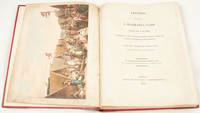
1813222916London.: John Murray. 1813. 10 hand coloured aquatints xiv 358pp ii Directions to the Binder lacks half title later half morocco red linen covered boards gilt-lettered spine 26.5 x 20.7 cms margins trimmed one plate with slight loss to the publisher's signature title page strengthened at the hinge small chip at the lower corner two leaves with short sealed edge tears text unaffected fifteen leaves stained at the gutter with loss to the inner margin of one plate final leaf with soft creases and a short sealed tear text unaffected the margins of the plates rather dusty and browned good condition. Firsthand account by Thomas Duer Broughton 1778-1835 a British army officer of the East India Company appointed military resident with the Mahrattas in 1802. Compiled from a series of letters to his brother Broughton's account includes detailed descriptions of festivals and ceremonies. Nine of the ten fine handcoloured plates are notable for being after sketches by Indian artist "Deen Alee". . John Murray. hardcover
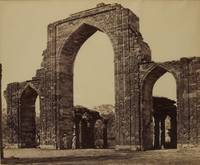
186632820551<p><b>This is a splendid pair of Samuel Bourne views of the Qutb complex in Delhi.</b></p><p>The first photograph shows the Delhi minaret and "victory tower" at the Qutb complex the tallest minaret in the world built of bricks. "The Qutb Minar is one of the most famous monuments in India and one of the most significant examples of early Indo-Islamic architecture. It is a tower of victory which also served as a minaret for the adjacent Quwwat al-Islam Might of Islam mosque. It was begun by Qutb-ud-Din Aybak ruled 1206-1210 the first Sultan of Delhi and founder of the Mamluk or Slave Dynasty and continued by Shams-ud-Din Iltutmish ruled 1211-1236. It is 72.5 m 238 ft high and rises in five tapering fluted" British Library.</p><p>The second photograph shows the screen of the Quwwat-ul-Islam mosque. "The screen which is often referred to as the 'Great Arch' is 6.7 metres wide and 16 metres high. An inscription on the central arch states that it was built in 1199 by Qutbuddin Aibak. It was one of the first Islamic monuments to be built by Hindu craftsmen in India. The craftsmen used the traditional method of laying blocks of stone horizontally and rounding the sides of individual stones to create the curve of the arch. The screen was ornately decorated with carved calligraphy and repeating scroll-like designs" Victoria and Albert Museum. The iron pillar at the left is cropped as issued. The dark tones and strong contrast wonderfully highlight the intricate carvings.</p><p>British photographer Samuel Bourne traveled throughout India from 1863-1870 photographing monuments people and landscapes. "By the time Bourne left India in 1870 to return to England he had produced over 2500 views mostly of architecture and landscapes which distributed by his partner Charles Shepherd constitute the most exhaustive record made in India by a single photographer. Bourne's carefully thought-out meticulously crafted images were collected by tourists archaeologists and botanists alike" Metropolitan Museum of Art.</p>