142 résultats
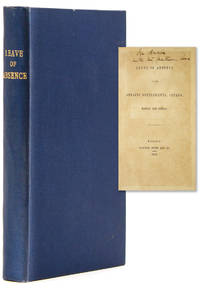
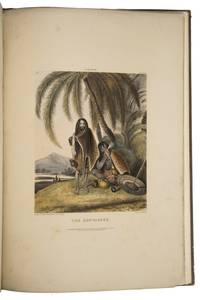
1839223681London.: Smith Elder and Co. Cornhill. 1839. Engraved handcoloured frontispiece opposite the additional engraved title page sketch map and 7 other full-page illustrations one folding and 5 hand-coloured text illustrations 2 half-title xvii including both the engraved and printed title pages 283pp; original blind-stamped pebbled green cloth boards 23 x 14.5 cms re-backed mounting the original gilt-lettered backstrip endpapers renewed scant spotting the boards faded and the backstrip chipped at the foot with the neat inked inscription of a previous owner but in very good condition. Scarce. Pioneering account beautifully illustrated after sketches by the author. Marianne Postans travelled to India in 1833 with her husband Thomas Postans a Captain in the 15th Regiment of the Bombay Native Infantry where he was posted to Cutch Kutch the northwestern region of modern-day Gujarat. They both shared a deep interest in the people and traditions of India. Marianne's account attempts to describe the culture of the region its bards and bardic literature including specific songs and stories of Kutchi bards arts and crafts and agriculture and trade. She also describes in detail rituals such as infanticide and the practise of sati. <br>The beauty of the Rann awed her: “The distant aspect of the Runn resembles that of the ocean at ebb tide; and as some water always remains on it the refraction of light produces the most beautiful and mysterious effects decorating it with all the enchantments of the most lovely specimens of mirage whose magic power exerting itself on the morning mists indues this desert tract with the most bewitching scenes…”. . Smith, Elder and Co. Cornhill. hardcover
1884189408London: Printed by the Ballatyne Press "For Private Circulation" 1884. Duleep Singh reclaims his throne First and only edition privately issued of this controversial presentation of the maharajah's grievances against the British Government's claims to the Punjab. Decidedly uncommon around 14 copies traced institutionally just a couple at auction. An excellent copy of a fragile fugitive and highly desirable work here in a variant binding to the black skiver usually encountered. The child king Duleep Singh 1838-1893 Maharajah of Lahorewas carried into exile following defeat in the Second Anglo-Sikh War 1848-9 converting to Christianity in 1854 obtaining a royal audience and becoming "an immediate success" with the Queen and eventually settling in Elveden Suffolk with Bamba Müller his "part-Ethiopian part-German" ODNB wife who he had met in Cairo when returning from his mother's funeral in India; "Duleep Singh loved Elveden and rebuilt the church cottages and the school. His fame as a shooter of game was revived in the grounds of the great estate". However "amid European glamour the spirit that had tasted sovereignty was hibernating somewhere in the mind of Duleep Singh. Prompted initially by his mother then by his cousin Thakur Singh Sandhanwalia and finally by the supposed prophecies of the tenth Sikh guru Duleep Singh began a battle with the British government asserting the illegality of the annexation of the Punjab and demanded to be reinstated as maharajah. In 1886 he tried to return to India to place himself as the prophesied head of the Sikh people but was arrested at Aden. Here he was received back into the Sikh faith". From Paris he made himself the centre of various plots to overthrow British rule in the Punjab scheming with Russian and Irish revolutionaries to force the Khyber Pass but all of these conspiracies came to nothing. Increasingly dogged by ill health he sought a reconciliation with Victoria who "responded with a full pardon through the secretary of state on 1 August 1890". He died in Paris in 1893 and was carried back to his beloved Elveden and buried in the graveyard of St Andrew's and St Patrick's Church. The present work represents the historical groundwork to his campaign for reinstatement to the throne and was distributed solely to those who he felt could be of influence to that end. It was "compiled partly from historical sources and partly from private information and documents furnished" Preface by Duleep Singh himself and encompasses a sketch of the early history of the Punjab; a biographical narrative of the Maharajah; and an explanation "of the peculiar Relations in which the Maharajah stands towards the Government and the causes of the differences between them". Octavo. pp. viii 183. Original moderate red cloth over flexible boards title gilt to the front cover single fillet blind panel to both covers grey-blue decorative endpapers. Slightly rubbed the spine sunned; endpapers a little browned pale toning to the text-block else a very good copy. hardcover
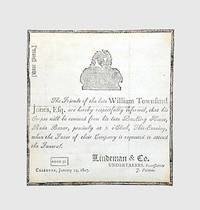
1807122432Calcutta: Star Press 24 January 1807. Haunting piece of Company-rule ephemera announcing the funeral of William Townsend Jones c.1757-1807 attorney on the council of the Supreme Court of Judicature at Fort William the highest court of British India from its foundation in 1774 until 1862. Jones's name is now usually connected with his indictment in December 1789 for flogging to death one Sheriut Allah the brother of his durwan gate-porter whom he suspected of stealing one of his dogs which was "an unlikely crime for a Muslim" Franklin. He was acquitted by the Supreme Court who concluded that Sheriut Allah had died by suicide by eating opium. The affair arose only two years after the impeachment of Warren Hastings in 1787 whose fall from grace had begun with a similar miscarriage of justice involving the execution of a native East India Company administrator Nandakumar. Jones is also a recurring character in the recently published diaries of Calcutta surveyor and builder Richard Blechynden 1759-1822 which reveal that he was also rumoured to have killed another of his servants his mater sweeper. The undertaker Peter Lindeman 1771-1856 of Scottish descent worked from premises at 144 Durrumtollah; from 1803 the Calcutta Missionaries held services in his house on Cossitollah Street until the completion of a new chapel at Lall Bazar in 1809 of which he became a trustee. Single sheet of laid paper 130 x 139 mm printed on one side. Mourning border motif of urn on an altar. Contemporary signature "T. R. R" on verso shaved; the leaf sometime removed from an album or mount adhesive markings and 3 strips of adhesive paper verso 3 faint creases from folding minute hole to one intersection of folds. In excellent condition. Franklin "Orientalist Jones": Sir William Jones Poet Lawyer and Linguist 1746-1794 pp. 300-1; Robb "Memory Place and British Memoirals in Early Calcutta" in Rashkow et al. eds Memory Identity and the Colonial Encounter in India online accessed 4/11/2017; see further Robb ed. Sex and Sensibility: Richard Blechynden's Calcutta Diaries 1791-1822 online. unknown
1813222915London.: Edward Orme. 1813. 20 hand coloured aquatint plates 149pp x Index including the Half Title and List of Plates; contemporary half calf over marbled boards spine gilt-lettered in compartments marbled edges 28.2 x 22 cms the first plate a trifle spotted with a small chip from the bottom margin slight age-toning and minor spotting in very good condition. Scarce suite of finely hand coloured aquatints depicting domestic colonial life in British India: the Europeans at their leisure attended by Indian servants. Doyley's compositions are often quietly satirical: Plate IV "A Gentleman Dressing Attended by His Head-Bearer and Other Servants" shows a young man in his gown relaxed seated and reading while an Indian servant washes his feet another in the background pours his drink and yet another makes his bed all overseen by the "Head-Bearer". The artist Charles Doyley was illustrating and observing a world in which was an intimate participant he had been born in India into a family that had long served in India himself serving as a member of the Bengal Civil Service from 1797 to 1838. <br> <br>Abbey Travel 435; Tooley 185 . Edward Orme. hardcover
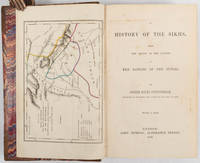
1849222747London.: John Murray. First Edition. 1849. Frontispiece map and one other folding map both hand-coloured in outline folding table xxxvi 425 3 pp; early half calf marbled boards 21.5 x 14 cms marbled endpapers spine blind-stamped in compartments and gilt-ruled red title label folding map with a sealed 4cm fold split at the head of one fold scant spotting and age-toning boards a trifle rubbed and scuffed neat inked previous owner's name to the front free endpaper and the pencilled name and address of bookseller R. D. Steedman paper abrasion to the verso of the front free endpaper a very good copy. <br> <br>Handsome armorial bookplate 'Erimus' to the front pastedown. First edition. Rare. <br>Joseph Davey Cunningham 1812-1851 wrote this landmark English work on the history of the Sikhs whilst serving as a Captain in the Bengal Engineers and the Political Agent to Bhopal. He had gathered extensive first-hand knowledge during eight years 1837–1845 of service as a political assistant on the Sikh frontier. The work gained notoriety for Cunningham's criticism of Sir Henry Hardinge's management of the Anglo-Sikh War. The subsequent disgrace led to his professional ruin and is reported to have hastened his early death at the age of 38. A second edition issued posthumously by the author's brother Peter Cunningham 1816–1869 a prominent British writer and critic softened its criticism of British policy. . John Murray. hardcover
1859320421Calcutta: Thacker Spink & Co. printed by P.M. Craneburgh at the Bengal Military Orphan Press 1859. First edition. iv 244 viii pp. 8vo. Original blue ribbed cloth spine gilt bookplate to front pastedown of Sir Charles P. Hobhouse Bart. Bradford-on-Avon presentation inscription to title page. A fine copy. First edition. iv 244 viii pp. 8vo. Inscribed on the title page: "For Annie with the Author's love." This copy also formerly belonged to Sir Charles Parry Hobhouse 3rd Baronet of Westbury.<br /> <br /> A crisp copy recording the anonymous author's seven month's of exploring through South East Asia in 1851 and 1853. Departing 8 September 1851 the author who remains anonymous to this day spent four months travelling to Ceylon and Singapore before returning to Calcutta. In 1853 he set off again this time for a three month excursion to the Madras and Bombay Presidencies. There are vivid descriptions of Singapore Penang Malacca Madras Calcutta Bombay Bangalore and Candy as well as coffee plantations and Buddhist temples. The author spends quite some time travelling overland and describes an ascent of Pedro Tallagalla and Kilkamany and camping at Makoortie Peak. Despite the scarcity of this little book it did attract critical attention. A favourable notice appeared in the Calcutta Review which states that the author had "seen and noted down . as much as any one who had preceded or who has since followed him in the same track."<br /> <br /> The work concludes with an appendix in two parts the first being a table showing the route modes of transport ship rail bandy pony and the amount of time spent at each location. The second is titled "Hints for travellers" which concludes: "Travellers will find it wiser never to have coolies to their palanquins when they can procure bearers; never to go in palanquins when they can with safety from the sun ride; never ride down passes when they can walk and never to be discouraged by indifference or dissuaded by alarms from prosecuting any enterprise." There is nothing in the preface to explain the six year delay between the conclusion of his travel and the publication of the account.<br /> <br /> Exceedingly rare. No copies on OCLC or COPAC. The only other copy we know of is the Brooke-Hitching copy identically bound; the present copy is in superior condition. The Calcutta Review vol. 33. July-December 1859. Serampore: "Friend of India" Press 1859 pp. lxviii-lxxi Thacker, Spink & Co. (printed by P.M. Craneburgh at the [Bengal] Military Orphan Press) unknown
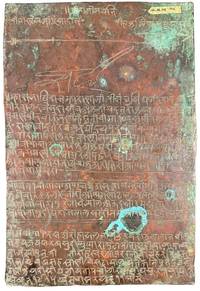
181942798Eastern India possibly Bengal or Assam circa 18th-19th century. Copper plate 13 7/8 x 9 1/8 inches engraved on both sides. The principal face with several lines of incised text at the head followed by a large engraved validating or emblematic mark and below this three dense sections of text divided by ruled horizontal lines. The reverse largely uninscribed with three small engraved seals or validating marks near the edge. An inscribed copper plate of Indian origin possibly Bengal or Assam engraved in a Bengali or Bengali-Assamese script and preserving a formal documentary text in metal.<br/> <br/> This copper plate belongs to the South Asian tradition of preserving legal devotional and administrative records on durable metal supports. Copper plate documents often described as tamrapatra or copper charters were used for grants endowments title rights decrees and other formal acts their material permanence giving them authority beyond that of ordinary manuscript documents. The present example appears to preserve a substantial text arranged in ruled sections and accompanied by validating marks. The script appears close to Bengali or Bengali-Assamese. The letterforms show rounded and looped shapes consistent with scripts used in eastern India. If confirmed this would suggest an origin in Bengal Assam or a neighbouring region where related scripts were used for administrative and religious writing. From their earliest centuries of development copper plate inscriptions have occupied a central place in South Asian documentary culture particularly in the recording of land grants royal edicts temple endowments and other formal transactions. Their durability made them suitable for preserving records intended to endure and they were often deposited in temples or held by families or institutions as proof of rights and privileges. While earlier examples are frequently associated with royal chancelleries the practice continued into the early modern and colonial periods with regional administrations and local authorities maintaining related forms of documentation. The present plate appears to belong to this later phase of the tradition when such documents were still being produced for administrative legal or commemorative purposes. Its relatively large format and the density of inscription suggest a formal text of some substance while the additional engraved devices indicate an effort to authenticate or formalise the record. The copper plate offers a direct example of a documentary practice that bridges manuscript culture and more durable forms preserving both the text itself and the physical conventions of its transmission. unknown
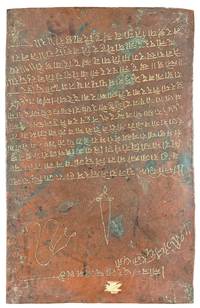
181942797Western or Northern India circa 18th or 19th century. Copper plate 15 1/2 x 9 3/4 inches engraved on both sides one face densely filled with horizontal lines of incised text and with additional marks including a dagger or torch device and other validating or ownership marks. The reverse more sparsely inscribed with two lines of text. An inscribed copper plate of Indian origin engraved on both sides and belonging to the South Asian tradition of preserving legal devotional and commemorative texts.<br/> <br/> A striking survival from the documentary culture of South Asia where copper served as a durable support for records intended to outlast paper and palm leaf. Such copper records often described as tamrapatra or copper charters were valued because they were portable difficult to alter and capable of serving as enduring witnesses to grants decrees endowments title rights and other formal acts. The script appears to belong to the Nagari family possibly Devanagari or a related cursive administrative hand such as Modi the script long used for Marathi official and business writing. From their earliest centuries of development copper plate inscriptions have occupied a central place in South Asian documentary culture particularly in the recording of land grants royal edicts temple endowments and other formal transactions. Their durability made them suitable for preserving records intended to endure and they were often deposited in temples or held by families or institutions as proof of rights and privileges. While earlier examples are frequently associated with royal chancelleries the practice continued into the early modern and colonial periods with regional administrations and local authorities maintaining related forms of documentation. The present plate appears to belong to this later phase of the tradition when such documents were still being produced for administrative legal or commemorative purposes. Its relatively large format and the density of inscription suggest a formal text of some substance while the additional engraved devices indicate an effort to authenticate or formalise the record. The copper plate offers a direct example of a documentary practice that bridges manuscript culture and more durable forms preserving both the text itself and the physical conventions of its transmission. unknown
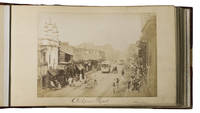
1874ABC_46925Calcutta 1874. Contemporary gold-tooled half red morocco brown cloth sides. Oblong 8vo. With 33 mounted sepia albumen prints ca. 15/15.5 x 10.5/11 cm all captioned. Manuscript title and captions of the pictures in English written in brown ink in a neat 19th-century cursive hand. Photograph album containing 33 albumen prints of buildings important places views and people in Calcutta in the 1870s. The album opens with some architectural photographs including the governor's house the new market the post office St. Paul's cathedral and the high court. Also included are views of roads and streets that are still important today such as Benting Street Chilpore Road Russell Street and Strand Road and 5 albumen prints of the B.Y. Docks. The album also contains views near Kalighat and Barnatore especially of the landscape but also of a Hindu temple. The album concludes with some photographs of people living in Calcutta showing beggars carpenters palki bearers a barber ending the album with a group of Rohillas.The album includes a photograph of the statue of Sir James Outram unveiled in Calcutta on 22 May 1874 an all photographs seem likely to have been made soon after that.Binding a little worn and scuffed endpapers a little dust-soiled some leaves marginally slightly dust-soiled some leaves slightly browned some occasional foxing paper of the last photograph slightly damaged not affecting the image some images a little faded but overall in good condition. A highly interesting album showing life in Calcutta in the 1870s.l For dating the statue of Sir James Outram: Catalogue of the sculpture of J.H. Foley in: Dublin Historical Record 32 3 1979 pp. 108-116. hardcover
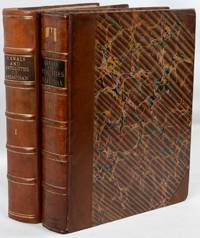
1829222492London.: Smith Elder and Co. First Edition. 1829-1832. First edition. Rare. Two vols: <br>Vol I Engraved frontispiece large folding engraved map of Rajast'han hand-coloured in outline and laid-down on linen 29 engraved plates or tables three folding iii-xxx title dedication introduction contents lacks half-title ii list of plates 806 pp errata leaf; <br>Vol II Engraved frontispiece 22 engraved plates two folding iii-xxxii title dedication introduction lacks half-title ii list of plates 791 pp. <br>Two of the plates foxed four with marginal foxing images unaffected the list of plates in Vol I strengthened at the foot and p.329 with an archivally sealed tear no loss; contemporary half calf over marbled boards 31.5 x 25 cms quarto Vol I sympathetically re-backed endpapers renewed gilt-lettered title labels between gilt-ruled raised bands the remains of a library ticket to the head of Vol II speckled edges a good set of the rare first edition. <br>With the bookplate of Anthony Mactier Durris. A landmark illustrated work of British India; the rare first edition with a noteworthy provenance. Anthony Mactier 1773-1854 served as Registrar of the High Court in Calcutta before returning to Scotland in 1834 purchasing the Durris estate in 1837. At the time Tod's "Annals" was regarded as "the political officer's bible" see Charles Allen "Lives of the Indian Princes" 1985 p. 255 and shaped European and Indian perceptions of Rajput identity. . Smith, Elder, and Co. hardcover
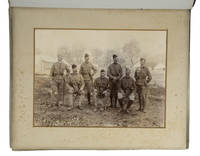
1898ABC_457021898. 2 PARK Superintendent. 1898. Catalogue of photographs by Sergeant A.J. Clarke R.E. taken during Tirah Expedition 1897-1898. Kirkee Pune India Sappers and Miners' Press 1898. Small folio 22 x 14.5 cm 4 pp. With a lithographed title-page. Loosely inserted in the album. Collection of photographs taken by a British Indian Army officer who served in the Peshawar Column during the Tirah Expedition in the Northwest Frontier of India from June 1897 to April 1898 including a manuscript Key that identifies seven British officers that are in the first photo of the album and a list of captions to 10 photos in the album.The Tirah Expedition was aimed against the Afridi and Orakzai tribes in British Indias Northwest Frontier modern-day Khyber Pashtunkhwa province of Pakistan. One of many Northwest Frontier campaigns of British India the Tirah campaign concentrated on the area west and south of Peshawar in the mountainous region between the valleys of the Bara and Kohat Rivers. The album primarily documents the actions of the Tirah field forces Peshawar Column under command of Brigadier-General Arthur George Hammond 1843-1919 which followed the route of the Bara Valley.The present photo album contains 8 large albumen photos documenting the movement of the Peshawar Column. The large photos were taken by W. Rahn according to the memoirs of Peshawar Column officer Richard Thomsett we had a photographer named Rahn with the column and he accompanied us until we arrived at Ali Masjid in December 1897 when an accident necessitated his returning to India. Rahn was a German who had come out to the East some twenty years before and seemed to be ubiquitous for wherever we were there he was with his camera ready and I must say he took some very excellent pictures.The present album also includes 43 smaller gelatin photos with manuscript captions for 10 of them on a small piece of paper perfectly describing the photos on leaves 5 and 9 of the album. The album is supplemented with a rare 4-page brochure no doubt produced in a small print-run that lists 99 photos. About 20 have been marked by hand in pencil probably by the albums compiler. The brochure indicates that the present photos could be purchased from the Bombay Sappers and Miners.8 of the large photos have contemporary manuscript captions in ink on the mounts. 2 marks on the front paste-down reading "photographs by British Royal Engineers. Tirah Expedition 1897-1898 North India. Binding slightly rubbed on extremities the original 5 cords replaced with 3 new black cords hinged to stubs . A few images mildly faded. The additional manuscript leaves foxed and worn. Otherwise in good condition.l The navy and army illustrated V no. 53 24 December 1897 pp. 150-152 4 of the 8 large photographs & no. 57 18 February 1898 p. 275; R.G. Thomsett With the Peshawar olumn. Tirah expeditionary force London 1899 pp. 103-104. unknown
18803050981880. Albumen prints approximately 9 x 11-1/2 in. mounted on card with manuscript captions 61 signed and numbered in the negative by Bourne the rest unattributed. 1 vols. Oblong folio. Contemporary full pebbled morocco. Light traces of rubbing occasional light foxing to mounts. Albumen prints approximately 9 x 11-1/2 in. mounted on card with manuscript captions 61 signed and numbered in the negative by Bourne the rest unattributed. 1 vols. Oblong folio. An excellent and varied view of British India in the 1860s with large-format photographs supplied by one of the longest running photography firms in the world. The images grouped by location generally show architectural views as well as some Himalayan and rural views. Images include scenes from Goverdhan Deig Cawnpore Lucknow Benares Calcutta Darjeeling Udaipur Palace in the Lake and Ahmedabad. unknown
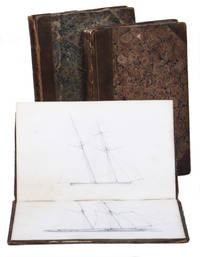
1822ABC_49460Aboard the Winchelsea written and drawn at sea 1822. Contemporary half gold-tooled brown calf marbled paper sides each volume with a different marbled paper the journal volume with marbled endpapers. 8vo. The two sketchbooks contain a total of ca. 100 pages of sketches of ships done in pencil including 1 page containing signal flags in colour. 3 volumes. With: Two sketchbooks with pencil drawings of ships. A neatly-written and illustrated sea journal kept by James Dudman the second mate on board the East India Company's ship Winchelsea during a 1822-23 voyage to India. Launched in 1803 the Winchelsea was already a veteran East Indiaman this being her ninth voyage - she made a total of eleven voyages for the EIC before she was broken up in 1834. On the present voyage commanded by Captain William Adamson she carried 592 people including the 17th and 44th Regiments of Foot and detachments of the King's and EIC's soldiers and a number of women and children. The sea journal volume is accompanied by two additional volumes by Dudman containing pencil sketches of unidentified masted sailing vessels.The Winchelsea's journey from its departure at Blackwall Dock on April 24 1822 to its arrival in Bengal and eventual return to England via St. Helena and The Downs on May 24 1823 reflects the extensive maritime routes integral to British imperial dominance. The ship's role in transporting personnel and cargo exemplifies the strength of the EIC's logistical network sustaining Britain's colonial and economic interests in India. The journal with its careful record-keeping offers an intimate glimpse into the daily operations experiences and extraordinary events encountered by the second mate aboard an East Indiaman during Britain's height of imperial expansion.The journal written in Dudman's beautiful scribe-like handwriting opens with an entry dated 24 April 1822 at Blackwall Dock where the voyage started "bound for Bengal." The next few pages contain a detailed listing of the people on board beginning with the ship's company of 122 men with names followed by the troops on board: "List of a detachment of His Majesty's Troops belonging to the 44th Regt. of Foot on board the Honable. Company's Ship Wincelsea for Bengal" comprising name and rank of 367 men followed by the names of 42 women on board as well as the name and age of 57 children on board including 3 who died at sea plus 4 additional passengers.At Saugur meaning Sagar Island they took on board further passengers duly noted in an additional "List of H.M. 17th Regiment of Foot with the Women and Children accompanying them. Embarked on board the Honble. Company's ship Winchelsea at Saugur New Anchorage for England."Beyond the usual records of position winds weather and other ships Dudman includes interesting notes on unusual occurrences. Perhaps the most fascinating event was recorded on February 10 1823: a major earthquake off the coast of India experienced by the Winchelsea: "At 10 minutes past 1 PM every one on board was greatly alarmed at the singular feel of the ship which was in a violent trembling motion as if the ship was grazing over a rocky shoal and a loud rumbling noise similar to the roll.g! of a Bull quickly along the deck this very singular seuration lasted certainly not less than a minute those below ran on deck to enquire the cause and those below the poop below to ask the same question. I was in the round house at the time when it comen'd. The noise appeared to me as coming along the quarter deck and instantly over the poop the sea was smooth and the day clear. I looked out at the stern windows but saw no appearance of any shoal which I certainly would have done had such existed. The water being very clear and the ship not going more than 2 knots I cannot account for this very singular phenomenon in any other way than its being the shock of an Earthquake".The voyage journal of the Winchelsea during its 1822-23 journey to Bengal provides valuable insight into the maritime operations of the EIC its commercial and colonial reach and the strategic importance of British trade with India in the early 19th century. As a veteran East Indiaman the Winchelsea was part of the vast trading network that connected Britain with the Indian subcontinent transporting soldiers goods and passengers under the auspices of the EIC which functioned as both a commercial enterprise and a colonial governing force.The journal volume contains the typographic book plate of Mr. Jas. Dudman on the front pastedown and a manuscript inscription in ink on the first flyleaf by Lumsden Dudman who was married to Mary Anne Shirreff "Joseph H. Shirreff from L.S. Dudman Xmas 1892" one of the sketchbooks contains a manuscript inventory list in Greek of goods for sale on the first flyleaf and one of the sketchbooks with ownership signature "L: Dudman / Sept. 27 1836" likely Rev. Lumsden S. Dudman perhaps a brother of James Dudman. Some general wear to the leather spines and corners of the boards of the volumes occasionally foxed but overall internally clean. Overall in good condition. unknown
1842M2ACVI942UQXLondon: Thomas McLean 1842. Contemporary half calf with cloth sides gold tooled title on front cover. Large folio 545 x 375 cm. With 6 hand coloured lithograph plates and a lithographed title. First and only edition of an ethnographic study of native Indian people by William Tayler 1808-1892 who was at that time Acting Salt Agent of the Central Division of Cuttack for the East India Company. He dedicated his work to "Lady William Bentinck" born Lady Mary Acheson 1809-1850 who was the wife of the Governor-General of India. The illustrations were drawn by Tayler himself who was an amateur artist and drew much of the Indian daily life that he encountered. He selected the present 6 drawings to be published and had them lithographed by J. Bouvier. The first 3 plates not only show the ways of Indian people but even more so the luxurious life of the English in India. The first plate The Young Civilian's Toilet shows a young man relaxing while being treated by several servants who are named Anglo-Indians. The room is strewn with objects of leisure. The next 2 plates The Young Ladies Toilet & The Breakfast show equal scenes. The other 3 plates are more ethnographic in nature showing native Indians in their everyday life: Women grinding at the mill; the Sunyasees Sannyasis & The village barber. Tayler later became a controversial figure for his excessively harsh oppression of Indian people when he was the commissioner of Patna.Spine and covers slightly worn pages a little frayed some foxing on the text pages. Dedication page broened. Plate 2 detached and inserted loosely. Plates in good condition.l Abbey Travel 465; Bobins I 272; H.K. Kaul Early Writings on India 454; Prasannajit De Silva Colonial Self-Fashioning in British India c. 1785-1845 2018 pp. 116-119. Thomas McLean, hardcover
1865311412Madras: Lawrence Asylum Press 1865. Illustrated with 12 mounted albumen photographs captioned in ink. Text within braided rule borders. ii 65 pp. 1 vols. 8vo. Full black morocco spine with gilt rules boards with gilt roll borders ornamental cornerpieces titled in gilt on upper cover yellow endsheets with orange ticket Bound at the Lawrence Asylum Press within border. Some minor rubbing occasional foxing. Fine. Gift inscription on first blank "J. Michael with the kindest regards of J.C.H. July 17th 1875. Illustrated with 12 mounted albumen photographs captioned in ink. Text within braided rule borders. ii 65 pp. 1 vols. 8vo. Spectacular unrecorded privately printed diary recounting a hunting expedition in Kerala southern India from 27 July to 22 September 1865 "the best shikar trip I have ever had". The narrator and his companion A.M.D. bagged 43 heads of eleven different types of big game including tiger bear elephant bison chettul and others with original albumen photographs mounted and captioned in a neat hand. <br /> The unnamed narrator mentions passing hunting parties one such Brown Jones and Robinson suggests that he read Trollope when the novel appeared as a serial in the Cornhill; the terrain around Hassanoor Ghaut was familiar to him for he had planted fruit trees and roses near a camp building; mention is made also of Hamilton Brooke and Faulkener hunting the area the previous year. This may be Douglas Hamilton who in 1892 published a long retrospective 'Records of Sport in Southern India'.<br /> The narrator buys prepared photographic plates from a departing hunter who had ordered them from the Patent dry Collodion Co. of Birmingham. The two hunters were accompanied by the dog Scamp chief among a pack that included Tinker and a plucky three-legged dog Pinko both killed by a panther and bearers of cowardly deportment save for the plucky Rajii who stood by when the narrator faced bear and elephant. At times the grass was too high for a man to get through easily.<br /> Notably the hunter describes many photographic incidents including how the frontispiece "The Tiger's Siesta" came to be made. One day D. encountered a a tigress atop the head of a young elephant and shot her despite the commotion. The young elephant ran off. The next day going to photograph the tigress the narrator was charged by a herd of elephants. He shot an elephant cow and they moved on to photograph the elephant "taking the tigress with us. The men who carried her threw her body into the elephants arms and it looked so strange the tigers mouth being curiously drawn up as if she were laughing that I thought I would try a picture in that position.". UNRECORDED in all the usual references and catalogues Lawrence Asylum Press unknown
1837ABC_46027London Calcutta etc.: various publishers 1837. Half calf with marbled sides and lettering in gold on spine or cloth with marbled sides and a spine label. 8vo. Some illustrated with plates and maps. 107 volumes many containing multiple articles. Handsomely bound extraordinary collection of important scientific journal articles by 19th and 20th century Western explorers of Afghanistan Central Asia China the Himalayas India including Assam Bengal Kashmir and Punjab Karakoram Pakistan including Sindh and Tibet with content covering anthropology archaeology exploration geography geology glaciology history language and grammar mountaineering and politics. At the time these were the far outskirts of the world for Western science where a lot was yet to be learned. Often the maps in these journals are the first modern maps of such regions and findings were the first to be scientifically published.Generally in very good condition.Please inquire for a full list of contents. various publishers, hardcover
18933075751893. 193 original albumen prints ranging in size from 180mm x 260mm to 239mm x 290mm mounted on card most captioned in ink in English in a fin-de-siècle Vienna hand; approx. 60 with small printed captions mounted to boards; 8 photographs untitled. 2 vols. Oblong 4to. Housed in two contemporary morocco backed cases stamped in gilt "Indien" on spine and upper covers with third box to match. Some occasional bowing of boards photographs fine and well preserved with exception of a stock image of the Taj Mahal lightly faded and some soiling to the mount. 193 original albumen prints ranging in size from 180mm x 260mm to 239mm x 290mm mounted on card most captioned in ink in English in a fin-de-siècle Vienna hand; approx. 60 with small printed captions mounted to boards; 8 photographs untitled. 2 vols. Oblong 4to. Group of 193 original albumen print photographs documenting the Indian portion of the world tour of Archduke Franz-Ferdinand of Austria 1863-1914. This official voyage of the Archduke lasting from December 1892 to October 1893 had explicit diplomatic ethnographic and scientific aims as well as an unspoken goal of permitting the Archduke to recover his health after a diagnosis of tuberculosis. The royal party traveled aboard the imperial cruiser Kaiserin Elisabeth the most modern vessel of the Austrian fleet. They spent two weeks in Ceylon now Sri Lanka before arriving in India in mid-January 1893. The party spent two-and-a-half months in India before touring Nepal returning briefly to Calcutta to embark for Singapore at the end of March. The world tour continued with visits in Australia the Pacific Islands Japan Canada and the American West before the Archduke sailed from New York to Le Havre.<br /> The Archduke's stay in India included diplomatic engagements military reviews and a formal visit to the sixth Nizam of Hyderabad who was in late Victorian times the richest man in the world. The Archduke was put up in the Nizam's Bashir Bagh palace. The Archduke also spent considerable time hunting hawking pigsticking bagging some 20 tigers and leopard antelope sambhur black buck and just about every other beast of the chase in Ceylon he had hunted elephant. Franz-Ferdinand was a devoted hunter whose lifetime game bag exceeded 200000 animals; on the world tour his entourage included a huntsman and his taxidemist Eduard Hodek 1858-1929 who was also the Archduke's photographer and boon companion. The itinerary of the Archduke's travels permits the close dating of many of the photographs and events of the trip. A detailed list of the photographs is available. An exhibition in Vienna in 1894 publicized the collections made by the Archduke during his world travels and his diary was published as Tagebuch meiner Reise um die Erde in two volumes 1895-6. Upon the death of his father in 1896 Franz-Ferdinand became the heir to the Austrian throne. His assassination at Sarajevo in 1914 proved the spark that sent Europe and the world into war.<br /> The photographs document a wide range of subjects both formal and informal including views of the Archduke's activities grand receptions by the Nizam of Hyderabad military reviews sporting and equestrian events topographical vistas palace scenes as well as ethnographic and hunting images including substantial game bags. Many of the formal photographs of events in Hyderabad were taken by Lala Deen Dayal 1844-1905 noted court photographer to the Nizam and the first Indian photographer to gain international recognition for his work as a pioneer of photography in India only a few bear his studio stamp; but the images are identified in Höfer. Some of the views of and around Calcutta are from Samuel Bourne or Bourne and Shepherd.<br /> A spectacular visual record of 1890s India the opulence of the court of Hyderabad and sporting episodes in the life of Franz-Ferdinand. Regina Höfer Imperial Sightseeing: Die Indienreise von Erzherzog Franz-Ferdinand von Österreich-Este Vienna Museum für Völkerkunde Wien 2010 unknown