142 résultats
189848651London: S.W. Partridge 1898. 8vo. 320 pp. Frontisp. Contemporary full red calf prize binding raised bands on spine gilt decoration gilt dentelles gilt lettering on front cover gilt & green morocco spine label marbled fore-edges & endpapers minor edgewear rubbing to fore-edges very slight bumping to corners still a VG copy presented to H.I. Marriner as Prize for Latin Form I from The Old Ride School Branksome Park Bournemouth which was located in Martello Road between Branksome Park and Canford Cliffs. Second printing prize binding of this third volume in the Romance of Colonization series. S.W. Partridge, hardcover
189849175London: James Bowden 1898. Tall 8vo. 159 1 pp. Photo frontisp. 13 photo plates 57 plates. Original khaki-coloured cloth illustration & brown lettering on front cover over beveled boards a.e.g. chipping wear soiling damage head & foot of spine bumping & wear to corners some minor soiling to endpapers still G- reference copy w/ Bookseller’s label on front pastedown for Queen City Book Co. Cincinnati OH and former ownership stamp. First edition of this scarce illustrated account of the relief of the British Garrison at Chakdara during the siege of Malakand by 10000 Pashtuns commanded by Saidullah. The British relief column was sent to assist General William Hope Meiklejohn and was accompanied by a young 2nd Lieutenant Winston Churchill who later published his Story of the Malakand Field Force. James Bowden, hardcover
189552526New York: Charles Scribner’s Sons 1895. 12mo. 390 2 pp. plus 16 pp. publisher’s catalogue. Frontisp. 11 plates 3 maps 1 large double-page colour map. Blue pictorial publisher’s cloth cover art image of figure in tuban holding sword tiger on spine in red white & black white red & gilt lettering decoration minor darkening dustsoiling minor wear to couple corners slight bumping to couple corners still VG bright copy. First edition of this rousing tale of privateers shipwreck and rescue in India during the third and fourth Anglo-Mysore Wars in Indian 1790-1799. Henty has focused on the failings of Lord Cornwallis as he describes the battles in which Tipu Sultan invaded the state of Travancore with French allies which ended in his defeat at the siege of Serigapatam and the signing of the Treaty which required him to surrender half his kingdom to the British East India Company. The Fourth Anglo-Mysore War resulted in the death of Tipu Sultan when the British won a decisive victory at the Siege of Seringapatam in 1799. William Henry Margeston 1861-1940 was a noted English painter and illustrator primarily known for his striking portraits of women. Charles Scribner’s Sons, hardcover
189753180London: Methuen & Co. 1897. Tall 8vo. x 2 361 pp. Photo frontisp. 15 photo plates 1 large folding colour map. Blue pebbled cloth gilt lettering on spine very minor shelfwear rubbing slight bumping to couple corners VG copy. First edition of this excellent work compiled from information collected during the course of the Ethnographical Survey of the Provinces Agra and Oudh in northwest India. Methuen & Co., hardcover
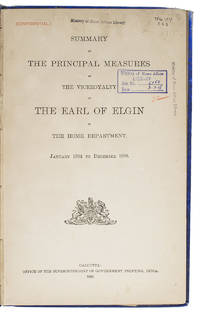
1898ABC_45361Calcutta: Office of the Superintendent of Government printing India 1898. Blind-stamped blue cloth title in gold on spine blue decorated endpapers. Folio. With armorial vignette on the title page. The official Summary always published at the end of a Viceroy-ship by the Office of the Superintendent of Government printing in Calcutta containing the narrative of proceedings of the Home Department in this case from January 1894 to December 1898 the time the 9th Earl of Elgin served in that function. The extensive contents pp. i-iv refers always to the pages in the appendices pp. 1-6156 ! not present.During his time as Viceroy famine broke out in India in which Elgin reportedly admitted that up to 4.5 million people died. Other estimates have put the death toll at 11 million people. His administration in India was otherwise notable for the Afridi frontier uprisings of 1897-1898.With the label of the Home Department Juridical Branche on the front board and a second label with the shelfmark and stamps of the Ministry of Home Affairs on the title page and elsewhere including a Confidential stamp. Head of both boards damaged and damp-stained front hinge worn front endpapers loose slightly browned throughout.l Bence-Jones Mark. The Viceroys of India London 1982. Office of the Superintendent of Government printing, India, hardcover
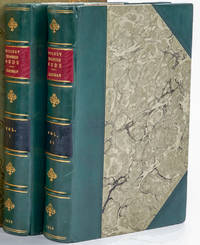
1858022106London: Richard Bentley 1858. First Edition. Hardcover. Text toned. Very Good in a Fine binding and clamshell box. Two 5" x 7-1/4" volumes in modern half polished green calf with marbled boards and matching calf corners gilt-decorated spines with contrasting gilt-lettered morocco spine labels: lxxx 337; vi 424 pages. Housed in a green cloth clamshell box. Illustrated with a folding map. <br/><br/> Richard Bentley hardcover
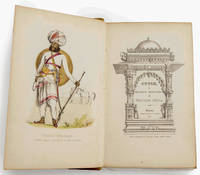
1844022107London: J. Hatchard and Son 1844. First Edition. Hardcover. Partly unopened; scattered foxing but text and plates mostly clean. Some fraying along spine edges; gilt fairly bright. Easily Very Good in a Fine clamshell box. Two 6-1/2" x 9-3/4" volumes in publisher's gilt-decorated and lettered green cloth: xii 478; vii i 459 1 pages. Housed in a green cloth clamshell box. Illustrated with 32 color chromolithographic plates with tissue guards. Lieutenant-Colonel William Henry Sleeman who spent his entire career in India was best known for his fight to suppress the activities of "thugs" bands of criminals who attacked robbed and often murdered innocent travelers. In these volumes he describes his experiences doing so as well as his thoughts on various aspects of Indian life including Hinduism local festivals and folklore natural history governance military discipline and the justice system. In 1828 Sleeman made the first documented discovery of dinosaur fossils in Asia before the term "dinosaur" was even formally coined. ABBEY TRAVEL 466. <br/><br/> J. Hatchard and Son hardcover
1839022098London: Smith Elder and Co. 1839. First Edition. Hardcover. Fairly unobtrusive library blindstamp on frontispiece pictorial title map and several text pages. Still an attractive clean example of a scarce title in a Fine clamshell box. Modern half polished calf with marbled boards and matching calf corners 5-1/2" x 9"; xvii 3 283 1 pages housed in a red buckram clamshell box. Lacking the printed title page but with the lithographed additional pictorial title and illustrated with a hand-colored map 8 engraved plates 7 of which are hand-colored including 1 folding and several text engravings. In 1834 the author's husband was posted to Cutch a western district of present-day Gujarat India and there she gathered the notes and made the drawings that would form the basis for this her first publication. <br/><br/> [Smith, Elder and Co.] hardcover
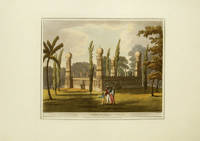
1804204074London.: Edward Orme. 1804 but circa1834. Handcoloured aquatint engraving 29.6 x 37.5 cm platemark; 41.2 x 58.6 cm sheet very good clean condition. A beautifully executed aquatint from the series "Picturesque Scenery in the Kingdom of Mysore" by James Hunter first published in "A Brief History of Ancient and Modern India" by Francis William Blagdon in 1805 the engraving is dated on the plate June 4 1804. This copy is from a subsequent edition the sheet watermarked "Whatman Turkey Mill 1834" see Abbey 425. . Edward Orme. unknown
188945217Calcutta:: Printed by Bama Churan Dutta 1889. First edition. sewn but lacking wrappers. Light wear; some soiling; very good. Neither the BMC nor NUC mentions the folding frontispiece map. 8vo. Folding frontispiece map. Printed by Bama Churan Dutta, unknown
1874B7111Hyderabad India: Residency Press. 1874-5. Bindings rubbed interior generally clean. Binding: 1874 vol in printed paper wraps backed in green cloth. 1875 in publisher’s limp printed paper boards rebacked in blue cloth. Notes: Ex-library ink stamps on titles.<br>Very good example. Rare volumes on India. <br><br>1874 volume with errata slip bound in.<br> Size: 8vo. 240 x 150 mm Volume: 2 volumes. Category: Book Asia Central India & Ceylon / Sri Lanka; Residency Press. paperback
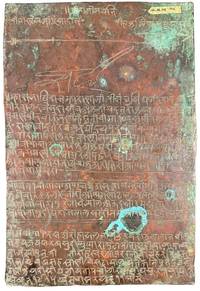
181942798Eastern India possibly Bengal or Assam circa 18th-19th century. Copper plate 13 7/8 x 9 1/8 inches engraved on both sides. The principal face with several lines of incised text at the head followed by a large engraved validating or emblematic mark and below this three dense sections of text divided by ruled horizontal lines. The reverse largely uninscribed with three small engraved seals or validating marks near the edge. An inscribed copper plate of Indian origin possibly Bengal or Assam engraved in a Bengali or Bengali-Assamese script and preserving a formal documentary text in metal.<br/> <br/> This copper plate belongs to the South Asian tradition of preserving legal devotional and administrative records on durable metal supports. Copper plate documents often described as tamrapatra or copper charters were used for grants endowments title rights decrees and other formal acts their material permanence giving them authority beyond that of ordinary manuscript documents. The present example appears to preserve a substantial text arranged in ruled sections and accompanied by validating marks. The script appears close to Bengali or Bengali-Assamese. The letterforms show rounded and looped shapes consistent with scripts used in eastern India. If confirmed this would suggest an origin in Bengal Assam or a neighbouring region where related scripts were used for administrative and religious writing. From their earliest centuries of development copper plate inscriptions have occupied a central place in South Asian documentary culture particularly in the recording of land grants royal edicts temple endowments and other formal transactions. Their durability made them suitable for preserving records intended to endure and they were often deposited in temples or held by families or institutions as proof of rights and privileges. While earlier examples are frequently associated with royal chancelleries the practice continued into the early modern and colonial periods with regional administrations and local authorities maintaining related forms of documentation. The present plate appears to belong to this later phase of the tradition when such documents were still being produced for administrative legal or commemorative purposes. Its relatively large format and the density of inscription suggest a formal text of some substance while the additional engraved devices indicate an effort to authenticate or formalise the record. The copper plate offers a direct example of a documentary practice that bridges manuscript culture and more durable forms preserving both the text itself and the physical conventions of its transmission. unknown
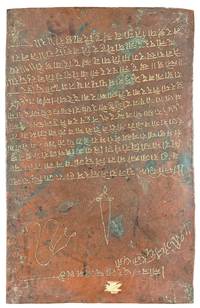
181942797Western or Northern India circa 18th or 19th century. Copper plate 15 1/2 x 9 3/4 inches engraved on both sides one face densely filled with horizontal lines of incised text and with additional marks including a dagger or torch device and other validating or ownership marks. The reverse more sparsely inscribed with two lines of text. An inscribed copper plate of Indian origin engraved on both sides and belonging to the South Asian tradition of preserving legal devotional and commemorative texts.<br/> <br/> A striking survival from the documentary culture of South Asia where copper served as a durable support for records intended to outlast paper and palm leaf. Such copper records often described as tamrapatra or copper charters were valued because they were portable difficult to alter and capable of serving as enduring witnesses to grants decrees endowments title rights and other formal acts. The script appears to belong to the Nagari family possibly Devanagari or a related cursive administrative hand such as Modi the script long used for Marathi official and business writing. From their earliest centuries of development copper plate inscriptions have occupied a central place in South Asian documentary culture particularly in the recording of land grants royal edicts temple endowments and other formal transactions. Their durability made them suitable for preserving records intended to endure and they were often deposited in temples or held by families or institutions as proof of rights and privileges. While earlier examples are frequently associated with royal chancelleries the practice continued into the early modern and colonial periods with regional administrations and local authorities maintaining related forms of documentation. The present plate appears to belong to this later phase of the tradition when such documents were still being produced for administrative legal or commemorative purposes. Its relatively large format and the density of inscription suggest a formal text of some substance while the additional engraved devices indicate an effort to authenticate or formalise the record. The copper plate offers a direct example of a documentary practice that bridges manuscript culture and more durable forms preserving both the text itself and the physical conventions of its transmission. unknown
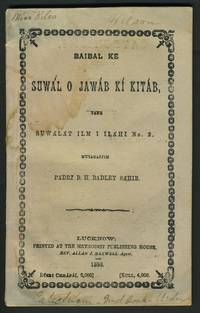
188823582Lucknow India: Methodist Publishing House 1888. Paperback. Very good condition. Methodist pamphlet printed in Urdu in a question and answer format. Owners' signatures at top of front wrapper "Miss Niles" and Mr. "Wilson" and "Catechism 2nd Book Urdu" in ink.<br /> <br /> Brenton Hamline Badley 1849-1891 American missionary was born in Monmouth Indiana in 1849. He was first assigned to the North India Annual Conference. He preached his first sermon in the local dialect within a short period and spent the next four years preaching throughout the countryside. He later returned to Lucknow and served there until the end of his life.<br /> <br /> Badley helped with the development of the Centennial Boys School into Reid Christian College now Lucknow Christian College. Mr. Badley authored books and articles on Indian Missions for American publications and put together the 1876 Indian Missionary Directory. <br /> <br /> 12mo 68pp advertisements 8pp. Printed plum paper wrappers. Wrappers slightly marked; text clean and bright. Methodist Publishing House paperback
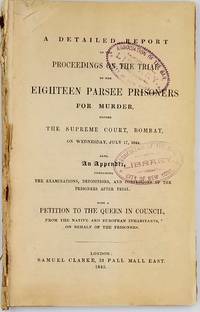
184524004London: Samuel Clarke 1845. First printing. pamphlet. Good overall. 8vo 118pp. Disbound but complete. Deaccessed by the NY Association of the Bar Library with their stamp on the title page.<br /> <br /> An Indian murder tried under British law in which Parsi defendants were accused of murdering another Parsi adherents of Zoroastrianism in Bombay with a rapid and harsh sentence meant to instill fear of British law and punishment in the local people. <br /> <br /> The trial was held at the Supreme Court before the British Chief Justice of Bombay Sir Henry Roper. The all European jury produced a guilty verdict against ten of the eighteen with 8 acquitted. The Chief Justice sentenced 6 of the 10 to transportation for life to Singapore due to a mercy appeal from the jury but sentenced the remaining four to be hanged. <br /> OCLC: 563643483 2 copies British Library. Samuel Clarke unknown
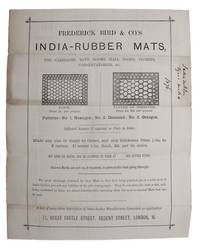
1876AQ21543London: s.n. 1876. Single leaf handbill. Numerous horizontal and vertical folds manuscript docket title to margin lightly creased and dust-soiled. An apparently unrecorded handbill advertising the services of London-based India Rubber mat and tyre manufacturers Frederick Bird & Co. . Dimensions 220 x 280 mm. [s.n.] unknown
189759126London Calcutta & Madras: W. Thacker & Co. 2 Creed Lane; Higginbotham & Co. 1897. Thick 8vo. xxvii 1 435 1 pp. plus xii 4 pp. publisher’s ads. With numerous plates text illustrations diagrams. Burgundy-coloured cloth gilt inset panel on front cover from original binding w/ original spine laid back down on spine renewed endpapers minor edgewear rubbing occasional toning still a VG- copy w/ bookplate of Albert Sayman on front pastedown. Third edition and considered the “best†edition of this fishing classic for South Asia detailing the angler’s pursuit of the “Mahseer†the chief of the Indian game fishes. Included are expanded and substantially revised chapters on flyfishing live bait fishing bottom fishing for Labeo freshwater sharks and much more all augmented with expanded illustrations. W. Thacker & Co., 2, Creed Lane; Higginbotham & Co., hardcover
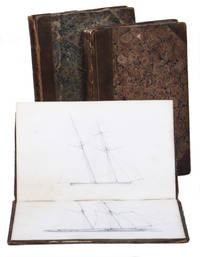
1822ABC_49460Aboard the Winchelsea written and drawn at sea 1822. Contemporary half gold-tooled brown calf marbled paper sides each volume with a different marbled paper the journal volume with marbled endpapers. 8vo. The two sketchbooks contain a total of ca. 100 pages of sketches of ships done in pencil including 1 page containing signal flags in colour. 3 volumes. With: Two sketchbooks with pencil drawings of ships. A neatly-written and illustrated sea journal kept by James Dudman the second mate on board the East India Company's ship Winchelsea during a 1822-23 voyage to India. Launched in 1803 the Winchelsea was already a veteran East Indiaman this being her ninth voyage - she made a total of eleven voyages for the EIC before she was broken up in 1834. On the present voyage commanded by Captain William Adamson she carried 592 people including the 17th and 44th Regiments of Foot and detachments of the King's and EIC's soldiers and a number of women and children. The sea journal volume is accompanied by two additional volumes by Dudman containing pencil sketches of unidentified masted sailing vessels.The Winchelsea's journey from its departure at Blackwall Dock on April 24 1822 to its arrival in Bengal and eventual return to England via St. Helena and The Downs on May 24 1823 reflects the extensive maritime routes integral to British imperial dominance. The ship's role in transporting personnel and cargo exemplifies the strength of the EIC's logistical network sustaining Britain's colonial and economic interests in India. The journal with its careful record-keeping offers an intimate glimpse into the daily operations experiences and extraordinary events encountered by the second mate aboard an East Indiaman during Britain's height of imperial expansion.The journal written in Dudman's beautiful scribe-like handwriting opens with an entry dated 24 April 1822 at Blackwall Dock where the voyage started "bound for Bengal." The next few pages contain a detailed listing of the people on board beginning with the ship's company of 122 men with names followed by the troops on board: "List of a detachment of His Majesty's Troops belonging to the 44th Regt. of Foot on board the Honable. Company's Ship Wincelsea for Bengal" comprising name and rank of 367 men followed by the names of 42 women on board as well as the name and age of 57 children on board including 3 who died at sea plus 4 additional passengers.At Saugur meaning Sagar Island they took on board further passengers duly noted in an additional "List of H.M. 17th Regiment of Foot with the Women and Children accompanying them. Embarked on board the Honble. Company's ship Winchelsea at Saugur New Anchorage for England."Beyond the usual records of position winds weather and other ships Dudman includes interesting notes on unusual occurrences. Perhaps the most fascinating event was recorded on February 10 1823: a major earthquake off the coast of India experienced by the Winchelsea: "At 10 minutes past 1 PM every one on board was greatly alarmed at the singular feel of the ship which was in a violent trembling motion as if the ship was grazing over a rocky shoal and a loud rumbling noise similar to the roll.g! of a Bull quickly along the deck this very singular seuration lasted certainly not less than a minute those below ran on deck to enquire the cause and those below the poop below to ask the same question. I was in the round house at the time when it comen'd. The noise appeared to me as coming along the quarter deck and instantly over the poop the sea was smooth and the day clear. I looked out at the stern windows but saw no appearance of any shoal which I certainly would have done had such existed. The water being very clear and the ship not going more than 2 knots I cannot account for this very singular phenomenon in any other way than its being the shock of an Earthquake".The voyage journal of the Winchelsea during its 1822-23 journey to Bengal provides valuable insight into the maritime operations of the EIC its commercial and colonial reach and the strategic importance of British trade with India in the early 19th century. As a veteran East Indiaman the Winchelsea was part of the vast trading network that connected Britain with the Indian subcontinent transporting soldiers goods and passengers under the auspices of the EIC which functioned as both a commercial enterprise and a colonial governing force.The journal volume contains the typographic book plate of Mr. Jas. Dudman on the front pastedown and a manuscript inscription in ink on the first flyleaf by Lumsden Dudman who was married to Mary Anne Shirreff "Joseph H. Shirreff from L.S. Dudman Xmas 1892" one of the sketchbooks contains a manuscript inventory list in Greek of goods for sale on the first flyleaf and one of the sketchbooks with ownership signature "L: Dudman / Sept. 27 1836" likely Rev. Lumsden S. Dudman perhaps a brother of James Dudman. Some general wear to the leather spines and corners of the boards of the volumes occasionally foxed but overall internally clean. Overall in good condition. unknown
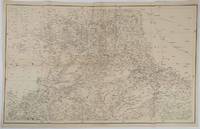
1859189711Calcutta.: Surveyor Generals Office. 1870. Reissue of 1859 edition. Lithographed map 57.2 x 93 cms; 61.1 x 96 cms sheet original folds old paper repairs to the verso and a sealed marginal tear central folds archivally strengthened some toning to the folds and creasing but the map in remarkably good clean condition. Impressive large Calcutta printing from the Survey of India showing Rajasthan Uttar Pradesh and surrounding states with extremely detailed delineation of settlements roads railways rivers and major points of interest the Taj Mahal is highlighted. . Surveyor Generals Office. unknown
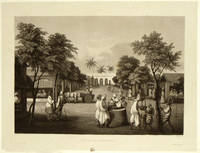
1835196250Paris.: A. Bertrand. 1835. Aquatint 27.1 x 36 cms; 31.6 x 47.2 cms sheet trimmed including platemark margins outside the platemark toned and discoloured edgewear with small chips mark at the foot of the caption split without loss at the lower corner of the platemark the image a fine dark impression in very good condition. Fine view of the market square at Pondicherry showing the well and the prison in the background from the official account of the Laplace voyage in the Favorite 1830-32 by voyage artist François-Edmond Pâris 1806-1893. The important French expedition encompassed India Southeast Asia and the Pacific. . A. Bertrand. unknown
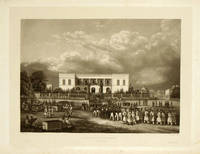
1835196251Paris.: A. Bertrand. 1835. Aquatint 27.1 x 36 cm; 32.3 x 47.2 cm sheet trimmed including platemark margins outside the platemark toned and discoloured with soft crease and small split not affecting the image to an upper corner the image a fine dark impression in very good condition. Beautifully executed view of the Governor's Palace in the Pondicherry showing soldiers and officials trouping out from the official account of the Laplace voyage in the Favorite 1830-32 by voyage artist François-Edmond Pâris 1806-1893. The important French expedition encompassed India Southeast Asia and the Pacific. . A. Bertrand. unknown
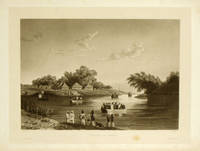
1835198166Paris.: A. Bertrand. 1835. Aquatint 27.1 x 36.3 cms; 32 x 47.6cms sheet trimmed including platemark margins outside the platemark toned and discoloured edge tears one encroaching on the platemark image unaffected small bloom of browning at the foot near caption the image a fine dark impression in very good condition. Tranquil river view by artist and draughtsman Barthelemy Lauvergne 1805-1875 from the official account of the Laplace voyage in the Favorite 1830-32. . A. Bertrand. unknown
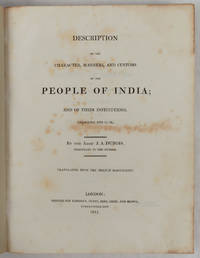
1817223218London.: Longman Hurst Rees Orme and Brown. 1817. xxvii 565pp 2 publisher's advertisements; half calf over marbled boards 27.5 x 22 cms endpapers renewed the title page and prelims spotted scant foxing elsewhere the final ten leaves tide-marked a good sound copy. Detailed account of the social cultural and religious practices of India during the late 18th and early 19th centuries. Abbé Dubois a French Catholic priest and missionary was stationed in India from 1792-1823 and his manuscript was purchased by the East India Company in 1807 publishing this English translation in 1817. . Longman, Hurst, Rees, Orme and Brown. hardcover
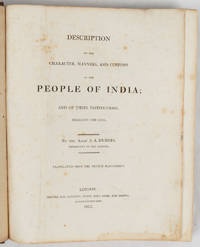
1817223216London.: Longman Hurst Rees Orme and Brown. 1817. xxvii 565pp 2 publisher's advertisments; contemporary diced morocco the boards with an elaborate double-border blind-stamped and gilt-embossed rubbed at the edges re-backed mounting the original gilt-decorated and lettered backstrip 27 x 22 cms marbled fore edges marbled endpapers the title page rather spotted and stained scant foxing elsewhere with the armorial bookplate of J. E. Saunders Finsbury Square and the neat pencilled inscription of a later owner to the initial blank a good copy. Detailed account of the social cultural and religious practices of India during the late 18th and early 19th centuries. Abbé Dubois a French Catholic priest and missionary was stationed in India from 1792-1823 and his manuscript was purchased by the East India Company in 1807 publishing this English translation in 1817. . Longman, Hurst, Rees, Orme and Brown. hardcover
1804204071London.: Edward Orme. Circa1804. Handcoloured aquatint engraving measuring 27.8 x 34cm. Sheet including platemark and generous margins measures 41.8 x 58.8cm. Very slight toning at the platemark but the plate in very bright clean condition. A beautifully executed aquatint from the series 'Picturesque Scenery in the Kingdom of Mysore' by James Hunter first published in 'A Brief History of Ancient and Modern India' by Francis William Blagdon in 1805 the engraving is dated on the plate June 4 1804. This may be from a subsequent edition see Abbey #425. . Edward Orme. unknown