[Boxing in India]Biblio.com

142 résultats
1889002014No Place: No Publisher 1889. Cabinet card of a Regimental boxing match in India approximately 165mm x 105mm in size dated 1889 to reverse. Image faded pin hole to either end where once pinned up slightly rubbed. Reverse has notes in ink 'From Joseph Theodore O'Brien to his affectionate chum Edward Perkins Ramplu India 20th February 1889 for Rs 150 37 rounds'. First Edition. Unbound. Good. 32mo Oblong. Cabinet Card. No Publisher Paperback
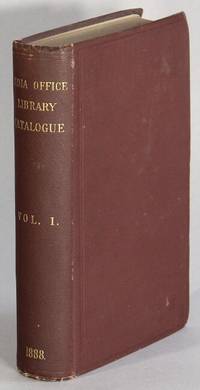
188869822London: printed by Eyre and Spottiswoode printers to the Queen's Most Excellent Majesty 1888. 8vo pp. 4 567 1; original brown cloth gilt-stamped spine; near fine. Without the separately printed Index and Supplements. This is the first in a series of catalogues that ran until 1937. It is the only catalogue of western books in the India Office. Other volumes included books in Sanskrit Hindistani Hindi Panjabi Pushtu Sindhi Bengali Oriya Assamese Marathi Gujarati and Persian languages. printed by Eyre and Spottiswoode, printers to the Queen's Most Excellent Majesty unknown
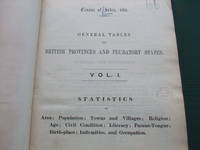
1892012276London: Printed for the Indian Government By Eyre and Spottiswoode 1892. Book measures 34.5x22.cm. xii522pp. Bound in period or early blind stamped cloth with gilt lettering. Cloth lightly rubbed dust/dirt marked library label on top board. Binding in good condition. Internally occasional library stamp cancellation stamp age tanning. Pages in good condition. . Cloth. Good Plus. Quarto. Printed for the Indian Government By Eyre and Spottiswoode Hardcover
1900100865c. 1900. 54 diapositive glass lantern slides 3-1/4 x 4 and 3-1/4 x 3-1/4 inches six hand-colored bound at edges with gummed paper or metal frame some with manufacturer's printed label and manuscript caption; a few with hairline cracks. Housed in contemporary wooden box with lid. A varied collection of ethnographic and architectural scenes largely from Northern India with a few of Ceylon Sri Lanka tea production. Some of the locations include Darjeeling Mumbai Bombay Kakinada Elephanta Caves Mumbai Calcutta including many of the Hooghly River Dehli Sinla Ceylon Kashmir as well as one scene of European tourists scaling pyramids in Egypt. The collection appears to have been gathered from various sources with plates manufactured by T.H. McAllister New York William Garrison Reed Boston J. Moore Birmingham and William H. Rau Philadelphia. unknown
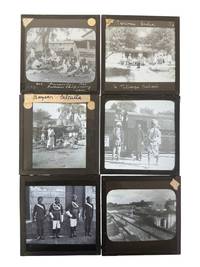
1900232871900. India glass lantern slide archive documenting class hierarchy dichotomy in British India with scenes of village labor bazaar exchange railway movement industrialization Sikhs and colonial cavalry circa 1900-20. Images clearly depict the class divid and Cast system; villagers and laborers are shown seated on bare ground in carpentry work men and goats occupy an unpaved settlement space Sikh men stand beside a railway carriage tied to imperial transport networks a factory scene introduces mechanized industry and a formal portrait of turbaned cavalry soldiers.<br /> Photo archive of 8 glass lantern slides 3.25" x 3.25" India circa 1900 to 1920. Several slides retain manuscript captions on the mounts including "Central India" "Village School" "Bazaar Calcutta" and "MV. parannis an Indian carpentry clas." "Parannis" is probably a misspelling or misreading of "Pariahs" a historical caste/community term used in colonial-era descriptions of South Indi The British largely preserved formalized and exploited the Indian caste system rather than dismantling it. Their relationship with caste was pragmatic: caste became a tool for administration taxation labor control military recruitment and social organization across British India. The "Village School" slide shows a line of children and adults posed before a low building under dense tree cover with one figure standing forward in the open yard. The carpentry slide shows a large group of Indian boys outdoors beneath a tree seated or crouched on the ground around planks and hand tools with timber laid across the foreground and simple structures behind. The Calcutta bazaar scene places vendors baskets and goods in an open market setting under palms while the village scene presents men in loose garments in what seems to be a cattle farm setting. One slide shows Sikh men beside a railway carriage one barefoot in the foreground and others gathered near the rail car doors linking Indian bodies to the movement of goods troops and passengers through the colonial rail system. Another slide presents four uniformed soldiers in turbans possibly the Madras cavalry posed formally with boots sashes and weapons before a masonry wall. The factory view shows smoking industrial works with long roofs tracks and an extended production yard further cementing colonial industrialization within the archive.<br /> <br /> British rule in India relied on linked systems of extraction transport discipline and military force and these slides place those systems beside the people who bore their unequal social effects. Railways expanded under colonial finance and administration to move troops raw materials and commercial goods; industrial sites grew beside older economies of hand labor and bazaar trade; Indian soldiers and cavalry units served within an army organized to secure imperial control; and rural schools workshops and village scenes expose the local social world that existed under those pressures rather than outside them. Light edge wear some mount loss to several slides; no cracks or chips. Overall very good condition. British colonialism widened India's class divide by concentrating wealth transport and military power in imperial systems while leaving many Indians in village labor and low paid market work. unknown
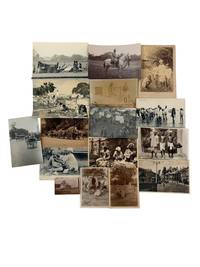
1890234981890. Colonial Indian labor photo archive depicting street work informal commerce transport labor and social hierarchy under British rule circa 1890s-1920s. British India depended on low-paid manual labor to move people goods food and raw materials through cities ports hill stations and military cantonments. The group contrasts workers seated on the ground with baskets tools tents carts and roadside goods against riders on horseback and passengers carried by rickshaw carriage and bullock cart. <br /> <br /> Photo archive of 16 silver gelatin photographs and black-and-white real photo postcards various sizes India circa 1890s-1920s. Marketplace sellers sit among baskets cloth tents and on the ground goods; families and workers gather beside tents and rough encampments; men pull or guide rickshaws carriages and ox-drawn carts through colonial streets. A mounted man sits formally on a white horse while views of Simla show pedestrians commercial buildings and hill-station streets associated with British administration and seasonal elite life. Additional scenes show an outdoor "Hindu barber" "Indian coolies" carrying large baskets men seated by stonework near a Gothic-style building children posed in white garments some hand written captions en verso identify locations or tasks.<br /> The archive records the everyday labor that supported colonial India before independence when caste landlessness debt and imperial wage economies shaped who carried cleaned hauled shaved sold and served. Ligh toning handling and edge wear; overall in very good condition. A late colonial documentation of Indian labor and social separation grounded in street work transport marketplace survival and the visible privileges of those being carried or served. unknown
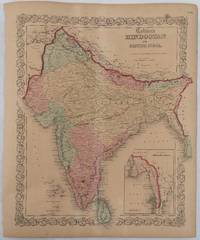
1859224156New York.: J. H. Colton. 1859. Hand-coloured map 40 x 33 cms inset map "Continuation of British India" 12 x 9.3 cms showing Burma elaborate decorative burst border a few spots sheet age-toned inner margin a little chipped not affecting the map and small split in the outer margin no loss text "Farther India or Indo-China" from Colton's atlas on the verso an attractive map in good condition. Attractively hand-coloured map showing different districts presidencies and independent kingdoms with contrasting pastel pinks yellows greens and blues. Major Presidencies Bengal Bombay and Madras are shown alongside extensive detail on river networks the Himalayan range roads and early railway lines connecting major trading hubs. Published a year after the East India Company was stripped of its governing powers following the tumultuous events of the 1857 Indian Rebellion Sepoy Mutiny. This 1859 map is one of the very first American atlas sheets printed to reflect the formal establishment of direct British Crown rule the Raj. It illustrates a subcontinent transitioning from a corporate-held trade monopoly into the crown jewel of Queen Victoria's empire neatly delineating newly pacified administrative boundaries. . J. H. Colton unknown
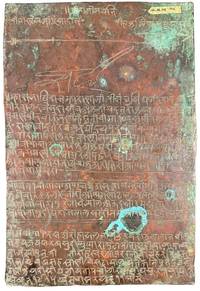
181942798Eastern India possibly Bengal or Assam circa 18th-19th century. Copper plate 13 7/8 x 9 1/8 inches engraved on both sides. The principal face with several lines of incised text at the head followed by a large engraved validating or emblematic mark and below this three dense sections of text divided by ruled horizontal lines. The reverse largely uninscribed with three small engraved seals or validating marks near the edge. An inscribed copper plate of Indian origin possibly Bengal or Assam engraved in a Bengali or Bengali-Assamese script and preserving a formal documentary text in metal.<br/> <br/> This copper plate belongs to the South Asian tradition of preserving legal devotional and administrative records on durable metal supports. Copper plate documents often described as tamrapatra or copper charters were used for grants endowments title rights decrees and other formal acts their material permanence giving them authority beyond that of ordinary manuscript documents. The present example appears to preserve a substantial text arranged in ruled sections and accompanied by validating marks. The script appears close to Bengali or Bengali-Assamese. The letterforms show rounded and looped shapes consistent with scripts used in eastern India. If confirmed this would suggest an origin in Bengal Assam or a neighbouring region where related scripts were used for administrative and religious writing. From their earliest centuries of development copper plate inscriptions have occupied a central place in South Asian documentary culture particularly in the recording of land grants royal edicts temple endowments and other formal transactions. Their durability made them suitable for preserving records intended to endure and they were often deposited in temples or held by families or institutions as proof of rights and privileges. While earlier examples are frequently associated with royal chancelleries the practice continued into the early modern and colonial periods with regional administrations and local authorities maintaining related forms of documentation. The present plate appears to belong to this later phase of the tradition when such documents were still being produced for administrative legal or commemorative purposes. Its relatively large format and the density of inscription suggest a formal text of some substance while the additional engraved devices indicate an effort to authenticate or formalise the record. The copper plate offers a direct example of a documentary practice that bridges manuscript culture and more durable forms preserving both the text itself and the physical conventions of its transmission. unknown
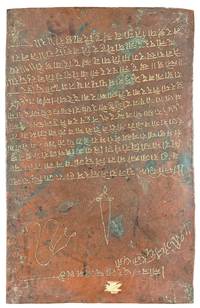
181942797Western or Northern India circa 18th or 19th century. Copper plate 15 1/2 x 9 3/4 inches engraved on both sides one face densely filled with horizontal lines of incised text and with additional marks including a dagger or torch device and other validating or ownership marks. The reverse more sparsely inscribed with two lines of text. An inscribed copper plate of Indian origin engraved on both sides and belonging to the South Asian tradition of preserving legal devotional and commemorative texts.<br/> <br/> A striking survival from the documentary culture of South Asia where copper served as a durable support for records intended to outlast paper and palm leaf. Such copper records often described as tamrapatra or copper charters were valued because they were portable difficult to alter and capable of serving as enduring witnesses to grants decrees endowments title rights and other formal acts. The script appears to belong to the Nagari family possibly Devanagari or a related cursive administrative hand such as Modi the script long used for Marathi official and business writing. From their earliest centuries of development copper plate inscriptions have occupied a central place in South Asian documentary culture particularly in the recording of land grants royal edicts temple endowments and other formal transactions. Their durability made them suitable for preserving records intended to endure and they were often deposited in temples or held by families or institutions as proof of rights and privileges. While earlier examples are frequently associated with royal chancelleries the practice continued into the early modern and colonial periods with regional administrations and local authorities maintaining related forms of documentation. The present plate appears to belong to this later phase of the tradition when such documents were still being produced for administrative legal or commemorative purposes. Its relatively large format and the density of inscription suggest a formal text of some substance while the additional engraved devices indicate an effort to authenticate or formalise the record. The copper plate offers a direct example of a documentary practice that bridges manuscript culture and more durable forms preserving both the text itself and the physical conventions of its transmission. unknown
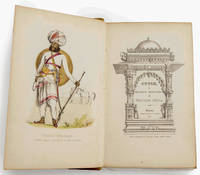
1839022098London: Smith Elder and Co. 1839. First Edition. Hardcover. Fairly unobtrusive library blindstamp on frontispiece pictorial title map and several text pages. Still an attractive clean example of a scarce title in a Fine clamshell box. Modern half polished calf with marbled boards and matching calf corners 5-1/2" x 9"; xvii 3 283 1 pages housed in a red buckram clamshell box. Lacking the printed title page but with the lithographed additional pictorial title and illustrated with a hand-colored map 8 engraved plates 7 of which are hand-colored including 1 folding and several text engravings. In 1834 the author's husband was posted to Cutch a western district of present-day Gujarat India and there she gathered the notes and made the drawings that would form the basis for this her first publication. <br/><br/> [Smith, Elder and Co.] hardcover
1839223681London.: Smith Elder and Co. Cornhill. 1839. Engraved handcoloured frontispiece opposite the additional engraved title page sketch map and 7 other full-page illustrations one folding and 5 hand-coloured text illustrations 2 half-title xvii including both the engraved and printed title pages 283pp; original blind-stamped pebbled green cloth boards 23 x 14.5 cms re-backed mounting the original gilt-lettered backstrip endpapers renewed scant spotting the boards faded and the backstrip chipped at the foot with the neat inked inscription of a previous owner but in very good condition. Scarce. Pioneering account beautifully illustrated after sketches by the author. Marianne Postans travelled to India in 1833 with her husband Thomas Postans a Captain in the 15th Regiment of the Bombay Native Infantry where he was posted to Cutch Kutch the northwestern region of modern-day Gujarat. They both shared a deep interest in the people and traditions of India. Marianne's account attempts to describe the culture of the region its bards and bardic literature including specific songs and stories of Kutchi bards arts and crafts and agriculture and trade. She also describes in detail rituals such as infanticide and the practise of sati. <br>The beauty of the Rann awed her: “The distant aspect of the Runn resembles that of the ocean at ebb tide; and as some water always remains on it the refraction of light produces the most beautiful and mysterious effects decorating it with all the enchantments of the most lovely specimens of mirage whose magic power exerting itself on the morning mists indues this desert tract with the most bewitching scenes…”. . Smith, Elder and Co. Cornhill. hardcover
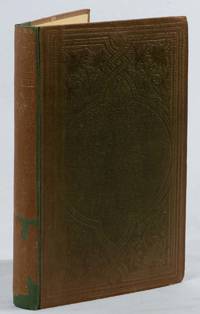
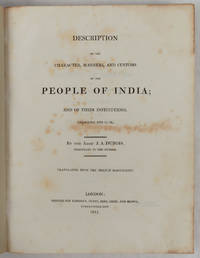
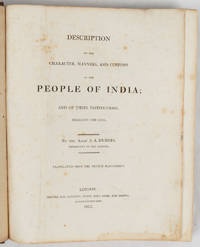
1817223218London.: Longman Hurst Rees Orme and Brown. 1817. xxvii 565pp 2 publisher's advertisements; half calf over marbled boards 27.5 x 22 cms endpapers renewed the title page and prelims spotted scant foxing elsewhere the final ten leaves tide-marked a good sound copy. Detailed account of the social cultural and religious practices of India during the late 18th and early 19th centuries. Abbé Dubois a French Catholic priest and missionary was stationed in India from 1792-1823 and his manuscript was purchased by the East India Company in 1807 publishing this English translation in 1817. . Longman, Hurst, Rees, Orme and Brown. hardcover
1817223216London.: Longman Hurst Rees Orme and Brown. 1817. xxvii 565pp 2 publisher's advertisments; contemporary diced morocco the boards with an elaborate double-border blind-stamped and gilt-embossed rubbed at the edges re-backed mounting the original gilt-decorated and lettered backstrip 27 x 22 cms marbled fore edges marbled endpapers the title page rather spotted and stained scant foxing elsewhere with the armorial bookplate of J. E. Saunders Finsbury Square and the neat pencilled inscription of a later owner to the initial blank a good copy. Detailed account of the social cultural and religious practices of India during the late 18th and early 19th centuries. Abbé Dubois a French Catholic priest and missionary was stationed in India from 1792-1823 and his manuscript was purchased by the East India Company in 1807 publishing this English translation in 1817. . Longman, Hurst, Rees, Orme and Brown. hardcover
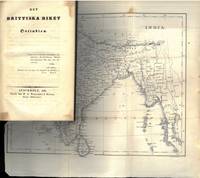
183969956Stockholm 1839. 8vo. Samtidig skinnryggbind med ryggforgylling. Marmorerte dekler. 6 291 7. Med to foldekarter. Tryckt hos P. A. Norstedt & Söner Svensk. <br/><br/><em>Det ene kartet med rift. </em> unknown
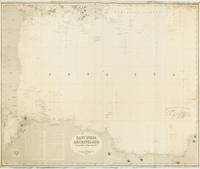
1881143683London: James Imray and Son 1881. Good. London James Imray and Son 1881. A very large engraved chart in two sheets combined printed surface 1039 × 1240 mm overall sheet size 1039 × 1264 mm with minimal hand-colouring mounted together on the original blue backing paper with the publisher's title-label on the verso. Minor chipping at the edges with minimal loss to the headline title above the top border; a few light stains and creases; a short sealed tear to the middle of the left and right sides one extending about 100 mm into the printed surface; a few old pencil annotations; in good condition. A very large and detailed blueback chart of the western part of the Java Sea the passages connecting it to the Indian Ocean the Sunda Strait and the South China Seas the Karimata Gaspar and Bangka Straits and Batavia Jakarta. Lighthouses are highlighted with spots of red and yellow colouring. <p>The publisher's inkstamp dated 1882 appears near the imprint. The title-label on the verso reads 'Chart No. 161. Western Route to China. In Six Charts. Chart No 1. Price 7s. 6d.'. James Imray and Son unknown
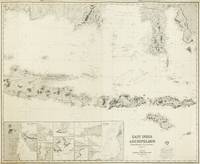
1881143682London: James Imray and Son 1881. Very Good. London James Imray and Son 1881/ 1863. A very large engraved chart in two sheets combined size approximately 1040 × 1285 mm with minimal hand-colouring mounted together on the original blue backing paper with the publisher's title-label on the verso. Head and foot slightly cropped with slight loss to the text outside the border; some marginal chips and tears with two that extend slightly into the printed surface now expertly sealed; short left-hand portion of the top margin a little waterstained not affecting the printed surface; a few trifling spots of foxing and some unobtrusive creases; overall in very good condition. A very large and detailed blueback chart of the Java Sea including the eastern half of the Indonesian archipelago and the southern coasts of Borneo and Sulawesi. It includes twelve inset charts: the Baly Bali Strait; Sapie Bay; Labuan Tring Bay; Tafel Hoek; Segoro Wedie Bay; Beliling and Sangsit Roads; Bunkolan and Lirang Roads; Koeboe Road; Amok Bay and Padang Cove; Tiulik Road; Oedyon Road; and Macassar. Lighthouses are highlighted with small spots of red and yellow colouring. <p>The publisher's inkstamp dated 1882 appears below the title. The title-label on the verso reads 'Chart No. 171. Eastern Passages to China & Japan in Nine Charts. Chart No 1. Price 7s. 6d.'. James Imray and Son unknown
1885INDIA007593Henry Hansard London. 1885. First edition. Folio. 288 pages. Original wrappers. Bookseller's rubber stamp on upper cover and title-page. Spine cracked but largely intact. Wrappers a bit creased. Very good. Rare. Henry Hansard, London. unknown
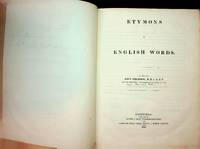
1826AA1372Edinburgh: Oliver & Boyd 1826. First. Very Good. A very good copy of this scarce study of the origins of English words Rebound in brown cloth with gilt titles on spine Ex-library but other than the gilt accession number at the base of the spine and slight paste residue on the ffep there are no other indications of its library ownership Binding is quite tight and sound There is an ink inscription on a fly leaf from the author's son Major later Major General Thomson dated Montreal 1842 and a vintage newspaper clipping about English word usage is affixed to the same page Text is age darkened There are a few minor pencil and ink annotations throughout and on the rear fly leaf but no other marks or damage to text at all A nice copy of a very uncommon volume there were recently fewer than a dozen copies found on OCLC<br /> <br /> Major-General Francis Ringler Thomson R E 1794-1863 was the son of the author He joined the Royal Engineers in 1812 and served many assignments in France and across the Empire including Ceylon Gibraltar Canada and Malta A Major in Canada when he inscribed this book in 1842 he continued to rise through the ranks and was eventually promoted to Major General in 1856 Unpaginated but approx 200 pp. Oliver & Boyd unknown
1847316972New York: William H. Colyer 1847. First Edition. Frontis. 209pp. Bound in full modern mottled brown calf. Fine. First Edition. Frontis. 209pp. Huntress 166 William H. Colyer unknown
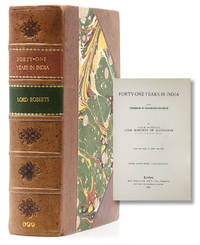
1900316898London: Macmillan and Co 1900. New Edition in One Volume. With 42 Illus. ii 601pp. 8vo. Bound in three quarters mottled brown calf and marbled boards green leather title label. Fine. New Edition in One Volume. With 42 Illus. ii 601pp. 8vo. Macmillan and Co unknown
1853911681853. House of Commons London. 1853. Tall sl. narrow hardback bound in plain dark moss green cloth. xviii 275 pages; vi 141 pages. hardcover
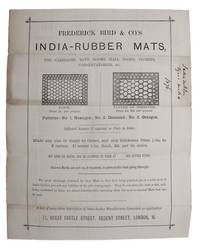
1876AQ21543London: s.n. 1876. Single leaf handbill. Numerous horizontal and vertical folds manuscript docket title to margin lightly creased and dust-soiled. An apparently unrecorded handbill advertising the services of London-based India Rubber mat and tyre manufacturers Frederick Bird & Co. . Dimensions 220 x 280 mm. [s.n.] unknown
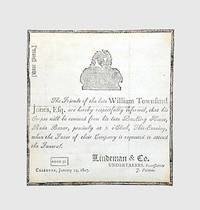
1807122432Calcutta: Star Press 24 January 1807. Haunting piece of Company-rule ephemera announcing the funeral of William Townsend Jones c.1757-1807 attorney on the council of the Supreme Court of Judicature at Fort William the highest court of British India from its foundation in 1774 until 1862. Jones's name is now usually connected with his indictment in December 1789 for flogging to death one Sheriut Allah the brother of his durwan gate-porter whom he suspected of stealing one of his dogs which was "an unlikely crime for a Muslim" Franklin. He was acquitted by the Supreme Court who concluded that Sheriut Allah had died by suicide by eating opium. The affair arose only two years after the impeachment of Warren Hastings in 1787 whose fall from grace had begun with a similar miscarriage of justice involving the execution of a native East India Company administrator Nandakumar. Jones is also a recurring character in the recently published diaries of Calcutta surveyor and builder Richard Blechynden 1759-1822 which reveal that he was also rumoured to have killed another of his servants his mater sweeper. The undertaker Peter Lindeman 1771-1856 of Scottish descent worked from premises at 144 Durrumtollah; from 1803 the Calcutta Missionaries held services in his house on Cossitollah Street until the completion of a new chapel at Lall Bazar in 1809 of which he became a trustee. Single sheet of laid paper 130 x 139 mm printed on one side. Mourning border motif of urn on an altar. Contemporary signature "T. R. R" on verso shaved; the leaf sometime removed from an album or mount adhesive markings and 3 strips of adhesive paper verso 3 faint creases from folding minute hole to one intersection of folds. In excellent condition. Franklin "Orientalist Jones": Sir William Jones Poet Lawyer and Linguist 1746-1794 pp. 300-1; Robb "Memory Place and British Memoirals in Early Calcutta" in Rashkow et al. eds Memory Identity and the Colonial Encounter in India online accessed 4/11/2017; see further Robb ed. Sex and Sensibility: Richard Blechynden's Calcutta Diaries 1791-1822 online. unknown
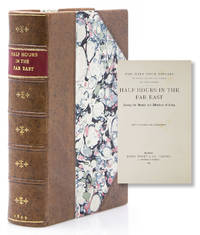
1899317966London: James Nisbet 1899. Illus.xiii 1 354 adspp. 8vo. Bound in three quarters mottled brown calf and marbled boards. Fine. Illus.xiii 1 354 adspp. 8vo. <br/><br/> James Nisbet hardcover
1893ADndLTD.32Brisbane: Warwick & Sapsford Printers 1893. 1893. 8vo. pp. 152 xxvi ads. 3 coloured maps 2 double-page 15 plates 1 full-page tinted & numerous text illus. 3 tipped-in ads. ads on enleaves. stiff cloth-backed illus. wrs. wrs. creased stained & detached spine perished out leaves embrowned. Sixth Edition so noted on upper cover. See Ferguson 7424. Hardcover. Brisbane: Warwick & Sapsford, Printers, 1893. Hardcover